
Introduction
All modern heavy-duty diesel trucks rely on turbocharging systems to generate reliable pulling power. Unlike ordinary passenger cars, semi-trucks and long-haul haulage vehicles work under constant extreme loads.
These trucks regularly climb steep slopes, run long highway routes, and withstand high engine temperatures. These harsh working conditions wear down turbo system parts far faster than standard vehicles.
Among all turbo components, the turbocharger actuator is one of the most overlooked yet critical parts. Most drivers and fleet managers pay close attention to turbo blades, intercooler pipes, and engine oil quality. However, few people monitor the small actuator that controls core boost pressure.
Simply put, the turbocharger actuator acts as the control brain of the entire turbo system. It manages the wastegate or variable turbine geometry. It precisely adjusts boost pressure during acceleration, steady cruising, and hill climbing.
A fully functional actuator ensures smooth acceleration, stable power output, and consistent fuel economy. Once the actuator starts to fail, a series of performance issues will appear gradually.
The biggest problem with turbo actuator failure is its slow progression. Early warning signs are very subtle. Most operators dismiss slight power lag as normal truck wear. By the time obvious faults appear, secondary damage has already harmed the turbo and engine.
Many fleets waste money replacing the entire turbocharger when only the actuator is faulty. Industry data shows that over 70% of turbo boost-related issues stem from a bad actuator, not a damaged turbo core.
This detailed guide covers everything you need to know. It includes actuator working principles, common failure symptoms, root causes, professional diagnosis methods, step-by-step repair steps, and long-term maintenance tips. For premium replacement turbo parts, check our heavy duty truck OEM parts catalog.
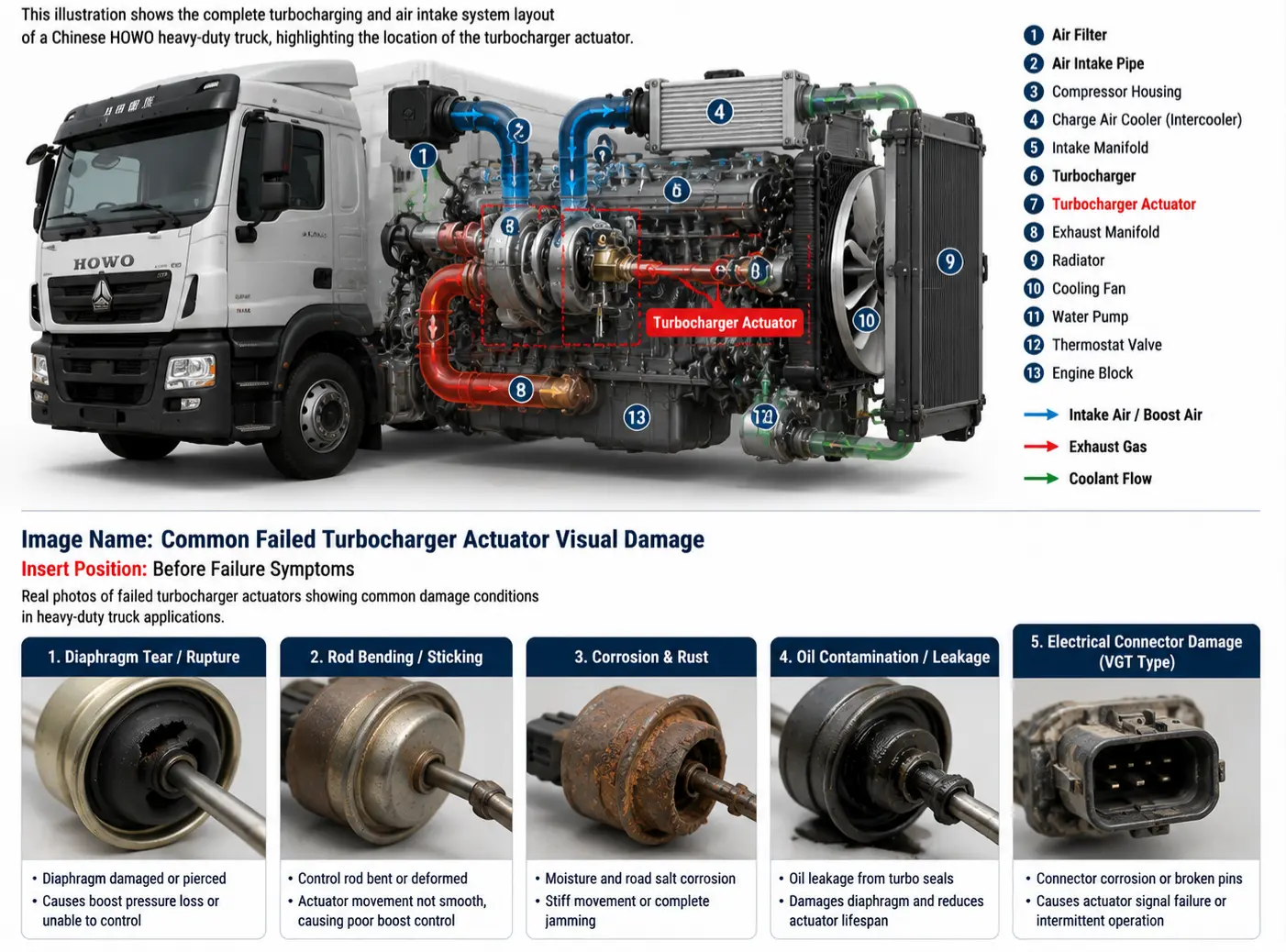
What Is a Turbocharger Actuator & How Does It Work?
Before troubleshooting or repairing faults, it is important to understand the basic function of a turbocharger actuator. This simple knowledge helps you avoid misdiagnosis and unnecessary part replacements.
A turbocharger actuator is a pressure control component mounted on the turbocharger housing. Heavy-duty trucks use two main types: vacuum-style actuators and electronic VGT actuators.
Traditional wastegate turbo systems use vacuum actuators. Internal diaphragm pressure pushes a control rod. This rod opens and closes the turbo wastegate valve. It limits excessive boost pressure at high engine RPM to protect the engine from damage.
Modern Chinese heavy trucks, including Sinotruk HOWO, FAW J6, Shacman, and Dongfeng models, adopt VGT (Variable Geometry Turbo) systems. Their electronic actuators adjust turbine vane angles in real time.
This precise adjustment stabilizes boost pressure at all speed ranges. It improves low-end torque for starting and climbing. It also prevents dangerous over-boosting during high-speed driving.
Many truck owners mix up actuator faults and intercooler pipe leaks. Both problems cause power loss, but their causes and fixes are completely different. You can learn more about pipeline faults in our intercooler pipe leak problems guide.
To sum up, pipe leaks cause air loss, while actuator faults cause pressure control failure. Telling these two issues apart saves plenty of troubleshooting time.
Why a Healthy Turbo Actuator Is Critical for Heavy-Duty Trucks
The small turbo actuator has a huge impact on overall truck performance. The reason is simple: it works continuously during every acceleration, climb, and heavy-load operation.
First, a healthy actuator maintains stable boost pressure. Steady boost ensures complete diesel combustion. This keeps fuel consumption low and power output consistent during long hauls.
Second, it protects the turbocharger from over-speed damage. Without proper actuator control, the turbo spins too fast under heavy loads. This wears bearings, scratches blades, and burns out the turbo core prematurely.
Third, it reduces exhaust blockages and emissions. Unregulated boost pressure leads to incomplete combustion. This creates carbon buildup and black smoke, which easily clog DPF filters.
Finally, a functional actuator prevents sudden roadside breakdowns. Faulty actuators often trigger engine limp mode. This limits vehicle speed and interrupts normal transportation operations.
Most Common Bad Turbocharger Actuator Symptoms
Turbo actuator failure follows a clear progressive pattern. Early symptoms are mild and easy to ignore. Moderate faults affect daily driving. Severe failures will disable the truck entirely. Below are all typical symptoms sorted by fault severity.
1. Sluggish Acceleration and Weak Low-End Torque
This is the earliest and most common warning sign. You may barely notice the difference when the truck is empty. However, power shortage becomes obvious when carrying heavy cargo or climbing slopes.
The truck accelerates slowly with delayed throttle response. Even full accelerator input fails to generate enough torque for overtaking or uphill driving.
This issue occurs because the faulty actuator cannot properly close the wastegate or adjust VGT vanes. The turbo fails to build sufficient boost pressure at low and mid engine RPM.
2. Excessive Black Smoke During Acceleration
Black exhaust smoke is a typical sign of actuator failure. A faulty actuator causes insufficient turbo boost, which reduces air intake into the engine.
The fuel injection system still sprays the standard amount of diesel. The unbalanced air-fuel ratio leads to incomplete combustion. Extra carbon particles burn off as thick black smoke.
Continuous black smoke not only wastes fuel but also clogs the DPF filter. This triggers frequent regeneration cycles and increases daily maintenance costs.
3. Sudden Rise in Fuel Consumption
If your truck’s fuel cost increases suddenly with no changes to routes or load weight, the turbo actuator is a top suspect.
Insufficient boost pressure forces the engine to consume more fuel to maintain normal power. Incomplete combustion also causes severe fuel waste. The combination leads to obvious overconsumption.
4. Abnormal Turbo Noise
A failing actuator causes unstable boost regulation. You may hear irregular high-pitched whining sounds during acceleration.
This noise differs from pipe leak whistling. It fluctuates with engine RPM and only appears intermittently in the early failure stage. It often disappears after restarting the engine.
5. Frequent Limp Mode Activation
Modern diesel engine ECUs monitor boost pressure in real time. When the actuator cannot maintain standard pressure, the system records fault codes.
To protect the engine and turbo from secondary damage, the ECU automatically limits power output. The truck enters limp mode, restricting speed and acceleration.
6. Stuck or Loose Actuator Rod
You can check this issue through simple manual inspection. The actuator control rod may get stuck in a fixed position and fail to move freely.
In other cases, the rod moves with excessive looseness and no tension. Both conditions confirm damage to the internal diaphragm or gear structure.
7. Boost Pressure Error Fault Codes
Common diagnostic trouble codes include P0299, P0401, and P2563. All these codes directly indicate turbo actuator regulation failure and inconsistent boost pressure.
Main Causes of Turbocharger Actuator Failure
Turbo actuator damage never happens randomly. Most failures result from harsh working environments, poor daily maintenance, or low-quality replacement parts. The six core causes are listed below.
1. Long-Term High-Temperature Aging
The actuator sits extremely close to the turbo housing. Turbo surface temperatures often exceed 500°C during heavy-load operation.
Continuous high heat ages internal rubber diaphragms and plastic gears. Aged materials lose elasticity and precision, which directly causes boost pressure regulation failure.
2. Carbon Buildup Blockage
Diesel exhaust produces tiny carbon particles during operation. These particles gradually accumulate on turbo vanes and wastegate valves.
Thick carbon deposits block normal component movement. The actuator rod cannot push or pull freely, resulting in fixed, unregulated boost pressure.
3. Insufficient Vacuum Pressure
Older heavy-duty trucks rely on vacuum-controlled actuators. A faulty vacuum pump or leaking vacuum hoses reduce suction power.
Insufficient vacuum fails to drive the actuator rod normally. This causes low boost pressure and unstable engine performance.
4. Electronic Component Wear
Electronic VGT actuators contain small drive motors and position sensors. After long working hours, motor brushes wear out, and sensor data begins to drift.
Inaccurate sensor data leads to wrong vane adjustment. The ECU detects mismatched boost pressure and triggers permanent fault codes.
5. Vibration and Mechanical Fatigue
Heavy trucks generate strong chassis vibration during driving. The actuator bracket and internal transmission structure bear continuous vibration impact.
Long-term vibration loosens fixing screws, wears gear structures, and causes rod deformation, which destroys normal actuator operation.
6. Low-Quality Aftermarket Parts
Many fleet owners choose cheap generic actuators to cut costs. These low-grade parts lack high-temperature resistance and factory calibration.
They work normally for a short time but fail quickly under heavy loads. Always use calibrated truck engine turbo parts for stable long-term performance.
How to Diagnose a Bad Turbo Actuator (Professional Methods)
Accurate diagnosis is essential before repair or replacement. You must confirm the fault comes from the actuator, not turbo damage, pipe leaks, or sensor errors.
1. Visual Inspection
Start with a simple visual check. Look for bent rods, loose mounting screws, cracked housing, and surface carbon blockage.
Manually push and pull the control rod. It should move smoothly with steady resistance. Stiff movement or excessive looseness confirms internal failure.
2. Real-Time Boost Data Scan
Connect a professional truck scanner to read live boost pressure data. Compare the actual pressure with the factory standard values.
If boost pressure rises slowly and cannot reach the rated peak during acceleration, the actuator fails to regulate pressure normally.
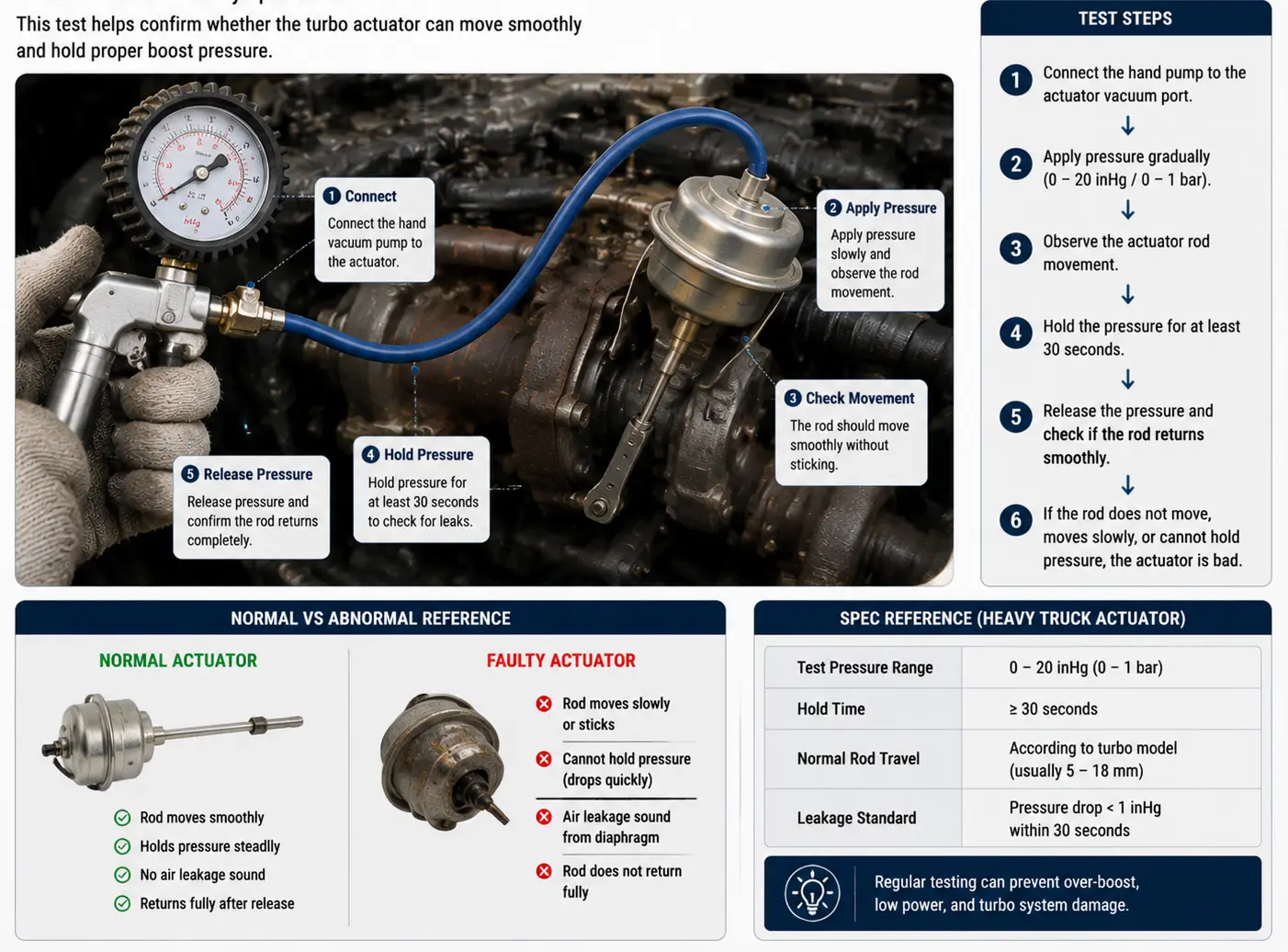
3. Manual Pressure Test
Use a manual air pump to apply stable pressure to the actuator air port. Observe the rod’s stretching distance and response speed.
Slow response, no movement, or inconsistent travel distance proves the actuator is faulty and needs replacement.
4. Loaded Road Test
Perform a real road test with standard cargo loads. Observe acceleration response, exhaust smoke, and overall power stability.
If power recovers temporarily after clearing fault codes but fails again immediately, the actuator has permanent mechanical damage.
Step-by-Step Turbo Actuator Replacement & Repair Guide
Most faulty actuators cannot be repaired internally. Direct replacement is the most reliable and cost-effective solution. The following steps apply to all mainstream Chinese heavy trucks, including HOWO, J6P, Shacman, and Dongfeng models.
Step 1: Complete Safety Preparation
Park the truck on flat, stable ground. Engage the handbrake and place wheel chocks to prevent sliding.
Turn off the engine and wait at least 30 minutes for the turbo system to cool down. Never disassemble hot turbo parts to avoid burns and seal damage.
Step 2: Disconnect Wiring and Hoses
For electronic actuators, carefully unplug the wiring harness. Do not pull the wires directly to avoid bending or damaging pin terminals.
For vacuum actuators, remove the vacuum pipe and mark the interface position to ensure correct reinstallation.
Step 3: Loosen Fixing Bolts
Use a matched socket wrench to loosen the actuator mounting bolts. Store all screws in order for reuse.
Separate the actuator rod from the turbo linkage. Avoid forced prying to prevent bending the linkage arm.
Step 4: Remove the Old Actuator
Take off the faulty actuator completely. Clean all carbon deposits on the turbo linkage and mounting surface.
Check linkage flexibility carefully. Remove stubborn carbon buildup to ensure smooth movement after installing the new part.
Step 5: Install the New Calibrated Actuator
Place the new actuator in the original mounting position. Align the rod length with the factory standard stroke data.
Tighten the mounting bolts evenly. Do not over-tighten to prevent housing deformation and internal part stress.
Step 6: Adjust Rod Stroke and Clearance
Precisely adjust the control rod length. Ensure no excessive tension or loose clearance in the linkage structure.
Accurate stroke adjustment guarantees precise boost regulation and avoids repeated pressure fault codes in the future.
Step 7: Reconnect All Connections
Firmly plug in the electronic wiring harness. Reinstall vacuum hoses according to the marked positions.
Double-check all connections to prevent air leakage or poor signal contact.
Step 8: Clear Fault Codes and Test Run
Use a professional scanner to clear all historical fault codes. Start the engine and let it idle for 10 minutes.
Perform multiple acceleration tests to check for abnormal noise, black smoke, and stable boost pressure.
Complete a loaded road test to confirm full power recovery and normal turbo operation.
Common Repair Mistakes That Cause Repeat Failure
Many fleets replace turbo actuators but face the same faults again soon. In most cases, repeated failures stem from improper repair operations, not defective parts.
1. Skipping stroke calibration: Installing a new actuator without adjusting the rod stroke causes incorrect boost pressure and immediate performance faults.
2. Residual carbon buildup: Unclean linkage carbon blocks component movement and leads to stuck boost regulation.
3. Loose wiring connections: Poor electrical contact triggers intermittent fault codes and unstable actuator operation.
4. Mismatched actuator models: Different turbo specifications require matched actuator parameters. Universal parts cannot fit perfectly.
5. Over-tightened bolts: Excessive bolt force deforms the actuator housing and damages internal gear operation.
Daily Maintenance Tips to Extend Actuator Lifespan
Simple daily maintenance can effectively double the turbo actuator’s service life and greatly reduce failure rates.
Clean turbo system carbon deposits every 50,000 kilometers to avoid component jamming.
Regularly check vacuum hose tightness for vacuum-style actuators to maintain stable suction pressure.
Avoid long-term full-load high-speed driving to reduce turbo and actuator heat load.
Replace engine oil on schedule to prevent internal carbon accumulation in the turbo system.
Always choose OEM calibrated actuators for replacement. For professional technical support, contact our team via the contact support channel.
Conclusion
The turbocharger actuator is a small but vital component of heavy-duty truck turbo systems. Most turbo-related power loss, black smoke, and high fuel consumption issues come from actuator failure, not turbo core damage.
You can solve boost-related faults at low cost by identifying early symptoms, conducting accurate diagnosis, and following standard replacement steps. Regular maintenance also avoids sudden roadside breakdowns and cuts fleet repair expenses.
For more professional heavy-duty truck repair and maintenance guides, browse our complete truck system maintenance guides.


