
Learn the top truck tire wear causes, how to spot uneven tire wear on trucks in 60 seconds, and how to fix irregular wear before tires go out of service.
Park the tractor-trailer on level ground, take a tire gauge and a flashlight, and spend sixty seconds before you order a single part. That quick read of the tread usually points to the real truck tire wear causes faster than any invoice history will.
What Does the Tread Tell You in the First Minute?
Say you have just pulled up beside a tractor that has been pulling a lowbed for a few months. Start at the steer axle. Run your palm across each tread block, front to back and then back to front. If one direction feels smooth and the other catches, you are feeling feathering, a sign the tire has been dragged sideways.
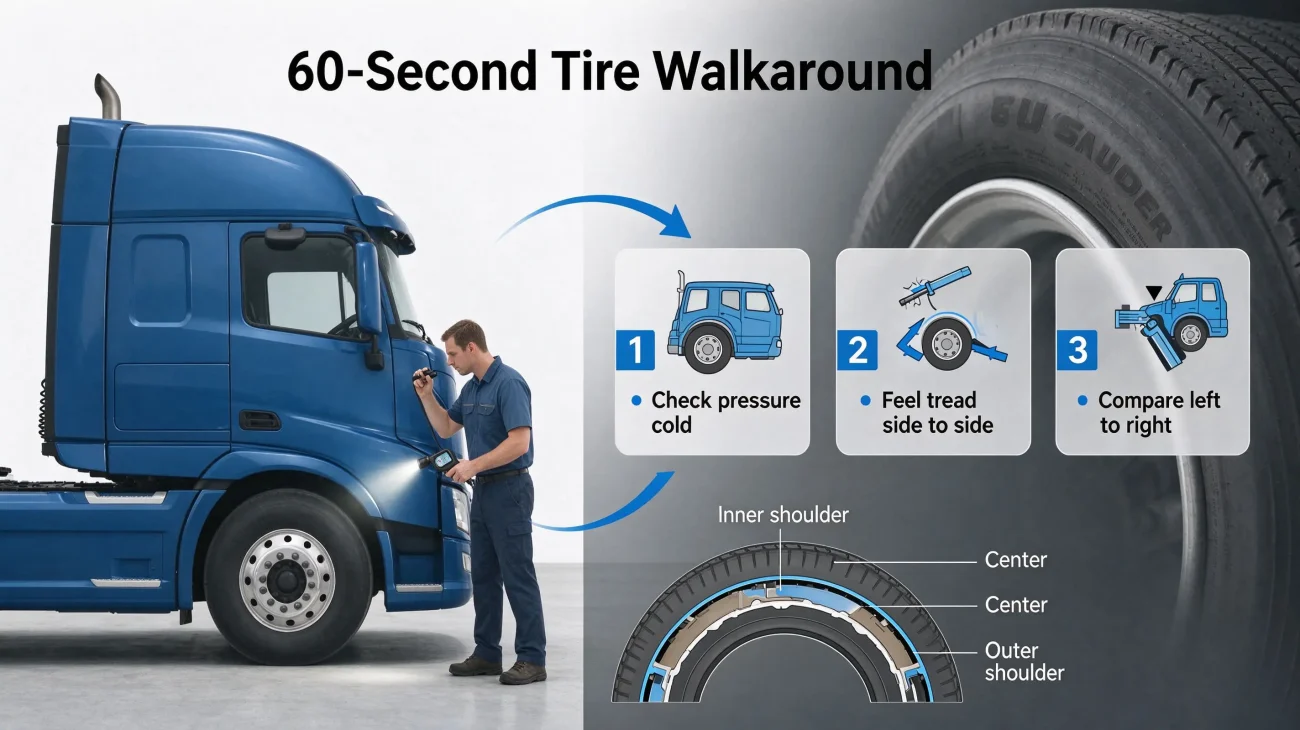
Next, shine the light along the inner shoulder. That edge is easy to miss from the driver’s side, and it often wears first when something is wrong with toe or camber. Then compare the left steer with the right. A visible difference points to a one-sided problem, such as a bent component or a pressure error, rather than a general one.
Work back to the drives and the trailer axles. Gauge every tire cold, and write the numbers down. Compare the steer axle against the trailer axles, because the two groups wear for different reasons. Steer tires respond mostly to alignment and pressure. Trailer tires respond more to load, axle parallelism, and scrub on tight turns.
Position narrows the cause quickly. Center wear leans toward overinflation. Both shoulders worn leans toward underinflation or overload. One shoulder worn leans toward camber or toe. Scalloped or cupped blocks suggest worn suspension parts or imbalance. Feathering suggests toe.
None of this replaces a measurement. It does tell you which measurement to take first, and that saves hours in the shop.
What Are the Signs of Irregular Truck Tire Wear?
The signs of irregular truck tire wear are shoulder rounding, center-only wear, cupping or scalloping, flat spots, and a tread-depth gap between the two tires of a dual. Any of these means the tire is no longer carrying load evenly across its footprint. The pattern points to the fault behind it.
Shoulder rounding shows as a rolled edge where the tread meets the sidewall. Center-only wear leaves the shoulders deep and the middle bald. Cupping appears as dips spaced around the circumference, and you can feel it with a hand better than you can see it. Flat spots come from lockups, brake faults, or a unit left standing under load.
Dual mismatch deserves extra attention. When one tire of a pair is noticeably shorter in diameter, its partner carries extra load and drags the smaller tire along. Both wear faster. Duals are commonly matched within about three-quarters of an inch of circumference.
Federal rules in the US set minimum tread depths of 4/32 inch on steer tires and 2/32 inch on other positions, so irregular wear can pull a tire out of service early even when the average depth looks fine. Our technical support library covers inspection routines in more depth.
A few terms come up repeatedly in the rest of this guide:
- Toe — the angle between a tire’s direction and the direction the axle is traveling, seen from above.
- Camber — the inward or outward tilt of the wheel when viewed from the front.
- Thrust angle — the direction the rear axle points relative to the vehicle’s centerline.
- Feathering — tread ribs worn with one edge sharp and the other rounded, caused by sideways scrub.
- Cupping — scooped dips around the tread, usually tied to bounce or imbalance.
- Scrub — lateral dragging of a tire across the road surface instead of rolling straight.
Why Do Truck Tires Wear Out Fast?
One camp blames the tire, the other blames the truck. In practice, early removals trace back to the truck far more often than to the casing. A tire built to a sound standard still wears quickly when pressure, alignment, load, or duty cycle is off.
Look at it from the tire’s side first. Tread compound, casing construction, and tread design set the ceiling for life. A tire designed for long-haul highway use will give up tread quickly in a yard with constant tight turns. So the first question is whether the tire suits the job. Matching tire type to application removes one variable.
Now look at it from the vehicle’s side. Inflation is the most common factor because it changes daily and nobody sees it. Alignment drifts after curb strikes, worn bushings, and hard use. Load sets heat and flex. Duty cycle sets the number of turns, stops, and miles.
These sources rarely act alone. A fleet might see two trucks on the same route with a two-to-one difference in tire life. The usual reason is that one truck runs a few psi low and carries a slightly bent axle, while the other does not.
So the reasonable approach is to treat the tire as the evidence, not the culprit. Check pressure, alignment, and load first. Blame the product only after those three are clean. The sections that follow take each factor in order of how often it shows up.
How Much Does Inflation Pressure Change Wear?
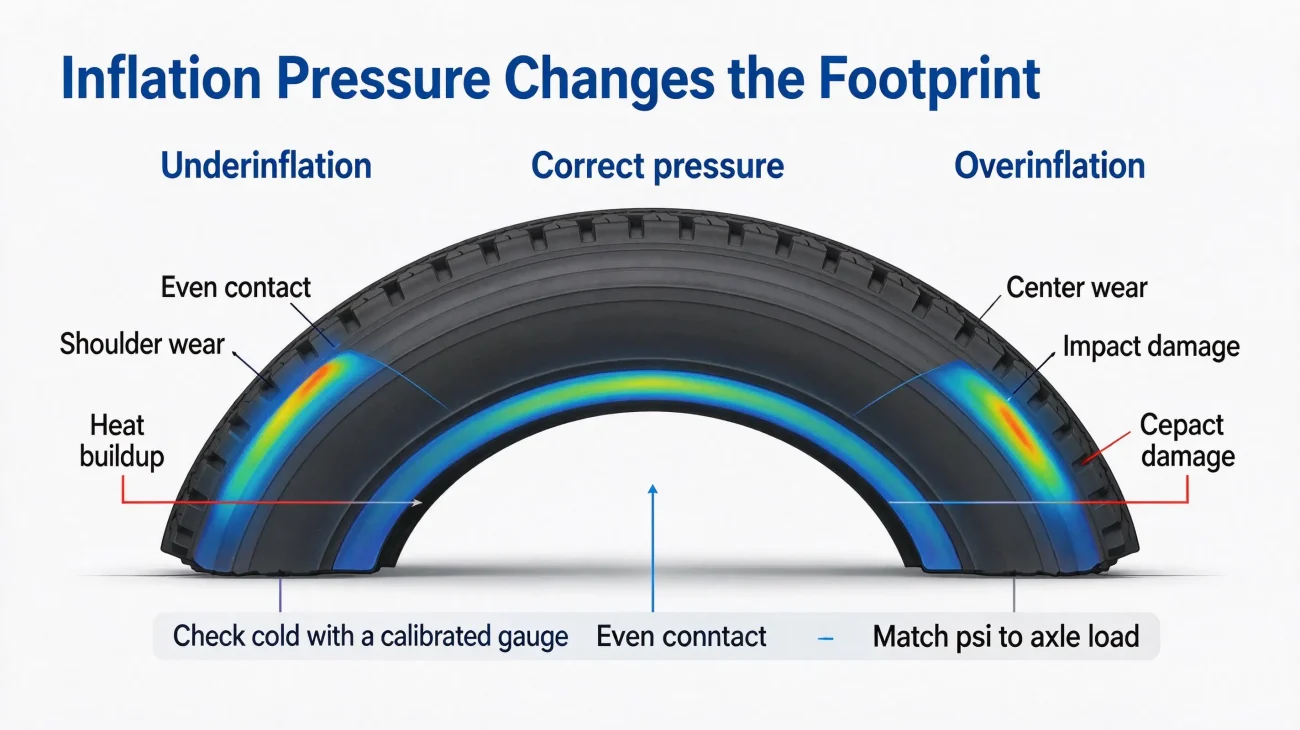
Set pressure to the load on that axle, and check it cold. That is the rule, and most other inflation advice follows from it. Pressure charts from tire makers tie psi to load, so the right number for a lightly loaded trailer is not the right number for a loaded one.
Underinflation lets the shoulders carry too much of the load. They wear faster, run hotter, and flex the sidewall more. Heat is the larger risk, because it weakens the casing and shortens retread potential. A commonly used estimate is that running around 20 percent below target pressure can cost a meaningful share of tread life, so treat the figure as direction rather than a promise.
Overinflation does the opposite. The crown pushes into the road, and the center wears while the shoulders stay deep. Ride quality drops, and the tire is more exposed to impact damage.
Typical drive and trailer tires in the 22.5-inch class run in the range of roughly 100 to 110 psi cold when fully loaded. Always confirm against the manufacturer’s load and inflation table for your exact tire size and axle weight.
Cold means the tire has stood for at least a few hours or has been driven less than a mile. A hot reading is naturally higher, and bleeding air from a hot tire leaves it underinflated once it cools.
The rule has limits. Matching pressure to load works only if you know the actual axle load. A fleet that runs the same trailer both empty and fully loaded needs a practice for adjusting, or a compromise pressure it understands.
Finally, do not trust the eye. A tire can lose 20 psi and look nearly normal. Use a calibrated gauge, and check the valve caps and cores while you are there.
Which Alignment Faults Cause Uneven Tire Wear on Trucks?
Alignment faults fall into a few groups, and each has its own signature. Compared with pressure problems, they tend to produce wear that is lopsided or directional rather than symmetrical. Compared with load problems, they tend to appear on specific axles rather than on every tire in the group.
Toe error scrubs the tread sideways, giving feathering across the whole width. Camber error shifts load toward one shoulder. Thrust angle error means the drive axle is pointing off-center, so the steer axle must be turned slightly to keep the truck straight, which wears steer tires on one side. Axle parallelism faults on a trailer drag tires sideways, especially on the rear axle of a tandem or tri-axle group.
| Fault | Typical wear signature | Axle most affected | Usual corrective action |
|---|---|---|---|
| Excess toe-in or toe-out | Feathering across the tread | Steer | Reset toe to specification |
| Camber error | One shoulder worn | Steer | Inspect kingpins and bushings, then adjust or replace |
| Thrust angle error | One-sided steer wear, dog tracking | Drive and steer | Square the drive axle to the frame |
| Non-parallel trailer axles | Scrub and shoulder wear on rear axles | Trailer | Align axles to the kingpin centerline |
| Worn bushings or loose parts | Cupping or scalloping | Any | Replace worn components, rebalance |
The key takeaway is that the wear shape tells you which row to start with, and fixing the wrong row wastes a day.
Trailer axle misalignment is the one most often overlooked, since many shops align only the tractor. Heavy haulers and long lowbeds suffer most, because a few millimeters of error at the axle becomes sustained scrub over thousands of miles. Our main site gives an overview of the equipment categories this applies to.
How Do Axle Load Distribution and GVWR Affect Tire Life?
Load affects tire life through several criteria, and it helps to check each separately. Gross vehicle weight rating (GVWR) is the maximum loaded weight the vehicle is rated to carry. Axle ratings and tire load capacities sit underneath it, and any one of them can be the limiting number.
Total weight against rating. Running above the axle or tire rating raises heat and flex, and the casing pays for it. Even modest, repeated overloading shortens life and reduces retreadability.
Axle load distribution. Axle load distribution is how total weight is split across the axles. A load placed too far forward or back can overload one group while others run light. The scale ticket for each axle group matters more than the gross figure.
Side-to-side balance. A load that sits off-center loads one side of an axle harder. You will see wear and heat build-up on that side, often with a matching pressure drop.
Axle configuration. Tri-axle and quad-axle configurations spread weight over more tires, which helps. They also add more scrub in turns, because axles that cannot steer must drag sideways through a curve. Extra axles shift the problem from load to scrub rather than removing it.
Load sharing within the group. Suspension condition and equalization decide whether each axle in a group carries its share. A stiff or damaged suspension leaves one axle overloaded while its neighbor loafs.
As a rough sense of scale, tires under a steady overload of around 10 percent can run noticeably hotter, and wear rises with that heat. Treat the number as an indication, not a rule.
Weigh by axle group at least when you change loads or routes. A certified scale visit costs little compared with a set of tires removed early.
Can Fifth Wheel Height and Kingpin Setup Change Wear Patterns?
Yes, and the warning sign is a tractor-trailer that looks fine but wears drives and trailer axles differently from its twins. Fifth wheel height and trailer pitch change how weight transfers between the tractor drive axles and the trailer axles. A trailer that sits nose-high or nose-low loads one group more heavily.
The typical pattern is easy to miss. If the trailer nose rides low, extra weight lands on the drives, and those tires wear at the shoulders and run hot. If the nose rides high, the trailer axles take more and the kingpin carries less. Either way, the setup is wrong for the load.
Kingpin size matters for heavy work. A 2-inch kingpin is the usual choice for general highway trailers. A 3.5-inch kingpin is used on heavy haul trailers because it handles higher vertical and horizontal loads at the coupling. Mismatching the fifth wheel and kingpin type is a safety issue first and a tire issue second.
Kingpin load and fifth wheel coupling forces also interact with wear. A worn or loose coupling lets the trailer shift under braking and turning, which raises scrub. Slack in the connection can show up in the tires long before it shows up in handling.
Check fifth wheel height against the trailer’s design, level the trailer when loaded, and look for lube and wear at the plate. For equipment on heavy trailer designs, look at the manufacturer’s trailer system specifications before changing any coupling setup.
Do not change kingpin or fifth wheel components on guesswork. Heavy loads leave little margin for error, and the tires are only the first thing to complain.
How Do Trailer Design and Frame Stiffness Show Up in the Tires?
Trailer frame design shows up in the tires through flex, load sharing, and scrub. A frame that flexes too much lets axles drift out of parallel under load, and a frame that is stiff and well built holds geometry across the full range of weights.
High-tensile steel girder frames, built from grades such as Q690 or T-1 steel, allow strong beams with less dead weight. That helps carry heavy equipment while keeping the axles in line. Material alone does not guarantee good tire life, since the frame still needs proper welding, axle mounting, and suspension tuning.
A gooseneck detachable design, also called RGN for removable gooseneck, lets the front detach so equipment can be driven on from the ground. The design changes how load transfers at the kingpin and across the axle group. When the gooseneck is attached, the trailer’s weight split depends on how the load sits relative to the neck and the rear axles.
Axle spread, the distance between axles in a group, is another decision with tire consequences. A wide spread reduces load on each axle point but increases scrub in sharp turns. A tight spread cuts scrub and raises load concentration. Neither is wrong, but the choice should match how the trailer is used.
For heavy equipment transport, such as excavators, cranes, and bulldozers, a frame and axle layout must hold both static weight and dynamic movement. If you are weighing options, review the available trailer brands and read the company background on the about page to see how each design approach is explained.
What Do Different Duty Cycles Do to a Tire?
Consider two trucks with the same tires and the same maintenance. One runs 500 miles a day on interstate highways. The other makes thirty stops a day around a quarry. After six months, their tires look nothing alike. That is duty cycle at work.
The scenarios below show how the stress changes.
Regional haul. A driver runs mixed highway and local roads with frequent stops. Heat cycles are frequent, and curb contact is common. Look for tires with good shoulder protection and check pressure often, since temperature swings alter readings.
Long-haul highway. A driver covers steady miles at constant speed. Wear is slow and even when everything is right, so small alignment errors show up clearly as feathering. Look for low rolling resistance and watch toe closely.
Vocational work. A dump or mixer truck makes tight turns, works on rough ground, and carries heavy, shifting loads. Cuts, chips, and scrub dominate. Look for a tread built for durability and plan on more frequent inspections.
Heavy equipment transport. A hauler moves excavators, cranes, or bulldozers on multi-axle trailers, often at low speeds and high loads. Scrub in turns and uneven load placement are the main risks. Look for correct axle load distribution, axle parallelism, and tire ratings that match the heaviest haul. Examples of this kind of work appear in our customer case pages.
The takeaway is simple. Choose tires for the worst regular day on the job, not the average one.
How Do These Factors Interact?
Fix the largest contributor first. That is the rule for combined faults, because small problems stack rather than add. A tire a little low on pressure, with slightly off toe, carrying a heavy load, will wear far faster than any of those factors would suggest on its own.
The reason is mechanical. Low pressure lets the tire deform more, which raises heat. Misalignment adds sideways force, which raises scrub. Heavy load multiplies both. Each factor makes the others worse, so wear grows faster than the sum.
That also explains why one correction sometimes appears to do nothing. Resetting alignment on a truck still running low pressure will improve things a little and leave most of the problem untouched. Raising pressure on a truck with a bent axle has the same limit.
To find the largest contributor, work from the cheapest and fastest check to the slowest. Pressure takes minutes. Weighing takes an hour. Alignment takes a shop visit. Frame and suspension inspection can take a day. Stop when a correction clearly changes the wear pattern over the following weeks.
The rule has an exception. If a tire shows structural damage or heat distress, do not keep it in service while you sort out causes. Remove it, then investigate.
In short, expect more than one cause, and sequence repairs by size of effect and cost of check. Do not stop at the first fault found if the wear shape suggests there is another.
What Are the Common Mistakes and Myths About Tire Wear?
A common belief is that rotation fixes irregular wear. It does not. Rotation spreads the symptoms around, and the cause stays on the truck. The mistakes below are worth avoiding.
Rotating tires to hide a mechanical fault. It makes every tire look slightly worn instead of one badly worn, and the real fault goes unfixed. Find the cause first, then rotate if the position and tire type allow it.
Mixing tire sizes or wear levels on duals. A smaller or more worn tire forces its partner to carry extra load and drag. Match diameters within roughly three-quarters of an inch of circumference, and replace in pairs where practical.
Trusting visual pressure checks. A tire can be well below target and still look normal. Use a calibrated gauge on cold tires, and log the readings so trends are visible.
Replacing tires without correcting the cause. New tires on a misaligned axle will wear out in the same pattern, only sooner than you expect. Fix the mechanical issue before mounting.
Assuming the tire brand is the problem. Switching brands rarely helps if inflation, alignment, or load is wrong. Compare at least two trucks on the same route before concluding the product is at fault.
Myths tend to survive because they sound plausible and cost little to follow. The check that disproves them usually takes minutes, so make it a habit.
How to Fix Truck Tire Wear: Diagnosis and Corrective Steps
The way to fix truck tire wear is a repeatable sequence: measure, find the cause, repair, and recheck. Run it the same way on every unit, and you will build a record that makes later problems easier to read.
- Gauge every tire cold, and record pressure, tread depth at three points across the tread, and wear position.
- Compare each reading against load and inflation tables and against the other axles and sides.
- Weigh the unit by axle group, and check load placement and fifth wheel height.
- Inspect the suspension, bushings, kingpins, wheel bearings, and brakes for play or damage.
- Align the steer, drive, and trailer axles to specification, including trailer axle parallelism.
- Correct pressure, replace damaged tires, and match duals by diameter.
- Recheck pressure after a short interval, then measure tread again after a set mileage to confirm the pattern has changed.
Use this checklist to keep each inspection consistent:
- Check pressure cold with a calibrated gauge.
- Measure tread depth at the inner, center, and outer positions.
- Compare duals for matched diameter and wear.
- Confirm axle group weights against ratings.
- Inspect kingpin, fifth wheel plate, and coupling for wear.
- Verify trailer axle parallelism after any impact or repair.
Choosing a corrective approach
When several fixes compete for budget, use four criteria. First, compare cost of the fix with the cost of the tires it protects. Second, check how fast the wear is progressing. Third, consider whether the fault affects safety. Fourth, weigh how long the truck will be out of service. As a rule of thumb, repair safety-related and fast-progressing faults first, then work down by cost-effectiveness.
A short example
Take an unnamed fleet unit with feathered steer tires and low pressure on the drives. The team resets toe, corrects pressure, and rechecks after a few thousand miles. If the feathering stops advancing, toe was the main cause. If it continues, they move on to bushings and axle condition.
Weighing the approach
| Advantages | Limitations |
|---|---|
| Targets the cause, so tire life improves on every future set | Takes longer than simply replacing worn tires |
| Builds records that make later faults easier to read | Needs discipline in measuring and logging |
| Reduces heat and casing damage, which helps retreadability | Alignment and weighing equipment may mean outside shop visits |
| Surfaces safety faults before they cause a failure | Results show only after weeks or miles, not immediately |
Tire and fleet maintenance teams generally agree that the cause should be fixed before tires are replaced, and that pressure and alignment checks pay back faster than most other measures. For deeper guidance, browse the support articles or contact the team with questions about a specific trailer.
FAQ
How often should I check tire pressure?
Weekly at a minimum, and daily where practical. Use a calibrated gauge on cold tires. Heavy-haul and vocational units merit more frequent checks, since loads and surfaces change quickly.
When should I rotate truck tires?
Rotate when wear between positions starts to diverge, not on a fixed calendar alone. Correct any mechanical fault first. Steer tires usually stay in place, while drive and trailer positions may be rotated depending on the tire type and the fleet’s policy.
Do retreads wear differently from new tires?
Not significantly when casing, pressure, and alignment are right. Retreads respond to the same wear causes as new tires. Because they rely on the casing’s remaining life, heat damage from underinflation or overload hurts them more.
Which standards apply to trailer components?
ISO 9001 covers a manufacturer’s quality management system, while ECE R55 addresses mechanical coupling components, and SAE J-series standards cover items such as kingpin and fifth wheel dimensions. None of them specifies tire wear directly. Check the standards relevant to your region and the trailer’s documentation.
Wear position is the fastest clue to the cause, and pressure, alignment, and load account for most early removals. Start your next inspection with a cold gauge, a flashlight, and a written record, and fix the largest contributor before mounting new rubber. If a heavy trailer keeps eating tires, send the details to the team through the contact page.


