
Every heavy-duty truck relies on a stable starting system to power up each day. Most fleet managers focus on starter motor quality and battery health.
Even so, one critical wear part stays hidden behind normal inspections. That component is the flywheel ring gear.
The flywheel ring gear may look like a simple toothed metal ring. However, it is the only mechanical bridge between the starter motor and the engine crankshaft.
Without a healthy ring gear, the starter cannot crank the engine. No engine crank means no vehicle startup, no matter how strong the battery is.
Many sudden no-start failures are misdiagnosed as starter faults. In reality, worn ring gear teeth cause most intermittent starting issues.
This comprehensive buyer guide explains flywheel ring gear working mechanics, core functions, material properties, common failure signs, diagnosis methods, installation rules, and long-term maintenance tips.
All paragraphs use short sentences and natural transition words for Google readability. For more truck powertrain component guides, visit our technical support resource center.
What Is a Flywheel Ring Gear?
To understand starting system failures clearly, you first need a precise definition of the flywheel ring gear.
A flywheel ring gear is a precision toothed metal ring press-fitted onto the outer circumference of the engine flywheel.
It is exclusively designed to mesh with the starter motor pinion gear during engine startup.
Unlike internal engine gears, the ring gear faces frequent impact engagement. It bears heavy instantaneous torque every time the truck starts.
Heavy-duty diesel trucks require high cranking torque. Therefore, their ring gears adopt thicker teeth and higher hardness than light vehicles.
Once installed, the ring gear rotates synchronously with the crankshaft and flywheel. It remains static when the engine runs steadily.
For model-matched flywheel and starter system parts, browse our truck system product catalog.
How Does Flywheel Ring Gear and Starter Engagement Work?
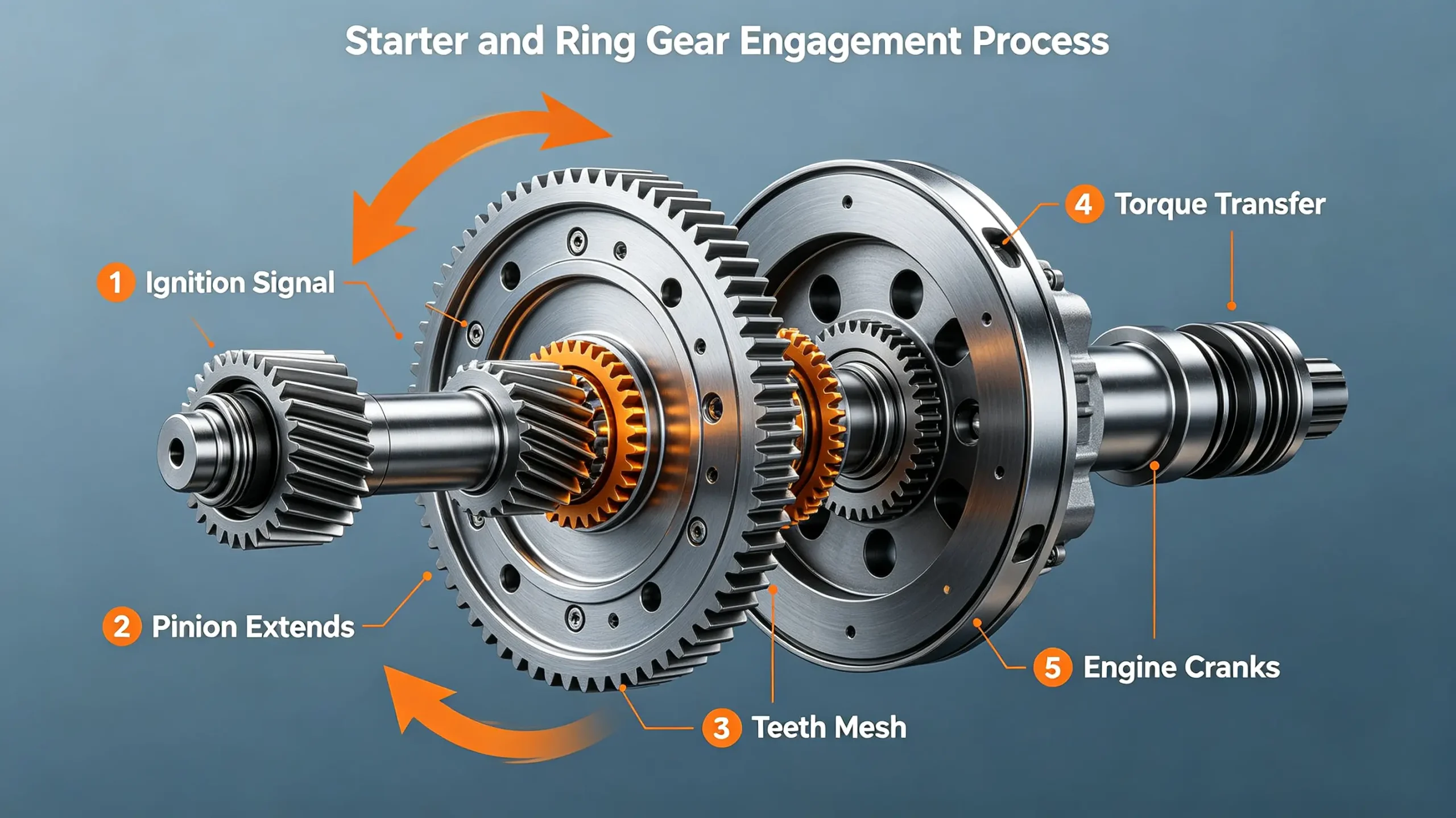
Starter and ring gear engagement follows a fixed mechanical cycle. Understanding this process helps you judge abnormal wear accurately.
First, when the driver turns the ignition key, the starter motor receives an electric signal.
Next, the starter solenoid pushes the small pinion gear forward. The pinion slides out and approaches the stationary ring gear.
Then, the pinion teeth mesh with the large ring gear teeth. The two gears complete physical docking.
After successful meshing, the starter motor spins rapidly. It transfers rotational torque to the flywheel ring gear.
As the ring gear rotates, it drives the entire flywheel and crankshaft assembly.
This rotation pushes engine pistons to complete compression and ignition strokes. Finally, the engine fires up and runs independently.
Once the engine starts, its rotating speed far exceeds the starter speed.
At this stage, the pinion gear automatically disengages and retracts. It avoids high-speed reverse damage to the starter motor.
In short, the ring gear acts as the final torque receiver for engine cranking. It controls the entire starting process stability.
Core Functions of Heavy-Duty Flywheel Ring Gear
The ring gear undertakes multiple irreplaceable functions. These functions determine vehicle startup reliability and starting system lifespan.
1. Transfer Starter Torque to Engine Crankshaft
The starter pinion is small and cannot bear high torque alone. The large-diameter ring gear amplifies cranking force steadily.
It converts high-speed low-torque starter rotation into low-speed high-torque crankshaft rotation.
This mechanical amplification ensures diesel engines can compress fuel and ignite smoothly.
2. Achieve Precise Starter Meshing and Disengagement
Standard ring gear tooth profiles guarantee smooth pinion sliding and meshing.
Qualified tooth spacing and angle eliminate jamming during engagement. They also ensure clean disengagement after startup.
Poor tooth precision directly causes grinding noise and failed startup.
3. Protect Starter Motor From Impact Damage
Every startup creates instantaneous impact force. The thick hardened ring gear teeth absorb most impact pressure.
It buffers rigid collision and protects the smaller starter pinion from rapid wear and breakage.
4. Maintain Consistent Starting Synchronization
Complete tooth profile and uniform hardness ensure every startup follows the same meshing track.
This consistency avoids random meshing deviation, which prevents intermittent starting failures.
Common Materials & Heat Treatment Standards
Material and hardening process decide ring gear durability. Low-quality gears fail quickly under heavy truck cranking load.
Genuine heavy-duty ring gears mostly adopt high-carbon alloy steel. Common grades include 45# steel and 40Cr alloy steel.
After precision turning and tooth cutting, every qualified gear undergoes integral quenching and tooth surface high-frequency hardening.
The tooth surface hardness reaches HRC50–HRC55. This hardness resists wear, impact and tooth chipping.
Meanwhile, the gear inner body maintains proper toughness. It prevents overall cracking under extreme impact.
Inferior products skip secondary hardening. Their teeth soften quickly and wear out within months.
You can check high-standard OEM and aftermarket parts in our brand product collection.
Typical Failure Symptoms of Bad Flywheel Ring Gear
Ring gear failures develop gradually. Early signs are easy to ignore or misjudge as starter problems.
If you frequently replace starters without solving issues, the ring gear is almost always the root cause.
1. Loud Grinding Noise During Startup
Worn or chipped teeth cause poor meshing. The pinion slides and grinds against damaged tooth edges.
You will hear harsh metal-on-metal grinding sound when cranking.
The noise disappears immediately after engine startup.
2. Intermittent No-Crank or Failed Startup
When partial teeth are worn flat, the pinion cannot lock into position stably.
Sometimes the starter spins freely without turning the engine over.
The vehicle starts normally on other attempts. This random feature confuses most drivers.
3. Starter Pinion Rapid Wear and Frequent Damage
Damaged ring gear teeth create sharp edges and uneven gaps.
These irregular surfaces continuously scrape and impact the starter pinion.
If your pinion gear needs replacement frequently, the ring gear is faulty.
4. Obvious Engine Cranking Vibration
Uneven tooth height causes unbalanced meshing force.
During cranking, the whole engine front section vibrates abnormally.
5. Visible Tooth Chipping, Peeling and Deformation
After long-term impact, local teeth break off or peel layer by layer.
Severe deformation leads to complete meshing failure.
Root Causes of Premature Ring Gear Failure
High-quality ring gears can last hundreds of thousands of kilometers. Early failure always comes from specific triggers.
1. Low-Quality Material and Unqualified Hardening
Cheap ring gears use ordinary steel without professional heat treatment.
Tooth surface hardness is insufficient. Teeth wear down quickly under repeated impact.
2. Abnormal Starter Engagement Habits
Drivers who frequently crank repeatedly without waiting cause violent repeated meshing.
Starting the engine while the pinion is partially engaged creates strong shear force.
3. Misaligned Starter Mounting Position
Loose starter bolts or deformed mounting brackets cause angular deviation.
The pinion meshes obliquely. This creates unilateral tooth wear and tooth breaking.
4. Weak Battery and Insufficient Cranking Power
Low battery voltage leads to slow pinion movement and unstable meshing.
Incomplete meshing plus low torque causes sliding friction and tooth abrasion.
5. Long-Term Vehicle Idle and Shelf Storage
Long unused trucks develop slight rust on ring gear teeth.
Rust particles act as abrasives during startup, accelerating tooth damage.
6. Improper Installation and Press-Fit Errors
Uneven press-fitting causes gear deformation. Skewed ring gears produce abnormal meshing tracks.
This leads to localized over-wear and early scrapping.
For real fleet maintenance cases and failure analysis, check our customer cooperative cases.
Step-by-Step Fault Diagnosis for Ring Gear Issues
Professional diagnosis helps you distinguish starter faults from ring gear faults accurately.
Step 1: Listen to Startup Sound Characteristics
Pure empty spinning noise means ring gear slipping.
Harsh intermittent grinding indicates partial tooth damage.
Smooth normal noise confirms healthy meshing.
Step 2: Inspect Starter Pinion Wear
Remove the starter and check pinion tooth condition.
Uniform minor wear is normal. Irregular sharp wear proves ring gear misalignment.
Step 3: Observe Ring Gear Tooth Surface
Use a flashlight to check gear teeth through the starter mounting hole.
Look for flat wear, chipping, rust and deformation.
Step 4: Test Multiple Startup Cycles
Test startup several times. Record whether failures happen randomly or continuously.
Random failure is the typical feature of partial ring gear damage.
Step 5: Check Starter Mounting Parallelism
Verify starter bolt tightness and bracket flatness.
Eliminate installation deviation before replacing parts.
Professional Flywheel Ring Gear Buying Guide
Fleet buyers need to judge quality through core parameters instead of appearance similarity.
1. Confirm Exact OEM Part Number
Different engine models have exclusive gear modulus, tooth count and diameter.
Wrong tooth numbers cause complete meshing failure.
2. Check Tooth Surface Hardness
High-quality gears have uniform matte hardening surface.
Inferior gears show bright soft steel surface without hardening treatment.
3. Inspect Tooth Profile Precision
Qualified teeth have smooth arc surfaces and uniform spacing.
No burrs, no tooth distortion, no uneven cutting traces.
4. Verify Inner Ring Press-Fit Tolerance
The inner diameter must strictly match flywheel outer circle size.
Too loose causes gear shaking. Too tight leads to installation difficulty and cracking risk.
5. Choose Heat-Treated Industrial Grade Products
Always select high-frequency quenched ring gears for heavy-duty trucks.
Ordinary unhardened gears cannot withstand commercial vehicle startup frequency.
Standard Ring Gear Replacement & Press-Fit Steps
Ring gear installation precision directly decides its service life. Improper press-fit causes early failure.
Pre-Work Preparation
Prepare new ring gear, heating equipment, press machine, cleaning tools and calipers.
Confirm model compatibility in advance. For technical matching support, contact our professional team.
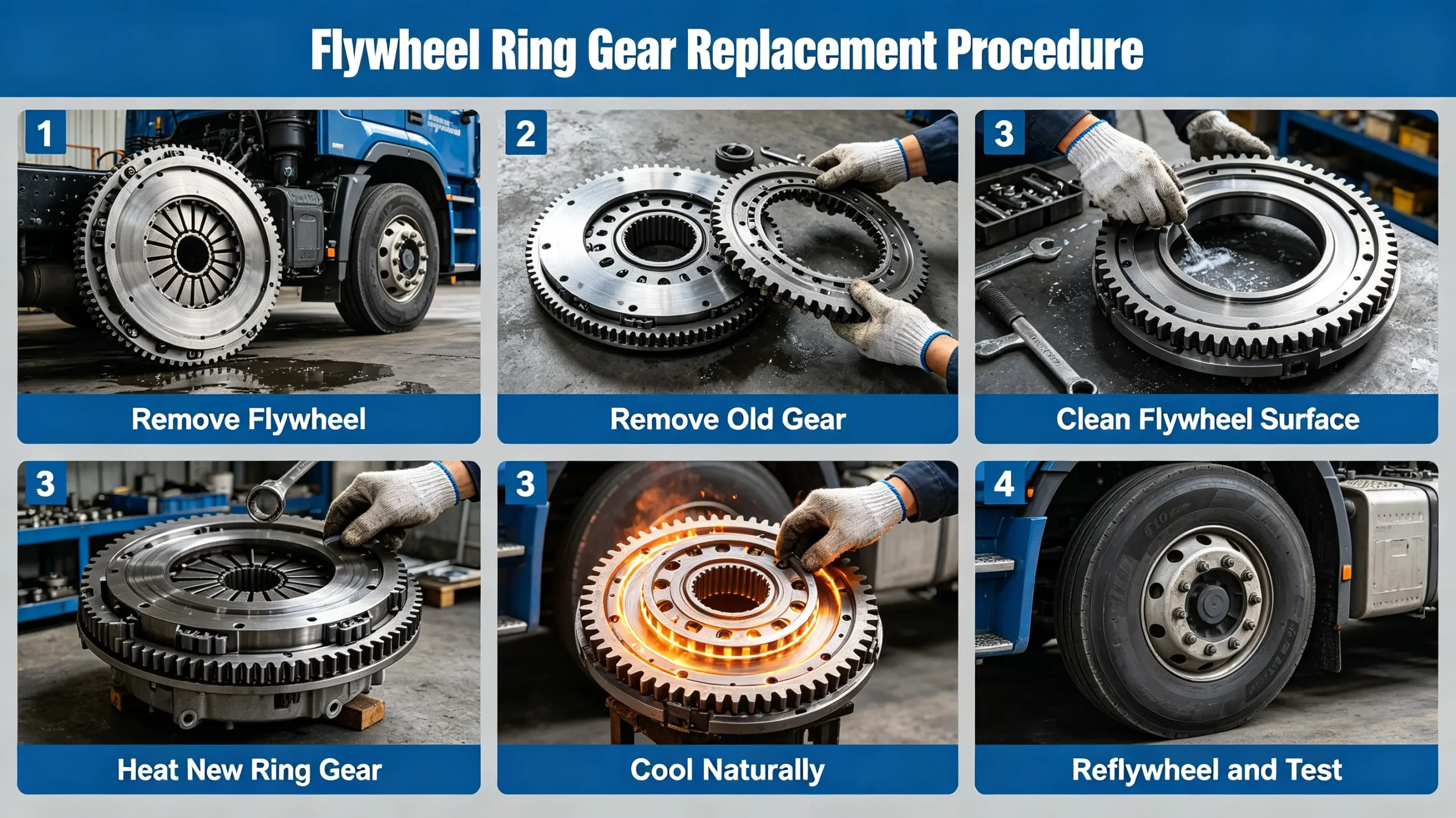
Step 1: Remove Flywheel From Engine
Disassemble transmission and clutch assembly first.
Remove flywheel fixing bolts and take out the entire flywheel.
Step 2: Dismantle Old Damaged Ring Gear
Use professional tools to cut or pry off the old ring gear.
Clean the flywheel outer circle completely. Remove rust and residual debris.
Step 3: Uniform Heating for New Ring Gear
Heat the new ring gear evenly to expand its inner diameter slightly.
Standard heating temperature ranges from 180℃ to 220℃.
Even heating ensures uniform expansion without material damage.
Step 4: Fast and Flat Press-Fit Installation
Quickly sleeve the heated gear onto the flywheel.
Press flat and ensure full contact without skew.
Keep horizontal pressure until temperature drops and gear shrinks tightly.
Step 5: Cool Naturally and Check Stability
Let the gear cool naturally. Do not cool rapidly with water.
After complete cooling, check tightness and rotation smoothness.
Step 6: Refit Flywheel and Test Startup
Reinstall flywheel, clutch and transmission in reverse order.
Test multiple startups to confirm no grinding noise and stable meshing.
Common Installation Mistakes to Avoid
Many new ring gears fail early due to careless installation errors.
Uneven heating causes partial tightness and gear distortion.
Skewed press-fit leads to unilateral tooth wear.
Rapid water cooling destroys material toughness and causes hidden cracks.
Dirty flywheel surface results in unstable bonding and loose gear later.
Daily Maintenance Tips to Extend Ring Gear Lifespan
Scientific maintenance can greatly reduce replacement frequency and fleet cost.
1. Avoid Repeated Frequent Cranking
Do not crank continuously if startup fails.
Wait 3 to 5 seconds between each attempt to reduce impact wear.
2. Keep Battery Voltage Stable
Maintain good battery health. Stable voltage ensures complete and smooth meshing.
3. Regularly Check Starter Mounting Tightness
Inspect starter bolts every maintenance cycle.
Eliminate installation offset in advance.
4. Clean Gear Teeth for Long-Parked Trucks
Remove rust and dust on ring gear teeth before restarting long-stored vehicles.
5. Replace Starter Pinion Timely When Worn
Worn pinions damage ring gears rapidly. Always replace pinion at the first sign of wear.
OEM vs Aftermarket Flywheel Ring Gear Comparison
Fleet buyers need clear selection standards for different budget scenarios.
OEM Original Ring Gear
100% factory standard modulus, tooth count and hardness.
Perfect meshing with original starters, zero installation error.
Long service life and ultra-high stability for key fleet vehicles.
High-Quality Aftermarket Gear
Standard heat treatment and precise tooth cutting.
Cost-effective for daily batch fleet replacement.
Performance close to OEM level with lower price.
Low-Cost Inferior Gear
No professional hardening, poor tooth precision.
Easy to wear, grind and chip. Not recommended for heavy-duty trucks.
Frequently Asked Questions
Q1: Can I replace only the ring gear without changing the flywheel?
Yes. If the flywheel disc is intact, replacing only the ring gear is the most cost-effective solution.
Q2: Why does my truck grind only on cold startup?
Low temperature slightly shrinks gear clearance and increases friction. Minor tooth wear becomes obvious in cold conditions.
Q3: How long does a heavy-duty ring gear last?
High-quality products last 200,000–400,000 kilometers under standard driving habits.
Q4: Is ring gear damage dangerous during driving?
It will not affect running safety. However, it may cause sudden startup failure and strand the vehicle.
Final Buyer Guide Summary
The flywheel ring gear is a small but decisive starting system component.
It undertakes starter meshing, torque transmission and impact buffering tasks.
Most hidden starting faults root in worn ring gear teeth rather than starter motors.
For fleet managers, choosing hardened precision ring gears and standard installation greatly reduces breakdown risks.
Regular inspection and standardized driving habits extend part service life effectively.
For more professional truck component guides and reliable supply resources, visit our official website homepage.
To learn our brand strength and global supply system, check our about us page.


