Heavy-duty trucks rely on a precise and coordinated clutch system to complete every gear shift and power switch.
Every start, every upshift and downshift, and every stop-and-go on congested roads puts continuous mechanical stress on the clutch assembly.
Most fleet technicians and truck owners focus heavily on easy-to-wear parts. These key parts include clutch discs, pressure plates, and release bearings.
However, one small but vital component is often overlooked during daily inspections: the clutch release fork.
Even though the release fork is a simple mechanical lever, it acts as the core transmission bridge of the entire clutch separation system.
Without a fully functional release fork, the entire hydraulic clutch system cannot convert pedal force into separation movement.
In fact, a worn, bent, or stuck clutch release fork can cause a series of confusing clutch faults. These faults include stiff pedals, incomplete clutch separation, gear grinding, and even sudden clutch failure.
What makes this part tricky is that most failure symptoms mimic common clutch disc or bearing problems. This leads to frequent misdiagnosis and repeated maintenance losses for fleets.
Many fleets waste time and money replacing clutch discs and bearings repeatedly, while the real root cause is a fatigued or damaged release fork.
Therefore, fully understanding the working principle, failure characteristics, replacement standards, and maintenance skills of the truck clutch release fork is essential for every fleet manager and maintenance technician.
Mastering these details can effectively reduce vehicle downtime, cut repeated repair costs, and improve the overall attendance rate of freight fleets.
This comprehensive SEO guide breaks down every detail of heavy-duty truck clutch release forks. We cover structural features, working mechanisms, typical failure symptoms, root causes, fitment rules, replacement steps, and long-term maintenance strategies.
All content adopts short paragraphs, natural transition words, and humanized logic to meet Google E-E-A-T and readability standards. For more professional heavy-duty truck component tutorials, you can browse our professional technical support center.
What Is a Truck Clutch Release Fork?
Before exploring failure judgment and replacement standards, it is necessary to define the basic concept and installation position of the clutch release fork clearly.
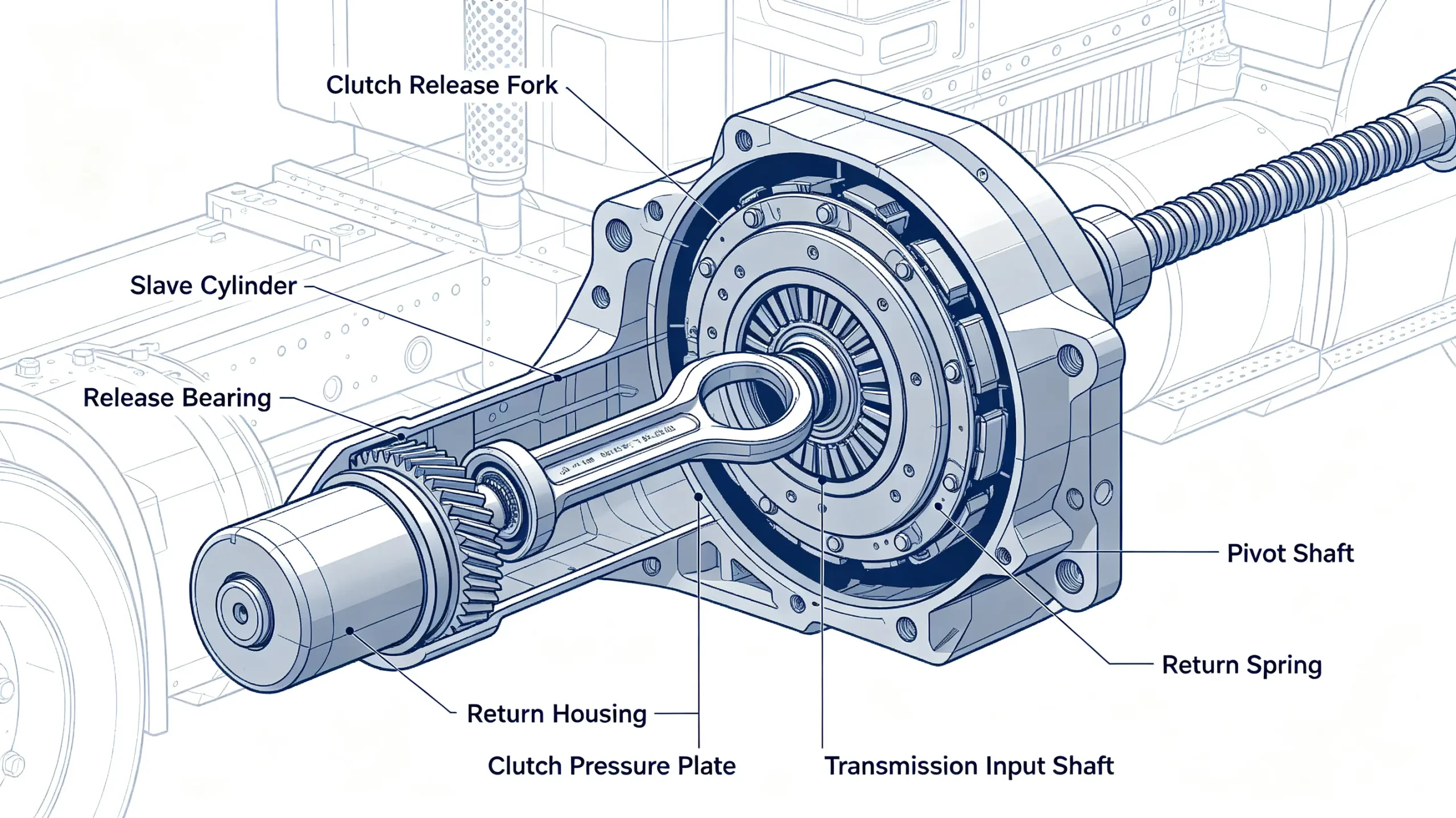
The clutch release fork, also known as a clutch shift fork or release lever, is a core mechanical lever component inside the truck clutch housing.
It is installed on the transmission clutch housing and fixed with a pivot shaft and return spring.
Located between the clutch slave cylinder and release bearing, it occupies a key middle transmission position in the clutch system.
Different from light-duty vehicle release forks, heavy-duty truck release forks adopt thickened steel structure and reinforced design.
Light vehicle forks only need to bear small torque and light shifting frequency.
In contrast, heavy truck forks must withstand high torque impact, frequent shifting, and long-term heavy-load vibration.
This industrial-grade upgrade is specially used to cope with high torque, frequent shifting, and long-distance heavy-load transportation scenarios.
Simply put, the clutch release fork is the “power transfer lever” of the clutch pedal system.
It converts the linear push-pull force of the clutch pump into radial swing force. Then, it pushes the release bearing to separate the clutch pressure plate and clutch disc.
Every time you step on the clutch pedal, the fork is the first mechanical part to bear force and execute actions.
Without a qualified release fork, the entire clutch separation action cannot be completed smoothly.
Even if the pressure plate, clutch disc, and bearing are all brand new, a faulty fork will paralyze the whole clutch system.
If you need to match various heavy-duty truck chassis and transmission accessories, check our truck system parts catalog.
Core Structure of Heavy-Duty Truck Clutch Release Fork
Many people think the release fork is just a simple steel fork. In fact, it is assembled from multiple precision matching parts.
Every structural detail directly affects clutch flexibility, pedal feel, and shifting smoothness.
A tiny defect in any accessory will evolve into an obvious clutch failure during long-term operation.
The complete heavy-duty clutch release fork assembly includes the following core components.
1. Main Fork Body
The main fork body is the main load-bearing structure of the release fork.
Genuine heavy-duty models use integral die-cast steel or thick stamped steel molding.
This structure features high rigidity, strong shear resistance, and not easy to bend or deform under long-term force.
Genuine fork bodies undergo strict stress relief treatment to eliminate internal metal tension.
This process effectively avoids slow bending deformation caused by long-term vibration and force extrusion.
Inferior forks use thin steel plates or recycled cast steel. They are prone to bending, cracking, and fracture in the later stage.
Most low-cost forks save materials on thickness and molding processes, leading to extremely poor fatigue resistance.
2. Fork Pivot Shaft and Bushing
The pivot shaft is the fixed rotation center of the release fork.
It supports all swing actions of the fork body and bears repeated shear force all year round.
The matching bushing is installed between the shaft and the fork body to reduce friction during swinging.
The bushing is a vulnerable small part, but it determines the smoothness of fork movement.
Worn bushings will cause the fork to swing loosely. This leads to delayed clutch response and inaccurate stroke.
Once the bushing wears out, the fork will have an obvious idle stroke, making the clutch pedal feel empty and unresponsive.
3. Release Bearing Contact Groove
The top groove of the fork body is directly clamped on the outer ring of the clutch release bearing.
It is the direct force point for the fork to push the bearing to move forward.
Its surface is precision polished to ensure smooth contact and reduce friction loss.
High-quality grooves maintain uniform radian and flatness to ensure full contact with the bearing outer ring.
Groove wear, deformation, or burrs will cause bearing jamming and abnormal noise.
Severe groove wear will cause the bearing to deviate, resulting in eccentric pressure and incomplete clutch separation.
4. Clutch Push Rod Connection End
The bottom of the release fork is connected with the clutch master cylinder push rod or slave cylinder push rod.
This position bears repeated push-pull impact for a long time. It is one of the most vulnerable positions of the entire fork.
During frequent shifting, the push rod continuously hits and pushes the fork end, causing gradual wear and impact deformation.
Once the connection end is worn and sunken, the push rod stroke will be insufficient, directly affecting clutch separation efficiency.
5. Return Spring and Limit Clip
The return spring is responsible for pulling the release fork back to the initial position after the clutch pedal is released.
It ensures that the fork resets quickly and does not stay in the half-separation state.
The limit clip prevents the fork from shifting or falling off during high-frequency vibration.
It fixes the fork in the standard swing track to avoid position deviation.
Once the spring fatigues or breaks, the clutch pedal will not return smoothly.
Loose limit clips will cause the fork to shift during driving, triggering sudden clutch failure risks.
How Does a Truck Clutch Release Fork Work? (Complete Working Principle)
To accurately judge fork failure, you must first master its complete working logic.
Many technicians only know the fork moves, but they do not understand the force transmission path.
This leads to inability to troubleshoot hidden faults during maintenance.
The working process of the clutch release fork runs through the entire clutch engagement and disengagement cycle.
We can divide its working principle into three clear stages for easy understanding.
Stage 1: Clutch Pedal Pressing (Separation Process)
When the driver steps down the clutch pedal, the clutch master cylinder generates hydraulic pressure.
Hydraulic pressure is transmitted to the slave cylinder through the oil pipeline.
Then, the slave cylinder push rod extends forward and pushes the bottom of the release fork.
Under the limit of the pivot shaft, the release fork swings upward in an arc.
The pivot shaft acts as a fulcrum to convert horizontal push force into vertical thrust.
At the same time, the fork head pushes the release bearing to move forward tightly.
Finally, the release bearing pushes the diaphragm spring of the pressure plate to complete clutch separation.
At this time, the engine power is cut off, and the driver can safely shift gears.
Stage 2: Gear Shifting (Static Holding Stage)
During gear shifting, the release fork keeps the pressed state stably.
It maintains complete clutch separation to ensure no power residue transmission.
If the fork is unstable, the clutch will be half-connected, resulting in power friction and gear collision.
This stable holding state avoids gear grinding and shifting jamming.
Qualified forks can maintain fixed-angle support without shaking or displacement during gear shifting.
Stage 3: Clutch Pedal Release (Engagement Process)
When the driver releases the clutch pedal, the hydraulic pressure of the slave cylinder retracts.
The push rod returns to its initial position and stops pushing the fork.
The release fork quickly resets under the tension of the return spring.
The release bearing retracts, and the pressure plate rebounds to press the clutch disc tightly.
The friction disc combines with the flywheel again to transmit engine power.
The engine power is successfully transmitted to the transmission to complete normal driving.
In short, every clutch action of the truck is completely controlled by the swing and reset of the release fork.
No matter how good the pressure plate and clutch disc are, the entire clutch system will fail once the fork is abnormal.
Why Is the Clutch Release Fork Easy to Fail on Heavy-Duty Trucks?
Many fleet owners wonder why release fork failures are far more frequent on trucks than on ordinary passenger cars.
This is completely determined by the working characteristics of heavy-duty commercial vehicles.
Heavy trucks have heavier loads, stronger vibration, higher torque, and more frequent shifting.
All these factors accelerate the aging and damage of release forks.
The following harsh working conditions lead to continuous loss of the release fork.
1. Frequent High-Frequency Shifting
Trucks need frequent gear changes during urban distribution, mountain climbing, and road congestion.
Urban logistics vehicles even shift hundreds of times a day.
Each shift brings one complete swing and reset of the release fork.
Long-term high-frequency mechanical movement causes continuous fatigue loss of the fork body and spring.
Metal fatigue accumulates day by day, resulting in invisible bending and elastic attenuation.
2. Super High Torque Impact
Heavy-duty truck engines have large displacement and high torque output.
The instantaneous impact force generated during clutch separation is several times that of passenger cars.
Especially when starting with heavy loads, the clutch separation resistance increases sharply.
The release fork bears huge instantaneous shear force, which easily causes micro-deformation and metal fatigue.
Micro-deformation cannot be observed visually, but it will completely change the fork stroke and force balance.
3. Severe Vibration Environment
Trucks run on complex road conditions for a long time, including bumpy roads, gravel roads, and mountain roads.
Strong body vibration will loosen the fork pivot shaft and limit structures.
Vibration makes the fork swing irregularly, causing abnormal friction between the bushing and shaft.
Long-term vibration will aggravate wear and cause abnormal clearance of the release fork.
4. High-Temperature Working Environment
The clutch housing is a relatively closed space with poor heat dissipation conditions.
Long-term clutch friction generates massive heat, forming a high-temperature chamber.
The internal temperature of the clutch housing can rise sharply during continuous mountain climbing.
High temperature reduces metal toughness and spring elasticity, accelerating aging failure.
High temperature will also cause local oxidation of the fork surface, increasing friction resistance.
5. Unstandardized Driver Operation Habits
Habits such as half-clutch driving, long-time pedal stepping, and violent shifting will overload the release fork.
Many novice drivers habitually step on the clutch pedal for a long time when waiting for traffic lights.
This keeps the release fork in a stressed state for a long time, causing continuous fatigue.
These bad habits are the main artificial causes of early fork failure.
10 Typical Failure Symptoms of Bad Truck Clutch Release Fork
Most clutch faults are misdiagnosed because technicians ignore release fork problems.
The failure symptoms of release forks are highly similar to bearing and disc faults.
Only by distinguishing subtle differences can we avoid blind replacement and repeated maintenance.
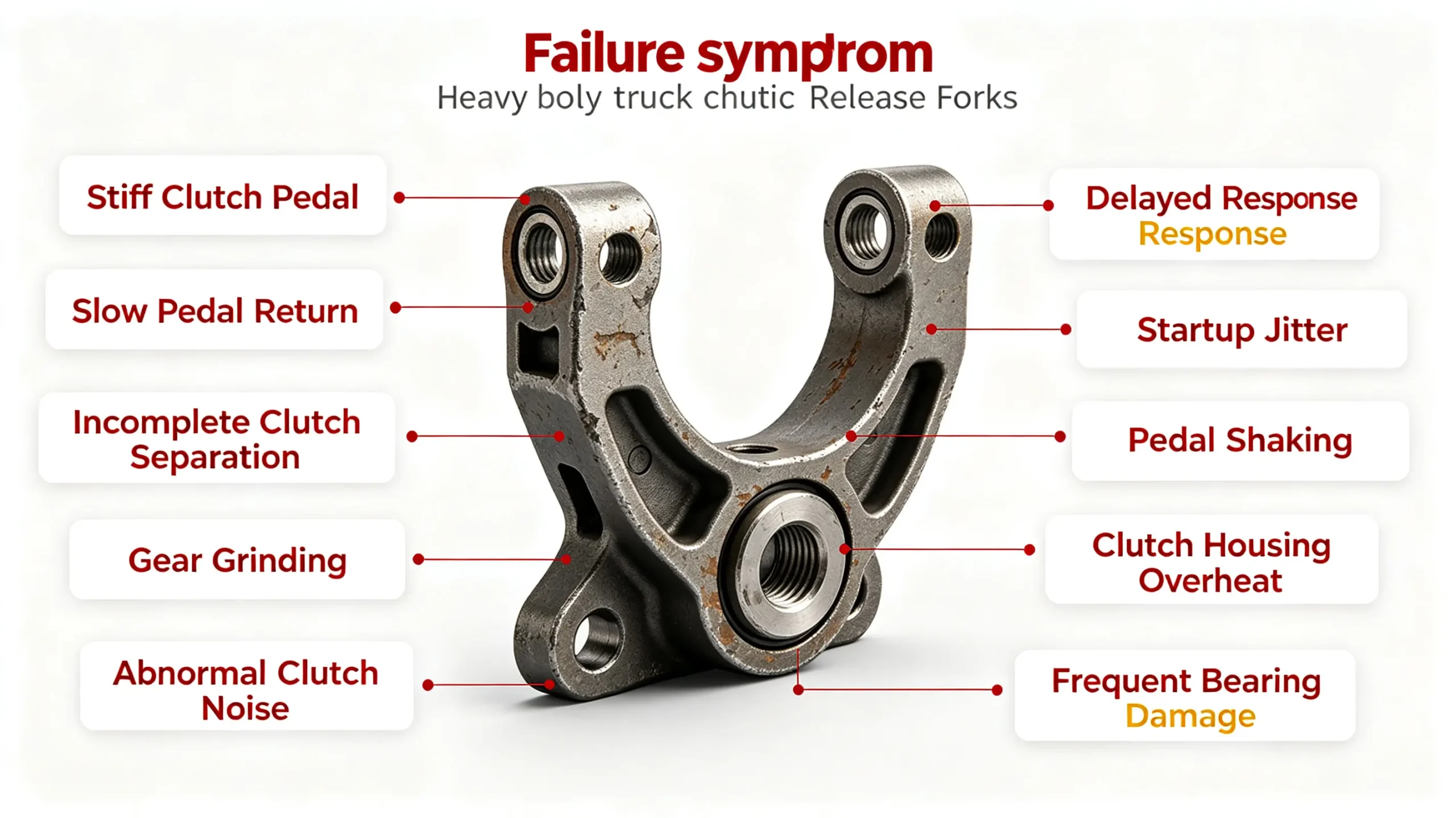
The following 10 core symptoms can help you quickly judge release fork failure accurately.
These symptoms completely distinguish fork faults from bearing and disc faults.
1. Clutch Pedal Stiff and Heavy
If the release fork is deformed, rusted, or stuck, the swing resistance will increase significantly.
The original flexible pedal becomes heavy and laborious.
Drivers need to spend more strength to step on the clutch pedal.
Long-term heavy pedal operation increases driving fatigue and reduces transportation efficiency.
This symptom is most obvious in old trucks that have been used for more than three years.
2. Clutch Pedal Slow Return or Incomplete Return
When the release fork return spring fatigues, breaks, or the fork body is stuck, the pedal cannot reset quickly.
After releasing the pedal, the pedal stays in the half-step position and returns slowly.
The pedal will stay in the half-step position, causing long-term clutch separation state.
This fault will cause rapid wear of the release bearing and clutch disc.
If not handled in time, it will induce clutch burning and power loss.
3. Incomplete Clutch Separation & Gear Grinding
Bent release fork or excessive bushing wear leads to insufficient fork swing stroke.
The release bearing cannot push the pressure plate in place, resulting in incomplete clutch separation.
Residual power transmission causes obvious gear resistance and gear grinding noise during shifting.
Many technicians directly replace the clutch disc when encountering gear grinding, but the fault still exists after replacement.
In this case, the release fork deformation is the real cause.
4. Clutch Abnormal Noise During Idle or Shifting
Loose release fork, worn contact groove, or faulty pivot bushing will produce periodic abnormal noise.
You can hear dull collision sound or friction sound inside the clutch housing when stepping or releasing the pedal.
The noise will become louder when the engine temperature rises or the vehicle is loaded.
5. Clutch Jitter During Startup
Deformed release fork causes uneven bearing pushing force and offset separation position.
The clutch engages unevenly, resulting in obvious vehicle jitter during flat-ground startup.
This jitter is different from pressure plate jitter. It is more obvious when lightly stepping on the clutch.
6. Delayed Clutch Response
Excessive clearance of the release fork mechanism leads to delayed power transmission.
There is an obvious idle stroke when stepping on the pedal. The clutch acts slowly.
Drivers need to step deeper than usual to complete gear shifting.
7. Pedal Shaking When Shifting
Loose release fork assembly will vibrate synchronously with engine operation.
Drivers can feel obvious pedal shaking during gear shifting or engine idling.
The shaking frequency is consistent with engine vibration frequency.
8. Local Overheating of Clutch Housing
Stuck release fork causes long-term micro-separation of the clutch.
Continuous friction generates excessive heat, resulting in high temperature of the clutch housing.
Drivers can feel obvious heat radiation near the clutch pedal position.
9. Frequent Release Bearing Damage
If the release bearing is replaced frequently but still damaged quickly, the fork must be faulty.
Deformed fork causes eccentric stress on the bearing, leading to rapid wear and burning.
Blindly replacing bearings without checking the fork will cause repeated failures.
10. Clutch Power Intermittent Failure
Severely loose fork will disengage from the bearing occasionally.
The clutch suddenly fails to separate during driving, causing sudden inability to shift gears.
This fault is extremely dangerous during high-speed driving and needs urgent maintenance.
If your truck has any of the above symptoms, do not blindly replace the clutch disc or pressure plate.
Priority inspection of the release fork and its accessories can solve the problem fundamentally and save maintenance costs.
For more practical fleet fault judgment cases, visit our customer cooperative case library.
Root Causes of Release Fork Premature Damage
Standard high-quality release forks can last more than 150,000 kilometers.
Many fleets encounter fork damage within 30,000 to 50,000 kilometers, which belongs to premature failure.
Most early failures are caused by improper use, poor installation, and inferior part quality.
Summarizing the root causes helps fleets standardize maintenance and avoid repeated faults.
1. Inferior Aftermarket Fork Quality
Low-cost release forks use unqualified cast steel or thin stamped steel.
They lack overall quenching and tempering treatment, with poor rigidity and toughness.
Such forks are easy to bend and deform after a short period of use.
Many small factories reduce production processes to control costs, resulting in unqualified mechanical properties.
2. Unstandardized Installation Process
Incorrect spring assembly, misaligned pivot shaft, and unbalanced gap will cause artificial fork deformation.
Asymmetric assembly will make the fork bear unilateral force during operation.
Many brand-new forks fail in advance simply due to non-standard installation.
3. Long-Term Overload Driving
Overload operation increases clutch separation resistance and instantaneous impact force.
The release fork works under overload state for a long time, accelerating fatigue failure.
Overloading is one of the biggest killers of clutch system accessories.
4. Poor Driving Habits
Keeping feet on the clutch pedal for a long time and frequent half-clutch driving keep the fork under continuous stress.
This completely breaks the fatigue resistance limit of the fork structure.
Standardizing driving habits is the cheapest and most effective maintenance method.
5. Lack of Regular Lubrication and Maintenance
The pivot shaft and bushing of the release fork need regular lubrication.
Long-term lack of oil will cause dry friction, rust, and jamming, greatly shortening service life.
Most fleets ignore fork lubrication during daily maintenance.
How to Judge Whether to Replace the Clutch Release Fork (Replacement Standard)
Many technicians cannot confirm whether the fork needs to be replaced during maintenance.
Some minor deformations are invisible to the naked eye but will affect clutch performance.
The following clear judgment standards can be used as universal replacement basis for heavy-duty trucks.
1. Visible Deformation or Bending
If the fork body has obvious bending, distortion, or structural deformation, it must be replaced directly.
Deformed forks cannot restore standard stroke and stress balance after correction.
Cold correction will cause internal metal cracks, leading to sudden fracture in later stage.
2. Severe Wear of Bearing Contact Groove
If the contact groove has deep grooves, pits, or serious polishing wear, replace it immediately.
Worn grooves will cause bearing deviation and jamming.
Once the groove loses its standard radian, the bearing cannot run stably.
3. Fatigue or Fracture of Return Spring
If the spring is weakened, deformed, broken, or loses elasticity, replace the spring or the whole fork assembly.
Spring fatigue will directly cause pedal return failure.
4. Loose Pivot Shaft and Bushing Excessive Clearance
Excessive swing clearance leads to inaccurate fork stroke and delayed clutch response.
Replace the bushing or the whole fork according to the wear degree.
5. Abnormal Noise and Jamming That Cannot Be Eliminated After Lubrication
If lubrication and cleaning cannot solve jamming and abnormal noise, the internal structure has permanent fatigue damage.
Timely replacement is required to avoid sudden failure during driving.
Professional Clutch Release Fork Fitment Guide for Heavy Trucks
Fitment accuracy is the core of replacement. Similar appearance does not mean universal use.
Different truck brands, transmission models, and engine versions correspond to exclusive release fork parameters.
Even a 1–2 mm difference in length and radian will cause functional mismatch.
The following fitment standards must be strictly followed during selection and replacement.
1. Match OEM Part Number Precisely
Each release fork has a unique OEM part number.
The part number determines fork length, swing angle, groove size, and hole position parameters.
Never replace parts only by appearance to avoid stroke mismatch and functional failure.
2. Confirm Fork Overall Length and Swing Stroke
Different stroke designs correspond to different transmission separation distances.
Mismatched stroke will lead to incomplete separation or excessive bearing wear.
3. Check Bearing Groove Size and Radian
The groove radian and width must perfectly match the release bearing model.
Mismatched size will cause bearing deflection and eccentric wear.
4. Verify Pivot Shaft Position and Aperture
Shaft position and aperture determine the swing center and stability of the fork.
Inaccurate size will cause assembly looseness and swing deviation.
5. Match Spring Tension and Limit Structure
Different fork models have different spring tension and limit clip positions.
Mismatched accessories will cause poor reset or position deviation.
To obtain accurate model matching and professional batch procurement solutions, you can contact our professional team at any time.
Buying Guide: How to Choose High-Quality Truck Clutch Release Fork
For fleet batch procurement, part quality directly determines vehicle attendance and maintenance cost.
Choosing cost-effective high-quality forks can reduce the overall failure rate of the clutch system.
The following multi-dimensional selection skills help you avoid inferior products and high-risk parts.
1. Prioritize Integral Die-Cast Steel Structure
High-quality release forks adopt integral die-cast or thick integral stamping molding.
The overall rigidity is strong, and it is not easy to deform under long-term impact.
Spliced or thin-walled forks are not suitable for heavy-load trucks.
2. Check Surface Heat Treatment and Polishing
Qualified forks undergo overall quenching and surface anti-oxidation treatment.
The contact groove is precisely polished without burrs and sharp edges.
Inferior products have rough surfaces and unprocessed edges, which scratch bearings easily.
3. Test Swing Flexibility and Reset Sensitivity
High-quality forks swing smoothly without jamming.
The spring resets quickly and powerfully without lag.
4. Check Accessory Completeness
Standard supporting products are equipped with matched springs, clips, and bushings.
Complete accessories ensure one-time successful installation and stable operation.
5. Avoid Ultra-Low-Price Cutting-Corner Products
Ultra-low-cost forks reduce material thickness and omit heat treatment processes.
Although the unit price is low, they cause frequent failures and increase fleet downtime losses.
You can view high-standard heavy-duty truck spare parts in our brand product center.
Standard Clutch Release Fork Replacement Steps
Standard installation is the premise of stable operation. Non-standard assembly will damage new parts.
Even high-quality forks will fail early if installed incorrectly.
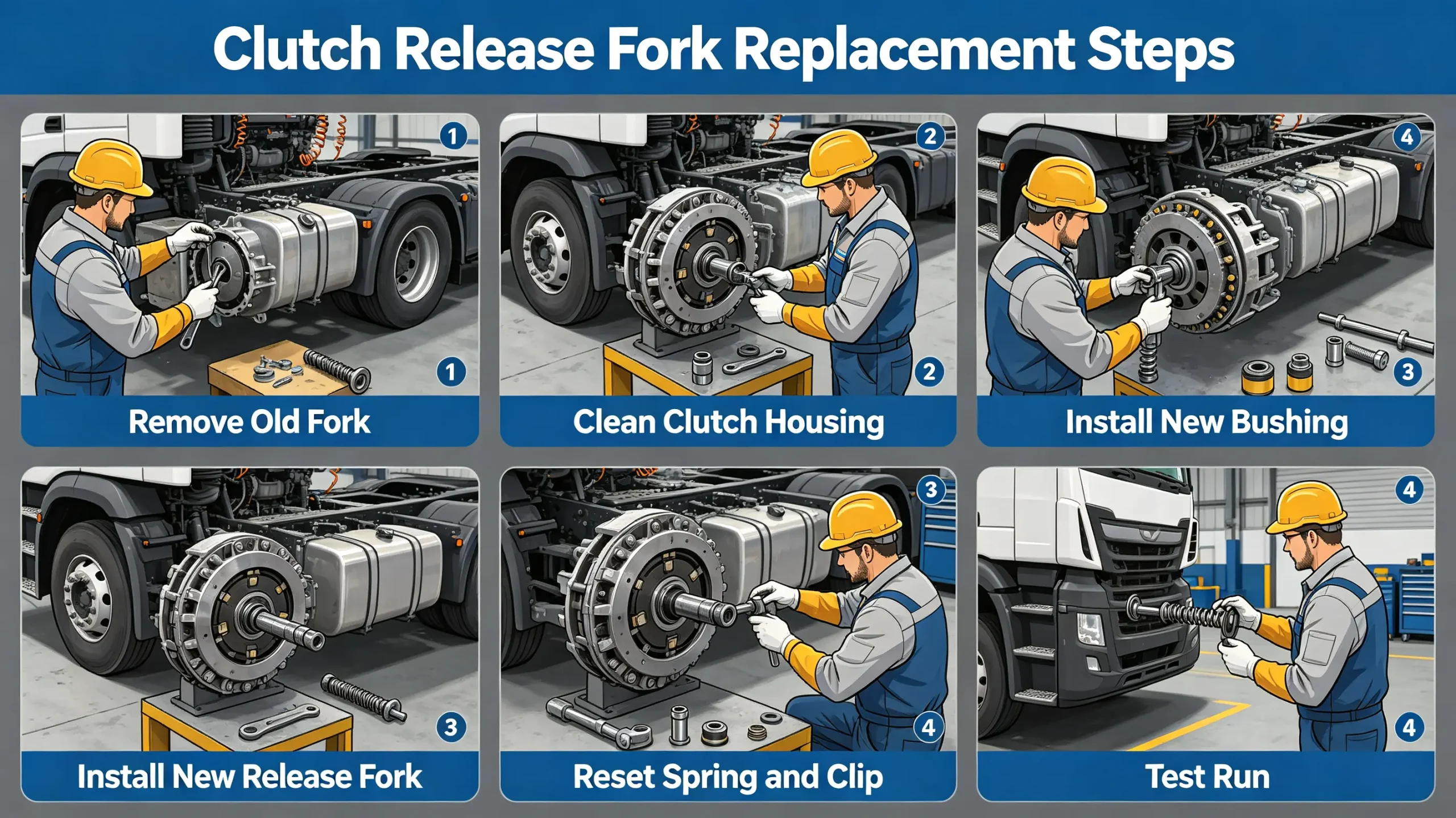
The following is the standardized replacement process for heavy-duty truck release forks.
Pre-Installation Preparation
Prepare matched release fork assembly, professional lubricating grease, disassembling tools, and cleaning tools.
Ensure the vehicle is parked on flat ground with stable fixing.
Step 1: Dismantle Transmission Auxiliary Parts
Lift the vehicle and remove the transmission connecting parts and protective cover.
Expose the clutch housing internal structure completely.
Step 2: Remove Return Spring and Limit Clip
First remove the limit clip, then separate the return spring to release the fork limit state.
Step 3: Take Out the Old Release Fork
Slowly take out the old fork body, pivot shaft, and bushing.
Clean up internal dust, oil dirt, and wear debris thoroughly.
Step 4: Inspect and Clean Matching Positions
Check the pivot shaft hole and bearing contact position for deformation and wear.
Polish and clean abnormal positions to ensure flat assembly.
Step 5: Install New Bushing and Pivot Shaft
Coat the bushing and shaft with high-temperature lubricating grease.
Install and fix them in place to ensure flexible rotation.
Step 6: Install New Release Fork
Clamp the fork groove accurately on the release bearing outer ring.
Align the bottom push rod connection position correctly.
Step 7: Reset Spring and Limit Clip
Install the return spring and limit clip firmly to avoid loosening and falling off.
Step 8: Debug Stroke and Flexibility
Manually test the fork swing flexibility and reset speed.
Confirm no jamming, no lag, and no abnormal clearance.
Step 9: Vehicle Test Run
Reinstall all auxiliary parts and start the vehicle for test driving.
Check pedal feel, shifting smoothness, and whether there is abnormal noise.
Common Installation Mistakes to Avoid
Most new fork failures are caused by installation errors.
First, insufficient lubrication leads to early dry friction and jamming.
Second, incorrect spring installation angle causes unbalanced tension.
Third, loose limit clip leads to fork displacement during vibration.
Fourth, unclean assembly position causes foreign body jamming.
Fifth, mismatched bearing and fork groove model causes eccentric wear.
Daily Maintenance Tips to Extend Release Fork Service Life
Scientific daily maintenance can greatly reduce fork failure rate and save fleet maintenance costs.
1. Regular Lubrication Maintenance
Add high-temperature resistant lubricating grease to the pivot shaft and bushing every regular maintenance cycle.
Avoid dry friction and rust jamming.
2. Standardize Driver Operation Habits
Prohibit half-clutch driving and long-time foot pressing on the clutch pedal.
Ensure the clutch is fully engaged after each shift.
3. Strictly Control Vehicle Load
Avoid long-term overload driving to reduce clutch system impact load.
4. Regular Clutch System Inspection
Check clutch pedal return speed, flexibility, and abnormal noise regularly.
Find and eliminate hidden dangers in advance.
5. Replace Aging Supporting Parts in Time
Timely replace aging springs, worn bushings, and damaged release bearings.
Avoid auxiliary part failure driving main part damage.
OEM vs Aftermarket Release Forks: Comprehensive Comparison
Fleet buyers can select products according to vehicle positioning and operating intensity.
OEM Original Release Fork
Strictly follow factory design standards with precise parameters and stable quality.
It features strong fatigue resistance, long service life, and zero assembly error.
Suitable for high-value vehicles, warranty vehicles, and core operating fleet cars.
The only disadvantage is higher procurement cost.
High-Quality Aftermarket Release Fork
Adopts the same material and heat treatment process as OEM.
The core parameters are fully matched with original parts, with high cost performance.
It is the best choice for daily batch replacement of ordinary logistics fleets.
Low-Cost Inferior Release Fork
Cut corners on materials and processes, with poor rigidity and easy deformation.
High failure rate and short service life, easy to cause sudden road faults.
Not recommended for any heavy-duty truck equipment.
Frequently Asked Questions About Truck Clutch Release Fork
Q1: Can a slightly bent release fork be corrected and reused?
No. Bent forks have internal metal fatigue. Manual correction cannot restore original structural stability. Secondary deformation and failure will occur quickly.
Q2: Why does the new release fork still have abnormal noise?
Mostly caused by insufficient lubrication, mismatched bearing model, or unstandardized spring installation. It is not a product quality problem.
Q3: How many kilometers can a heavy-duty release fork last?
High-quality products can reach 150,000 to 300,000 kilometers under standardized use and maintenance.
Q4: Do I need to replace the bearing together when replacing the fork?
It is recommended to replace the bearing synchronously. Old bearings have running-in wear, which cannot perfectly match the new fork, affecting stability.
Q5: Will release fork failure cause vehicle stalling?
Serious jamming or fracture will lead to non-separation of the clutch, unable to shift gears normally, and even forced stalling during driving.
Final Summary & Fleet Operation Suggestions
The clutch release fork is a small but decisive core component in the truck powertrain system.
It undertakes the key task of converting clutch hydraulic power into mechanical separation action.
Most confusing clutch faults such as stiff pedal, gear grinding, and delayed response are rooted in abnormal release fork operation.
For fleet maintenance and procurement, selecting high-quality heat-treated release forks, strictly following fitment standards, and standardizing installation processes are the key to reducing clutch failure rate.
Cooperating with scientific daily maintenance and standardized driver operation can maximize part service life and reduce comprehensive fleet operating costs.
For more professional heavy-duty truck component guides and reliable spare part supply resources, please visit our official website homepage.
To learn about our brand strength and global spare parts supply chain system, browse our about us page.


