Why does a part that fits in one hand cause more fitment returns than many engine components? A parts importer in East Africa unpacks 150 combination switches for Howo A7 tractors. Within days the first workshop calls back. The connector clicks in and the wipers run, but pulling the stalk for high beam leaves the low beam on.
The housing, the stalk and the plug all matched the supplier’s photo. The pin assignment did not, because the switch came from a different production variant.
This is a common problem with combination switches. The unit price is low, but a wrong part is expensive. You pay freight both ways, a truck sits off the road, and the workshop customer starts to question every shipment that follows.
This guide explains how to identify, specify and quality-check a steering column switch before you place a bulk order. It is based on more than 15 years of exporting Sinotruk Howo, Sitrak and Shacman truck parts from Jinan, and on the mistakes we have watched buyers make and fix.
What is a combination switch? A combination switch is the multifunction assembly mounted on the steering column. It controls a truck’s turn signals, high/low beam and flash-to-pass, wipers and washer, and often the horn and exhaust brake. Because it connects to the cab harness and body electronics, it must match the vehicle’s exact OEM part number.
Key Takeaways
- Always source by OEM part number, not by photo or model name. Variants that look the same can differ in connector pinout, voltage logic or stalk functions.
- Confirm make, model, cab type, production year and steering side (LHD/RHD) before you quote or order.
- On newer cabs, check clock spring compatibility and steering-wheel controls. The switch and the spiral cable often need to be matched as a pair.
- Judge quality by contact material, connector sealing, cycle-endurance testing and an IATF 16949-certified supply chain. Price alone tells you little.
- Inspect and bench-test a sample from every batch before it goes to workshops.
What a Combination Switch Does on a Heavy Truck
On a passenger car, the steering column switch handles lights and wipers. On a heavy truck it usually does more. Many Chinese platforms also route auxiliary braking, and sometimes cruise or retarder commands, through the same assembly.
Core Functions Controlled from the Stalks
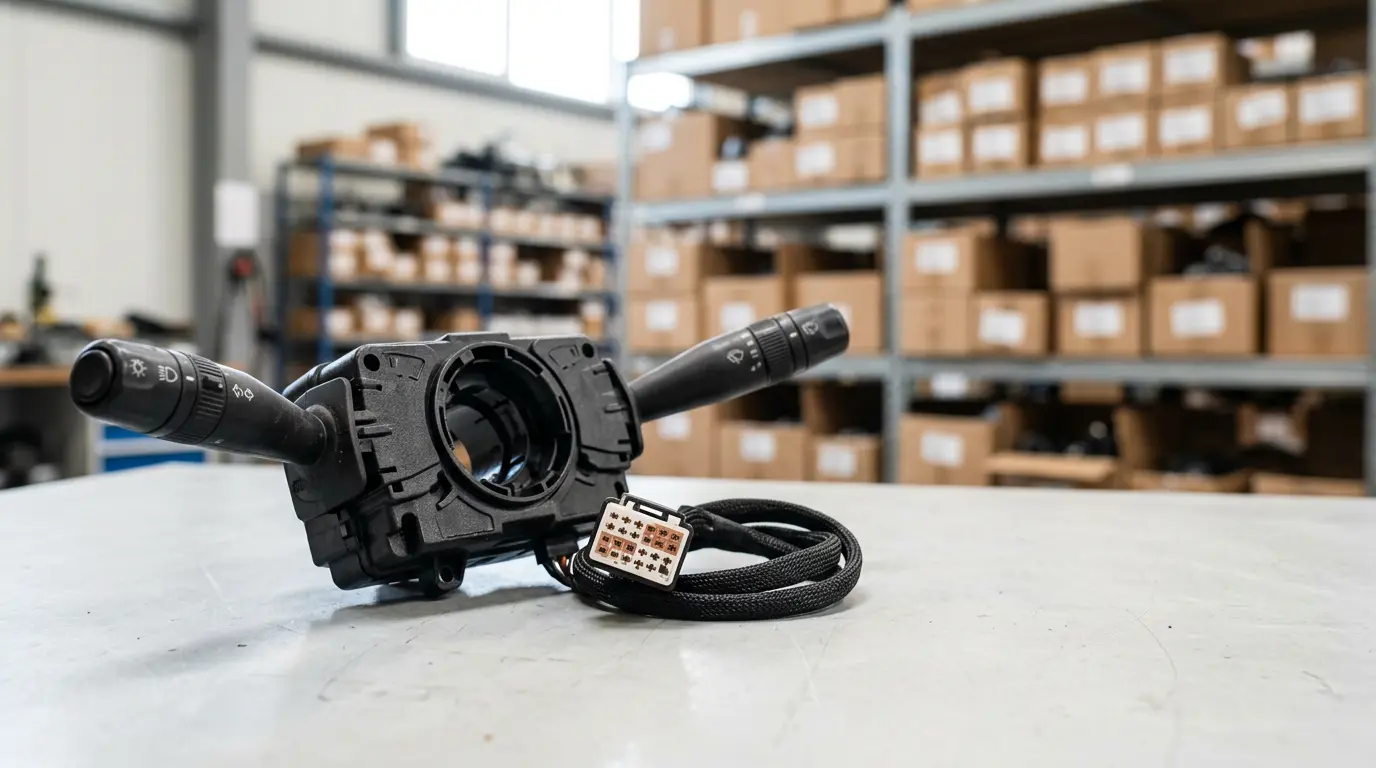
The left stalk usually carries the turn signal switch, the headlight dimmer switch for high and low beam, flash-to-pass, and on some models the horn.
The right stalk usually controls the windshield wiper switch (intermittent, low and high), the washer pump, and on many Chinese heavy trucks the exhaust brake or hydraulic retarder.
Layouts still vary by platform and generation. Do not assume that one manufacturer’s right stalk is a mirror of another’s. Also note that a few cabs move the exhaust brake to a dash switch altogether.
| Function | Typical Stalk Position | What Goes Wrong When It Fails | Fleet Impact |
|---|---|---|---|
| Turn signal / hazard cancel | Left stalk | Signal does not self-cancel; intermittent indication | Roadworthiness and inspection failure |
| Headlight high/low beam | Left stalk | Stuck on one beam; no flash-to-pass | Night-driving safety risk; possible fines |
| Wiper speeds / intermittent | Right stalk | Dead speed position; wipers will not park | Vehicle grounded in rain season |
| Washer | Right stalk (push or pull) | Pump does not activate | Visibility issues on dusty routes |
| Exhaust brake / retarder | Right stalk (many Chinese models) | No engagement or no staged braking | Higher service-brake wear; downhill risk |
| Horn | Stalk tip or steering wheel | Intermittent or no horn | Inspection failure |
Why Failures Matter More on Trucks
A failed exhaust brake stage on a loaded tractor going down a mountain grade puts all the braking load on the service brakes. That means faster lining wear at best. At worst, the brakes fade.
In the same way, a turn signal that will not self-cancel can fail a roadside inspection in many markets. For this reason, fleet managers should treat the combination switch as a safety-relevant part, not a convenience item.
Anatomy of the Switch: What You Are Actually Buying
You need to know what is inside the housing before you can judge quality. Two switches with the same part number on the label can perform very differently because of what sits behind the plastic.
Stalks, Detents and Return Springs
Each stalk is a lever on a pivot. A detent mechanism gives the driver the “click” between positions. Good units have crisp, repeatable detents. Weak springs or poorly molded cams lead to vague positions, and the wipers end up between speeds.
The turn signal cancel cam is a frequent weak point. It engages with a lug on the steering wheel hub. If the geometry is slightly off, the signal either fails to cancel or cancels too early.
Contacts and Internal Circuitry
Older and simpler designs use direct-switching contacts that carry lamp or relay current. Contact material is very important here. Silver-alloy contacts resist arcing and oxidation much better than plain brass or thin plating.
Newer cabs often use low-current signal switching. The switch sends a signal to a body control module or a CAN-based controller, and that module drives the loads. In those cases, resistor values or the logic state are just as important as physical fitment.
Connectors and Sealing
The connector is where most fitment errors happen. Housing shape, keying, number of pins and pin assignment all have to match. A plug that physically mates is not proof of compatibility.
Sealing affects service life as well. Trucks in humid coastal regions or dusty mining sites need connectors and housings that keep out moisture and fine particles. Otherwise corrosion causes intermittent faults that are hard to diagnose.
Platform Differences: Howo, Sitrak and Shacman
Sinotruk and Shacman have both built several cab generations, and switch designs changed with them. China’s heavy-truck exports reached record levels in 2023 according to China Association of Automobile Manufacturers (CAAM) data, with Sinotruk among the leading exporters. As a result, there are now many mixed-generation fleets in Africa, the Middle East, Central Asia and Latin America.
For a distributor, that mix means one “Howo switch” listing is not enough. You need to manage several variants.
Sinotruk Howo
Howo covers a broad range, from older Howo 371/375 cabs to the HW76 and A7 cabs and the newer TX and Max series. Within one model name, switch variants can change with production year, emission level and whether the truck has an exhaust brake on the stalk.
Sinotruk part numbers usually begin with the prefix WG, followed by a numeric sequence. Suffix changes can indicate a superseded or revised design, so read the full number.
Sitrak
Sitrak cabs are based on MAN technology licensed by Sinotruk, and their electrical architecture is closer to European practice. Steering column modules on Sitrak C7H and similar models often integrate with steering-wheel controls and a clock spring. That makes matching the pair more important.
Sitrak parts may carry both a Sinotruk WG number and a MAN-style cross-reference. Keep both in your catalogue so that searches from either direction work.
Shacman
Shacman F2000, F3000, X3000 and X5000/X6000 cabs each use different switch designs. The F-series units are fairly simple. The X3000 and later models add more integrated functions.
Shacman part numbers commonly start with DZ. Depending on the variant and region, axle and engine options (Weichai, Cummins) can also change the electrical configuration.
| Platform | Common Part Number Prefix | Key Variant Drivers | Clock Spring Relevance |
|---|---|---|---|
| Sinotruk Howo (older cabs) | WG | Cab generation, exhaust brake on stalk | Low on basic cabs |
| Sinotruk Howo (A7, TX, Max) | WG | Production year, steering-wheel controls, LHD/RHD | Medium to high |
| Sitrak (C5H, C7H) | WG + MAN cross-reference | Electronic architecture, multifunction wheel | High |
| Shacman F2000/F3000 | DZ | Cab version, auxiliary brake type | Low |
| Shacman X3000/X5000/X6000 | DZ | Electrical generation, optional features | Medium to high |
Note: Prefixes are general patterns, not rules. Always verify against the vehicle’s nameplate, parts book or the number stamped on the original part.
OEM Part Number Search: The Only Reliable Starting Point
The most useful habit a buyer can build is to start every enquiry from the OEM number. A photo, a model name or “same as last time” does not replace it.
Where to Find the Correct Number
- The old part itself. Most switches carry a label or molded number on the housing. Take a clear photo of it, together with the connector face.
- The vehicle parts catalogue (EPC). Searching by VIN or chassis number gives the most accurate result for that specific truck.
- The vehicle nameplate and build data. These confirm model, production date and configuration when the old part is missing or unreadable.
- Your supplier’s cross-reference database. A capable China truck parts exporter keeps supersession and interchange records and can confirm whether an older number has been replaced.
Handling Supersessions
Manufacturers revise parts. A switch may get a new number after a connector change or an internal circuit update. Sometimes the new part is fully backward-compatible. Sometimes it needs an adapter harness or does not fit older trucks at all.
Ask your supplier directly: “Is this a one-way or two-way supersession?” A clear answer prevents a lot of returns.
What to Send When Requesting a Quote
A complete enquiry gets a faster, more accurate quote. Include:
- OEM part number (and any older numbers your customers still ask for)
- Make, model, cab type and production year range
- LHD or RHD
- Photos of the connector face showing pin count and keying
- Functions on each stalk, including exhaust brake or retarder
- Quantity per part number and target delivery date
Clock Spring Compatibility on Newer Cabs
On trucks with steering-wheel buttons or an airbag, the clock spring (also called the spiral cable) sits between the steering wheel and the column. It keeps the electrical connection intact while the wheel turns.
On many modern cabs the combination switch and the clock spring are mounted together or share a carrier. Some designs sell them as one module.
Why the Pair Matters
If you install a new switch on a worn or mismatched clock spring, the horn or wheel controls may still fail. The workshop then blames the new switch, and you get a warranty claim for a part that has nothing wrong with it.
Clock spring variants also differ by connector count and the number of turns they allow. A unit meant for a different steering ratio or wheel can tear internally the first time the wheel reaches full lock.
Practical Guidance
- Check whether the OEM lists the switch and clock spring separately or as an assembly.
- Stock matching clock springs alongside switches for Sitrak and late-model Howo and Shacman cabs.
- Tell workshops to center the clock spring before installation and to follow the airbag disconnection procedure where one is fitted.
Quality Standards and How to Verify Them
Price differences between switch suppliers can be large. Often the gap reflects real differences in materials and testing, not only margin.
IATF 16949 and Supply-Chain Certification
IATF 16949 is the automotive quality management standard. It builds on ISO 9001 and adds requirements for defect prevention, traceability and process control. A manufacturer certified to it is expected to run documented control plans, PPAP-style approvals and corrective-action systems.
Ask for the certificate, and check that it covers the factory that actually makes the part, not only a trading company’s office.
Environmental and Electrical Testing
Well-made switches are validated against conditions found in real trucks. Relevant references include:
- ISO 16750 for environmental conditions and testing of electrical equipment in road vehicles (temperature, vibration, humidity)
- IEC 60529 IP ratings for dust and water ingress
- UN ECE Regulation 10 for electromagnetic compatibility where the switch contains electronics
- OEM-specific cycle-endurance tests that operate each function many thousands of times
Ask suppliers which tests they run and whether they can share reports. A supplier who answers “it’s good quality” without details deserves more questions.
Physical Indicators You Can Check
| Check Point | Good Sign | Warning Sign |
|---|---|---|
| Housing plastic | Clean molding, no flash, consistent color | Sink marks, brittle feel, strong odor |
| Detent feel | Crisp, even clicks in every position | Mushy or uneven positions |
| Connector pins | Straight, evenly plated, firmly seated | Loose pins, uneven plating, burrs |
| Labeling | Clear part number, batch or date code | No traceability marking |
| Packaging | Individual box, protective insert | Loose in bags; stalks bent in transit |
OEM vs Aftermarket Switch: Making the Right Call
The OEM vs aftermarket switch question has no single right answer. It depends on your customer base, warranty exposure and price position.
Genuine OEM
Genuine parts carry the vehicle manufacturer’s branding and come through its approved supply chain. Fitment is guaranteed and documentation is complete. The downsides are higher cost and, for older cab variants, sometimes limited availability.
OE-Equivalent and Quality Aftermarket
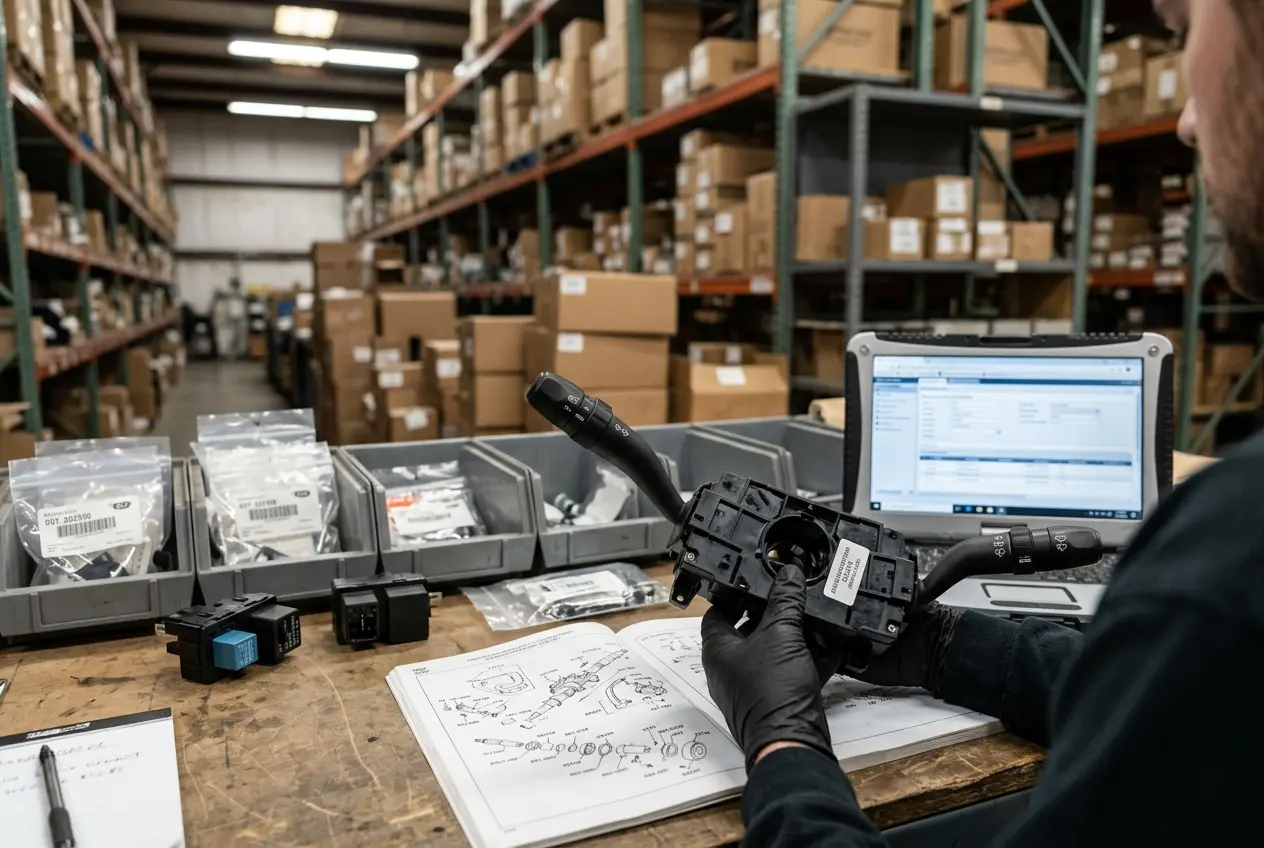
Many aftermarket switches come from factories that also supply, or once supplied, the original assembly line. Quality from these sources can be very close to genuine at a lower price. Quality also varies more between factories, which is why batch testing matters.
| Advantages of Quality Aftermarket Switches | Limitations to Manage |
|---|---|
| Lower unit cost improves margin for distributors | Quality varies between factories and batches |
| Better availability for older cab variants | Supersession records may be less complete |
| Flexible packaging and branding for wholesalers | Some fleets or tenders require genuine parts only |
| Easier to combine with other parts in one container | Warranty terms differ by supplier and must be agreed in writing |
| Competitive for price-sensitive workshop markets | Needs incoming inspection and sample testing |
Many importers stock both tiers. Genuine parts go to fleets with warranty or tender requirements, and quality aftermarket parts go to independent workshops. This approach also cushions you against supply gaps in either channel.
Step-by-Step: Sourcing a Combination Switch Batch
Here is the workflow we recommend to wholesale buyers and fleet procurement teams.
- Build your demand list by part number. Group demand by OEM number, not by model name. Note how many trucks each number covers in your market.
- Send a complete specification. Use the quote checklist above, with connector photos and stalk functions.
- Confirm supersessions and interchanges. Agree in writing which numbers the supplied part replaces.
- Request samples for new part numbers. Test them on an actual vehicle before you commit to volume.
- Agree on quality documents. Certificates, test reports, labeling and packaging standards.
- Consolidate the shipment. Switches are small and light. Combining them with cabin, chassis or engine parts in one container brings freight cost per unit down a lot.
- Inspect on arrival. Bench-test a sample from each batch before distribution.
[[PRODUCT_CARD: Sinotruk Howo combination switch]]
A Simple Bench Test
You do not need a lab. A 24V bench supply, a multimeter and the pinout diagram from the parts book cover most checks.
- Check continuity or resistance for every stalk position against the pinout.
- Cycle each function 20 to 30 times and listen for inconsistent detents.
- Test the turn signal cancel action by hand with the cam.
- Check the connector fit against a known-good harness plug.
Testing five units from a batch of 200 takes less than an hour. It can still catch a wrong variant before 200 switches reach your customers.
Installation Notes for Workshops
Many “defective” returns turn out to be installation errors. It helps to send your workshop customers a short instruction sheet. For more troubleshooting and fitting guides, see our technical support section.
- Disconnect the battery before removing the steering column covers. On airbag-equipped cabs, wait the time the manufacturer specifies.
- Center the steering wheel and mark its position before you remove it.
- Do not force the connector. If it resists, check the keying. It may be the wrong variant.
- Check the cancel cam alignment after you refit the wheel.
- Test every function before refitting the covers, including the exhaust brake and the wiper park position.
Warranty Terms Worth Agreeing Up Front
Warranty terms for electrical parts should be clear before money changes hands. In particular, agree on:
- The warranty period and whether it starts from shipment or from installation
- What evidence a claim needs (photos, batch code, failure description)
- How fitment errors caused by incorrect specification are handled, compared with manufacturing defects
- Whether replacements ship in the next consolidated order or separately
Clear terms protect both sides. They also make it easier to tell a real quality problem from a specification error.
Common Mistakes and Best Practices
Mistakes We See Repeatedly
- Ordering from photos. Many variants look identical. Without the number, you are guessing.
- Ignoring production year. One model name can cover two or three switch generations.
- Forgetting LHD/RHD. Stalk orientation and some functions change with steering side.
- Replacing the switch while ignoring the clock spring. On newer cabs, the fault may be in the clock spring.
- Buying the cheapest batch without testing. Savings on unit price disappear after one batch of returns.
Best Practices for Distributors and Fleets
- Keep an internal cross-reference sheet that links each OEM number to the models and years it fits.
- Record which number each fleet customer uses, so repeat orders stay consistent.
- Stock fast-moving variants deeply and slow-moving variants thinly.
- Combine switch orders with related parts such as gearbox parts to make better use of container space.
- Build a long-term relationship with one technically capable supplier instead of chasing the lowest quote each time. Our customer success cases show how this works in practice.
Frequently Asked Questions
Can I use a Howo switch on a Shacman truck if the connector fits?
No. Even when the connector mates, the pin assignment, stalk functions and cancel cam geometry usually differ. Always match the OEM part number for the specific vehicle.
How do I know if the fault is the combination switch or the wiring?
Check the switch on the bench against the pinout. If every position tests correctly, inspect the harness connector, ground points and any relays or control modules downstream. Corroded connectors are a common cause in humid climates.
Is the turn signal switch sold separately from the wiper switch?
On most Chinese heavy trucks, the turn signal and windshield wiper switch are parts of one combination assembly. Some designs allow you to replace a single stalk module, so check the parts book for your specific variant.
Why does my headlight dimmer switch work, but flash-to-pass doesn’t?
This usually points to a worn internal contact or a variant mismatch, where the flash function is wired to a different pin. Test the unit on the bench. If the switch is fine, check the relay or the body control module.
Do I need to replace the clock spring when I replace the switch?
Not always. On cabs where the two are integrated, or where the clock spring shows wear, replacing both together prevents repeat visits. Inspect the old clock spring for cracked ribbon or intermittent horn operation.
What minimum order quantity should I expect?
It depends on the supplier and the variant. Exporters who handle mixed containers can usually combine small quantities of several part numbers with other truck parts, which keeps your stock levels practical.
Conclusion: Source by Number, Verify by Test
The combination switch is a small part with a large effect on safety, uptime and customer trust. The buyers who avoid returns follow a simple process: start from the OEM part number, confirm the full vehicle configuration, check clock spring compatibility, and test every batch before distribution.
Everything else, including price, packaging and logistics, depends on getting that first step right.
JINAN METTLEAD AUTO SALES CO.LTD. supplies combination switches and a full range of cabin, engine, chassis and gearbox parts for Sinotruk Howo, Sitrak and Shacman, all identified by OEM part number. We work at factory prices and handle bulk and container orders for wholesalers, importers, fleets and workshops. If you also need complete vehicles, visit our homepage.
Ready to source with confidence? Send us your OEM part number list, vehicle details and target quantities through our contact page. Our team will confirm fitment, supersessions and pricing, and prepare a consolidated quote for your next container.


