
Heavy-duty trucks operate under continuous high-load conditions every single day. Every acceleration, gear shift, and hill climb puts massive strain on the vehicle’s powertrain system.
Most fleet managers pay close attention to clutch discs, starter systems, and transmission performance. However, the clutch pressure plate often flies under the radar during routine inspections.
In fact, the clutch pressure plate acts as the core clamping component of the entire clutch assembly. It directly controls clutch engagement, disengagement, and power transmission stability.
Even a minor defect in the pressure plate can trigger a chain of serious faults. These faults include clutch slipping, difficult gear shifting, power loss, and even complete vehicle stalling.
For professional fleet buyers, repair technicians, and parts distributors, mastering pressure plate fitment standards and selection rules is essential. It helps cut unnecessary replacement costs and reduce vehicle downtime.
This in-depth buying guide breaks down everything about truck clutch pressure plates. We cover core functions, internal structure, material standards, common failure symptoms, fitment requirements, installation specifications, and long-term maintenance strategies.
All content uses short paragraphs and natural transition words to meet Google readability standards. For more professional heavy-duty truck component tutorials, visit our technical support center.
What Is a Clutch Pressure Plate on Heavy-Duty Trucks?
Before diving into fitment and purchasing skills, it is vital to clarify the basic definition and working position of the clutch pressure plate.
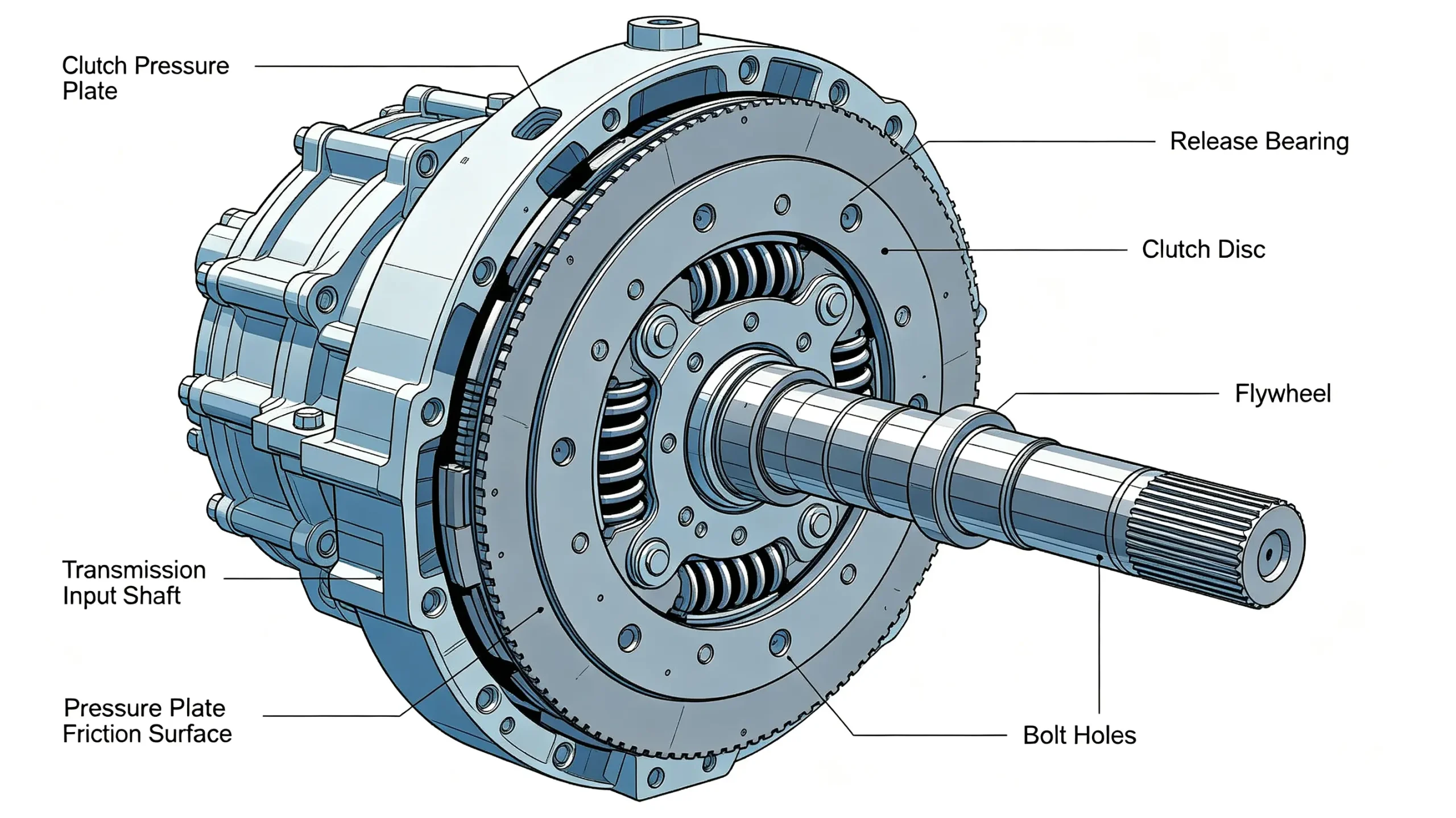
A clutch pressure plate, also known as a clutch cover assembly, is a key load-bearing part installed on the engine flywheel.
It works together with the clutch disc, release bearing, and flywheel to form a complete power switching system.
Unlike light-duty vehicle pressure plates, truck-grade pressure plates feature thicker structural design, stronger clamping force, and higher fatigue resistance.
These upgraded design features allow them to withstand frequent high-torque impacts during long-haul transportation and heavy-load operation.
In simple terms, the pressure plate is the “controller” of the clutch system. It determines whether power transfers smoothly from the engine to the transmission.
If you need model-matched clutch system parts for different truck brands and engines, browse our truck system parts catalog.
Many new fleet owners misunderstand the clutch assembly. They think the clutch disc alone handles all friction and power transfer.
In reality, the clutch disc is only the friction medium. Without a qualified pressure plate providing stable compression force, even a brand-new clutch disc cannot work normally.
This is why many trucks still suffer from slipping and jitter after clutch disc replacement. The real problem lies in neglected pressure plate aging and deformation.
Moreover, heavy-duty commercial vehicles have much stricter working conditions than passenger cars. Truck engines generate higher torque, especially during startup, climbing, and full-load cargo transportation.
Therefore, truck clutch pressure plates must adopt industrial-grade manufacturing standards. Ordinary civilian-grade pressure plates cannot adapt to long-term high-intensity operation.
Core Components of a Truck Clutch Pressure Plate Assembly
A qualified pressure plate is not a simple iron shell. It consists of multiple precision parts that work in tandem.
Each component affects clamping stability, wear resistance, and overall service life. The following parts form the complete pressure plate assembly.
1. Clutch Cover Housing
The cover housing is the outer frame of the pressure plate. It adopts high-strength cast steel or stamped steel structure.
Its main function is to fix all internal parts and connect with the flywheel stably.
It also provides overall structural rigidity to resist deformation under long-term high pressure.
Genuine heavy-duty clutch covers undergo strict stress relief treatment after stamping or casting.
This process eliminates internal metal stress generated during production. It prevents slow deformation after long-term vibration and high temperature.
Inferior products skip stress relief processing. Their housings gradually deform after installation, causing uneven pressure and clutch jitter.
2. Diaphragm Spring
The diaphragm spring is the heart of the pressure plate. It provides stable elastic clamping force for the clutch disc.
Different from ordinary coil springs, diaphragm springs feature uniform pressure distribution and strong fatigue resistance.
When the driver steps on the clutch pedal, the release bearing pushes the diaphragm spring. This action lifts the pressure plate and cuts off power transmission.
When the pedal is released, the spring rebounds quickly and presses the clutch disc tightly for power output.
The diaphragm spring’s taper angle and elastic modulus are precisely calculated according to truck engine torque.
Each pressure point on the spring must maintain consistent elasticity. A single soft point will cause local insufficient compression force.
This tiny defect leads to partial clutch slipping, which gradually burns the clutch disc and expands the fault range.
3. Pressure Plate Friction Surface
The flat metal surface that directly contacts the clutch disc is the pressure plate friction surface.
This surface undergoes precision grinding and high-temperature treatment. It maintains flatness under repeated friction and high heat.
Surface flatness directly determines clutch bonding uniformity and anti-slip performance.
Professional manufacturers control the flatness error within 0.02mm per 100mm. This ultra-precise standard ensures full-surface fitting with the clutch disc.
Low-quality pressure plates have rough surfaces with obvious cutting traces. These traces create gaps between the plate and disc, resulting in incomplete contact.
4. Straps and Driving Pins
Straps and driving pins connect the cover housing and the movable pressure plate body.
They ensure synchronous rotation of the entire assembly while allowing flexible displacement during clutch movement.
These small parts are easy to wear, yet their failure will cause unbalanced pressure and clutch jitter.
Many buyers only focus on large components and ignore these small accessories. In fact, worn straps are a common hidden cause of clutch failure.
Once the straps age and loosen, the pressure plate will deflect during operation. This generates eccentric friction and accelerates overall system wear.
5. Adjusting and Limit Structures
Modern heavy-duty pressure plates come with automatic wear adjustment structures.
They compensate for clutch disc wear automatically to keep consistent clamping force throughout the service cycle.
Old-fashioned manual adjustment pressure plates require regular manual calibration during maintenance.
If fleet maintenance is not timely, the clamping force will gradually weaken, leading to hidden slipping faults.
Automatic adjustment models greatly reduce manual maintenance pressure. They are more suitable for high-frequency operating fleets.
Key Functions of Heavy-Duty Clutch Pressure Plates
Many buyers only know that pressure plates press the clutch disc. In reality, it undertakes multiple core protective and control functions.
1. Provide Stable Clamping Force for Power Transmission
The most basic function is to provide continuous and uniform clamping force.
When the clutch is engaged, the pressure plate locks the clutch disc between itself and the flywheel.
This firm fit ensures zero slipping during engine power output, even under full load and climbing conditions.
For heavy trucks, stable clamping force is the core guarantee of transportation efficiency.
Slight slipping will cause engine power waste, increased fuel consumption, and reduced climbing power.
Long-term weak clamping force will also cause continuous high-temperature friction, burning the clutch disc and damaging the flywheel surface.
2. Realize Smooth Clutch Engagement and Disengagement
The elastic deformation of the diaphragm spring controls the separation and combination of the clutch system.
Qualified pressure plates deliver linear and sensitive pedal feedback.
They avoid sudden jerking or delayed response during gear shifting, improving driving smoothness.
Unsmooth clutch engagement greatly affects driving experience and transportation safety.
Sudden power combination will cause vehicle forward jerking, increasing cargo shaking risk and driver fatigue.
3. Absorb Vibration and Buffer Powertrain Impact
During truck startup, acceleration, and gear switching, the powertrain generates strong torsion impact.
The pressure plate’s elastic structure absorbs partial instantaneous impact force.
It protects the engine, transmission, and driveshaft from rigid impact damage.
The truck powertrain is an integrated system. A single violent impact will be transmitted to the entire power assembly.
The pressure plate acts as a buffer damper. It effectively prolongs the service life of transmission gears, bearings, and crankshaft components.
4. Prevent Overheating and Thermal Deformation
High-quality pressure plates adopt heat-resistant materials and heat dissipation structural design.
They resist thermal deformation caused by long-term friction heat accumulation.
This ensures stable clamping performance even after frequent continuous shifting.
Frequent urban transportation and mountain road driving lead to continuous clutch operation.
Heat accumulates rapidly in the clutch chamber. Inferior pressure plates deform quickly in such environments, triggering a series of faults.
5. Maintain Long-Term Clutch System Consistency
With automatic wear compensation design, standard pressure plates keep consistent clamping force.
They avoid gradual clutch slipping caused by disc wear, extending the overall clutch assembly service life.
Excellent consistency reduces the frequency of clutch system maintenance. It helps fleets save a lot of time and labor costs.
Common Material & Heat Treatment Standards for Truck Pressure Plates
Material quality and processing technology determine the durability and stability of pressure plates.
Inferior products cut corners on materials and heat treatment. They fail quickly under heavy truck working conditions.
The following are mainstream material standards for genuine and high-quality aftermarket heavy-duty pressure plates.
1. High-Strength Stamped Steel for Cover Housing
Most OEM pressure plate covers use thickened high-carbon steel plates.
After integral stamping and stress relief treatment, the housing features high rigidity and anti-deformation ability.
It will not deform under long-term bolt tension and high-temperature environment.
The thickness of truck clutch cover steel plates is significantly higher than that of light vehicle parts.
This structural upgrade is designed specifically for heavy-load torque impact and long-term vibration working conditions.
2. Alloy Steel Diaphragm Spring
Diaphragm springs use professional spring alloy steel. They undergo multiple quenching and tempering treatments.
This processing ensures high elasticity, strong fatigue resistance, and no permanent deformation.
Qualified springs can maintain stable elasticity after millions of clutch operations.
Each heat treatment step has strict temperature and time standards.
Irregular heating or rapid cooling will destroy the internal metal structure, leading to spring fatigue failure in advance.
3. Precision Ground Friction Surface
The pressure working surface adopts ultra-precision grinding technology.
The flatness error is controlled within a tiny range. This guarantees uniform contact with the clutch disc.
Meanwhile, the surface undergoes anti-high-temperature oxidation treatment to resist friction scratches and thermal corrosion.
High-temperature oxidation resistance is crucial for truck clutch parts.
Long-term high-temperature friction easily causes metal surface oxidation and carbon deposition, affecting clamping accuracy.
4. High-Toughness Connection Accessories
Internal straps and driving pins use wear-resistant alloy materials.
They resist shear force and friction loss, avoiding early loosening or fracture.
You can view high-standard OEM and upgraded clutch parts in our brand product center.
Typical Failure Symptoms of Worn Clutch Pressure Plates
Most fleet technicians habitually replace the clutch disc when encountering clutch faults.
In fact, more than 40% of recurring clutch problems stem from faulty pressure plates instead of worn discs.
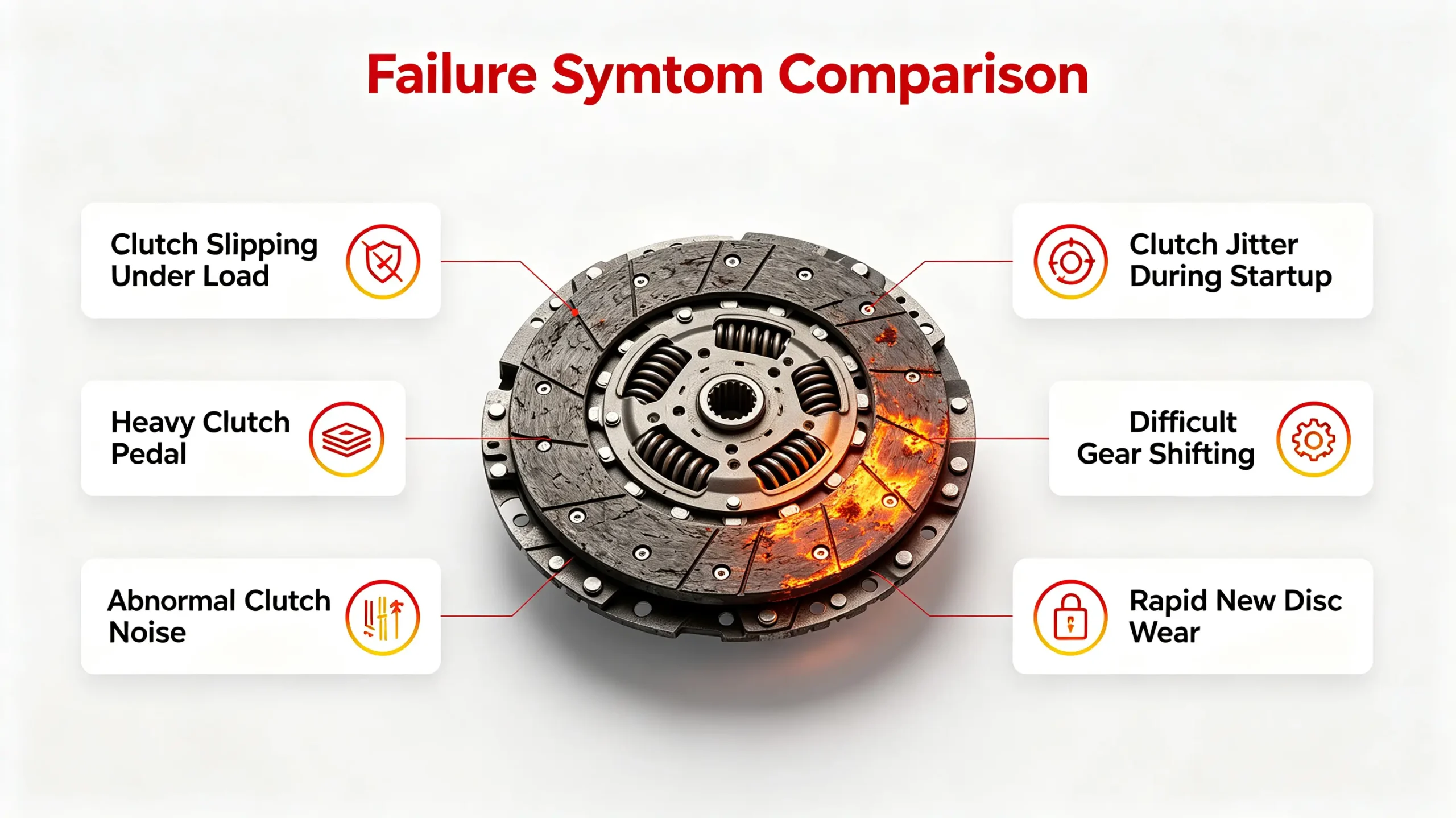
The following typical symptoms help you accurately judge pressure plate failures and avoid blind part replacement.
1. Persistent Clutch Slipping Under Load
Clutch slipping is the most obvious sign of pressure plate fatigue failure.
When the truck accelerates uphill or carries heavy loads, engine speed rises fast while vehicle speed increases slowly.
This phenomenon happens because the pressure plate’s clamping force drops. It cannot lock the clutch disc tightly enough.
Even with a new clutch disc, slipping will continue if the pressure plate is aging or deformed.
Slight slipping is difficult to detect during flat road driving. It only becomes obvious under heavy load or climbing conditions.
Fleet managers should pay special attention to power changes during uphill driving, which is the best time to detect early pressure plate faults.
2. Obvious Clutch Jitter During Startup
If the vehicle jitters violently during flat-ground startup, check the pressure plate first.
Uneven pressure plate surface or fatigue spring elasticity causes inconsistent local clamping force.
The clutch disc contacts the flywheel unevenly, resulting in periodic jitter during engagement.
Clutch jitter not only affects driving comfort but also causes cargo displacement and vibration damage to vehicle parts.
3. Heavy or Stiff Clutch Pedal Feel
A deformed diaphragm spring or stuck internal structure increases pedal resistance.
Drivers need to apply much more force to step on the clutch pedal.
Long-term heavy pedal operation increases driver fatigue and affects driving efficiency.
For long-haul drivers, a heavy clutch pedal increases driving burden and even affects driving safety during long-distance transportation.
4. Difficult Gear Shifting and Gear Grinding
Failed pressure plates cannot completely separate the clutch disc.
Residual power transmission causes gear meshing conflict during shifting.
Drivers will feel obvious gear resistance and hear gear grinding noise.
Long-term gear grinding will wear transmission gear teeth, leading to higher repair costs.
5. Abnormal Clutch Chamber Noise
Loose internal straps, aging springs, or deformed pressure plates will produce abnormal noise.
Dull collision or friction sounds often appear during clutch stepping or engine idling.
6. Rapid New Clutch Disc Wear
If a newly replaced clutch disc wears out in a short time, the pressure plate is definitely faulty.
Uneven pressure causes local over-friction and partial burning of the clutch disc.
This is a typical repetitive fault in fleet maintenance. Blindly replacing only the clutch disc will never solve the root problem.
Root Causes of Premature Pressure Plate Failure
Genuine standard pressure plates can last 200,000 to 400,000 kilometers.
Most early failures are caused by improper use, poor installation, or inferior part quality.
Summarizing failure causes helps fleets standardize vehicle maintenance and reduce repeated losses.
1. Inferior Aftermarket Part Quality
Low-cost pressure plates use unqualified steel materials and skip key heat treatment processes.
Their diaphragm springs have poor elasticity and weak fatigue resistance.
The friction surface is not precisely ground, leading to uneven pressure from the start.
Many small factories pursue low prices to capture the market. They cut core production processes such as quenching, tempering, and precision grinding.
Although the appearance is almost the same as genuine parts, the internal performance gap is huge.
2. Long-Term Overload Transportation
Overload operation increases clutch torsion and friction pressure sharply.
The pressure plate works under ultra-limited load for a long time.
This accelerates spring fatigue and surface thermal deformation.
Overloading is the main killer of truck clutch systems. It far exceeds the design load of parts and causes rapid performance attenuation.
3. Unstandardized Driving Habits
Half-clutch sliding, frequent sudden acceleration, and delayed gear shifting cause continuous clutch friction.
Massive heat accumulates in the clutch chamber, leading to pressure plate thermal deformation and spring failure.
Standardizing driver operation habits is the cheapest and most effective way to extend clutch service life.
4. Non-Standard Disassembly and Installation
Asymmetric bolt tightening, messy installation sequence, and uneven locking force cause artificial pressure plate deformation.
Many brand-new pressure plates fail early purely due to irregular installation.
5. Long-Term High-Temperature Working Environment
Poor vehicle heat dissipation or frequent climbing operations keep the clutch chamber high-temperature.
Long-term high temperature reduces spring elasticity and causes permanent structural deformation.
6. Mismatched Part Fitment
Using pressure plates with mismatched parameters will cause unbalanced load operation.
Excessive or insufficient clamping force both lead to accelerated system wear.
For real fleet maintenance cases and failure analysis, check our customer cooperative cases.
Critical Clutch Pressure Plate Fitment Standards for Trucks
Fitment is the core of pressure plate selection. Appearance similarity cannot guarantee normal use.
Different engine displacements, torque parameters, and transmission models correspond to exclusive pressure plate specifications.
The following fitment standards must be strictly followed during purchasing and replacement.
1. Match OEM Part Number Strictly
Each truck model and engine version has a unique OEM part number for the pressure plate.
The part number determines core parameters such as outer diameter, spring pressure, and bolt hole position.
Never replace parts only by appearance. Tiny parameter differences will cause poor meshing and abnormal wear.
2. Confirm Rated Clamping Force
Heavy-duty trucks with high torque output require high clamping force pressure plates.
Insufficient clamping force leads to slipping under load. Excessive clamping force increases pedal weight and transmission load.
Always match the clamping force with the engine’s rated torque.
3. Verify Outer Diameter and Overall Size
Pressure plate outer diameter must match flywheel diameter perfectly.
Size deviation will cause incomplete contact with the clutch disc, resulting in local friction and jitter.
4. Check Bolt Hole Position and Spacing
Bolt hole quantity, diameter, and spacing must conform to OEM standards.
Inaccurate hole positions cause forced assembly. This generates internal stress and plate deformation.
5. Confirm Separation Height and Stroke Parameters
Different pressure plates have different separation stroke designs.
Mismatched stroke will cause incomplete clutch separation or excessive separation wear.
6. Match Automatic Adjustment Function
Newer heavy-duty truck models support automatic clutch wear adjustment.
Manual and automatic adjustment pressure plates cannot be mixed. Wrong fitment leads to functional failure.
Professional Clutch Pressure Plate Buying Guide for Fleet Buyers
Fleet batch procurement requires stable quality and long-term cost performance.
The following multi-dimensional selection standards help buyers avoid inferior products and high-risk parts.
1. Prioritize Heat-Treated Industrial-Grade Products
Ordinary non-heat-treated pressure plates are only suitable for light-load vehicles.
Heavy-duty trucks must choose products with integral quenching and spring high-frequency hardening.
Only heat-treated parts can resist long-term high-temperature friction and fatigue deformation.
2. Inspect Friction Surface Flatness and Finish
High-quality pressure plates have smooth, flat, and uniform grinding surfaces.
No scratches, pits, or uneven cutting traces exist on the working surface.
Inferior products have rough surfaces, which cause rapid clutch disc wear.
3. Test Diaphragm Spring Elastic Consistency
Qualified diaphragm springs have uniform elasticity across all pressure points.
No local softness or rigid areas exist. This ensures balanced overall clamping force.
4. Check Internal Accessories Integrity
Standard assemblies come with complete straps, pins, and limit parts.
Missing or inferior internal accessories will cause early loosening and abnormal noise.
5. Avoid Ultra-Low-Price Cutting-Corner Products
Ultra-low-cost pressure plates usually use recycled materials and omit heat treatment.
Although the initial purchase cost is low, they cause frequent failures and higher overall fleet maintenance costs.
6. Choose Supplier With Stable Matching Ability
Batch procurement requires accurate model matching capability.
Professional suppliers can provide precise OEM matching services to avoid batch mismatch risks.
For professional part matching and bulk order support, you can always contact our team.
Standard Clutch Pressure Plate Installation Steps
Good products require standard installation to exert maximum performance.
Non-standard installation will deform new pressure plates and trigger early failure.
The following is the standardized installation process for heavy-duty truck pressure plates.
Pre-Installation Preparation
Prepare matched pressure plate, standard bolt sets, cleaning tools, and clutch alignment tools.
Clean the flywheel surface thoroughly to remove oil dirt, rust, and residual debris.
Before formal installation, technicians must check all tools for completeness and qualification.
Unqualified tools will affect installation accuracy and even cause part damage.
Step 1: Fix Vehicle and Dismantle Auxiliary Parts
Park the truck on flat ground and fix the tires stably.
Lift the vehicle and disassemble the transmission assembly to expose the clutch system.
Step 2: Remove Old Pressure Plate and Clutch Disc
Loosen fixing bolts in diagonal sequence to avoid flywheel unilateral stress.
Take out the old pressure plate and clutch disc completely.
Step 3: Inspect Flywheel Status
Check flywheel surface for scratches, burning marks, and deformation.
Replace or polish the flywheel if abnormal wear exists before installing new parts.
Many fleets ignore flywheel inspection. A flawed flywheel will directly damage the new pressure plate and clutch disc.
Step 4: Position New Clutch Disc and Pressure Plate
Fix the clutch disc with a positioning tool to ensure center alignment.
Place the new pressure plate flat on the flywheel and align all bolt holes accurately.
Step 5: Diagonal Gradual Tightening
Tighten bolts in diagonal cross order gradually.
Do not tighten a single bolt fully at one time. This avoids plate deformation.
Ensure uniform stress on the entire pressure plate surface.
Step 6: Refit Transmission and Accessories
After confirming stable installation, refit the transmission, release bearing, and connecting parts.
Check all connection gaps and fixing points repeatedly.
Step 7: Test Run and Function Verification
Start the engine and test clutch engagement and disengagement sensitivity.
Test gear shifting smoothness and listen for abnormal noise.
Complete road test to confirm no slipping, jitter, or abnormal vibration.
Common Installation Errors to Avoid
Most installation-induced failures come from several repetitive minor errors.
First, avoid one-sided bolt tightening. Uneven force is the top cause of pressure plate deformation.
Second, do not install with oil stains on the flywheel surface. Oil will cause clutch slipping directly.
Third, never use inferior non-standard bolts. Low-strength bolts loosen under long-term vibration.
Fourth, avoid inaccurate center positioning. Offset installation leads to eccentric wear and jitter.
Daily Maintenance Tips to Extend Pressure Plate Service Life
Scientific daily maintenance can greatly extend the service life of pressure plates and reduce fleet operating costs.
1. Abandon Half-Clutch Driving Habits
Half-clutch sliding causes continuous high-temperature friction.
It accelerates spring fatigue and surface thermal deformation.
Train drivers to step the clutch fully and release it smoothly.
2. Strictly Control Vehicle Load
Avoid long-term overloaded driving to reduce clutch system load.
Standard load operation keeps pressure plate working within rated parameters.
3. Regular Clutch System Inspection
During routine maintenance, check clutch pedal feedback and shifting status.
Detect early slipping or jitter signs to avoid aggravated faults.
4. Keep Clutch Chamber Clean and Dry
Prevent sediment, moisture, and oil from entering the clutch chamber.
Dirty environments accelerate internal part wear and corrosion.
5. Replace Worn Supporting Parts Timely
Timely replace worn release bearings and damaged clutch discs.
Aging matching parts will indirectly damage the pressure plate structure.
OEM vs Aftermarket Clutch Pressure Plates: Full Comparison
Fleet buyers need to select products reasonably according to vehicle positioning and budget.
OEM Original Pressure Plates
OEM products strictly follow factory design standards in materials, processing, and parameters.
The clamping force is stable, the flatness is precise, and the service life is the longest.
They are suitable for high-value vehicles, warranty vehicles, and key fleet operating vehicles.
The only shortcoming is the relatively high unit procurement cost.
High-Quality Aftermarket Pressure Plates
Regular high-grade aftermarket products adopt the same material and heat treatment process as OEM.
The core parameters fully match original standards with high cost performance.
They are the best choice for daily batch replacement of ordinary logistics fleets.
Low-Cost Inferior Pressure Plates
Inferior products cut corners on materials and processing.
They have unstable clamping force, easy deformation, and short service life.
They easily cause repeated faults and vehicle downtime. Not recommended for any heavy-duty truck.
Frequently Asked Questions About Truck Clutch Pressure Plates
Q1: Can a deformed pressure plate be repaired instead of replaced?
No. Structural deformation and spring fatigue are irreversible. Repair cannot restore original clamping precision.
Continued use will cause recurring clutch faults.
Q2: Why does a new pressure plate still jitter after replacement?
The problem usually lies in unpolished flywheel, incorrect installation sequence, or mismatched model parameters.
It is not a quality problem of the pressure plate itself.
Q3: How long does a heavy-duty clutch pressure plate last?
Standard high-quality products can last 200,000–400,000 kilometers under standardized driving and maintenance.
Q4: Do pressure plates need to be replaced together with clutch discs?
It is recommended to replace them together. Old pressure plates cannot match new discs perfectly, shortening the new disc’s service life.
Q5: Will faulty pressure plates damage the transmission?
Yes. Long-term slipping and unbalanced power output cause gear impact and transmission internal wear.
Final Buying & Maintenance Summary
The clutch pressure plate is an indispensable core component of the truck powertrain system.
It undertakes key tasks such as power clamping, separation control, and vibration buffering.
Most recurring clutch failures are misdiagnosed as disc problems, while the real root cause is pressure plate aging or deformation.
For fleet buyers, adhering to strict fitment standards and selecting high-quality heat-treated products is crucial.
Standard installation and scientific daily maintenance can maximize part service life and reduce fleet comprehensive operating costs.
For more professional truck component guides and reliable spare part resources, visit our official website homepage.
To learn our brand strength and global supply chain system, browse our about us page.


