
Every heavy-duty commercial truck relies on a tightly matched powertrain system to deliver stable power output. Most fleet operators focus heavily on engine performance, transmission shifting logic, and driveshaft condition.
Even so, many mid-level chassis components are easily overlooked during daily inspections. The flywheel housing is one of the most critical yet underrated parts in the entire powertrain assembly.
Simply put, the flywheel housing acts as the core connection bridge between the engine and the transmission. It seals the flywheel assembly, supports clutch operation, and ensures precise alignment of the entire powertrain.
A minor defect in the flywheel housing will not trigger an immediate breakdown. However, long-term misalignment and structural wear will cause continuous secondary damage.
Common secondary faults include clutch jitter, abnormal transmission noise, shaft wear, and even gearbox shell cracking. For fleet managers, repair technicians, and bulk parts buyers, mastering flywheel housing knowledge greatly reduces long-term maintenance costs.
This in-depth guide explains flywheel housing working principles, core functions, material characteristics, common failure symptoms, diagnosis steps, installation standards, and professional maintenance advice. All content is optimized for Google readability with short paragraphs and natural transition words. For more heavy-duty truck component tutorials, visit our technical support center.
What Is a Flywheel Housing in Heavy-Duty Trucks?
To understand the importance of this component, it is necessary to start with its basic definition and installation position.
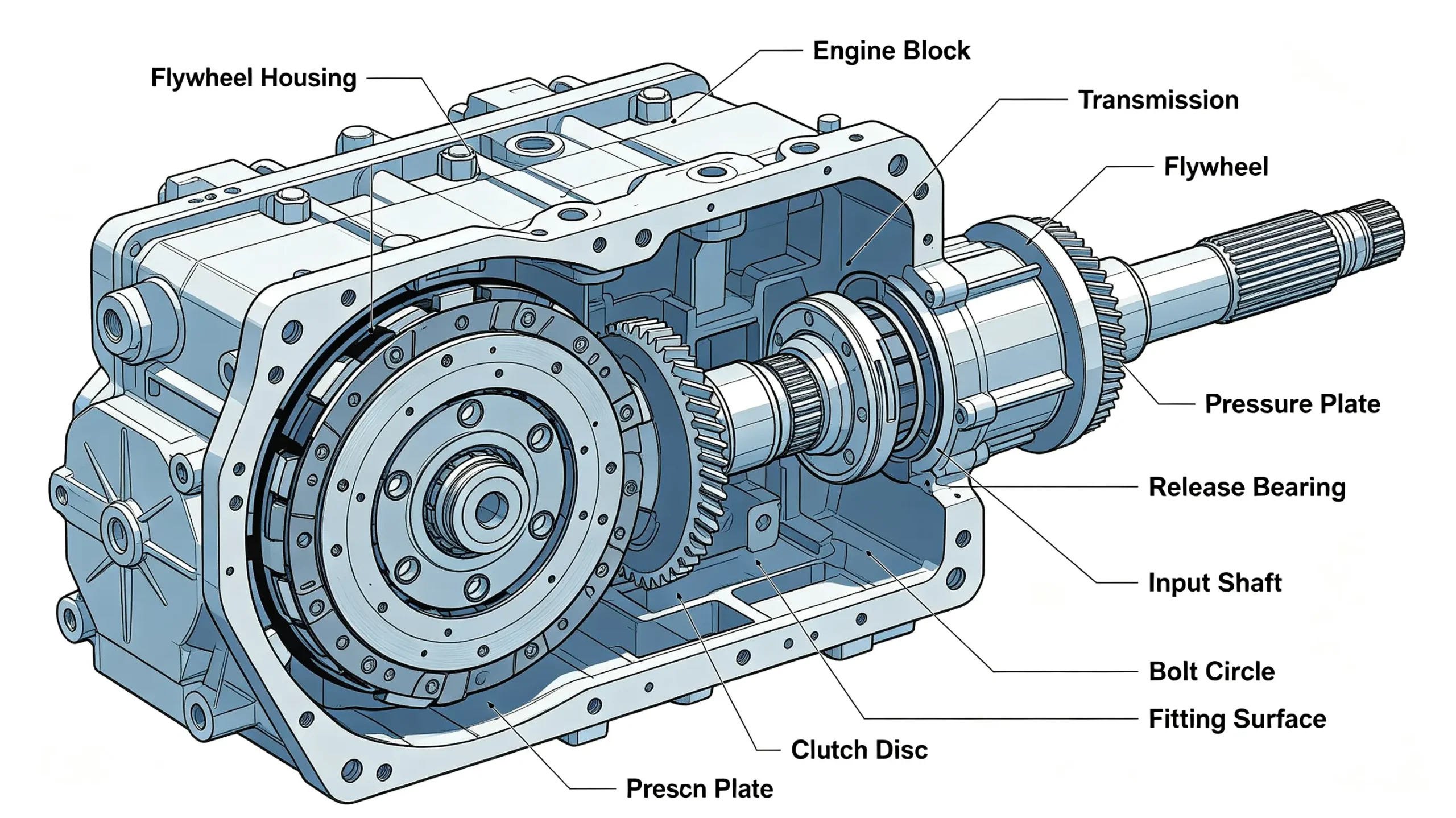
A flywheel housing, also known as a bell housing, is a thick cast metal shell installed at the rear end of the engine block. It covers and protects the engine flywheel, clutch disc, pressure plate, and release bearing assembly.
Unlike lightweight automotive housings, heavy-duty truck flywheel housings are designed for extreme load conditions. They feature thick wall structures, high rigidity, and strong anti-deformation performance.
In the overall powertrain layout, the flywheel housing is precisely sandwiched between the engine and the transmission. It serves as the fixed transition base for gearbox installation.
Without a qualified flywheel housing, the engine and transmission cannot maintain coaxial precision. Even brand-new clutch and transmission parts will wear out rapidly.
Different truck brands and engine models adopt exclusive flywheel housing sizes and bolt layouts. You can find model-matched powertrain components in our truck system parts catalog.
Core Functions of Heavy-Duty Flywheel Housing
Most buyers only recognize the flywheel housing as a simple protective cover. In fact, it undertakes multiple irreplaceable core tasks during vehicle operation.
Each function directly affects powertrain stability, part service life, and driving safety. The following sections break down its practical functions in detail.
1. Connect and Fix Engine and Transmission
The primary function of the flywheel housing is to connect the engine and transmission into a unified powertrain unit.
The front end of the housing is tightly fixed to the engine cylinder block. The rear mounting surface provides standard installation points for the gearbox assembly.
This integrated fixing structure avoids relative displacement between the two core components. It provides a stable foundation for power transmission.
2. Protect Flywheel and Clutch Internal Components
The flywheel and clutch assembly are high-speed rotating components. They are extremely vulnerable to external dust, sediment, and moisture.
The fully enclosed housing structure effectively isolates external pollutants. It prevents abrasive dust from entering the clutch friction area.
At the same time, it can block broken friction debris and avoid secondary damage to other chassis parts.
3. Ensure Powertrain Coaxiality and Alignment
Coaxiality is the key standard for normal powertrain operation. The flywheel housing strictly controls the concentricity between the engine crankshaft and transmission input shaft.
Precise alignment ensures smooth power transmission. It eliminates eccentric friction and offset vibration during operation.
Once the housing deforms, the entire powertrain will run off-center. This causes a series of continuous wear problems.
4. Reduce Vibration and Stabilize Drivetrain Operation
Heavy-duty trucks generate strong torsion and vibration during acceleration, deceleration, and gear shifting.
The high-rigidity cast structure of the flywheel housing can absorb and disperse partial powertrain vibration. It improves overall drivetrain stability.
Compared with thin stamping parts, thick cast housing effectively reduces resonance noise during high-speed driving.
5. Support Auxiliary System Installation
Most heavy-duty flywheel housings reserve standard mounting holes. These positions are used for installing speed sensors, clutch actuators, and engine accessories.
A complete housing structure ensures the normal installation and signal collection of auxiliary systems. It guarantees synchronized operation of the entire vehicle control system.
Common Materials for Heavy-Duty Flywheel Housings
Material quality directly determines the rigidity, shock resistance, and service life of the flywheel housing.
Unlike ordinary auto parts, heavy-duty truck flywheel housings rarely use lightweight aluminum alloys. They prioritize strength and fatigue resistance.
The following two material types dominate the commercial truck market, each with unique applicable scenarios.
1. High-Strength Cast Iron (Mainstream OEM Standard)
Most original factory flywheel housings adopt ductile cast iron materials. This material features high density, strong compression resistance, and excellent fatigue resistance.
It can withstand long-term high-torsion operation and frequent road impact. It is not easy to deform or crack under heavy-load conditions.
Cast iron housing also has good vibration damping performance. It effectively suppresses powertrain resonance.
For long-haul logistics trucks and general engineering vehicles, cast iron flywheel housing is the most reliable and cost-effective choice.
2. Reinforced Cast Steel (Heavy-Duty Enhanced Version)
Mining trucks, heavy construction vehicles, and overloaded transport trucks face harsher working conditions.
For these extreme scenarios, manufacturers adopt reinforced cast steel flywheel housings. The overall structural strength is significantly higher than cast iron.
Cast steel materials have stronger impact resistance and crack resistance. They can adapt to frequent bumpy roads and instantaneous impact loads.
Although the cost is higher, it greatly reduces the risk of shell rupture in harsh environments. You can view high-spec OEM and upgraded parts in our brand product center.
Key Structural Features of Qualified Flywheel Housings
When purchasing and replacing flywheel housings, appearance similarity cannot represent overall quality.
Professional buyers and technicians need to judge quality through core structural details. The following features are essential for qualified heavy-duty housings.
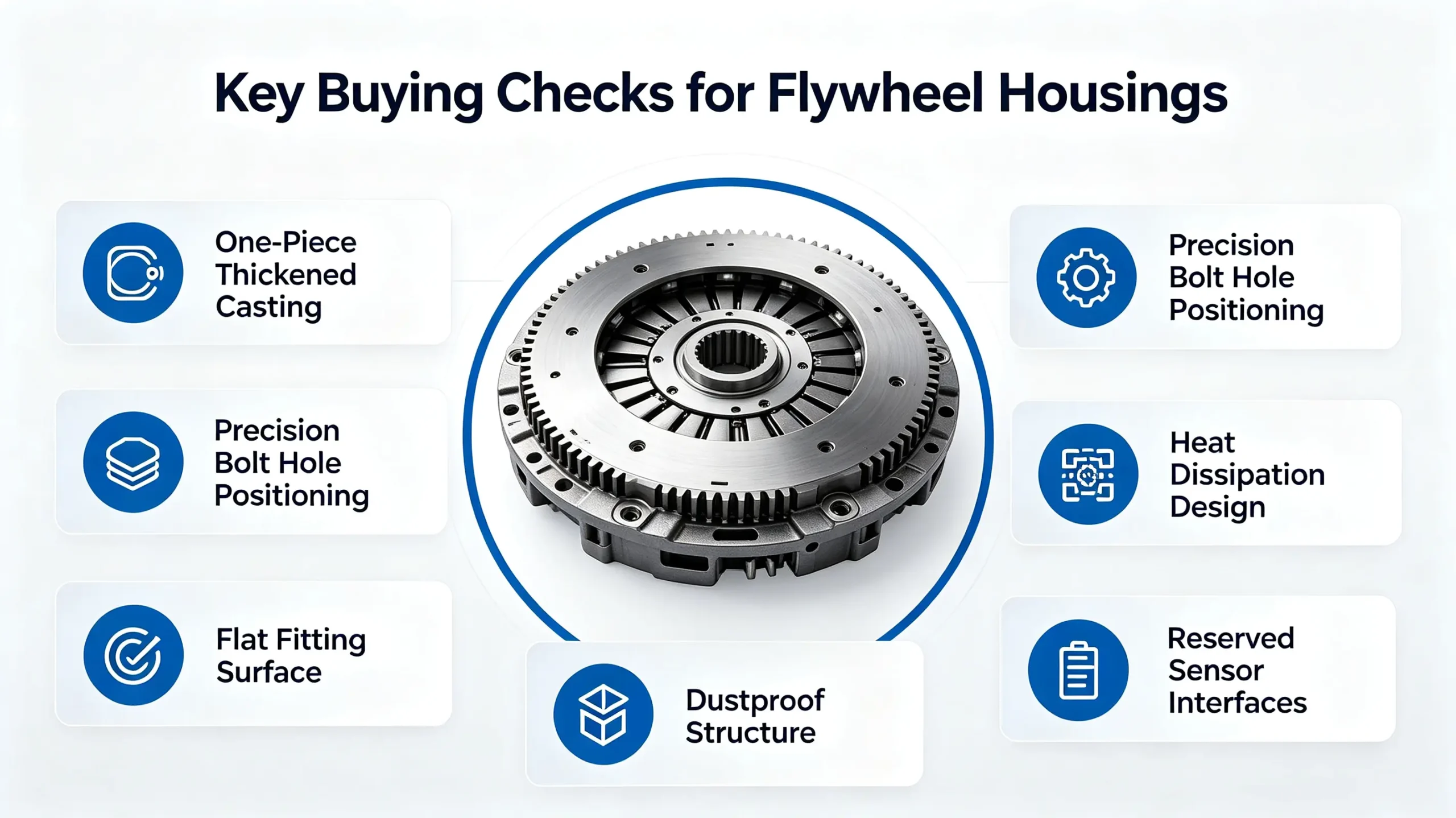
1. Integral Thickened Cast Structure
High-quality flywheel housings adopt integral one-piece casting. The wall thickness is uniform and meets factory standard parameters.
Inferior products use thin walls to reduce costs. They deform slightly under torsion, causing powertrain misalignment.
2. High-Precision Bolt Hole Positioning
All mounting holes must strictly follow OEM original data. Hole diameter, hole spacing, and verticality need zero deviation.
Inaccurate hole positions will cause forced assembly. Forced installation generates internal stress, leading to later deformation and cracking.
Precision drilling ensures flat and tight fitting between engine and transmission surfaces.
3. Smooth Fitting Surface Without Deformation
The front and rear fitting surfaces of qualified housings are finely machined. The flatness error is controlled within a tiny range.
Rough surfaces or warped planes will cause uneven clamping. This leads to oil leakage, air leakage, and vibration deviation.
4. Reasonable Heat Dissipation and Dustproof Design
Clutch friction generates massive heat during frequent shifting. Standard housings reserve scientific heat dissipation holes.
This design avoids excessive internal temperature accumulation. It prevents clutch friction plate thermal decay and aging.
Meanwhile, the dustproof structure blocks external sediment, balancing heat dissipation and protection performance.
5. Reserved Sensor and Accessories Interface
Modern heavy-duty trucks are equipped with intelligent speed sensors and clutch position sensors.
Qualified flywheel housings complete all reserved interfaces according to vehicle configuration. No secondary drilling or modification is required during installation.
Common Failure Symptoms of Faulty Flywheel Housing
Flywheel housing failure progresses slowly. Early symptoms are scattered and easy to misjudge as clutch or transmission faults.
Most fleet owners replace clutches and bearings repeatedly without solving the root problem. The fundamental reason is ignoring hidden housing deformation.
The following typical symptoms can help technicians quickly locate flywheel housing faults.
1. Persistent Clutch Jitter During Starting
If the vehicle always jitters obviously during start-up and gear engagement, and the clutch disc and pressure plate are intact, the housing may be deformed.
Deformed housing causes clutch assembly operation deviation. Friction contact is uneven, resulting in periodic jitter.
2. Abnormal Chassis Noise During Acceleration and Deceleration
When accelerating or decelerating, a dull collision or friction sound appears near the clutch position.
This phenomenon usually indicates loose housing or slight displacement. The powertrain produces abnormal friction during torsion changes.
3. Frequent Clutch Bearing Damage
If the release bearing is frequently damaged and worn in a short time, it is not necessarily a bearing quality problem.
Housing misalignment causes eccentric operation of the release bearing. Long-term offset friction leads to rapid failure.
4. Transmission Oil Leakage and Poor Sealing
Warped housing fitting surfaces cause insufficient sealing pressure. Oil leakage often occurs at the junction of engine and gearbox.
Repeated replacement of gaskets cannot solve the leakage problem fundamentally.
5. Visible Cracks and Deformation on Housing Surface
After long-term heavy load and impact, obvious cracks, deformation, or bolt hole tearing will appear on the housing surface.
These visible faults mean the housing has completely failed and must be replaced immediately.
6. Unstable Gear Shifting and Vague Gear Position
Housing deformation drives overall gearbox offset. It affects the stability of shift linkage and shift travel.
Drivers will feel loose gear levers, unclear gear engagement, and easy gear jumping during driving.
Root Causes of Flywheel Housing Premature Failure
Genuine standard flywheel housings can last for hundreds of thousands of kilometers. Most early failures are caused by external factors and improper operation.
Summarizing failure causes helps fleets standardize vehicle use and avoid repeated losses. For reliable part supply cases, check our customer cooperative cases.
1. Inferior Aftermarket Housing With Substandard Casting
Low-cost inferior housings use recycled cast materials. The internal density is insufficient, and rigidity is unqualified.
They are prone to micro-deformation under slight torsion. Hidden cracks will gradually expand during long-term operation.
2. Long-Term Overload Transportation
Overload is the main cause of powertrain torsion overload. Excessive cargo weight increases engine and transmission torsion pressure.
The flywheel housing bears extra bending and torsion load, resulting in fatigue deformation and cracking.
3. Frequent Severe Road Impact
Driving on mountain roads, construction roads, and muddy roads brings continuous chassis impact.
Instant impact force is transmitted to the powertrain. The rigid flywheel housing bears concentrated stress, causing local cracking.
4. Non-Standard Disassembly and Installation
Asymmetric bolt tightening, random tool prying, and uneven force during installation will cause artificial housing deformation.
Many new parts fail quickly simply because of unstandardized installation processes.
5. Long-Term Clutch Abnormal Friction
Improper driving habits such as half-clutch driving cause continuous high-temperature friction.
Long-term high temperature causes thermal deformation of the housing. It destroys the original flatness and coaxiality.
6. Bolt Loosening and Long-Term Vibration
Long-term vehicle vibration may cause fixing bolts to loosen slightly.
Loose bolts lead to uneven stress on the housing. Continuous vibration amplifies tiny deformation and finally causes structural failure.
Step-by-Step Fault Diagnosis for Flywheel Housing
Accurate diagnosis can avoid blind replacement of clutches and bearings. The following standardized steps help technicians quickly confirm housing faults.
Step 1: Overall Visual Inspection
Clean the housing surface thoroughly. Observe for visible cracks, deformation, oil leakage traces, and bolt hole damage.
Check whether the heat dissipation holes are blocked and whether the sealing surface is warped.
Step 2: Bolt Looseness Inspection
Inspect all fixing bolts one by one. Confirm no looseness, missing bolts, or sliding threads.
Loose bolts are the most common inducement of abnormal vibration.
Step 3: Clutch Operating State Test
Start the engine and test clutch engagement and disengagement.
Persistent jitter, stuck clutch, and abnormal friction sound all indicate possible housing misalignment.
Step 4: Powertrain Offset Detection
Observe the fitting gap between engine and transmission. Check for unilateral gap deviation.
Uneven gap directly proves housing deformation and powertrain offset.
Step 5: Road Test Verification
Carry out actual road test. Test acceleration, deceleration, and gear shifting status.
Summarize vibration and noise rules to confirm fault severity and replacement necessity.
Standard Flywheel Housing Replacement Installation Steps
Standard installation directly determines the service life of new housings. Non-standard operation will cause brand-new parts to fail early.
The following is the official standardized replacement process for heavy-duty truck flywheel housings.
Pre-Installation Preparation
Prepare model-matched flywheel housing, standard bolt sets, gaskets, cleaning tools, and lifting equipment.
Confirm part OEM numbers to avoid model mismatch. For professional part matching support, you can always contact our team.
Step 1: Vehicle Safety Fixing
Park the truck on flat ground. Tighten the parking brake and block the tires.
Lift the vehicle steadily with professional lifting equipment to ensure stable operation space.
Step 2: Dismantle Auxiliary Accessories
Remove the transmission assembly first. Then disassemble clutch accessories, sensors, and connecting lines.
Sort out all removed parts to avoid loss and wrong installation.
Step 3: Remove Old Flywheel Housing
Loosen the fixing bolts in diagonal sequence. Remove the old housing slowly and evenly.
Do not pry violently to prevent engine fitting surface damage.
Step 4: Clean Fitting Surface Thoroughly
Clean all residual gaskets, oil dirt, rust, and debris on the engine fitting surface.
Ensure the installation plane is flat, clean, and free of sundries.
Step 5: Install New Flywheel Housing
Place the new housing in the standard position. Align all bolt holes accurately.
Install standard gaskets to ensure overall sealing performance.
Step 6: Symmetrical Bolt Tightening
Tighten bolts in diagonal cross sequence gradually. Do not tighten single bolt fully at one time.
Ensure uniform stress on the housing to avoid artificial deformation.
Step 7: Refit Transmission and Accessories
Reinstall the transmission assembly, sensors, and auxiliary parts in reverse order.
Check all interfaces and fixing points to ensure complete installation.
Step 8: Test Run and Fault Confirmation
Start the engine for idling test. Observe vibration and noise changes.
Carry out road test to confirm clutch operation and powertrain stability.
Common Installation Errors to Avoid
Many maintenance teams have fixed wrong operation habits. These small errors lead to repeated failures.
First, avoid using non-standard bolts. Low-strength bolts loosen easily under long-term vibration.
Second, avoid one-side excessive tightening. Uneven force is the main cause of housing deformation.
Third, do not omit sealing gaskets. Missing gaskets will cause oil leakage and dust invasion.
Fourth, do not install with dirt remaining. Residual sundries will cause uneven fitting and hidden stress.
Professional Maintenance Tips to Extend Flywheel Housing Life
Scientific daily maintenance can effectively delay aging and deformation, reducing fleet overall maintenance costs.
1. Regular Visual Inspection in Daily Maintenance
Check the flywheel housing status every routine maintenance. Focus on cracks, oil leakage, and bolt looseness.
Early inspection can eliminate hidden dangers before major faults occur.
2. Avoid Long-Term Overload and Violent Driving
Standardize cargo loading to avoid over-limit operation. Train drivers to shift gears smoothly.
Reduce frequent sharp acceleration and deceleration to lower powertrain torsion load.
3. Timely Clean Surface Dust and Oil Dirt
Long-term accumulated oil dirt will corrode the housing surface and block heat dissipation holes.
Regular cleaning ensures good heat dissipation and avoids local high-temperature deformation.
4. Repair Clutch Abnormalities in Time
Once clutch jitter, slipping, and abnormal friction are found, repair immediately.
Avoid long-term abnormal friction causing housing thermal deformation.
5. Regular Bolt Torque Inspection
Check housing fixing bolt torque regularly. Supplement and tighten loose bolts in time.
Keep overall stress balance of the powertrain connection surface.
OEM vs Aftermarket Flywheel Housing: Full Comparison
Fleet buyers often face selection confusion between original and aftermarket parts. The two types have obvious differences in performance and cost.
OEM Original Flywheel Housing
OEM parts adopt factory-standard casting materials and precision machining.
The flatness, coaxiality, and structural strength fully meet vehicle design standards.
The service life is long, and the stability is extremely high. It is suitable for high-end fleets and vehicle warranty maintenance.
The only disadvantage is the relatively high unit price.
High-Quality Aftermarket Housing
Regular qualified aftermarket parts adopt upgraded casting processes.
The overall performance is close to OEM standards, with higher cost performance.
It is the best choice for daily batch replacement of ordinary logistics fleets.
Inferior Low-Cost Housing
Ultra-low-price products cut corners seriously. The material density is insufficient, and precision is poor.
Deformation and cracking often occur in a short time. It will induce a variety of secondary faults.
It is strongly not recommended for any heavy-duty commercial vehicle.
Frequently Asked Questions About Flywheel Housing
Q1: Can a slightly cracked flywheel housing continue to be used?
No. Tiny cracks will expand rapidly under vibration and torsion. It may cause housing rupture and powertrain failure during driving.
Q2: What is the main difference between bell housing and flywheel housing?
They are the same component with different names. Bell housing is the common foreign term, while flywheel housing is the mainstream domestic definition.
Q3: Will housing deformation cause gearbox damage?
Yes. Long-term misalignment will cause input shaft eccentric wear, bearing damage, and even gearbox shell cracking.
Q4: How long does a heavy-duty flywheel housing last?
High-quality standard products can last 300,000 to 500,000 kilometers. Harsh working conditions will shorten the service life significantly.
Q5: Is flywheel housing replacement a high-difficulty maintenance project?
The disassembly process is complex, but the core difficulty lies in flat installation and symmetrical tightening. Standard operation ensures long-term stability.
Final Buyer Guide Summary
The flywheel housing is the core connecting component of engine and transmission. It undertakes positioning, protection, shock absorption, and stable connection functions.
Although it is not a vulnerable part, its structural stability determines the overall service life of the powertrain system.
For fleet buyers, selecting high-rigidity, high-precision standard housing can effectively reduce clutch, bearing, and transmission failure rates.
Matching scientific installation and daily maintenance can maximize part utilization and reduce comprehensive fleet operating costs.
For more heavy-duty truck professional guides and high-quality parts resources, visit our official website homepage.
To learn about our brand strength and global supply system, browse our about us page.


