
Compare truck emission standards worldwide: Euro 6 vs Euro 5, EPA vs Euro, China VI, BS VI and Japan PNLT. Learn which standard applies in your country.
The plate follows the registration market, not the badge on the grille. That rule of thumb settles most questions about truck emission standards, and this guide also shows the points where it stops working.
Which Emission Standard Applies? Let the Registration Country Decide
The country where a truck is titled, fuelled and inspected sets its emission tier. That is why one chassis can leave the same assembly line with three different aftertreatment packages, each built for a different destination.
If you are asking which emission standard for my country applies to a new unit, start with the registration authority, not the manufacturer’s brochure. The authority decides what paperwork it accepts, and the paperwork is tied to a specific certificate and model year.
Most markets map onto one of five regimes: Euro VI in the EU and many markets that copy it, US EPA 2010 rules, China VI, Bharat Stage VI in India, and Japan’s Post New Long-Term (PNLT) rules. Others sit a tier or two behind, usually Euro IV or Euro V.
The rule has a second half. A truck can be legal where it is registered and still be refused at a border, a low-emission zone or a port. If a unit will ever cross a line, the stricter side decides.
You can browse the truck categories to see how tractors, tippers and cargo bodies are grouped before you pick a tier. The four situations where the plate rule fails come later in this guide.
What Are the Different Truck Emission Standards, and Why Don’t They Line Up?
Five rulebooks matter in practice. They differ less in headline limit values than in the test cycle, the durability window and the way in-service checks are run, so a limit printed on a spec sheet cannot be compared across regions without context.
| Regime | Region | Headline NOx approach | Test basis | Typical durability focus |
|---|---|---|---|---|
| Euro VI | EU and followers | About 0.4 g/kWh on the steady-state cycle | WHSC and WHTC plus on-road PEMS | Long, with in-service conformity checks |
| EPA 2010 and the 2027 step | United States | 0.20 g/bhp-hr now, a much lower figure from model year 2027 | FTP and supplemental cycles | Mileage-based useful life, lengthened in the 2027 rule |
| China VIb | China | Close to Euro VI levels | WHSC, WHTC and PEMS | Long, with remote OBD monitoring |
| Bharat Stage VI | India | Modelled on Euro VI | WHSC and WHTC | Similar to Euro VI |
| Japan PNLT | Japan | Strict, with its own cycle | JE05 transient mode | Mileage-based, national OBD rules |
The takeaway: compare tiers by test method and durability, not by the single NOx number.
Similar limits, different test cycles
Steady-state and transient cycles, cold-start weighting and payload assumptions all change the figure an engine must hit. An engine that passes one cycle comfortably can struggle on another because its exhaust runs cooler at low load, and SCR needs heat to work.
Durability windows and in-service testing
How long an engine must stay compliant, and who tests it after sale, separates regimes more sharply than the NOx ceiling. Euro VI and China VI use on-road testing of trucks already in service. Treat the headline figure as an entry ticket, not a guarantee of year-five behavior. Further background articles sit in the knowledge base.
Euro 6 vs Euro 5 Trucks: What Actually Changes Behind the Cab?
Euro 6 cuts the NOx ceiling by roughly a factor of five against Euro 5 and adds particle-number and ammonia limits. In practice that puts selective catalytic reduction (SCR), a diesel particulate filter (DPF) and closed-loop urea dosing on essentially every truck.
Euro 5 engines often met their limits with SCR alone or with exhaust gas recirculation, and many carried no particulate filter. Euro 6 needs the full chain, which adds weight, packaging volume behind the cab and a heavier cooling load.
The balance sheet is easiest to read side by side.
| Advantages of Euro 6 | Limitations of Euro 6 |
|---|---|
| Access to low-emission zones and the widest range of border crossings | Higher purchase cost and a heavier aftertreatment package |
| Far lower NOx and particulate output, with on-board monitoring | More consumables: urea, filter cleaning, sensors |
| Better resale prospects in markets that keep tightening | Sensitive to poor fuel and poor urea |
| Newer engines often claim better fuel economy | Short-trip, low-load duty can cause filter regeneration problems |
The practical advice: if a truck will work in an Euro VI market or cross into one, Euro 5 is a short-lived saving. Where neither is true and fuel quality is poor, a simpler tier can be the sounder operational choice.
EPA vs Euro Truck Emissions Requirements: What Really Differs?
The ambition is similar and the paperwork is separate. EPA and Europe each run their own certification, test procedures, durability mileage and label, so a Euro 6 type approval earns nothing toward an EPA certificate.
Does an engine certified in one system pass in the other?
No. Each regulator certifies an engine family against its own cycles and issues its own paperwork. The hardware may look alike, but calibration, diagnostics and documentation are built for one rulebook.
How do the regulators measure compliance?
The EPA certifies engines on a dynamometer and expresses limits per brake horsepower-hour. The EU uses kilowatt-hours and adds on-road PEMS testing. The unit difference alone makes spec-sheet comparisons misleading.
What about durability?
The EPA ties useful life to miles and extended it for the heaviest class in its 2027 rule. Euro VI sets useful life by distance and years, with longer values for heavier categories. Check the current regulatory text before you rely on any number.
Why does this matter when buying?
A unit built for the US cannot simply be re-plated in Europe, or the reverse. Chassis, labeling, diagnostics and even the weights-and-dimensions envelope differ. The about us page explains who we are, and the customer service page covers how to raise spec questions before an order.
Where the Rule of Thumb Breaks: Used Imports, Retrofits and Parallel Markets
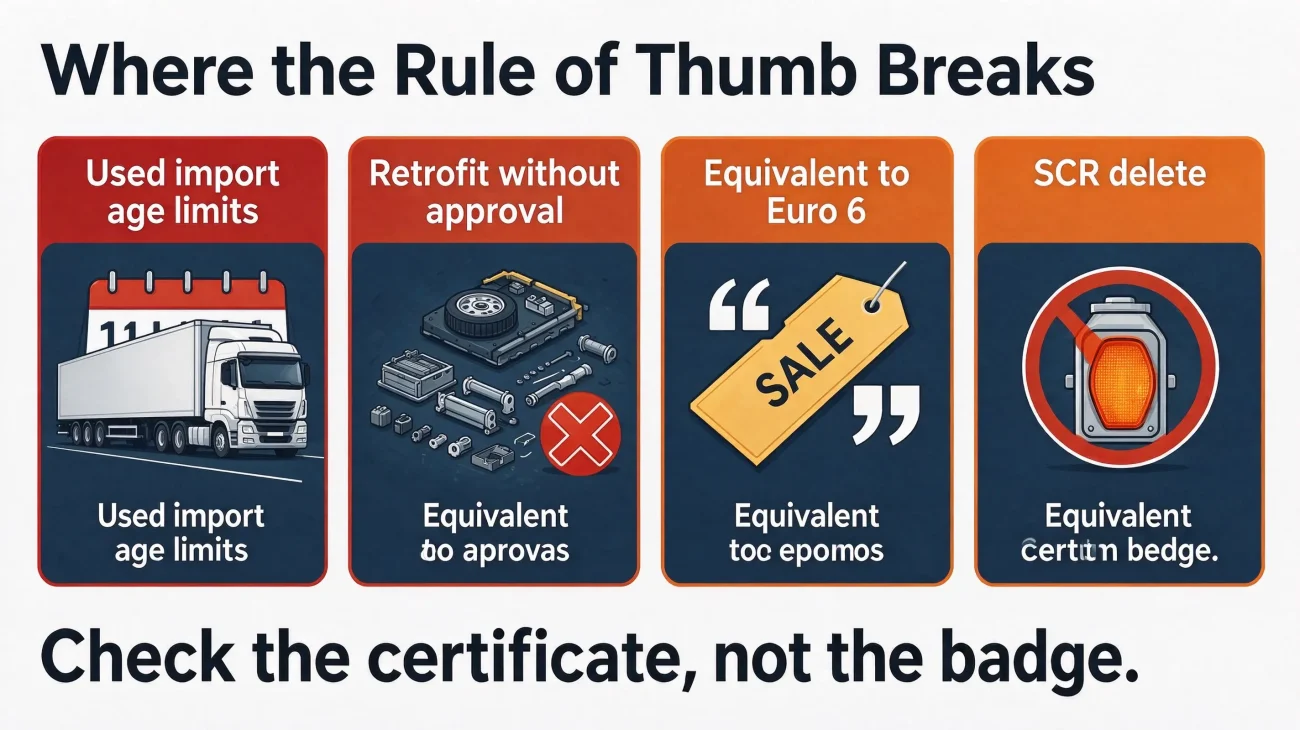
The registration-country rule fails at four points: import bans keyed to first-registration date, retrofit claims that cover the engine but not the approval, “equivalent to Euro 6” badges, and engines whose urea function has been switched off. Each is a common mistake with a cost.
Mistake one: assuming a used truck takes the tier of its new home. Many countries limit used imports by age or by the tier the truck was first registered under. A relatively young unit from a strict market can be refused where an older one from a lenient market is accepted. Check the rule on first-registration date before you buy.
Mistake two: trusting a retrofit to fix the paperwork. A retrofit filter or SCR kit may reduce emissions, but the approval belongs to the vehicle type. Unless the authority recognises the retrofit, the plate is unchanged. Ask for the recognition in writing.
Mistake three: accepting “equivalent to Euro 6”. Equivalence is a sales phrase, not a certificate. Ask for the type-approval documents and the model year.
Mistake four: buying a truck with a deleted SCR system. Switching off urea dosing leaves the engine non-compliant and often voids its approval. Restoring it typically means new sensors, software and sometimes a new catalyst, and the result may still not be accepted. Walk away unless the full repair is documented.
Parallel markets, where vehicles are re-routed between countries, add the same risk. The certificate has to match the unit, not the nameplate.
How Much Does a Higher Tier Cost Over Five Years?
The purchase premium is the smallest line. Urea consumption, filter servicing, fuel sulphur sensitivity and resale value move the five-year total by more than the sticker difference does.
The usual rule in this trade is that urea runs at roughly 3 to 6 percent of diesel consumption on an SCR engine, depending on load and calibration. On a high-mileage tractor that is a meaningful annual volume, and it grows with the distance driven.
Filter care is the second line. A DPF generally needs periodic cleaning or replacement, with intervals set by duty cycle, oil quality and how often regeneration completes. Urban stop-start work shortens intervals, while steady highway running extends them.
Fuel is the third. High-sulphur diesel can poison catalysts and clog filters, so an expensive repair can follow a cheap tank. Plan the fuel route, not just the truck.
Resale is the fourth, and it works in the higher tier’s favour. A unit built for a strict market keeps a wider pool of buyers, while a lower-tier unit can lose value fast when a market tightens. On the other side, extra aftertreatment mass can reduce payload where weights are capped.
Model these four lines for your own duty cycle. If you want help framing them, contact the team with your route and load profile.
How to Choose a Tier for a Mixed Fleet
Spec to the strictest market any unit will ever be registered in, then split the fleet by duty instead of compromising every truck on one package. Cross-border units take the top tier, and captive units take what their own market allows.
Five criteria usually decide the split.
Border exposure. If a truck might cross into a stricter market even once a year, buy for that market. Retrofitting later is costlier than specifying correctly.
Access rules. Low-emission zones and port restrictions can lock out lower tiers from the most profitable routes. Map them against your contracts.
Fuel and urea availability. A top-tier engine on unreliable fuel is a liability. Match the tier to what the route can supply.
Service support. A workshop that cannot diagnose aftertreatment faults will turn small problems into downtime. Check parts and software coverage.
Residual plans. If units will be resold into a stricter market, the higher tier protects value. If they will run to scrap in one country, it matters less.
Rule of thumb: pick one tier for all units that could cross a border, and a separate tier for units that never will. Do not average the two.
What to Verify Before You Commit to a Spec
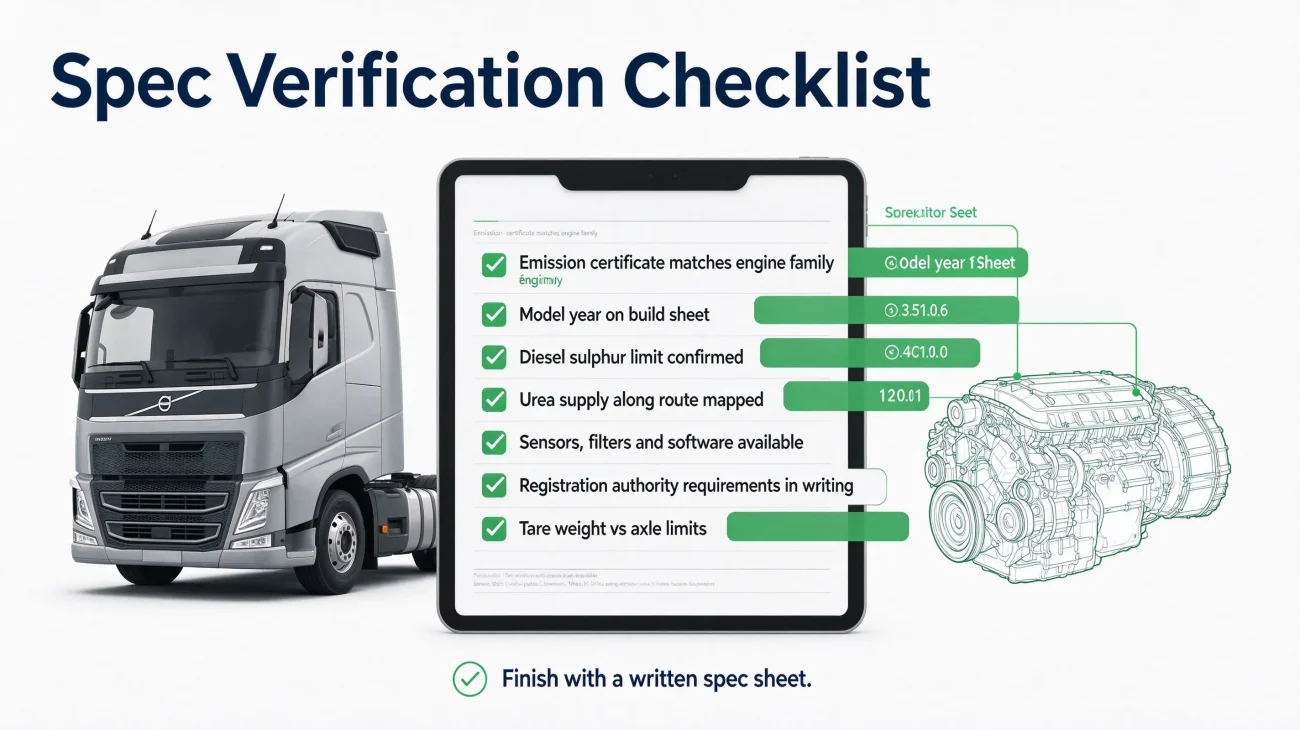
Five checks settle it: certificate and model-year match, the sulphur ceiling of the fuel you can actually buy, urea supply along the route, aftertreatment parts coverage, and the registration route in the destination market. Work through them in this order.
- Request the emission certificate and confirm it matches the engine family and model year on the build sheet.
- Check the maximum sulphur content of diesel on your routes and compare it with the engine maker’s limit.
- Map urea points along every regular route, including winter conditions where freezing affects storage.
- Confirm that the dealer or workshop stocks sensors, filters and catalysts and can read the diagnostic software.
- Ask the registration authority in writing which documents it needs and which tier it accepts for the unit’s age.
- Compare the weights-and-dimensions envelope, including tare weight, with your legal axle and gross limits.
The sixth point is easy to forget. The extra aftertreatment hardware adds mass, and mass reduces payload where limits are fixed.
Finish with a short written spec sheet that lists the tier, the certificate reference and the fuel assumption. Examples of how others have documented specs appear in the cooperation cases.
Three Operating Profiles and the Tier Each One Needs
A fleet manager running trailers between two countries has a different problem from one running parcel vans through a city centre. Three profiles cover most buying decisions.
Long-haul and cross-border
Long-haul units crossing borders need the highest tier they will ever enter. These operators need predictable access, plain paperwork and fuel they can trust. Look for a full Euro VI-class package, reliable urea supply along the corridor and a diagnostic system that dealers in each country can read.
Urban distribution
Urban distribution buys the newest tier for access rights rather than for air quality. Zone rules can ban lower tiers outright. These fleets need low-speed filter management, because short trips cool the exhaust and can prevent regeneration. Check that regeneration strategy and the cleaning interval before you order.
Site and construction work
Site and construction fleets can often stay a tier lower without losing a permit, as long as the trucks never leave the site’s regulatory area. They need robustness, simple servicing and tolerance for variable fuel. Look for a tier the local workshop can actually maintain.
One caution applies to all three. A site tipper that gets sold or reassigned to a stricter market later will carry its original tier with it. If that is plausible, spec higher now and accept the small premium as insurance.
Fuel Quality and AdBlue Discipline Decide Whether Compliance Holds
An SCR engine is only as clean as the fluid it burns. Sulphur content and urea quality determine whether a truck is still compliant in year three, whatever the certificate says.
A view commonly voiced by workshop leads is that most aftertreatment failures begin at the fuel pump or the urea can, not on the assembly line. That fits what the hardware does. Sulphur poisons catalysts, and contaminated urea crystallises in injectors and sensors.
Diesel exhaust fluid (DEF), sold in Europe as AdBlue, is a 32.5 percent urea solution made to ISO 22241. It freezes at roughly minus 11 degrees Celsius, so cold-climate trucks need heated tanks and lines. It also degrades with heat and long storage, so old stock is a risk.
Discipline is mostly habit. Buy urea from sealed, traceable containers and avoid topping up from open drums. Keep the filler cap clean. Use the diesel grade the engine maker specifies, and keep fuel receipts when a warranty claim is possible.
Driver behaviour matters too. Ignoring dashboard warnings can trigger power derating, and defeating the system leads to a non-compliant truck. Train drivers to treat an urea warning like an oil-pressure warning.
Where fuel quality cannot be controlled, a lower tier with a simpler system may serve better than a top-tier engine running outside its design window.
One Tractor, Two Markets: A Worked Spec Comparison
The same 4×2 tractor built for a Euro VI market and for a market a tier lower diverges in tank volume, tare weight, cooling pack and price. Only some of those differences can be reversed later.
Take two generic units. The Euro VI version carries a larger urea tank, a DPF and SCR canister mounted along the frame, and a bigger radiator package for the extra heat. That adds weight over the front and rear axles.
The lower-tier version carries a smaller aftertreatment package, a lighter cooling pack and often a simpler wiring harness. Its tare weight is lower, so it can carry a little more payload under the same gross limit.
Geometry also changes legal loading. Wheelbase and kingpin-to-rear-axle distance shift axle loading under the US Federal Bridge Formula, and EU limits under Council Directive 96/53/EC cap what the extra aftertreatment mass costs you in payload. Air suspension and load equalization help distribute weight, but they do not remove the cap.
What can be reversed? Software, tank size and some cooling parts can sometimes be changed. The engine family, the certificate and the frame layout cannot.
The lesson is to decide the destination before the build order. Changing it after production is the expensive route. For help matching a chassis to your market, visit the main site.
The Vocabulary That Decides the Spec
Eight terms carry most of the weight in a negotiation, and each one changes what you can register where. Knowing them keeps a supplier’s quote honest.
- WHSC — the World Harmonized Stationary Cycle, a steady-state engine test used for Euro VI and similar regimes.
- WHTC — the World Harmonized Transient Cycle, a dynamic test that includes cold and hot starts.
- DPF — a diesel particulate filter that traps soot and controls particle number (PN), the count of particles per kilowatt-hour.
- SCR — selective catalytic reduction, which uses urea to turn NOx into nitrogen and water.
- DEF — diesel exhaust fluid, the 32.5 percent urea solution sold as AdBlue in Europe.
- OBD — on-board diagnostics, the system that monitors emission hardware and triggers warnings or derating.
- Durability period — the distance or time an engine must stay compliant under the regulation.
- GVWR — gross vehicle weight rating, the maximum loaded weight the manufacturer allows for the vehicle.
Ask each supplier to state these in writing for the exact unit. Vague answers on durability or certificate scope are a warning sign.
FAQ
Can a Euro 5 truck still be registered in the EU?
Generally not as a new unit, since new registrations must meet Euro VI. Used Euro 5 trucks already registered may remain on the road, but zone rules and national policies can restrict them. Check the rules of the specific country and city.
Does a Euro 6 truck satisfy EPA rules?
No. The EPA requires its own certification and label, and a Euro 6 approval does not transfer. Plan the build for the regulator whose plate it will carry.
Can urea function be restored after a delete?
Sometimes, but not reliably. Restoration usually needs new sensors, software and possibly a catalyst, and the authority may still reject the unit. Treat a deleted truck as a repair project, not a finished vehicle.
Is AdBlue quality the same everywhere?
No. The ISO 22241 standard defines it, but local suppliers vary in compliance and storage. Buy sealed, labelled containers from reputable outlets.
How long does a particulate filter last?
Typically several hundred thousand kilometres under steady duty, though intervals vary widely. Stop-start work, poor oil and failed regeneration shorten life.
Does a higher tier reduce the GVWR I can plate?
Not directly, since the rating comes from axles and chassis. The extra aftertreatment mass reduces payload within the same gross limit.
The Decision, in One Line
Buy the tier of the strictest market you will ever register in, and budget for fluids and filters rather than for the badge. That rule covers most cases, and the exceptions are the ones in this guide: used imports, retrofits, loose equivalence claims and tampered systems.
Your next step is simple. Write down every country, zone and port a unit might enter during its life, then ask your supplier for the certificate that covers that list.


