
Why is your diesel engine hard to start? Learn how to diagnose diesel engine problems in order, which diagnostic tools to use, and when to repair or replace.
A technician replaced all four injectors on a hard-starting engine, and it still cranked without catching because air was entering upstream of the lift pump.
That story repeats in workshops everywhere, and it shows why a fixed order matters more than good instincts. This guide covers the common diesel engine problems and solutions that account for most downtime. It sets out a diagnostic sequence, the tools that make each check meaningful, and the criteria for choosing between repair, rebuild and replacement. If you already know the basics, treat it as a working reference for the next stubborn engine.
Why Is My Diesel Engine Hard to Start? Where the Usual Diagnosis Stops Too Early
A diesel engine that is hard to start is missing at least one of four things: enough cranking speed, fuel at the right pressure, enough compression, or enough heat. Most misdiagnoses happen because the first plausible fault gets fixed and the rest of the chain is never checked.
Start by sorting the complaint. A cold-start failure points toward glow plugs, intake heaters, thin battery capacity, thick oil or marginal compression. A warm-start failure leans toward fuel problems such as a leaking check valve, a failing injector, a heat-soaked sensor or a weak high-pressure pump.
Then separate cranking speed from combustion. If the engine turns slowly, the fault is electrical or mechanical, and no amount of fuel work will cure it. If it spins briskly but never fires, the fault sits in fuel delivery, timing or compression.
Typical cranking speed for a healthy engine is roughly 150 to 250 rpm, depending on displacement and starter design. A sluggish crank suggests voltage drop, not a fuel problem. A crisp crank with no start suggests the opposite.
Notice what each branch rules out. Fast cranking with white vapour from the exhaust means fuel is arriving but not igniting, which points toward low compression, poor heat or badly timed injection. Fast cranking with clean, dry exhaust means little or no fuel is arriving at all.
The usual diagnosis stops early because it tests the component that is easiest to reach. Injectors and pumps are visible and replaceable, so they get blamed first. The sections below put them in their proper place: after the cheap, reversible checks.
A Diesel Engine Troubleshooting Guide: How to Diagnose Diesel Engine Problems in Order
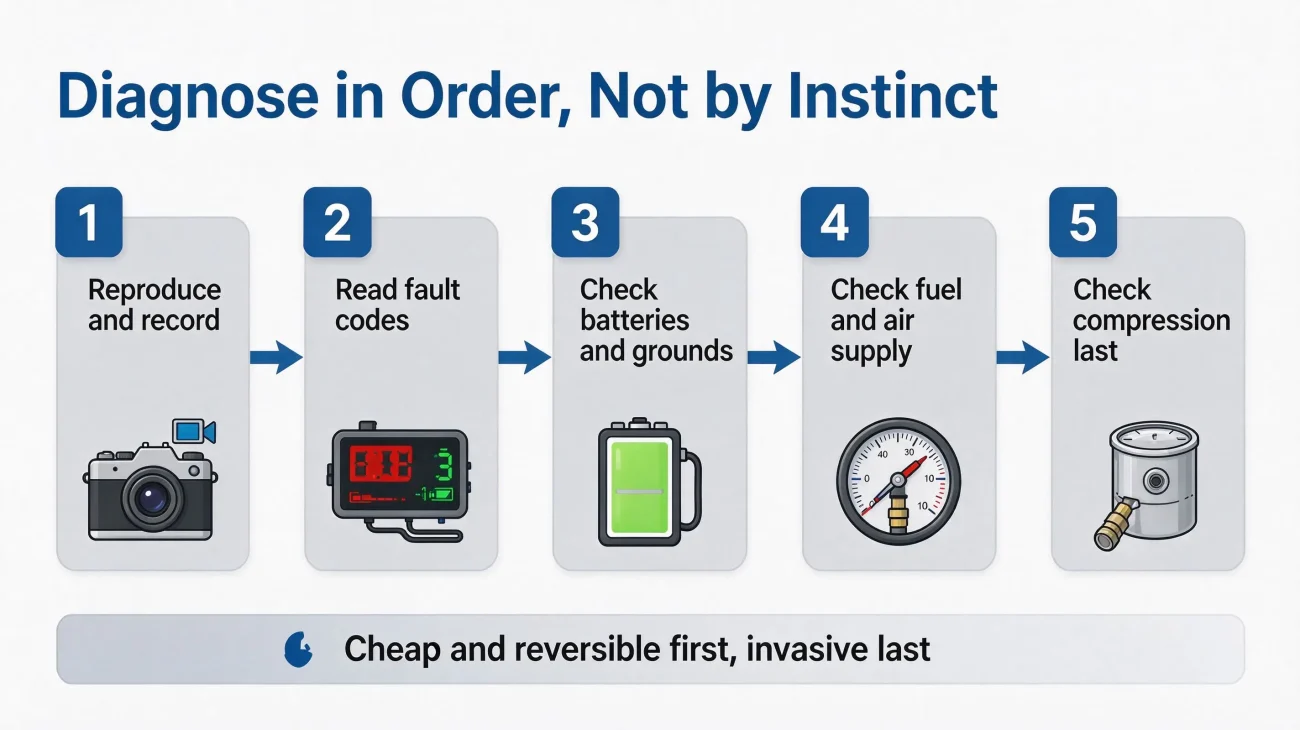
The principle is simple: work from the cheapest, most reversible check to the most invasive one, and confirm each result before moving on. Skipping ahead feels efficient, but it usually produces a second fault on top of the first. For deeper background reading, the knowledge base covers related fundamentals.
The sequence below suits most engines, from mechanically injected units to common rail systems.
- Verify the complaint and the conditions: reproduce the fault, note whether the engine is hot or cold, and record fuel level, recent filter or fuel changes and any warning lamps.
- Pull fault codes and freeze-frame data, and write them down before clearing anything.
- Check batteries, cables and grounds under cranking load, since a voltage drop here distorts every later reading.
- Check fuel supply first, including tank pickup, filters, lift pump pressure and air in the lines, then check air supply, including the filter, intake path and boost hoses.
- Check compression and cylinder leakage last, once supply and electrical faults are excluded.
The order reflects cost and risk. Reading codes takes minutes and changes nothing, while a compression test means removing injectors or glow plugs and carries its own risks.
One habit saves hours: after each step, state what the result rules in and out. If a result contradicts the symptom, stop and recheck the previous step instead of pressing on. A good result at step three, for example, does not excuse a sloppy reading at step four.
Diesel Engine Diagnostic Tools List: What Each Tool Tells You
A scan tool is necessary but never sufficient, because codes point to circuits and not to root causes. A rail pressure code, for instance, can come from a weak pump, a leaking injector, a restricted filter or a bad sensor. The question to ask of any tool is what it answers and how it can mislead you.
Cheap tools used well often beat expensive tools used loosely. A mechanical fuel pressure gauge costs little and settles arguments that a scan tool cannot.
| Tool | Question it answers | Common way it misleads | Best used at |
|---|---|---|---|
| Scan tool and live data | What does the ECU see and command? | Codes describe a circuit, not the failed part | Start of every job |
| Multimeter and oscilloscope | Is the signal or voltage real and clean? | Static readings hide intermittent drops | Electrical and sensor checks |
| Fuel pressure and return-flow gauges | Is supply adequate and are injectors leaking? | Wrong test point gives a false pass | Fuel system isolation |
| Compression and cylinder leakage testers | Does each cylinder seal? | Low cranking speed lowers readings | After supply is cleared |
| Smoke meter and boost gauge | Is combustion clean and is boost on target? | Readings depend on load and temperature | Power and smoke complaints |
| Borescope | What is the internal condition? | Limited view of liner walls and ring lands | Before teardown decisions |
The takeaway is that each tool narrows a question, and none replaces a sequence. Fleet owners comparing equipment for a workshop can start with the gauges and meters, then add scan capability matched to the engine families they run. Our home page shows the vehicle range that these tools typically support.
Common Diesel Engine Problems and Solutions in the Fuel System
Contamination, air ingress and worn injection components cause a large share of no-start and rough-running complaints. The low-pressure side deserves suspicion first, because it is cheaper to test and fails more often than the high-pressure side.
Water, microbial growth and clogged filters
Water enters through condensation, poor storage or damaged caps. Once it sits at the bottom of a tank, microbial growth can form a slime that blocks pickups and loads filters quickly. The fix is to drain the water separator, clean or replace the filters, and address the tank itself if contamination is heavy.
Vehicles that sit for long periods, including units shipped by Ro-Ro or assembled from SKD and CKD kits, are especially exposed to stale fuel and condensation. Fresh fuel and new filters at commissioning prevent many early complaints.
Lift pump, check valve and air ingress
A failing lift pump gives weak supply under load, while a leaking check valve lets fuel drain back and causes long cranking after a rest. Air entering through a cracked line, loose banjo bolt or tired seal produces the exact symptom from the opening example. Clear tubing at the filter head quickly shows whether bubbles are present.
As a hedged sanity check, mechanical lift pumps commonly deliver only a few psi at cranking, while electric supply pumps are often in the range of roughly 5 to 15 psi. Common rail systems typically need a few hundred bar at cranking to start. Always compare against the manufacturer specification for the engine in front of you.
Injector balance and return flow
Injector balance rates from live data and return-flow tests identify the leaking or lazy unit without removing it. Compare each cylinder against its neighbours instead of chasing an absolute number.
Warning: replacing high-pressure pumps or injectors before ruling out low-pressure supply faults is expensive and often fails. A starved high-pressure pump can wear quickly, and new parts then inherit the same problem.
What Causes Black Smoke, Low Power and Surging Under Load?
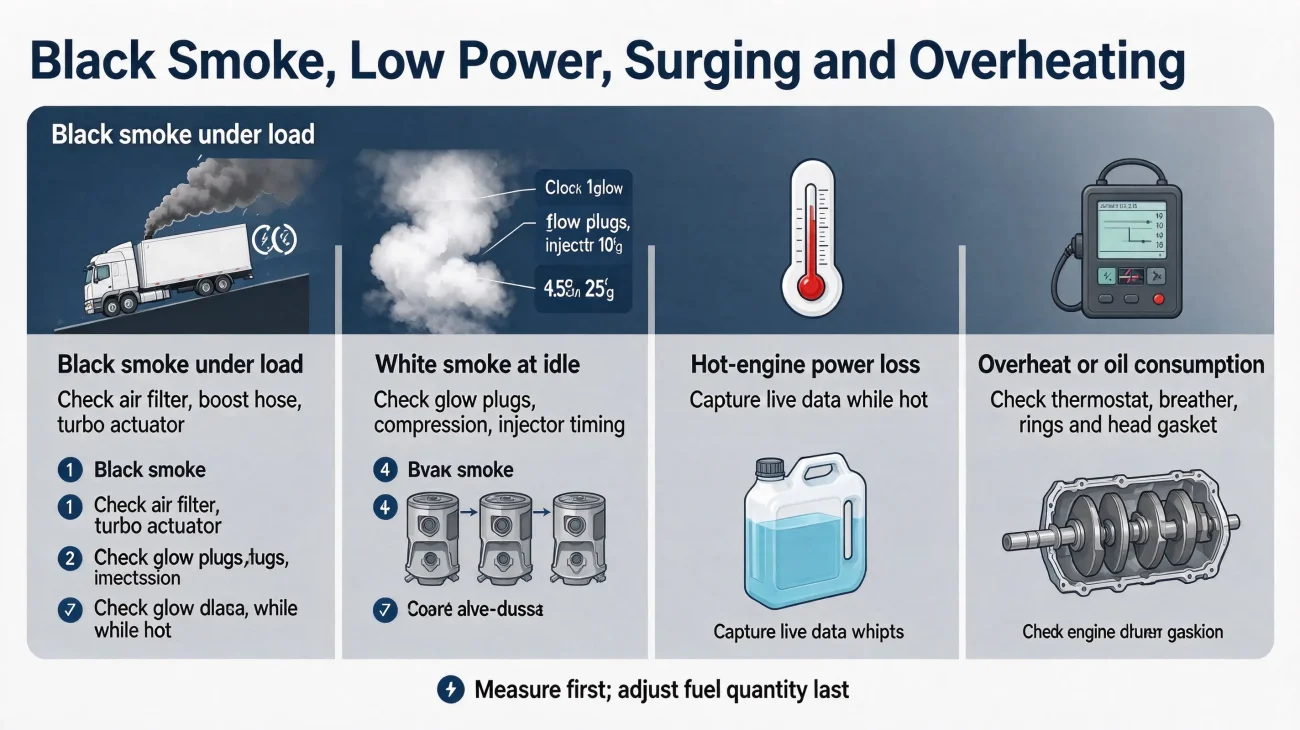
Black smoke, low power and surging under load are usually caused by restricted air, a turbocharger or boost leak, or an EGR valve stuck open or closed, not by fuel quantity alone. Too little air for the fuel delivered gives soot, lost power and unstable fuelling. Diagnosis therefore starts with the air path and boost measurements.
Three short scenarios show how the same family of faults looks different in the field.
A loaded climb with black smoke
A truck pulls cleanly on the flat but smokes black and loses speed on a grade. Who sees this: haulage operators running loaded on hilly routes. What to look for: a blocked air filter, a split charge-air hose, a sticking turbo actuator or a boost leak at a clamp. A boost gauge under load tells you quickly whether the turbocharger is delivering its target pressure.
A light-load idle with white smoke
An engine idles roughly and blows white smoke that clears as it warms. Who sees this: operators of vehicles that run short, cold duty cycles. What to look for: weak glow plugs, one cylinder not firing, low compression or injector timing issues. Hold the idle and check cylinder contribution in live data, since one dead cylinder produces most of the vapour.
A power loss that appears only when hot
An engine feels fine in the morning and weakens after an hour. Who sees this: drivers on long, steady runs. What to look for: heat-sensitive sensors, a failing fuel temperature sensor, a restricted DPF building backpressure, or a partly seized EGR valve. Capture live data while the fault is present, because a cold workshop re-test will often show nothing.
In every case, measure first. Fuel quantity is the last thing to adjust, not the first.
Overheating, Oil Consumption and Compression Loss: Symptom or Wear?
Some faults are cheap to correct, while others signal internal wear that no external repair will cure. Telling them apart early prevents spending money on a cooling or breather fix when the engine is already worn out, and the reverse.
On the cheap side sit thermostats, water pump drive problems, a blocked radiator, a loose fan clutch and a restricted PCV (crankcase breather) system. A stuck thermostat or clogged core can push an otherwise healthy engine into overheating. A restricted breather can raise crankcase pressure and push oil past seals, which mimics wear.
On the costly side sit blow-by from worn rings and liners, valve seat recession and head gasket breaches. Heavy blow-by shows as vapour from the breather, oil mist throughout the engine bay and falling compression. A head gasket breach shows as coolant loss with no external leak, bubbles in the coolant, or oil that turns milky.
What the smoke colour narrows down
Blue smoke contrasts with white and grey in what it suggests. Blue means oil is burning, which points toward worn valve stem seals, turbocharger seals or ring wear. White smoke means unburned fuel or coolant vapour, and it leans toward cold-start combustion problems or a gasket breach. Grey sits between them and often points to mixed causes such as poor atomisation or intake restriction.
Use smoke colour as a pointer and not as proof. A compression test, cylinder leakage test and coolant pressure test supply the proof.
Which Aftertreatment Faults Are Worth Repairing: DPF, EGR and SCR?
Most aftertreatment faults are worth repairing, provided the upstream cause is fixed first. A diesel particulate filter (DPF) is a ceramic filter that traps soot, and replacing a clogged unit without finding why it clogged invites a repeat failure within weeks.
The decision comes down to three routes: forced regeneration, off-vehicle cleaning and replacement. Forced regeneration, which burns off soot using a controlled high-temperature cycle, suits filters with moderate soot loading. Off-vehicle cleaning suits filters with heavy soot or ash loading but an intact substrate. Replacement is for cracked, melted or oil-contaminated filters.
The same logic applies to the exhaust gas recirculation (EGR) valve and selective catalytic reduction (SCR) systems. A sticky EGR valve is often a symptom of oily intake air or excess blow-by. SCR faults commonly trace back to diesel exhaust fluid quality, injector crystallisation or NOx sensor failure.
| Advantages of repairing | Limitations of repairing |
|---|---|
| Keeps the original emissions-certified configuration intact | Repeat failure if the upstream cause is not found |
| Cleaning is usually cheaper than replacement | Cleaning cannot fix a cracked or melted substrate |
| Forced regeneration needs no parts removal | Repeated regens on an oil-fouled filter can worsen damage |
| Preserves resale and inspection compliance | Sensor and software faults may need dealer-level tools |
One firm limit applies. Deleting or bypassing emissions equipment is illegal in most regulated markets and can expose owners to fines and failed inspections. Repair the system, and do not remove it.
How to Choose Between Repair, Rebuild and Replacement
Decide on the cost of downtime, remaining engine life, parts availability and core condition, not only on the repair quote. A cheap repair on a tired engine can cost more over a year than a planned rebuild. A full replacement can be the cheaper choice when the vehicle earns its keep every day.
Five criteria help structure the decision.
Downtime cost. Count lost revenue per day, not just labour. A vehicle that cannot work for three weeks may justify a replacement engine that is available now.
Compression and blow-by results. As a rough guide, compression that varies by more than about 10 to 15 percent between cylinders, together with heavy blow-by, pushes the decision toward rebuild. A single weak cylinder with otherwise good readings may justify a targeted repair.
Remaining service life. Consider how many more years and hours the vehicle will run. A truck due for retirement rarely justifies a full rebuild.
Parts and support availability. Obsolete injectors, unusual turbochargers and discontinued ECUs can make a repair slower than a swap. Check supply before you commit. The customer service page explains how to ask about parts support for a specific vehicle.
Core condition. A cracked block, scored crank journals or a damaged cylinder head can end a rebuild before it starts. Inspect with a borescope and measure before you order parts.
Weight and payload matter too. A heavier replacement engine raises tare weight and cuts payload, which matters for vehicles close to their gross vehicle weight rating (GVWR). Browse the truck categories when the question becomes whether to replace the whole vehicle.
Rule of thumb: if the repair cost approaches about half the value of a rebuilt or replacement engine, and the engine shows wear in more than one system, rebuild or replace.
Diesel Engine Diagnostic Mistakes That Cost the Most Time
A few habits waste more labour than any hard fault does. Each one feels reasonable in the moment, which is why it keeps happening.
Swapping parts from codes. A code names a circuit, not a failed part. Replacing the sensor or injector named in the code often leaves the real fault untouched and adds a new bill. Test the circuit, the wiring and the supply, then decide on the part.
Skipping the battery and ground check. Low voltage under cranking load can set false codes, slow the crank and upset sensor readings. Measure voltage drop across cables and grounds while cranking before touching anything else.
Bleeding the system without finding the air leak. Repeated bleeding hides a leak for a day, and the engine then fails again somewhere inconvenient. Find the entry point with clear tubing or a pressure test, fix it, then bleed once.
Clearing codes before recording them. Once cleared, freeze-frame data and the failure history are gone, and intermittent faults become far harder to trace. Photograph or write down every code and its conditions first.
Trusting a single test. A test that passes under the wrong conditions proves little. A fuel pressure reading at idle says nothing about pressure under load, so repeat tests under the conditions that trigger the complaint.
The common thread is skipped evidence. Every one of these mistakes replaces a measurement with an assumption.
Worked Example: A Cranks-But-Won’t-Start Engine Traced Step by Step
This is a generic, unnamed example, shown to illustrate the method and not any real customer case. The real-world cases in our cooperative case section cover vehicle supply, which is a different subject.
Symptoms
A medium-duty diesel truck cranks briskly but will not catch. It started normally the day before, and the fuel level is half a tank. The dashboard shows no warning lamps, and a scan shows a low rail pressure code.
The first wrong theory
The low rail pressure code suggests a failing high-pressure pump or a leaking injector. The workshop considers replacing the pump, which would be a large and avoidable expense.
The test that disproved it
Before any parts are ordered, a technician connects clear tubing at the fuel filter outlet and cranks the engine. The tubing fills with bubbles and foamy fuel. That points to air in the low-pressure side, so the high-pressure pump is simply starving.
Root cause and fix
A pressure test of the supply line finds a hairline crack in a rubber hose between the tank and the lift pump, which draws air under suction. The technician replaces the hose, renews the filter, bleeds the system once and confirms a clean, bubble-free flow. The engine starts on the first attempt, and the rail pressure code does not return after a test drive.
The lesson is that the code described a symptom downstream of the fault. A five-minute tubing check avoided a costly and wrong repair.
How Fuel, Air, Heat and Electrical Faults Interact
One fault often masks or mimics another, which is why single-cause thinking fails so often. A weak battery lowers cranking speed, which reduces compression heat and fuel pressure at start, and the whole picture then looks like a fuel problem. The fuel system gets blamed, yet the repair belongs in the electrical system.
The reverse happens too. A leaking injector dilutes engine oil with fuel, which thins the oil, increases wear and raises crankcase vapour. The engine then looks worn, when the first fault was a single injector.
Air and heat interact in a similar way. A restricted air filter reduces airflow, which raises exhaust temperature and soot loading. That in turn clogs the DPF and sets off a regeneration cycle, and the driver reports a power problem that began with a cheap filter.
Cooling faults feed back as well. An overheating engine can set sensor faults, derate power and soften injector seals, so the original cooling fault gets buried under secondary complaints.
Professional practice generally favours root-cause discipline over parts replacement. Experienced technicians tend to treat every secondary symptom as a clue, and not as a separate job. The reasoning is economic as well as technical: a replaced part that was not the cause costs money twice, once for the part and again for the repeat visit.
When symptoms seem to contradict each other, they often share one upstream cause. Look for what feeds both before you treat either.
Glossary of Diesel Diagnostic Terms
Diesel diagnosis uses a handful of terms that are easy to confuse. The definitions below are those needed to read this guide and most service documentation.
- Blow-by — combustion gas that leaks past the piston rings into the crankcase, and a key indicator of ring and liner wear.
- Return flow — the fuel that injectors send back to the tank, measured to reveal leaking or worn injectors.
- Injector balance rate — a live-data value showing how much fuelling correction each cylinder needs to keep the engine running smoothly.
- Forced regeneration — a service procedure that raises exhaust temperature on demand to burn soot out of the DPF.
- DEF — diesel exhaust fluid, a urea solution injected into the exhaust so the SCR system can reduce NOx emissions.
- Freeze-frame data — a snapshot of engine conditions recorded by the ECU at the moment a fault code was set.
- Glow plug circuit — the heater elements, relay and wiring that warm combustion chambers to help a cold engine ignite fuel.
These terms recur throughout service manuals, so knowing them speeds up reading and communication with parts suppliers.
A Short Decision Rule for Diesel Troubleshooting
Confirm supply before suspecting components, and measure before you replace. Supply means electrical power, clean fuel at the right pressure, and clean air at the right volume. Components, such as injectors, pumps and turbochargers, only deserve suspicion once supply has been proved good.
If two consecutive checks contradict the symptom, restart from the battery and fuel supply. Contradictory results usually mean an earlier test was wrong, or a shared upstream fault is distorting everything. Going back costs minutes, and pressing forward can cost days.
Keep a written record as you go: codes, readings, conditions and results. That record protects you from repeating tests and makes handover to another technician straightforward.
For questions about matching engines to vehicle applications, or about support for a specific unit, the contact page is the place to start. Learn the order, trust the measurements, and treat every code as a clue and not a verdict.
FAQ
How long should cranking take before a diesel starts?
Usually no more than a few seconds on a warm engine, and somewhat longer when cold. If it has not started after roughly 10 to 15 seconds, stop and rest the starter. Longer attempts overheat the starter and drain the battery.
Can bad fuel damage injectors permanently?
Yes. Water and abrasive contamination can score injector surfaces and damage high-pressure pumps. Fixing the fuel quality early usually limits the harm, but damaged injectors do not recover and need replacement.
When is a diagnostic scan not enough?
A scan is not enough when codes are absent, intermittent or generic. Mechanical faults such as air leaks, low compression and worn rings rarely set a clear code. Pressure gauges, leakage tests and visual checks fill the gap.
How often should fuel filters be changed?
Follow the manufacturer’s interval, which is commonly somewhere between 10,000 and 30,000 km depending on engine and duty. Poor fuel quality or dusty conditions justify shorter intervals. A filter that clogs early is a sign to look at fuel quality.
Is white smoke always a head gasket problem?
No. White smoke is often just unburned fuel or condensation at a cold start, and it clears as the engine warms. Persistent white smoke with coolant loss or bubbles in the coolant is what points toward a gasket breach.


