
Introduction
Heavy-duty Chinese trucks have become mainstream transportation equipment for global logistics, construction, and mining industries. Classic models including Sinotruk HOWO, Shacman X3000, FAW J6, and Dongfeng KC occupy huge market shares worldwide.
Compared with European and American truck brands, Chinese heavy-duty trucks deliver outstanding cost performance. They feature strong load capacity, durable overall structure, and affordable aftermarket spare part support.
Meanwhile, these vehicles are designed to adapt to complex global road conditions. Whether for long-haul highway transportation or rugged off-road engineering operations, they maintain stable working performance.
Even so, long-term heavy-load operation inevitably accelerates component aging. Most fleet failures are not caused by major engine faults, but by overlooked small chassis accessories.
Among these easily worn parts, the engine mount bracket is one of the most underestimated components. Although it looks simple, it supports the entire diesel engine and gearbox assembly.
Furthermore, it isolates violent engine vibration and buffers impact force during driving. To put it simply, the mount bracket determines the overall stability of the truck’s power system.
When the engine mount bracket works normally, the engine runs smoothly, the cab remains comfortable, and peripheral parts suffer less vibration wear.
On the contrary, once the bracket loosens, deforms, or cracks, a series of abnormal problems will occur gradually. These hidden faults will continuously affect driving safety and vehicle service life.
In actual fleet maintenance work, most technicians focus on core overhaul items. These items include engine oil replacement, fuel system cleaning, and truck brake caliper maintenance.
However, regular inspection of engine mount brackets is often omitted. This maintenance blind spot causes minor faults to accumulate over tens of thousands of miles.
Slowly, tiny cracks expand, bolt gaps increase, and rubber cushion elasticity fails. Eventually, drivers face obvious engine shaking, abnormal noise, and even part dislocation.
What’s worse, unstable engine fixation will continuously pull pipelines, wiring harnesses and connecting parts. It indirectly causes oil leakage, circuit aging and other secondary faults.
This comprehensive guide focuses entirely on Chinese heavy-duty truck models. It covers mount bracket working principles, failure symptoms, root causes, standardized replacement steps, and daily maintenance strategies.
All content is field-tested and suitable for Sinotruk, Shacman, FAW and Dongfeng fleets. It helps fleet managers and technicians accurately diagnose faults and avoid repeated maintenance costs.
To ensure matching installation accuracy and long-term driving stability, always choose high-quality mount brackets and supporting truck chassis system parts.
What Is an Engine Mount Bracket & How Does It Work?
Before troubleshooting and replacement, it is necessary to fully understand the basic structure and working logic of the engine mount bracket. This basic knowledge helps you distinguish normal aging from dangerous structural failure.
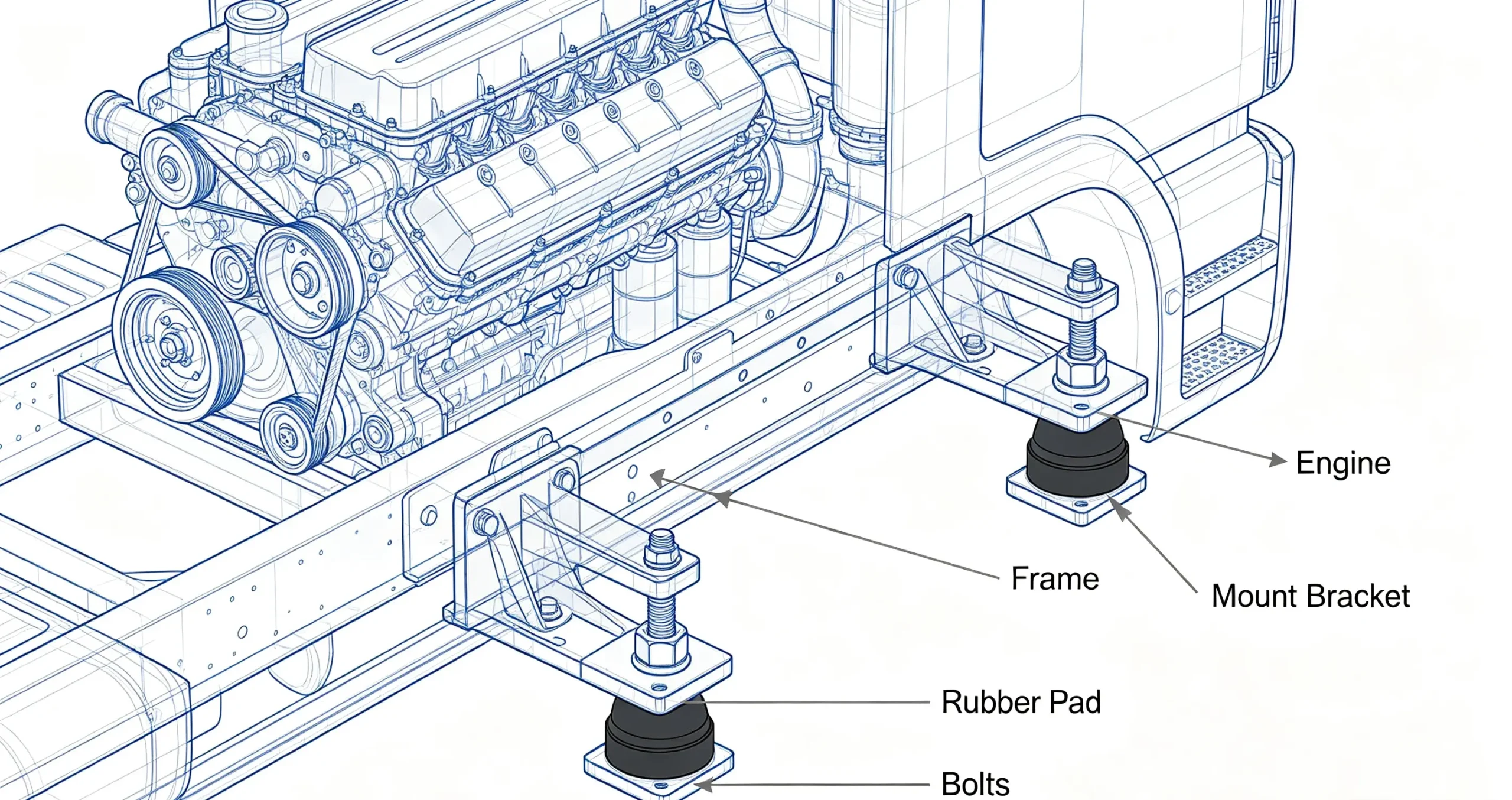
In short, the engine mount bracket is the fixed bridge between the engine assembly and the truck frame. It is the core load-bearing and vibration-isolating component of the power system.
A complete engine fixing system consists of two key parts. The first is a high-strength metal cast bracket, and the second is a wear-resistant rubber shock-absorbing mount pad.
These two parts work in cooperation and cannot function independently. The metal bracket undertakes rigid load-bearing and positioning tasks, while the rubber pad undertakes flexible buffering and vibration isolation work.
The metal bracket is made of thickened cast iron or high-toughness steel plate. Through integrated casting and stamping technology, it owns strong compression resistance and torsion resistance.
Its main task is to bear the static weight of the engine and gearbox. At the same time, it limits engine displacement during acceleration, deceleration and bumpy driving.
Without qualified bracket fixation, the engine will shift left and right or front and back. This offset will cause abnormal stress on the transmission system and connecting pipelines.
Correspondingly, the rubber mount pad installed between the bracket and the engine plays a key buffering role. It absorbs high-frequency vibration generated by engine combustion and piston operation.
Through vibration isolation, it prevents engine resonance from transmitting to the chassis and cab. Therefore, it effectively improves driving comfort and reduces overall vehicle fatigue wear.
In addition, the engine mount bracket also has precise positioning functions. It ensures the engine and gearbox remain in a horizontal and balanced state during long-term operation.
This balanced installation posture avoids abnormal stretching of water pipes, oil pipes and wiring harnesses. It greatly reduces the failure rate of peripheral auxiliary systems.
Genuine brackets for Chinese heavy-duty trucks are specially customized for heavy-load working conditions. They feature thickened structure, anti-rust treatment and strong impact resistance.
In contrast, cheap generic aftermarket brackets have thin structures and poor toughness. They are easy to deform and crack under long-term overload and vibration.
It is important to distinguish mount bracket faults from other engine faults. For example, truck cylinder head failures are caused by high-temperature combustion and thermal fatigue.
However, engine mount bracket damage belongs to pure mechanical fatigue failure. It is mainly induced by long-term vibration, impact and improper installation.
Therefore, troubleshooting ideas are completely different. Mastering the working principle can help technicians quickly locate faults and avoid misjudgment.
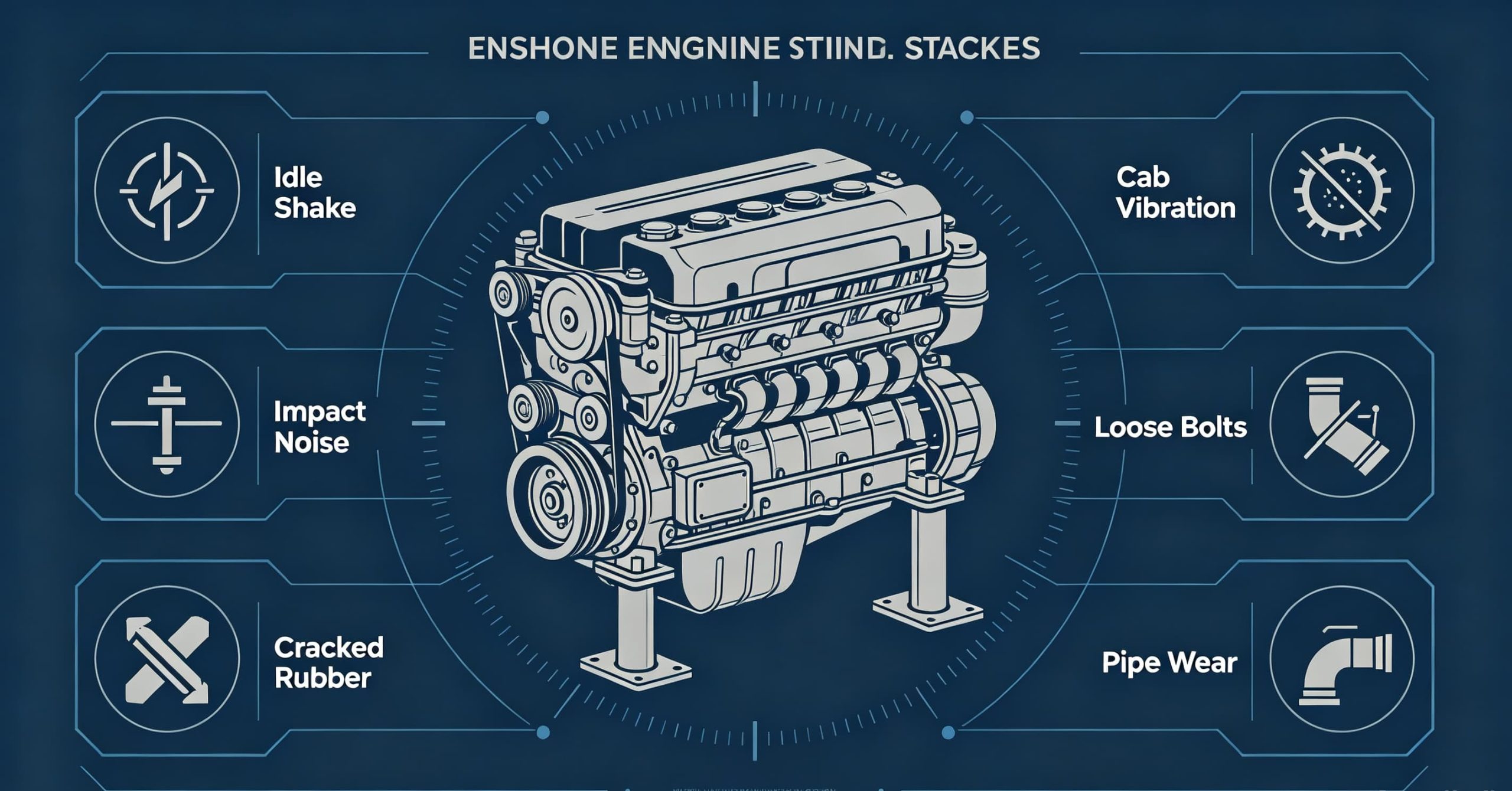
7 Common Symptoms of Damaged Truck Engine Mount Bracket
Engine mount bracket failure is a typical cumulative fatigue fault. It does not break down suddenly, but deteriorates slowly with the increase of driving mileage and working time.
In the early stage of failure, the symptoms are very subtle. Most drivers cannot perceive abnormal changes. But as the damage accumulates, various obvious abnormal phenomena will appear one after another.
Timely capturing these early symptoms can help fleets replace parts in advance. It avoids secondary damage to expensive engine, gearbox and chassis components.
The following seven symptoms are the most common and typical failure manifestations of engine mount brackets on Chinese heavy-duty trucks.
1. Obvious Engine Shaking at Idle Speed
A healthy engine runs smoothly and stably at idle speed. There is no obvious jitter or resonance inside the cab.
Once the engine mount bracket loosens, deforms, or the rubber pad ages and fails, the engine loses stable support. As a result, idle shaking becomes extremely obvious.
Drivers can clearly feel continuous vibration on the steering wheel and seat. In severe cases, the dashboard, door panels and interior accessories will shake synchronously.
This symptom is most obvious after cold start. It is the most intuitive early warning signal of mount bracket aging.
2. Abnormal Impact Noise During Acceleration & Deceleration
Under normal fixing conditions, the engine will not produce displacement during speed changes. The whole power system runs tightly and stably.
When the mount assembly fails, there will be a tiny movable gap between the engine and the frame. During sudden acceleration or emergency braking, the engine shifts instantly.
This instantaneous offset causes metal collision between the bracket and the frame. Drivers can hear dull metal impact sounds at the moment of speed switching.
Different from engine failure noise, this abnormal sound only appears during dynamic speed changes and disappears when driving at a constant speed.
3. Excessive Vibration Transmitted to Cab & Chassis
Qualified engine mount assemblies can isolate more than 90% of engine high-frequency vibration. Thus, the cab maintains a comfortable driving state.
After the rubber pad hardens or the bracket loosens, the vibration isolation function fails. A large amount of engine resonance directly transmits to the chassis and cab.
Long-term driving in a high-vibration environment will cause driver fatigue. Meanwhile, it accelerates the loosening and aging of cab interior parts.
In addition, long-term chassis vibration will also aggravate the wear of truck shock absorber parts, causing chassis resonance linkage faults.
4. Visible Loose Bolts & Bracket Cracks
Visual inspection is the most efficient and direct detection method for mount bracket faults. Technicians can quickly judge the aging degree through observation.
After long-term vibration, the fixing bolts of the bracket will gradually loosen. Obvious gaps will appear between the bolt body and the mounting hole.
At the same time, stress concentration areas of the bracket will produce tiny fatigue cracks. These cracks will continue to expand with vibration and impact.
If the bracket surface is uneven, deformed or cracked, it means the structural strength has failed and cannot continue to be used.
5. Aging, Cracking & Collapsed Rubber Mount Pads
In most service scenarios, rubber mount pads fail earlier than metal brackets. Because rubber materials are sensitive to high temperature and aging.
The engine cabin maintains a high-temperature environment for a long time. High temperature will gradually harden the rubber pad and make it lose elasticity.
After long-term extrusion and vibration, the rubber pad will appear dry cracking, delamination and collapse. It completely loses the buffering and vibration isolation effect.
Even if the metal bracket is intact, the failure of the rubber pad alone will cause overall instability of the engine fixing system.
6. Abnormal Wear of Peripheral Pipelines & Harnesses
Unstable engine fixation will cause irregular shaking of the power assembly during operation. This drives continuous tension and friction on connected pipelines and wiring harnesses.
Over time, the outer protective layer of oil pipes and water pipes will wear and age. The wrapping skin of the wiring harness is also prone to damage and wire exposure.
These hidden wear problems easily induce oil leakage, water leakage and circuit short circuit faults. Most maintenance personnel ignore the root cause of bracket failure.
7. Offset Engine Assembly Position
Severe bracket deformation or fracture will cause overall offset of the engine assembly. Obvious position deviation can be observed from the side of the vehicle.
The offset engine will change the working angle of the clutch and gearbox. It increases transmission resistance and aggravates gearbox bearing wear.
If not repaired in time, it will further induce power transmission failure and increase fleet maintenance costs.
Root Causes of Early Engine Mount Bracket Failure
To solve mount bracket faults fundamentally and avoid repeated failures, it is necessary to clarify all inducing factors. Most early failures are caused by the superposition of multiple reasons.
The main causes include overload operation, poor road conditions, irregular driving habits, high-temperature environment, insufficient maintenance and unqualified spare parts.
1. Long-Term Overload Transportation
Overload is the primary cause of early bracket damage for Chinese heavy-duty trucks. Many fleets pursue transportation volume and frequently exceed the rated load.
Excessive load increases the overall weight of the vehicle. The engine mount bracket bears extra pressure and impact far beyond the design standard.
Long-term overload operation causes metal fatigue of the bracket. It gradually deforms, sinks and cracks, leading to premature failure.
2. Complex Road Conditions & Frequent Impact
Many engineering trucks and mining trucks work on unpaved gravel roads, muddy roads and bumpy mountain roads.
Frequent jolts and impacts generate strong instantaneous force. This force directly acts on the engine mount bracket and rubber pads.
Alternating impact force accelerates metal fatigue and rubber aging. It greatly shortens the service life of the entire fixing assembly.
3. Aggressive & Irregular Driving Habits
Frequent sharp acceleration, sudden braking and rapid gear shifting will cause instantaneous displacement of the engine assembly.
Each displacement will bring strong tensile force and impact force to the bracket. Long-term irregular driving will accumulate a large amount of fatigue damage.
In contrast, stable and gentle driving can effectively reduce bracket load and prolong part service life.
4. Long-Term High-Temperature Cabin Environment
The diesel engine generates a lot of heat during operation. The engine cabin is in a closed high-temperature state for a long time.
High temperature accelerates the aging and hardening of rubber mount pads. It also causes repeated thermal expansion and contraction of metal brackets.
This thermal cycle gradually reduces metal toughness and rubber elasticity. It induces early failure of the mount system.
5. Insufficient Daily Maintenance & Inspection
Most fleets have complete maintenance plans for engines, tires and brake systems. However, they lack targeted inspection for mount brackets.
Loose bolts, aging rubber pads and tiny cracks cannot be found in time. Small problems continue to accumulate and eventually evolve into major faults.
Regular inspection and fastening can effectively avoid most sudden bracket failures.
6. Inferior Aftermarket Spare Parts Matching
To save costs, many truck owners choose low-cost generic brackets and rubber pads. These unqualified parts have substandard materials and processes.
Low-quality brackets have insufficient thickness and toughness. They are easy to deform under load. Inferior rubber pads cannot resist high temperature and vibration.
Using unqualified parts will not solve faults fundamentally. Instead, it causes repeated damage and increases long-term maintenance costs.
For stable replacement effect, always match genuine or high-quality heavy-duty parts, consistent with professional engine component standards.
Standard Judgment Criteria for Bracket Replacement
Not all minor aging phenomena need immediate replacement. Scientific judgment can help fleets save unnecessary maintenance costs while ensuring driving safety.
The following clear standards are summarized for heavy-duty truck mount bracket replacement. Once these situations occur, parts must be replaced immediately.
First, replace the bracket immediately if there are visible cracks, bending deformation, thread slipping or hole expansion. These structural damages are irreversible and will deteriorate rapidly.
Second, replace the rubber pad if it appears severe hardening, delamination, hollowing, collapse or penetrating cracks. Lost elasticity means complete loss of vibration isolation function.
Third, replace the whole assembly if idle engine shaking cannot be eliminated after bolt fastening. It proves that internal structural fatigue has occurred.
Fourth, replace parts if the engine is offset and peripheral pipelines and harnesses are repeatedly worn. Unstable fixation will induce multiple secondary faults.
Fifth, replace in time if abnormal impact noise occurs frequently during driving. It indicates that the movable gap has exceeded the safe range.
Step-by-Step Engine Mount Bracket Replacement Process
Standardized replacement steps determine the final installation quality. Non-standard operation will cause new vibration, deviation and loose faults after replacement.
The following complete operation process is summarized according to field maintenance experience. It is fully applicable to Sinotruk, Shacman, FAW and Dongfeng heavy-duty trucks.
Step 1: Vehicle Parking & Safety Preparation
Park the truck on a flat and hard ground to ensure stable vehicle support. Tighten the handbrake and pad the front and rear tires to prevent sliding.
Turn off the engine and wait for 30 to 60 minutes of natural cooling. Avoid high-temperature scalding during disassembly and ensure safe operation.
Step 2: Stably Support the Engine Assembly
Use a professional hydraulic jack and support frame to stably support the bottom of the engine and gearbox assembly.
Confirm the supporting point is accurate and the stress is uniform. Prevent sudden falling or offset of the engine after the bracket is removed.
Do not support the oil pan alone to avoid local deformation and damage to the engine shell.
Step 3: Remove Blocking Peripheral Parts
According to the actual installation position, remove the guard plate, air duct, oil pipe limit frame and wiring harness fixing card that block the bracket.
Classify and store disassembled bolts and accessories to avoid loss and misinstallation. Mark the pipeline and harness positions for accurate resetting.
Step 4: Dismantle Old Bolts & Failed Bracket
Loosen the fixing bolts symmetrically in diagonal order. Do not unscrew a single bolt completely at one time to avoid stress deviation.
After all bolts are loosened evenly, take out the old metal bracket and failed rubber mount pad completely.
Check the old parts carefully to confirm specific failure points, which provides reference for subsequent maintenance optimization.
Step 5: Clean & Polish Mounting Surface
Thoroughly clean the mounting positions of the engine and frame. Remove dirt, oil stains, rust and residual sundries.
Ensure the installation plane is flat, clean and free of foreign matter. Uneven surface will cause unbalanced stress on new parts and lead to early damage.
Step 6: Install New Rubber Pad & Bracket
Place the new high-quality rubber mount pad in the standard positioning groove first. Ensure the pad is flat and not skewed.
Align the new engine mount bracket with the mounting holes, place it stably, and check the fitting gap to ensure accurate positioning.
Step 7: Symmetric Torque Fastening
Screw in the fixing bolts manually first to ensure no thread slipping. Then tighten them symmetrically and diagonally with a torque wrench.
Control uniform standard torque. Excessive torque will crack the bracket, while insufficient torque will cause loose fixation and vibration.
Step 8: Reset Parts & Test Operation
Reinstall all disassembled guard plates, pipelines and wiring harness fixing parts. Check all connecting positions for firmness.
Start the engine to test idle operation. Observe whether there is jitter or abnormal noise.
Finally, conduct road test to confirm stable acceleration and deceleration without abnormal vibration or impact sound.
Professional Installation Precautions
Many post-repair recurring faults are caused by non-standard installation details. The following key precautions must be strictly followed during replacement.
First, replace parts in complete sets. Never mix new rubber pads with old brackets or new brackets with aging pads. Mismatched parts will cause unbalanced stress.
Second, strictly control installation torque. Follow the factory standard torque parameters to avoid structural damage or loose fixation.
Third, keep the installation plane clean and flat. Any foreign matter will affect the fitting degree and cause local stress concentration.
Fourth, keep the engine in a horizontal neutral position during installation. Avoid left-right offset to prevent transmission system stress.
Fifth, check the aging degree of peripheral pipelines during replacement. Replace severely aging accessories in advance to avoid secondary faults.
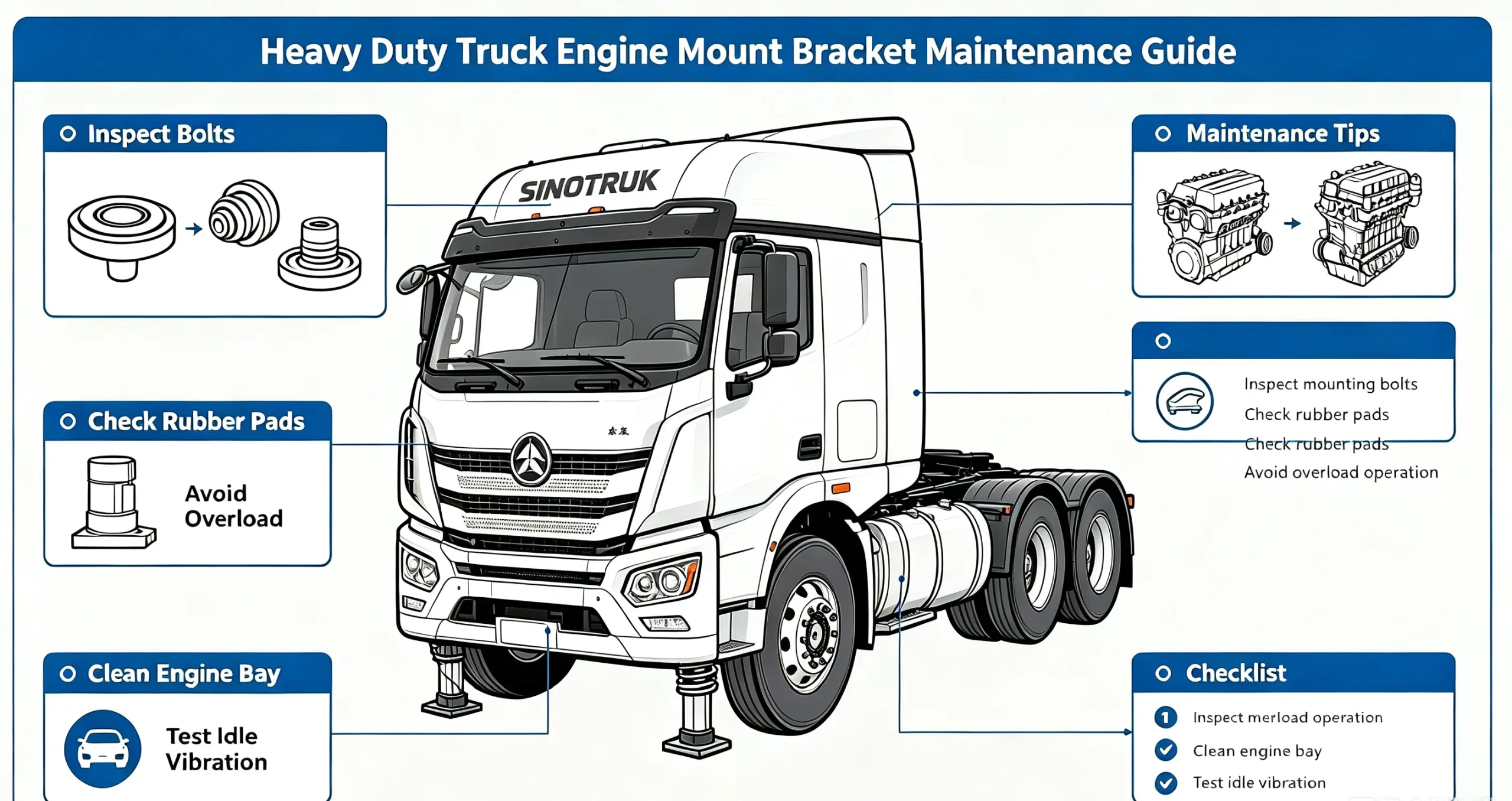
Long-Term Maintenance Tips to Extend Bracket Service Life
Scientific daily maintenance can effectively delay mount bracket aging, reduce fleet replacement frequency and cut overall operating costs.
Combined with the working characteristics of Chinese heavy-duty trucks, we have summarized practical long-term maintenance strategies.
First, avoid long-term overload and over-limit driving. Keep the load within the rated range to reduce bracket bearing pressure.
Second, adopt gentle driving habits. Reduce sharp acceleration and sudden braking to minimize instantaneous impact on the fixing system.
Third, conduct special inspection every 20,000 miles. Check bolt tightness, bracket deformation and rubber pad aging status regularly.
Fourth, clean engine cabin oil dirt and dust regularly. Keep good heat dissipation environment to avoid accelerated rubber aging.
Fifth, repair chassis abnormal vibration in time. Excessive overall vehicle vibration will aggravate bracket fatigue damage.
Sixth, match qualified original parts for replacement. Avoid inferior accessories to ensure long-term stable operation of the mount system.
You can also cooperate with complete truck engine parts maintenance plans to form systematic vehicle protection.
Frequently Asked Questions
Q1: Can I continue driving with a slightly loose engine mount bracket?
Short-distance low-speed driving is acceptable, but long-term driving is not recommended. Slight looseness will rapidly deteriorate under vibration, causing engine offset and part damage.
Q2: How long is the service life of heavy truck engine mount brackets?
Under standard working conditions, genuine brackets can last 2–3 years. Severe working environments and overload operation will greatly shorten the service cycle.
Q3: Is it necessary to replace rubber pads together with brackets?
Yes. It is a professional maintenance standard to replace the whole set. Matching old and new parts will cause inconsistent stress and lead to early failure again.
Q4: Will faulty mount brackets affect fuel consumption?
Yes. Unstable engine operation causes abnormal combustion resistance and power loss, which indirectly increases fuel consumption and reduces transportation efficiency.
Conclusion
The engine mount bracket is a small but indispensable core component of heavy-duty truck chassis system. It undertakes engine load-bearing, fixing and vibration isolation missions.
Although it is easily ignored in daily maintenance, its operating state directly affects engine stability, driving comfort and overall vehicle safety.
Long-term overload, poor road conditions and insufficient maintenance are the main causes of bracket failure. Timely identification of early symptoms and standardized replacement are the key to avoid major faults.
By adopting scientific driving habits and regular maintenance plans, fleets can effectively extend the service life of mount brackets and reduce unplanned downtime losses.
In the long run, good mount system maintenance can stabilize engine performance, reduce overall maintenance costs, and improve fleet operational benefits.


