
Introduction
Heavy-duty trucks are the core backbone of global bulk logistics, infrastructure construction, mining transportation and long-distance freight industries. In overseas markets, Chinese brand heavy trucks have occupied a dominant market share with ultra-high cost performance, strong load-bearing performance and durable overall quality.
The most mainstream exported models cover Sinotruk HOWO series, Shacman F3000/X3000, FAW J6P/J7, Dongfeng KC/VL and Foton Auman GTL/EST. These vehicles are widely used in Africa, the Middle East, Central Asia, Southeast Asia and Latin America.
Compared with European and American heavy trucks, Chinese heavy-duty trucks have more adaptable chassis structures. They are more suitable for poor road conditions, long-term full-load operation and complex construction site working environments.
For fleet companies and individual truck owners, vehicle downtime equals direct economic loss. Therefore, daily preventive maintenance is far more important than post-fault repair.
Most truck maintenance work focuses on wearing parts such as engine oil, diesel filter, air filter, brake pads and tires. Most technicians ignore hidden chassis wearing parts represented by engine mounting rubbers.
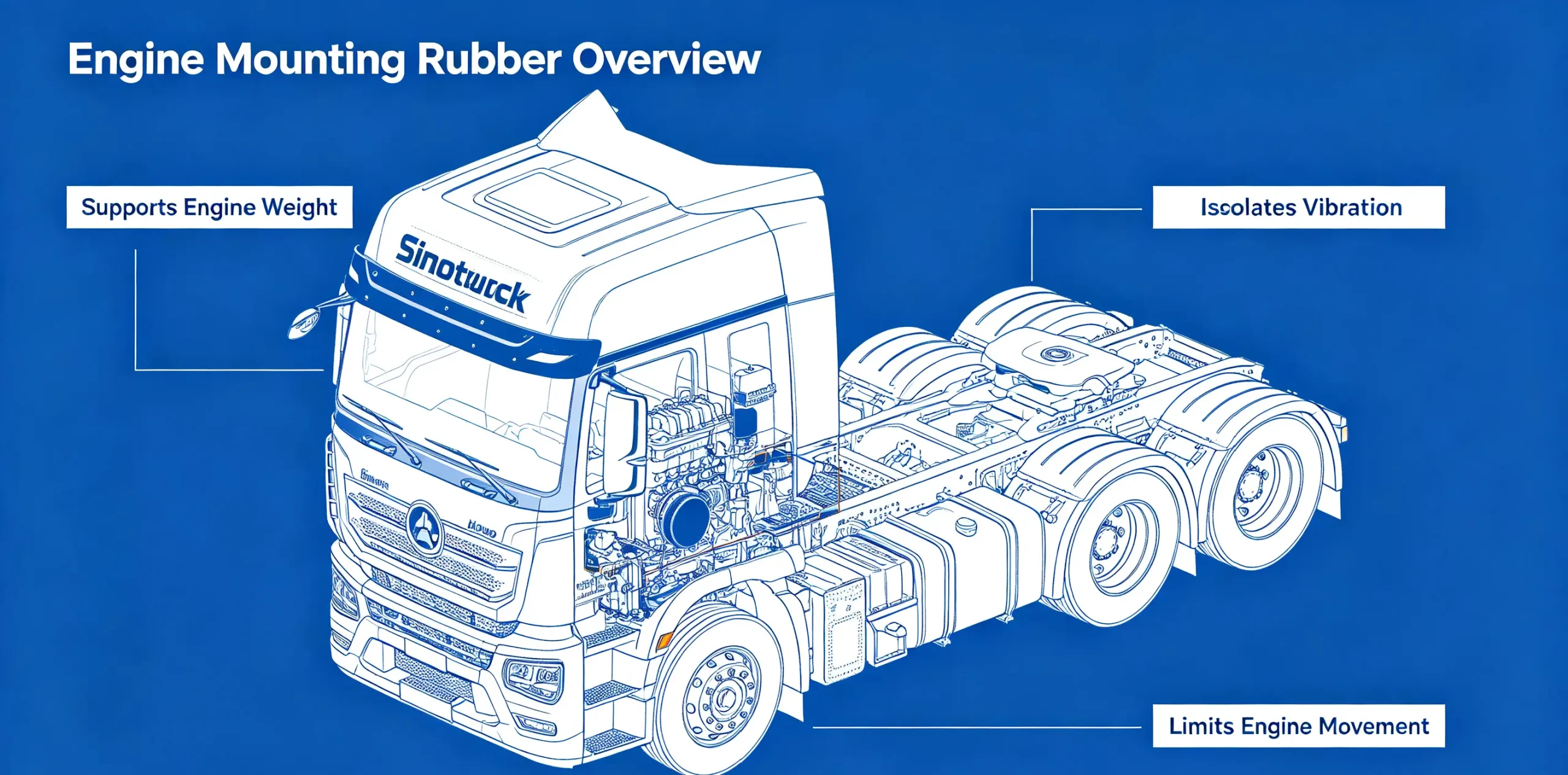
Engine mounting rubber, also known as engine mount cushion, engine vibration isolator or engine support pad, is a key flexible connection component between the power assembly and the vehicle chassis.
Although it looks like a simple rubber block with metal brackets, it undertakes three extremely critical core tasks in the actual operation of heavy trucks.
It bears the total weight of the engine and gearbox assembly, isolates high-frequency vibration during engine operation, and limits the front, rear, left and right displacement of the engine during vehicle driving.
The service condition of engine mounting rubbers determines the overall stability of the vehicle. It also affects driving comfort, part service life and even driving safety.
The diesel engine of a heavy truck will generate continuous mechanical vibration and periodic combustion impact during working. The vibration frequency is high and the amplitude is large.
If there is no qualified mounting rubber for buffer isolation, all vibration will be directly transmitted to the frame, cab and various auxiliary parts of the vehicle.
Long-term rigid vibration conduction will cause irreversible fatigue damage to the whole vehicle. It will trigger a variety of secondary faults that are difficult to troubleshoot.
Common secondary faults include loose circuit wiring harnesses, aging and cracking of cooling water pipes, oil pipe leakage, and abnormal wear of clutch and transmission parts.
Different from sudden mechanical faults, the failure of engine mounting rubber is a typical cumulative fatigue failure. The aging process is slow and progressive.
It will gradually deteriorate from slight elasticity attenuation and surface micro-cracks to overall hardening, bulging, collapse and complete failure.
In each aging stage, the vehicle will have corresponding obvious early warning symptoms. However, most fleet maintenance personnel lack professional identification capabilities.
They often delay the replacement until the rubber is completely collapsed and the vehicle has severe jitter and abnormal noise. This virtually increases maintenance costs and vehicle downtime.
This professional maintenance guide is tailored for Chinese mainstream heavy-duty truck models. It combines overseas user working conditions and after-sales maintenance pain points.
The guide systematically sorts out the structural principle of engine mounting rubber, progressive failure symptoms, deep failure root causes, standardized disassembly and replacement processes, professional operation taboos and long-term scientific maintenance strategies.
It solves most common confusion problems in daily maintenance for overseas fleet managers, self-employed drivers and professional maintenance technicians.
Standardized inspection and batch replacement of mounting rubbers can effectively avoid secondary damage to engines and chassis systems. It greatly reduces vehicle failure rates.
It can significantly extend the overall service life of heavy trucks and help fleets reduce long-term operating and maintenance costs.
To ensure the long-term stable operation of truck power system and chassis system, matching high-quality original standard accessories is essential. Cooperate with professional suppliers to replace complete sets of truck chassis system parts to achieve overall chassis maintenance.
High-quality matching accessories can completely solve vibration and abnormal noise problems and avoid repeated failures of chassis buffer components.
What Is an Engine Mounting Rubber & How Does It Work?
To accurately judge mounting rubber faults and carry out standardized replacement maintenance, you must first master professional structural knowledge and working principles.
The engine mounting rubber used on heavy-duty trucks is completely different from the buffer rubber of passenger cars and light commercial vehicles in terms of material, structure and load standard.
Heavy truck mounting rubber is specially customized for heavy-load, high-vibration and long-time continuous working conditions. Its structural strength and fatigue resistance are far higher than ordinary rubber parts.
The whole set of accessories includes high-toughness composite rubber main body, upper and lower thickened metal fixing brackets, built-in anti-compression steel skeleton, limit gaskets and anti-loosening bolts.
High-quality regular products adopt mixed formula of natural rubber and synthetic rubber. This formula balances high temperature resistance, aging resistance, compression resistance and tear resistance.
The engine cabin of a heavy truck will maintain a high temperature state of 80℃ to 120℃ for a long time during long-distance transportation.
Premium mounting rubber products can work stably in high-temperature environments for a long time without rapid hardening and failure.
According to different installation positions and stress-bearing functions, heavy truck engine mounting rubbers are divided into four categories: front mounting rubber, rear mounting rubber, left side mounting rubber and right side mounting rubber.
Multiple sets of mounting rubbers work together to form a stable support system. They jointly bear the weight of the engine and gearbox power assembly.
Different positions of mounting rubbers bear different stress directions and vibration frequencies. Front mounts bear more impact force, while rear mounts bear more torsional vibration.
Therefore, after long-term operation, all mounting rubbers will have synchronous aging and fatigue problems. Single replacement cannot solve the fundamental vibration problem.
The core working principle of engine mounting rubber is elastic vibration isolation and flexible buffering.
The rubber material has good elastic deformation ability. It can absorb and digest the high-frequency mechanical vibration generated by engine combustion and mechanical operation.
It effectively cuts off the vibration transmission path between the power assembly and the chassis frame, so that the vibration will not be transmitted to the whole vehicle.
During engine start, sudden acceleration, emergency braking and rapid gear shifting, the engine will produce obvious instantaneous displacement and torsional impact.
The flexible rubber structure can buffer rigid metal impact. It avoids direct collision and friction between the engine bracket and the chassis frame.
In addition to vibration reduction and buffering, mounting rubbers also play an accurate positioning and limiting role.
It can limit the excessive shaking and displacement of the engine. It ensures that the assembly angle of gearbox, clutch and transmission shaft remains normal.
This avoids abnormal wear and power loss of the transmission system caused by engine offset.
In daily maintenance, many inexperienced technicians easily confuse mounting rubber fatigue failure with engine mechanical failure.
Rubber aging failure belongs to flexible component fatigue damage, which is caused by long-term vibration and high-temperature aging.
It is completely different from rigid mechanical faults such as engine cylinder damage and truck cylinder head failures.
Accurate fault distinction can avoid blind engine disassembly and wrong maintenance, greatly improving maintenance efficiency and accuracy.
7 Common Symptoms of Worn-Out Engine Mounting Rubbers
Engine mounting rubber failure is a continuous and progressive deterioration process. There will be obvious and identifiable early warning symptoms in each stage.
Timely identification and diagnosis of these typical symptoms can help fleet personnel replace parts in advance. It avoids sudden vehicle breakdown and long-time shutdown loss.
1. Excessive Cab Vibration at Idle Speed
Idle vibration is the earliest and most intuitive failure feature of aging mounting rubbers.
When the truck engine is in normal idle state, the operation is stable and uniform without obvious jitter and vibration.
When the mounting rubber ages, hardens or loses elasticity, its vibration absorption capacity decreases sharply.
The high-frequency vibration generated by the engine cannot be buffered and will be directly transmitted to the frame and cab.
Drivers can clearly feel obvious shaking on the steering wheel, dashboard, seat and even the whole cab.
This idle vibration is most obvious after cold start. It will not disappear with engine temperature rise, which is a key judgment feature.
Long-term cab vibration will cause driver fatigue and affect driving judgment and driving safety.
2. Clunking Impact Noise During Acceleration & Braking
Aged, deformed and collapsed mounting rubbers will produce tiny gaps between the engine fixing bracket and the chassis frame.
When the vehicle accelerates sharply, brakes urgently or shifts gears rapidly, the engine will displace instantaneously under the action of inertia.
The metal bracket collides rigidly with the chassis, resulting in dull clunking, banging and impact noise.
This abnormal noise is extremely regular. It only appears during dynamic speed changes and disappears completely during constant-speed cruising.
Many drivers misjudge it as chassis loose fault. In fact, most of this noise comes from failed engine mounting rubbers.
3. Unstable Engine Idle & Rough Operation
Completely failed mounting rubbers cannot fix the engine power assembly stably.
The engine will shake irregularly left and right and front and back during operation.
This unbalanced shaking state will destroy the original combustion balance and power output stability of the diesel engine.
The truck will show weak power, slow acceleration and intermittent jitter during driving.
This symptom is highly similar to fuel supply failure and injector failure. It is easy to be misjudged by inexperienced maintenance personnel.
If the fuel system is normal after inspection, the mounting rubber failure should be prioritized.
4. Visible Engine Offset and Tilt
In the middle and late stage of mounting rubber failure, the rubber will have uneven compression deformation.
The stress-bearing parts are collapsed and sunken, while the non-stress-bearing parts are bulged and deformed.
This causes the whole engine assembly to tilt left and right or shift front and back.
Maintenance personnel can clearly observe the engine position deviation from both sides of the engine cabin.
Engine offset will change the assembly horizontal angle of gearbox, clutch and transmission shaft.
It increases transmission resistance, aggravates part wear, and even causes power transmission jitter.
5. Cracked, Hardened and Bulged Rubber Surface
Visual inspection is the most direct, efficient and zero-cost detection method for mounting rubber faults.
After long-term high-temperature baking, the rubber material will gradually harden and lose original elasticity and toughness.
Under continuous vibration and extrusion, the rubber surface will produce dry cracks, peeling damage and local bulging deformation.
In severe cases, the rubber will be hollowed out and collapsed, completely losing vibration damping and buffer functions.
Once surface cracks appear, it means the mounting rubber has entered the failure period and must be replaced as soon as possible.
6. Frequent Pipeline and Harness Wear Failure
Unstable engine shaking will drive the overall displacement of peripheral water pipes, oil pipes and wiring harnesses.
Long-term repeated micro-friction and tension will wear the outer protective layer of pipelines and harnesses.
It is easy to cause cooling water leakage, engine oil leakage and circuit harness damage.
Most unexplained pipeline damage and oil-water leakage faults are caused by hidden mounting rubber failure.
Replacing pipelines alone cannot solve the problem. The fundamental solution is to replace failed mounting rubbers.
7. Whole Vehicle Chassis Resonance
When multiple groups of front, rear, left and right mounting rubbers fail at the same time, the engine vibration cannot be isolated.
All high-frequency vibration will be transmitted to the whole chassis frame, causing overall chassis resonance.
During vehicle driving, the whole body shakes obviously, and various body accessories are loose and abnormal.
Long-term chassis resonance will also accelerate abnormal tire wear and chassis fastener loosening.
Root Causes of Early Engine Mounting Rubber Failure
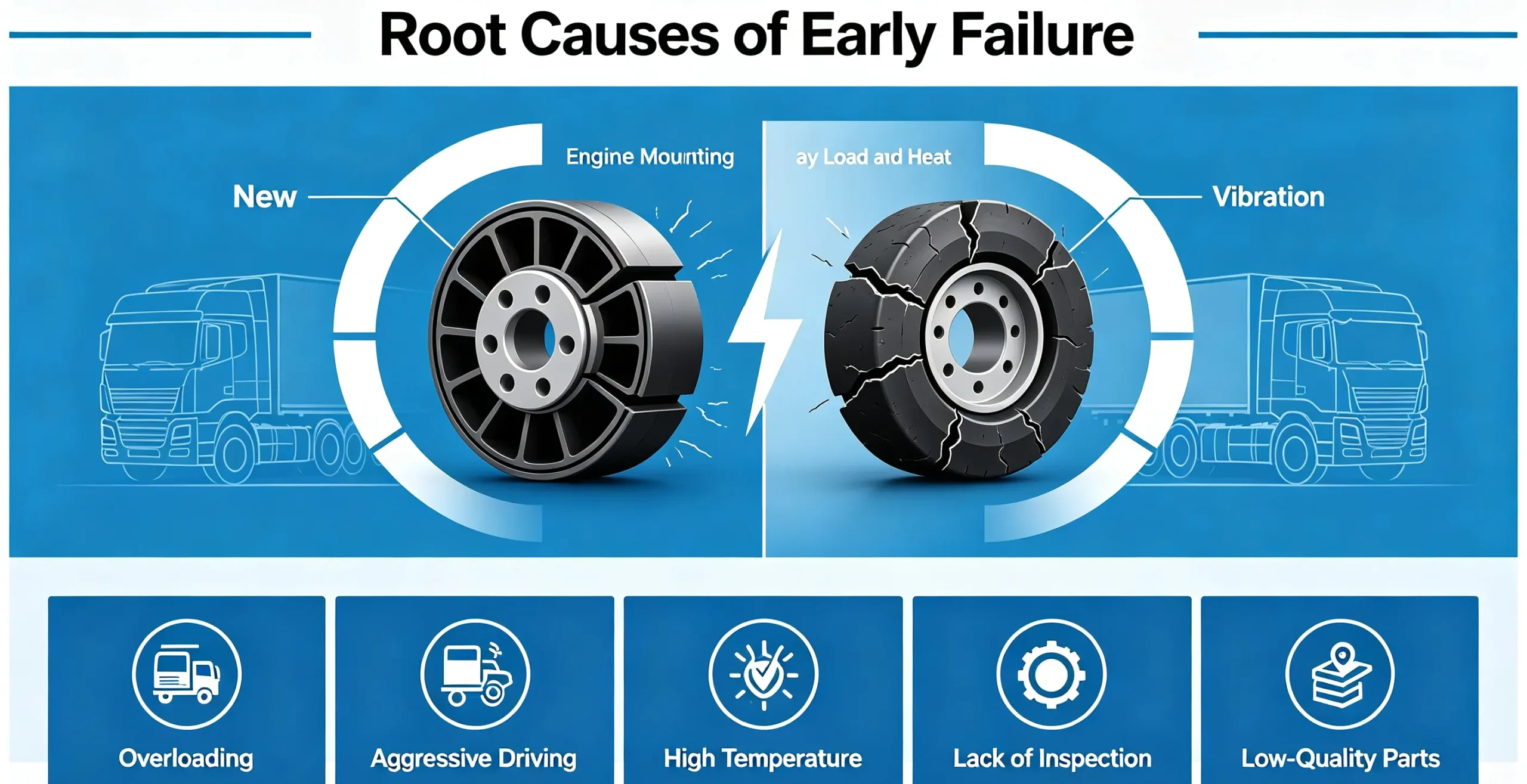
High-quality original factory standard engine mounting rubbers have a theoretical service life of 3 to 5 years under standard load and good road conditions.
A large number of trucks have serious rubber aging and failure within 1 to 2 years of use. Almost all early failures are caused by improper use and insufficient maintenance.
1. Long-Term Overload Transportation
Overload operation is the primary cause of premature failure of heavy truck mounting rubbers.
Most freight and construction trucks work with overload for a long time to pursue economic benefits.
Exceeding the factory rated load makes the mounting rubber bear far beyond the designed pressure for a long time.
The rubber produces permanent compression deformation and elastic fatigue, which cannot be recovered.
Long-term overload will greatly shorten the service life of mounting rubbers by more than half.
2. Severe Working Environment Impact
Mining trucks and engineering trucks often drive on gravel roads, muddy roads, rugged mountain roads and unopened construction roads.
Frequent jolts, bumps and instantaneous impact force cause continuous shear damage to mounting rubbers.
Harsh working environments accelerate rubber aging, structural cracking and internal skeleton fatigue.
3. Aggressive Driving Habits
Many truck drivers have aggressive driving habits, including frequent sharp acceleration, sudden braking and rapid gear shifting.
These operations will cause violent instantaneous displacement and torsion of the engine power assembly.
The mounting rubber bears repeated strong shear force and impact force, resulting in rapid elastic loss and fatigue damage.
4. Long-Term High-Temperature Aging
Heavy trucks often run continuously for long distances. The engine cabin maintains a high-temperature state for a long time.
Continuous high temperature accelerates the aging and molecular cracking of rubber materials.
The rubber gradually hardens and becomes brittle, completely losing elastic buffer and vibration isolation ability.
5. Lack of Routine Inspection
Most fleet maintenance plans only focus on oil replacement and filter element maintenance.
There is no regular inspection mechanism for chassis wearing parts such as mounting rubbers.
Minor cracks and slight deformation continue to accumulate and eventually evolve into complete failure.
6. Inferior Aftermarket Replacement Parts
Many truck owners choose low-cost inferior fake mounting rubbers to save maintenance costs.
Inferior products have no built-in steel skeleton reinforcement, and the rubber formula is poor.
They are prone to rapid aging, bulging and collapse after installation, resulting in repeated faults.
Using low-quality parts will only increase later maintenance costs and vehicle downtime losses.
Step-by-Step Engine Mounting Rubber Replacement Guide
Engine mounting rubber replacement is a standardized and professional chassis maintenance project.
Non-standard disassembly and installation will easily cause engine offset, unbalanced stress and secondary vibration faults.
The following detailed operation steps are summarized based on years of heavy truck field maintenance experience, suitable for all Chinese mainstream heavy-duty truck models.
Step 1: Safety Preparation and Vehicle Parking
Park the heavy truck on flat, hard and horizontal ground to ensure stable body support.
Tighten the handbrake firmly and pad the front and rear tires with anti-slip wooden blocks to prevent vehicle sliding.
Turn off the engine completely and cut off the vehicle power supply.
Wait for more than 30 minutes to let the engine and cabin cool down naturally to avoid high-temperature scalding during construction.
Step 2: Stably Support Engine Assembly
Use a professional hydraulic jack and fixed safety support frame to support the engine and gearbox assembly.
Select the solid and thick part of the engine block as the stress support point.
It is forbidden to support the oil pan alone to avoid oil pan deformation and engine damage.
Adjust the jack height to make the engine stress uniform and stably fixed without shaking.
Step 3: Remove Blocking Accessories
Remove the bottom engine guard plate, air guide pipe and pipeline limit frame in turn.
Disassemble the wiring harness fixing cards and limit bolts that block the installation position.
Classify and store all disassembled bolts and small accessories in order to avoid loss and misinstallation.
Fully clean up obstacles to completely expose the mounting rubber installation area.
Step 4: Dismantle Old Mounting Rubber
Loosen the fixing bolts symmetrically in diagonal order to avoid single-side unbalanced stress of the engine.
After all bolts are completely loosened, take out the aging rubber pad and matching metal bracket completely.
If the old rubber is stuck due to long-term compression and aging, gently pry it loose with a flat screwdriver.
Step 5: Clean Installation Plane
Thoroughly polish and clean the engine mounting plane and chassis frame mounting plane.
Completely remove surface oil dirt, rust, sundries and residual rubber debris.
Ensure the installation plane is flat, clean and free of protrusions to avoid unbalanced stress of new parts.
Step 6: Install New Mounting Rubber
Take out the new high-quality mounting rubber assembly and place it accurately according to the positioning groove.
Carefully check the front, rear, left and right orientation to avoid reverse installation.
Align the metal bracket with the chassis mounting holes and place it flat without skew and deviation.
Step 7: Standard Torque Fastening
Screw the fixing bolts manually first to ensure smooth thread and no slipping teeth.
Use a professional torque wrench to tighten the bolts symmetrically and diagonally according to the factory standard torque value.
Over-tightening will crush the rubber buffer layer, and under-tightening will cause engine shaking and displacement.
Step 8: Reset Accessories and Test Drive
Reinstall all disassembled guard plates, air pipes, wiring harnesses and limit accessories in reverse order.
Start the engine to run idle for 5 to 10 minutes to check for abnormal vibration and noise.
Carry out low-speed road test to confirm stable engine operation and no chassis resonance fault.
Professional Tips for a Successful Replacement
Most post-replacement vibration recurrence faults are caused by ignored small operational details.
Mastering professional maintenance skills can effectively improve the one-time qualification rate of replacement construction.
-
Replace in complete sets: Front, rear, left and right mounting rubbers bear engine stress synchronously. It is forbidden to replace a single rubber pad alone. Mixed use of new and old parts will cause unbalanced stress and rapid secondary failure.
-
Strict torque control: Different heavy truck models have corresponding factory torque parameters. Standard diagonal fastening ensures uniform stress and stable vibration damping performance.
-
Check matching parts synchronously: During rubber replacement, inspect engine fixing brackets, limit bolts and gaskets. Replace deformed and fatigued metal parts together to avoid hidden dangers.
-
Keep horizontal installation: Ensure the engine is in neutral horizontal state during installation. Offset installation will cause long-term eccentric wear of transmission system parts.
Long-Term Maintenance Tips to Extend Mounting Rubber Life
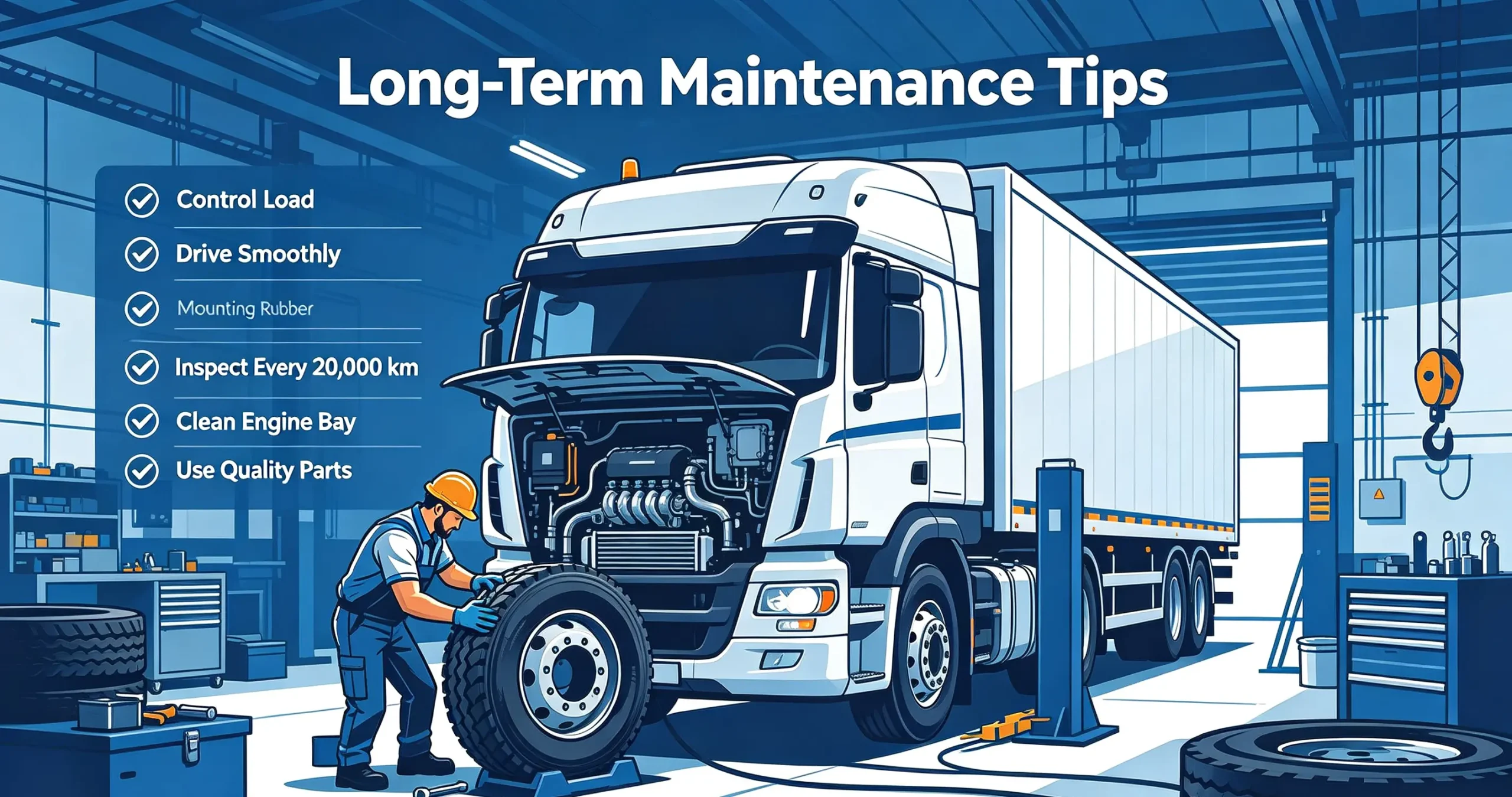
Scientific and standardized daily maintenance can greatly delay the aging speed of mounting rubbers and reduce replacement frequency.
It effectively saves long-term fleet maintenance costs and improves vehicle operation stability.
-
Strictly control load capacity: Avoid long-term overload driving. Keep the cargo load within the factory rated range to reduce long-term compression fatigue of rubber parts.
-
Optimize daily driving habits: Adopt stable and gentle driving mode. Reduce frequent sharp acceleration, sudden braking and rapid gear shifting to lower instantaneous impact on mounts.
-
Regular special inspection: Conduct special inspection of mounting rubbers every 20,000 kilometers. Focus on checking cracks, collapse, bulging and looseness.
-
Keep engine cabin heat dissipation smooth: Regularly clean cabin dust, oil dirt and sundries. Avoid heat accumulation causing high-temperature aging of rubber.
-
Adhere to high-quality OEM parts: Reject inferior low-price accessories. Choose high-quality original standard mounting rubbers to ensure long-term stable vibration damping performance.
Frequently Asked Questions
Q: How long do heavy truck engine mounting rubbers last?
A: High-quality OEM standard mounting rubbers can last 3–5 years under standard load and flat road conditions. Long-term overload and harsh working conditions will shorten the service life to 1–2 years or even shorter.
Q: Can I continue driving with slightly aging mounting rubber?
A: Slight surface aging and micro-cracks can be used temporarily with frequent inspection. Once collapse, obvious cracks or offset appear, replacement must be carried out immediately to prevent engine displacement faults.
Q: Why does engine vibration still exist after replacing new mounting rubber?
A: The main reasons include uneven installation plane, non-standard fastening torque, aging and deformation of matching brackets, and non-set replacement of single rubber pad. Recheck all installation details and stressed parts.
Conclusion
Engine mounting rubber is a small but extremely core wearing part in the heavy-duty truck power system.
Although it is inconspicuous in the whole vehicle structure, it undertakes key functions of load-bearing, vibration isolation and positioning.
The working state of mounting rubbers directly determines engine operating stability, driving comfort and overall vehicle safety.
Most early failures of mounting rubbers are caused by unreasonable load, harsh working conditions, irregular driving habits and insufficient daily maintenance.
Timely identification of failure symptoms and standardized replacement maintenance can effectively avoid high-cost secondary faults and vehicle downtime.
Scientific long-term maintenance can significantly extend the service life of mounting rubbers and reduce fleet operating costs.
For global fleet owners and maintenance technicians, mastering mounting rubber maintenance knowledge is an essential basic skill.
It helps improve vehicle operation efficiency and reduce unplanned maintenance losses.
When you need durable, high-precision and OEM-matching heavy truck replacement parts, please choose professional and reliable suppliers.
Mettlead Truck Parts provides full-series high-quality heavy-duty truck chassis parts and engine accessories for global users.
All products meet original factory standards, effectively solving vibration, abnormal noise and wear problems for Chinese heavy trucks, and escorting long-term stable fleet operation.


