
Introduction
Heavy-duty trucks operate under extreme load conditions every single day. Whether hauling full cargo across long highways or climbing steep mountain roads, diesel engines consistently maintain high output to meet transportation demands.
As a result, engine temperature control becomes one of the most critical factors for long-term vehicle reliability. Even minor cooling system abnormalities can gradually evolve into severe mechanical failures.
Most fleet managers and professional drivers pay close attention to large cooling components. Radiators, cooling fans and water pumps always receive regular inspection during routine maintenance.
However, many operators overlook a tiny yet decisive component: the coolant temperature sensor. Despite its compact size, this sensor directly controls the engine’s temperature adjustment logic.
Simply put, the coolant temperature sensor acts as the engine’s temperature eyes. It continuously monitors real-time coolant temperature and sends accurate data to the truck’s ECU.
Based on these signals, the engine control unit adjusts fuel injection, fan speed, idle performance and exhaust treatment strategies. Therefore, any sensor deviation will disrupt the entire cooling system rhythm.
What makes this issue tricky is that sensor faults do not always trigger obvious warning lights immediately. In the early failure stage, symptoms appear intermittently and easily get mistaken for normal engine fluctuations.
As time passes, inaccurate temperature readings lead to slow warm-up, excessive fuel consumption, poor power output and even unplanned overheating.
For long-haul fleets, unexpected overheating faults result in delayed deliveries, expensive roadside repairs and shortened engine service life. In severe cases, piston scuffing or cylinder deformation can permanently damage the engine.
To avoid these costly consequences, every driver and technician must master basic sensor diagnosis and repair skills. In this guide, we cover real failure causes, practical symptom identification, precise testing methods and standardized repair procedures.
Additionally, you can build a full cooling system protection routine by learning heavy truck engine cooling system maintenance to reduce long-term breakdown risks.
What Is a Coolant Temperature Sensor & How Does It Work?
Before troubleshooting specific faults, it is necessary to clarify the basic function and working principle of the coolant temperature sensor. This fundamental knowledge helps you avoid misdiagnosis during actual repair scenarios.
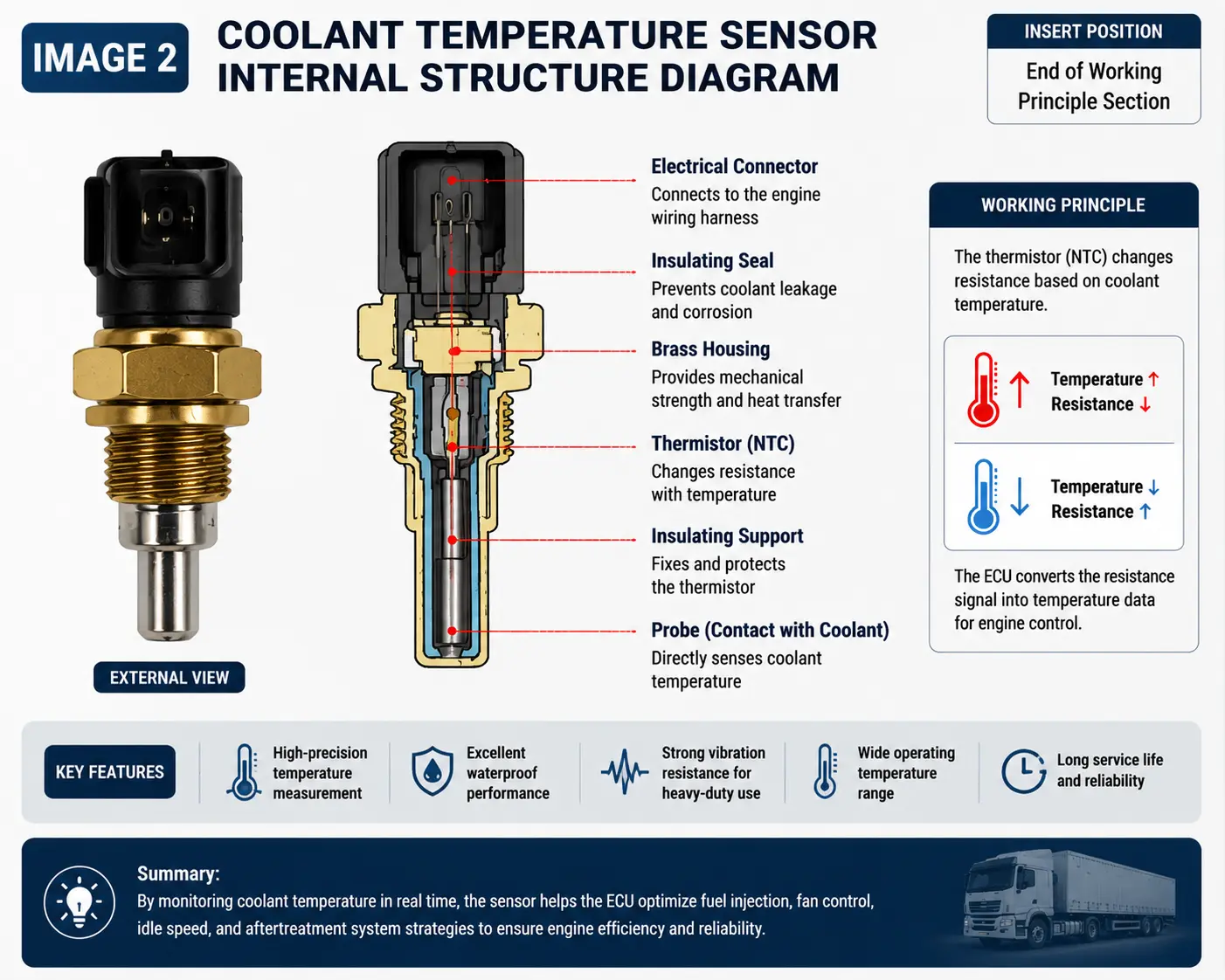
In heavy-duty diesel trucks, the coolant temperature sensor is a thermistor-based precision electronic component. Its core characteristic is that internal resistance changes according to coolant temperature fluctuations.
Generally, heavy truck engines adopt negative temperature coefficient thermistors. This means when coolant temperature rises, sensor resistance decreases. When temperature drops, resistance increases accordingly.
The ECU captures these real-time resistance changes and converts them into accurate temperature data. This data becomes the core basis for all engine thermal management decisions.
Unlike light vehicle sensors, heavy-duty truck sensors feature enhanced waterproof performance, vibration resistance and high-temperature tolerance. These upgrades adapt to long-hour operation and harsh chassis vibration environments.
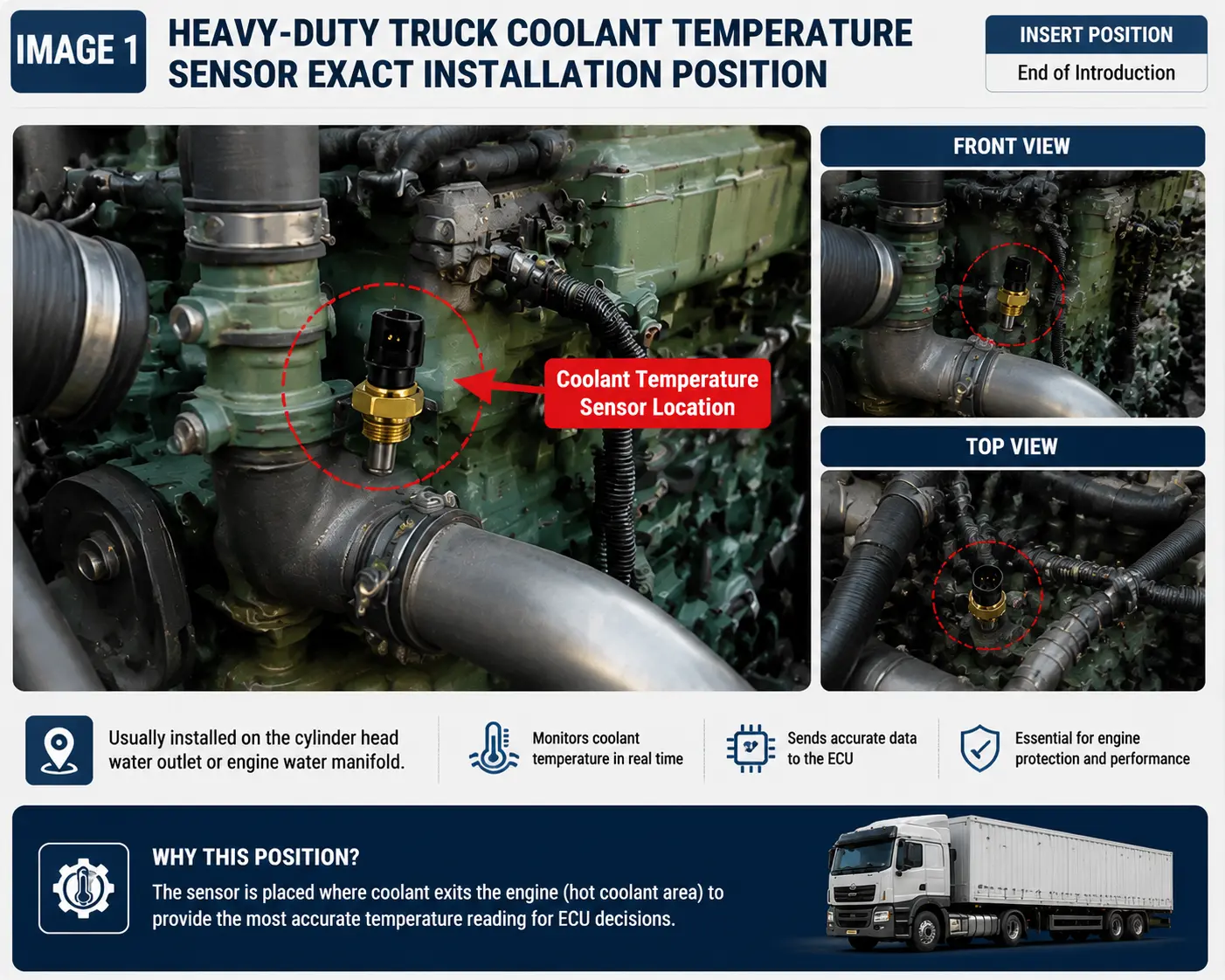
In most mainstream truck models including Sinotruk, FAW, Shacman and Dongfeng, the coolant temperature sensor installs on the cylinder head water outlet or engine water manifold. This position ensures direct and accurate temperature detection.
It is worth noting that some engines are equipped with two temperature sensors. One sensor is responsible for ECU signal feedback, while the other transmits data to the dashboard temperature gauge.
Therefore, when dashboard readings are abnormal but the engine runs normally, or vice versa, technicians need to distinguish the functions of the two sensors instead of blindly replacing parts.
Furthermore, the coolant temperature sensor works closely with other cooling system parts. If you want to distinguish component responsibilities clearly, you can check our detailed introduction about truck water pump failure symptoms and causes to avoid confusing cooling system faults.
Primary Root Causes of Coolant Temperature Sensor Failure
Coolant temperature sensor failures rarely occur without reason. Through sorting out a large number of fleet maintenance records, we found that most sensor faults stem from cumulative wear and improper daily use.
Different failure causes correspond to different fault manifestations. By matching causes and symptoms, you can achieve one-time accurate diagnosis and avoid repeated disassembly and replacement.
1. Long-Term High-Temperature Aging
The sensor probe is always immersed in circulating high-temperature coolant during engine operation. Long-term alternating temperature changes will gradually aging internal thermistor materials.
After aging, the sensor resistance response becomes sluggish. It cannot synchronize with real-time coolant temperature changes, resulting in delayed or inaccurate signal output.
This aging process is irreversible. Generally, after 2 to 3 years of high-intensity operation, most sensors will have different degrees of performance degradation.
2. Coolant Deterioration & Internal Scale Deposition
Many fleet teams ignore regular coolant replacement. After long-term use, the coolant will deteriorate, precipitate impurities and form thick scale on the sensor surface.
Scale covers the sensor probe and isolates direct contact between the probe and coolant. In this case, the sensor can only detect surface temperature of the scale instead of real water temperature.
This leads to constant low temperature display, delayed fan start and invisible overheating risks. This is also one of the most easily overlooked hidden dangers in daily maintenance.
3. Chassis Vibration & Loose Installation
Heavy trucks often pass through bumpy road conditions. Long-term high-frequency vibration will loosen the sensor thread and connector.
Loose installation causes poor sensor contact and unstable signal transmission. In serious cases, the sensor probe position deviates, affecting temperature detection accuracy.
4. Water Leakage & Connector Oxidation
Aging sensor sealing gaskets will cause slight coolant leakage. The leaked liquid flows to the wiring plug and causes pin oxidation and corrosion.
Oxidized pins lead to increased circuit resistance, signal distortion and intermittent signal loss. Finally, the ECU reports fault codes or displays abnormal temperature values.
5. Improper Maintenance Operation Damage
During engine overhaul or cooling system maintenance, many technicians apply excessive force when disassembling peripheral parts. This operation easily scratches the sensor probe or squeezes the wiring harness.
In addition, using unqualified coolant will corrode the sensor probe in advance and shorten the overall service life of the component.
6. Harness Aging & Circuit Short Circuit
The sensor wiring harness is exposed near the engine for a long time. High-temperature baking and rubber aging will cause wire skin cracking and water ingress.
Once a short circuit or open circuit occurs, the sensor completely fails to work, and the engine enters default protection mode.
Typical Symptoms of a Faulty Coolant Temperature Sensor
Sensor faults have obvious progressive characteristics. Early symptoms are relatively mild, while later failures will seriously affect driving safety and economic benefits.
The following abnormal performances are all typical manifestations of coolant temperature sensor failure. You can quickly judge the fault state according to actual vehicle conditions.
1. Abnormal Dashboard Temperature Display
This is the most intuitive fault feature. Some vehicles show extremely low temperature all year round even after long-distance driving.
Conversely, some dashboards suddenly jump to high temperature or even red warning state during normal driving, while the actual engine temperature is normal.
These jumping or fixed abnormal readings basically prove that the temperature sensor signal is distorted or invalid.
2. Difficult Cold Start & Long Cranking Time
When the sensor fails to detect low-temperature coolant state accurately, the ECU cannot activate the cold-start rich fuel strategy normally.
As a result, the engine lacks sufficient fuel supply during cold startup, causing prolonged cranking, unstable ignition and even startup failure.
3. Sharp Increase in Fuel Consumption
Under normal working conditions, the engine will reduce fuel injection properly after reaching operating temperature. However, a faulty sensor always feeds back low-temperature signals to the ECU.
The ECU mistakenly judges that the engine is still in cold state and maintains long-term rich fuel injection. This directly leads to significantly increased fuel consumption per hundred kilometers.
4. Cooling Fan Runs Abnormally
If the sensor signal is stuck at high temperature, the cooling fan will keep running at high speed even when the engine is cold, resulting in extra power loss and abnormal noise.
On the contrary, if the signal is fixed at low temperature, the fan cannot start when the engine is hot, causing hidden overheating dangers during climbing or heavy-load operation.
5. Unstable Idle & Jittering Engine
Inaccurate temperature signals interfere with ECU idle adjustment logic. The engine cannot switch to stable hot-idle state normally.
Therefore, obvious idle jitter, irregular RPM fluctuation and weak low-speed torque will appear after the engine is warmed up.
6. Engine Overheating & Fault Code Alarm
In the late stage of sensor failure, complete signal loss will trigger the engine protection mechanism. The system pops up temperature sensor fault codes and limits engine power output.
If the driver ignores the alarm and continues driving, real overheating will occur, causing cylinder pad burnout and engine thermal deformation.
It is worth mentioning that many engine power loss faults are easily confused with sensor problems. You can accurately distinguish faults through our sorted truck engine power loss causes to avoid wrong repairs.
Pre-Inspection Preparation & Safety Specifications
Before officially disassembling and testing the coolant temperature sensor, standardized preparation work must be completed. This step can effectively avoid secondary damage and safety accidents.
First, park the truck on a flat and ventilated workshop ground. Firmly tighten the hand brake and pad the tires to prevent vehicle sliding during operation.
Most importantly, do not inspect immediately after turning off the engine. You need to wait 20 to 30 minutes for the coolant temperature to drop naturally.
High-temperature coolant has strong pressure. Random disassembly will cause liquid ejection and scalding accidents. This is a safety rule that must be followed strictly.
Prepare necessary tools in advance, including a digital multimeter, socket wrench set, clean container for residual coolant, waterproof gloves and clean wiping cloths.
At the same time, clean the dust and oil stains around the engine sensor installation position to prevent sundries from falling into the coolant pipeline after disassembly.
For standard engine operation specifications, you can refer to truck chassis parts installation tips to ensure standardized and safe overall operation.
Step-by-Step Coolant Temperature Sensor Testing & Repair Process
The following set of processes is suitable for all mainstream heavy-duty truck models. Independent maintenance workshops and fleet maintenance teams can directly apply this complete process for diagnosis and replacement.
Step 1: Record Vehicle Fault Phenomena
First, start the engine and observe the real-time performance of the dashboard temperature gauge. Record whether the temperature is too low, too high or jumping randomly.
At the same time, confirm whether the cooling fan works normally and whether there are jitter, power loss and excessive fuel consumption problems. These records provide basis for subsequent fault judgment.
Step 2: Read ECU Fault Codes & Data Stream
Connect the professional truck diagnostic instrument to read historical and current fault codes. Common sensor fault codes include open circuit, short circuit and signal deviation.
In addition, observe the real-time temperature data stream. If the data remains unchanged with temperature changes, the sensor has completely failed.
Step 3: Visual Inspection of Sensor & Harness
Check whether the sensor installation thread is loose, whether there is coolant seepage around the gasket, and whether the probe is covered with thick scale.
Inspect the wiring harness for cracking, abrasion and water ingress. Check whether the plug pins are oxidized, corroded or loose.
Most low-level faults can be directly found through visual inspection, which can save unnecessary disassembly steps.
Step 4: Multimeter Resistance Test
Turn off the engine and unplug the sensor connector. Adjust the multimeter to the resistance gear and connect the two pins of the sensor.
Measure the resistance value at normal temperature and hot engine state respectively. Compare the measured data with the factory standard parameters.
If the resistance value does not change with temperature, or the numerical deviation is too large, it can be judged that the sensor is invalid and needs to be replaced.
Step 5: Safely Remove the Faulty Sensor
Place a clean container under the sensor to collect the flowing coolant and avoid waste and environmental pollution.
Slowly unscrew the sensor with a socket wrench. Do not use violent shaking to prevent thread slipping and engine body damage.
After removal, check the probe surface scaling and corrosion degree again to confirm the real cause of failure.
Step 6: Clean Installation Position & Replace Sealing Gasket
Clean the residual scale and old gasket residues on the installation thread to ensure a flat and clean installation base surface.
It is necessary to replace the brand-new sealing gasket. Never reuse the old gasket, otherwise secondary liquid leakage will easily occur.
Step 7: Install New OEM Standard Sensor
Select the sensor completely consistent with the original factory model. Generic parts often have inaccurate resistance parameters and poor temperature adaptability.
Align the thread and screw it in manually first to avoid thread slipping. After positioning, tighten it with a wrench moderately. Do not over-tighten to prevent thread cracking.
Step 8: Reconnect Harness & Check Sealing Performance
Insert the wiring plug firmly until you hear a locking click to ensure good contact. Arrange the harness reasonably to avoid extrusion and high-temperature baking.
Start the engine and idle for several minutes to observe whether there is liquid leakage at the sensor installation position.
Step 9: Replenish Coolant & Exhaust Air
After disassembly and replacement, air will enter the cooling system. Trapped air will cause inaccurate temperature detection and local overheating.
Supplement qualified coolant to the standard liquid level, and perform standard air exhaust operation according to the vehicle model requirements.
Step 10: Test Run & Verify Repair Effect
After the engine is fully warmed up, observe the dashboard temperature change. Check whether the cooling fan starts and stops normally.
Test the vehicle for a short distance to confirm that there is no power loss, jitter and abnormal fuel consumption. At the same time, read the data stream again to verify that the temperature signal is normal.
For standardized vehicle maintenance processes, you can refer to heavy truck maintenance steps guide to standardize each repair link.
Common Technician Mistakes During Sensor Replacement
In daily maintenance work, many small operational errors will lead to unsatisfactory repair results. Even after replacing the sensor, old faults still recur.
1. Reusing Old Sealing Gaskets
Old gaskets have aging deformation and poor compression performance. Reuse will inevitably lead to slow coolant leakage and air intake, affecting temperature stability.
2. Installing Incompatible Universal Sensors
Different engine models have different thermistor resistance parameters. Universal sensors cannot match the ECU program, resulting in inaccurate signal feedback all the time.
3. Ignoring Scale Cleaning
If the installation hole scale is not cleaned, even a new sensor will be covered quickly, resulting in repeated failure of temperature detection.
4. Skipping Air Exhaust After Replacement
Many technicians ignore air exhaust. Trapped air causes virtual high temperature or virtual low temperature, which is easily misjudged as new sensor failure.
5. Random Wiring Harness Binding
Exposed and disordered wiring harnesses are prone to high-temperature aging and vibration friction damage, laying hidden dangers for future circuit faults.
Preventive Maintenance Tips to Extend Sensor Service Life
Most coolant temperature sensor faults are preventable. Scientific daily maintenance can greatly extend component service life and reduce unexpected failure rates.
1. Replace Coolant Regularly
Strictly follow the factory cycle to replace coolant. High-quality antifreeze can effectively inhibit scale generation, corrosion and probe aging.
Avoid mixing different brands of coolant, so as not to cause chemical reaction and precipitate impurities.
2. Regularly Clean Cooling System Scale
For vehicles with long service life, regularly clean the radiator and pipeline scale to keep the coolant circulation smooth and ensure accurate sensor detection.
3. Check Sensor Plug & Harness Monthly
Regularly check whether the plug is loose or oxidized, and whether the harness is worn. Deal with minor problems in advance to avoid expanding into major faults.
You can formulate a complete inspection plan with reference to truck monthly maintenance checklist.
4. Avoid Long-Term High-Temperature Overload Operation
Long-term heavy-load climbing and high-speed operation keep the engine at extreme temperature, which accelerates sensor aging and pipeline fatigue.
5. Keep Engine Compartment Clean
Regularly clean engine surface oil and dust to avoid heat accumulation, reduce harness aging speed and protect electronic sensor components.
OEM-Grade Truck Coolant System Parts Supply
The stability of engine temperature detection depends entirely on the quality of matching sensors. OEM-standard components can ensure accurate resistance parameters and long-term operational stability.
We supply full-series heavy-duty truck coolant temperature sensors, sealing gaskets and supporting cooling system parts for Sinotruk, FAW, Shacman, Dongfeng and other mainstream models.
All parts strictly follow factory size and parameter standards, supporting direct bolt-on installation without modification. No signal deviation or adaptive problems occur after replacement.
We support retail single-piece orders and fleet bulk wholesale. Sufficient stock and global shipping can quickly meet the parts demand of repair shops and transportation companies.
For professional technical support and parts consultation, please visit our official website mettlead.com to obtain one-stop spare parts service.
Frequently Asked Questions About Coolant Temperature Sensors
1. Can I continue driving with a faulty coolant temperature sensor?
It is not recommended. Although the vehicle can run temporarily, it cannot monitor real engine temperature. Once real overheating occurs, it will cause irreversible engine damage.
2. Why does the new sensor still display abnormal temperature?
The common reasons include incomplete air exhaust, residual scale interference, oxidized wiring pins or mismatched sensor model parameters.
3. How long is the service life of a heavy truck temperature sensor?
Under normal maintenance conditions, the service life is about 3 to 5 years. Poor coolant quality and frequent high-load operation will greatly shorten the service life.
4. Will sensor failure cause the engine to stall?
Serious signal loss will trigger the engine protection mode, resulting in power limitation and even forced shutdown during driving, which affects driving safety.
5. What is the difference between single-core and dual-core temperature sensors?
Single-core only provides ECU signal, while dual-core simultaneously supplies signals for ECU and dashboard. The two cannot be replaced universally.
Conclusion
The coolant temperature sensor is a small but core component in the heavy truck engine cooling system. Its working state directly determines engine temperature control accuracy, fuel economy and driving safety.
Most sensor faults come from coolant deterioration, scale deposition, harness aging and long-term high-load operation. These hidden faults are gradual and can be completely avoided through standardized maintenance.
Timely identification of early symptoms, standardized testing and replacement operations are the key to solving sensor problems. At the same time, replacing high-quality OEM parts can ensure long-term stable operation.
For fleet managers, establishing a regular cooling system inspection mechanism can effectively reduce vehicle failure rate, cut maintenance costs and improve transportation efficiency.
If you need matching OEM-grade coolant temperature sensors and professional repair guidance for your heavy truck, our team can provide you with fast quotation and technical support.


