
Introduction
Heavy-duty trucks handle long hauls, heavy loads and nonstop highway travel. A stable engine cooling system keeps these vehicles running safely under tough working conditions.
Most fleet technicians focus on big cooling parts like radiators and cooling fans. Yet the water pump pulley is often ignored. This small mechanical part plays a critical role in cooling system operation.
The water pump pulley transfers rotation power from the engine belt to the water pump shaft. Without a working pulley, the water pump cannot spin or circulate engine coolant.
Small pulley problems slowly stop coolant flow. They trigger steady overheating and lead to permanent engine damage if left unfixed.
Pulley failures are progressive, not sudden. Early signs include faint noise and minor vibration. Most drivers overlook these subtle daily warning signals.
As damage worsens, pulley wobble, belt slippage and loose bolts appear. In extreme cases, the pulley detaches while driving. This causes instant overheating and forced roadside stops.
Unexpected pulley failures hurt fleet operations. They cause delivery delays, costly emergency repairs, wasted labor and lower vehicle efficiency.
Severe overheating leads to cylinder head deformation and piston damage. Full engine overhauls cost fleets thousands of dollars in avoidable expenses.
All truck drivers and fleet maintenance staff should master pulley failure diagnosis and standard repair methods.
This guide covers practical failure causes, clear symptoms, professional testing and step-by-step repairs. It also shares daily maintenance tips to prevent future issues.
If you need matched cooling system components for your heavy truck, explore our full truck system parts catalog covering all cooling and drive system accessories.
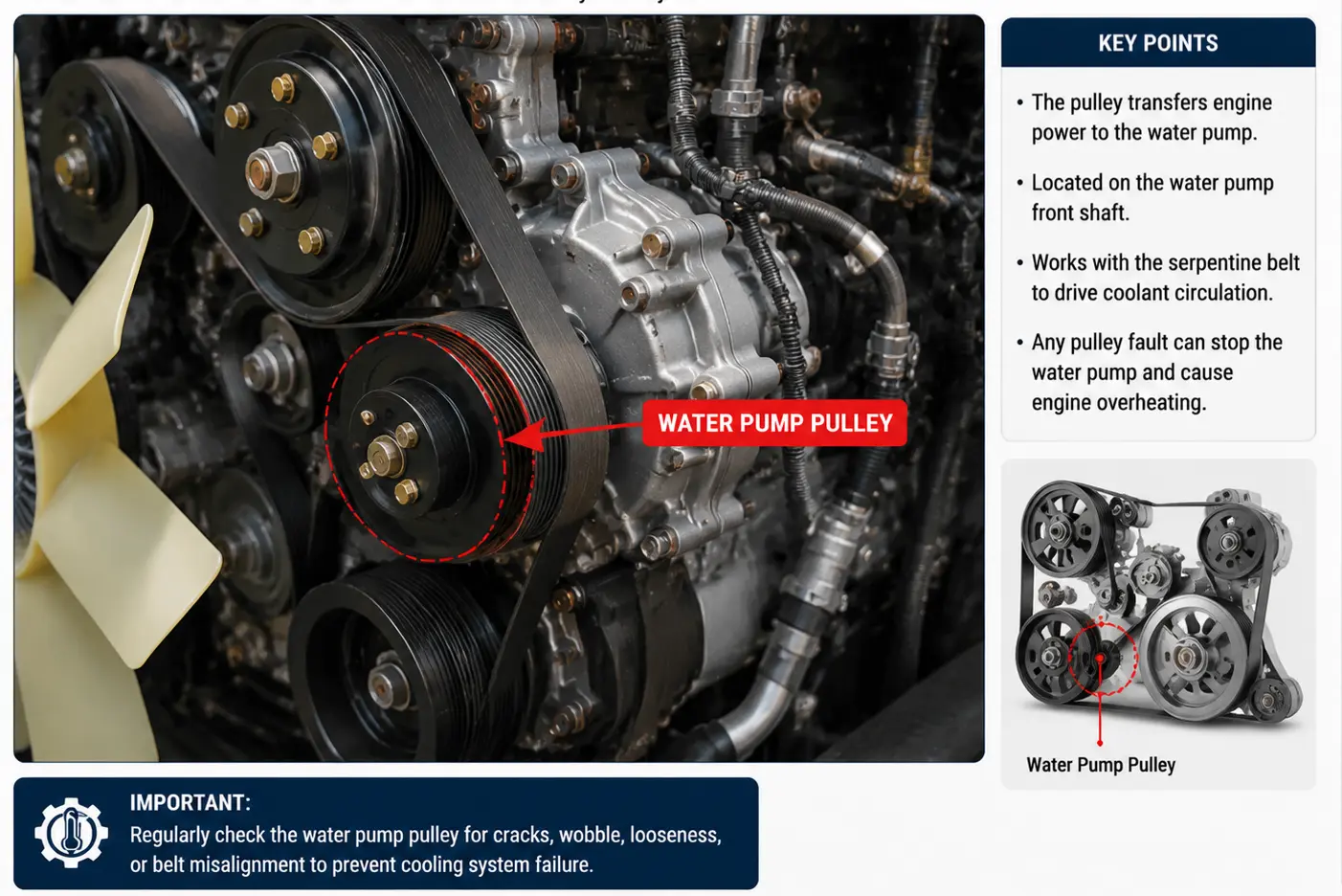
What Is a Truck Water Pump Pulley & How Does It Work?
Basic structural knowledge helps you avoid misdiagnosis during maintenance. It simplifies accurate pulley fault troubleshooting for heavy-duty trucks.
The water pump pulley is a round metal or high-strength plastic component. It mounts on the front shaft of the engine water pump and belongs to the front accessory drive system.
Its core job is straightforward. It receives power from the engine crankshaft via the serpentine belt. It then drives the water pump impeller to rotate continuously.
A rotating impeller pushes coolant through the engine block, cylinder head and radiator. This steady circulation maintains a safe and stable engine temperature.
Heavy-duty truck pulleys differ from light-vehicle versions. They have thicker walls, reinforced bolt holes and stronger vibration resistance.
These durable designs fit long-hour high-load operation, frequent start-stop cycles and rough road conditions for commercial trucks.
This pulley fits most mainstream truck models, including Sinotruk, FAW, Shacman, Dongfeng and Cummins-powered units. It sits in the lower-middle section of the front accessory drive system.
It works alongside tensioner pulleys, idler pulleys, fan clutches and alternator pulleys. Together, these parts form a complete belt-driven power loop.
The pulley does not pump coolant itself. It only delivers rotation power. Still, nearly all water pump operational faults show first through pulley abnormalities.
Always check both the pulley and water pump bearing when you hear front-engine noise or feel vibration. You can find brand-specific OEM pulleys for your vehicle model in our heavy truck brand parts collection.
Main Root Causes of Truck Water Pump Pulley Failure
Pulley failures almost never happen without warning. Most issues stem from long-term wear, improper maintenance or damaged matching parts.
Each failure cause creates unique symptoms. Matching signs to root problems helps you complete one-time accurate repairs and avoid repeated disassembly.
1. Long-Term Vibration & Fatigue Deformation
Trucks often travel on bumpy mountain roads, rural roads and construction routes. Constant chassis vibration transfers to the front engine accessory system.
Thousands of operating hours create tiny fatigue cracks on pulley metal surfaces. These cracks expand over time and cause bending or partial fracture.
Pulleys with slight installation offset bear uneven rotation force. They wear out much faster than correctly installed parts.
2. Improper Belt Tension (Too Tight or Too Loose)
Many new technicians over-tighten serpentine belts during replacement. Excessive tension creates strong continuous pull on the pulley.
This tight force squeezes pulley grooves, accelerates bearing wear and even bends the water pump shaft in severe cases.
Loose tension causes belt slippage. Friction heat burns and hardens pulley surfaces, creating uneven groove wear and slippery glaze buildup.
3. Water Pump Bearing Wear & Shaft Runout
The internal bearing supports the entire rotating pulley structure. Worn loose bearings eliminate stable rotation support.
This issue creates obvious pulley wobble and eccentric movement. Unbalanced rotation worsens belt wear and produces constant abnormal noise.
Over 70% of pulley wobble faults come from worn bearings, not damaged pulley bodies. Replacing only the pulley will not fix the root issue.
4. Foreign Object Impact & Physical Damage
Gravel, mud and road debris often bounce into the front engine compartment during travel. These objects strike the spinning pulley.
Minor impacts scratch pulley grooves. Hard collisions bend pulley edges, create chips and cause rotation deviation.
Rough prying during past maintenance also causes invisible deformation that leads to future failure.
5. Coolant Leakage & Metal Corrosion
Aging water pump seals leak coolant onto the pulley surface. Long-term coolant exposure erodes metal and builds up rust.
Corroded pulleys cannot fully grip the serpentine belt. This triggers frequent slippage, unstable power transfer and faster belt aging.
6. Low-Quality or Mismatched Aftermarket Pulleys
Many fleets install cheap universal pulleys to cut costs. These unqualified parts have thin material, inaccurate groove angles and poor dynamic balance.
Even short-term use causes severe vibration, belt deviation and accelerated wear across the entire accessory drive system.
7. Loose Bolts & Misaligned Installation
Incomplete bolt tightening or long-term vibration loosens pulley fasteners. Slight looseness immediately causes rotation wobble and offset.
Unfixed loose bolts gradually worsen. They may detach completely and make the pulley fall off during driving.
For more professional troubleshooting and maintenance guidance for truck cooling systems, check our technical support resource library.
Typical Symptoms of a Bad Truck Water Pump Pulley
Pulley failures follow clear progressive stages. Early symptoms are mild and intermittent. Late-stage issues threaten driving safety and engine integrity.
Learning these common signs lets you catch faults early and prevent small issues from turning into costly engine damage.
1. Front Engine Squealing or Chirping Noise
Abnormal squealing is the clearest early warning. Worn or deformed pulley grooves prevent tight belt contact and create high-frequency noise.
The sound is loudest during cold starts, acceleration and hill climbing. It fades slightly after warm-up but never fully disappears.
Noise that fluctuates with engine RPM always points to a front accessory pulley transmission fault.
2. Visible Pulley Wobble & Rotation Offset
Worn bearings or deformed pulleys create obvious side-to-side wobble during idling. Severe wear creates a larger swing range.
Healthy OEM pulleys spin smoothly with zero visible shaking. Wobble is the most reliable visual sign of pulley failure.
3. Excessive Belt Wear & Black Rubber Powder Buildup
Misaligned or deformed pulleys cause uneven belt friction. Fine black rubber powder collects heavily around pulley grooves.
Frequent belt cracking, edge fraying and rapid aging always signal underlying pulley problems.
4. Load-Dependent Engine Overheating
Severe pulley slippage slows water pump rotation below engine speed. Coolant circulation efficiency drops sharply under load.
Engine temperature stays normal at idle. It rises quickly during heavy-load driving or climbing and triggers overheating alerts.
5. Unstable Accessory Operation & Engine Vibration
Pulley offset creates unbalanced belt tension. This disrupts operation of the alternator, fan clutch and other accessories.
Drivers feel obvious front-engine jitter during acceleration, which reduces overall driving stability.
6. Recurring Coolant Leaks at the Pump Shaft
Persistent pulley wobble damages internal water pump seals. This causes slow coolant leakage at the pump shaft.
Many technicians only replace seals. They ignore pulley wobble, which is the true root cause, leading to repeated leaks.
7. Sudden Belt Shedding or Pulley Detachment
Advanced-stage failure causes loose bolts or broken pulley structures. The belt can slip off instantly while driving.
This stops coolant circulation completely and triggers rapid engine overheating. It creates major highway safety risks.
Our successful cooperation cases with global fleet enterprises cover various cooling system fault solutions, you can refer to our customer cooperation cases for practical fleet maintenance experience.
Pre-Repair Preparation & Safety Rules
Standard pre-repair steps prevent secondary part damage and personal injury. Always follow these rules before disassembly.
Park the truck on flat, dry workshop ground. Engage the hand brake fully and block tires to prevent sliding during service.
Never start work immediately after engine shutdown. Wait 20 to 30 minutes for the engine and coolant to cool completely.
Hot engine parts and boiling coolant cause severe scalds. Cooling system maintenance always requires full temperature reduction.
Prepare all tools in advance: socket wrench set, belt tension tool, flashlight, clean gloves and wiping cloths.
Place a clean container nearby to catch residual coolant. This prevents waste and workshop floor contamination.
If you encounter complex repair problems or need customized part consultation, feel free to contact our professional team for one-on-one technical support.
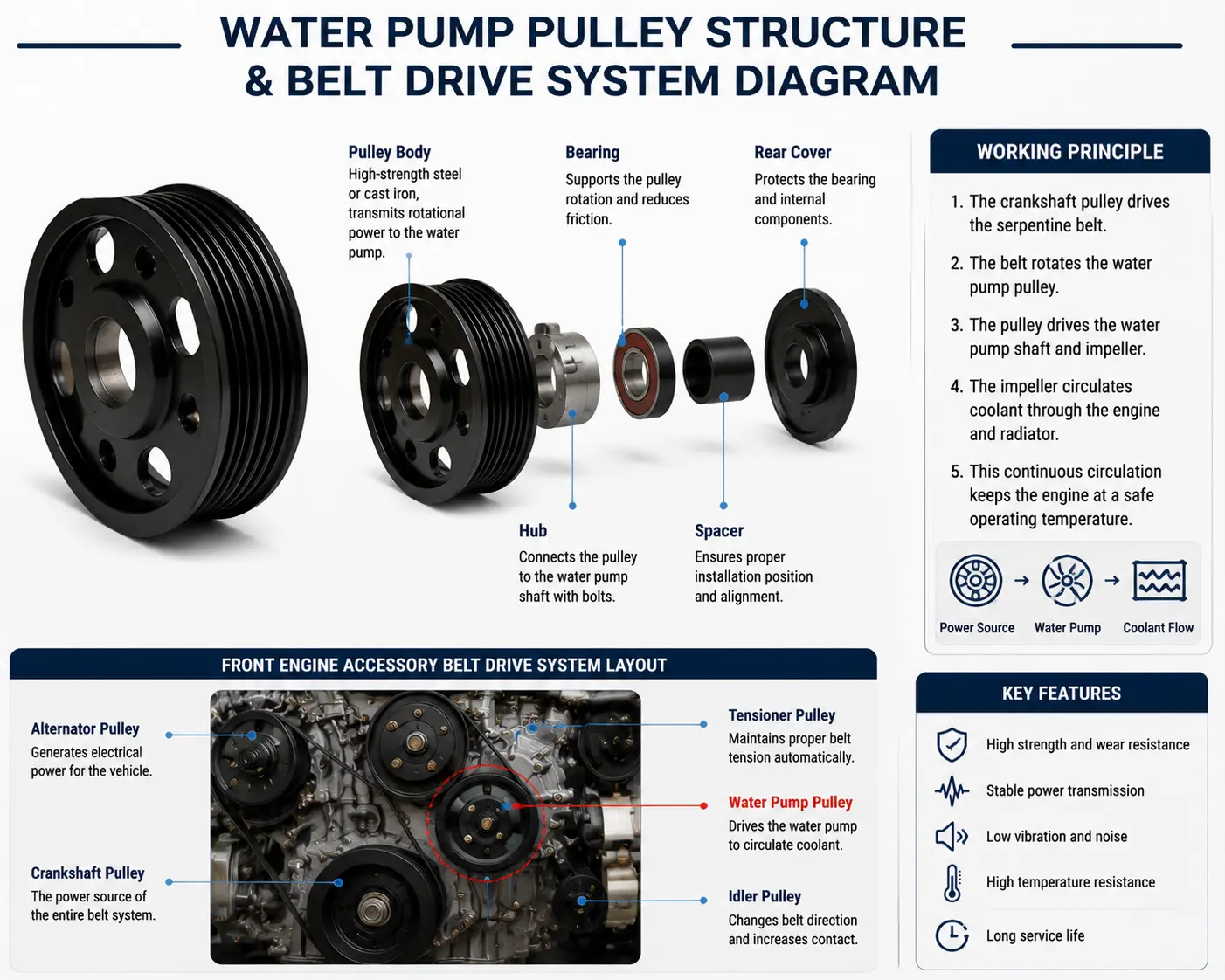
Step-by-Step Pulley Inspection & Replacement Guide
This universal process fits all mainstream heavy-duty truck models. Professional repair shops and fleet teams can apply these steps directly.
Step 1: Confirm Fault Symptoms & Test Operation
Start the engine and idle for 3–5 minutes. Listen closely for abnormal front-engine noise and check for pulley wobble.
Slightly raise engine RPM to observe noise changes. Record all abnormal symptoms for accurate diagnosis.
If possible, perform a short test drive to verify overheating or power loss under load conditions.
Step 2: Complete Visual Inspection After Cooling
Shut down the engine and wait for full cooling. Open the hood and inspect the pulley’s overall condition.
Check for cracks, edge chips, groove wear, corrosion spots and black rubber powder buildup.
Gently shake the pulley by hand. Excessive free movement signals loose bearings or loose mounting bolts.
Step 3: Check Belt Tension & Alignment
Inspect overall serpentine belt tension. Confirm it is not too tight, too loose or unevenly stressed.
Observe belt running track. Left or right deviation indicates pulley deformation or misaligned installation.
Ensure all accessory pulleys sit on the same horizontal plane before disassembly.
Step 4: Release Tension & Remove the Serpentine Belt
Use a professional tension tool to slowly lift the tensioner pulley. Release belt tension gently to avoid spring damage.
Once fully relaxed, slide the belt off the water pump pulley groove and lay it flat for inspection.
Check the belt for cracks, aging, hardening and groove wear. Replace damaged belts during pulley service.
Step 5: Loosen & Remove Pulley Mounting Bolts
Use a matched socket wrench to loosen bolts evenly in a diagonal pattern. This prevents uneven stress deformation.
Remove all bolts completely and store them in order to avoid loss or mixing.
Step 6: Remove Old Pulley & Test Pump Shaft
Pull the old pulley off slowly. Never pry violently, as this bends the delicate water pump shaft.
Manually rotate the pump shaft after removal. Check for stiff movement, abnormal noise and loose play.
Replace the bearing or full water pump assembly if the shaft does not rotate smoothly or wobbles.
Step 7: Clean Mounting Surface & Residual Debris
Wipe the pump shaft mounting base thoroughly. Remove dust, rust and leftover rubber debris.
A flat, clean mounting surface ensures tight, stable installation for the new pulley.
Step 8: Install New OEM Standard Pulley
Select a brand-new pulley that fully matches your truck’s OEM specifications. Match diameter, groove width and bolt hole positions exactly.
Align the pulley flat against the shaft and hand-thread bolts first to avoid stripped threads.
Tighten bolts diagonally and evenly with moderate torque. Avoid over-tightening to prevent deformation or thread damage.
Step 9: Reset Belt & Adjust Standard Tension
Route the serpentine belt back into all pulley grooves following the original factory path.
Confirm full groove engagement with no offset or jumping. Reset the tensioner to achieve standard belt tightness.
Keep tension balanced: overly tight belts wear bearings fast, while loose belts cause slippage and noise.
Step 10: Start Engine & Verify Full Function
Start the engine and idle for 5–10 minutes. Check for stable pulley rotation and abnormal noise.
Monitor engine temperature for overheating and inspect the pump shaft for coolant leaks.
Complete a short loaded test drive to confirm all faults are fully resolved.
You can learn more about our brand strength, product quality control and service advantages from our company profile page.
Common Mistakes That Cause Repeated Pulley Failures
Most recurring pulley faults stem from avoidable maintenance errors. These small oversights shorten part lifespan and waste repair costs.
1. Over-Tightening the Serpentine Belt
Technicians often over-tighten belts to prevent slippage. Excess tension creates constant pressure on pulleys and bearings.
This habit drastically accelerates wear and leads to premature component failure.
2. Ignoring Worn Tensioner and Idler Pulleys
Fatigued tensioner springs or worn idler pulleys cause unstable belt tension. New water pump pulleys will still wobble and make noise.
Always inspect matching accessory pulleys during every repair.
3. Only Replacing the Pulley (Ignoring Bad Bearings)
Worn pump bearings are the top cause of pulley wobble. Installing a new pulley on a bad bearing guarantees repeated failure.
Always test bearing condition before finishing repairs.
4. Using Mismatched Universal Aftermarket Pulleys
Generic universal pulleys have poor dynamic balance and non-standard groove sizes. They cause persistent vibration and belt deviation.
Stick to OEM-matched parts for long-term stability.
5. Uneven Bolt Tightening & Crooked Installation
Asymmetrical bolt tension tilts the pulley. Offset rotation creates unbalanced force and continuous wear.
Diagonal, even tightening is mandatory for correct installation.
6. Skipping Post-Installation Testing</h3>>
Many technicians finish work immediately after assembly. Unnoticed minor installation errors cause in-operation failures.
Always perform an idle test and short road test to confirm repair quality.
Preventive Maintenance Tips to Extend Pulley Service Life
Most pulley failures are preventable with simple, regular maintenance. Good habits reduce breakdowns and cut fleet repair costs.
1. Check Belt Condition and Tension Monthly
Inspect belt tightness and surface condition every month. Adjust tension timely and replace aging belts early.
This avoids uneven pulling force that damages pulleys over time.
2. Clean Front Engine Debris Regularly
Clear dust, gravel and oil buildup in the front engine compartment regularly.
This prevents flying debris from striking and damaging rotating pulleys.
3. Inspect Pulley Noise and Stability Daily
Idle the engine briefly during daily pre-trip checks. Listen for squealing and watch for pulley wobble.
Fix minor faults early to stop serious failures.
4. Replace Coolant on Factory Schedule
Old, degraded coolant corrodes pump seals and pulley surfaces. Follow factory intervals for full coolant replacement.
This prevents leakage, rust buildup and pulley contamination.
5. Avoid Continuous Overload and High-Speed Operation
Long heavy climbs and nonstop high-speed driving overstress the cooling system.
Proper vehicle rest reduces accessory system fatigue and extends part life.
6. Always Choose OEM-Quality Replacement Parts
OEM-standard pulleys and belts offer accurate sizing and reliable dynamic balance.
Genuine-grade parts eliminate abnormal vibration and ensure long-term stable operation.


