
Introduction
Heavy-duty trucks travel millions of miles annually across highways, rural roads, and rugged construction routes. Every exterior cab component endures nonstop exposure to harsh outdoor conditions. Among these vital parts, the truck mirror assembly is one of the most safety-critical yet frequently neglected accessories.
Unlike ordinary passenger car mirrors, heavy-duty truck mirror assemblies are complex integrated units. They combine main rearview mirrors, wide-angle blind spot mirrors, electric adjustment motors, heating defogging modules, turn signal lights, and sturdy mounting brackets. Each part works together to guarantee driving visibility for long-haul drivers.
Over time, external wear and daily impact will gradually damage the mirror assembly. Cracked glass, loose brackets, faulty electric adjustment, and non-functional heating are extremely common issues for aging fleets. Many truck owners delay replacement due to trivial daily impact, which leads to severe hidden safety risks.
A damaged mirror assembly directly blocks blind spot vision during lane changes, reversing, and overtaking. In rainy, foggy, or night driving scenarios, defective mirror functions greatly increase collision and rollover risks. Additionally, broken or deformed mirror assemblies will fail annual vehicle inspections in most regions.
Replacing a truck cab mirror assembly is not a simple plug-and-play task. It requires accurate model matching, strict OEM parameter standards, and standardized installation procedures. Mismatched low-quality mirrors will cause vibration blur, angle deviation, and even early failure after short-term use.
This full-length guide covers every detail of heavy-duty truck mirror assembly replacement. We start with basic structural introduction, then elaborate common failure symptoms, root causes, selection standards, model matching skills, step-by-step installation, and daily maintenance. For professional truck exterior accessory support, you can refer to our technical support page for targeted solutions.
Basic Overview & Structural Composition of Heavy-Duty Truck Mirror Assembly
Before learning replacement and maintenance knowledge, it is necessary to fully understand the complete structure of a standard heavy-duty truck mirror assembly. Different from single-function ordinary mirrors, truck cab mirror assemblies are multi-functional integrated systems tailored for commercial vehicle driving scenarios.
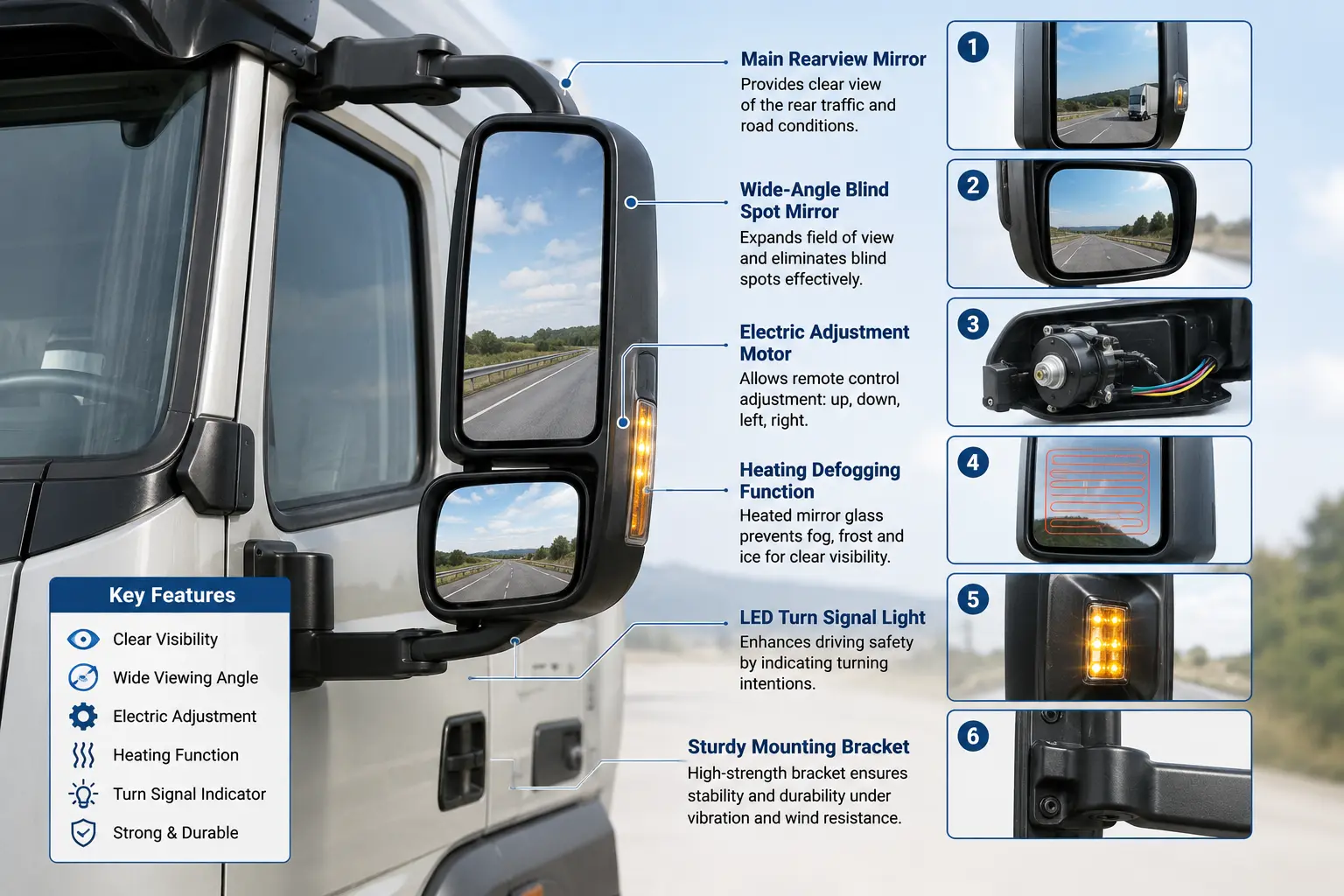
Generally speaking, a complete heavy-duty mirror assembly consists of six core components. Each component undertakes independent functions and affects the overall use effect and service life. Understanding these structures helps you accurately judge fault locations and select qualified replacement parts.
First is the main rearview mirror glass. This large-area flat mirror undertakes the main rear observation task. It presents distant road conditions and vehicle status behind the cab, serving as the core vision guarantee for long-distance driving.
Second is the auxiliary wide-angle blind spot mirror. This small curved mirror is usually installed at the bottom or side of the main mirror. It eliminates visual dead angles that flat mirrors cannot cover, which is critical for truck reversing, lane changing, and narrow-road driving.
Third is the electric adjustment motor module. Built into the mirror shell, this small motor group supports up, down, left, and right angle adjustment through cab control buttons. It replaces traditional manual adjustment and greatly improves driving convenience.
Fourth is the heating defogging component. Equipped with heating wires inside the mirror glass, this module rapidly melts frost, ice, and rainwater in low-temperature and rainy weather. It ensures clear mirror vision in harsh weather conditions.
Fifth is the LED turn signal lamp. Integrated on the mirror shell, the streamer turn signal synchronizes with the vehicle’s steering system. It reminds surrounding vehicles and pedestrians of driving intentions, improving active driving safety.
Sixth is the fixed bracket and outer shell. The high-strength metal bracket bears the weight of the entire mirror assembly and resists vibration and wind resistance during driving. The durable plastic shell protects internal motors, circuits, and heating modules from dust and water erosion.
All structural accessories of the mirror assembly belong to supporting truck exterior parts. You can view complete matching exterior component categories through our truck system parts category to ensure overall model consistency.
It is worth mentioning that different brands of heavy-duty trucks have exclusive mirror assembly parameters. SINOTRUK, SHACMAN, FAW, and FOTON all adopt independent bracket sizes, circuit interfaces, and installation hole positions. Therefore, targeted model matching is essential before replacement.
Typical Failure Symptoms of Aging or Damaged Truck Mirror Assembly
Most mirror assembly failures do not happen suddenly. Instead, they show gradual abnormal symptoms in daily use. Timely capturing these subtle signs can help you replace parts in advance, avoid sudden vision failure during transportation tasks, and reduce driving risks.
Different abnormal manifestations correspond to different damaged components. Some faults only require single glass replacement, while others need overall assembly replacement. The following summarizes all high-frequency failure symptoms of heavy-duty truck mirror assemblies in actual fleet operation.
Blurred, Scratched or Cracked Mirror Glass
This is the most intuitive and common mirror assembly fault. Long-term highway driving leads to frequent impact of gravel, dust, and flying insects on the mirror surface. Over time, dense scratches and pitting marks will appear on the glass.
In addition, accidental collision during parking and narrow-road passing often causes local cracking or overall fragmentation of the mirror glass. Low-temperature cold shrinkage and high-temperature thermal expansion will also aggravate crack expansion.
Scratched and cracked mirrors will refract light disorderly at night and in strong sunlight. This causes serious vision interference and easily leads to driver misjudgment of rear road conditions. Severe glass damage directly fails vehicle safety inspections.
Electric Adjustment Stuck, Slow or Completely Unresponsive
Most modern heavy-duty trucks are equipped with electric adjustable mirror assemblies. After long-term use, many drivers will encounter unsmooth adjustment problems.
Specific manifestations include slow mirror angle movement, obvious jitter during adjustment, fixed-direction clamping stagnation, and even no response when pressing the adjustment button.
This fault is mainly caused by aging internal adjustment motor, gear wear, water ingress and rust of the rotating shaft, or poor contact of the control circuit. Simple cleaning and lubrication can relieve minor faults, but severe motor aging requires overall assembly replacement.
Mirror Heating Function Failure
The mirror heating function is a practical configuration for long-haul trucks, especially suitable for rainy, snowy, and foggy seasons. Once the heating module fails, the mirror surface will be covered with frost and rain fog for a long time.
Judging heating failure is very simple. After turning on the vehicle heating switch, wait 3 to 5 minutes and touch the mirror surface. If the temperature does not rise at all, the internal heating wire or control circuit is damaged.
Heating faults are mostly caused by water ingress oxidation of internal wiring and burnout of heating wires after years of use. This kind of electrical damage cannot be repaired manually and can only be solved by replacing the mirror assembly or independent heating glass.
Loose Bracket, Vibration and Mirror Shaking During Driving
Heavy-duty trucks have strong engine vibration and road resonance during driving. Long-term high-frequency vibration will loosen the mirror assembly fixing bolts and aging damping rubber pads.
The typical symptom is obvious mirror shaking when the vehicle speed exceeds 60km/h. The rear view becomes blurred and jittery, making it impossible to clearly observe rear vehicle dynamics.
If not dealt with in time, the loose bracket will further aggravate wear of internal motor and rotating shaft. In severe cases, the mirror assembly may fall off during high-speed driving, causing secondary traffic hazards.
Turn Signal Light Not Working or Flickering Abnormally
The mirror integrated turn signal is an important active safety reminder component. Abnormal light operation will affect the driving reminder function and also cause vehicle inspection failure.
Common faults include light dimming, intermittent flickering, and complete no light output. Most problems come from aging LED lamp beads, water ingress and short circuit of lamp grooves, and virtual connection of wiring harness plugs.
Water Accumulation & Fog Inside Mirror Shell
After long-term wind and rain erosion, the mirror shell waterproof rubber ring will age and deform. Rainwater and humid air will penetrate into the shell and form condensed water fog inside.
Long-term internal humidity will cause oxidation and rust of internal motors, circuits, and metal parts. This indirectly leads to adjustment failure, heating damage, and light faults, greatly shortening the overall service life of the mirror assembly.
Root Causes of Heavy-Duty Truck Mirror Assembly Damage & Aging
To avoid frequent replacement of mirror assemblies and reduce fleet maintenance costs, it is necessary to clarify the fundamental causes of component damage. Different from small car mirrors, truck mirror assemblies face more complex damage factors in actual operation.
By summarizing a large number of fleet maintenance cases, we have sorted out the six core causes of mirror assembly failure, covering environmental factors, operational factors, and part quality factors.
Harsh Outdoor Working Environment Erosion
Heavy-duty trucks mostly operate in open-air and complex road scenarios. Long-term exposure to strong sunlight will accelerate aging and yellowing of the mirror shell plastic and aging of waterproof rubber parts.
Frequent rainwater washing and humid air will cause water accumulation inside the mirror body and circuit oxidation. In northern low-temperature environments, repeated freezing and thawing will crack internal structural parts and glass.
In mining, construction, and rural road scenarios, dust, mud, and gravel impact will cause continuous wear on the mirror surface and shell, resulting in irreversible damage.
Long-Term High-Frequency Vibration Fatigue
Truck engines and cargo loads bring strong body vibration. Road bumps further amplify the vibration amplitude of the cab exterior parts.
The mirror assembly is installed on the outer side of the cab, belonging to the vibration end of the body. Long-term high-frequency vibration will cause bolt loosening, rubber pad aging, gear wear, and wiring virtual connection, inducing various intermittent faults.
Accidental Collision & Manual External Damage
Truck mirrors protrude from the cab body, making them extremely vulnerable to collision damage. Narrow road passing, roadside obstacle friction, and manual collision during parking will all damage the mirror assembly.
Even minor friction will scratch the mirror shell and glass. Slight collision displacement will change the internal stress structure, leading to subsequent vibration and shaking problems.
Unqualified Low-Quality Replacement Parts
Many truck owners choose cheap generic mirror assemblies for cost savings. However, unqualified parts have insufficient shell toughness, unstable motor quality, and inaccurate bracket hole positions.
Low-quality mirrors have poor wind resistance and vibration resistance. They are prone to shaking and failure after short-term use, and the failure recurrence rate is far higher than genuine parts.
Therefore, selecting brand-matching qualified accessories is the key to long-term stable use. You can filter genuine supporting parts for your truck model through our brand product page.
Irregular Daily Operation & Maintenance Neglect
Frequent manual forced stirring of the electric mirror, violent folding, and random wiping of the mirror surface with rough towels will accelerate component wear and mirror scratch.
Most fleet drivers ignore daily mirror maintenance. They do not clean internal dust, do not check waterproof aging, and do not fasten loose bolts, leading to gradual accumulation of minor faults into severe damage.
Vehicle Voltage Instability Impact
Unstable truck battery voltage will cause instantaneous overvoltage impact on mirror internal motors, heating modules, and LED lights. Long-term unstable power supply will accelerate electrical component aging and increase failure probability.
Why Timely Cab Mirror Assembly Replacement Is Indispensable for Trucks
Some truck owners think minor mirror faults do not affect driving and delay replacement for a long time. In fact, faulty mirror assemblies bring multiple hidden dangers to driving safety, vehicle inspection, and fleet operation costs.
First of all, incomplete vision seriously reduces driving safety. Truck blind spots are already large. Scratched, blurred, or shaking mirrors will completely block effective rear vision, easily causing lane change collisions, reversing scratches, and rear-end accidents.
Secondly, damaged mirror assemblies will directly fail annual vehicle safety inspections. Traffic inspection departments have clear regulations on the completeness and clarity of vehicle rearview devices. Unqualified mirrors will lead to inspection failure and affect vehicle normal operation.
In addition, delayed replacement will expand maintenance costs. Minor glass scratches and single electrical faults only need low-cost partial replacement. However, long-term neglect will lead to linkage damage of brackets, motors, and circuits, eventually requiring expensive overall assembly replacement.
Finally, complete and clear mirror accessories can effectively improve driving efficiency. Clear vision reduces driver observation pressure, avoids repeated adjustment, and improves the safety and efficiency of long-distance transportation tasks.
Core Selection Standards for Heavy-Duty Truck Mirror Assembly Replacement
When purchasing replacement mirror assemblies, many users fall into the price-only trap and ignore matching degree and quality standards. In fact, truck mirror selection has strict industry standards and model matching requirements.
To help you avoid buying wrong or inferior parts, we have summarized a set of universal and practical selection standards suitable for all mainstream heavy-duty truck models.
Strict Model & Parameter Matching
Different truck years and configurations correspond to different mirror assembly parameters. You need to confirm bracket size, installation hole position, wiring harness pin definition, and function configuration before purchasing.
Electric adjustment, heating defogging, and streamer turn signal configurations must be consistent with the original vehicle. Mismatched functions will lead to unusable functions or circuit short-circuit risks.
Genuine OEM Quality & Material Standard
High-quality truck mirror assemblies adopt high-toughness ABS shell materials, which are resistant to high temperature, aging, and impact. The mirror glass is made of high-definition float glass with anti-glare and scratch-resistant coating.
Internal motors and heating modules comply with original factory electrical standards, with stable power and long service life. Inferior accessories use recycled materials, which are easy to age, deform, and damage.
Vibration Resistance & Wind Resistance Performance
Qualified mirror assemblies have passed professional vibration testing and high-speed wind resistance testing. The damping structure is reasonable, and there is no obvious shaking at high speed.
Generic unqualified mirrors have insufficient structural stability. They will jitter seriously at high speed, affecting driving vision and even falling off in severe cases.
Complete Waterproof & Sealing Performance
Original factory mirror assemblies are equipped with high-quality waterproof rubber rings and sealed structures. They can effectively block rainwater, dust, and humid air and protect internal electrical components.
Poorly sealed mirrors are prone to water fog and water accumulation inside after rain, leading to frequent electrical faults and greatly reduced service life.
Formal Supplier & After-Sales Guarantee
Purchasing through regular professional suppliers can ensure part authenticity and complete after-sales service. You can browse our company introduction to understand our formal qualification and supply system of truck accessories.
We provide model matching consultation, quality inspection before delivery, and after-sales technical support for all mirror assembly products, helping users avoid replacement risks.

Step-by-Step Professional Cab Mirror Assembly Replacement Guide
Truck mirror assembly replacement belongs to low-difficulty but high-precision cab exterior maintenance work. As long as you follow standardized steps, novice drivers can complete DIY replacement without professional maintenance experience.
The following universal steps are suitable for SINOTRUK HOWO, SHACMAN X3000/F3000, FAW J6, FOTON AUMAN and other mainstream heavy-duty truck models.
Step 1: Cut Off Vehicle Power to Avoid Circuit Risks
Before disassembling any electrical accessory, you must turn off the vehicle key and disconnect the battery negative wire. This can effectively avoid short circuit, electric leakage, and burnout of electrical components during plugging and unplugging wiring harnesses.
Power-off operation is the primary safety guarantee for all vehicle electrical maintenance, which cannot be omitted for convenience.
Step 2: Remove the Original Mirror Fixing Bolts
Find the mirror assembly fixing bolts on the cab outer bracket. Most models are equipped with hidden bolt covers. First pry open the decorative cover with a plastic crowbar to expose the internal bolts.
Use a professional socket wrench to loosen the fixing bolts slowly. It is not recommended to use excessive force to prevent sliding wire and bolt breakage.
Step 3: Disconnect Internal Wiring Harness Plug
After loosening the bolts, gently hold the mirror assembly and pull it outward. You will find the wiring harness connecting the mirror and the cab body.
Press the plug buckle firmly and pull out the wiring harness slowly. Do not drag the wire violently to avoid breaking the internal wire core.
Mark the wiring interface position appropriately to avoid wrong plugging during subsequent installation.


