
Why a Stuck Truck Window Is More Than an Inconvenience
Imagine this. You are halfway through a 12-hour haul, and the sky opens up. Rain hammers the windshield. You reach over to roll up the passenger window, and nothing happens. The switch clicks. The glass stays halfway down. Water starts pooling on the seat. By the time you pull over, the door panel is soaked, and your paperwork is ruined.
This is not a rare scenario. Every month, thousands of truck drivers deal with power window failures. Most of them start small. A slow window here. A strange noise there. Drivers ignore it because the window still works. Then one day, it stops completely.
The culprit is often the window regulator motor. This small electric component sits inside the door panel. It does the heavy lifting every time you press the window switch. Over time, it wears out. When it fails, you are stuck with a window that will not move.
On a passenger car, this is annoying. On a heavy-duty truck, it is a safety issue. A stuck window exposes the cab to weather. It compromises security at truck stops. It can even prevent you from communicating with toll booth workers or inspection officers.
The good news? You do not have to wait for a total failure. Window regulator motors almost always give warning signs before they die. Learning to read these signs can save you hundreds of dollars in emergency repairs.
This guide walks you through everything you need to know. We cover the symptoms, the causes, the diagnosis process, and the repair steps. Whether you are a fleet manager or an owner-operator, this information will help you make smarter decisions about your power window system.
Let us start by understanding what this motor actually does, and why it matters so much in a commercial truck cab.
Understanding the Window Regulator Motor in Heavy-Duty Cabs
Most drivers never think about their window motor until it breaks. That is understandable. The part hides behind the door panel. You cannot see it. You only interact with it through a small switch on the armrest.
But understanding how it works will help you spot problems early. It will also help you avoid getting ripped off by mechanics who want to replace the whole regulator when only the motor is bad.
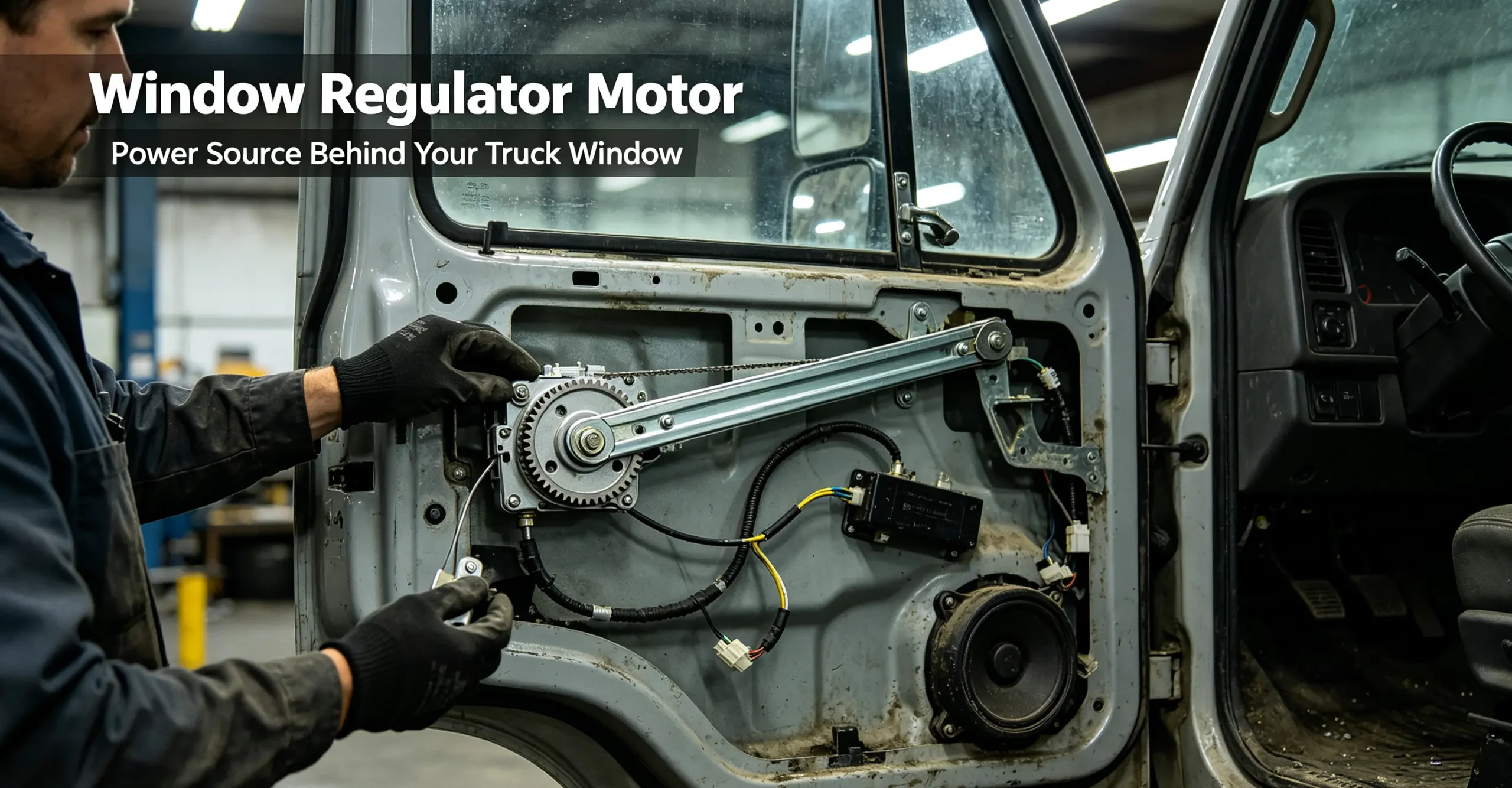
The basic setup. Your power window system has three main parts. The switch sends a signal. The motor provides the power. The regulator converts that power into up-and-down movement of the glass.
The motor itself is a small DC electric motor. It has a gear on the end. That gear meshes with the regulator mechanism. When you press the switch, current flows to the motor. The motor spins. The gears turn. The window moves.
It sounds simple, and it is. But the motor works hard. Truck windows are heavy. The glass alone can weigh 10 to 15 pounds. Add in the friction from the rubber seals, and the motor has to generate significant torque every single time you use it.
Why truck motors fail more often. Heavy-duty trucks operate in harsh conditions. Dust gets into the door. Water seeps past the seals. Temperature swings from freezing to boiling. The cab vibrates constantly on rough roads.
All of this takes a toll on the motor. The brushes wear down. The armature gets dirty. The gears strip. The wiring corrodes. A motor that might last 10 years in a passenger car can fail in half that time in a work truck.
Cable vs. scissors regulators. There are two common regulator types. Cable-style regulators use flexible steel cables to move the glass. Scissors-style regulators use hinged arms that look like, well, scissors.
Cable regulators are more common in modern trucks. They are lighter and cheaper to build. But the cables can fray and snap. When that happens, the motor may still work, but the window will not move.
Scissors regulators are more robust. They handle heavy glass better. But they have more pivot points, and those points can wear and bind.
Knowing which type your truck has matters when it comes time to repair. Some motors are sold separately. Others only come as part of a complete regulator assembly.
If you are unsure what your truck uses, check the parts catalog for your specific make and model. You can also browse our window system components to see the options available for most major truck brands.
Now that you understand the basics, let us look at the warning signs. These are the symptoms that tell you your motor is on its way out.
Early Warning Signs Your Regulator Motor Is Failing
The hardest part about power window problems is that they develop gradually. You might not notice a slow window at first. Then one day, you realize it takes two presses to get the glass all the way up.
Here are the most common symptoms, ordered from earliest warning signs to complete failure.
1. Slow window movement. This is the first sign. The window takes longer to go up or down than it used to. You might notice it more on cold mornings, when the rubber seals are stiff.
A slow window means the motor is struggling. It cannot generate enough torque to move the glass at normal speed. This could be because the brushes are worn, or because the regulator is binding. Either way, it is a red flag.
2. Clicking or grinding noises. When you press the switch, you hear a click from inside the door. Or you hear a grinding sound that was not there before.
Clicking usually means the motor is getting power but cannot turn. The gear might be stripped, or the regulator might be jammed. Grinding often means the gears are worn and not meshing properly.
3. Window moves only partway. The glass goes up three inches, then stops. You wait a minute, try again, and it moves a little more. This is a classic sign of a motor overheating.
When a motor wears out, it draws more current. That extra current generates heat. The motor has a thermal protection circuit that shuts it off when it gets too hot. Once it cools down, it works again. For a while.
4. Window works intermittently. Sometimes it works. Sometimes it does not. You might have to press the switch several times. Or it might work from the driver switch but not the passenger switch.
Intermittent operation can point to a bad motor, but it can also mean a bad switch or loose wiring. We cover how to tell the difference later in this guide.
5. Window falls down on its own. You roll up the window, and a few minutes later, it has slid halfway down. This is usually a regulator problem, not a motor problem. The cables have slipped or the gears have stripped.
However, if the motor gear is stripped, it can also cause this symptom. The motor cannot hold the weight of the glass, so it drifts down.
6. No response at all. You press the switch. Nothing happens. No noise. No movement. The window is completely dead.
This could be a burned-out motor. But it could also be a blown fuse, a bad switch, or a broken wire. Before you buy a new motor, you need to diagnose the problem properly.
If you are experiencing any of these symptoms, do not wait. A window that works intermittently today can fail completely tomorrow. And if it fails in the down position during a rainstorm, you are looking at water damage inside the cab.
For fleet operators, catching these issues early can mean the difference between a $50 motor replacement and a $500 door panel repair. Our technical support team often helps fleets identify these problems before they turn into costly breakdowns.
Next, let us dig into what actually causes these motors to fail in the first place.
What Actually Causes Window Regulator Motors to Burn Out
A window regulator motor does not just die for no reason. Something causes it. Understanding the root cause will help you prevent the next one from failing too soon.
Here are the most common causes, ranked by how frequently we see them in the field.
1. Normal wear and tear. This is the number one cause. Every time you press the window switch, the motor spins. The brushes rub against the commutator. The gears turn. The bearings rotate.
Over hundreds of thousands of cycles, these parts wear out. The brushes get thin. The gears lose their teeth. The bearings develop play. Eventually, the motor cannot generate enough torque to move the window.
This is inevitable. It is not a design flaw. It is just what happens when a small motor works hard for years.
2. Water damage. Truck doors are not waterproof. They are water-resistant. When it rains, water runs down the window and into the door. It is supposed to drain out through holes at the bottom.
But if those drain holes get clogged with dirt and debris, water pools inside the door. The motor sits in that water. It corrodes. The brushes rust. The wiring connections oxidize.
This is especially common in trucks that operate in rainy climates or that get washed frequently with high-pressure hoses.
3. Overloading from binding regulators. This is a silent killer. The regulator gets dirty or starts to bind. The window moves slower. The motor has to work harder to overcome the friction.
The extra work draws more current. More current means more heat. Heat breaks down the insulation on the motor windings. Eventually, a winding shorts out, and the motor dies.
The worst part? If you replace the motor without fixing the binding regulator, the new motor will fail too. We see this all the time. A driver replaces the motor. Six months later, it fails again. The root cause was never addressed.
4. Electrical issues. Voltage spikes, poor grounds, and corroded connectors can all damage a motor. If the motor is not getting enough voltage, it runs slow and hot. If it gets too much voltage, the windings burn out.
Loose connections are particularly problematic. They create resistance. Resistance generates heat. That heat travels down the wire and into the motor.
5. Physical damage. Accidents happen. Someone slams the door too hard. A tool falls inside the door panel during a repair. The window gets frozen shut and someone forces it down.
Any of these can crack the motor housing, strip the gears, or bend the motor shaft. Once that happens, the motor is done.
6. Manufacturing defects. This is rare, but it happens. Some aftermarket motors are built with cheap materials. The brushes are low quality. The gears are soft metal. The bearings are not properly sealed.
These motors might fail within a year of installation. That is why it pays to buy quality parts from trusted suppliers. At Mettlead, we only source window regulator motors from manufacturers that meet OEM quality standards.
Now you know what causes the failures. But how do you know for sure that the motor is the problem? That is what we cover next.
How to Diagnose a Bad Motor vs. a Bad Regulator
This is the most important step. A lot of drivers and even mechanics skip proper diagnosis. They see a window that does not work and immediately order a new motor. Sometimes they are right. Often they are wrong.
The power window system has several components. Any one of them can cause the same symptom. Before you spend money on parts, you need to isolate the problem.
Here is a systematic approach that works on most heavy-duty trucks.
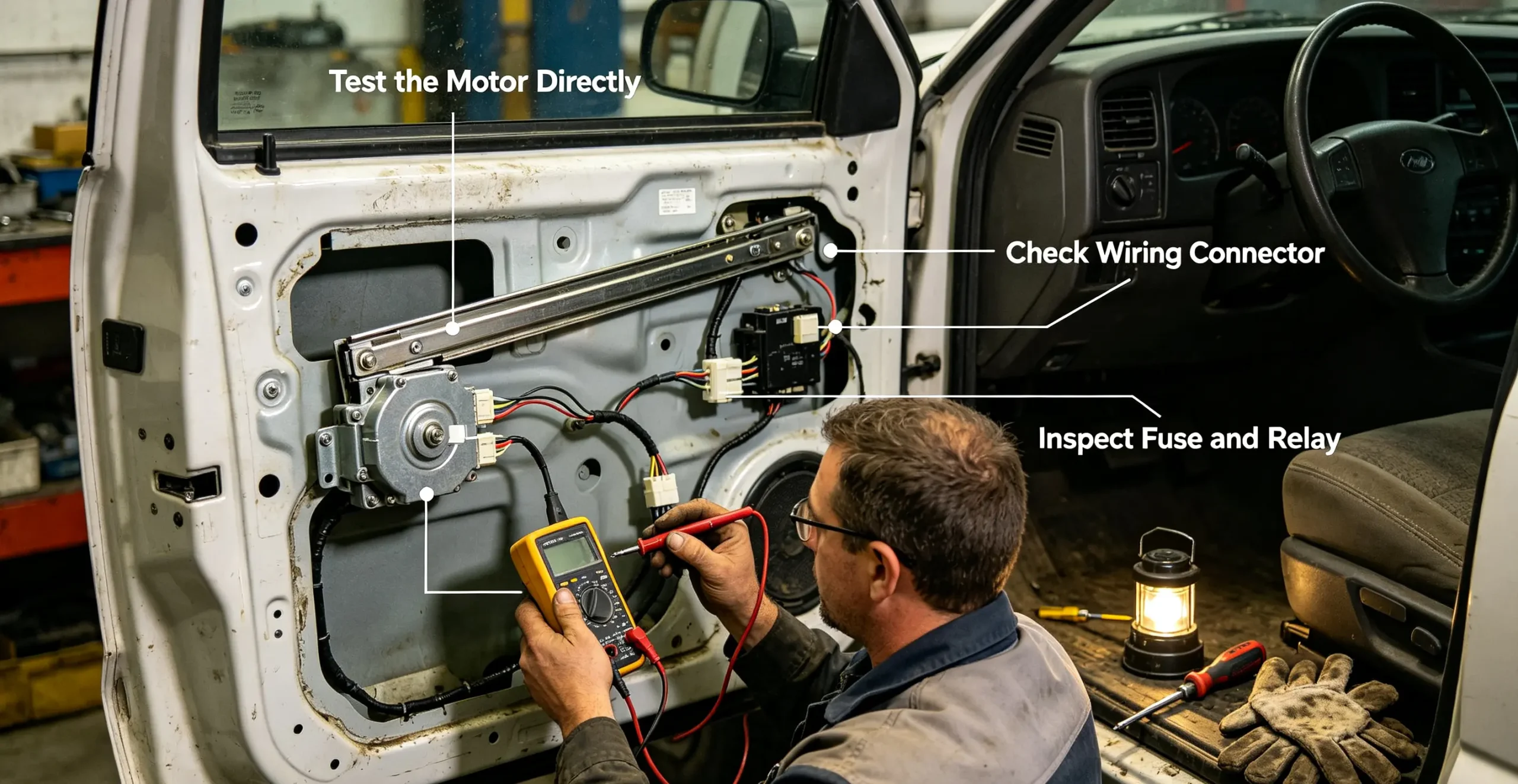
Step 1: Check the fuse and relay. Start with the simplest thing. Find the power window fuse in the fuse box. Pull it out. Look at the wire inside. If it is broken, the fuse is blown.
Replace the fuse and test the window. If the fuse blows again immediately, you have a short circuit somewhere in the system. Do not keep replacing fuses. Find the short.
Also check the power window relay if your truck has one. Relays can fail. Swap it with another relay of the same type and see if the window works.
Step 2: Test the switch. The switch is the most-used part of the system. It gets pressed thousands of times. The contacts inside wear out.
To test the switch, you can try the passenger switch if the driver switch does not work. If the window works from one switch but not the other, the bad switch is the problem.
If neither switch works, you need to test with a multimeter. Remove the switch from the door panel. Probe the terminals while pressing the button. You should see voltage change when you press up or down.
Step 3: Check the wiring. The wires run from the switch, through the door jamb, to the motor. The door jamb is a trouble spot. The wires flex every time you open and close the door. Over time, they can break inside the insulation.
Inspect the rubber boot in the door jamb. Peel it back. Look for cracked or broken wires. Even if the insulation looks fine, a wire could be broken inside.
Use a multimeter to check continuity from the switch to the motor. If there is no continuity, you have a broken wire.
Step 4: Test the motor directly. This is the definitive test. Disconnect the motor from the wiring harness. Connect a 12V power source directly to the motor terminals. Reverse the polarity to make it go the other direction.
If the motor runs when connected directly, the motor is fine. The problem is elsewhere in the system. If the motor does not run, it is bad.
You can also listen for the motor. If you press the switch and hear a humming or clicking from inside the door, the motor is getting power. It just cannot turn. This usually means stripped gears or a jammed regulator.
Step 5: Inspect the regulator. If the motor runs but the window does not move, the regulator is the problem. Remove the door panel. Look at the regulator mechanism.
Check for frayed cables. Look for broken plastic clips. See if the glass has come off the track. Try moving the glass by hand. If it moves freely, the regulator is not holding it.
Sometimes the motor and regulator fail at the same time. The regulator binds, which burns out the motor. In that case, you need to replace both.
If this sounds complicated, do not worry. Most of these tests take 15 to 20 minutes with basic tools. And if you are not comfortable doing it yourself, any qualified mechanic can run through this checklist.
For fleets that want to reduce diagnostic time, our cooperative case studies show how proper diagnosis protocols cut parts costs by up to 30 percent.
Once you know what is wrong, the next question is: should you repair it or replace it?
Repair or Replace: Making the Right Call for Your Fleet
This is where a lot of people make expensive mistakes. They either spend too much on unnecessary parts, or they try to save money and end up doing the job twice.
Let us break down the options.
Option 1: Replace just the motor. If the motor is bad and the regulator is in good shape, you can replace just the motor. This is the cheapest option. A new motor typically costs $40 to $80.
But there is a catch. On some trucks, the motor is riveted to the regulator. You have to drill out the rivets and bolt the new motor in place. This takes extra time and requires some mechanical skill.
Also, if the regulator is showing signs of wear, replacing just the motor is a bad idea. The new motor will have to work against a worn regulator, and it will fail prematurely.
Option 2: Replace the motor and regulator as an assembly. This is what most mechanics recommend. A complete regulator with motor costs $80 to $150. It takes less time to install because you do not have to separate the old motor from the regulator.
More importantly, you get a matched set. The new motor and new regulator are designed to work together. There is no risk that a worn regulator will burn out your new motor.
For fleets, this is usually the better option. The extra $40 to $70 is cheap insurance against a comeback repair.
Option 3: Rebuild the old motor. Some shops offer motor rebuilding services. They replace the brushes, clean the commutator, and lubricate the bearings. This costs about the same as a new motor, and it takes longer.
We do not recommend this for most applications. A rebuilt motor has old windings and old gears. It might last another year, or it might fail next month. A new motor comes with a warranty and predictable performance.
Cost comparison. Let us look at real numbers. For a typical heavy-duty truck:
- Motor only: $40 to $80 for parts, 1 to 2 hours labor
- Motor and regulator assembly: $80 to $150 for parts, 45 minutes to 1.5 hours labor
- Motor rebuild: $60 to $100, 2 to 3 hours labor
At $100 per hour shop rate, the total cost looks like this:
- Motor only: $140 to $280
- Motor and regulator: $180 to $300
- Motor rebuild: $260 to $400
As you can see, the complete assembly is often the best value. It costs only slightly more than a motor-only repair, and it gives you a fresh start on the whole system.
When to repair vs. replace. Here is a simple decision framework:
- If the truck is under 5 years old and the regulator looks new: replace just the motor
- If the truck is over 5 years old: replace the motor and regulator together
- If the regulator has visible damage or binding: replace both
- If the motor failed due to water damage: replace both (water likely damaged the regulator too)
- If you are doing the repair yourself and want to save money: motor only is fine if the regulator checks out
Of course, these are general guidelines. Your specific situation may differ. If you need help choosing the right parts for your truck model, contact our parts specialists. They can look up your exact truck and recommend the correct components.
Once you have decided what to replace, it is time to do the work. Let us walk through the replacement process step by step.
Step-by-Step Window Regulator Motor Replacement
Replacing a window regulator motor is not the hardest repair you will ever do. But it does require patience and attention to detail. The door panel is full of clips, wires, and sharp edges. Rushing the job leads to broken clips and scratched trim.
Here is the general procedure. Always consult the service manual for your specific truck, as details vary by make and model.
Tools you will need:
- Phillips and flathead screwdrivers
- 10mm and 8mm sockets with ratchet
- Door panel removal tool (or a flat pry bar wrapped in tape)
- Multimeter (for testing)
- Drill with drill bits (if you need to remove rivets)
- Rivet gun or bolts and nuts (for reassembly)
- Silicone lubricant or white lithium grease
- Shop towels
- Work gloves and safety glasses
Step 1: Disconnect the battery. Safety first. Disconnect the negative battery terminal. This prevents accidental window operation while you are working inside the door. It also protects you from electrical shorts.
Step 2: Remove the door panel. This is where most people break things. Door panels are held on by screws and plastic clips. The screws are usually hidden under decorative caps or behind the door handle.
Look for screws in the armrest, behind the door pull, and along the bottom edge of the panel. Remove all of them. Then use your panel tool to pry the panel away from the door. Start at the bottom and work your way up.
Be gentle. The clips break easily. If a clip does break, you can buy replacement clips at any auto parts store. Once all the clips are free, lift the panel up and off the door. Disconnect any wiring harnesses attached to the panel.
Step 3: Peel back the moisture barrier. Behind the door panel, there is a plastic sheet or foam barrier. This keeps water out of the cab. Carefully peel it back. Do not tear it. You will need to reseal it later.
If the barrier is torn or the adhesive is gone, replace it. A bad moisture barrier is a common cause of water damage to the motor and regulator.
Step 4: Secure the window glass. Before you remove the regulator, you need to secure the glass. If the window is in the down position, carefully raise it by hand. Then tape it to the top of the door frame with masking tape.
This prevents the glass from falling and breaking when you remove the regulator. Use several strips of tape. Make sure it is secure.
Step 5: Disconnect the motor wiring. Find the motor wiring connector. It is usually near the bottom of the door. Press the release tab and disconnect it. Inspect the connector for corrosion or damage. If it looks bad, replace it.
Step 6: Remove the regulator or motor. If you are replacing the complete assembly, remove the bolts that hold the regulator to the door. There are usually 4 to 6 bolts. Then carefully remove the regulator through the access hole in the door.
If you are replacing just the motor, you need to separate it from the regulator. The motor is usually held on by 3 bolts or rivets. If it is bolts, simply remove them. If it is rivets, drill them out.
Be careful when drilling. Use a drill bit slightly smaller than the rivet. Do not drill too deep or you will damage the regulator.
Step 7: Install the new motor or assembly. If you are using a new motor, bolt it to the old regulator. Use the bolts that came with the motor, or use nuts and bolts if you drilled out rivets.
If you are using a complete assembly, position it inside the door and bolt it in place. Tighten the bolts to the manufacturer’s specification. Do not overtighten, or you will strip the threads in the door.
Step 8: Reconnect the wiring and test. Before you put everything back together, reconnect the battery and test the window. It should move up and down smoothly. There should be no strange noises.
If the window does not work, check your connections. Make sure the motor is plugged in. Check the fuse. If the motor runs but the window does not move, the regulator may not be installed correctly.
Step 9: Lubricate the tracks. While you have the door open, lubricate the window tracks and regulator mechanism. Use silicone spray on the rubber tracks. Use white lithium grease on the regulator gears and pivot points.
This will reduce friction and extend the life of your new motor. It is a small step that makes a big difference.
Step 10: Reassemble the door. Once everything works, remove the tape holding the glass. Reinstall the moisture barrier. Make sure it seals properly. Then reinstall the door panel.
Line up the clips with the holes in the door. Press firmly to seat them. Reinstall all the screws. Reconnect any wiring harnesses. Test the window one more time.
Pro tip: Take photos as you disassemble the door. This will help you remember where everything goes when you put it back together. It is easy to forget which screw goes where.
If you are not comfortable doing this repair yourself, take it to a professional. The labor cost is usually reasonable, and you avoid the risk of breaking parts. For fleet operators, having a trusted repair partner is essential. You can learn more about our company and how we support fleets with both parts and technical guidance.
Now, replacing the motor is only half the battle. If you want it to last, you need to maintain the system properly.
Preventive Maintenance to Extend Motor Life
Most window regulator motor failures are preventable. With a little regular maintenance, you can double or even triple the life of your power window system.
Here is what we recommend.
1. Clean and lubricate the window tracks. This is the single most important thing you can do. Dirt and grime build up in the rubber tracks. This creates friction. The motor has to work harder. It runs hotter. It wears out faster.
Every 6 months, clean the tracks with a soft brush and window cleaner. Then spray them with silicone lubricant. Do not use WD-40 or oil-based lubricants. They attract more dirt and make the problem worse.
2. Keep the drain holes clear. The bottom of your door has drain holes. These let water escape. If they clog, water pools inside the door and damages the motor.
Check the drain holes every 3 months. Use a small wire or paper clip to clear any debris. This is especially important if you drive on dirt roads or in dusty conditions.
3. Replace worn weatherstripping. The rubber seals around the window degrade over time. They get hard and cracked. This increases friction on the glass.
If you see cracks or tears in the weatherstripping, replace it. New seals reduce friction and keep water out of the door. It is a cheap part that saves you from expensive motor repairs.
4. Avoid using the window when it is frozen. In winter, the window can freeze to the rubber seal. If you press the switch and the window does not move, do not keep pressing. You will burn out the motor.
Instead, use a de-icer spray or a heat gun to thaw the seal. Gently try to move the glass by hand before using the switch. Once it moves freely, you can use the power window normally.
5. Do not slam the doors. Slamming the door sends shockwaves through the entire assembly. The motor, regulator, and glass all take a hit. Over time, this can loosen connections and damage components.
We know. Truck doors are heavy, and sometimes you have to give them a little extra push. But try to close them firmly without slamming. Your window motor will thank you.
6. Inspect during regular service. Every time you do an oil change or other regular service, take 2 minutes to check the windows. Roll them up and down. Listen for unusual noises. Watch for slow movement.
Catching a problem early means you can fix it before it leaves you stranded. A slow window today is a dead window next month.
7. Use quality replacement parts. When you do need to replace a motor, do not buy the cheapest one you can find. Cheap motors use inferior materials. They fail faster.
Look for motors from reputable manufacturers. Check the warranty. A motor with a 2-year warranty is a better investment than one with a 90-day warranty, even if it costs a little more.
At our brand catalog, you will find window regulator motors from trusted manufacturers that meet or exceed OEM specifications. We do not sell cheap parts that fail in six months.
Following these maintenance steps will significantly reduce your power window repair costs. For a fleet of 20 trucks, this can add up to thousands of dollars in savings every year.
Before we wrap up, let us address some common misconceptions about power window motors.
Common Myths About Power Window Motors Debunked
There is a lot of bad information floating around about power window motors. Some of it comes from well-meaning but misinformed drivers. Some of it comes from shops that want to sell you unnecessary repairs.
Let us set the record straight.
Myth 1: If the window does not work, the motor is bad. This is the most common myth. As we discussed earlier, the motor is just one part of the system. The switch, fuse, relay, wiring, and regulator can all cause the same symptom.
Always diagnose before you replace. A $10 switch or a $2 fuse is a lot cheaper than a $60 motor.
Myth 2: You have to replace the regulator when you replace the motor. Not true. If the regulator is in good shape, you can replace just the motor. This saves money.
However, if the regulator is worn or binding, replacing just the motor is a waste of money. The new motor will fail because it has to work against the bad regulator.
Myth 3: Power window motors cannot be repaired. Technically, they can. You can replace the brushes and clean the commutator. But it is usually not worth it.
A rebuild costs about the same as a new motor. And a rebuilt motor still has old windings and old gears. It is a false economy. Buy a new motor with a warranty.
Myth 4: All aftermarket motors are the same. This could not be further from the truth. There is a huge difference in quality between manufacturers.
Cheap motors use soft metal gears that strip quickly. They use thin brushes that wear out fast. They do not have proper sealing, so water gets in and corrodes the internals.
Quality motors use hardened steel gears, thick brushes, and sealed bearings. They cost more, but they last much longer.
Myth 5: A slow window always means a bad motor. Not necessarily. A slow window can also mean dirty tracks, dry lubrication, or a binding regulator.
Before you replace the motor, try cleaning and lubricating the tracks. If the window speeds up, the motor was fine. You just saved yourself a repair bill.
Myth 6: You need special tools to replace a window motor. Basic hand tools are usually enough. A screwdriver, socket set, and panel removal tool will get the job done on most trucks.
Some trucks require a drill to remove rivets, but that is about as specialized as it gets. This is a repair that most people can do in their driveway.
Myth 7: Window motors fail suddenly without warning. Almost never. Window motors give plenty of warning signs. Slow movement, strange noises, intermittent operation. These are all red flags.
If your window suddenly stops working, it is more likely a fuse or wiring problem than a motor failure. Motors die gradually, not instantly.
Knowing the truth behind these myths will help you make better decisions and avoid unnecessary expenses. If you ever have questions about a power window problem, our technical support resources are a great place to start.
Now, let us answer some of the most frequently asked questions we hear from drivers and fleet managers.
Professional Mechanic Q&A
Q: How long does a window regulator motor last on a heavy-duty truck?
A: It depends on usage and conditions. On average, you can expect 5 to 8 years or 500,000 to 800,000 miles. Trucks that operate in dusty or rainy environments may see shorter life. Trucks with well-maintained window systems can go 10 years or more.
Q: Can I drive with a stuck window?
A: If the window is stuck in the up position, yes. You can drive it. Just get it fixed when you can. If it is stuck in the down position, you need to address it immediately. Water, dirt, and theft are all real risks. You can temporarily tape a plastic sheet over the opening, but this is not a long-term solution.
Q: My window works sometimes but not others. Is this the motor?
A: It could be. But intermittent problems are more often caused by a bad switch or loose wiring. The motor is either working or it is not. If it works sometimes, the issue is usually in the electrical circuit before the motor.
Q: Can I replace just one motor, or should I replace both sides?
A: You only need to replace the bad one. The other side is fine. However, if the truck is high mileage and both windows are showing signs of slowing down, you might want to do both at the same time to save on labor.
Q: How long does the replacement take?
A: For an experienced mechanic, 45 minutes to 1.5 hours. For a do-it-yourselfer, 2 to 3 hours. The first time you do it, it will take longer. After that, you will be faster.
Q: Do I need to reset anything after replacing the motor?
A: On most trucks, no. The new motor should work immediately. Some luxury vehicles with one-touch auto-up windows require a reset procedure. Check your owner’s manual for details.
Q: Is it safe to use the window in the rain?
A: Yes. The system is designed to get wet. The motor is sealed, and the door has drain holes. As long as the drain holes are clear and the moisture barrier is intact, rain should not cause problems.
Q: What is the difference between a motor and a regulator?
A: The motor is the electric motor that provides power. The regulator is the mechanical assembly that moves the glass. They work together but are separate parts. Sometimes they are sold separately, sometimes as a complete assembly.
Q: Can I install a used motor from a salvage yard?
A: You can, but we do not recommend it. You do not know how old the used motor is or how much life it has left. It might fail in a month. A new motor is affordable and comes with a warranty.
Q: My window goes down fine but is slow going up. Why?
A: Going up requires more torque because the motor is lifting the weight of the glass against gravity. Going down, gravity helps. If the motor is weak, it will show up first in the up direction. This is an early sign of motor failure.
If you have a question that is not covered here, feel free to reach out to our team. We have helped thousands of drivers and fleet managers solve their power window problems.
Final Thoughts
A bad window regulator motor is one of those problems that seems minor until it is not. A slow window is easy to ignore. A stuck window in the rain is a major headache.
The good news is that these failures are predictable. The warning signs are obvious if you know what to look for. And the repair is straightforward if you take the time to diagnose properly.
Here is the key takeaway: do not just replace parts. Diagnose the problem. Understand the root cause. Fix the whole system, not just the symptom.
If your regulator is binding, replacing the motor alone is a temporary fix. The new motor will fail. Clean and lubricate the tracks. Replace worn weatherstripping. Keep the drain holes clear. These simple steps will make your new motor last for years.
And when you do need parts, buy quality. A cheap motor is not a bargain if it fails in six months. Quality parts from trusted suppliers save you money in the long run.
At Mettlead, we understand the unique challenges of heavy-duty truck maintenance. Our customer success stories show how the right parts and the right advice keep fleets on the road and out of the shop.
Whether you are fixing one truck or managing a fleet of fifty, the principles are the same. Pay attention to the warning signs. Invest in quality parts. Do the maintenance. Your windows will reward you with years of reliable service.
Do not wait until you are stuck on the side of the road in a rainstorm. Check your windows today. If something does not seem right, address it now. A small repair today prevents a big bill tomorrow.


