Introduction
The door lock actuator is a small but indispensable electrical component on every heavy-duty truck and commercial vehicle. Although it does not directly affect engine power or driving safety, it controls the normal locking and unlocking of vehicle doors.
For fleet drivers, long-haul truckers, and logistics operators, a faulty door lock actuator can cause persistent daily troubles. It may lead to inconvenient door operation, abnormal noise, or even door locking failure.
In severe cases, a broken door lock actuator may cause safety hazards during driving. Unlocked doors may pop open on bumpy roads, endangering driver safety and cargo security.
Many truck owners ignore minor door lock abnormalities in the early stage. They only choose maintenance when the actuator is completely damaged. This approach often leads to higher replacement costs and unexpected downtime losses.
This comprehensive guide covers all core knowledge about faulty door lock actuators. We will explain basic working principles, typical failure symptoms, root causes, targeted troubleshooting steps, and professional repair and replacement solutions.
Meanwhile, we will share practical maintenance tips to extend actuator service life. For professional technical guidance on truck electrical system failures, you can refer to our professional technical support page for targeted solutions.
What Is a Door Lock Actuator & How Does It Work on Heavy Trucks
Before troubleshooting faults, it is essential to clarify the basic structure and working logic of the door lock actuator. This foundation helps you accurately judge failure causes and avoid blind disassembly and replacement.
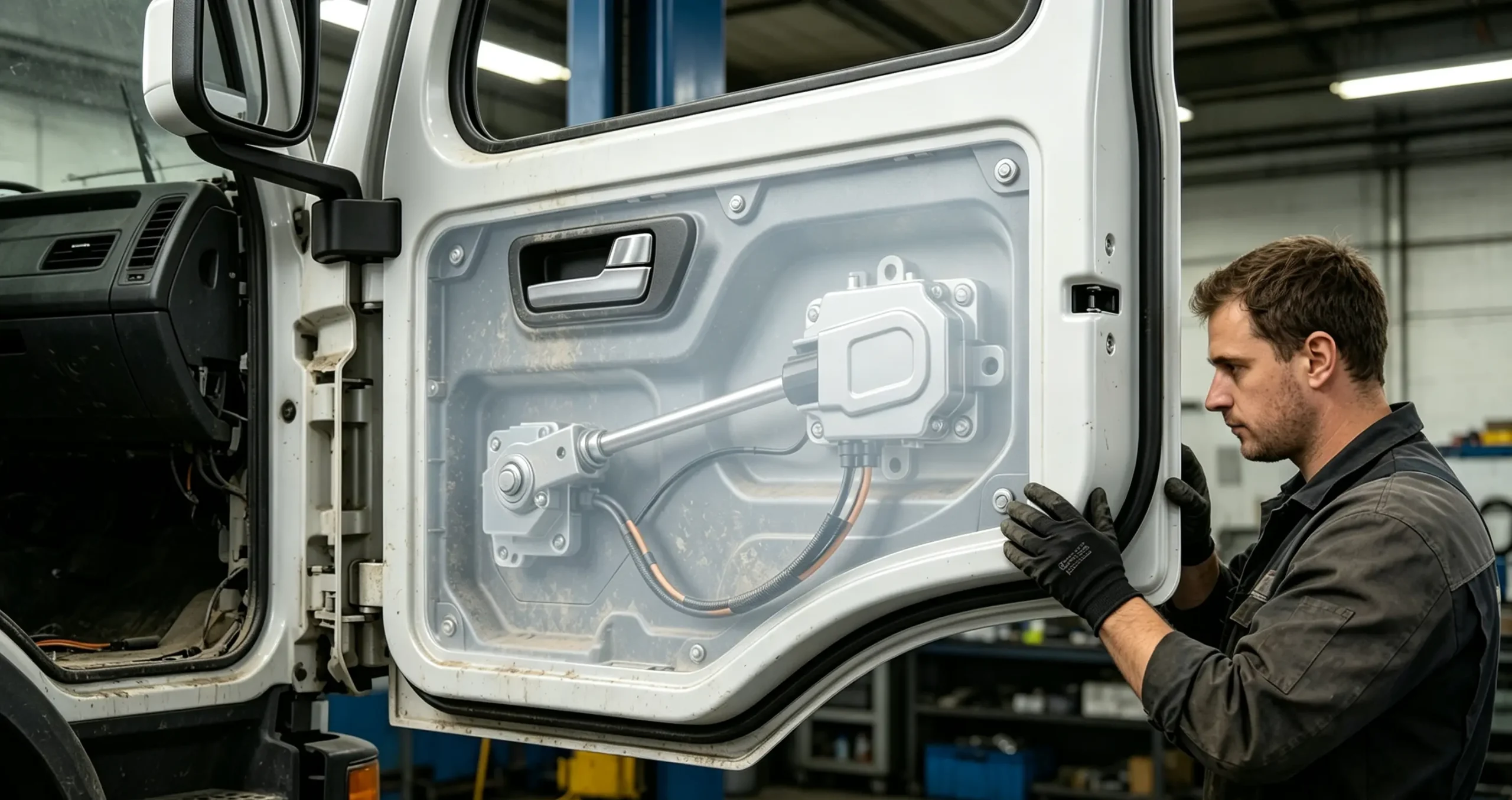
Simply put, the door lock actuator is an integrated electric drive device installed inside the vehicle door panel. It serves as the executive component of the central door locking system.
Different from traditional manual door locks, modern heavy-duty trucks rely on actuators to complete automatic locking and unlocking actions. It converts electrical signals from the cab control panel or remote key into mechanical motion.
The internal structure of a standard truck door lock actuator is compact and precise. It includes a tiny DC motor, reduction gear set, connecting pull rod, limit switch, and built-in circuit board.
When you press the lock or unlock button, the vehicle electrical system transmits current signals to the actuator motor. The motor drives the gear set to rotate and push the internal pull rod to complete door lock switch actions.
Moreover, the built-in limit switch can feed back door lock status signals to the truck’s central control system. This allows the dashboard to display real-time door opening and closing reminders.
Since the actuator belongs to a core component of the truck electrical system, its matching precision is extremely high. You can view complete supporting electrical and system accessories through our truck system parts category to ensure model consistency.
Long-haul trucks usually work in complex road conditions. Frequent vibration, temperature changes, and dust erosion will gradually wear the internal structure of the actuator. This is why door lock actuator failures are extremely common in used heavy trucks.
Most Common Bad Door Lock Actuator Symptoms
Faulty door lock actuators have obvious and distinguishable symptoms. Most failures do not occur suddenly. Instead, they show gradual abnormal signs in the early stage.
Timely identifying these subtle symptoms can help you repair or replace parts in advance. This effectively avoids complete failure and sudden vehicle door malfunction during transportation tasks.
The following are the most typical failure manifestations summarized from long-term truck maintenance cases. Each symptom corresponds to different internal damage degrees and fault locations.
1. Inconsistent Door Locking & Unlocking Response
This is the earliest and most easily overlooked symptom of actuator aging. When you press the central control lock button or remote key, the truck door cannot respond synchronously.
In most cases, one door locks or unlocks slowly, while other doors work normally. Sometimes the door responds occasionally and fails intermittently.
Many drivers mistake this problem for insufficient remote key power. In fact, it is mostly caused by aging actuator gears and poor internal contact of the limit switch.
The internal gear set of the actuator wears after long-term operation. The gear clamping stagnation leads to delayed power transmission, thus causing slow door lock response.
2. Abnormal Clicking Noise Inside the Door Panel
If you hear a continuous faint clicking sound inside the door panel after locking or unlocking the door, your door lock actuator is already faulty.
This noise comes from the idling rotation of the internal motor and slipping gears. The motor receives electrical signals and runs normally, but the worn gears cannot drive the pull rod to act.
The continuous meshing and slipping of damaged gears produce regular clicking noise. If not repaired in time, the gears will be completely worn out, leading to thorough actuator failure.
It is worth noting that abnormal noise only during door locking or unlocking indicates unilateral gear wear. Noise in both states means severe overall aging of the actuator.
3. Door Fails to Lock or Unlock Completely
This is the most intuitive medium-stage failure symptom. When you press the lock button, the door cannot be locked tightly. Or the locked door cannot be opened through electric control.
In this case, manual door handle operation is usually still effective. This proves that the door lock mechanical structure is normal, and the problem lies entirely in the electric actuator.
Severe gear wear, loose pull rod, or aging limit switch will cause the actuator to fail to complete the full stroke. Thus, the door lock cannot reach the standard locking or unlocking position.
For logistics trucks that often park outdoors, incomplete door locking will lead to cargo safety risks. It is necessary to solve this fault in a timely manner.
4. Automatic Repeated Locking & Unlocking
Some truck owners encounter strange intermittent faults. The central control door lock automatically locks and unlocks repeatedly without any button operation.
This phenomenon is mainly caused by the aging and failure of the actuator’s built-in limit switch. The switch cannot accurately identify the door lock state and continuously feeds back wrong signals to the central control system.
The central control system repeatedly sends start and stop instructions to the actuator motor, resulting in cyclic locking and unlocking actions.
This fault will cause excessive power consumption of the truck battery. Long-term unresolved problems may lead to battery power loss and failure to start the vehicle.
5. Dashboard Door Warning Light Stays On
The door indicator light on the truck dashboard always remains on, even after all doors are firmly closed. This is a typical derivative fault of actuator damage.
As mentioned earlier, the actuator is equipped with a status feedback switch. When the actuator fails, it cannot feed back the closed door signal to the central control system.
The system defaults that the vehicle door is in an open state, so the warning light keeps flashing or staying on.
Although this fault does not affect driving, it will interfere with the driver’s judgment. It may also mask real door opening faults and bring potential safety hazards.
6. Actuator No Response at All
This belongs to the late-stage complete failure symptom. After pressing the lock and unlock button, the door has no response at all, with no noise or mechanical action.
This situation is usually caused by motor burnout, circuit board short circuit, or complete disconnection of internal wiring. It requires direct replacement of the door lock actuator.
Do not continue to press the button repeatedly after complete failure. Repeated power supply may cause circuit overload and burn out the central control fuse.
Core Causes of Door Lock Actuator Failure on Heavy-Duty Trucks
To fundamentally solve actuator faults, we need to clarify the internal and external causes of damage. Different failure causes correspond to different repair schemes and maintenance strategies.
Compared with passenger cars, heavy-duty trucks have harsher working environments. Therefore, the failure causes of truck door lock actuators are more concentrated and regular.
1. Long-Term Vibration & Mechanical Wear
Heavy trucks often run on bumpy mountain roads, construction roads, and rural roads. Long-term high-intensity vibration is the primary cause of actuator aging.
The internal gears, pull rods, and fixed bolts of the actuator are prone to loosening and wear under continuous vibration. Frequent vibration will also lead to virtual connection of internal circuit contacts.
Over time, the transmission precision of the mechanical structure decreases, and the electrical signal transmission becomes unstable. Various abnormal symptoms begin to appear.
2. Dust, Mud & Humidity Erosion
The door panel interior is not a fully closed space. Dust, rainwater, and mud splashed during driving will enter the door panel and adhere to the actuator surface.
For trucks operating in mining and construction scenarios, dust accumulation is more serious. Dust accumulates in gear gaps, increasing friction and causing gear clamping stagnation and wear.
In rainy and humid environments, moisture will cause circuit board oxidation and contact rusting. This leads to poor signal transmission and short-circuit faults.
3. Frequent Manual & Electric Switching Operation
Fleet trucks have high usage frequency. Drivers frequently switch door locks manually and electrically every day, resulting in high-frequency operation of actuators.
Each locking and unlocking action causes gear meshing and motor operation. Long-term high-frequency use will accelerate mechanical fatigue and shorten service life.
Especially for trucks with frequent driver replacement, irregular door opening and closing habits will further aggravate actuator loss.
4. Low-Quality Modified or Inconsistent Parts
Many truck owners choose low-cost generic actuators for temporary replacement after faults. However, unqualified parts have inaccurate gear parameters and unqualified motor power.
Inconsistent matching parts will increase operation load. The motor is prone to overheating and burnout, and the gear wear speed is far faster than original parts.
Therefore, it is very important to select brand-matching genuine accessories. You can filter exclusive supporting parts for your truck model through our brand product page.
5. Battery Voltage Instability
Truck battery voltage instability will also damage the door lock actuator. Instant overvoltage or undervoltage will impact the internal circuit board and motor.
Long-term unstable voltage will cause circuit board aging and motor power attenuation, leading to slow response and intermittent failure of the actuator.
Step-by-Step Troubleshooting for Faulty Door Lock Actuator
Before formal disassembly and maintenance, standardized troubleshooting is required. This step can accurately locate the fault point and avoid unnecessary part replacement and maintenance costs.
Many truck owners directly replace the actuator after abnormal door lock symptoms. In fact, some faults are caused by line virtual connection and do not require part replacement.
The following is a set of universal troubleshooting steps suitable for all SINOTRUK, SHACMAN, FAW, and FOTON heavy-duty truck models.
Step 1: Eliminate Remote Key & Central Control Faults
First, rule out external control terminal faults. Press the door lock button inside the cab to test the door response.
If the internal button works normally while the remote key fails, the fault lies in the remote controller instead of the actuator.
If both internal button and remote key cannot control the door lock, it can be confirmed that the fault is in the door actuator or internal circuit.
Step 2: Test Single-Door Independent Response
Observe the working status of each door lock separately. If only a single door is abnormal and other doors work normally, the fault is localized in the corresponding single-door actuator.
If all doors fail synchronously, the problem may lie in the central control module or main circuit, not the individual actuator.
Step 3: Listen for Internal Abnormal Noise
Press the lock and unlock button and attach your ear to the door panel to listen for internal motor operation sound.
If there is a clicking sound but no door action, it is judged as gear wear and slipping fault.
If there is no sound at all, it is judged as motor burnout or line disconnection fault.
Step 4: Detect Circuit Voltage & Line Connection
Use a multimeter to detect the voltage of the actuator power supply line. Normal truck door lock voltage is stable at 12V or 24V.
If the voltage is abnormal, check the central control fuse and main line. If the voltage is normal, confirm that the actuator itself is damaged.
Step 5: Check Door Panel Water & Dust Accumulation
Check whether there is rainwater leakage and serious dust accumulation inside the door panel. Humidity and dirt will cause short circuit and poor contact faults.
Cleaning and dehumidification can solve some intermittent faults without replacing parts.
Practical Fix Solutions for Different Actuator Faults
After accurate troubleshooting, targeted repair schemes can be adopted according to different fault degrees. Minor faults can be repaired on-site, while severe aging and damage require part replacement.
1. Simple Cleaning & Lubrication for Mild Sticking
For slow door lock response and slight clamping stagnation caused by dust accumulation and insufficient lubrication, disassembly and cleaning maintenance can be carried out.
Remove the door panel interior decoration plate, clean the dust and dirt on the actuator gear set and pull rod with a clean cloth.
Apply special mechanical lubricating oil to the gear meshing position and pull rod moving gap. Avoid using inferior lubricating oil that is easy to adsorb dust.
After lubrication, test the door lock repeatedly. Most mild response delay faults can be completely solved.
2. Contact Repair for Intermittent Failure
For intermittent locking failure and automatic jumping faults caused by aging and oxidation of limit switch contacts,
you can disassemble the actuator circuit board, polish the oxidized contacts with fine sandpaper, and clean the surface with alcohol.
After polishing and resetting, the signal feedback sensitivity can be restored, and the repeated locking and unlocking faults can be eliminated.
3. Gear Replacement for Wear & Slippage Faults
For abnormal noise and ineffective door lock caused by gear wear and slipping, you can replace the internal gear set separately.
Compared with replacing the entire actuator, replacing only gears can save maintenance costs. It is suitable for actuators with intact motors and circuits.
It should be noted that the gear model must be completely matched. Mismatched gears will cause secondary wear and structural damage.
4. Overall Actuator Replacement for Complete Failure
For faults such as motor burnout, circuit board short circuit, and severe overall aging, overall replacement of the door lock actuator is the only effective solution.
The replacement operation is simple and the effect is thorough. It can completely solve all abnormal door lock faults and restore the original vehicle operation state.
If you need to purchase original matching door lock actuators and electrical accessories, you can contact our professional team to obtain model matching and quotation services.
Professional Step-by-Step Door Lock Actuator Replacement Guide
Replacing a truck door lock actuator is a simple DIY maintenance project. As long as you follow standardized steps, you can complete the replacement without professional maintenance experience.
The following steps are suitable for most mainstream heavy-duty truck models, with strong universality and operability.
Step 1: Cut Off Vehicle Power Supply
Before disassembly, turn off the vehicle key and disconnect the battery negative wire. This avoids circuit short circuit and electric shock damage during disassembly.
Power off operation is the most critical precondition for electrical component maintenance, which can effectively protect vehicle circuit safety.
Step 2: Remove Door Panel Decorative Cover
Use a professional plastic crowbar to gently pry open the door interior decorative plate. Do not use metal tools to avoid scratching the door paint and plastic parts.
Remove the fixing screws hidden under the door handle and armrest in turn, and separate the decorative plate from the door body.
Slowly lift the decorative plate and expose the internal door lock mechanism and actuator installation position.
Step 3: Disconnect Wiring Harness & Connecting Rod
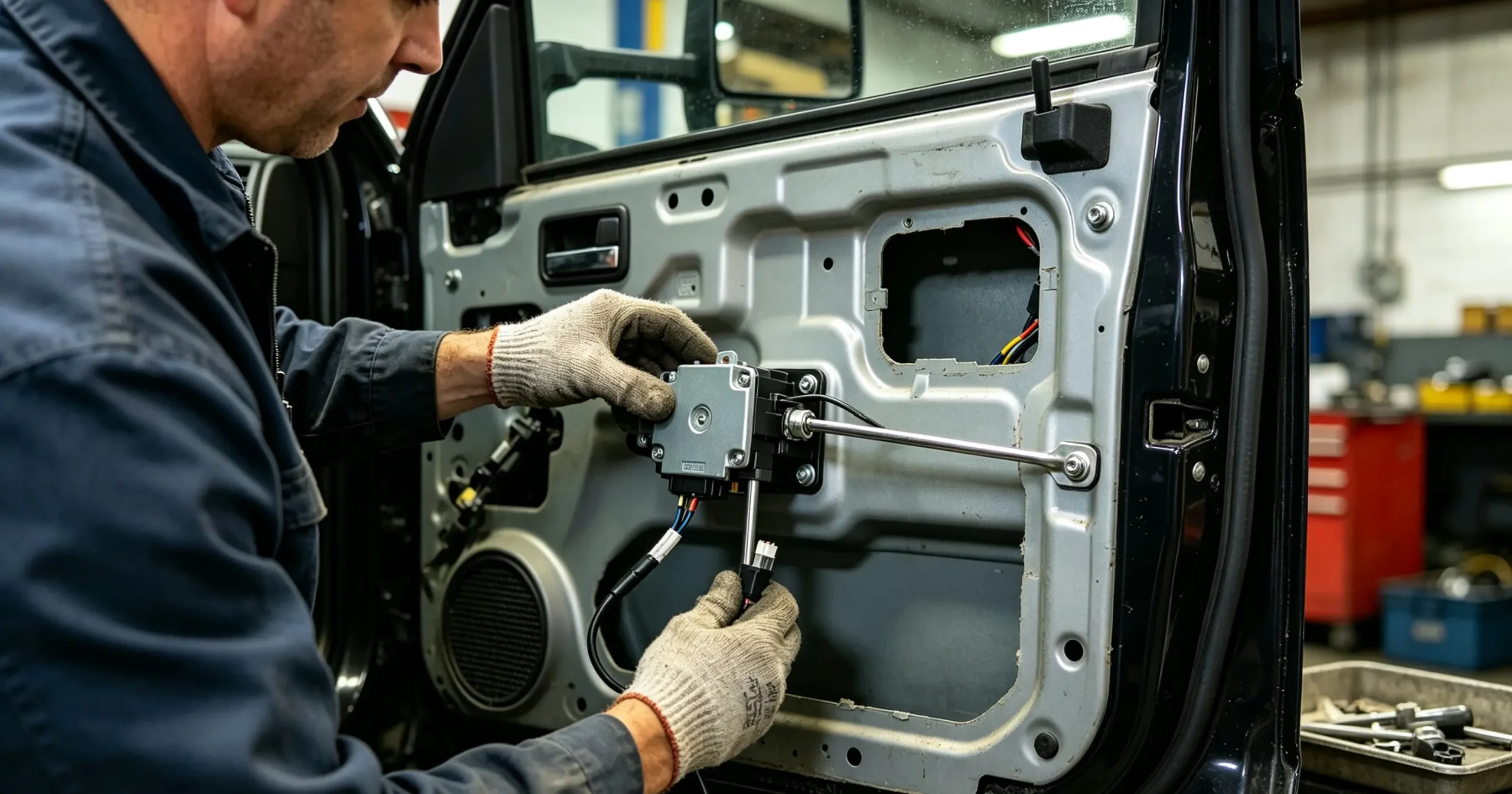
Find the actuator plug and gently press the buckle to pull out the power signal harness.
Then disconnect the mechanical connecting rod between the actuator and the door lock structure. Mark the installation position to avoid incorrect installation during resetting.
Step 4: Remove Old Actuator & Install New One
Step 5: Reset Wiring & Test Operation