In the global heavy-truck sector, unplanned downtime is the single largest destroyer of fleet profitability. For operators running Sinotruk vehicles—including the widely deployed HOWO, SITRAK, and HOHAN series—a disciplined, data-driven service program is not a luxury but a core operational strategy.
Sinotruk (China National Heavy Duty Truck Group) has expanded aggressively across Africa, Southeast Asia, the Middle East, and Latin America, with export volumes climbing steadily through the mid-2020s. As these fleets age, structured Sinotruk truck maintenance becomes the deciding factor between a five-year service life and a decade of reliable haulage.
This guide delivers practical, hands-on procedures for fleet managers and technicians. It covers model-specific intervals, step-by-step servicing, fault diagnosis, and the business case behind preventive care.
Understanding Sinotruk Models and Their Maintenance Requirements
Before touching a wrench, technicians must recognize that service intervals differ significantly by model and drivetrain. Applying HOWO 7 intervals to a SITRAK C7H, for example, can lead to premature oil degradation or unnecessary part replacement.
Common Sinotruk Series and Powertrains
The HOWO platform remains the workhorse of the lineup, historically powered by the WD615 and increasingly by the MAN-derived MC series engines. The premium SITRAK range—developed in partnership with MAN technology—typically runs the MC11 and MC13 engine families for long-haul duty.
The HOHAN series positions itself as a value-focused mid-range option, commonly fitted with MC07 and MC09 engines. Understanding these powertrains is essential because oil capacity, filter type, and emissions hardware vary across them.
Model-Specific Maintenance Baselines
The table below summarizes typical OEM guidance. Always cross-check against the unit-specific service manual, since regional fuel quality and duty cycles influence real-world intervals.
| Model Series | Engine Type | Oil Change Interval | Major Service Interval |
|---|---|---|---|
| HOWO 7 | WD615 / MC11 | Every 15,000–20,000 km | 80,000 km |
| SITRAK C7H | MC13 | Every 25,000–40,000 km | 100,000 km |
| HOHAN N7 | MC07 / MC09 | Every 20,000 km | 90,000 km |
Values represent typical OEM guidance; verify against the unit-specific service manual and local operating conditions.
Pre-Maintenance Preparation: Tools, Parts, and Documentation
Efficient servicing begins before the truck enters the bay. Assembling the right tools, parts, and records prevents mid-job delays and warranty disputes.
Essential Tools and Diagnostic Equipment
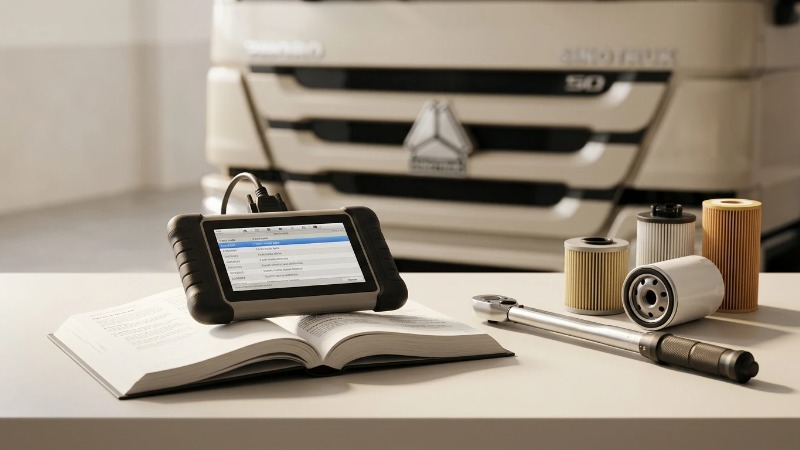
Technicians should have a calibrated torque wrench set, oil filter cap wrenches sized for MC-series canisters, and coolant pressure testers on hand. Correct torque values—such as sump plug and cylinder head fastener specs—must be sourced from the manual to avoid leaks and thread damage.
A diagnostic scanner compatible with Sinotruk ECUs (supporting the WeiCai/Weichai control units) is indispensable for reading fault codes, monitoring DPF status, and triggering forced regenerations. Generic OBD readers often cannot access proprietary parameters.
Genuine vs. Aftermarket Parts Considerations
Genuine Sinotruk components carry holographic authentication labels and QR-verifiable serial numbers. Counterfeit filters and injectors are a documented problem in high-volume export markets and can cause rapid engine wear.
Quality aftermarket parts can reduce costs on non-critical items like cabin filters or wiper components. However, for injectors, turbochargers, and emissions sensors, OEM sourcing protects both reliability and warranty coverage.
Recording and Logging Best Practices
Digital maintenance logs are now the industry standard. A complete service history preserves warranty eligibility, supports resale value, and enables trend analysis across the fleet.
Record date, mileage, parts used (with batch numbers), fluid specifications, and the technician’s name for every intervention. This traceability is critical when investigating recurring faults.
Routine Preventive Maintenance: Step-by-Step Procedures
This section forms the operational core of any Sinotruk truck maintenance program. Follow each sequence methodically for consistent, repeatable results.
Daily and Pre-Trip Inspection Checklist
A five-minute pre-trip walkaround catches the majority of roadside failures before they occur. Drivers should verify the following before departure:
- Tire pressure and tread depth on all axles, including the spare.
- Engine oil, coolant, and washer fluid levels.
- All lighting: headlights, indicators, brake lights, and reflectors.
- Air brake pressure build-up and warning buzzer function.
- Visible fluid leaks under the engine, transmission, and axles.
- Mirror condition, horn, and windshield wiper operation.
Engine Oil and Filter Replacement
Warm the engine to operating temperature to ensure the oil drains fully. Position the vehicle on level ground and engage the parking brake.
- Remove the sump drain plug and allow the oil to drain completely into a rated container.
- Unscrew the oil filter and inspect the old element for metal particles—an early indicator of internal wear.
- Lubricate the new filter gasket, install by hand, then torque to specification.
- Refit the drain plug with a new sealing washer at the correct torque.
- Refill with the specified viscosity grade—commonly 15W-40 CI-4 for older WD615 units and lower-ash 10W-40 or 5W-40 for modern MC engines with DPF.
- Run the engine, check for leaks, then recheck the level after a settling period.
Cooling System Service
Overheating is among the most costly failures in warm-climate operation. Inspect coolant condition and concentration at each major service, and pressure-test the system to detect hairline leaks.
Clean debris from the radiator and charge-air cooler fins, and verify thermostat opening temperature during warm-up. Replace coolant per the interval to prevent corrosion and cavitation of the water pump.
Air and Fuel Filter Maintenance
In dust-heavy environments—common on African and Middle Eastern haul routes—air filter intervals must be shortened dramatically. A restricted air filter starves the engine, increasing fuel burn and turbo stress.
Fuel filters should be replaced on schedule and primed correctly to avoid air locks. Water separators require daily draining where fuel quality is inconsistent.
Brake System Inspection and Adjustment
Sinotruk heavy trucks use air brake systems that demand regular attention. Check pad and lining wear against manufacturer thresholds, and inspect drums or discs for scoring and heat cracking.
Drain the air tanks daily to expel accumulated moisture, which corrodes valves and causes winter freeze-ups. Verify slack adjuster travel and system pressure hold within specification.
Scheduled Maintenance Intervals Summary Table
Keep this consolidated reference on the shop floor for quick verification during service planning.
| Component | Inspection Interval | Replacement Interval |
|---|---|---|
| Engine Oil & Filter | Every service | 15,000–40,000 km (model dependent) |
| Fuel Filter | 20,000 km | 40,000 km |
| Air Filter | 10,000 km | 40,000 km or as needed |
| Coolant | 20,000 km | 200,000 km / 2 years |
| Transmission Fluid | 50,000 km | 100,000 km |
| Brake Fluid/System | Every service | Per wear indicators |
Diagnosing and Troubleshooting Common Sinotruk Issues
Effective diagnosis blends scan-tool data with hands-on inspection. The following patterns reflect frequent field reports from high-mileage export fleets.
Frequent Fault Codes and Their Meanings
Reading diagnostic trouble codes (DTCs) narrows the search, but technicians should always confirm the root cause physically before replacing components.
| Symptom | Likely Cause | Recommended Action |
|---|---|---|
| Power loss / limp mode | DPF clogging, sensor fault | Regenerate DPF, scan ECU |
| Excessive smoke | Injector or fuel timing issue | Inspect injectors, fuel system |
| Overheating | Coolant leak, faulty thermostat | Pressure test, replace parts |
| Air pressure warning | Compressor or valve leak | Test air system integrity |
Emissions and DPF/SCR System Maintenance
Modern MC-engine trucks meet stricter emissions standards using Diesel Particulate Filters (DPF) and Selective Catalytic Reduction (SCR) with AdBlue/DEF. Poor DEF quality is a leading cause of derate faults in hot climates.
Ensure DEF meets ISO 22241 purity standards and is stored below high heat to prevent degradation. Monitor the DPF differential pressure and allow passive or active regeneration cycles to complete rather than interrupting them.
Extending Component Lifespan: Field-Proven Best Practices
The difference between a struggling and a thriving fleet often lies in habits beyond the workshop.
Driver Behavior and Its Maintenance Impact
Excessive idling accelerates oil contamination and DPF soot loading without adding productive mileage. Aggressive acceleration and overloading stress the drivetrain, brakes, and tires disproportionately.
Fleet studies consistently show that driver coaching can reduce maintenance-related costs by double-digit percentages. Load management within rated GVW is the simplest lever for longevity.
Seasonal and Climate-Based Maintenance Adjustments
Cold-climate operators should use appropriate winter-grade fuel, verify block heater function, and prioritize air-tank moisture draining. In high-temperature regions, cooling system integrity and DEF storage become the primary concerns.
Off-road and dusty routes demand shortened air filter and lubrication intervals plus more frequent undercarriage inspection.
Predictive Maintenance and Telematics
Telematics platforms now allow fleets to shift from reactive to predictive servicing. By tracking engine hours, fuel trends, fault frequency, and idle time, managers can schedule interventions before a breakdown occurs.
Integrating telematics data with the maintenance log creates a feedback loop that continually refines service intervals for each individual truck.
Cost Analysis: Maintenance Investment vs. Downtime Savings
The business case for disciplined servicing is clear when the full cost of downtime—lost revenue, penalty fees, and towing—is included.
Sample Annual Maintenance Cost Breakdown
The illustrative figures below show how preventive spending offsets far larger reactive costs.
| Maintenance Category | Estimated Annual Cost (per truck) | Downtime Reduction Impact |
|---|---|---|
| Preventive servicing | $1,200–$1,800 | High |
| Unplanned repairs (reactive) | $3,000+ | N/A (avoidable) |
| Tire management | $800–$1,500 | Moderate |
Figures are illustrative estimates; adjust to regional labor and parts pricing.
A well-maintained truck typically returns several dollars in avoided downtime for every dollar spent on preventive care—making structured maintenance one of the highest-ROI activities in fleet operations.
Frequently Asked Questions (FAQ)
How often should a Sinotruk HOWO have an oil change?
Most HOWO 7 units require an oil and filter change every 15,000–20,000 km, depending on engine family and duty cycle. Trucks operating in dusty or heavy-load conditions should service at the shorter end of that range, and always use the OEM-specified viscosity grade.
Can I use aftermarket parts without voiding the warranty?
During the warranty period, using genuine or Sinotruk-approved parts is the safest way to protect coverage. Quality aftermarket parts are acceptable for non-critical items, but injectors, turbochargers, and emissions sensors should remain OEM to avoid disputes and reliability issues.
What is the most common cause of Sinotruk engine overheating?
The most frequent culprits are coolant loss from leaks, a failing thermostat, and blocked radiator or charge-air cooler fins. A cooling system pressure test combined with fin cleaning resolves the majority of overheating cases before they cause head gasket damage.
How do I reset the DPF/service warning light?
First address the underlying cause, then use a Sinotruk-compatible diagnostic scanner to trigger a forced DPF regeneration or clear the service counter. Never reset the light without resolving the fault, as recurring soot buildup can permanently damage the filter.
What maintenance is required for the AdBlue/SCR system?
Keep the DEF tank filled with ISO 22241-compliant fluid, store DEF away from extreme heat, and inspect the dosing injector and NOx sensors during scheduled service. Contaminated or degraded DEF is the leading cause of SCR-related engine derates.
Conclusion and Call to Action
Structured, data-driven servicing is the foundation of uptime, safety, and low total cost of ownership across the HOWO, SITRAK, and HOHAN ranges. By following model-specific intervals, adopting predictive telematics, and insisting on genuine parts, fleets can extend vehicle life while shrinking unplanned repair spend.
Consistency is what separates a reliable fleet from a costly one. Every properly logged oil change and every completed regeneration cycle compounds into measurable long-term savings.
Take the next step: Download our printable Sinotruk maintenance checklist for your shop floor, subscribe to the technical newsletter for updated service bulletins, and consult an authorized Sinotruk service center for model-specific support tailored to your operating region.
Lorem ipsum dolor sit amet, consectetur adipiscing elit. Ut elit tellus, luctus nec ullamcorper mattis, pulvinar dapibus leo.


