
Introduction
Modern heavy-duty trucks rely on smart electronic powertrain systems instead of outdated mechanical controls. Older diesel trucks used manual mechanical adjustments to manage fuel delivery and engine operation. This basic setup had fewer failure points but could not deliver modern efficiency or emission compliance. Today’s semi-trucks, cargo haulers, and commercial fleets use precise computerized controls to boost performance, stability, and fuel economy. This industry-wide upgrade allows trucks to meet strict modern road emission standards while supporting heavy-load commercial transportation tasks.
Electronic control systems deliver clear operational benefits, yet they introduce unique failure risks that most truck operators overlook in daily use. The Electronic Control Unit (ECU) ranks as the most critical and frequently misdiagnosed electronic component on heavy-duty trucks. It acts as the truck’s central onboard brain and controls nearly every core function for safe, stable, and efficient long-haul operation. Minor ECU defects rarely trigger full breakdowns, which makes early fault detection extremely challenging for drivers and fleet teams.
Most vehicle inspections focus entirely on visible mechanical wear. Operators regularly check tires, brake components, and fluid leaks but ignore gradual electronic degradation inside the ECU. Early ECU issues only appear under specific stress conditions like high engine heat, humid weather, or rough road vibration. These subtle irregularities often get dismissed as temporary sensor glitches instead of early signs of hardware or software decline.
Untreated minor ECU faults grow worse over accumulated driving hours. Small intermittent issues evolve into severe, high-risk malfunctions that disrupt normal operation. Hard starting, mild power lag, and occasional idle shaking eventually turn into sudden in-transit stalling, complete startup failure, and constant dashboard fault alerts. These problems raise maintenance costs for individual owners and create costly unplanned downtime for professional fleets, with penalties, wasted labor, and idle equipment cutting directly into operational profits.
Field maintenance data from commercial truck repair facilities highlights a critical industry issue. Roughly 30 percent of all unexplained, recurring truck faults trace back to a compromised ECU. Many local repair shops lack advanced electronic diagnostic tools and specialized ECU troubleshooting skills. Technicians often fix surface fault codes by replacing sensors, injectors, and DPF filters while leaving the true ECU-related root cause unaddressed. This incomplete repair cycle leads to repeated faults and unnecessary maintenance expenses.
Every truck operator benefits from learning early ECU failure signs and standardized maintenance workflows. Early intervention prevents dangerous roadside breakdowns, reduces long-term repair costs, and maximizes vehicle uptime. This detailed guide covers all progressive ECU failure symptoms, core root causes, step-by-step diagnosis methods, and field-proven repair solutions. All content draws from real heavy-duty truck maintenance cases to deliver practical, actionable guidance for drivers and fleet managers.
If you face complex ECU faults that basic troubleshooting cannot resolve, our professional team offers precise diagnosis, program calibration, and custom part-matching support. Reach out for one-on-one tailored expert assistance through our technical support page.

What Is a Truck ECU and What Does It Do?
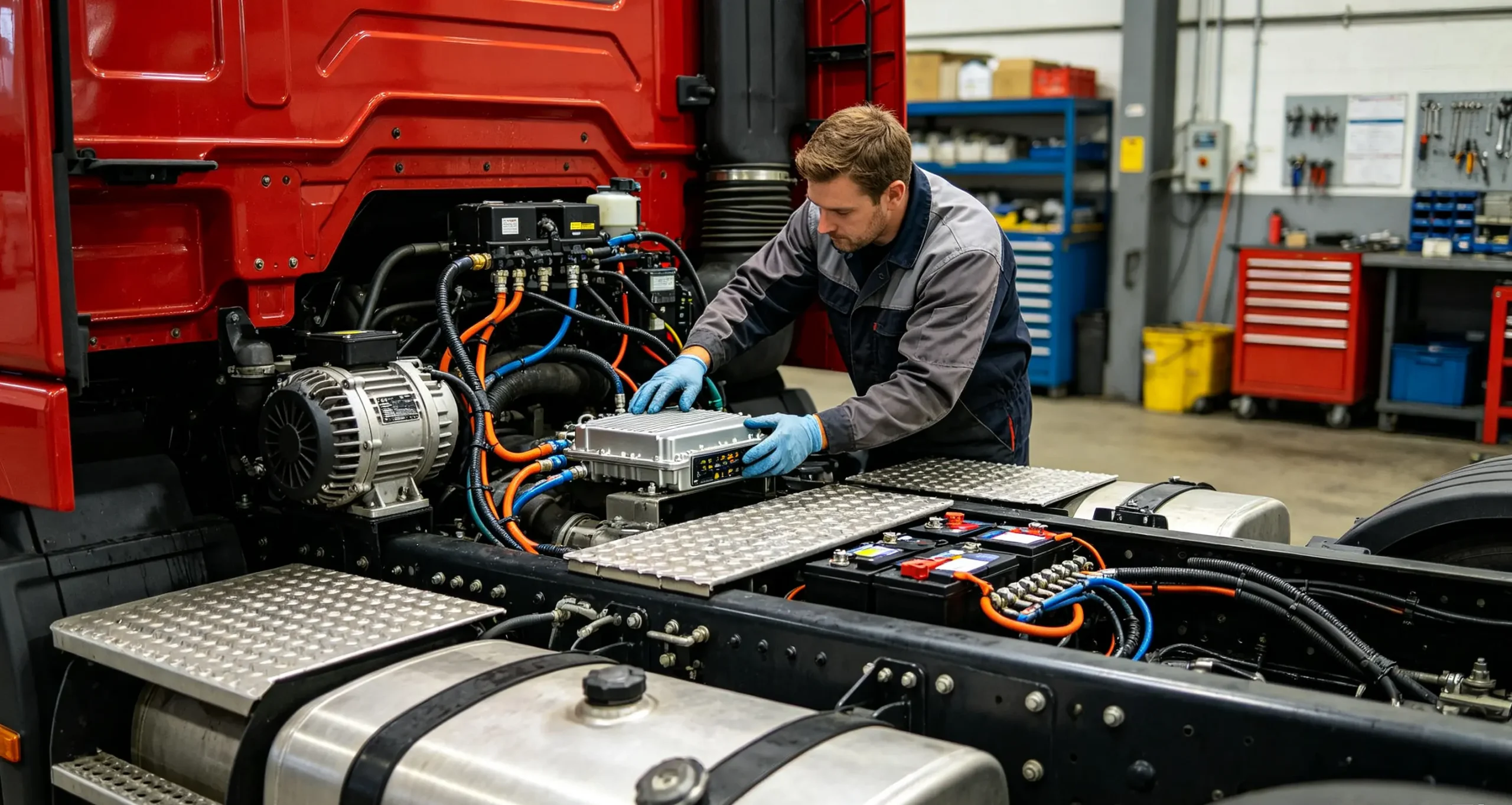
A truck ECU is an industrial-grade electronic control module built exclusively for heavy-duty commercial vehicles. It features far stronger durability and environmental tolerance than standard ECUs used in consumer passenger cars. Heavy-duty trucks operate in extremely harsh conditions, including constant vibration, extreme temperature shifts, heavy dust buildup, and prolonged rain and humidity exposure. Ordinary electronic hardware fails quickly in these environments, so truck ECUs undergo specialized reinforcement to sustain long-term stable operation.
Manufacturers design truck ECUs to resist vibration damage, high-temperature degradation, freezing-condition instability, and moisture corrosion. Technicians mount the module in a sheltered chassis position to avoid direct external impact. Waterproof, anti-vibration wiring harnesses connect the ECU to the full vehicle network of precision sensors and mechanical executive parts. This connection forms a closed-loop control system that oversees every major functional module on the truck.
The ECU control network covers the engine power system, precision fuel injection system, chassis braking system, exhaust aftertreatment system, and smart auxiliary driving functions. The module runs continuously during vehicle operation and collects real-time data from dozens of onboard sensors every second. It tracks coolant temperature, intake pressure, fuel injection pressure, turbo boost levels, traveling speed, DPF soot accumulation, and SCR urea concentration to monitor overall vehicle status.
The core ECU function involves high-speed data analysis and adaptive performance adjustment. It compares real-time sensor readings against factory-calibrated standard parameters. It sends instant corrective commands whenever data falls outside safe operational ranges. This dynamic adjustment stabilizes engine performance and adapts vehicle output to match changing road conditions and load weights.
The ECU boosts power output for high-demand scenarios such as heavy-load starting, steep hill climbing, and high-speed highway acceleration. It increases fuel supply and power reserve to eliminate weak performance under strain. During steady flat-road cruising, it optimizes fuel injection timing and volume to cut unnecessary fuel waste. This balance delivers reliable power and improved long-term fuel economy. Built-in factory programming also provides multi-layer engine protection to prevent damage from overspeeding, overheating, and sustained overload operation.
Modern Euro 5 and Euro 6 emission standards have expanded ECU functionality beyond basic engine power regulation. The ECU acts as the central controller for the entire exhaust emission management system. It actively monitors DPF soot buildup and triggers automated high-temperature regeneration cycles to clear debris and prevent filter clogging. It adjusts SCR urea injection timing and volume with extreme precision to ensure full pollutant reaction and consistent emission compliance.
The ECU also manages all smart auxiliary driving features that improve truck safety and usability. Key functions include ABS anti-lock braking, traction control, hill-start assist, and constant-speed cruise control. Every electronic operation on modern heavy-duty trucks depends on a fully functional ECU. Software disorder, parameter drift, or circuit damage disrupts core vehicle logic and triggers a wide range of recurring operational faults.
Major truck brands use custom ECU hardware and exclusive proprietary programming. SINOTRUK HOWO, Shacman, FAW, Foton AUMAN, and Dongfeng all deploy model-specific ECUs calibrated for unique engine displacements, vehicle configurations, and emission requirements. Generic universal ECUs fail to match original factory parameters and cause program mismatch, unstable operation, and persistent electronic faults. Browse fully compatible, high-quality ECU modules and truck electronic system parts in our truck system parts category.
Most Common Bad Truck ECU Symptoms (Early & Severe Signs)
Truck ECU failure progresses through three clear stages: early intermittent hidden faults, mid-term frequent obvious malfunctions, and late-stage permanent severe damage. Early warning signs stay subtle and only activate under specific stress triggers like high heat, humid air, or intense road vibration. Most drivers and junior technicians misdiagnose these subtle issues as temporary sensor errors or minor circuit contact problems instead of early ECU degradation.
Faults grow more frequent and noticeable without professional repair. Mid-stage issues start to disrupt daily driving and reduce transport efficiency. Late-stage damage creates permanent functional failures that disable normal vehicle operation. Operators who recognize these progressive symptoms early can avoid costly downtime and safety risks. Below is a complete breakdown of every typical ECU failure sign with clear identification guidance.
1. Intermittent Hard Starting or No Start
Intermittent hard starting ranks as the earliest and most telltale sign of declining ECU health. This fault follows a consistent environmental pattern. It rarely appears in cool, dry, stable weather but surfaces frequently after high-load driving, when engine bays retain residual heat, or during rainy, humid conditions.
All standard starting components work normally when this ECU fault occurs. The battery holds stable voltage, the starter spins smoothly, fuel lines remain clear, and ignition circuits stay intact. Despite fully functional mechanical and electrical starting hardware, the engine fails to ignite reliably.
The issue resolves temporarily after a short cooling or drying period. The truck starts normally once the ECU temperature drops or accumulated moisture clears. This recoverable intermittent pattern stems from aging internal solder joints and slightly corroded circuit boards inside the ECU. Heat and humidity disrupt signal transmission and block startup command delivery.
The fault becomes permanent in advanced failure stages. Many inexperienced repair teams waste funds replacing starters, batteries, and injectors. These surface-level fixes never resolve the underlying ECU circuit and signal failure, so the starting issue persists indefinitely.
2. Random Engine Stalling While Driving
Sudden in-transit stalling is one of the most dangerous ECU failure symptoms. It creates major safety hazards on highways, mountain roads, and high-traffic routes. This issue differs completely from mechanical stalling, which always includes gradual power loss, abnormal noise, and clear warning signs.
ECU-related stalling happens instantly with zero advance warning. The truck runs perfectly normally one moment and shuts down abruptly the next. Intense road vibration and high engine bay heat act as the main triggers. Bumpy roads loosen weak internal ECU solder joints, while sustained high heat disrupts chip performance and signal stability.
The ECU stops sending fuel injection and ignition commands once signal transmission breaks. This cuts engine power entirely and causes immediate stalling. The vehicle regains normal function after a few minutes of power-off cooling. Vibration and heat trigger repeated stalling episodes, which confirms deteriorating ECU internal connections and hardware aging.
Ignoring this symptom heightens accident risks during commercial transportation. Progressive damage eventually leads to non-recoverable stalling failures that disable the vehicle entirely during operation.
3. Weak Engine Power and Sluggish Acceleration
The ECU controls all engine power output logic for modern heavy-duty trucks. It adjusts performance dynamically based on real-time load weight, traveling speed, and road conditions. Degraded ECU software or hardware triggers conservative power-limiting protection modes that reduce overall engine output.
Drivers notice consistent power shortages across common driving scenarios. The truck feels weak during heavy-load starting, accelerates slowly on flat highways, and lacks sufficient reserve power for climbing and overtaking. Full accelerator input produces minimal engine speed gain, and the vehicle fails to reach standard cruising speed in a reasonable timeframe.
Accelerator response turns delayed and insensitive with noticeable pedal idle stroke. Most operators misdiagnose this issue as carbon buildup, DPF clogging, or turbocharger failure. Standard cleaning and component debugging produce no improvement because the fault originates from electronic control deviation, not mechanical blockage.
Only professional ECU recalibration, software repair, or hardware replacement resolves power attenuation and acceleration lag caused by internal ECU failure.
4. Frequent Unnecessary Limp Mode Activation
Limp mode serves as a factory-built vehicle self-protection feature. It limits speed and power to prevent secondary damage during confirmed hardware or electronic faults. The system only activates under genuine failure conditions in healthy vehicles.
A faulty ECU triggers frequent, unprompted limp mode activation with no corresponding mechanical or electronic damage. Full vehicle inspections confirm all sensors, lines, and executive parts work properly, yet the dashboard displays repeated fault alerts and forces restricted operation.
Clearing fault codes with diagnostic tools delivers only short-term relief. Limp mode reactivates after short-distance driving. This repetitive, unprompted protection behavior signals ECU program confusion, data disorder, and incorrect signal judgment. It ranks among the most commonly misdiagnosed truck ECU issues and steadily reduces fleet transport efficiency.
5. Random Fault Codes and Dashboard Warning Lights
Healthy ECUs deliver precise fault detection and targeted error reporting. They generate specific fault codes tied directly to single faulty components or isolated systems. This allows technicians to locate and fix issues quickly and accurately.
Damaged or degraded ECUs lose reliable data analysis and signal judgment capabilities. They produce chaotic, unrelated fault codes that span engine, braking, exhaust, and transmission systems. These error codes appear randomly with no fixed recurrence pattern or logical connection.
Technicians find no physical damage or functional faults when troubleshooting based on these alerts. Wiring, sensors, and executive components all operate normally. Random flashing warning lights and multi-system error codes confirm flawed ECU data processing and incorrect fault logic.
6. Unstable Idle and Engine Shaking
The ECU manages precise fuel distribution and cylinder balance for stable engine idle operation. It calculates individual cylinder fuel injection volume based on factory idle standards to maintain consistent, smooth engine rotation.
ECU failure disrupts fuel injection logic and creates uneven cylinder fuel supply. Some cylinders receive insufficient fuel while others receive excess fuel, which breaks balanced engine operation. Idle speed fluctuates widely and fails to stabilize at standard factory values.
The vehicle body shakes noticeably during idle states. Severe cases produce direct idle stalling. Symptoms grow more obvious when the engine reaches full operating temperature. Many technicians misdiagnose the issue as throttle carbon buildup or injector blockage, though mechanical cleaning cannot fix electronic control-based idle instability.
7. Unexplained High Fuel Consumption
Abnormal fuel consumption increase is the most subtle, long-term consequence of ECU failure. It does not trigger sudden breakdowns but raises daily operational costs continuously. Most operators fail to identify the root cause after completing routine maintenance and component checks.
Filter replacement, oil service, carbon cleaning, and pipeline inspections show no faults, yet excessive fuel waste persists. The core cause involves ECU parameter drift and calculation inaccuracies. A compromised ECU cannot match fuel injection volume to real-time load and road conditions.
The module injects excess fuel to compensate for flawed sensor feedback data. Fuel consumption rises noticeably under identical load weight, driving habits, and road conditions. Only ECU recalibration, software repair, or hardware replacement restores standard fuel economy.
8. DPF Regeneration Failure
All modern emission-compliant heavy-duty trucks rely entirely on ECU control for DPF monitoring and active regeneration. The ECU tracks soot accumulation levels inside the filter and triggers high-temperature cleaning cycles once soot reaches factory threshold limits.
Regeneration burns accumulated soot to keep filters unblocked, maintain normal exhaust flow, and preserve engine power. Faulty ECUs lose accurate soot monitoring abilities and fail to send valid regeneration commands.
Uncleared soot builds continuously and raises exhaust back pressure. Exhaust flow restriction reduces engine power and further increases fuel consumption. Long-term unresolved regeneration failure causes permanent DPF clogging, which requires expensive manual cleaning or full filter replacement.
9. Failed ECU Programming and Diagnostics
Complete diagnostic and programming failure signals severe, irreversible ECU hardware damage. Burned internal chips and large-scale circuit corrosion disable all communication functions between the ECU and professional diagnostic equipment.
Diagnostic scanners cannot establish system connection to read real-time data, check historical faults, clear error codes, or flash updated programming parameters. Software resets and calibration routines produce no improvements at this stage.
Precision hardware repair or full matched ECU replacement serves as the only viable solution to restore normal vehicle electronic control functions.
Real Root Causes of Truck ECU Failure
Most recurring ECU faults stem from unresolved underlying triggers instead of random component breakdowns. Surface repairs that only address visible symptoms lead to repeated malfunctions. Operators and technicians must understand core failure causes to eliminate hidden risks and achieve long-term stable operation.
Water Ingress and Moisture Corrosion
Moisture invasion ranks as the top cause of intermittent ECU faults, accounting for over 40 percent of all ECU failure cases. Rubber gaskets seal the ECU shell against external moisture. Long-term vibration and seasonal temperature swings age and crack these gaskets, which breaks the waterproof barrier.
Road splash during rainy driving, high-pressure engine bay washing, and humid seasonal air penetrate the compromised shell. Moisture settles on precision internal circuit boards and disrupts signal conduction. This creates intermittent connection issues, chaotic data transmission, random fault codes, hard starting, and in-transit stalling.
Short-term moisture exposure causes temporary glitches. Long-term dampness leads to circuit rust, chip oxidation, and permanent hardware burnout. Moisture-related corrosion remains the most common hidden trigger for progressive ECU aging.
Voltage Spikes and Unstable Power Supply
The ECU is a precision electronic module that requires consistent, stable voltage to operate correctly. Aging batteries, faulty alternators, and poor grounding create fluctuating system voltage and sharp power spikes during startup and operation.
Instant high-voltage surges damage internal capacitors and microchips. This creates irreversible hardware defects and erases calibrated program data. Improper service practices amplify these risks significantly.
Disconnecting and reconnecting wiring harnesses or electronic modules with active power generates intense current impact. This disrupts ECU parameters, creates data drift, and damages circuit logic. These unregulated power fluctuations produce hard-to-diagnose recurring electronic faults.
Long-Term Vibration Fatigue
Heavy-duty trucks operate on bumpy construction roads, rugged mountain routes, and worn municipal roads for extended hours. Continuous high-frequency vehicle vibration stresses delicate internal ECU components.
Tiny factory-secured solder joints loosen after months and years of consistent vibration exposure. This creates hidden intermittent connection faults. Circuits maintain stable contact while stationary and disconnect only under intense driving vibration.
Standard visual inspections and basic instrument checks cannot detect vibration-induced ECU damage. These subtle flaws create non-reproducible intermittent malfunctions that rank among the most difficult truck electronic faults to troubleshoot.
High-Temperature Aging
Extended high-load climbing, continuous high-speed cruising, and summer heat create excessive engine bay heat buildup. Poor enclosed-space heat dissipation sustains high temperatures around the ECU module.
Persistent heat accelerates internal component aging. It causes capacitor bulging, chip performance decline, and circuit board thermal deformation. Heat-damaged ECUs display consistent hot-fault patterns: abnormal operation at full engine temperature and automatic recovery after complete cooling.
Short-term high heat exposure creates temporary parameter drift. Long-term thermal aging produces permanent hardware failure and total ECU functional collapse.
Non-Standard Maintenance Operations
Improper service practices during routine repairs and part replacement frequently damage truck ECUs. Many entry-level technicians lack specialized ECU protection awareness and follow unsafe operational habits.
Common unsafe practices include battery replacement without full power disconnection, hot-swapping ECU wiring harnesses, and arbitrary circuit or electrical component modifications. Each action delivers sudden current and voltage shocks to the ECU module.
These impacts corrupt factory programming, disrupt parameter balance, and damage circuit stability. Most unexplained recurring ECU faults develop from these entirely avoidable service errors.
Low-Quality Aftermarket ECUs
Many operators select low-cost generic or refurbished aftermarket ECUs to cut short-term maintenance expenses. Budget aftermarket modules carry significant hidden risks and create higher long-term operational costs.
Low-quality ECUs use simplified manufacturing processes and uncalibrated internal parameters. They lack the high-temperature resistance and vibration stability of original OEM components. They work normally for short periods after installation but degrade rapidly under regular truck operating stress.
Vibration and temperature changes quickly trigger program disorder, parameter drift, and hardware failure. This creates repeated vehicle faults, frequent downtime, and ongoing repair costs. Reliable long-term operation requires brand-matched, high-quality OEM or certified remanufactured ECUs. Explore verified brand-compatible components in our brand product lineup.

How to Diagnose a Bad Truck ECU (Step-by-Step)
Accurate diagnosis forms the foundation of cost-effective, efficient ECU repair. Blind component replacement based on surface fault codes wastes money and delays proper fault resolution. The following five-step professional diagnosis workflow draws from field-verified maintenance cases and works for both individual operators and professional technicians.
Step 1: Read full-system fault codes — Use a dedicated heavy-duty truck diagnostic scanner to pull error codes across engine, braking, exhaust, and transmission systems. Multiple unrelated scattered fault codes with no matching physical damage confirm probable ECU failure.
Step 2: Test power and ground circuits — Use a multimeter to verify stable ECU input voltage, consistent current flow, and reliable grounding. Resolve basic power supply instability first to eliminate common diagnostic misjudgments.
Step 3: Perform physical ECU inspection — Dismount and examine the ECU shell and internal circuit board. Check for water stains, rust marks, burn traces, bulging capacitors, and detached solder joints. Visible physical damage confirms hardware failure.
Step 4: Monitor live sensor data — Connect diagnostic equipment to view real-time sensor operation data. Functional sensors and intact wiring paired with inconsistent or incorrect ECU data feedback confirm flawed internal data processing.
Step 5: Try reset and reprogramming — Execute factory reset and professional program flashing to fix software-level faults. Persistent symptoms after full software repair confirm irreversible hardware damage that requires physical repair or replacement.
Proven ECU Failure Solutions
Different ECU fault types and damage severity require targeted repair strategies. Matching the correct solution to the specific fault balances repair costs and long-term vehicle reliability while avoiding over-maintenance or incomplete fixes.
1. ECU Reset & Reprogramming (Software Faults)
Professional maintenance data shows over 40 percent of truck ECU faults stem from pure software issues. Common software failures include program disorder, parameter drift, calibration deviation, and localized data loss with no physical hardware damage.
Factory reset and professional program flashing fully restore original ECU operating parameters. This fixes false fault codes, power limiting errors, unstable idle performance, and excess fuel consumption caused by software flaws. The method delivers fast results at low cost while preserving original vehicle matching data.
2. Circuit Board Repair (Minor Hardware Damage)
Minor hardware issues like loose solder joints, slight circuit corrosion, and individual capacitor failure respond well to precision circuit repair. Professional technicians re-solder weak connections, replace faulty components, and clean corroded circuit areas.
This approach eliminates intermittent faults caused by minor aging damage. It retains original factory ECU calibration and vehicle parameter matching while avoiding the high cost of full module replacement.
3. OEM or Quality Reman ECU Replacement (Severe Damage)
Core chip burnout, large-area circuit corrosion, and total program crash create irreversible ECU damage. Calibration and minor circuit repairs cannot restore stable operation in these cases. Matched OEM or certified remanufactured ECU replacement delivers the safest, most reliable fix.
Always select modules calibrated for the truck’s exact brand, model, engine type, and emission standard to prevent program mismatch and secondary faults. Review real installation and performance results of our components through our customer cases.
4. Full Vehicle Circuit Inspection
Complete circuit inspection serves as a critical post-repair step to prevent recurring ECU faults. Technicians test generator output, battery health, grounding stability, and wiring harness condition to eliminate voltage fluctuation and moisture exposure risks.
This process builds a stable, safe operating environment for repaired or new ECU modules and prevents secondary damage and repeated malfunctions.
ECU Repair vs Replacement: How to Choose
Most truck operators struggle to choose between ECU repair and replacement. The best option depends entirely on fault type and damage severity. Pure software faults and minor circuit damage respond well to professional repair, which saves costs while retaining factory calibration and stable performance.
Severely damaged modules and fleet vehicles requiring maximum operational stability benefit more from direct replacement. New matched ECUs eliminate all hidden faults, remove downtime risks from recurring malfunctions, and support continuous commercial transportation operations.
Daily Tips to Extend ECU Lifespan
Over 90 percent of ECU failures develop from improper daily operation and unstandardized service habits, not natural component aging. Consistent correct maintenance prevents most hidden ECU faults and extends module service life significantly.
Keep the ECU mounting area dry and clean at all times. Avoid high-pressure water spraying on the engine bay and ECU position to block moisture ingress and corrosion risk. Always disconnect battery power before plugging or unplugging vehicle wiring and electronic modules to prevent voltage impact damage.
Check battery and generator performance monthly to maintain stable system voltage. Avoid prolonged overload climbing and continuous high-temperature driving to reduce engine bay heat accumulation and slow thermal aging. Schedule quarterly professional ECU calibration and fault detection to resolve minor hidden issues before they escalate into costly major failures.
FAQs About Truck ECU Failure
Q1: Can I drive a truck with a bad ECU?
Mild early ECU faults allow short-distance, low-load driving but carry inherent safety risks. Random stalling and startup failure can occur at any time. Severe ECU damage disables normal vehicle operation entirely. Long-distance driving with a faulty ECU remains unsafe and not recommended.
Q2: Are truck ECU faults repairable?
Nearly all common truck ECU faults support professional repair. All software errors and minor circuit hardware damage resolve fully with calibration and precision service. Only extreme chip burnout and large-area circuit damage require full module replacement.
Q3: How long does a truck ECU last?
Proper use and regular maintenance let original OEM ECUs last 5 to 8 years. Harsh high-heat, humid, and high-vibration environments or irregular service shorten lifespan to 2 to 3 years.
Q4: Can a bad ECU cause high fuel consumption?
Yes. Faulty ECU parameter drift creates inaccurate fuel injection control. Excess fuel delivery and unoptimized power output raise fuel consumption noticeably. Standard mechanical maintenance cannot fix this issue, which requires ECU recalibration or hardware repair.
Q5: How to tell ECU faults apart from sensor faults?
Sensor faults create single-point, single-system errors with fixed repeatable fault codes. ECU faults trigger multi-system random errors with no detectable physical component damage after full vehicle inspection. This key difference simplifies accurate diagnosis.
Conclusion
The ECU functions as the core intelligent control hub for modern heavy-duty trucks. Its operating state directly impacts driving safety, power performance, fuel efficiency, and commercial operational profitability. All ECU degradation produces recognizable early warning signs that every truck driver and fleet manager can observe and identify. Issues like intermittent hard starting, sudden in-transit stalling, weak engine power, unexplained high fuel consumption, and frequent limp mode activation are clear indicators of declining ECU performance.
Most ECU failures stem from avoidable triggers, including moisture corrosion, unstable power voltage, long-term vibration fatigue, continuous high-temperature aging, and irregular maintenance habits. Generic low-quality aftermarket ECUs also contribute to recurring faults that disrupt daily transportation operations. Unlike sudden mechanical failures, ECU damage develops gradually, leaving plenty of time for early detection and targeted intervention.
Timely and accurate diagnosis is key to resolving ECU problems efficiently. Simple software recalibration and minor circuit repairs can fix most early and mid-stage faults at a low cost, while severely damaged modules require professional replacement with OEM or high-quality remanufactured ECUs. Pairing repairs with full circuit inspections and standardized daily maintenance effectively prevents secondary damage and repeated malfunctions.
Proper daily care and regular professional inspections greatly extend ECU service life, stabilize overall vehicle performance, and cut long-term fleet maintenance costs. For complex ECU fault diagnosis, matched part selection, and professional technical support, feel free to contact our professional team at any time. You can also visit our company introduction page to learn more about our professional truck parts service and global support system.


