Introduction
Heavy-duty trucks form the backbone of global commercial freight transportation. Every single day, these robust vehicles travel across diverse road conditions worldwide.
They cover urban arterial roads, rural country highways, rugged mountain terrains and arid desert routes without interruption. Their stable operation directly supports global logistics and economic circulation.
Unlike ordinary passenger cars that run intermittently for daily commuting, heavy trucks face far harsher operating scenarios. Most fleet trucks operate continuously for 10 hours or longer per day.
Furthermore, these vehicles often carry full loads and work under high-temperature, high-load and high-vibration environments for weeks on end. Such long-term extreme operation brings huge challenges to engine stability.
During engine combustion and mechanical operation, a massive amount of heat is generated every minute. If this heat cannot be discharged and regulated in a timely manner, various mechanical faults will inevitably occur.
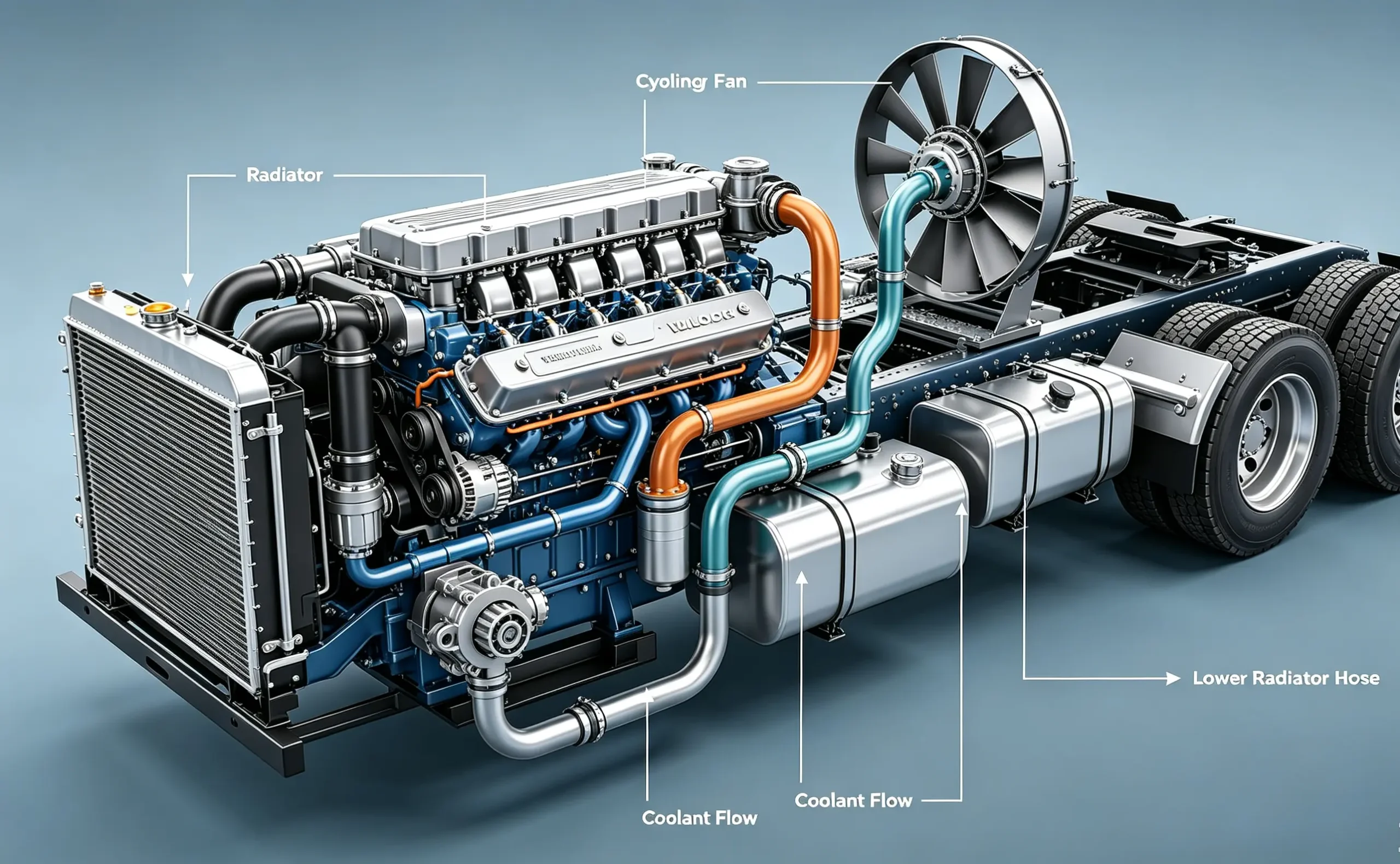
For this reason, the truck engine cooling system is universally recognized as the most critical protective system for heavy-duty engines. It decides the overall driving stability, part service life and long-term operational safety of the truck.
In routine fleet maintenance and daily inspection work, most managers and technicians tend to focus only on large and visually obvious cooling system components. These key parts mainly include radiators, cooling fans, water pumps and coolant liquid quality.
Conversely, the small truck thermostat valve is frequently overlooked in conventional inspections. Many maintenance personnel mistakenly believe that this tiny component has little impact on overall engine performance.
In reality, the thermostat valve acts as the core control switch of the entire truck cooling system. It undertakes the irreplaceable task of real-time coolant circulation regulation and temperature balancing.
To put it simply, the thermostat serves as an intelligent temperature gatekeeper for heavy-duty truck engines. It precisely judges engine temperature status and switches coolant circulation modes accordingly.
On one hand, it locks internal circulation to help the engine warm up quickly during cold starts. On the other hand, it opens external circulation to dissipate excess heat during high-load operation.
Besides, it balances engine temperature fluctuations across all working stages. These stages cover cold start idling, low-speed cruising, full-load climbing and long-distance high-speed driving.
Without a fully functional thermostat valve, the entire cooling system will lose precise temperature regulation capability. As a result, the engine will fall into two extreme abnormal operating states.
For one thing, the engine will overheat rapidly under heavy load, which triggers safety hazards. For another, it will keep running at an excessively low temperature during normal driving.
Both abnormal working modes will cause irreversible damage to internal engine precision parts. Meanwhile, they greatly increase fleet daily failure rates and long-term operating costs.
Specifically, sustained engine overheating will lead to a series of serious mechanical faults. Common issues include cylinder head warping, piston scuffing, engine oil deterioration and cylinder gasket burnout.
In severe cases, these faults will cause sudden engine shutdown on the road and even force a complete engine overhaul, bringing huge economic losses to fleet operators.
In contrast, long-term low-temperature operation will greatly reduce fuel combustion efficiency. This directly leads to increased fuel consumption, weakened engine power and accelerated internal part wear.
Additionally, incomplete fuel combustion caused by low temperature will produce a large number of carbon deposits and harmful exhaust pollutants. These deposits accumulate inside the engine and affect long-term performance.
Moreover, excessive exhaust emissions will cause trucks to fail regular environmental inspection tests, resulting in operational restrictions and additional maintenance troubles for fleet teams.
Worse still, early thermostat valve failures produce almost no obvious warning signs. The subtle abnormal changes are extremely difficult to detect through simple daily visual inspections.
By the time drivers and maintenance staff notice obvious faults such as overheating alarms or obvious power attenuation, the engine has already suffered long-term hidden damage.
Therefore, mastering the working principle, failure characteristics and professional maintenance methods of truck thermostat valves is a basic skill for all truck drivers and fleet maintenance technicians.
In addition, standardized daily inspection and timely fault replacement can effectively reduce the overall failure rate of the cooling system. It also extends the full service life of heavy-duty truck engines.
This in-depth practical guide comprehensively elaborates on all core knowledge related to truck thermostat valves. It covers basic structural composition, complete working process and core functional advantages.
Meanwhile, it sorts out typical failure symptoms, root fault causes, standardized repair steps and scientific preventive maintenance skills in detail.
Furthermore, this article summarizes common maintenance mistakes that lead to repeated failures and provides targeted solutions. For high-quality matched truck thermostat valves and complete cooling system accessories, you can browse our truck system parts catalog for one-stop selection.
What Is a Truck Thermostat Valve? Core Definition & Basic Structure
Before diving into the specific working principle of the thermostat valve, it is essential to clarify its accurate industry definition and internal structural composition. This foundation helps users accurately judge faults and standardize maintenance operations.
A truck thermostat valve is a professional temperature-sensitive mechanical control component specially designed for heavy-duty commercial vehicle engines. It is generally installed at the engine coolant outlet or water pump inlet position.
As the core control unit of the heavy truck cooling system, its primary responsibility is to sense real-time coolant temperature changes. Correspondingly, it automatically switches coolant circulation modes to stabilize engine temperature.
It is crucial to distinguish truck thermostat valves from ordinary thermostat parts used in family passenger cars. Heavy-duty trucks operate under far harsher working conditions and generate much higher engine heat.
For this reason, truck thermostat valves adopt upgraded industrial-grade manufacturing standards. They feature stronger high-temperature resistance, better structural stability and longer fatigue resistance than ordinary automotive thermostats.
These optimized structural designs enable the thermostat to adapt to long-hour continuous operation, heavy-load driving and complex variable road environments. It can maintain stable performance without frequent failure.
At present, almost all mainstream heavy-duty truck models on the global market adopt mature wax-type thermostat valves. This mechanical structure has been fully verified by decades of market application and practical maintenance.
Compared with electronic thermostat structures, traditional wax-type thermostats have outstanding stability and ultra-low failure rates. They can effectively avoid electronic component damage caused by truck vibration and voltage fluctuation.
Besides, they can resist the interference of harsh working environments such as high temperature, dust and humidity, which is more suitable for heavy-duty truck operation scenarios.
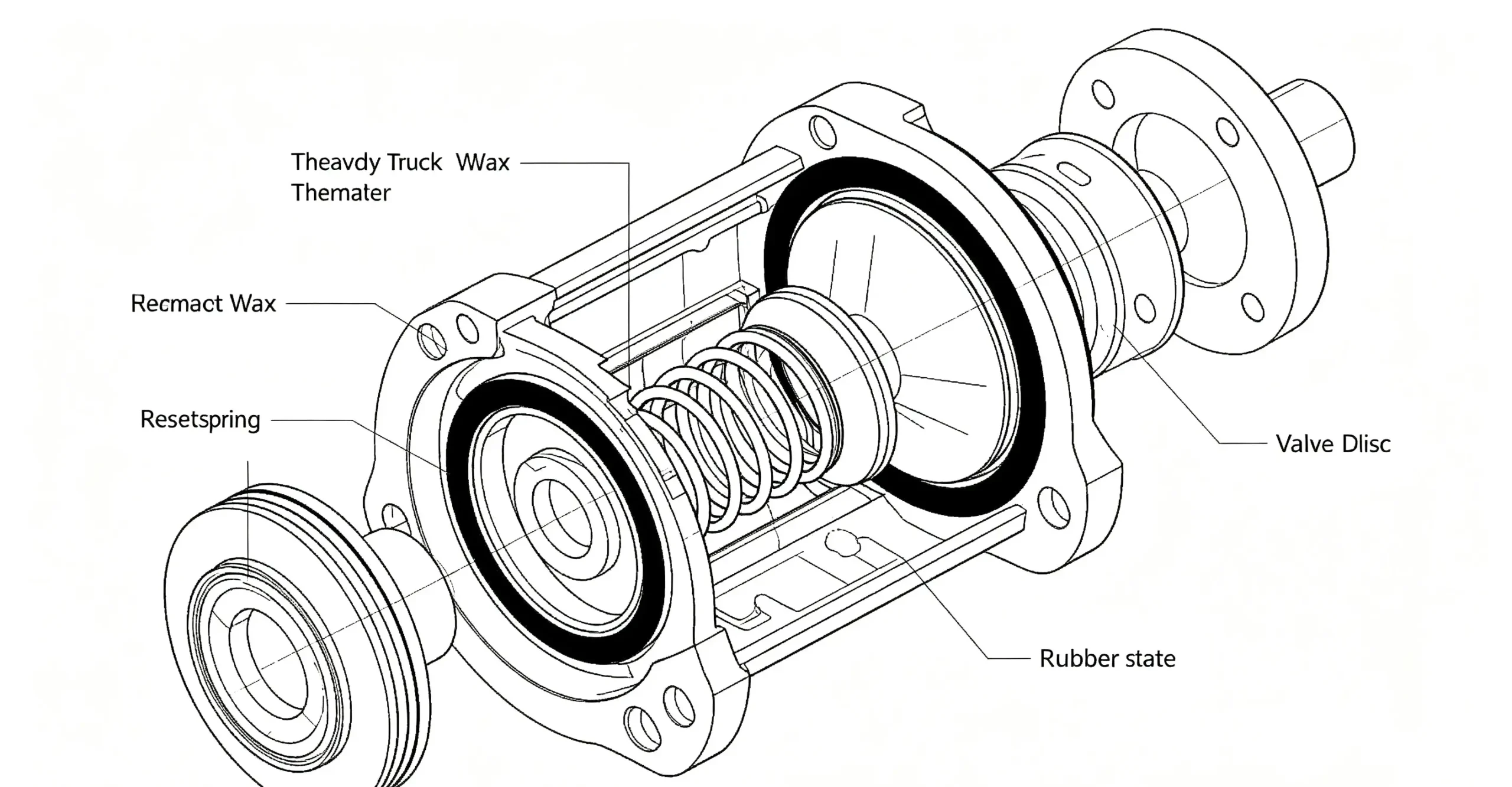
A complete heavy-duty truck thermostat valve consists of multiple precision-matched parts. Every single component has an independent division of labor, and all parts cooperate closely to complete accurate temperature control actions.
The core internal structures mainly include thermal wax sensing chamber, stainless steel reset spring, flow control valve disc, fixed valve seat and rubber sealing gasket. Each part plays an irreplaceable role.
First and foremost, the thermal wax sensing chamber serves as the core sensing component of the entire thermostat. Its interior is filled with high-precision thermal expansion wax with stable physical properties.
This special industrial wax has fixed thermal expansion and cold contraction characteristics. It can produce regular volume changes with tiny coolant temperature fluctuations to drive valve mechanical movement.
Secondly, the high-strength stainless steel reset spring undertakes the valve disc reset work. After the engine stops running and coolant temperature drops, the spring pushes the valve back to the closed state.
This automatic reset function ensures the thermostat returns to the initial standby state. It fully prepares for the next cold start and warm-up process of the truck engine.
In fact, the spring’s toughness, fatigue resistance and structural stability directly determine the overall service life and working accuracy of the thermostat valve.
In addition, the valve disc and fixed valve seat are the key execution structures for controlling coolant circulation. The gap between them accurately controls coolant flow rate in different working modes.
When the valve is fully closed, semi-open or fully open, it can cut off or connect the large circulation channel in real time. This realizes intelligent hierarchical regulation of engine temperature.
Finally, the external rubber sealing gasket is an indispensable auxiliary sealing component. It fills the assembly gap between the thermostat housing and the engine mounting surface.
This effectively prevents coolant leakage and external air inhalation in the cooling system. It guarantees the overall tightness and operational stability of the entire coolant circulation loop.
It is worth mentioning that different brands and models of heavy-duty trucks have different engine displacement and heat generation parameters. Thus, the matching thermostat opening temperature varies accordingly.
The conventional opening temperature of mainstream truck thermostats on the market ranges from 75℃ to 85℃. For high-power large-displacement engines, the matching opening temperature can reach 88℃ or even 92℃.
Only thermostat parts with accurate temperature parameters can perfectly match the engine’s heat dissipation demand. Mismatched parameters will directly cause overheating or low-temperature operation faults.
To find brand-specific and model-matched standard thermostat parts, you can check complete product parameter data and genuine OEM parts in our heavy truck OEM parts collection.
How Does a Truck Thermostat Valve Work? Complete Working Principle
Overall, the working principle of the truck thermostat valve is based on the stable physical characteristics of thermal expansion and cold contraction of internal industrial thermal wax.
Relying on this physical change, the thermostat realizes automatic switching between two core circulation modes of the cooling system. The two modes are small internal circulation and large external circulation.
In short, the thermostat can intelligently adjust the coolant circulation path according to real-time engine coolant temperature changes. It always maintains the engine within the optimal working temperature range.
In order to let professional technicians and truck drivers understand the working logic more clearly and intuitively, we divide the entire continuous working process into four coherent and independent stages.
These four stages cover cold start standby, warm-up transition, full-load heat dissipation and shutdown reset. Each stage has unique working characteristics and definite functional purposes.
1. Cold Engine Start & Small Circulation Mode
The cold start stage refers to the initial state when the truck engine is completely shut down and parked for a long time. At this moment, the coolant temperature is completely consistent with the ambient temperature.
In this state, the coolant temperature is far lower than the preset opening threshold of the thermostat valve. The internal thermal wax is in a solid and fully contracted state with no expansion pressure generated.
Under the stable elastic action of the high-toughness reset spring, the valve disc is tightly pressed on the fixed valve seat. Meanwhile, the large circulation channel leading to the external radiator is completely closed.
In contrast, the reserved small circulation bypass inside the engine block remains completely unobstructed. Therefore, the coolant can only form a closed loop inside the engine block, cylinder head and water pump.
In this small circulation mode, the coolant does not flow through the external radiator at all. It will not be cooled by external natural wind or vehicle-mounted cooling fans.
As a result, the heat generated by engine combustion and mechanical operation can be quickly accumulated inside the engine. This greatly shortens the engine warm-up time after cold start.
Rapid warm-up is extremely critical for heavy-duty truck engines. It can effectively reduce incomplete fuel combustion caused by ultra-low temperature during cold start.
At the same time, it relieves dry friction of internal engine parts, reduces mechanical wear and lowers idle fuel consumption and carbon deposit generation in the cold start stage.
Especially in low-temperature winter environments and high-altitude cold areas, the small circulation mode of the thermostat is the core guarantee for normal cold start and stable initial operation of truck engines.
2. Engine Warm-Up & Mixed Circulation Transition Stage
With the continuous idling operation and low-speed flat-road driving of the truck engine, the internal coolant temperature rises steadily and slowly approaches the thermostat’s preset opening temperature.
At this transitional stage, the solid thermal wax inside the thermostat begins to melt slowly. Its volume expands gradually and produces continuous and stable thrust to push the valve disc.
When the expansion thrust of the molten thermal wax exceeds the elastic tension of the reset spring, the valve disc is slowly pushed open. The large circulation channel starts to open slightly.
Different from the single small circulation mode in the cold start stage, this stage belongs to a mixed circulation transition state. Both small internal circulation and large external circulation work simultaneously.
Specifically, a part of the high-temperature coolant flows to the external radiator through the slightly opened large circulation channel for heat dissipation and cooling treatment.
The other part of the coolant still maintains internal small circulation operation. This design ensures that the engine temperature will not drop sharply or rise too fast.
The existence of the mixed circulation stage effectively avoids the sudden full opening of the thermostat valve. It thoroughly prevents sharp and irregular fluctuations in engine working temperature.
This stable and gentle transition process ensures that the engine temperature rises slowly and uniformly. It creates a constant and optimal temperature environment for engine combustion and mechanical operation.
This transition stage lasts for a short time. With the gradual increase of engine load and continuous rise of coolant temperature, it will quickly switch to the full large circulation working mode.
3. Full Temperature Operation & Large Circulation Mode
When the truck runs continuously under high-load conditions, the engine will generate a large amount of heat stably. Common high-load scenarios include long-distance high-speed driving, full-cargo transportation and continuous mountain climbing.
At this time, the coolant temperature continues to rise steadily and finally exceeds the full-opening threshold of the thermostat valve. The internal thermal wax expands to the maximum volume limit.
The maximum expansion force completely overcomes the elastic tension of the reset spring. The valve disc is pushed to the fully open state, and the large circulation channel is completely unblocked.
At the same time, the valve body completely blocks the small circulation bypass inside the engine. The coolant no longer maintains independent internal circulation.
All high-temperature coolant flows out of the engine interior and enters the external radiator assembly. The radiator relies on natural wind impact and electronic cooling fans for forced heat dissipation.
After the high-temperature coolant is fully cooled in the radiator, it flows back to the engine interior through the water pump again. This forms a complete and efficient large-scale heat dissipation circulation loop.
The large circulation mode is the core heat dissipation working mode for engine high-load operation. It can timely and efficiently take away the massive heat generated by the engine.
This mode always keeps the engine working temperature within the safe and standard range. It completely avoids engine overheating faults caused by excessive heat accumulation.
Whether in hot summer high-temperature environments or long-term heavy-load operation scenarios, the large circulation mode ensures continuous and stable power output of heavy-duty truck engines.
4. Automatic Reset After Engine Shutdown
After the truck completes the transportation task and the engine is completely shut down, the engine stops generating heat. The temperature of the internal coolant begins to drop slowly and steadily.
As the coolant temperature decreases continuously, the internal thermal wax of the thermostat cools down gradually and shrinks in volume. The expansion thrust generated by the wax disappears slowly.
The thermostat automatically resets to the cold-start standby state, waiting for the next engine start and warm-up cycle. The whole reset process is fully automatic without any manual operation or intervention.
This intelligent cycle switching logic enables the thermostat to adapt to all engine working states. It realizes unattended and precise full-process temperature control for the cooling system.
To further understand the matching logic of cooling system components and systematic fault diagnosis methods, you can browse rich professional articles and practical guides in our truck technical support articles.
Key Functions of Truck Thermostat Valve in Cooling System
Most truck drivers and maintenance personnel only regard the thermostat as a simple switching part. In fact, it undertakes multiple core protection functions related to engine safety, fuel economy and service life.
Every functional advantage of the thermostat is indispensable for the stable operation of heavy-duty truck engines. It plays a positive role in reducing failure rate and saving fleet long-term operating costs.
In order to let users fully recognize the importance of this small component, we systematically sort out five core functions of the truck thermostat valve in the cooling system based on a large number of maintenance cases.
1. Accelerate Cold Start Warm-Up Speed & Reduce Mechanical Wear
If the truck is not equipped with a qualified and intact thermostat valve, the cooling system will always maintain a full large circulation state without any temperature regulation.
During cold start and low-temperature driving in winter, external natural wind will continuously cool the radiator and circulating coolant. The engine cannot accumulate heat to reach the optimal working temperature for a long time.
Long-term low-temperature operation will lead to excessive viscosity of engine oil. The fluidity and lubrication effect of the engine oil will decrease significantly.
In this case, the friction resistance of internal moving parts such as pistons, crankshafts and bearings increases greatly. The mechanical wear of the engine is intensified exponentially.
The intact thermostat valve effectively blocks the large circulation channel during cold start. It enables the engine to warm up quickly and reach the optimal lubrication temperature in a short time.
This greatly reduces the mechanical wear of the engine in the cold start stage. It effectively prolongs the overall service life of heavy-duty truck engines and reduces early aging of parts.
2. Stabilize Engine Working Temperature & Ensure Stable Power Output
Heavy-duty truck engines generate far more heat than ordinary passenger car engines under load conditions. Uncontrolled heat accumulation will easily cause local overheating of the engine.
Local overheating will lead to unstable engine operation, power attenuation and jitter during driving. In severe cases, it will cause sudden flameout and seriously affect driving safety and transportation efficiency.
The thermostat valve can dynamically adjust the coolant circulation mode according to real-time temperature changes. It always locks the engine temperature in the standard safe working range.
Stable engine temperature ensures uniform viscosity of engine oil and stable operation of all mechanical moving parts. It makes the engine power output more continuous, smooth and stable.
Whether it is flat road cruising, heavy-load cargo transportation or long-distance mountain climbing, the thermostat can provide reliable and stable temperature protection for the engine.
3. Optimize Fuel Combustion & Reduce Fuel Consumption and Emissions
Engine fuel combustion efficiency is closely linked to working temperature. Low-temperature operation is the primary cause of incomplete fuel combustion for heavy-duty truck engines.
When the engine temperature is too low, the fuel cannot be fully atomized and mixed with air. A large amount of fuel cannot be completely burned and is wasted in vain, resulting in increased fuel consumption.
At the same time, incomplete combustion will produce a large number of carbon deposits, carbon monoxide and particulate pollutants. It not only wastes fuel energy but also causes excessive exhaust emissions.
The thermostat valve ensures that the engine quickly reaches and maintains the optimal combustion temperature. It greatly improves fuel atomization effect and overall combustion efficiency.
Sufficient and full combustion effectively reduces idle and cruising fuel consumption. It also reduces harmful exhaust emissions to help trucks meet strict environmental inspection standards.
4. Prevent Thermal Deformation & Avoid Major Engine Failures
Engine overheating is recognized as one of the main killers of heavy-duty truck engines in the industry. Short-term high temperature will cause cylinder head gasket burnout and local part ablation.
Long-term continuous overheating will lead to irreversible deformation of the cylinder head, piston scuffing and complete deterioration and failure of engine oil.
These major thermal damage faults will directly lead to engine overhaul. It brings huge maintenance costs and economic losses to fleet owners and individual drivers.
The thermostat valve acts as the first line of defense for engine overheating protection. It timely starts the large circulation heat dissipation mode to discharge excess heat inside the engine.
It avoids excessive heat accumulation inside the engine and fundamentally prevents various thermal damage faults of engine precision parts.
5. Adapt to Complex Working Conditions & Improve Environmental Adaptability
Heavy-duty trucks need to travel and operate in various complex geographical and climatic environments worldwide. The ambient temperature varies greatly in different seasons and regions.
In high-temperature summer southern regions, the external temperature is extremely high, and the engine heat dissipation pressure is huge. In low-temperature northern mountain areas and winter environments, the engine is prone to insufficient temperature rise.
The thermostat valve can automatically switch circulation modes according to ambient temperature and engine load changes. It perfectly adapts to various complex working scenarios and climatic conditions.
It can not only ensure sufficient heat dissipation in high-temperature environments to prevent overheating but also guarantee rapid warm-up in low-temperature environments to avoid low-temperature wear.
This function greatly improves the environmental adaptability and operational stability of heavy-duty trucks. You can refer to our customer cooperation cases to learn more about regional targeted maintenance schemes.
Common Truck Thermostat Valve Failure Symptoms
Thermostat valve failures are typical hidden mechanical faults in truck cooling systems. Most faults evolve slowly from minor subtle abnormalities to serious functional failures, rather than sudden out-of-order faults.
In the early failure stage, the abnormal performance of the truck is very subtle. These tiny changes are easy to be ignored by drivers and routine maintenance personnel.
However, long-term accumulation of minor faults will eventually trigger major cooling system failures and permanent engine damage. Thus, accurate identification of thermostat failure symptoms is crucial.
Combined with a large number of heavy truck maintenance practices and on-site fault handling experiences, we have sorted out six most common and typical thermostat failure symptoms with detailed judgment standards.
1. Engine Overheating Under Load
Engine overheating under load is the most typical and widespread failure symptom of a faulty thermostat valve. This fault is mainly caused by the thermostat being stuck in the closed state.
When the thermostat valve is stuck closed, the large circulation channel leading to the external radiator cannot be opened normally. The cooling system loses its external heat dissipation function.
At this time, the cooling system can only maintain small internal circulation. The massive heat generated by the engine under load cannot be discharged through the radiator.
When the truck is under heavy load, climbing slopes or running at high speed, the engine generates heat rapidly. Heat accumulates in a short time and causes the engine temperature to rise sharply.
Drivers can clearly observe that the dashboard temperature gauge rises rapidly. In severe cases, the engine overheating alarm will be triggered directly to remind of abnormal temperature.
If the load is not reduced or the vehicle is not stopped for heat dissipation in time, it will easily cause engine cylinder pulling and scrapping, resulting in huge maintenance losses.
2. Persistent Low Engine Temperature
Different from overheating faults, persistent low engine temperature is mainly caused by the thermostat being stuck in the fully open state.
When the thermostat valve is stuck open, the large circulation channel is always unobstructed. The cooling system maintains full large circulation operation all the time without temperature regulation.
In cold winter or low-temperature plateau environments, external cold wind continuously cools the radiator coolant. The engine cannot complete rapid warm-up and heat accumulation.
During the whole driving process, the engine temperature always stays below the standard working range and cannot rise to the optimal combustion temperature.
At this time, the truck will have obvious abnormal symptoms including weak power, slow acceleration and significantly increased fuel consumption. This is a typical fault characteristic of stuck-open thermostat.
3. Slow Temperature Rise During Cold Start
Under normal working conditions, a qualified intact thermostat can make the engine temperature rise to the standard working range within 3 to 5 minutes after cold start and idling.
If you find that the engine warm-up speed is significantly slower than usual, it means that the thermostat valve cannot be tightly closed as normal.
Aging internal spring fatigue or slight deformation of the valve body will lead to a tiny gap in the closed state of the thermostat.
A small amount of coolant continuously flows to the radiator through the gap, causing continuous heat loss of the engine. This results in slow temperature rise and long-term low-temperature operation after cold start.
4. Fluctuating Engine Temperature
The normal working temperature of a heavy-duty truck engine is stable and fixed within a narrow standard range. There will be no large-scale random up and down fluctuations.
If the thermostat internal spring is fatigued or the thermal wax is aging and deteriorated, the opening and closing actions of the valve body will become unstable and irregular.
During truck driving, the engine temperature will jump randomly. Sometimes the temperature is normal, sometimes it is too high or too low, showing obvious unstable fluctuation.
This symptom is very easy to be misjudged as a temperature sensor fault. In actual maintenance, technicians must check the thermostat working state first to avoid fault misjudgment.
5. Coolant Leakage Near Thermostat Housing
After long-term high-temperature operation and continuous chassis vibration of the truck, the thermostat rubber sealing gasket will gradually age, deform and lose elasticity.
In addition, non-standard installation and uneven bolt tightening will lead to tiny assembly gaps between the thermostat housing and the engine mounting surface.
These tiny gaps will cause slow seepage of coolant. Drivers can observe residual coolant traces and wet water stains around the thermostat housing.
Continuous loss of coolant will reduce the total amount of cooling liquid in the system. It further aggravates engine overheating risks and induces secondary cooling system faults.
6. Abnormal Frequent Operation of Cooling Fan
The working frequency of the truck cooling fan is automatically adjusted according to the real-time engine temperature. Normal and stable temperature corresponds to normal fan operation frequency.
When the thermostat fails to switch the circulation mode normally, the engine temperature will be abnormal. The cooling fan will start frequently or keep running continuously without stopping.
Frequent fan operation will increase the idle load of the engine. It leads to increased power consumption and fuel consumption, and also shortens the overall service life of the cooling fan assembly.
Main Causes of Truck Thermostat Valve Failure
Thermostat valve failures are almost never accidental. Almost all faults are caused by long-term improper use habits, poor daily maintenance and natural aging of parts.
Understanding the root causes of thermostat failures can help maintenance personnel formulate targeted preventive measures. It effectively avoids repeated faults and extends the actual service life of parts.
Combined with years of heavy truck on-site maintenance experience, we summarize six core causes of thermostat valve failure, covering use, maintenance, parts quality and installation specifications.
1. Aging and Deterioration of Internal Thermal Wax
Thermal wax is the core sensing material of the thermostat valve. Its physical activity and stability directly determine the working accuracy and sensitivity of the entire thermostat.
After long-term high-temperature baking and repeated cold and hot temperature cycling, the activity of the thermal wax will gradually decline and age.
The aged thermal wax cannot expand and contract sensitively with temperature changes. It will cause delayed valve opening, incomplete closing or direct valve jamming.
This is the most common natural aging failure of thermostats. It is also the main reason for the failure of thermostat valves of most long-term operating old trucks.
2. Spring Fatigue and Elastic Failure
The thermostat reset spring works in a high-temperature and high-vibration environment for a long time. Long-term repeated compression and reset actions will cause irreversible elastic fatigue.
After spring fatigue occurs, the elastic tension decreases significantly. It cannot provide enough thrust to make the valve body close tightly and reset in place.
The valve body is in a semi-open state for a long time, resulting in persistent large circulation of the cooling system and long-term low engine temperature.
3. Coolant Scale and Impurity Blockage
Many fleets and individual drivers use unqualified inferior coolant or even tap water for emergency replacement in daily vehicle use.
Tap water and inferior coolant contain a large amount of mineral impurities. After long-term high-temperature heating and circulation, these impurities will form hard scale and sediment.
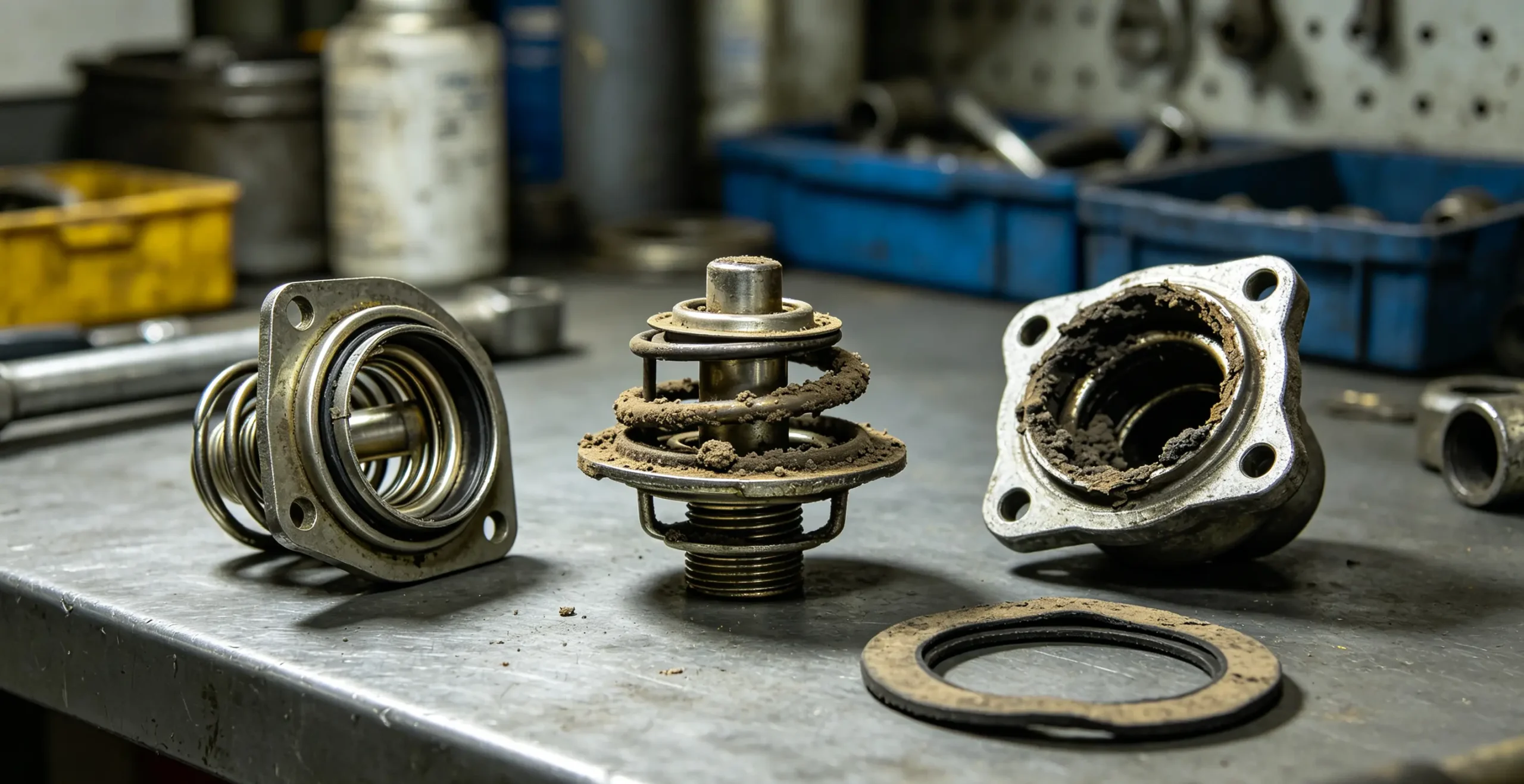
These scales and impurities will gradually adhere to the thermostat valve body, valve seat and movement gap. They block the normal opening and closing stroke of the valve body.
In the later stage of blockage, the thermostat will be stuck in a fixed position and completely lose the function of automatic temperature regulation and circulation switching.
4. Long-Term Engine Overheating Impact Damage
If the truck engine often overheats due to cooling fan failure, radiator blockage and other accessory faults, the instantaneous temperature will exceed the thermostat’s high-temperature tolerance range.
Excessive instantaneous high temperature will destroy the internal wax molecular structure and spring toughness of the thermostat. It causes permanent damage to the core sensing and reset components.
Even if the engine overheating fault is repaired later, the damaged thermostat cannot recover its performance and must be replaced in time.
5. Low-Quality Aftermarket Thermostat Parts
In order to save short-term maintenance costs, many users choose low-cost generic inferior thermostats for replacement in daily maintenance.
These inferior aftermarket parts have inaccurate thermal wax ratio, unqualified spring toughness and insufficient structural precision.
Their temperature sensing accuracy is poor, and structural stability cannot meet heavy-load operation standards. They are prone to jamming and functional failure in a short service cycle.
Using inferior thermostats will not only fail to solve the original cooling system fault but also cause repeated faults and increase overall maintenance costs.
6. Non-Standard Installation and Gasket Misalignment
In the process of thermostat replacement and maintenance, uneven bolt tightening and offset gasket placement are very common non-standard operations.
Asymmetrical bolt pressure will cause deformation of the thermostat housing and internal valve body. The offset gasket will block the valve movement gap.
The deformed valve body cannot operate flexibly. It is very easy to get stuck in the working process, resulting in early thermostat functional failure.
Pre-Repair Safety Preparation & Inspection Standards
Thermostat valve disassembly, inspection and replacement belong to conventional cooling system maintenance projects. However, non-standard operation will easily cause safety accidents and secondary component faults.
Therefore, it is necessary to complete standardized safety preparation and pre-inspection work before all maintenance operations. This ensures construction safety and post-repair equipment stability.
First of all, park the truck on a flat and hard ground. Tighten the hand brake firmly and use professional tire stoppers to fix the front and rear tires to prevent vehicle sliding during maintenance.
Secondly, turn off the engine completely and cut off the vehicle power supply. It is necessary to wait 20 to 30 minutes for the engine and coolant to cool down completely.
Never disassemble thermostat and cooling system parts when the engine is hot. High-temperature coolant will cause severe skin scalding accidents and safety hazards.
Prepare professional maintenance tools in advance, including matched socket wrenches, screwdrivers, clean rags and new special sealing gaskets matching the vehicle model.
At the same time, prepare a clean and pollution-free container for storing drained coolant. This avoids coolant waste and environmental pollution during construction.
Before formal disassembly, check the engine surface and cooling pipeline for obvious damage, leakage and blockage to eliminate other combined hidden faults.
If you encounter complex and difficult-to-judge cooling system faults during maintenance, you can contact our professional technical team for free targeted guidance and solutions.
Step-by-Step Truck Thermostat Valve Inspection & Replacement Guide
The following set of standardized operation steps is universal for all mainstream heavy-duty truck models. It applies to Sinotruk, FAW, Shacman, Dongfeng and all Cummins engine supporting models.
The steps are simple, practical and highly operable, suitable for professional repair shops and daily maintenance of fleet teams. Strict implementation can ensure zero secondary faults after repair.
[Image 5: Step-by-Step Truck Thermostat Replacement Process]
Step 1: Confirm Abnormal Symptoms & Preliminary Fault Judgment
Start the engine and keep it idling stably for 5 minutes. Carefully observe the rising speed and final stable value of the dashboard temperature gauge.
If the temperature rises rapidly and triggers an overheating alarm under slight load, it can be preliminarily judged that the thermostat is stuck closed.
If the temperature rises slowly and always stays below the standard working range, it is mostly a stuck-open thermostat fault.
Record all abnormal driving phenomena in detail to verify the specific failure cause after disassembly and avoid fault misjudgment.
Step 2: Release System Pressure & Drain Partial Coolant
After the engine is completely cooled down, slowly unscrew the coolant expansion tank cap to release the internal pressure of the cooling system.
Place a clean storage container directly under the thermostat housing drain bolt. Slowly loosen the drain bolt to discharge part of the coolant.
Draining an appropriate amount of coolant can effectively prevent liquid overflow and splashing during thermostat disassembly, ensuring clean and safe construction.
Step 3: Loosen and Remove Fixing Bolts
Use a matched socket wrench to loosen the thermostat housing fixing bolts in diagonal order.
Diagonal loosening can avoid uneven pressure on the housing, which prevents shell deformation and permanent sealing gaps after reinstallation.
After all bolts are loosened, take out the bolts in order and place them in a fixed storage position to avoid loss and confusion.
Step 4: Disassemble and Take Out the Old Thermostat
Gently shake the thermostat housing to separate it from the engine mounting surface. Then take out the internal thermostat valve and aging old sealing gasket.
Carefully observe the surface of the old thermostat. Check for scale adhesion, valve deformation, jamming marks and aging damage traces.
Combined with the previous driving abnormal symptoms, accurately confirm the specific failure cause of the thermostat valve.
Step 5: Clean Mounting Surface and Housing
Use a clean rag and professional cleaning tools to thoroughly wipe the thermostat housing and engine mounting plane.
Completely remove residual scale, aging gasket fragments, dust and oil stains on the assembly surface.
A clean, flat and smooth mounting surface is the key to ensure tight sealing of the new thermostat and avoid coolant leakage after installation.
Step 6: Install New Thermostat and Sealing Gasket
Select OEM-matched thermostat parts with accurate opening temperature parameters to ensure consistent performance with the original factory parts.
Install the new special sealing gasket first to fill the assembly gap. Place the thermostat into the housing strictly according to the correct direction mark.
Align the housing with the engine mounting position, and tighten the fixing bolts evenly in diagonal order.
Control the bolt tightening force moderately. Do not over-tighten to avoid shell cracking and thread sliding damage.
Step 7: Refill Coolant and Exhaust Air
Slowly inject qualified special antifreeze coolant into the expansion tank. Fill the liquid level to the standard scale line specified by the corresponding vehicle model.
Start the engine and keep it idling stably for 10 minutes. Open the cooling system exhaust port to discharge all air bubbles in the pipeline completely.
Air bubbles remaining in the pipeline will cause poor coolant circulation and false overheating. Complete air exhaust is an indispensable key step.
Step 8: Test Run and Verify Repair Effect
Observe the dashboard temperature change during engine idling. Confirm that the temperature rises steadily and stays in the standard safe range.
Carry out a certain load road test. Check whether there are abnormal temperature fluctuations, overheating faults and coolant leakage phenomena.
If all operating indicators are normal, the thermostat replacement and maintenance work is completed successfully.
To learn more about our OEM parts quality control system and factory production strength, you can visit our company introduction page.
Common Thermostat Repair Mistakes That Cause Repeated Failures
Many fleet teams and individual drivers often encounter repeated thermostat failures shortly after replacement. In most cases, this is not a parts quality problem but caused by non-standard maintenance operations.
These common maintenance mistakes are easy to be ignored in daily work, but they will directly lead to secondary faults and continuously increase fleet maintenance costs.
We have sorted out six most common wrong operations in thermostat maintenance, and analyze the hazards and standardized solutions one by one to help users avoid maintenance pitfalls.
1. Blindly Removing the Thermostat
In high-temperature summer seasons, many drivers blindly remove the thermostat valve completely to avoid engine overheating during driving.
This is a very wrong and harmful operation. After removing the thermostat, the cooling system will always maintain full large circulation without temperature regulation.
The engine cannot reach the optimal working temperature for a long time. Long-term low-temperature operation will significantly increase fuel consumption and aggravate internal engine wear.
Moreover, it will cause excessive carbon deposit accumulation and continuous power attenuation, bringing long-term hidden dangers to engine service life.
2. Using Mismatched Temperature Specification Thermostat
Different engine models have strict matching requirements for thermostat opening temperature parameters. Parameter matching is the premise of normal thermostat operation.
Blindly installing low-temperature thermostats will lead to slow engine warm-up and long-term low-temperature operation.
Installing high-temperature thermostats will cause insufficient heat dissipation. The engine is extremely prone to overheating under heavy load and climbing conditions.
Only thermostats with consistent original factory parameters can perfectly match the engine heat dissipation demand and ensure the normal operation of the cooling system.
3. Reusing Aging Old Gaskets
In order to save minor maintenance costs, many technicians reuse aging old gaskets when replacing thermostat valves.
After long-term high-temperature use and vibration, the old gasket has completely lost elasticity and sealing performance. It is prone to deformation and gap leakage after reinstallation.
Reusing old gaskets will cause coolant leakage and air inhalation. It seriously affects the circulation efficiency and temperature regulation stability of the cooling system.
4. Ignoring Pipeline Scale Cleaning
If the truck cooling system has accumulated a large amount of scale and impurities for a long time, simply replacing the thermostat cannot solve the fundamental problem.
The residual scale in the pipeline will continue to adhere to the new thermostat valve body. It will block the movement gap and cause repeated jamming faults.
For vehicles with serious scale accumulation, professional system cleaning and impurity removal must be carried out before replacing the thermostat.
5. Uneven Bolt Tightening
Many technicians tighten the thermostat fixing bolts randomly in a fixed order. This irregular operation will cause uneven pressure on the housing.
Asymmetrical pressure will deform the thermostat shell and internal valve body. It leads to inflexible valve movement and poor sealing effect.
Diagonal uniform tightening is the only standard operation to ensure assembly quality and long-term stable operation of the thermostat.
6. Skipping Air Exhaust After Replacement
Many maintenance personnel ignore the air exhaust step after replacing the thermostat and refilling coolant due to lazy operation.
The air bubbles remaining in the pipeline will form air resistance. It leads to poor coolant circulation and false engine overheating phenomenon.
Incomplete air exhaust is one of the most common hidden causes of unstable engine temperature after thermostat replacement.
Daily Preventive Maintenance Tips for Truck Thermostat Valve
The actual service life of the truck thermostat valve is closely related to daily maintenance habits. Scientific and standardized daily maintenance can greatly extend the service life of parts.
At the same time, it can effectively reduce the overall failure rate of the cooling system, reduce fleet long-term maintenance costs and improve truck operational efficiency.
Based on long-term fleet maintenance experience, we summarize six practical and effective daily maintenance tips for thermostat valves, which are suitable for all heavy-duty truck users.
1. Use Qualified Antifreeze Coolant
Never use tap water or unqualified inferior coolant for long-term use. Tap water and low-quality coolant contain a large amount of mineral impurities.
High-quality special antifreeze coolant can effectively inhibit scale generation and pipeline corrosion. It protects the thermostat valve body and internal components from dirt blockage and aging damage.
2. Replace Coolant Regularly According to Factory Cycle
After long-term use, the coolant will deteriorate, fail and produce a large number of suspended impurities.
Users must follow the factory specified cycle to replace the coolant fully. This keeps the entire cooling system clean and ensures flexible and sensitive thermostat operation.
3. Observe Engine Temperature Changes Daily
Check the dashboard temperature gauge carefully during daily pre-trip inspection. Pay attention to the temperature rise speed and stable operating temperature.
Timely discover abnormal temperature rise, slow warm-up and temperature fluctuation faults. Early intervention and maintenance can avoid minor faults evolving into major engine damage.
4. Clean Cooling System Scale Regularly
Perform professional cooling system scale cleaning and impurity removal every 1 to 2 years. Thoroughly remove internal pipeline deposits and aged dirt.
This preventive maintenance effectively avoids thermostat jamming faults and ensures smooth and unobstructed coolant circulation.
5. Avoid Long-Term Engine Overheating Operation
Timely check and solve various engine overheating faults. Frequent overheating will cause permanent damage to the thermostat core components.
Avoid long-term overheating operation to protect the thermostat performance stability and extend its service life.
6. Choose OEM-Quality Replacement Parts
When replacing the thermostat valve, must choose genuine OEM matched parts. Avoid low-cost inferior aftermarket parts.
Genuine OEM thermostats have accurate temperature sensing and stable structural performance. They adapt to heavy truck high-load operation and avoid frequent failure.
Professional OEM Truck Thermostat Valve & Cooling System Parts Supply
The operational stability of the truck cooling system depends entirely on high-precision and model-matched parts. Unqualified thermostat parts will bring huge hidden dangers to fleet safe operation.
We supply full-series heavy-duty truck thermostat valves, cooling system gaskets, water pumps, radiators and complete cooling system supporting accessories.
All parts are fully compatible with Sinotruk, FAW, Shacman, Dongfeng, Cummins and other mainstream heavy-duty truck and engine models.
Every product strictly complies with OEM factory parameter standards. It features accurate temperature control, flexible switching action and ultra-long service life.
We support retail single-piece supply and fleet bulk wholesale services. Sufficient spot stock ensures fast global delivery and timely supply.
For customized parts


