
Introduction
Heavy-duty trucks serve as the core backbone of global freight, construction, and logistics industries. Every day, these vehicles travel countless miles across urban roads, rural highways, and rugged off-road terrains to deliver goods and support industrial operations.
Unlike light passenger vehicles, commercial trucks operate under extreme working conditions. They endure constant heavy loads, prolonged engine operation, and frequent vibration during long-haul transportation.
For this reason, every component inside a truck’s mechanical system requires high durability and stable performance. Even small auxiliary parts can directly influence overall driving safety and operational efficiency.
Among all vehicle systems, the fuel system stands out as one of the most critical functional units. It provides continuous power support for engine operation and determines fuel economy, startup stability, and driving power output.
Most fleet managers and drivers focus heavily on fuel pumps, injectors, and fuel tanks. Conversely, they often overlook the importance of the fuel return line, a humble yet indispensable pipeline component.
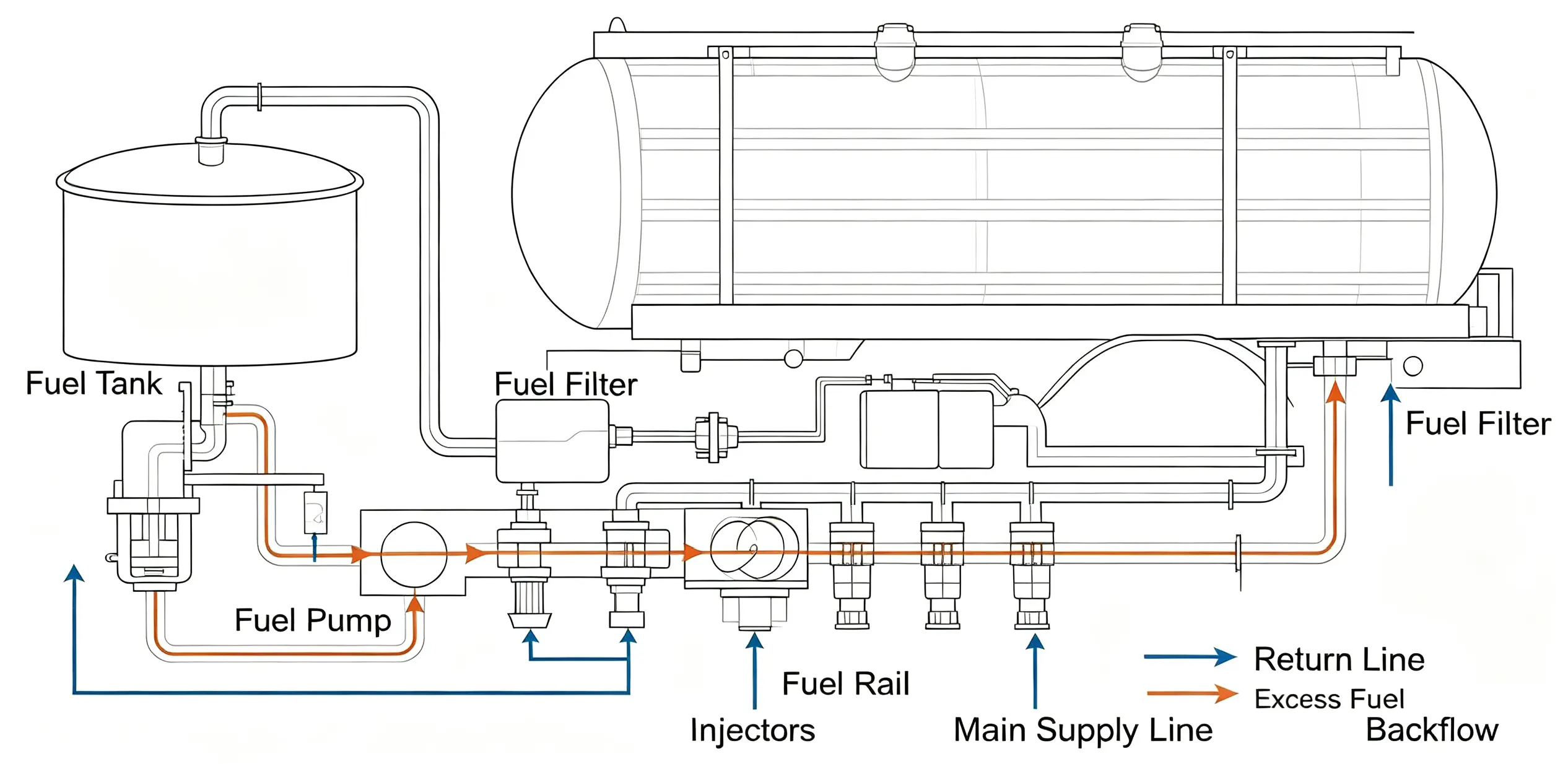
In simple terms, the fuel return line acts as a pressure regulation and circulation guard for the entire fuel system. It works alongside the main fuel supply line to form a complete closed-loop fuel delivery system.
When the engine runs, the fuel pump delivers a steady stream of diesel to meet combustion demands. Notably, not all pumped fuel is consumed during engine operation.
Excess unburned fuel needs a dedicated channel to flow back to the fuel tank. This is precisely the core function of a standard truck fuel return line.
Beyond basic fuel circulation, this pipeline also stabilizes internal fuel pressure, dissipates excessive heat, and eliminates air bubbles inside the oil circuit. All these functions prevent irregular fuel system fluctuations.
Nevertheless, the fuel return line faces severe service environment challenges throughout its service life. It is exposed to high engine temperatures, continuous chassis vibration, and external road contaminants year-round.
As a result, aging, cracking, blockage, and loose connections are extremely common faults for this component. These minor issues rarely trigger immediate engine failure, so they are easily ignored in daily inspections.
Over time, trivial return line defects gradually deteriorate into serious mechanical failures. They cause hard cold starts, weak acceleration, excessive fuel consumption, and even sudden engine stalling during driving.
In addition, damaged fuel return lines often lead to diesel leakage. This issue not only wastes fuel resources but also creates potential fire hazards for heavy-load truck operation.
For fleet enterprises, unaddressed return line problems translate to increased maintenance costs, reduced vehicle attendance, and delayed freight delivery schedules. These hidden losses greatly affect overall operational profitability.
Therefore, mastering professional diagnosis and repair methods for fuel return line issues is essential for every truck driver and maintenance technician. Timely troubleshooting ensures stable vehicle operation and cuts unnecessary operational expenses.
If you need high-quality replacement parts for system overhaul, our store provides durable and precision-matched truck fuel system parts for all mainstream heavy-duty truck models.
What Is a Truck Fuel Return Line? Core Structure & Working Principle
Before diving into fault diagnosis and repair operations, it is necessary to fully understand the basic structure and working logic of the truck fuel return line. In fact, many incorrect repairs stem from insufficient understanding of component operating principles.
Essentially, the fuel return line is a special auxiliary pipeline configured for heavy-duty truck fuel circulation systems. It is mainly made of high-temperature resistant and oil-resistant rubber composite materials for mainstream commercial trucks.
Structurally, one end of the return line connects to the fuel injector assembly or fuel rail of the engine. Meanwhile, the other end is fixed to the upper interface of the vehicle fuel tank to form a full circulation loop.
Different from the thick main fuel supply pipeline responsible for large-flow fuel delivery, the return line features a smaller inner diameter. It is designed specifically for low-pressure backflow of redundant fuel.
To enhance overall durability, standard return lines are equipped with reinforced woven layers inside. This structure effectively resists chassis vibration, external extrusion, and long-term thermal aging.
Furthermore, every connection joint of the return line is matched with professional rubber sealing rings and metal fixing clamps. These accessories ensure zero leakage under normal working pressure.
In terms of working mechanism, the entire fuel circulation process follows a fixed and stable logic. To begin with, the electric fuel pump or mechanical fuel pump extracts diesel from the bottom of the fuel tank.
Subsequently, the fuel is delivered through the main supply line to the engine’s fuel injection system. The system distributes precise fuel volume for cylinder combustion to generate driving power.
Since the fuel pump always supplies slightly more fuel than the engine’s actual combustion demand, redundant fuel accumulates inside the fuel rail and injector chamber.
Without a return line, excess fuel would cause continuous pressure accumulation inside the closed oil circuit. This situation would lead to unstable injection pressure and abnormal engine operation.
For this reason, the return line releases redundant fuel pressure by guiding excess diesel back to the fuel tank. This cycle maintains constant and stable pressure inside the fuel system.
In addition to pressure regulation, the fuel return line delivers two more key functional advantages. Firstly, circulating fuel takes away excessive heat generated during high-pressure fuel delivery.
This active heat dissipation effectively prevents fuel vaporization and air bubble generation. As we all know, air bubbles in the oil circuit will cause fuel supply interruption and engine jitter.
Secondly, continuous fuel backflow flushes tiny impurities inside the fuel rail and injector gaps. This self-flushing effect reduces local dirt deposition to a certain extent.
Overall, the fuel return line coordinates closely with other core components. It works with fuel pumps, injectors, and filter assemblies to guarantee efficient and safe engine operation.
For integrated vehicle performance, intact return lines perfectly match standard truck engine parts to avoid mismatched system operation failures.
Primary Causes of Truck Fuel Return Line Failures (Field Maintenance Summary)
Fuel return line damage and blockage are not caused by single factors. In field maintenance scenarios, most faults result from the combined effect of environmental erosion, mechanical wear, and improper use habits.
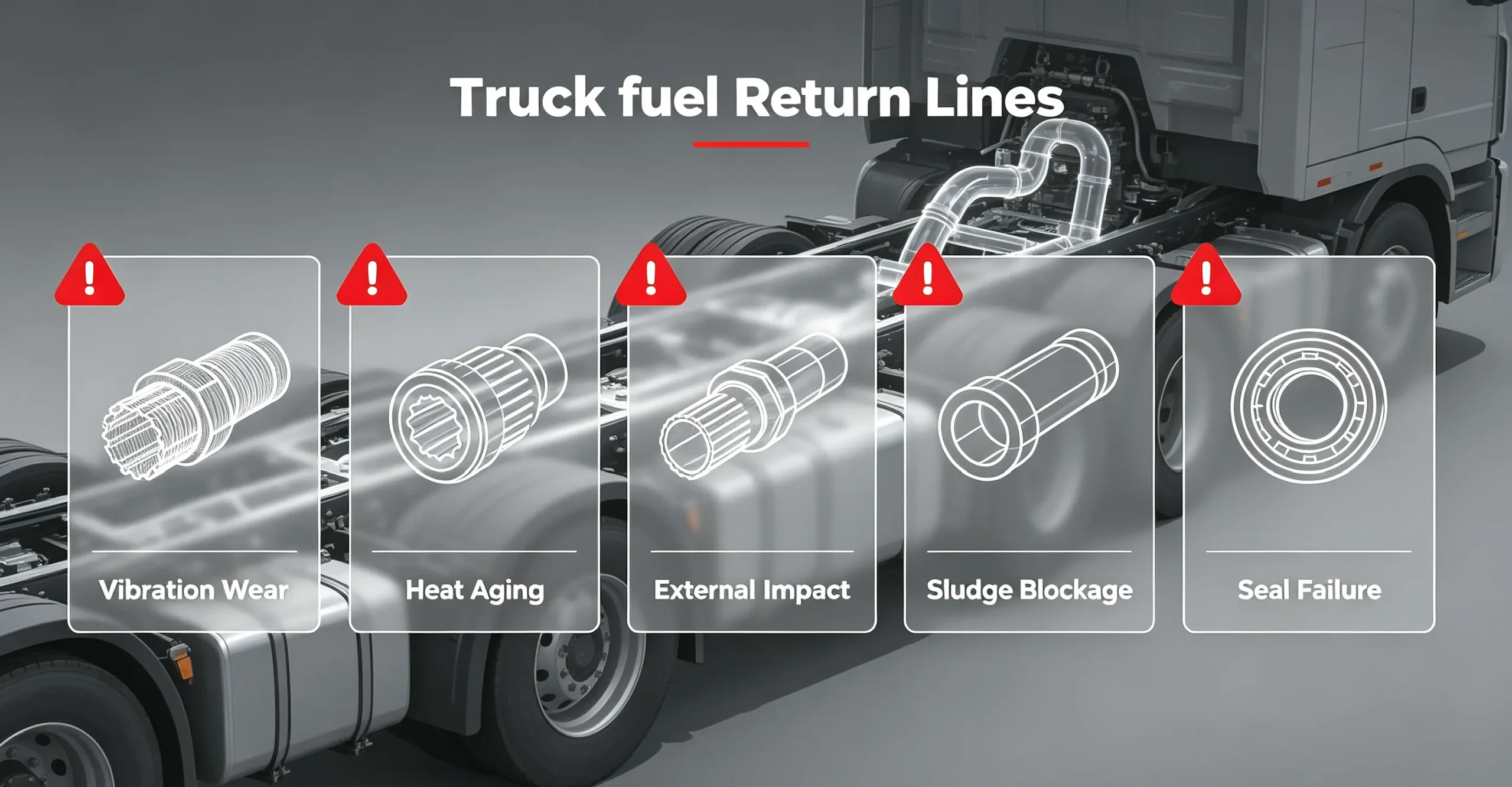
By sorting out a large number of actual maintenance cases, we summarize five core inducements for return line failures. Understanding these root causes helps implement targeted prevention and extend pipeline service life.
1. Long-Term Chassis Vibration and Friction Wear
Heavy-duty trucks generate intense high-frequency vibration during full-load driving. This vibration is transmitted to the entire chassis and all external pipeline components.
Unlike fixed engine internal parts, fuel return lines are suspended and installed on the chassis bracket. They lack rigid fixed support and will shake synchronously with vehicle operation.
Over time, the pipeline surface continuously rubs against metal brackets, wire harnesses, and chassis edges. This repeated friction gradually wears down the outer rubber protective layer.
Once the outer protective layer is worn through, the inner reinforced layer and oil-resistant layer lose protection. Consequently, pipelines become prone to cracking and leakage under slight pressure impact.
Notably, this kind of wear is progressive and hidden. It cannot be easily found in daily visual inspections, making it one of the most common latent faults.
2. Engine Compartment High-Temperature Aging
The front section of the fuel return line is arranged close to the engine cylinder and exhaust pipeline. These areas are the main high-temperature zones of the entire vehicle.
During long-distance continuous driving, the engine maintains high-load operation. The ambient temperature of the compartment often exceeds 100 degrees Celsius for hours.
Although professional return line materials have high-temperature resistance, long-term continuous thermal baking will still cause material fatigue aging.
Specifically, high temperature makes the rubber pipeline gradually harden and lose original elasticity. The originally flexible and tough pipeline becomes brittle and rigid.
When the vehicle passes bumpy roads, brittle pipelines cannot buffer vibration. As a result, transverse cracks and longitudinal fractures appear on the pipe wall easily.
In severe aging cases, the pipeline will crack directly and cause large-area fuel leakage, which seriously endangers driving safety.
3. External Impact and Road Debris Extrusion
Most heavy trucks are used for mountain road transportation, rural freight, and construction site operations. These road environments are complex and full of uncertain obstacles.
When vehicles pass rugged roads, roadside stones, mud blocks, and abandoned building debris often hit the chassis bottom pipelines.
Since the fuel return line is exposed at the bottom of the chassis without protective baffles, it bears the brunt of external impact and extrusion.
Instant strong extrusion will flatten the pipeline local section. This deformation reduces the inner diameter of the oil passage and hinders normal fuel backflow speed.
Repeated impact will also cause pipeline dislocation and fixed clamp loosening. These changes break the original stable oil circuit layout and trigger circulation disorders.
4. Diesel Impurity Deposition and Internal Blockage
Fuel quality varies greatly in different regional refueling stations. Many truck drivers choose low-price non-standard diesel to save fuel costs.
Such inferior diesel contains a large amount of mechanical impurities, colloidal substances, and sediment. These pollutants cannot be completely filtered by ordinary fuel filters.
Micro impurities will flow into the fuel circulation system along with diesel. Most tiny particles gather in the low-flow return line instead of the high-speed supply line.
Day by day, accumulated colloids and sediment adhere to the inner pipe wall. They gradually narrow the effective flow area of the oil passage.
In the early stage, partial blockage only slows down fuel return speed. In the later stage, complete blockage will cause fuel pressure accumulation and system disorder.
5. Joint Loosening and Sealing Ring Failure
All butt joints of fuel return lines rely on rubber sealing rings for waterproof and oil-proof sealing. Meanwhile, metal clamps provide fixed locking force.
Under long-term vehicle vibration, the locking force of metal clamps will gradually weaken. The screws are prone to loosening and displacement.
Additionally, rubber sealing rings will age, harden, and deform after long-term contact with diesel and high temperature.
Once the sealing ring loses elasticity, tiny gaps appear at the pipeline joints. These gaps cause slow diesel seepage, which is hard to detect in daily use.
If not replaced in time, seepage will worsen into obvious oil leakage. This fault leads to pressure loss of the fuel system and attenuated engine power.
Typical Symptoms of Faulty Fuel Return Lines (Early Warning Signs)
Different return line faults correspond to obvious vehicle abnormal symptoms. By observing driving states and engine performance, you can quickly locate fault types without professional detection equipment.
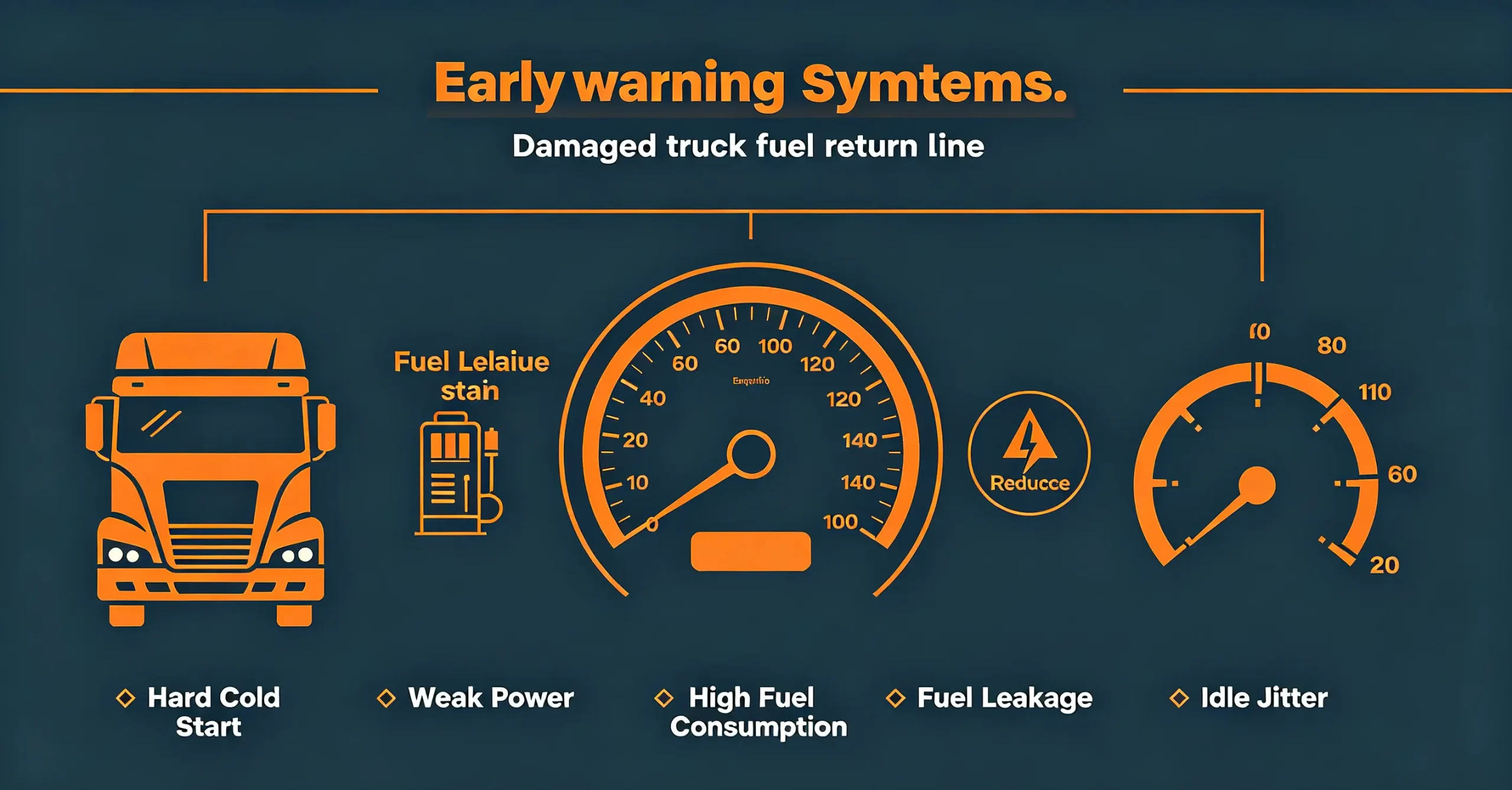
In general, all abnormal manifestations are derived from two core problems: unsmooth fuel circulation and unstable system pressure. The following are the most representative early warning signals.
1. Difficult Cold Startup and Repeated Ignition Failure
Cold start difficulty is the most typical symptom of blocked fuel return lines. After the truck is parked overnight, the fuel system should maintain a certain residual pressure for the next startup.
When the return line is severely blocked, residual pressure inside the oil circuit cannot be released normally. Meanwhile, new fuel cannot circulate smoothly to form effective pressure.
For this reason, drivers need to step on the accelerator repeatedly and start the engine multiple times. Even after successful ignition, the engine will jitter violently for a short time.
This symptom is more obvious in low-temperature winter environments. Many people misjudge it as battery failure or low-temperature diesel waxing, ignoring return line blockage.
2. Insufficient Acceleration Power and Weak Climbing Performance
When the truck accelerates rapidly or climbs steep slopes, the engine needs instantaneous high-pressure fuel supply to output enough power.
If the return line is blocked or unsmooth, excess fuel cannot flow back in time. This causes instantaneous pressure accumulation inside the fuel rail.
Unstable fuel pressure leads to inaccurate fuel injection volume of injectors. The combustion process is incomplete and insufficient.
As a result, the vehicle shows obvious power weakness. The speed increases slowly, and the engine makes a stuffy roaring sound during climbing.
3. Sharp Increase in Daily Fuel Consumption
Unbalanced fuel pressure caused by return line faults is a key inducement of high fuel consumption. Incomplete combustion wastes a large amount of diesel resources.
Furthermore, to maintain normal driving power, drivers often increase accelerator opening. This operation further increases fuel injection volume and forms a vicious cycle of high consumption.
Many fleet data statistics show that trucks with faulty return lines have 10% to 20% higher fuel consumption than normal vehicles. This brings huge long-term cost losses.
4. Visible Diesel Leakage and Chassis Oil Stains
Cracked pipelines and loose joints will cause intuitive fuel leakage problems. After the truck runs for a period of time, obvious wet oil stains appear on the chassis pipeline surface.
In severe cases, diesel drops continuously when the vehicle stops. The leaked fuel adheres to the chassis and dust, forming obvious black oil dirt.
Beyond fuel waste, leaked diesel will corrode chassis metal parts and rubber accessories. It also greatly increases the risk of spontaneous combustion under high-temperature engine conditions.
5. Unstable Engine Idle Speed and Frequent Vehicle Jitter
Normal engine idle speed should be stable and uniform. However, return line circulation disorders will cause fluctuating fuel pressure.
Fluctuating pressure leads to unstable single fuel injection volume. The engine combustion state is inconsistent, resulting in up and down idle speed.
Drivers can obviously feel continuous slight jitter of the cab when the vehicle is stationary. This jitter will intensify when electrical equipment such as air conditioners is turned on.
6. Easy Engine Flameout During Low-Speed Driving
When the truck runs at low speed or idles for a long time, the fuel supply flow is relatively low. At this time, return line blockage has the most obvious impact.
Insufficient fuel circulation causes local pressure loss. The fuel supply cannot keep up with the minimum combustion demand, leading to sudden engine flameout.
This fault is extremely dangerous in urban road driving and ramp driving. Sudden flameout will cause vehicle stalling and easily induce rear-end traffic accidents.
Step-by-Step Troubleshooting Methods for Fuel Return Line Issues
Before formal disassembly and repair, systematic and standardized fault inspection is essential. Blind replacement of parts will not only waste maintenance costs but also fail to solve fundamental problems.
The following inspection steps are summarized from professional field maintenance experience. They are simple, efficient, and suitable for all heavy-duty truck models without professional detection tools.
Step 1: Static Visual Inspection of Overall Pipeline Layout
First of all, park the truck on a flat and hard ground. Turn off the engine completely and wait for the engine compartment to cool down to avoid high-temperature scalding.
Open the chassis protective baffle and observe the entire return line layout from the fuel tank interface to the engine fuel rail interface.
Focus on checking four key states: pipeline surface cracks, local deformation and flattening, joint oil seepage stains, and loose fixing clamps.
In particular, pay attention to the pipeline sections near the engine high-temperature zone and chassis friction parts. These positions are the most prone to failure.
Step 2: Manual Pipeline Unobstructed Test
If no obvious damage is found in visual inspection, you need to test the internal unobstructed state of the pipeline to judge blockage faults.
Loosen the fixing clamp of the return line fuel tank end and disconnect the pipeline interface. Prepare a clean air blowing tool or use manual blowing for testing.
If the air flow is smooth and unobstructed, the internal pipeline is clean and free of blockage. On the contrary, obvious resistance indicates accumulated dirt and local blockage.
For blocked pipelines, targeted cleaning or direct replacement is required according to the blockage degree.
Step 3: Joint Sealing Performance Detection
Recheck all pipeline connection joints one by one. Carefully observe the aging degree of internal rubber sealing rings.
Judge whether the sealing ring is hardened, deformed, cracked or detached. Check whether the metal clamp loses locking force and slides randomly.
Even if there is no obvious oil leakage, aging sealing parts need to be replaced in advance. Hidden seepage faults will worsen rapidly in subsequent driving.
Step 4: Dynamic Engine Running Test
After completing static inspection, start the engine and keep it running at stable idle speed for 3 to 5 minutes.
Observe the fuel backflow state of the return line in real time. Normal return lines have continuous and stable fuel backflow.
If the backflow is intermittent, weak or completely stagnant, it proves that the oil circuit circulation is abnormal and needs overhaul.
Meanwhile, listen to the engine running sound and feel the vehicle jitter state to comprehensively verify fault severity.
Complete Step-by-Step Guide to Fix Truck Fuel Return Line Issues
After accurately locating the fault point through inspection, you can carry out standardized repair operations. Different faults correspond to different solutions, including dirt cleaning, sealing replacement, and pipeline integral replacement.
The following universal overhaul process applies to all Sinotruk, Shacman, FAW, Volvo, and MAN heavy-duty trucks. Strict operation ensures zero secondary faults after repair.
Step 1: Strict Safety Pre-Operation Preparation
Safety is the primary premise of all fuel system maintenance. Firstly, cut off the vehicle main power supply to avoid circuit short circuit accidents.
Fully wait for the engine and chassis to cool down completely. High-temperature parts will cause scalding and may ignite leaked diesel.
Prepare matching new return lines, sealing rings, metal clamps, professional fuel system cleaning agents, and oil receiving containers in advance.
Place the oil container directly below the pipeline joint to collect residual diesel and prevent ground pollution and fuel waste.
Step 2: Dismantle the Damaged Old Pipeline
Loosen all fixed metal clamps along the return line in sequence from the fuel tank end to the engine end.
Slowly disconnect the pipeline interfaces at both ends to avoid violent pulling that causes residual fuel splashing.
Take out the entire old pipeline completely. Wipe and clean the dirt and residual colloids at the engine and fuel tank interfaces.
Check the old pipeline wall carefully to confirm crack positions, blockage degree and aging range for subsequent maintenance reference.
Step 3: Deep Cleaning of Internal Oil Circuit Impurities
For pipelines with slight blockage and no aging damage, deep cleaning can be adopted instead of replacement to save costs.
Inject professional fuel system cleaning agent into the pipeline interior. Soak for 10 to 15 minutes to dissolve internal colloids and sediment.
Flush the pipeline repeatedly with clean diesel until the outflow liquid is clear and free of impurities.
For severely blocked and aged pipelines, direct replacement is recommended. Cleaning cannot restore original pipeline performance.
Step 4: Install New Standard Fuel Return Line
Install the new high-quality return line strictly according to the original vehicle routing. Do not arbitrarily change the pipeline bending angle and fixing position.
Align the two ends of the pipeline with the engine and fuel tank interfaces accurately. Install new sealing rings to ensure complete fitting without gaps.
Fasten the metal fixing clamps steadily with tools. Ensure the clamps have sufficient locking force to avoid loosening caused by vibration.
Step 5: Standard Pipeline Routing and Fixing
After installation, rearrange the pipeline trend reasonably. Keep the pipeline away from high-temperature exhaust parts and sharp metal edges.
Reserve appropriate telescopic buffer space for the pipeline. This design offsets vehicle vibration and avoids tensile cracking.
Fix the pipeline on the chassis bracket in sections to prevent suspension shaking and friction wear during operation.
Step 6: Post-Installation Debugging and Functional Test
After all installation operations are completed, check all joints and fixing points again for tightness.
Start the engine and run it at idle speed for 5 minutes. Observe the pipeline for fuel leakage and check whether fuel backflow is stable.
Test vehicle acceleration and climbing performance to confirm no power weakness and idle jitter.
After confirming all functions are normal, complete the overall repair work and restore the chassis protective baffle.
Practical Daily Maintenance Tips to Prevent Return Line Faults
Most fuel return line faults are caused by insufficient daily maintenance. Scientific and standardized maintenance can greatly extend pipeline service life and reduce failure rate by more than 80%.
Based on long-term after-sales maintenance experience, we summarize six easy-to-operate and high-value maintenance suggestions for fleet and driver reference.
1. Adopt High-Quality Standard Diesel
Always refuel at regular gas stations to ensure diesel cleanliness and qualification. Avoid inferior low-price diesel containing excessive colloids and impurities.
Clean fuel can effectively reduce internal pipeline deposition. It fundamentally avoids blockage faults of return lines and fuel injectors.
2. Monthly Pipeline Visual Inspection
Arrange a special chassis pipeline inspection every month. Focus on checking return line aging, cracking, and joint seepage.
Deal with slight faults in advance to avoid minor problems evolving into major failures affecting driving safety.
3. Regular Replacement of Sealing Accessories
Rubber sealing rings are vulnerable aging parts. It is recommended to replace all return line sealing accessories every 20,000 kilometers.
Timely renewal of small accessories can avoid hidden leakage faults with low maintenance cost and high safety value.
4. Heat Insulation Protection for High-Temperature Sections
Wrap the return line near the engine compartment with professional heat insulation cotton. Isolate high-temperature heat source to slow down rubber aging speed.
This simple operation can effectively extend the pipeline service life and reduce thermal cracking probability.
5. Avoid Long-Time Overload and Rugged Road Driving
Try to avoid long-term full-load overlimit driving. Overload operation increases engine load and fuel system pressure.
Slow down when passing rugged road sections to reduce chassis vibration and external impact on pipelines.
6. Regular Fuel System Deep Cleaning
Carry out a full fuel system cleaning every 50,000 kilometers. Remove internal sediment and colloidal accumulation to keep oil circuit unobstructed.
Standard cleaning maintenance ensures long-term stable operation of return lines and the entire fuel system.
Professional Heavy-Duty Truck Fuel System Accessory Supply
The quality of replacement parts directly determines the repair effect and later service life. Inferior return lines and accessories will age and fail in a short time, causing repeated maintenance troubles.
As a professional manufacturer and supplier of heavy-duty truck spare parts, we provide full-series high-quality fuel system accessories for global customers.
Our truck fuel return lines adopt imported oil-resistant and high-temperature resistant rubber materials. They feature strong toughness, anti-aging performance, and vibration resistance.
All products are produced strictly in accordance with OE standard sizes. They perfectly match Sinotruk, Shacman, FAW, Dongfeng, Volvo, MAN, Scania and other mainstream models.
Beyond return lines, we support one-stop procurement of complete fuel system parts. You can find high-precision truck fuel injector parts, fuel filters, fuel pumps, and related accessories in our store.
We adhere to factory direct sales mode to eliminate middleman markups. Bulk wholesale customers can enjoy flexible discount policies and fast global shipping services.
In addition, we provide professional OE number matching services. We can customize non-standard parts for special truck models to meet personalized procurement needs.
All our products pass strict pre-delivery quality inspection. We provide reliable after-sales guarantee to ensure zero quality worries for customer use.
To further enrich your parts procurement portfolio, we also supply complete truck transmission parts and chassis accessories for full-vehicle maintenance solutions.
Whether you are a parts wholesaler, repair shop owner, or fleet enterprise, we can provide cost-effective and high-quality spare part support.
Common FAQ About Truck Fuel Return Line Issues
In daily maintenance and after-sales consultation, we have summarized many high-frequency questions about fuel return line faults and repair. The following unified answers help you solve common doubts.
1. Can I continue driving with a slightly leaking return line?
It is not recommended to drive continuously. Slight seepage is an early warning of serious leakage. With the increase of driving vibration, the seepage degree will worsen rapidly.
Long-term driving will cause fuel pressure loss, power attenuation, and fire hazards. It is necessary to replace sealing parts or pipelines in time.
2. Is pipeline cleaning effective for old blocked return lines?
Cleaning is only suitable for slight blockage without aging and deformation. For pipelines with inner wall colloid hardening and pipeline brittleness, cleaning cannot restore performance.
In this case, integral replacement is the most thorough and reliable solution.
3. How long is the service life of a new fuel return line?
Our high-quality factory return lines have a service life of 80,000 to 120,000 kilometers under standard use and maintenance conditions.
Inferior ordinary pipelines usually fail within 20,000 kilometers, with obvious aging and cracking phenomena.
4. Will return line faults damage the fuel injector?
Yes. Long-term unbalanced fuel pressure and uncirculated impurities will cause injector blockage and abnormal injection.
Timely repair of return line faults can effectively protect expensive injector components and reduce maintenance costs.
Conclusion
The fuel return line is a small but core auxiliary component of the heavy-duty truck fuel system. Although it does not directly participate in fuel combustion power generation, it controls system pressure balance and fuel circulation stability.
Most daily vehicle faults such as difficult startup, weak power, and high fuel consumption are closely related to abnormal return line operation.
In general, return line failures are mainly caused by vibration wear, high-temperature aging, impurity blockage, and loose seals. These faults are completely preventable and repairable.
By mastering standardized diagnosis and repair methods, drivers and maintenance personnel can quickly solve common return line problems on site.
Meanwhile, adhering to scientific daily maintenance habits can effectively extend pipeline service life and reduce long-term fleet operational costs.
If you need durable, OE-standard truck fuel return lines and supporting fuel system accessories, feel free to contact our professional team for wholesale prices and technical support.


