
Introduction
Heavy-duty trucks are the core support of China’s freight logistics, engineering construction and cross-regional transportation industries. Every day, a huge number of domestic heavy trucks including Sinotruk, FAW Jiefang, Shacman and Dongfeng run on urban roads, mountainous highways and construction sites.
Unlike ordinary passenger vehicles, these heavy-duty commercial vehicles always work in harsh operating environments. They bear long-term full-load operation, continuous chassis vibration and high-temperature engine working conditions all year round.
For this reason, every small component on the truck engine and chassis needs excellent durability and stable working performance. Even tiny electronic sensors can affect the overall driving safety and operational stability of the vehicle.
Among all engine supporting systems, the lubrication system is undoubtedly the key to guaranteeing long-term and trouble-free operation of heavy trucks. Qualified and stable engine oil pressure can lubricate internal moving parts, reduce mechanical friction and dissipate operating heat.
In the entire lubrication monitoring system, the oil pressure sensor plays an irreplaceable core role. Simply put, it is the real-time monitoring “electronic eye” of the truck engine.
Its main job is to continuously detect the dynamic changes of engine oil pressure during vehicle operation. Meanwhile, it converts pressure signals into electronic data and transmits them to the truck dashboard in real time.
In this way, drivers can clearly grasp the working state of the engine lubrication system at any time. Once the oil pressure is too high or too low, the dashboard will send out alarm reminders to avoid abnormal engine operation.
However, in daily vehicle maintenance, most drivers and fleet managers tend to focus on large core parts. These parts include engine assemblies, fuel supply systems, gearboxes and chassis brackets.
On the contrary, the small oil pressure sensor is often ignored. Because most sensor faults will not cause sudden engine stalling, people always choose to ignore minor abnormal signals.
In fact, the working environment of the oil pressure sensor is extremely harsh. It is directly installed on the engine cylinder block, facing long-term high-temperature baking, engine oil soaking and frequent chassis vibration.
After a long period of use, the sensor is prone to aging, blockage, signal deviation and line failure. These hidden faults will gradually evolve into serious problems that affect engine operation.
For example, faulty sensors will cause false oil pressure alarms, random jump of dashboard data, and even zero oil pressure display during normal driving. These abnormal phenomena will seriously interfere with the driver’s correct judgment.
Worse still, long-term unprocessed sensor faults will cover up real lubrication system failures. This will lead to insufficient engine lubrication, severe wear of crankshaft and bearings, and even engine scrapping in severe cases.
For fleet operating enterprises, sensor failures will directly increase vehicle maintenance costs. They will also reduce vehicle attendance, delay transportation tasks and cause unnecessary economic losses.
Therefore, every truck driver and maintenance technician must master professional diagnosis, troubleshooting and maintenance methods for oil pressure sensor faults.
Timely inspection and repair can not only ensure stable engine operation, but also greatly reduce the overall operating cost of the fleet. If you need high-quality matching accessories, we provide full-spec truck engine sensor parts for all domestic heavy truck models.
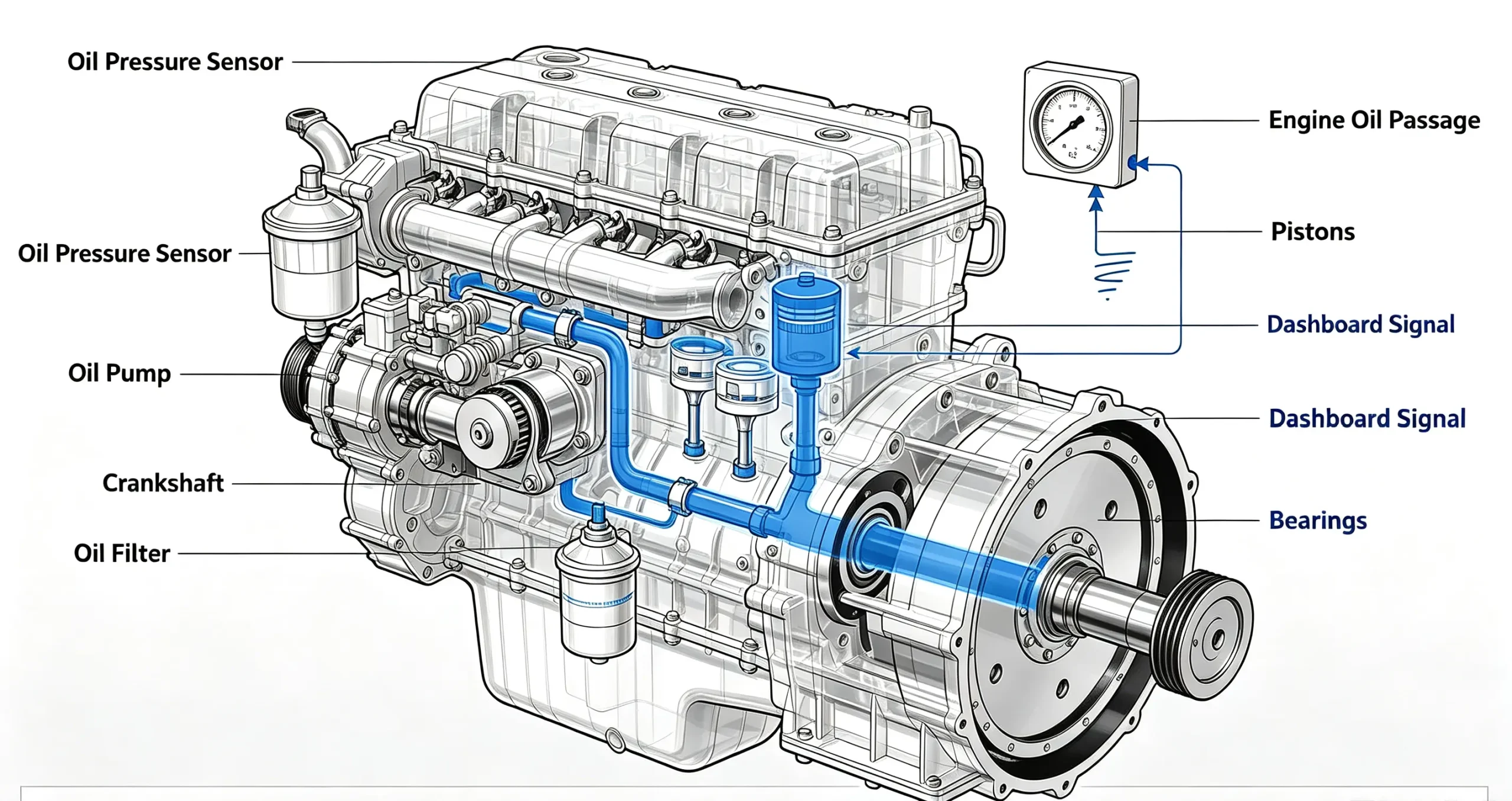
What Is a Truck Oil Pressure Sensor? Core Structure & Working Principle
Before carrying out specific fault detection and repair work, it is necessary to fully understand the basic structure and working principle of the truck oil pressure sensor. In fact, most incorrect maintenance operations are caused by insufficient understanding of component logic.
At present, almost all new domestic heavy-duty trucks are equipped with electronic induction oil pressure sensors. Compared with traditional mechanical sensors, electronic models have higher detection accuracy, faster signal response and stronger stability.
From the perspective of structural composition, the oil pressure sensor is a compact integrated component. It mainly consists of four core parts: pressure induction probe, internal sensing chip, rubber sealing base and external wiring plug.
The pressure induction probe is the core detection part. It is directly screwed to the reserved detection hole of the engine cylinder block, which can directly contact the circulating engine oil inside the lubrication system.
The internal sensing chip is the signal conversion center. It can capture tiny changes in oil pressure and convert physical pressure signals into standard electronic signals that the vehicle computer can recognize.
The rubber sealing base plays a dual role of fixing and anti-leakage. It can fill the installation gap to prevent engine oil leakage and avoid external dust and water from entering the installation thread.
The external wiring plug is responsible for signal transmission. It connects the sensor with the vehicle’s central control circuit to realize real-time data transmission and dashboard display.
In terms of specific working logic, the whole operation process is very regular and orderly. When the truck engine is started, the internal oil pump starts to work synchronously.
The oil pump pushes the engine oil to circulate rapidly in the oil passages of the engine crankshaft, bearings, pistons and other components. This continuous circulation forms stable lubricating pressure.
At this time, the pressure generated by the circulating engine oil will act on the sensor induction probe. The sensing chip will immediately capture the pressure data and convert it into electrical signals.
These electrical signals are transmitted to the vehicle ECU and finally displayed on the dashboard in the form of pointer swing or digital values.
Under normal working conditions, the engine oil pressure has a fixed standard range. The idle pressure is low and stable, while the pressure will rise appropriately during acceleration and climbing with load.
Once the oil pressure exceeds the safe range, the sensor will transmit abnormal signals. The vehicle system will trigger alarm prompts to remind the driver to stop for inspection in time.
It is worth mentioning that the oil pressure sensor does not work independently. It cooperates closely with the entire engine lubrication system and truck engine assembly parts to ensure the safe operation of the power system.
Primary Causes of Truck Oil Pressure Sensor Failures (Field Maintenance Summary)
Oil pressure sensor failure is never caused by a single factor. Combined with a large number of domestic heavy truck maintenance cases, most faults are the result of the combined effect of environmental erosion, mechanical wear and improper use habits.
By sorting out on-site maintenance experience, we summarize six core inducements leading to sensor failure. Understanding these root causes can help drivers achieve targeted prevention and reduce failure frequency.
1. Long-Term Engine High-Temperature Aging
The oil pressure sensor is installed in the high-temperature area of the engine compartment. When the heavy truck runs continuously with full load for a long distance, the engine will maintain high-power operation for hours.
The continuous high temperature inside the engine compartment will bake the sensor for a long time. Although industrial-grade sensors have high temperature resistance, long-term thermal radiation will still cause material fatigue and aging.
After aging, the internal chip sensitivity will decrease significantly. The external rubber sealing ring will harden and lose elasticity, resulting in slow signal response and poor sealing performance.
2. Frequent Chassis Vibration Damage
Domestic heavy trucks often pass through bumpy mountain roads, muddy construction roads and uneven rural roads. These complex road conditions will produce strong high-frequency vibration.
The vibration will be transmitted to the engine cylinder block and the fixed sensor. Long-term irregular vibration will loosen the sensor thread and cause virtual connection of the wiring plug.
Slight vibration looseness will lead to intermittent signal disconnection. Severe vibration displacement will directly cause the sensor to fail to detect pressure normally.
3. Engine Oil Impurity Blockage
Many fleet vehicles use low-quality engine oil or fail to replace engine oil and oil filter according to the cycle. Inferior engine oil contains a large number of metal wear debris, colloids and sediment.
These tiny impurities will circulate with the engine oil in the oil circuit and eventually deposit on the sensor induction probe and thread gap.
Over time, the accumulated impurities will block the pressure induction hole. The sensor cannot sense real-time oil pressure changes, resulting in fixed data display or random jumping faults.
4. Line Water Ingress and Oxidation Short Circuit
During daily high-pressure car washing and rainy day driving, rainwater and car washing sewage are easy to splash into the engine compartment.
If the sensor wiring plug is aging and poorly sealed, water will penetrate into the line interface. Long-term water accumulation will cause metal pin oxidation and line short circuit.
Short-circuited lines will cause signal disorder, resulting in frequent false alarms of the oil pressure lamp and even complete loss of sensor signals.
5. Improper Manual Installation and Disassembly Damage
In daily maintenance, many maintenance personnel have irregular operation habits. They use excessive torque when installing and tightening the oil pressure sensor.
Excessive force will squeeze and damage the internal precision sensing chip. It will also cause thread slipping and shell deformation, resulting in permanent sensor damage.
In addition, mismatched sensor model installation will also lead to signal parameter incompatibility, which cannot match the vehicle computer data system.
6. Natural Service Life Depletion
As a precision electronic accessory, the oil pressure sensor has a fixed service life. After the vehicle runs more than 100,000 kilometers, the internal electronic components will naturally age and decay.
The sensitivity and stability of the sensor will decline significantly. Even if there is no obvious damage, various minor abnormal faults will continue to appear, which belongs to normal aging failure.
Typical Symptoms of Faulty Oil Pressure Sensors (Early Warning Signs)
After the oil pressure sensor fails, the heavy truck will show a variety of obvious abnormal symptoms in the starting and driving process. These early warning signals are intuitive and easy to identify.
By observing the driving state and dashboard data changes, drivers can quickly judge sensor faults without professional detection equipment. The following are the most common typical symptoms.
1. Oil Pressure Alarm Light Frequent False Alarm
This is the most common early fault symptom. After the engine is started normally and runs stably, the oil pressure alarm light on the dashboard keeps flashing or always on.
After actual inspection, the engine oil quantity is sufficient, the oil quality is normal, and the oil circuit is unobstructed. In this case, it is basically judged as sensor signal error and false alarm failure.
2. Dashboard Oil Pressure Data Random Jumping
During vehicle acceleration, deceleration and climbing, the oil pressure pointer or digital data jumps up and down irregularly. The data fluctuates violently without regular changes.
The real engine oil pressure is stable, but the display data is disordered. This phenomenon is a typical performance of aging sensor chip and unstable signal transmission.
3. Idle Oil Pressure Display Zero or Ultra-Low
When the engine is running at stable idle speed, the dashboard directly displays zero oil pressure or far lower than the standard safe value.
After checking the oil pump, oil circuit and engine oil state, no abnormality is found. This fault is usually caused by sensor blockage or internal circuit damage.
4. Serious Signal Response Delay
When the vehicle accelerates with load or climbs a steep slope, the engine oil pressure rises rapidly, but the dashboard data cannot be updated in time.
The data stays in the low-pressure state for a long time and updates slowly. This delay will affect the driver’s real-time judgment of engine working state.
5. Engine Automatic Flameout Protection
In the late stage of severe sensor failure, the sensor will continuously send wrong low oil pressure signals to the vehicle ECU.
To protect the engine from dry friction damage, the system will trigger automatic flameout protection. Sudden flameout during driving will bring great hidden dangers to driving safety.
6. Inconsistent Cold and Hot Car Data
When the engine is cold started, the oil pressure data is normal. After the engine heats up and the temperature rises, the oil pressure display drops suddenly or alarms abnormally.
This symptom is mainly caused by high-temperature aging of the sensor. The chip cannot work normally under high-temperature environment, resulting in signal failure.
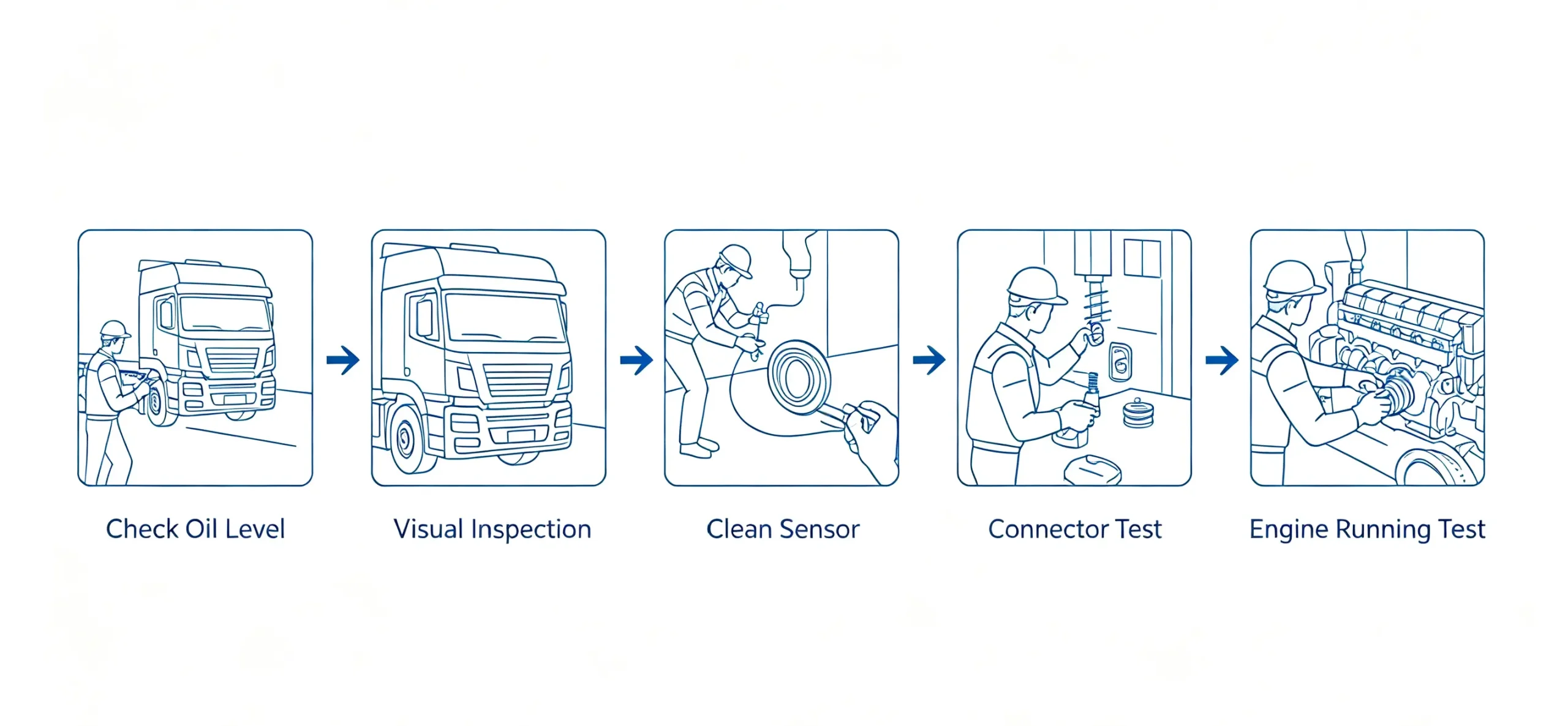
Step-by-Step Troubleshooting Methods for Oil Pressure Sensor Issues
When the above abnormal symptoms occur, blind replacement of parts is not recommended. Drivers and maintenance personnel can follow standardized steps to troubleshoot faults first to accurately locate the problem.
The following inspection steps are summarized from a large number of on-site maintenance practices. They are simple, efficient and suitable for all mainstream domestic heavy truck models.
Step 1: Check Basic Engine Oil Status First
First, park the truck on a flat ground, turn off the engine, and wait for the engine to cool down completely.
Pull out the engine oil dipstick to check whether the oil level is within the standard range. Confirm whether the engine oil is insufficient, deteriorated or mixed with excessive impurities.
Eliminate oil quality and oil quantity problems first to avoid misjudging normal oil circuit faults as sensor faults.
Step 2: Visual Inspection of Sensor Appearance and Wiring
Open the engine compartment baffle and find the oil pressure sensor installation position on the cylinder block.
Visually check whether the sensor shell is cracked, deformed or seeping oil. Focus on checking whether the wiring harness is aging, cracked or falling off.
Check whether the wiring plug is loose, water ingress or oxidized and rusted. Most signal faults can be found through visual inspection.
Step 3: Clean Sensor Induction Hole and Thread
For faults caused by impurity blockage, gently unscrew the sensor from the installation port.
Use clean qualified engine oil to clean the induction probe and thread gap. Remove accumulated colloids, metal debris and oil dirt.
After cleaning, install the sensor back temporarily and test whether the data returns to normal. Simple cleaning can solve most minor blockage faults.
Step 4: Line Plug Disconnection Test
Under safe operation conditions, unplug the sensor wiring harness plug, and observe the change of dashboard oil pressure data.
If the data returns to normal after unplugging, it proves that the sensor itself is damaged and needs to be replaced. If the fault remains unchanged, it is a vehicle line or circuit fault.
Step 5: Dynamic Engine Running Test
After completing static inspection and simple maintenance, start the engine and keep it running at idle speed for 3 to 5 minutes.
Observe the real-time change of oil pressure data. Then test the vehicle acceleration and climbing state to confirm whether the sensor signal is stable.
Comprehensively judge the fault severity to determine whether cleaning maintenance or integral replacement is required.
Complete Step-by-Step Guide to Fix Truck Oil Pressure Sensor Issues
When the sensor is severely aging, damaged or blocked and cannot be repaired by cleaning, integral replacement is the most thorough and effective solution.
The following standardized replacement process is applicable to all Sinotruk, FAW, Shacman and Dongfeng domestic heavy trucks. Strict operation can avoid secondary faults.
Step 1: Strict Safety Pre-Operation Preparation
Safety is the primary premise of engine accessory maintenance. First, turn off the vehicle engine and cut off the main power supply to prevent circuit short circuit.
Wait for the engine temperature to drop to the safe range to avoid high-temperature scalding during disassembly.
Prepare new matching oil pressure sensors, sealing gaskets, disassembly wrenches and oil receiving containers in advance to avoid oil splashing and waste.
Step 2: Disconnect Wiring Harness and Dismantle Old Sensor
Gently press the buckle of the sensor wiring plug and pull out the harness line slowly. Do not pull violently to prevent breaking the internal wire core.
Align the tool with the sensor shell, unscrew the old sensor counterclockwise slowly, and place the oil receiving container under the installation port.
A small amount of residual engine oil will flow out after disassembly, which needs to be collected to avoid polluting the engine compartment.
Step 3: Clean Installation Base and Thread Gap
After removing the old sensor, carefully clean the thread of the engine installation port and surrounding oil dirt impurities.
Ensure that the installation base is flat and clean. Residual impurities will cause poor sealing and oil leakage after new parts installation.
This step is easily ignored in daily maintenance, but it is the key to ensure no leakage and stable signal of new sensors.
Step 4: Install New Sensor and Standard Fastening
Put the new sealing gasket on the new sensor to ensure complete fitting without deviation.
Align the thread with the installation port, screw it in manually first to avoid thread slipping, and then use a tool to fasten it to the standard tightness.
Do not apply excessive torque to prevent damaging the internal precision chip and thread structure of the new sensor.
Step 5: Connect Wiring Harness and Check Sealing
Align the wiring plug with the sensor interface and insert it firmly until the buckle locks in place to avoid virtual connection and loosening.
Check the sensor installation position again to confirm no deviation and no gap leakage.
Step 6: Post-Installation Debugging and Running Test
Turn on the vehicle power supply first to observe whether the dashboard oil pressure alarm disappears and the data returns to normal.
Start the engine and run idle for 5 to 10 minutes to observe the real-time stability of oil pressure data.
Carry out on-load acceleration and climbing test to confirm that the sensor works normally and there is no oil seepage at the installation position.
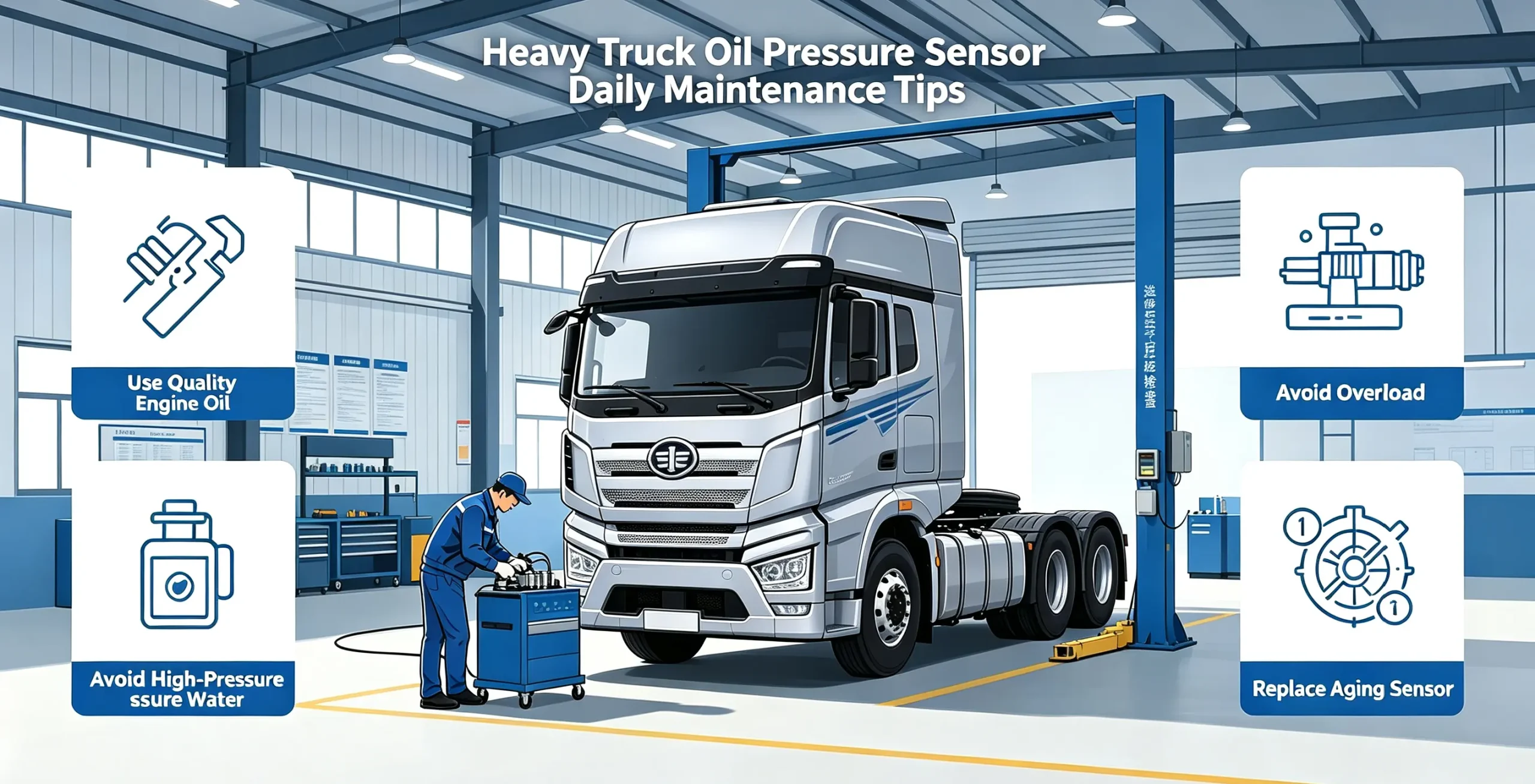
Practical Daily Maintenance Tips to Prevent Sensor Faults
According to field maintenance data, more than 80% of oil pressure sensor faults are caused by irregular daily use and lack of maintenance. Developing good maintenance habits can greatly extend sensor service life.
1. Use Qualified Regular Engine Oil
Never use inferior low-price engine oil with unqualified quality. Inferior engine oil contains a lot of colloids and impurities, which is easy to block the sensor probe.
Choose special engine oil suitable for domestic heavy trucks, and replace engine oil and oil filter strictly according to the mileage cycle.
2. Monthly Regular Sensor Inspection
Arrange a special engine compartment inspection every month. Focus on checking sensor appearance, wiring tightness and sealing state.
Deal with aging lines and slightly seeping sensors in advance to avoid minor faults evolving into serious failures.
3. Avoid Long-Term Overload Operation
Long-term full-load overload operation will cause the engine to overheat for a long time, accelerating the aging of electronic sensors.
Slow down when passing bumpy road sections to reduce strong vibration impact on engine sensors.
4. Avoid High-Pressure Water Flushing Sensor Position
During vehicle cleaning, do not use high-pressure water gun to directly flush the engine sensor and wiring plug position.
Prevent water ingress and oxidation of the line interface, which can effectively avoid signal short circuit and disorder faults.
5. Replace Aging Sensors in Advance
For vehicles with mileage exceeding 100,000 kilometers, sensors with slow response and unstable signals can be replaced in advance.
Prevent sudden failure during long-distance transportation and ensure driving safety.
Professional Heavy-Duty Truck Sensor Accessories Supply
The quality of replacement oil pressure sensors directly determines the later working stability and service life. Inferior sensors have low precision and short service life, which are prone to repeated faults.
We focus on providing OE-standard genuine accessories for domestic heavy trucks, covering Sinotruk, FAW, Shacman, Dongfeng and other mainstream models.
All our oil pressure sensors adopt high-temperature resistant and vibration-resistant chip materials, with accurate detection data and stable signal transmission.
In addition to oil pressure sensors, we also supply complete specifications of truck temperature sensor parts, speed sensors and other electronic sensing accessories.
We support retail and bulk wholesale, with sufficient spot supply and fast global logistics delivery.
At the same time, we provide one-stop supporting parts supply, including complete truck fuel system parts and engine wearing parts.
All products pass strict factory inspection, with reliable quality and perfect after-sales service, which is trusted by many maintenance factories and fleet companies.
Common FAQ About Truck Oil Pressure Sensor Issues
1. Can I drive with a faulty oil pressure sensor?
It is not recommended to drive continuously. Faulty sensors will cause wrong data display, making you unable to judge the real engine oil pressure state, which may lead to engine wear failure.
2. Does oil pressure alarm always mean sensor failure?
No. It may also be caused by insufficient engine oil, oil pump damage or oil circuit blockage. It is necessary to troubleshoot one by one to confirm the real fault point.
3. How long is the service life of a genuine oil pressure sensor?
Under standard use and regular maintenance, genuine sensors can work stably for 80,000 to 120,000 kilometers, far longer than inferior accessories.
4. Will mismatched sensors damage the truck circuit?
Mismatched sensors have inconsistent signal parameters, which will cause data disorder. In severe cases, it will lead to circuit overload and burn out vehicle electronic modules.
Conclusion
The oil pressure sensor is a tiny but vital component of the heavy truck engine lubrication system. It undertakes the important task of real-time oil pressure monitoring and safety early warning.
Most common engine oil pressure alarms and data abnormalities are closely related to sensor aging, blockage, line looseness and signal failure.
These faults are mostly caused by long-term high temperature, vibration erosion and insufficient daily maintenance, which are completely preventable and repairable.
By mastering standardized troubleshooting and replacement methods, maintenance personnel and drivers can quickly solve on-site sensor faults and restore normal engine working state.
Adhering to scientific daily maintenance can effectively reduce sensor failure rate, extend component service life and reduce fleet long-term operation costs.
If you need high-quality OE-standard truck oil pressure sensors and supporting engine accessories, feel free to contact our team for professional technical support and favorable wholesale prices.


