
Introduction
Heavy-duty commercial trucks form the core backbone of global logistics, construction, mining and long-haul transportation industries. Unlike ordinary passenger cars and light vehicles, Chinese heavy trucks face extremely harsh working conditions all year round.
Specifically, mainstream models including Sinotruk HOWO, Shacman X3000/F3000, FAW J6P/J7, Dongfeng KC and Foton Auman often carry heavy loads and run continuously over long distances. For this reason, stable component performance is the top priority for fleet operators and individual drivers worldwide.
Among various engine auxiliary systems, the serpentine belt drive system is one of the most essential yet easily ignored parts. In short, this single multi-groove belt drives almost all key peripheral engine accessories.
These critical components cover the alternator for power generation, water pump for engine cooling, air compressor for brake systems, hydraulic steering pump and auxiliary cooling fan. As a result, the entire truck’s driving safety and operational stability depend entirely on normal belt system operation.
Once the serpentine belt system works abnormally, a series of cascading faults will occur rapidly. For example, insufficient power generation leads to continuous battery drain and startup failure. Meanwhile, a stalled water pump causes severe engine overheating and even permanent cylinder damage.
In addition, a faulty air compressor results in insufficient brake air pressure, which greatly endangers road driving safety. Undoubtedly, any of these faults will force truck shutdown, cause huge economic losses and delay transportation schedules.
However, most maintenance teams only focus on regular serpentine belt replacement. They often overlook the core component that controls belt stability: the automatic belt tensioner. In fact, the tensioner’s condition directly determines belt wear degree, operating stability and overall service life.
Even with a brand-new high-quality belt, a faulty tensioner will still cause slipping, abnormal noise and rapid wear. Consequently, drivers face frequent repeated maintenance and unnecessary cost waste.
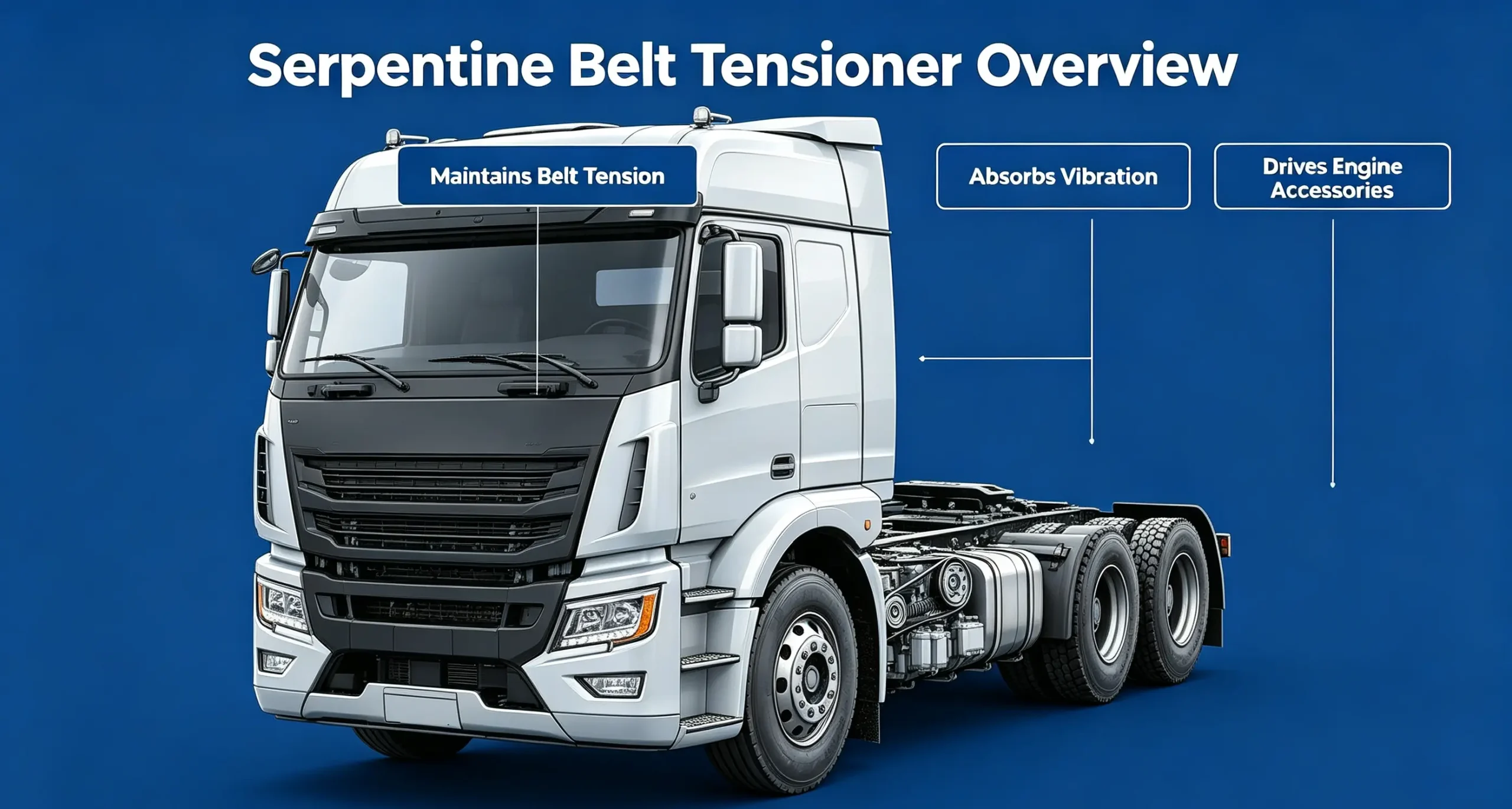
Simply put, the truck serpentine belt tensioner is a precision automatic compensation device customized for heavy-duty diesel engines. Its main function is to maintain consistent, standard belt tension under all working conditions.
This includes cold startup, idle operation, low-speed cruising, full-load acceleration and high-speed driving. Furthermore, it automatically compensates for belt length changes caused by thermal expansion, cold contraction and long-term wear.
By doing so, it effectively prevents common problems such as belt slipping, tooth jumping, deviation and fluttering during operation.
It is worth noting that Chinese heavy trucks always operate in high-temperature, high-vibration, dusty and muddy environments. Correspondingly, their belt tensioners bear long-term alternating stress and extreme working loads.
Gradually, continuous engine vibration, engine compartment high temperature, frequent start-stop impact and full-load operation lead to spring fatigue, bearing wear, damping failure and structural aging.
Different from sudden mechanical damage, tensioner failure is a progressive fatigue process. In other words, it has a complete early warning cycle from minor performance degradation to total functional failure.
In the early failure stage, subtle abnormal noise and slight belt flutter often appear, which are easy to ignore. As the condition worsens, belt slipping, loud squealing, accelerated wear and insufficient accessory power will emerge one after another.
In severe cases, the tensioner may get stuck or structurally damaged, causing sudden belt falling off or breakage. Ultimately, this paralyzes the entire engine auxiliary system and leads to sudden road shutdown.
Therefore, timely identification of failure symptoms, accurate root cause diagnosis and standardized maintenance are essential. These measures effectively avoid sudden breakdowns and greatly reduce fleet maintenance costs.
Most truck owners adopt passive maintenance and replace parts only after complete failure. This method significantly increases road fault risks and secondary component damage. On the contrary, preventive maintenance can double the belt system’s service life and reduce unplanned downtime.
This comprehensive professional guide is tailored for mainstream Chinese heavy-duty trucks and overseas working scenarios. It systematically explains tensioner structures, working principles, typical failure symptoms and root causes.
Moreover, it covers complete diagnosis methods, step-by-step replacement procedures, fault avoidance tips and long-term maintenance strategies. It serves as a practical reference for fleet managers, overseas technicians and individual truck drivers.
To conclude, selecting reliable matching parts is vital for stable long-term operation. Professional and high-quality truck engine system parts perfectly adapt to heavy-load conditions and improve the overall durability of belt drive systems.
What Is a Truck Serpentine Belt Tensioner & How It Works
To achieve accurate fault diagnosis and standardized maintenance, it is necessary to fully understand the tensioner’s structure and working mechanism. In general, heavy truck tensioners differ greatly from those used in passenger cars and light trucks.
Specifically, they adopt upgraded structural design, high-strength materials, stronger bearing capacity and professional damping performance. They are specially developed for high-vibration, high-temperature and heavy-load diesel engine working environments.
A complete OEM-standard tensioner assembly consists of multiple core precision components. These include a high-rigidity metal base, anti-fatigue torsion spring, reinforced swing arm, wear-resistant pulley and high-precision sealed bearing.
In addition, it is equipped with a built-in damping buffer structure, limit positioning mechanism and anti-loosening fasteners. Every component undertakes independent core functions and cooperates closely to realize automatic tension compensation and vibration suppression.
Overall, the structural design fully adapts to extreme truck working conditions, featuring excellent compression resistance, vibration resistance and high-temperature aging resistance.
The biggest advantage of automatic tensioners over traditional manual tension structures is intelligent real-time compensation. Traditionally, manual structures require regular bolt adjustment to change belt tension.
As a result, they cannot adapt to dynamic changes in belt length and engine operating status. In contrast, heavy truck automatic tensioners adjust tension dynamically according to real-time working conditions without manual intervention.
During long-term truck operation, serpentine belts undergo two types of length changes. Firstly, reversible deformation comes from thermal expansion during engine heating and cold contraction after shutdown.
Secondly, irreversible elongation is caused by long-term tension extrusion, vibration friction and material fatigue. Fortunately, automatic tensioners can perfectly adapt to both changes and maintain standard belt tension at all times.
This avoids excessive or insufficient tension and ensures high synchronization accuracy of the entire drive system.
The core working principle relies on the built-in high-strength torsion spring. To be specific, the spring stores elastic potential energy during installation and outputs stable and uniform pressure during operation.
The pulley at the end of the swing arm tightly presses the outer surface of the serpentine belt. With continuous spring pressure, the belt remains fully tensioned and closely fitted with every pulley groove to eliminate slipping gaps.
It is important to note that engine operating conditions are always changing. For instance, cold startup, idle stabilization, sudden acceleration, deceleration and heavy-load climbing all cause drastic speed and torque fluctuations.
These changes produce instantaneous tension impact on the belt. At this moment, the tensioner swing arm automatically swings within a fixed range to release or supplement tension instantly.
In short, it absorbs mechanical impact and tension fluctuations, effectively preventing belt slipping, fluttering and tooth jumping caused by unstable tension.
Besides tension compensation, the built-in damping structure is another key core design. Diesel engines generate continuous high-frequency mechanical vibration during operation.
Without effective damping, the belt will produce strong resonance, loud operating noise and accelerated fatigue wear. Therefore, the professional damping structure suppresses belt and swing arm vibration significantly.
This reduces system resonance, lowers running noise and improves the overall stability of the auxiliary drive system.
Stable standard tension is the basic guarantee for normal operation of all engine auxiliary accessories. Firstly, sufficient tension ensures the alternator runs at standard speed to output stable voltage and avoid battery undercharging.
Secondly, it guarantees constant water pump operation to provide sufficient cooling circulation and prevent engine overheating. Thirdly, it supports stable air compressor and hydraulic pump operation to ensure brake safety and flexible steering control.
Moreover, the pulley’s high-precision sealed bearing ensures smooth and flexible rotation. The bearing adopts multi-layer sealing and high-temperature resistant grease to resist high heat, dust and water vapor erosion in the engine compartment.
On the contrary, worn, stuck or damaged bearings will cause pulley stalling. This leads to violent fixed-point friction with the running belt and causes rapid belt damage and system failure.
Ultimately, all tensioner components are closely interconnected. Torsion spring fatigue, damping failure, bearing wear or swing arm deformation will all lead to overall tensioner failure.
Even if the belt remains intact, the entire auxiliary drive system will operate abnormally and trigger a series of chain faults.
8 Common Symptoms of Failing Serpentine Belt Tensioner
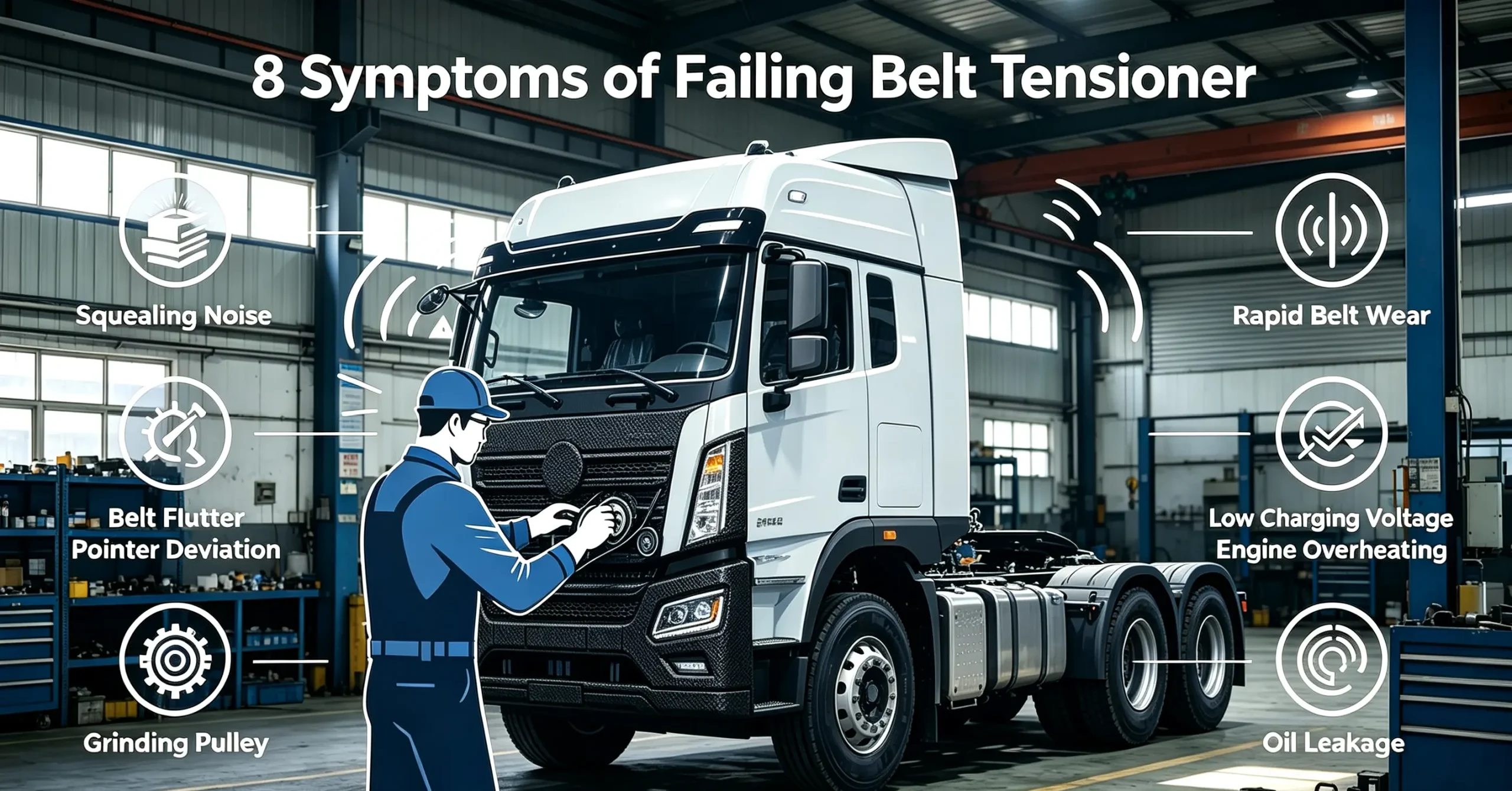
Truck belt tensioner failure is a gradual and layered process. In other words, obvious distinguishable warning symptoms appear in the early, middle and late failure stages.
Most sudden belt breakage and system paralysis result from long-term accumulated minor faults without timely repair. Therefore, mastering these typical symptoms helps achieve early warning and preventive maintenance to avoid road breakdowns.
1. Persistent Squealing & Chirping Belt Noise
Belt squealing and chirping are the most common and earliest warning signs of degraded tensioner performance. A healthy tensioner provides stable pressure to ensure tight belt-pulley fitting without sliding friction.
Once the spring fatigues, elastic pressure drops below the factory standard. This causes insufficient belt tension and continuous relative slipping between the rubber belt and metal pulleys, producing sharp harsh squealing noise.
Notably, this noise has obvious scenario regularity. It is most prominent during cold startup in low-temperature environments, as cold belts are stiff and fit poorly with pulleys.
After engine warming up, the noise temporarily weakens or disappears, easily misleading drivers into thinking the fault is resolved. In fact, tensioner failure persists, and the squealing will reappear during heavy-load acceleration and climbing.
As failure worsens, intermittent noise turns into continuous full-operation squealing. Long-term slipping friction also generates high temperature, causing belt surface ablation and accelerated aging.
2. Visible Belt Flutter & Vibration
Stable tension is the premise of smooth belt operation. When the tensioner damping fails or spring elasticity decreases, tension control capacity drops sharply.
For this reason, obvious up-and-down flutter and left-and-right swing of the belt can be observed during idle speed and low-speed driving.
The flutter amplitude is positively correlated with failure severity. Early-stage flutter only occurs during speed changes, while late-stage failure causes violent vibration even at stable idle speed.
Excessive vibration leads to uneven belt stress, local accelerated wear, edge friction and groove deformation. Meanwhile, vibration transmits to accessory pulleys and affects the service life of alternators and water pumps.
3. Abnormal Tensioner Arm Movement
A healthy tensioner swing arm moves smoothly within a fixed standard range. It flexibly adjusts angles with speed and tension changes without jamming, stagnation or excessive jitter.
In addition, the tensioner is equipped with a pointer and standard scale line, which serves as the most intuitive judgment basis for working status.
After aging and failure, the swing arm operates abnormally. Common problems include stiff movement, obvious adjustment resistance, stuck reset and excessive swing beyond the standard scale.
Severe spring fatigue causes the pointer to deviate permanently from the standard middle position. This means the tensioner completely loses automatic compensation ability and cannot adapt to belt state changes.
In short, this symptom accurately distinguishes tensioner faults from belt self-faults and effectively avoids maintenance misjudgment.
4. Grinding Noise from Tensioner Pulley
The tensioner pulley relies on internal sealed bearings for flexible rotation. Bearings are precision vulnerable parts that bear long-term high-speed rotation, vibration impact and high-temperature erosion.
After long service time, problems such as grease dry-up, ball wear, raceway damage and seal failure will occur, resulting in continuous dull grinding noise during operation.
This noise comes from the front engine accessory area and changes synchronously with engine speed. To be specific, higher speed brings louder grinding sound.
Early wear only produces faint noise during acceleration, while late failure causes continuous grinding accompanied by pulley jitter.
If left unprocessed, bearing damage will eventually cause pulley jamming and stalling. The stationary pulley violently rubs against the running belt, leading to large-area belt peeling and sudden breakage.
5. Accelerated Serpentine Belt Wear
Many drivers face repeated belt replacement and rapid wear. In most cases, this is not a belt quality issue but a hidden tensioner failure.
Unstable tension caused by faulty tensioners leads to frequent belt slipping, friction deviation and uneven stress. As a result, belt wear speed increases significantly.
Under normal conditions, high-quality belts last 2–3 years. However, matched with a faulty tensioner, belts develop groove wear, edge cracking, surface fluffing and rubber peeling within months.
Deformed belt grooves further worsen pulley fitting and slipping, forming a vicious cycle of accelerated damage. Therefore, priority should be given to tensioner inspection if frequent belt failure occurs without obvious pulley faults.
6. Insufficient Alternator Charging Voltage
Truck alternator power generation completely depends on belt-driven rotating speed. When tensioner tension is insufficient, serious belt slipping reduces the actual alternator speed.
Correspondingly, power generation voltage and current drop, resulting in persistent battery undercharging.
Drivers can clearly notice weak startup power, dim lights and frequent low-voltage prompts. However, most maintenance personnel misjudge the fault as alternator or battery damage.
They often ignore hidden tensioner problems and waste time on unnecessary electrical system inspection. In fact, solving tensioner-induced belt slipping can immediately restore normal charging performance.
7. Engine Overheating in Heavy Load
Heavy-load and climbing engine overheating is another typical hidden fault caused by tensioner failure. The engine cooling water pump is entirely driven by the serpentine belt.
Insufficient belt tension leads to water pump slipping and reduced rotating speed. This decreases cooling water circulation flow and weakens heat dissipation efficiency.
This fault has obvious scenario characteristics. Specifically, the water temperature remains normal at idle speed and on flat roads but rises rapidly during heavy-load driving and climbing.
The reason is that heavy load increases engine heat generation, while the low-speed water pump cannot provide sufficient cooling capacity, resulting in heat accumulation and overheating.
Long-term slight overheating causes engine carbon deposition, oil deterioration and component aging. Severe overheating will directly damage cylinders and pistons, causing huge maintenance losses.
8. Oil Leakage & Rust on Tensioner Surface
Tensioner internal bearings and damping structures are filled with high-temperature resistant grease, sealed by multi-layer rubber rings. After long-term high-temperature aging and vibration, the sealing structure fails.
This causes internal grease leakage, which adheres to the tensioner surface and serpentine belt, forming oil pollution.
Belt surface oil stains completely destroy belt-pulley friction balance and aggravate slipping and squealing problems. Meanwhile, humid and dusty engine compartment environments cause exposed tensioner metal parts to rust and corrode.
Rust increases pivot and swing arm friction resistance, leading to movement jamming and lost automatic compensation function. In short, surface oil leakage and rust indicate complete internal structural damage and require immediate replacement.
Root Causes of Truck Belt Tensioner Failure
High-quality OEM tensioners have a theoretical service life of 3–4 years under standard working conditions. Nevertheless, many truck tensioners fail prematurely within 1–2 years in actual use.
In most cases, early failure is not caused by product quality problems. Instead, it results from harsh working environments, irregular driving habits, inadequate maintenance and improper operation.
Thus, systematic root cause analysis helps fleets formulate targeted maintenance plans and effectively extend tensioner service life.
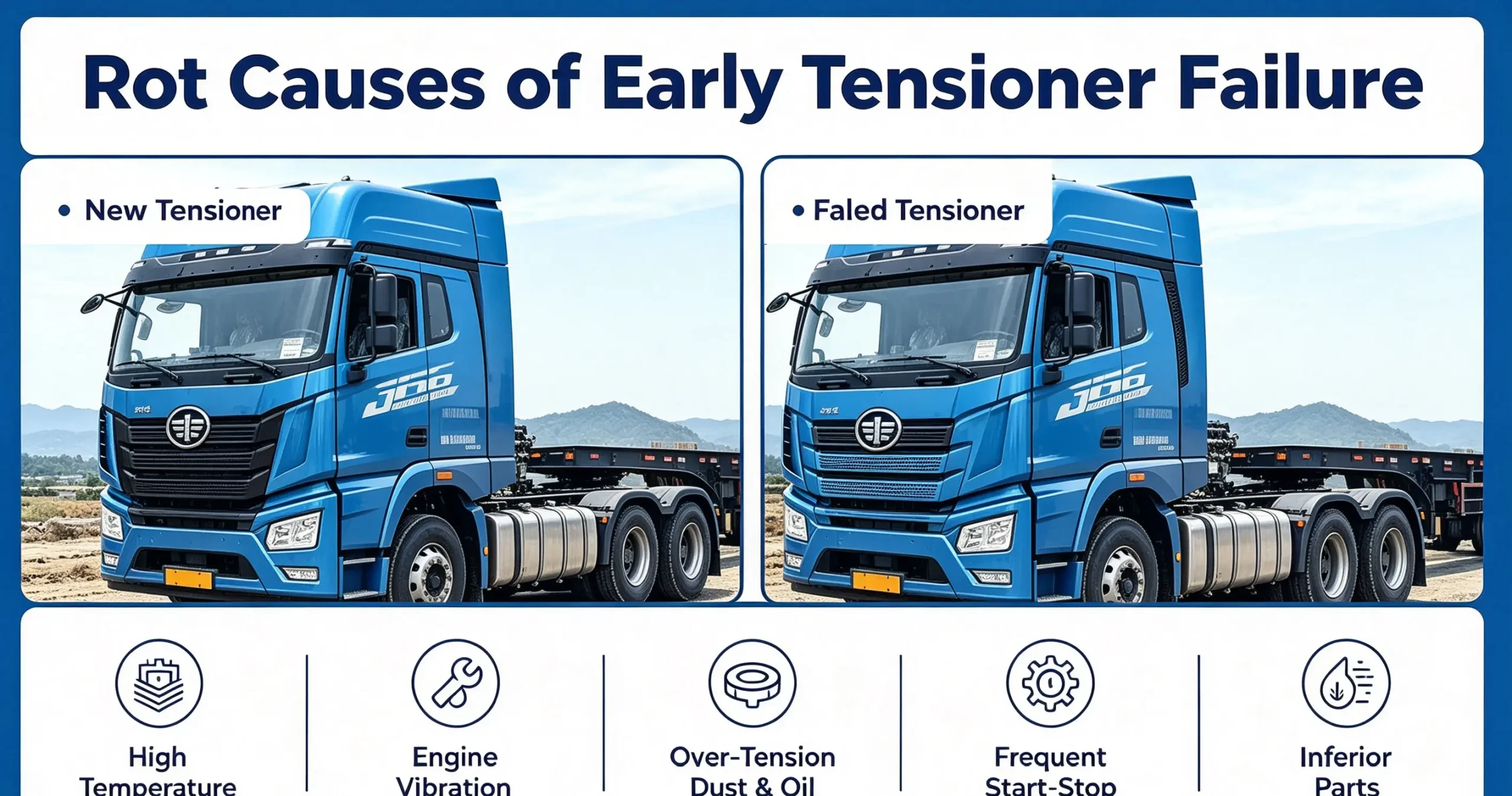
1. Long-Term High-Temperature Aging
The front accessory compartment of heavy-duty diesel engines is a typical high-temperature area. During continuous long-distance operation, combustion and exhaust heat gather steadily, keeping internal temperature between 80℃ and 120℃.
As a core component in this high-temperature zone, the tensioner bears long-term baking. Above all, high temperature is the biggest cause of internal component aging.
High heat causes torsion spring stress relaxation and elastic fatigue, reducing tension compensation capacity. Meanwhile, internal damping rubber hardens and loses vibration suppression performance.
In addition, high-temperature resistant grease dries up and carbonizes, leading to bearing lubrication failure and accelerated wear. To sum up, long-term high-temperature operation greatly shortens the overall tensioner service life.
2. Severe Engine Vibration Impact
Large-displacement heavy-duty diesel engines generate strong periodic mechanical vibration during operation. This high-frequency vibration continuously transmits to the engine bracket and tensioner fixing position.
As a result, the tensioner assembly bears long-term alternating impact loads.
Continuous vibration loosens fixing bolts and causes minor mounting base displacement. It also wears swing arm pivot connections and accumulates vibration fatigue.
Over time, the swing arm and bracket deform, leading to inaccurate tension adjustment angles and unilateral stress. Furthermore, vibration accelerates bearing ball and raceway wear, inducing early bearing failure.
3. Belt Over-Tension or Improper Installation
Improper manual operation during belt replacement is a major artificial cause of premature tensioner failure. Many inexperienced technicians misunderstand automatic tensioner working principles.
They arbitrarily over-tighten belts beyond factory standards, believing tighter belts ensure more stable operation.
Excessive belt tension causes the tensioner spring to bear long-term overload pressure far exceeding design limits. This leads to rapid spring fatigue and permanent deformation, losing compensation ability in a short time.
Besides over-tightening, wrong belt routing and uneven pulley fitting also cause unilateral tensioner stress. This results in swing arm and bearing eccentric wear as well as structural deformation.
4. Dust, Mud and Oil Pollution
Most Chinese heavy trucks work in engineering, mining and mountain road scenarios with extremely harsh environments. A large amount of dust, sediment and mud enters the engine accessory compartment during operation.
These tiny particles invade gaps between tensioner pivots and bearings, forming abrasive wear during swing and rotation. Consequently, movement jamming and increased friction resistance occur.
In addition, minor engine oil leakage and crankcase oil mist adhere to tensioners and belts. This destroys friction balance, causes continuous slipping and accelerates component aging and failure.
5. Frequent Start-Stop & Variable Load Operation
Short-distance distribution and construction site trucks feature frequent start-stop, rapid acceleration and sudden load changes. Every startup and acceleration produces instantaneous tension impact on belts and tensioners.
Notably, alternating impact loads are far more harmful to springs than stable static pressure. This greatly accelerates spring fatigue failure.
Moreover, frequent load changes cause continuous tensioner swing adjustment, increasing moving part wear frequency and shortening overall service life.
6. Inferior Aftermarket Tensioner Parts
To save short-term costs, many individual drivers and small fleets choose low-cost inferior aftermarket tensioners. These low-quality parts cut major corners in materials and production processes.
Specifically, they adopt low-strength ordinary springs, low-precision common bearings and inferior damping materials and lubricants.
As a result, these tensioners have poor high-temperature resistance, vibration resistance and fatigue resistance. They easily develop spring failure, bearing noise and structural deformation within a few thousand kilometers.
Although the purchase price is low, frequent replacement costs and vehicle downtime losses far exceed the cost of qualified OEM-standard accessories.
How to Diagnose Bad Belt Tensioner (Professional Inspection Steps)
In actual maintenance, belt faults and tensioner faults share similar symptoms and are easy to confuse. Therefore, standardized professional diagnosis is essential before disassembly and replacement.
This accurately locates fault sources and avoids blind replacement and unnecessary cost waste. The following 6-step inspection method is summarized from on-site maintenance experience with high accuracy and practicability.
Step 1: Listen for Running Noise
Start the engine and maintain stable idle speed for 1–3 minutes to fully warm up compartment accessories. Then, stand beside the engine accessory area and carefully identify running noise.
Distinguish continuous sharp squealing, intermittent chirping or dull grinding sounds from normal operating noise.
Gently adjust engine speed with the accelerator to observe noise changes. Generally, speed-linked squealing indicates insufficient tension and belt slipping.
Continuous speed-synchronized grinding noise typically means tensioner pulley bearing wear.
Step 2: Visual Inspection of Belt Operation
Observe the overall belt operating state during idle speed. Focus on checking for obvious flutter, swing, deviation and edge friction.
Meanwhile, inspect the belt surface for cracks, peeling, fluffing, oil stains and dust adhesion.
Compare belt condition and operating state to distinguish belt aging faults from tensioner faults. If the belt is intact but still slips and flutters, the tensioner is definitely the faulty component.
Step 3: Check Tensioner Pointer Scale
All standard heavy truck tensioners are equipped with visual pointers and standard scale lines. Observe the static pointer position carefully.
Under normal conditions, the pointer stably stays in the middle standard scale range.
Pointer deviation to the upper limit means over-tensioned belts. On the contrary, pointer exceeding the lower limit indicates severe spring fatigue and lost automatic compensation function.
This is one of the most intuitive and accurate criteria for judging tensioner failure.
Step 4: Test Tensioner Arm Flexibility
Turn off the engine completely and wait for natural cooling to avoid scalding. Use a socket wrench to act on the tensioner force point and compress the spring to release belt tension.
Then repeatedly push and pull the swing arm to test movement flexibility and resistance uniformity.
A qualified tensioner moves smoothly with uniform resistance and resets accurately. Stiff movement, jamming, excessive shaking or failed reset all indicate internal structural fatigue and damage.
Step 5: Inspect Pulley Bearing Condition
After fully slackening the belt, manually rotate the tensioner pulley repeatedly to check bearing status. Qualified bearings rotate freely without stagnation, friction noise or abnormal jitter.
In addition, no obvious lateral shaking or radial gap exists in normal pulleys.
Abnormal rotation noise, stagnation or lateral play all mean severe bearing wear. Since bearings cannot be repaired separately, the entire tensioner assembly needs replacement.
Step 6: Check for Oil Leakage and Deformation
Conduct a comprehensive appearance inspection of the entire tensioner assembly. Check the pulley, swing arm, base and pivot for grease leakage, oil stains, rust and cracks.
Also check for bracket and swing arm deformation, bending and looseness.
Any oil leakage, rust, structural deformation or crack damage indicates complete internal tensioner failure. Immediate replacement is required to prevent sudden driving faults.
Step-by-Step Guide to Fix & Replace Truck Belt Tensioner
Tensioner spring fatigue, bearing wear and damping failure are all irreversible structural damages. In other words, local repair cannot solve these fundamental problems.
Standard assembly replacement is the only thorough solution for all tensioner faults. The following detailed steps apply to all mainstream Chinese heavy-duty truck models with high safety and zero secondary faults.
Step 1: Prepare Tools & Safety Measures
Ensure all tools are intact to avoid construction interruption.
Park the truck on flat hard ground, tighten the handbrake and pad tires with anti-slip blocks. Turn off the engine and cut off battery power to prevent accidental startup and short circuits.
Wait more than 30 minutes for natural cooling to avoid high-temperature scalding during disassembly.
Step 2: Record Original Belt Routing
Heavy truck engine accessory systems have numerous pulleys and complex belt routing. Different engine models have different winding sequences.
Wrong routing after replacement will cause accessory reversal, belt deviation and component damage.
Therefore, take multi-angle clear photos or draw a detailed routing diagram before disassembly. Keep the records for accurate reinstallation reference.
Step 3: Release Belt Tension
Align the socket wrench with the tensioner’s special force application point. Apply steady force against the spring tension to compress the internal torsion spring and retract the swing arm.
After the belt is completely slackened, manually remove the belt from the tensioner pulley groove to reserve sufficient disassembly space.
Step 4: Remove Old Tensioner
Loosen the tensioner fixing bolts diagonally in sequence. Diagonal loosening prevents unilateral bracket stress, deformation and thread damage.
After all bolts are loosened, completely take out the old tensioner assembly.
Thoroughly clean the mounting plane to remove oil dirt, rust, dust and rubber residues. Ensure the plane is flat and clean to avoid uneven stress on the new tensioner.
Step 5: Compare & Verify New Tensioner
Place the new tensioner side by side with the old one for full comparison and verification. Check the consistency of mounting hole positions, bolt spacing, pulley size, swing arm angle and pointer scale.
Moreover, confirm the part number fully matches the truck engine model to avoid mismatched accessory installation.
Mismatched tensioners have inaccurate tension and unadaptable swing ranges, which will cause repeated faults.
Step 6: Install New Tensioner
Place the qualified new tensioner in the standard mounting position and align all bolt holes accurately. Manually screw in the fixing bolts slowly to protect threads from slipping and damage.
After manual preliminary fastening, use a torque wrench to tighten bolts diagonally and evenly according to factory standard torque values.
Standard torque fastening ensures uniform tensioner stress, avoids skew installation and guarantees stable tension compensation performance.
Step 7: Reinstall Serpentine Belt
Reinstall the belt strictly according to the pre-recorded routing photos and diagrams. Wind the belt in sequence into each pulley groove and press manually to ensure full bottom embedding.
Confirm no deviation, jumping or partial separation exists. Then slowly release the tensioner swing arm to let the device automatically tension the belt.
Step 8: Test Run & Inspection
Recheck all mounting positions to ensure no missing parts or loose bolts. Restore battery power and start the engine for 5–10 minutes of stable idling.
Observe belt operating status, check for flutter and deviation, and listen for abnormal noise. Confirm the tensioner pointer stays within the standard scale range.
Test engine acceleration stability and conduct a low-speed road test. Confirm no abnormal vibration, noise or overheating to complete the replacement operation.
Professional Repair Tips to Avoid Recurring Faults
Many fleets still encounter repeated belt noise, flutter and wear after tensioner replacement. In most cases, this stems from non-standard operation and neglected maintenance details.
The following professional tips effectively eliminate secondary faults and ensure long-term stable operation of the belt system.
-
Replace belt and tensioner together: Old belts suffer from irreversible elongation and fatigue after long-term use. Matching a new tensioner with a worn old belt causes unstable tension and slipping. Synchronous replacement is the most cost-effective solution for long-term system stability.
-
Do not over-tighten manually: Automatic tensioners have precise self-compensation functions and require no manual tension adjustment. Excessive artificial tension causes long-term spring overload and rapid fatigue failure, shortening new tensioner service life drastically.
-
Check pulley coaxiality: During replacement, inspect all accessory pulleys for deformation, wear and offset. Deformed pulleys cause unilateral tensioner and belt stress, leading to eccentric wear and repeated faults.
-
Clean oil stains thoroughly: Completely remove all oil, grease and dust from pulleys and belts before installation. Residual oil stains destroy friction balance and cause persistent slipping and squealing that simple replacement cannot solve.
-
Use standard torque: Asymmetric bolt tightening causes tensioner skew and abnormal stress direction. Strict diagonal symmetrical tightening per factory standards ensures accurate tensioner working angles.
Long-Term Maintenance Tips to Extend Tensioner Life
Scientific daily maintenance effectively delays tensioner aging and fatigue. It greatly prolongs the belt system’s service life, reduces annual maintenance costs and avoids unplanned vehicle downtime losses.
The following targeted suggestions are formulated based on heavy truck operating characteristics.
-
Regular visual inspection: Conduct special tensioner and belt system inspections every 10,000 kilometers. Focus on pointer position, swing flexibility, pulley wear and belt surface condition to eliminate minor hidden faults in advance.
-
Keep engine cabin clean: Regularly clean dust, sediment and oil dirt in the accessory compartment. This prevents particle invasion into tensioner gaps and reduces abrasive wear and high-temperature aging speed.
-
Avoid long-time high-load idling: Reduce prolonged high-load engine idling. Long-term idling causes compartment heat accumulation and accelerates aging of tensioner springs and rubber parts.
-
Optimize driving habits: Adopt stable and gentle driving. Reduce frequent sharp acceleration, sudden braking and rapid gear shifting to relieve instantaneous tension impact and spring fatigue pressure.
-
Choose high-quality OEM parts: Reject inferior low-cost aftermarket accessories. High-quality OEM tensioners feature stable spring performance, high-precision bearings and excellent heat and vibration resistance for extreme heavy-duty working conditions.
Frequently Asked Questions
Q: How long does a truck serpentine belt tensioner last?
A: Under standard flat-road conditions, reasonable load and scientific maintenance, high-quality OEM tensioners last 3–4 years. However, harsh mining, engineering and overload working environments shorten the service life to 1–2 years. Regular inspections effectively extend service time.
Q: Can I drive with a bad belt tensioner?
A: Short-distance low-speed driving is temporarily feasible but extremely unsafe. A faulty tensioner may cause sudden belt slipping, falling off or breakage at any time. This leads to engine overheating, power generation failure and brake abnormality, triggering serious safety accidents.
Q: Why does belt squeal still exist after tensioner replacement?
A: Common reasons include wrong belt routing, residual oil stains, deformed accessory pulleys, unqualified new tensioners and uneven mounting planes. Recheck the installation process and accessory status one by one to eliminate faults.
Q: Do I need to replace the tensioner and belt at the same time?
A: Yes, synchronous replacement is the most scientific and cost-effective method. Old belts have irreversible fatigue and elongation that cannot match new tensioner output perfectly. Matching replacement eliminates repeated faults and extends overall system service life.
Conclusion
The serpentine belt tensioner is a small yet core component of heavy-duty truck engine auxiliary drive systems. Although not a large engine part, it dominates the stability of the entire belt system.
Furthermore, it protects the normal operation of key accessories including water pumps, alternators and air compressors, directly relating to engine heat dissipation, power generation, brake safety and overall vehicle stability.
In general, most sudden belt breakage, engine overheating and electrical faults stem from long-term neglected tensioner aging and fatigue.
Fortunately, the progressive failure feature provides sufficient early warning time. As long as maintenance personnel master systematic diagnosis methods and conduct regular inspections, most sudden road breakdowns are avoidable.
Standardized replacement and scientific daily maintenance maximize tensioner system service life. They effectively reduce fleet operating costs and cut unplanned vehicle downtime.
For global fleet owners and technicians, mastering professional tensioner maintenance skills is essential to improve operating efficiency and reduce safety risks.
In conclusion, selecting reliable suppliers is critical for accessory quality and matching accuracy. Mettlead Truck Parts provides full-series OEM-standard serpentine belts, tensioners, idle pulleys and engine system accessories for global heavy truck users.
All products perfectly match Sinotruk, Shacman, FAW, Dongfeng and Foton models with stable quality and strong durability. They effectively solve various belt system faults and escort stable fleet operation worldwide.


