Introduction
Heavy-duty trucks rely on strong, stable chassis connections to carry heavy loads and withstand long-distance transportation stress. Every component under the vehicle works together to keep the axle, leaf springs, and frame aligned correctly.
Among all chassis fasteners, U bolts are some of the most critical yet underrated parts. These curved bolt clamps hold the leaf spring pack firmly against the truck axle.
Without properly functioning U bolts, the entire suspension assembly loses fixed positioning. Even small U bolt issues can slowly destroy suspension geometry and driving stability.
Many fleet teams focus only on big-ticket repairs, such as spring replacement or shock absorber upgrades. They often ignore minor U bolt loosening, rust, or stretching during daily inspections.
This careless oversight creates hidden dangers. A single loose or broken U bolt can trigger tire wear, chassis vibration, steering drift, and even axle displacement accidents.
U bolt failures do not happen suddenly. They develop gradually over thousands of miles. Early warning signs always appear before complete failure.
This guide fully explains common truck U bolt problems, progressive failure symptoms, root causes, inspection methods, professional replacement steps, and long-term prevention tips.
By mastering U bolt maintenance knowledge, fleet managers can reduce breakdown risks and cut unnecessary repair costs. Understanding full truck chassis system layouts helps technicians recognize why small fasteners impact overall vehicle safety so heavily.
What Are Truck U Bolts & Where Are They Installed?
Truck U bolts are U-shaped high-strength fasteners designed specifically for heavy-load suspension fixing. They feature a curved semicircular body and two parallel threaded ends.
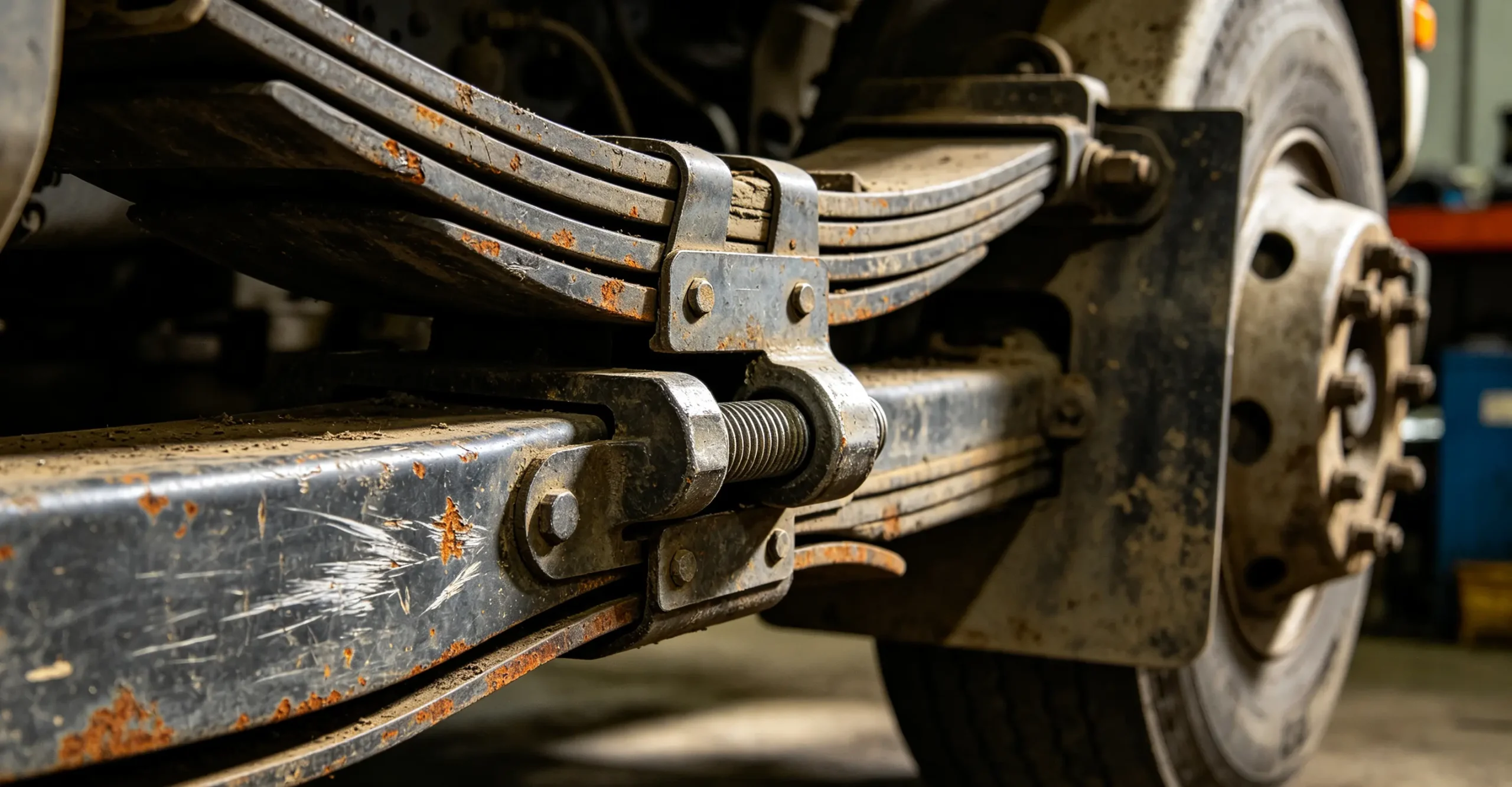
Their main installation position covers the top of the truck rear axle housing. They wrap around leaf spring packs and lock the springs tightly to the axle surface.
Matched with U bolt plates and locking nuts, these fasteners create a rigid fixed assembly. They prevent relative movement between leaf springs and axles during driving.
Unlike ordinary bolts, truck U bolts bear comprehensive force. They support vertical load, resist horizontal sliding, and limit torsion displacement.
In simple terms, U bolts are the “fixed anchor” of the entire leaf spring suspension system. All suspension buffer and load-bearing work must be based on stable U bolt locking.
If U bolts loosen or fail, leaf springs shift freely. The whole suspension system loses calibrated positioning accuracy.
Core Functions of Truck U Bolts in Suspension Systems
To understand U bolt failure hazards thoroughly, you must first clarify their core working functions. Every function directly affects chassis stability and driving safety.
1. Fixed Positioning of Leaf Springs and Axles
U bolts firmly press leaf spring packs against the axle housing. They eliminate gaps between springs and axles. This ensures synchronous movement of suspension and axles during driving.
2. Bearing Vertical Cargo Load
All vertical cargo weight transfers through leaf springs to U bolts and axles. High-strength U bolts disperse concentrated pressure evenly to avoid local stress deformation.
3. Resist Horizontal Displacement & Slippage
During acceleration, braking and turning, huge horizontal force acts on the suspension. U bolts prevent spring and axle sliding to maintain consistent wheel alignment data.
4. Maintain Suspension Geometry Parameters
Factory camber, toe angle and axle parallelism all depend on fixed U bolt positioning. Stable fastener status guarantees accurate chassis geometry.
5. Reduce Chassis Vibration & Abnormal Noise
Tight U bolt assembly avoids metal collision and friction gaps. It effectively reduces chassis vibration and eliminates random abnormal noise during driving.
Most Common Truck U Bolt Problems (Full Fault Classification)
U bolt faults are not limited to breakage. In actual fleet maintenance, loosening, stretching, rusting, thread slipping and deformation happen far more frequently.
These subtle problems are harder to detect than obvious cracks. They cause long-term hidden damage to truck chassis.
1. U Bolt Loosening (The Most Common Fault)
Long-term road vibration and load impact gradually loosen U bolt nuts. Micro gaps appear between pressure plates, springs and axles.
Loose U bolts do not cause immediate failure. However, they produce continuous small displacement during driving. This slowly distorts suspension geometry.
Most tire wear and steering drift problems originate from minor U bolt loosening that is left uncorrected.
Professional chassis vibration and loosening troubleshooting always prioritizes U bolt inspection as the first diagnosis step.
2. Thread Slippage & Thread Damage
Over-tightening during installation or long-term vibration abrasion causes thread tooth wear. Threads become slippery and lose locking friction.
Even if nuts appear tight visually, they cannot provide stable clamping force. This leads to invisible virtual looseness.
3. U Bolt Stretching & Permanent Deformation
Standard U bolts have strict elastic limits. Long-term overload operation exceeds material bearing range, causing permanent stretching.
Stretched U bolts cannot restore original tightness. Their clamping distance increases, resulting in insufficient compression force on leaf springs.
4. Rust, Corrosion & Surface Oxidation
Road rain, snow, salt water and mud cause severe chassis corrosion. U bolt surfaces and threads oxidize and rust easily.
Rust increases thread friction. It leads to inaccurate torque during tightening. Severe corrosion will directly reduce bolt strength and cause sudden fracture.
5. Fatigue Cracking & Sudden Breakage
Long-term alternating load and vibration produce tiny internal fatigue cracks. These cracks expand gradually until the U bolt breaks completely.
Broken U bolts directly lose fixing ability. Axles and leaf springs displace instantly, which easily causes traffic accidents.
6. Uneven Tightness & Asymmetric Stress
Uneven torque on left and right U bolts causes asymmetric suspension stress. One side is tight while the other side is loose.
This unbalanced force leads to chassis tilt, unilateral tire wear and body deviation during driving.
Progressive U Bolt Failure Symptoms (From Mild to Severe)
U bolt failure follows an obvious progressive rule. Symptoms evolve from subtle driving feelings to obvious mechanical faults. Drivers and technicians can judge fault severity accurately through different stages.
Stage 1: Slight Straight-Line Drift (Early Loosening)
In the early loosening stage, suspension positioning becomes unstable. The truck cannot maintain a perfectly straight track during cruising.
Drivers need frequent tiny steering corrections. This symptom becomes more obvious under full load and crosswind conditions.
Stage 2: Recurring Abnormal Tire Wear
Unstable axle positioning caused by loose U bolts changes wheel contact angles in real time. Feathered tread, unilateral inner wear and shoulder wear appear gradually.
Many fleets repeatedly adjust wheel alignment but gain no long-term effect. The core reason is unprocessed U bolt looseness.
High-quality chassis fastener matching standards prove that stable clamping force is the premise of valid wheel alignment.
Stage 3: Low-Speed Chassis Clunking Noise
When U bolt gaps increase further, metal collision occurs during acceleration and deceleration. Obvious clunking noise comes from the rear chassis.
The noise disappears on flat roads in the early stage but appears frequently on bumpy roads. Later, it occurs even during smooth driving.
Stage 4: Increased Cab Vibration & Floating Driving Feeling
Loose suspension assembly produces irregular vibration during driving. The vibration transmits to the frame and cab.
Drivers feel obvious floating and jittering at medium speeds. Long-term driving causes severe fatigue.
Stage 5: Unstable Braking & Braking Deviation
During braking, the axle shifts forward and backward due to insufficient U bolt clamping force. Braking feedback becomes delayed and soft.
Serious asymmetric looseness leads to left or right braking deviation, greatly reducing driving safety.
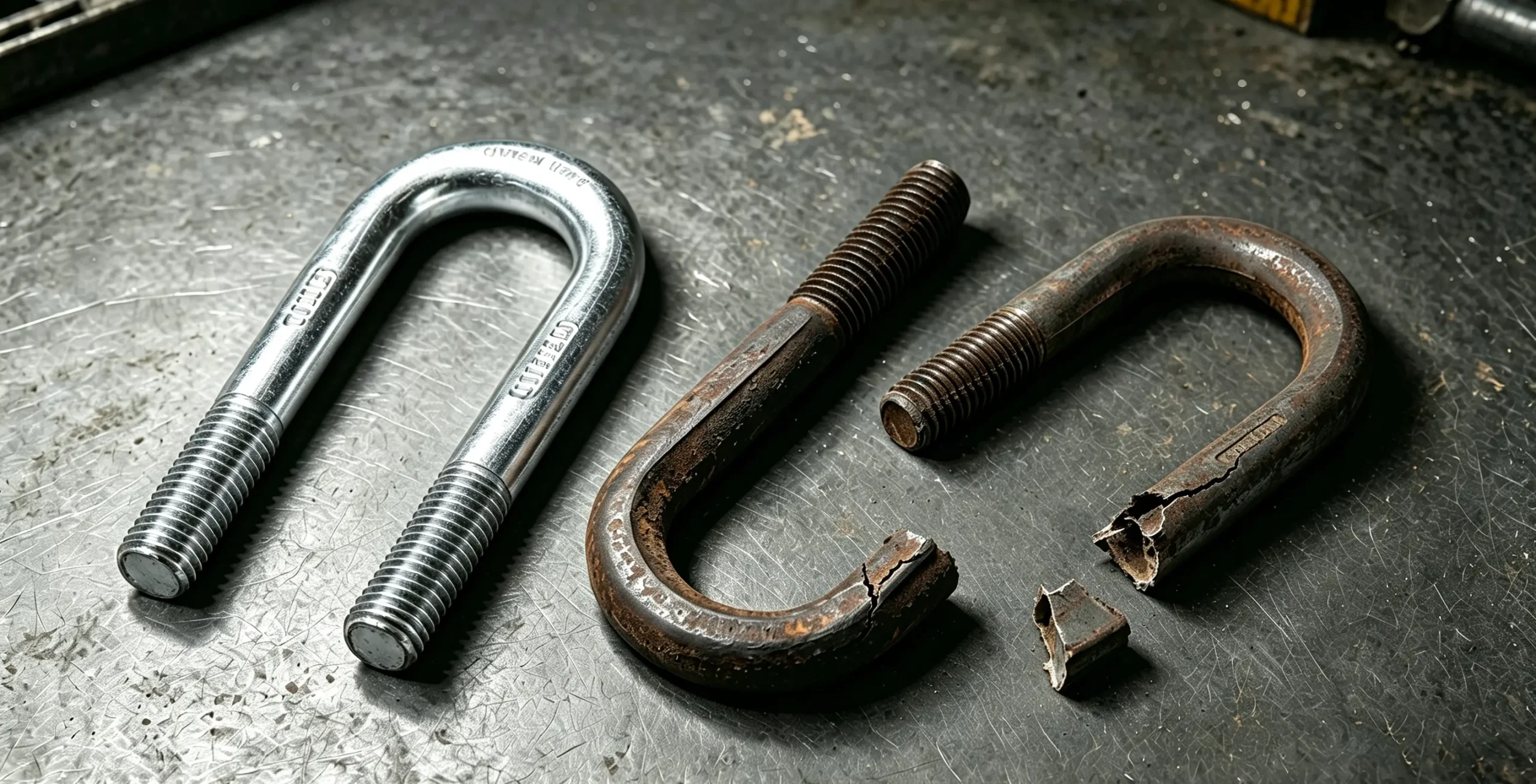
Stage 6: Visible Deformation, Rust & Broken Bolts (Late Failure)
In the late failure stage, U bolts show obvious stretching, bending, severe rust or thread peeling. Individual bolts break directly.
At this stage, the suspension is completely unstable. The vehicle must stop running immediately for replacement and maintenance.
Root Causes of Premature Truck U Bolt Failure
Most U bolts do not reach normal service life in actual use. Premature failure is mainly caused by improper use, poor maintenance and non-standard parts.
1. Long-Term Vehicle Overloading
Overloading is the top cause of U bolt stretching and fatigue fracture. Excess cargo far exceeds bolt design load limit.
Long-term over-compression causes irreversible elastic fatigue. Bolts gradually stretch and lose clamping performance.
2. Frequent Driving on Harsh Road Conditions
Mountain roads, gravel roads and construction roads bring continuous impact and vibration. U bolts bear frequent alternating stress.
High-frequency vibration accelerates nut loosening and material fatigue, greatly shortening service life.
3. Non-Standard Installation Torque
Over-tightening leads to bolt stretching and thread damage. Under-tightening causes insufficient clamping force and easy loosening.
Asymmetric left-right torque causes unbalanced suspension stress, inducing various chassis faults.
4. Low-Quality Inferior U Bolt Parts
Low-cost U bolts use unqualified steel materials. Their tensile strength and fatigue resistance fail to meet heavy-duty truck standards.
These inferior bolts deform and break easily under normal load. They bring huge hidden safety risks.
Choosing standard genuine chassis fasteners is the most effective way to avoid premature failure.
5. Lack of Regular Inspection & Secondary Tightening
Newly replaced U bolts will naturally relax slightly after running-in. Regular secondary tightening is required to maintain stable torque.
Most fleets ignore this step, resulting in gradual loosening and subsequent faults.
6. Chassis Corrosion & Long-Term Static Parking
Humid environment, road salt and mud accelerate bolt rusting. Long-term static load causes fixed stress deformation.
Both situations reduce U bolt toughness and strength, increasing failure probability.
Professional U Bolt Inspection Standards & Daily Check Methods
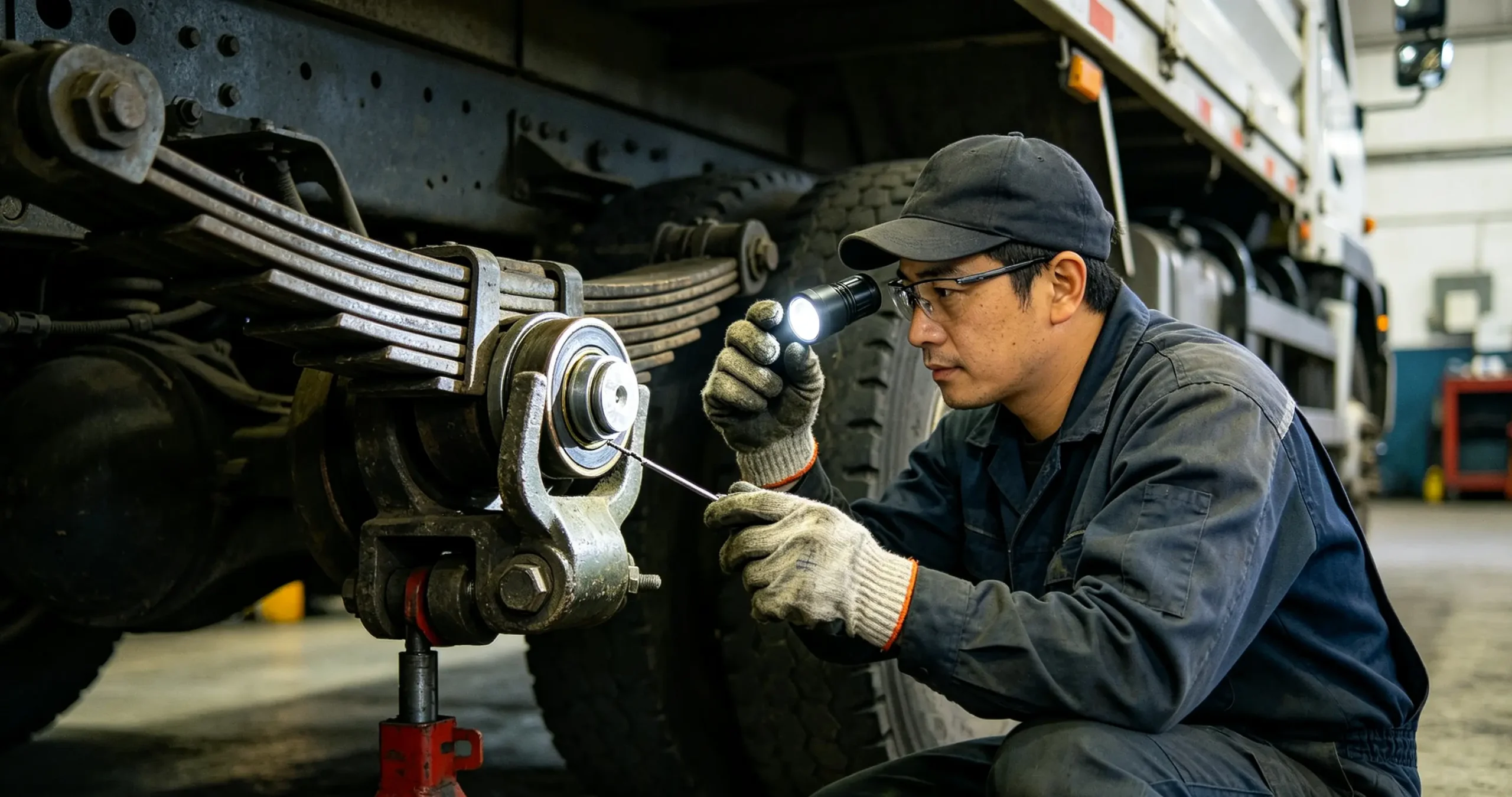
Standardized daily inspection can completely avoid sudden U bolt failures. Combined with professional fleet maintenance experience, the following inspection procedures are suitable for all heavy-duty trucks.
Our professional chassis maintenance team summarizes these practical inspection rules for long-term fleet safety management.
1. Visual Appearance Inspection
Check U bolt surface for rust, corrosion, bending deformation and thread damage. Replace bolts with severe oxidation or tooth slipping directly.
Observe whether the U bolt body is straight. Any slight bending indicates internal fatigue stress.
2. Manual Looseness Detection
Shake the U bolt pressure plate manually. No floating gap or shaking is allowed. Obvious looseness requires immediate tightening or replacement.
3. Torque Wrench Calibration Inspection
Use a professional torque wrench to detect locking torque. Compare with OEM standard values to judge insufficient tightness.
This method can accurately find virtual looseness that cannot be observed visually.
4. Suspension Gap Symmetry Check
Check left and right suspension gaps to ensure symmetry. Unbalanced gaps prove asymmetric U bolt stress.
5. Regular Re-Tightening After Replacement
After new U bolt replacement, complete secondary torque tightening within 500–1000 miles. This eliminates running-in relaxation gaps.
Step-by-Step Truck U Bolt Replacement Guide (Professional Standard Process)
Non-standard replacement is the main cause of repeated U bolt faults. Strict construction steps ensure long-term stable clamping effect.
Standard chassis fastener replacement cases verify that process precision determines service life.
Step 1: Vehicle Parking & Safety Fixing
Park the truck on flat hard ground. Chock tires tightly and engage the parking brake to prevent sliding.
Ensure the vehicle is in a completely static safe state before chassis operation.
Step 2: Jack Up Axle & Release Suspension Load
Use a hydraulic jack to lift the rear axle slightly. Release leaf spring compression tension to avoid bolt sticking during disassembly.
Match with safety support stands to ensure construction safety.
Step 3: Remove Rust & Lubricate Threads
Spray penetrating lubricant on U bolt nuts and threads. Wait 3–5 minutes for full penetration to prevent thread damage during disassembly.
Step 4: Loosen & Remove Old U Bolts
Loosen nuts symmetrically on both sides. Remove pressure plates and old U bolts completely.
Check leaf spring surfaces and axle surfaces for abrasion and deformation after disassembly.
Step 5: Clean Mounting Surface & Threads
Clean surface rust, mud and debris. Ensure zero impurities on the contact surface to avoid uneven stress.
Step 6: Install New Standard U Bolts
Adopt new high-strength U bolts for installation. Keep the bolt body vertical and stressed evenly.
Install pressure plates and flat washers in place to ensure fitting flatness.
Step 7: Symmetrical Graded Torque Tightening
Tighten nuts symmetrically in multiple stages. Do not lock one side completely in a single operation.
Finally reach factory standard torque value to ensure balanced stress on the whole assembly.
Step 8: Post-Installation Inspection & Road Test
Check for no gaps, no skew and no deformation after installation. Lower the vehicle and conduct road test verification.
Confirm no chassis noise, stable straight driving and no vibration deviation.
Key U Bolt Maintenance Tips to Extend Service Life
Scientific daily maintenance can maximize U bolt service life and reduce fleet maintenance frequency.
Perfect chassis system maintenance logic includes standardized fastener management.
First, strictly avoid long-term overload transportation to prevent bolt fatigue deformation.
Second, regularly clean chassis sediment and apply anti-rust maintenance to reduce corrosion damage.
Third, regularly check torque status and perform secondary tightening periodically.
Fourth, replace U bolts in pairs to ensure consistent stress on the same axle.
Fifth, choose high-strength genuine parts instead of cheap inferior products.
Sixth, avoid sharp acceleration and sharp braking to reduce instantaneous impact load.
Frequently Asked Questions About Truck U Bolts
1. Can I drive with loose U bolts?
Short-distance low-speed driving is temporarily feasible, but long-term driving is extremely dangerous. Loose U bolts cause axle displacement and suspension failure, easily leading to traffic accidents.
2. How often should truck U bolts be replaced?
Under standard working conditions, replace U bolts every 100,000–150,000 miles. For heavy-load and harsh road fleets, shorten the cycle appropriately.
3. Why do U bolts keep loosening after replacement?
The main reasons include uneven torque, dirty fitting surfaces, inferior bolt materials and lack of secondary tightening after running-in.
4. Is wheel alignment necessary after U bolt replacement?
Yes. U bolt replacement resets suspension positioning. Professional four-wheel alignment must be completed to correct tire angles and avoid abnormal wear.
5. What grade U bolts are best for heavy-duty trucks?
Heavy-duty trucks must use Grade 8 or Grade 10 high-strength U bolts. Ordinary low-grade bolts cannot meet heavy-load safety standards.
Conclusion
Truck U bolts are small chassis fasteners, but they control the core fixing accuracy of the entire suspension system. Their stability directly determines vehicle driving safety and chassis durability.
Most common faults such as tire wear, steering drift, chassis noise and vibration are closely related to U bolt loosening, stretching and fatigue failure.
Understanding truck U bolt problems, symptoms and professional replacement methods helps fleet teams achieve proactive maintenance and avoid passive breakdown repairs.
Standardized inspection, high-quality parts matching and scientific installation processes can completely solve recurring U bolt faults. This effectively reduces fleet operating costs and improves transportation safety.
If you need professional heavy-duty truck fastener matching and chassis maintenance consulting, feel free to contact our team for technical support.


