
Introduction
Every heavy-duty truck depends on a complete power transmission system to convert engine combustion power into forward driving force. Most drivers focus on engine horsepower, gearbox shifting smoothness, and tire condition. But very few people truly understand the transmission shaft, a component that undertakes all power transmission tasks between the gearbox and the drive axle.
The truck transmission shaft is not a simple iron rod. It is a precision dynamic assembly composed of multiple accessories. It needs to cope with variable road conditions, changing load weights, and frequent angle changes during vehicle operation. For Sinotruk HOWO, Shacman X3000, FAW J6P, Dongfeng KC and other mainstream Chinese heavy trucks, the transmission shaft directly affects power output efficiency, driving stability and fuel economy.
Many subtle driving problems that fleet drivers encounter every day, such as slight body jitter at high speed, weak power acceleration, and faint chassis noise, are actually caused by abnormal transmission shaft operation. Because the failure process is gradual, most drivers ignore early signs until severe vibration, shaft distortion or even shaft breakage occurs.
A damaged transmission shaft will not only reduce transportation efficiency, but also cause secondary damage to the gearbox, drive axle and suspension system. The maintenance cost of subsequent linkage failures is far higher than daily inspection and maintenance costs.
This article fully explains how the truck transmission shaft works from practical maintenance perspectives. It avoids rigid textbook theories, uses segmented plain language, and conforms to Google’s readability standards. The content covers internal structure, working logic, classification differences, failure causes, diagnosis methods and standardized maintenance steps.
We also embed reasonable internal links to help you systematically sort out the correlation between transmission shaft and other chassis and transmission parts. If you need stable and high-quality chassis accessories to replace worn parts, professional truck chassis parts can perfectly match mainstream domestic heavy truck models and reduce repeated failure rates.
What Is a Truck Transmission Shaft?
The truck transmission shaft, also known as the drive shaft or propeller shaft, is a core power transmission component located at the bottom of the truck chassis. It connects the vehicle’s transmission gearbox output end and the rear drive axle input end, and is responsible for transmitting torque and power generated by the engine and transmission to the driving wheels.
Different from ordinary light truck shafts, heavy-duty truck transmission shafts adopt thick-walled seamless steel pipe structures. Some high-load models use double-section or multi-section combined structures to adapt to long wheelbase designs. The overall structural strength, torsion resistance and bending resistance are far higher than ordinary civilian vehicle parts.
The most important design feature of the transmission shaft is its flexible transmission capability. The truck chassis will produce jitter, torsion and angle deviation during driving, braking and climbing. The transmission shaft can adapt to real-time changes in installation angles and distances through internal universal joints and telescopic structures, ensuring continuous and stable power transmission.
Many truck owners confuse transmission shafts with gearbox internal parts. In fact, the transmission shaft belongs to the truck transmission system external execution structure, while gears and bearings belong to internal gearbox components. The two cooperate with each other but have completely independent structures and failure mechanisms.
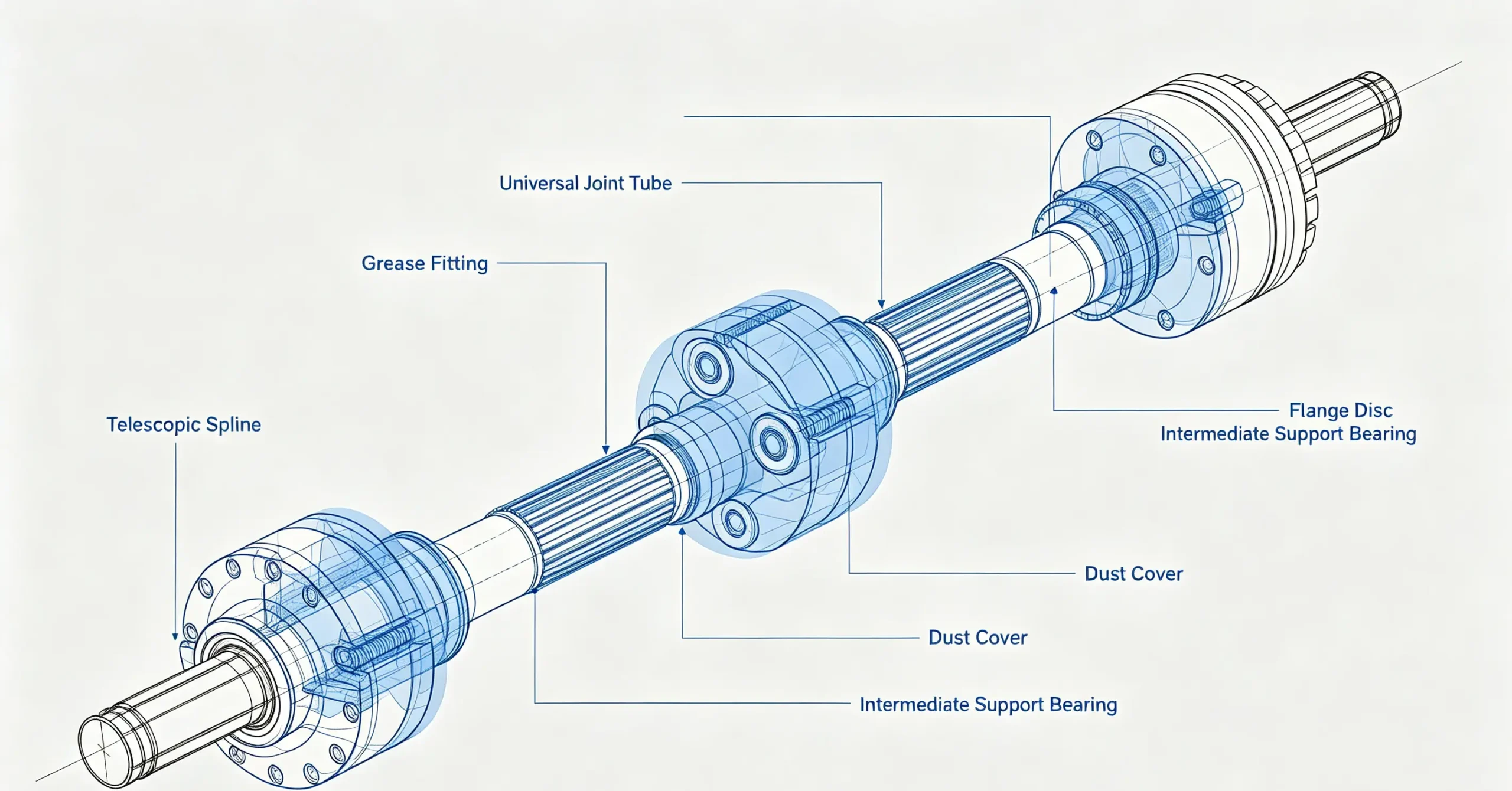
Core Structure of Truck Transmission Shaft (Full Component Breakdown)
A complete heavy-duty truck transmission shaft assembly is composed of multiple core accessories. Each part has independent functions and mutual coordination relationships. Any accessory wear or deformation will affect the overall working state of the shaft.
1. Transmission Shaft Tube
The shaft tube is the main body of the transmission shaft. Heavy trucks mostly use high-strength seamless steel tubes. The wall thickness is strictly designed according to the vehicle load standard. Its main function is to bear torsion and transmit power.
During long-term heavy-load operation, the shaft tube may have micro-torsion deformation. Slight deformation will cause high-speed jitter, and severe deformation will directly lead to shaft breakage and power interruption.
2. Universal Joint (U-Joint)
The universal joint is the most flexible core component of the transmission shaft. It is installed at both ends of the shaft tube. Its function is to solve the power transmission problem under variable angles.
When the truck passes bumpy roads or the suspension travels up and down, the relative angle between the gearbox and the drive axle will change. The universal joint can rotate freely at multiple angles to ensure uninterrupted power transmission.
Universal joint wear is the highest-frequency failure point of transmission shafts. Once the internal needle bearing is worn, gaps will appear, causing abnormal noise and vibration during operation.
3. Telescopic Sleeve & Spline Shaft
The telescopic spline structure is generally installed at the front end of the transmission shaft. It can freely stretch and adjust the overall length of the shaft according to chassis jitter and displacement changes.
When the truck accelerates, brakes or passes uneven roads, the wheelbase and chassis spacing will change slightly. The spline sleeve can effectively buffer length changes and avoid shaft bending or jamming.
4. Intermediate Support Bearing & Hanger
Long-wheelbase heavy trucks use double-section transmission shafts, which must be equipped with intermediate support bearings. The hanger fixes the bearing on the chassis beam to support the middle shaft body.
The intermediate bearing bears the weight of the shaft body and eliminates high-speed swing amplitude. Its operating stability directly determines whether the transmission shaft runs smoothly. For related maintenance knowledge, you can refer to truck transmission bearing replacement guide to master standard detection methods.
5. Flange Disc & Connecting Bolts
Flange discs are used for shaft end connection and fixation. They connect the transmission shaft with the gearbox output flange and drive axle input flange respectively. High-strength anti-loosening bolts ensure overall connection rigidity.
Loose flange bolts are one of the common hidden dangers in daily use. Slight looseness will cause eccentric operation of the shaft body and accelerate overall wear.
6. Dust Cover & Grease Fitting
The dust cover protects the internal universal joint and spline structure from dust, sediment and rain erosion. The grease fitting is used for regular grease injection lubrication to reduce metal friction.
Many early transmission shaft failures are caused by damaged dust covers and lost lubricating grease, which is easily overlooked in daily maintenance.
How Does a Truck Transmission Shaft Work? Complete Working Principle
The working process of the transmission shaft runs through the entire power transmission chain of the truck. Its working logic is simple but precise. It cooperates with the engine, clutch, gearbox and drive axle to complete power output.
The complete power transmission sequence is: engine power output → clutch power separation and combination → gearbox torque conversion and gear adjustment → transmission shaft power transmission → drive axle deceleration and torque increase → wheel driving.
In this whole set of processes, the transmission shaft undertakes the most critical intermediate transmission link. It needs to ensure that power is not lost during transmission, and adapt to various complex working condition changes.
Step 1: Receive Power From Transmission Gearbox
After the driver shifts gears and releases the clutch, the gearbox completes gear meshing and torque conversion. The output flange starts to rotate and transmits power to the front flange of the transmission shaft.
At this stage, the spline sleeve of the transmission shaft automatically fine-tunes the length according to the vehicle’s slight displacement to ensure tight connection without jamming.
Step 2: Flexible Power Transmission Through Universal Joint
During driving, the chassis is always in a vibrating state. The angle between the front and rear ends of the transmission shaft changes in real time. The universal joint flexibly adjusts the rotation angle to ensure that the shaft body maintains stable torsion transmission.
Without universal joint angle compensation, the rigid shaft body will bear huge bending force, which will be instantly damaged during driving.
Step 3: Stable Support From Intermediate Bearing
For double-section transmission shafts, the intermediate support bearing keeps the middle shaft body balanced. It avoids excessive swing amplitude during high-speed rotation and suppresses vibration resonance.
Once the intermediate bearing is worn and loose, the shaft body will swing irregularly, causing obvious chassis jitter at medium and high speeds.
Step 4: Transmit Power to Drive Axle
After stable transmission, the power is transmitted to the rear drive axle through the rear flange of the transmission shaft. The drive axle reduces speed and increases torque, and finally drives the wheels to rotate.
The entire working process is continuous and synchronous. The transmission shaft always maintains high-speed rotating operation during vehicle driving, so the wear loss is higher than other static parts.
Common Classification of Truck Transmission Shafts
According to different truck wheelbases, load capacities and chassis layouts, transmission shafts are divided into multiple types. Different structures have different working characteristics and failure probabilities.
1. Single-Section Transmission Shaft
Suitable for short-wheelbase light and medium trucks. The overall structure is simple, with low failure rate and strong rigidity. It is mostly used for urban distribution and light cargo transportation vehicles.
2. Double-Section Transmission Shaft
The most widely used structure for heavy-duty trucks. It adopts front and rear segmented design with intermediate support bearings. It is suitable for long-wheelbase logistics trucks and engineering vehicles, with stronger vibration resistance and stability.
3. Multi-Section Combined Transmission Shaft
Used for super long wheelbase special engineering vehicles. The structure is complex, with multiple universal joints and supports. It can adapt to extreme chassis angle changes and complex road driving.
4. Constant Velocity Transmission Shaft
High-end improved shaft body. It adopts constant velocity universal joint design, with more uniform rotation speed and smaller vibration. It is mostly used for high-speed logistics heavy trucks.
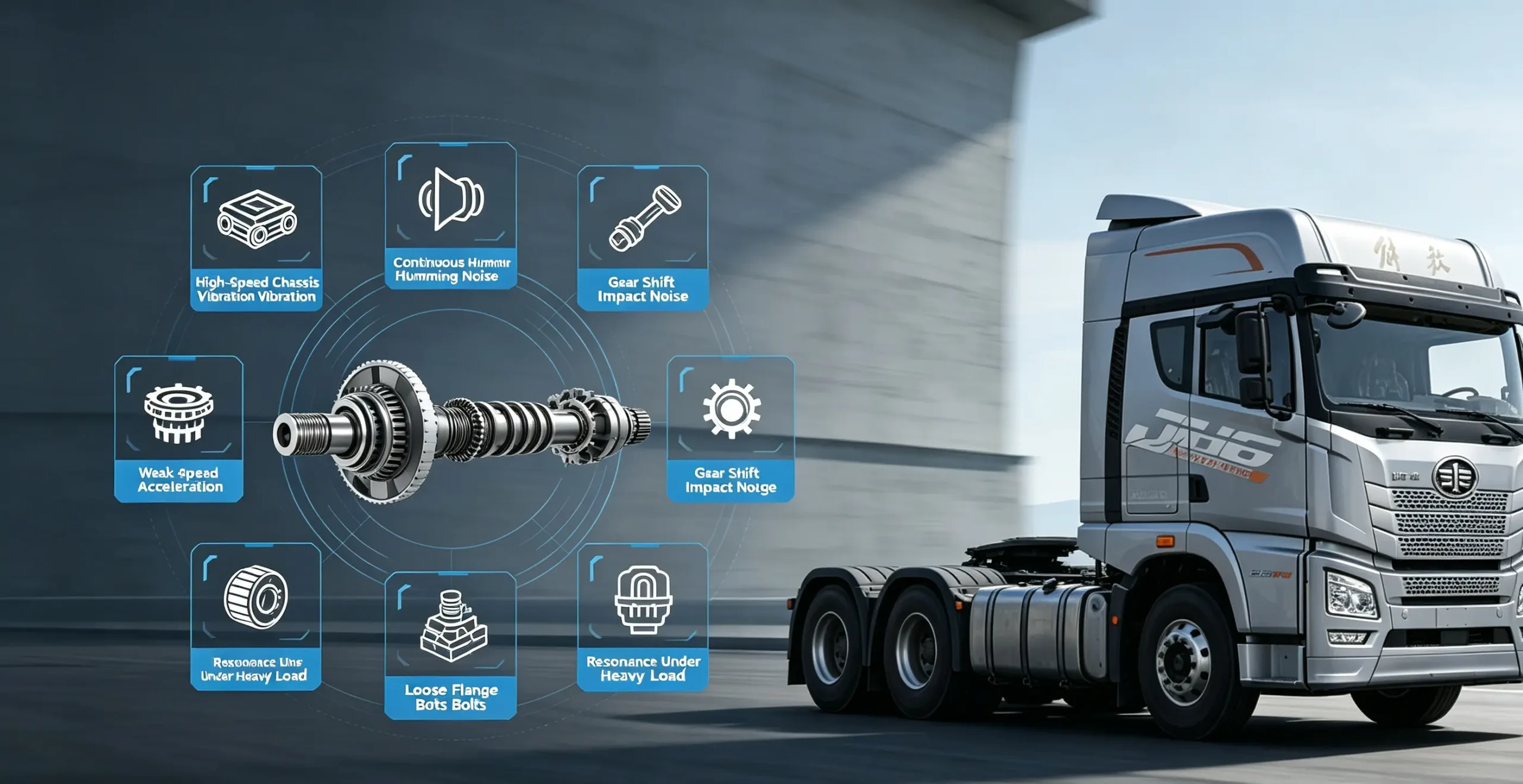
8 High-Frequency Symptoms of Abnormal Transmission Shaft Operation
Transmission shaft failure has obvious early warning signals. Most abnormal states will be reflected in driving feel, chassis noise and body vibration. Timely capture of these symptoms can avoid major breakdowns.
1. Chassis Vibration at Medium and High Speed
This is the most typical fault of transmission shaft imbalance. When the vehicle speed reaches 60-80km/h, the body and gear lever jitter obviously. The vibration weakens after reducing speed.
This problem is mostly caused by shaft body deformation, unbalanced weight loss or universal joint gap enlargement.
2. Continuous Chassis Humming Noise
During driving, there is a stable low humming sound at the chassis position. The noise changes with vehicle speed but not with gear position.
It is mainly caused by lack of lubricating grease, worn intermediate bearings or stuck universal joint rotation. It is similar to gearbox bearing noise, but the sound source is lower in position. You can distinguish it through truck gearbox noise diagnosis methods.
3. Obvious Impact Noise When Shifting Gears
When shifting gears or releasing the throttle suddenly, there is a clear “clunk” impact sound at the chassis.
This indicates excessive gaps in universal joints or spline structures. The power transmission has idle travel, resulting in instantaneous impact.
4. Weak Acceleration & Disjointed Power
The engine speed rises rapidly, but the vehicle speed increases slowly. The power output is not linear, and there is a feeling of power disjointment.
It is caused by excessive wear of spline teeth, resulting in power slipping during transmission.
5. Grease Leakage & Dust Cover Damage
Obvious grease splashing can be seen around the transmission shaft universal joint and spline. The dust cover is cracked and deformed.
Grease leakage will cause accelerated dry friction of internal parts and is the main inducement of early wear.
6. Deviated Shaft Body & Eccentric Rotation
Visually observe the rotating state of the transmission shaft. The shaft body swings up and down obviously, and the rotation is not concentric.
Long-term overload and bumpy road driving are the main causes of shaft body bending deformation.
7. Loose Flange Bolts
The connecting bolts at both ends of the shaft body are loose or missing. Local rust and vibration marks appear on the flange connection surface.
8. Resonance When Climbing Under Heavy Load
When climbing with full load, the chassis resonates strongly, and the vehicle body shakes violently. This is caused by insufficient torsion resistance of the aging transmission shaft.
Root Causes of Early Transmission Shaft Failure
Most transmission shafts have a designed service life of 3-5 years. Early failure within 1-2 years is basically caused by improper use and maintenance, not product quality problems.
1. Long-Term Overload Driving
Overload makes the transmission shaft bear far more torsion than the design standard. Long-term extreme torsion will cause metal fatigue, micro-deformation and gap enlargement.
2. Lack of Regular Lubrication Maintenance
Many fleets ignore transmission shaft grease injection work. Long-term lack of lubrication leads to dry friction of universal joints and bearings, resulting in rapid wear.
3. Fierce Driving Habits
Sudden acceleration, sudden braking and violent gear shifting will produce instantaneous impact torque on the transmission shaft. Repeated impact will loosen the internal matching gap.
4. Long-Term Driving on Bumpy Roads
Continuous chassis jitter will cause fatigue deformation of the shaft body and looseness of intermediate supports. Dust and sediment easily invade the interior to accelerate wear.
5. Substandard Aftermarket Accessories
Low-cost universal joints, bearings and shaft bodies have unqualified precision and material hardness. They cannot adapt to heavy-load working conditions and are prone to rapid failure.
6. Inaccurate Installation Angle
After gearbox or suspension maintenance, the installation height and angle change. The transmission shaft runs in a biased state for a long time, causing eccentric wear.
Practical Transmission Shaft Fault Diagnosis Methods (No Professional Equipment)
Daily fault inspection of transmission shafts does not require professional testing instruments. Drivers and maintenance personnel can complete accurate judgment through visual inspection, manual shaking and road tests.
Step 1: Static Manual Inspection
Park the vehicle on flat ground, turn off the engine, and shake the transmission shaft up, down, left and right by hand. If there is obvious shaking gap and abnormal jamming, it indicates universal joint or bearing wear.
Check whether the dust cover is damaged, whether there is grease leakage, and whether the flange bolts are loose.
Step 2: Dynamic Idling Test
Start the engine, hang in neutral gear and accelerate slightly. Listen to the chassis operating sound. Continuous low-frequency noise is a typical sign of abnormal transmission shaft operation.
Step 3: Road Speed Test
Test drive at different speed intervals of 40km/h, 60km/h and 80km/h. Judge whether the vibration is synchronized with the vehicle speed to confirm shaft balance failure.
Step 4: Load Climbing Test
Carry normal load for climbing test. If power transmission is lagging and chassis resonates obviously, it proves that the transmission shaft torsion resistance is insufficient or internal gaps are excessive.
Standard Transmission Shaft Disassembly & Maintenance Process
When the transmission shaft has obvious failure symptoms, standardized disassembly and maintenance must be carried out in time to avoid sudden breakdown on the road.
Step 1: Vehicle Fixing & Safety Protection
Park the truck on a flat hard ground, tighten the handbrake, pad the wheels, turn off the engine and cut off the power to ensure safe operation.
Step 2: Clean Surface Dust & Oil Dirt
Thoroughly clean the dust, sediment and oil dirt on the surface of the transmission shaft to prevent foreign matter from entering the universal joint and spline during disassembly.
Step 3: Mark Flange Position
Mark the front and rear flange connection positions to ensure original-position installation during reassembly and avoid balance deviation caused by dislocation.
Step 4: Remove Connecting Bolts
Loosen the flange fixing bolts at both ends in diagonal order. Remove the intermediate support fixing bolts and slowly take out the entire transmission shaft assembly.
Step 5: Split Components & Inspect Wear
Disassemble the universal joint, intermediate bearing and spline sleeve in turn. Check for wear, gap, deformation and grease deterioration.
Step 6: Replace Worn Accessories & Refill Grease
Replace severely worn universal joints and bearings. Clean the internal parts and refill high-temperature resistant lithium-based grease.
Step 7: Reassemble & Calibrate Balance
Reassemble all accessories in reverse order. Install according to the original marking position. Tighten the bolts with standard torque to ensure overall balance.
Step 8: Road Test Verification
After assembly, test drive at low speed first, then gradually increase the speed. Check for abnormal noise and vibration to confirm no hidden faults.
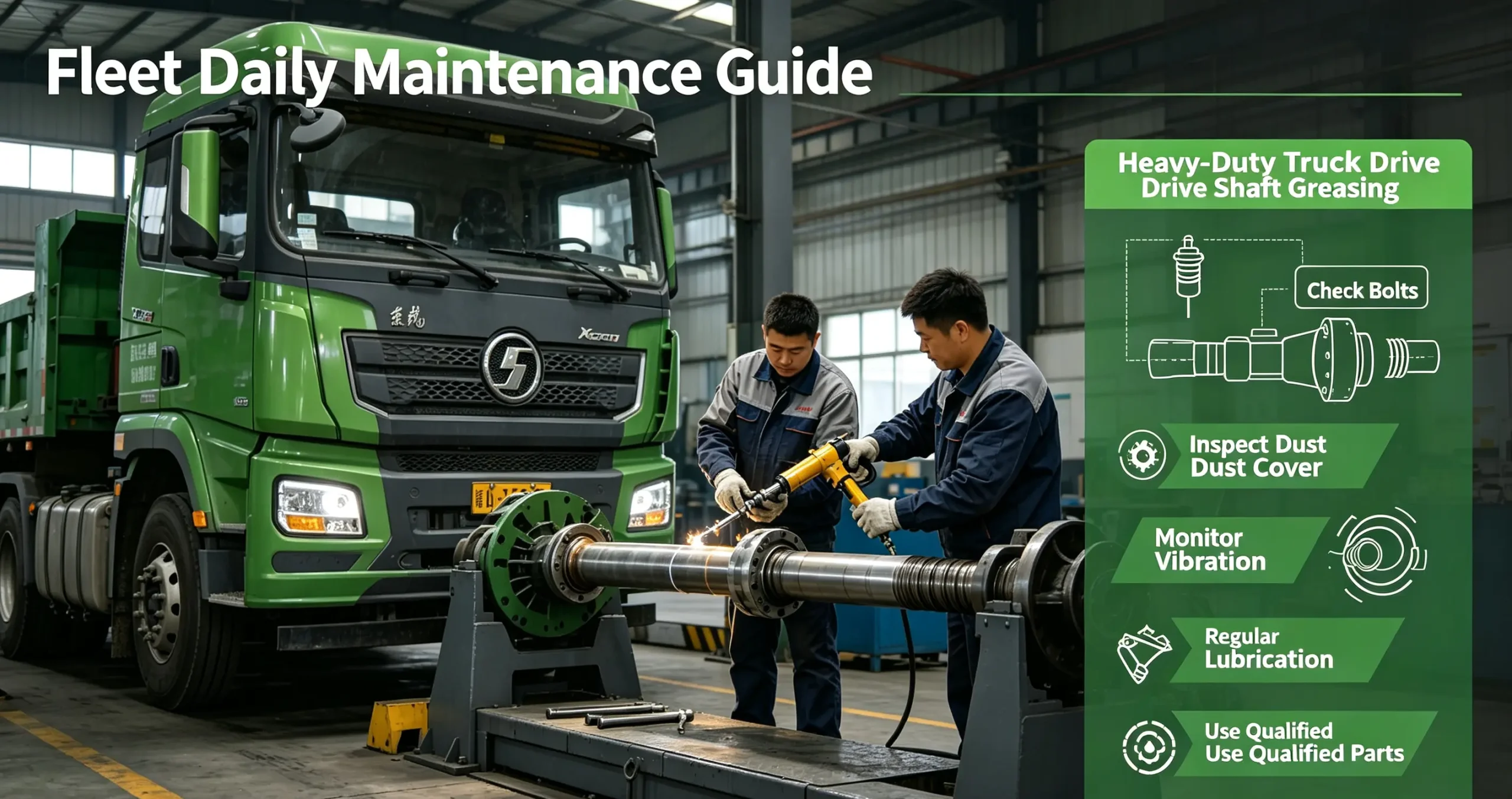
Daily Maintenance Tips to Extend Transmission Shaft Service Life
Scientific daily maintenance can double the service life of the transmission shaft assembly and greatly reduce the failure rate of chassis power parts.
-
Regular grease injection: Inject special high-temperature grease every 10,000 kilometers to ensure sufficient lubrication of universal joints and bearings.
-
Avoid long-term overload: Strictly control cargo weight to prevent the shaft body from bearing excessive torsion load for a long time.
-
Improve driving habits: Avoid sudden acceleration, sudden braking and violent shifting to reduce instantaneous impact on the shaft body.
-
Regular bolt inspection: Check flange and support bolts every month to prevent looseness and missing parts.
-
Timely replace damaged dust covers: Once the dust cover is cracked, replace it immediately to prevent dust and water from entering internal parts.
-
Match qualified supporting parts: When replacing worn parts, choose genuine standard accessories. For supporting drive axle parts, you can select reliable truck drive axle parts to ensure matching accuracy.
Frequently Asked Questions About Truck Transmission Shaft
Q: Is transmission shaft vibration harmful to the truck?
A: Yes. Long-term vibration will aggravate gearbox and drive axle bearing wear, cause chassis bolt looseness, and even lead to shaft breakage in severe cases.
Q: How long is the service life of a heavy truck transmission shaft?
A: With standard load and regular maintenance, it can be used stably for 4-5 years. Overload and lack of lubrication will shorten the service life to 1-2 years.
Q: Can I continue driving with a noisy transmission shaft?
A: It is not recommended. Noise is an early warning of wear. Long-term driving will expand the fault and cause higher maintenance costs.
Q: What is the difference between transmission shaft fault and gearbox fault?
A: Transmission shaft noise and vibration are synchronized with vehicle speed, while gearbox faults are mostly related to gear shifting. You can view truck clutch working principle to further distinguish power system faults.
Conclusion
The truck transmission shaft is an inconspicuous but indispensable core component in the power transmission system. Its working stability directly determines the truck’s driving safety, power performance and transportation efficiency.
Most transmission shaft failures are caused by accumulated minor problems such as insufficient lubrication, bad driving habits and neglected daily inspection. As long as drivers master basic working principles and fault judgment methods, most hidden dangers can be eliminated in advance.
Standardized use and maintenance can effectively extend the service life of the transmission shaft, reduce fleet downtime and maintenance costs, and create higher economic benefits for long-term transportation operations.
If you need high-quality transmission shaft assemblies and supporting chassis accessories, Mettlead Truck Parts provides full-series heavy-duty truck accessories that perfectly match Sinotruk, Shacman, FAW, Dongfeng and other mainstream models, helping fleets operate stably for a long time.


