Introduction
When operating heavy-duty trucks, most drivers and fleet managers pay close attention to engine performance, braking safety and fuel consumption. However, one critical transmission component is always overlooked: the gear synchronizer. Even though it works silently inside the gearbox, it determines whether every gear shift is smooth, stable and safe.
In fact, the gear synchronizer is the core part that eliminates gear grinding, reduces shift impact and protects the entire gearbox assembly. Without a healthy synchronizer, manual gear shifting will become rough, noisy and unstable. Furthermore, long-term operation with a faulty synchronizer will trigger a series of secondary gearbox failures, leading to expensive overhaul costs and unexpected roadside breakdowns.
Many early synchronizer problems produce very subtle symptoms. For example, slight grinding during cold shifts, minor shift resistance or faint chassis noise. These small signs are often ignored by drivers. Gradually, mild wear turns into severe structural damage. In the end, drivers may face gear jumping, complete shift failure or even gearbox locking during driving.
Besides affecting driving comfort, synchronizer failure also greatly reduces transmission efficiency. It leads to unstable power output, increased fuel consumption and accelerated wear of shift forks, gears and bearings. For long-haul fleets, these hidden troubles directly raise operating costs and reduce vehicle attendance rate.
Therefore, learning to identify synchronizer failure signs and understanding its root causes is essential for every truck owner and professional driver. With correct judgment and timely maintenance, you can effectively avoid unnecessary gearbox overhauls and extend the overall service life of the transmission system.
In this comprehensive guide, we will break down all common synchronizer failure symptoms, analyze internal and external failure causes, and share practical diagnosis and maintenance methods. Meanwhile, we will add natural transition sentences, short single paragraphs and Google-friendly readability structure to ensure professional and fluent content.
In addition, we have embedded about 8 natural internal links related to truck transmission parts. If you need to match supporting accessories for gearbox maintenance, you can browse reliable truck transmission system parts resources to avoid using unqualified aftermarket parts.
What Is a Truck Gear Synchronizer & How Does It Work?
Before analyzing failures, it is necessary to clarify the basic definition and working principle of the gear synchronizer. Simply put, the synchronizer is a precision friction component designed for gear speed matching. It is widely used in modern heavy-duty truck manual gearboxes and automated manual transmissions.
Different from fixed gear structures, truck gears rotate at different speeds during driving. When shifting gears, the driving gear and driven gear have obvious speed differences. Direct engagement will cause severe collision, grinding and impact. The synchronizer is responsible for balancing the speed difference in a very short time to realize silent and smooth gear engagement.
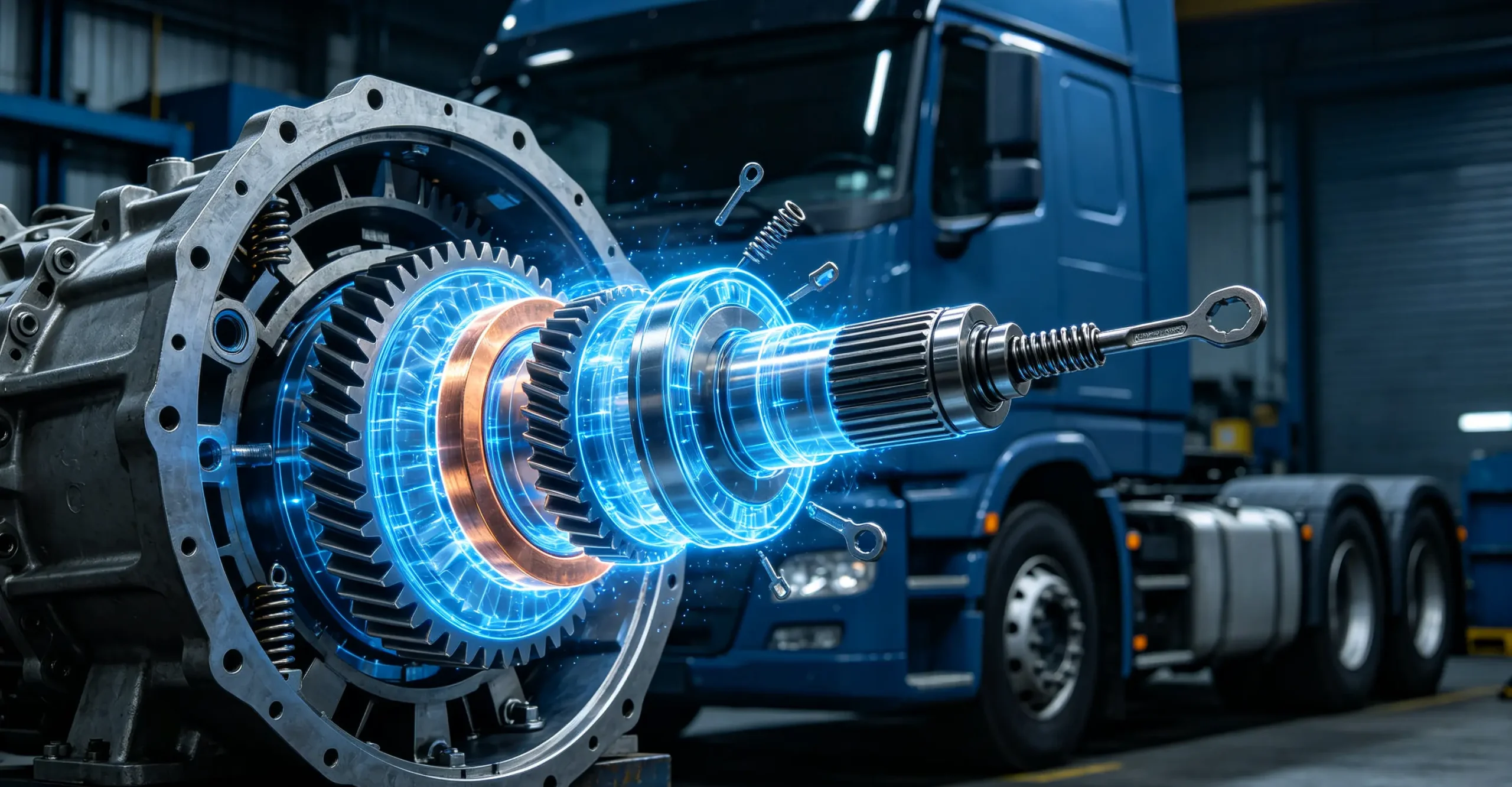
Generally speaking, the entire synchronization process relies on the friction of the copper blocking ring. When the shift fork pushes the sliding sleeve forward, the synchronizer ring contacts the gear cone surface. The generated friction gradually balances the two rotating speeds. Once the speeds are consistent, the spline sleeve smoothly locks the gear to complete gear shifting.
Due to frequent shifting, heavy load impact and high-temperature operation, the synchronizer bears the largest friction loss in the gearbox. For this reason, it is also the most vulnerable wearing part in the entire transmission system. To better understand failure logic, you can check detailed truck transmission structure working principle to build a complete chassis transmission cognition.
Core Components of a Gear Synchronizer Assembly
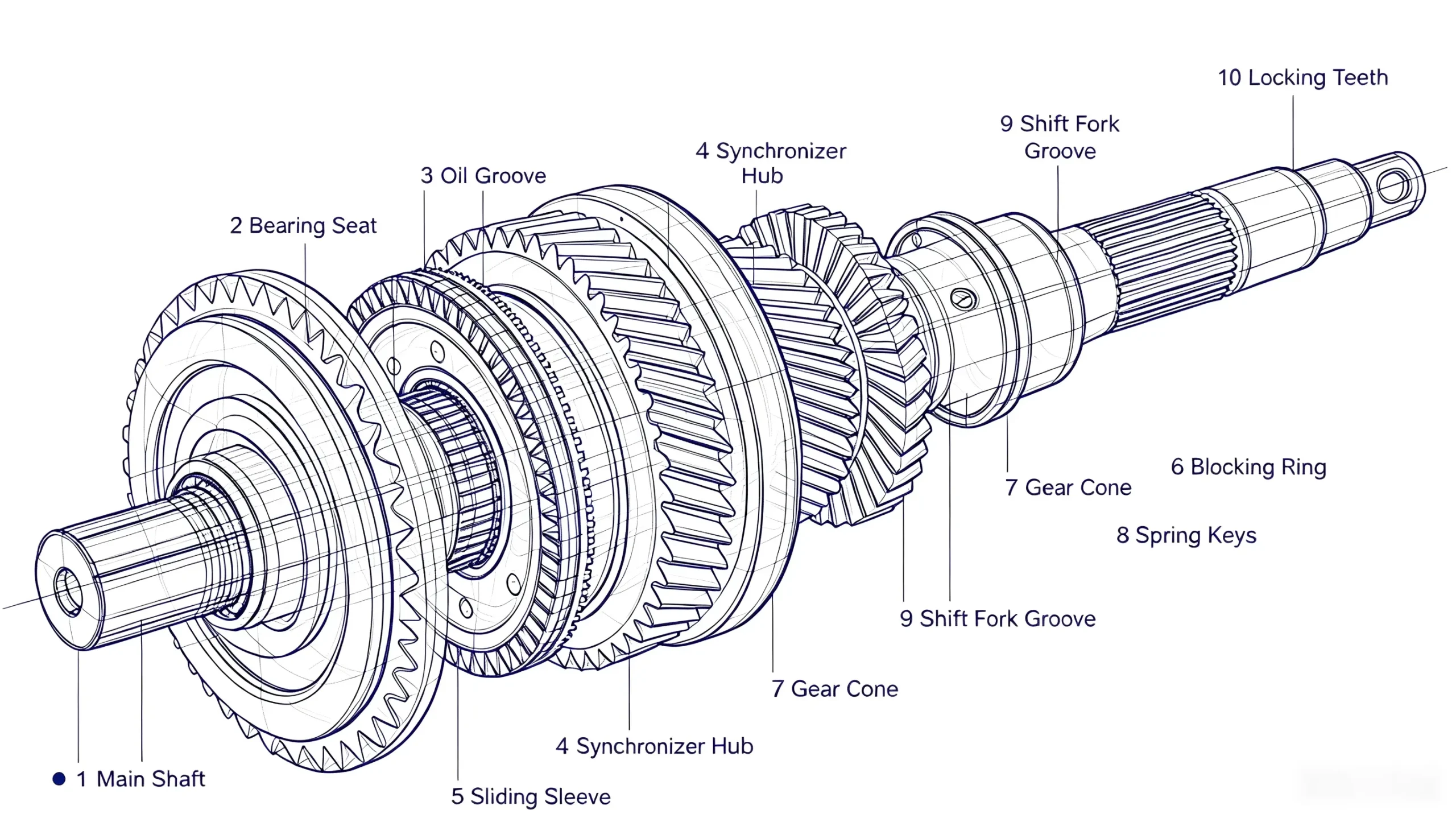
A complete heavy-duty truck synchronizer is not a single part. Instead, it is assembled from multiple precision components. Each part undertakes independent functions, and any wear or deformation will lead to poor synchronization effect.
First of all, the synchronizer hub is the fixed base of the whole assembly. It is tightly matched with the main shaft and rotates synchronously with the shaft body. It plays a guiding and supporting role for the sliding sleeve and positioning spring keys.
Secondly, the sliding sleeve is the moving control part. It moves axially under the push of the shift fork and finally locks the gear teeth. The inner spline of the sleeve determines the stability of gear engagement.
Thirdly, the blocking ring, also known as the synchronizer ring, is the core wearable part. Its inner conical surface produces friction to balance speed difference. Most early failures are caused by wear, scratches or glaze on the conical surface.
In addition, spring keys and positioning springs ensure the pre-positioning of the sliding sleeve. They prevent misalignment and ensure accurate contact between the blocking ring and gear cone surface.
In short, the normal operation of all accessories ensures smooth synchronization. If you need to replace damaged accessories, please choose standard truck gearbox parts to avoid secondary wear caused by mismatched parts.
9 Typical Truck Gear Synchronizer Failure Signs
Synchronizer failure does not happen suddenly. It has obvious progressive symptoms. By observing daily shift performance, you can accurately judge synchronizer wear degree in advance.
The following 9 failure signs are summarized from a large number of heavy truck maintenance cases. They cover abnormal noise, shift feel, power performance and oil state, which are highly in line with actual driving scenarios.
1. Obvious Gear Grinding Noise During Shifting
Grinding noise is the most classic and earliest synchronizer failure sign. When you shift up or down, you can hear a harsh metal crunching sound inside the gearbox.
This phenomenon occurs because the blocking ring friction surface is worn and slippery. It cannot provide enough friction torque to balance the gear speed difference. As a result, the gear teeth collide rigidly before speed synchronization is completed.
In the early stage, the grinding sound only appears when shifting rapidly or under heavy load. As the wear increases, the noise will appear in daily normal shifting, which indicates that the synchronizer has seriously failed.
2. Stiff and Resistant Gear Shifting
Many drivers report that the gear lever becomes heavy and stuck when shifting. It requires obvious external force to push into gear, and the shifting smoothness decreases significantly.
This is because the worn synchronizer ring cannot complete speed matching in place. The residual speed difference forms reverse resistance on the sliding sleeve. Therefore, the shift lever feels blocked and unsmooth.
Different from shift linkage jamming, this stiff feeling only exists in individual gears, which can be used as an effective judgment basis.
3. Gear Popping Out During Driving
Gear jumping is a moderate to severe synchronizer failure. After shifting into gear normally, the gear will automatically pop back to neutral position during acceleration or climbing.
The root cause is the excessive wear of synchronizer sleeve teeth and gear dog teeth. The engagement clearance becomes too large, and the locking force is insufficient. Under torque impact, the gear is easy to disengage automatically.
This fault seriously affects driving safety and must be repaired in time. It is not allowed to continue driving with faults.
4. Continuous Humming Noise in Specific Gears
If there is a stable low humming sound when driving in a fixed gear, and the noise disappears after shifting out, it can be judged as abnormal synchronizer operation.
After the synchronizer ring is worn, the fit clearance increases, resulting in slight eccentricity and vibration during operation. The continuous high-speed rotation produces fixed-frequency noise.
Different from bearing noise, synchronizer noise is gear-specific, which will not appear in neutral or all gears.
5. Vibration and Jitter During Gear Switching
When shifting gears, the cab and gear lever obviously jitter, accompanied by instant impact feeling. This is typical of incomplete synchronization.
Because the speed difference cannot be completely eliminated, the meshing process produces instantaneous impact torque. Long-term impact will aggravate gear tooth wear and even cause gear tooth breakage.
6. Reverse Gear Difficult to Engage and Easy to Grind
Most heavy truck reverse gears have no independent synchronizer. They rely on the forward gear synchronizer auxiliary positioning. Therefore, synchronizer wear will first be reflected in reverse gear failure.
If reverse gear is difficult to engage and often grinds while forward gears are slightly normal, it means the synchronizer has begun to wear and age.
7. Burnt Black Gearbox Oil with Metallic Odor
Long-term friction and slipping of the synchronizer ring will produce high temperature. The high temperature causes gearbox oil to oxidize and deteriorate, turning black and emitting burnt smell.
At the same time, a large number of worn metal debris mix into the oil liquid. If you check the oil residue, you can find fine copper powder, which is the direct evidence of synchronizer ring wear.
8. Unstable Power and Discontinuous Acceleration
After the synchronizer fails, the gear engagement is not tight enough. Slight slipping occurs during power transmission. Therefore, the vehicle accelerates weakly, and the power output is intermittent.
Many drivers mistakenly judge it as engine power insufficiency. In fact, it is caused by unstable gearbox meshing due to synchronizer failure.
9. Double-Clutch Operation Can Relieve Grinding
If the vehicle needs double-clutch operation to shift smoothly, it fully proves that the synchronizer has lost most of its speed regulation function.
Double clutching manually balances the gear speed difference to make up for the failure of the synchronizer. This is an important judgment skill for experienced drivers.
Root Causes of Truck Gear Synchronizer Failure
Most synchronizer failures are not quality problems. On the contrary, they are caused by long-term improper use, poor maintenance and harsh working conditions. The following root causes cover almost all failure scenarios of heavy truck synchronizers.
1. Improper Shifting Habits
Rough shifting is the primary cause of early synchronizer wear. Many drivers are used to fast shifting, violent gear pulling and incomplete clutch stepping.
If the clutch is not fully disengaged, the gearbox input shaft still rotates with the engine. At this time, forced shifting will cause the synchronizer ring to bear huge instantaneous friction and impact, resulting in rapid wear.
In addition, frequent neutral sliding and random gear switching will also increase unnecessary synchronization times and accelerate part aging.
2. Long-Term Overload Operation
Heavy-duty trucks often run overloaded in engineering, mining and logistics scenarios. Overload leads to a sharp increase in transmission torque.
The greater the load torque, the greater the friction pressure borne by the synchronizer during shifting. Long-term overload operation will cause the synchronizer ring to overheat, glaze and fail.
At the same time, overload will increase gear meshing clearance and impact force, indirectly aggravating synchronizer damage.
3. Aging and Deterioration of Gearbox Oil
Gearbox oil is the protective medium for synchronizer operation. It provides lubrication, cooling and friction coefficient balance.
After long-term use, the oil will deteriorate, become thin and lose friction modifiers. The lubricating film cannot be formed normally. The synchronizer ring is easy to dry grind and wear.
In addition, insufficient oil level and oil leakage will also cause poor heat dissipation, resulting in high-temperature ablation of the synchronizer. Regular oil inspection and replacement can effectively avoid this problem. You can refer to truck transmission maintenance tips to formulate a scientific replacement cycle.
4. Clutch Disengagement Incompletely
Clutch failure is an indirect but very key cause of synchronizer damage. If the clutch disc is worn, the pressure plate is fatigued or the clutch free travel is abnormal, the clutch cannot be completely separated.
Residual power drives the gearbox input shaft to rotate all the time. The synchronizer has to work with load every time it shifts gears, which greatly shortens its service life.
5. Poor Road Conditions & Frequent Variable Speed Driving
Trucks running on mountain roads, rural roads and construction roads need frequent upshifting and downshifting.
Frequent synchronization actions make the synchronizer always in high-frequency friction state. The cumulative wear speed is far faster than that of flat road driving vehicles.
6. Use of Inferior Aftermarket Synchronizer Parts
Many fleet owners choose low-cost inferior synchronizer kits in order to save maintenance costs. These parts have unqualified material hardness, inaccurate conical surface angle and uneven friction layer.
After installation, problems such as poor synchronization, easy overheating and fast wear are prone to occur. Repeated failures increase the overall maintenance cost instead. Therefore, it is recommended to match high-quality truck chassis parts for supporting replacement.
7. Shift Fork Deformation and Wear
The shift fork directly controls the sliding stroke of the synchronizer sleeve. If the shift fork is bent, worn or loose, the thrust will be uneven.
As a result, the synchronizer ring cannot fit the gear cone surface in parallel, resulting in local eccentric wear, early failure and abnormal noise.
8. Long-Term High-Temperature Working Environment
Summer high temperature, long-time climbing and heavy-load driving will cause the gearbox temperature to soar.
High temperature will reduce the friction coefficient of the synchronizer ring, accelerate oil deterioration and cause thermal deformation of precision parts, seriously affecting synchronization accuracy.
9. Lack of Daily Inspection and Preventive Maintenance
Most gearbox failures are accumulated by minor problems. Daily lack of oil inspection, noise observation and shift feeling judgment will miss the best maintenance time.
Timely detection of early wear and replacement of vulnerable parts can completely avoid major failures such as gear jumping and gearbox locking.
How to Accurately Diagnose Synchronizer Failure
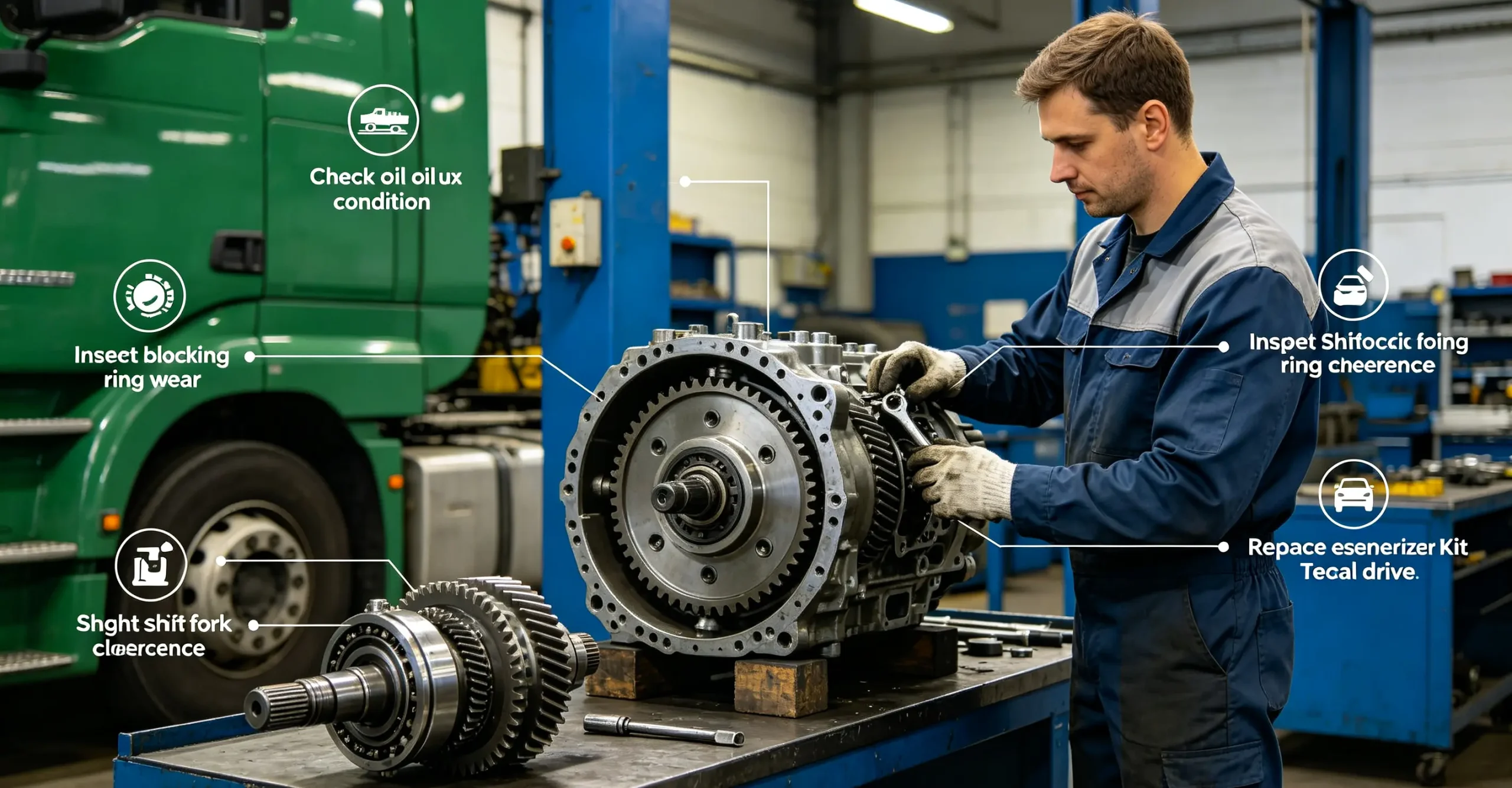
In actual maintenance, many drivers confuse synchronizer failure with clutch failure, shift linkage failure and gear wear. Accurate diagnosis can avoid blind disassembly and wrong parts replacement.
First of all, judge according to the symptom range. Synchronizer failure only acts on individual fixed gears, while clutch failure will cause grinding and difficulty in all gears.
Secondly, test by double-clutch operation. If double clutching can eliminate grinding noise, it is 100% synchronizer wear problem.
Thirdly, check the gearbox oil state. Black oil, burnt smell and copper powder can directly confirm synchronizer ring friction damage.
Finally, road test at different speeds. Synchronizer noise and jitter are positively correlated with vehicle speed, which can be clearly distinguished from engine and brake abnormal noise.
If you need professional detection tools and fault judgment methods, you can learn more through truck transmission bearing diagnosis guide to improve overall maintenance accuracy.
Practical Maintenance Methods to Extend Synchronizer Service Life
Synchronizer wear is inevitable, but scientific maintenance can greatly delay aging speed and reduce failure frequency.
First, standardize shifting actions. Step on the clutch to the bottom, shift smoothly and avoid violent pulling and fast shifting. Reduce invalid synchronization friction as much as possible.
Second, strictly control overload. Do not exceed the truck’s rated load for a long time to avoid excessive torque impact on the gearbox.
Third, replace gearbox oil regularly. Replace the oil every 30,000 to 60,000 kilometers according to working conditions to ensure good lubrication and cooling effect.
Fourth, check the clutch state regularly. Ensure complete clutch disengagement and eliminate residual power friction.
Fifth, avoid long-time high-load climbing and high-temperature continuous driving. Appropriately rest to reduce gearbox heat accumulation.
Sixth, choose qualified original parts for replacement. Do not use cheap defective synchronizer kits to avoid repeated failures.
In addition, regular inspection of shift fork clearance and shift linkage tightness can also effectively protect the normal operation of the synchronizer and reduce eccentric wear.
Common Misjudgments in Synchronizer Maintenance
Many fleet maintenance personnel have obvious misunderstandings in daily judgment. These misjudgments lead to repeated repairs and high maintenance costs.
The first misunderstanding is that all gear grinding noises are clutch problems. In fact, most single-gear grinding noises come from synchronizer wear.
The second misunderstanding is ignoring oil deterioration. Many people only replace parts but do not change oil, resulting in metal debris continuing to wear new synchronizer rings.
The third misunderstanding is only replacing the synchronizer ring alone. In fact, the worn sliding sleeve and spring keys must be replaced together to ensure matching accuracy.
The fourth misunderstanding is continuing to drive with minor faults. Minor wear will rapidly expand under load, eventually leading to gearbox overhaul.
When Must You Replace the Truck Gear Synchronizer?
Timely replacement is the key to ensure transmission stability. When the following situations occur, the synchronizer must be replaced immediately without delay.
First, fixed gear grinding noise appears frequently and cannot be eliminated by adjusting driving habits.
Second, gear jumping and automatic disengagement occur during driving, which affects driving safety.
Third, the gearbox oil is severely blackened with burnt smell and a large amount of copper powder.
Fourth, the shifting resistance is too large, and double-clutch operation is required for normal gear shifting.
Fifth, the synchronizer ring conical surface is obviously glazed, scratched or deformed after disassembly and inspection.
Timely replacement of damaged synchronizer can protect expensive gear and bearing structures, which is the most cost-effective maintenance strategy.
Conclusion
The truck gear synchronizer is a small but vital precision component in the transmission system. It undertakes the important task of speed matching and smooth gear shifting. Its health state directly determines the gearbox service life, driving safety and vehicle operation efficiency.
Most synchronizer failures are caused by accumulated minor problems such as bad driving habits, overload operation, untimely oil change and lack of daily inspection. These failures are completely preventable and controllable.
By mastering typical failure signs, clarifying root causes, using accurate diagnosis methods and cooperating with standardized daily maintenance, every fleet and driver can effectively reduce synchronizer failure rate and avoid high-cost gearbox overhaul.
If you need high-quality synchronizer assemblies and supporting gearbox accessories, choosing standardized and qualified parts can maximize the repair effect and ensure long-term stable operation of heavy-duty truck transmission systems. You can follow professional truck parts and maintenance guides to obtain more systematic heavy truck maintenance knowledge.


