
Cut fleet downtime & TCO: expert guide to specifying heavy-duty truck suspension bushings for durability, cost-efficiency & uptime.
A comprehensive technical resource for fleet managers, procurement leaders, and OEM decision-makers evaluating suspension bushing solutions for durability, cost-efficiency, and operational uptime.
Every heavy-duty truck rolling down the highway relies on dozens of small rubber and polyurethane components you rarely think about. Yet these unassuming parts quietly determine whether your fleet stays profitable or bleeds money through unexpected downtime.
This guide takes a hard look at one of the most overlooked yet strategically important elements of the chassis. Let’s start by reframing how enterprise buyers should think about them.
Introduction: Why Suspension Bushings Are a Strategic Component, Not an Afterthought
For years, procurement teams treated the humble suspension bushing as a throwaway commodity. Buy the cheapest option, install it, forget about it. That mindset costs fleets more than most managers realize.
A bushing sits at the junction where metal meets metal in your suspension. When it degrades, the effects ripple outward. Alignment drifts, tires wear unevenly, and adjacent components take on stress they were never designed to handle.
In other words, the quality of your bushing decision shapes your total cost of ownership (TCO) far beyond the sticker price of the part itself. Smart buyers recognize this early.
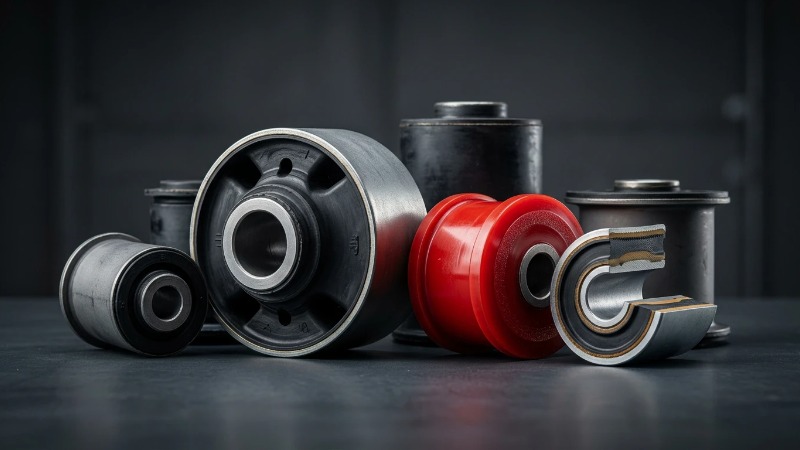
The Hidden Cost of Poor Bushing Selection
Consider what happens when a low-grade bushing fails prematurely. First, the truck comes off the road. Every hour a Class 8 vehicle sits idle represents lost revenue, and industry surveys consistently place downtime costs in the range of several hundred dollars per hour.
Then comes the cascade. A worn control arm bushing lets the suspension geometry shift. That shift accelerates tire wear, which can prematurely scrap a set of tires representing a significant portion of your maintenance budget.
Worse still, the misalignment stresses ball joints, shock mounts, and steering linkages. What began as a modest bushing problem snowballs into a multi-component repair. This is the true price of cutting corners upfront.
By contrast, a properly specified bushing protects the entire suspension ecosystem. It is one of the highest-leverage decisions in fleet maintenance planning.
Who This Guide Is For
This resource speaks directly to the people who make purchasing decisions that affect hundreds of vehicles. We designed it with several audiences in mind.
- Fleet operators seeking to reduce unplanned downtime and stabilize maintenance costs.
- Procurement managers evaluating suppliers, materials, and volume purchasing strategies.
- OEM engineers specifying components for new vehicle platforms.
- Aftermarket distributors building reliable product portfolios for their own customers.
Whether you approach bushings from an engineering angle or a spreadsheet angle, the following sections translate technical detail into business value. Let’s begin with the fundamentals.
What Is a Truck Suspension Bushing? (Core Function Explained)
At its simplest, a suspension bushing is a flexible cushion, usually cylindrical, that separates two rigid metal components. It allows controlled movement while absorbing shock and vibration.
Think of it as a shock-absorbing joint. Without it, metal would grind directly against metal, transmitting every road imperfection straight into the frame and the driver’s spine.
Despite their modest size, these components perform three critical jobs simultaneously. Understanding those jobs is the foundation of every smart purchasing decision.
The Bushing’s Job: Isolation, Compliance & Alignment
Isolation comes first. The bushing dampens vibration and road noise before it reaches the cab, protecting driver comfort and reducing fatigue on long hauls.
Compliance follows. A bushing must flex just enough to allow the suspension to articulate over bumps and through corners, yet resist excessive movement that would compromise handling.
Finally, alignment. By holding suspension components in their designed positions, the bushing maintains proper geometry under load. This keeps the tires planted correctly and the steering predictable.
Balancing these three demands is precisely why material selection and design matter so much. A bushing tuned for comfort behaves very differently from one tuned for load control.
Key Locations of Suspension Bushings on Heavy-Duty Trucks
Bushings appear throughout the chassis wherever movement must be controlled. On a typical heavy-duty truck you will find them in several primary locations.
- Control arm bushings connect the control arms to the frame and manage wheel travel.
- Leaf spring bushings sit at the eyes of the leaf spring and allow the spring to flex.
- Shackle bushings accommodate the length change of the leaf spring as it compresses.
- Sway bar (stabilizer) bushings control body roll during cornering.
Each position experiences a unique combination of forces. That is why a one-size-fits-all approach to bushing selection rarely delivers optimal results across an entire vehicle.
Diagram: Bushing Placement Across a Typical Heavy-Duty Chassis
| Bushing Type | Typical Location | Primary Function | Dominant Load Type |
|---|---|---|---|
| Control Arm Bushing | Frame-to-control-arm pivot | Controls wheel travel and geometry | Radial and torsional |
| Leaf Spring Bushing | Spring eye mounting points | Allows spring flex, absorbs vibration | Radial and axial |
| Shackle Bushing | Rear spring shackle | Accommodates spring length change | Radial |
| Sway Bar Bushing | Stabilizer bar to frame | Controls body roll | Torsional |
| Cab Mount Bushing | Cab-to-frame interface | Isolates cab from chassis vibration | Axial and radial |
This mapping helps procurement teams build accurate parts lists and avoid ordering the wrong specification. For deeper technical assistance with placement and specification, our technical support resources offer practical guidance.
Suspension Bushing Design Principles
Behind every effective bushing lies a set of engineering trade-offs. Enterprise buyers do not need to become design engineers, but understanding these principles sharpens your evaluation of competing products.
Design ultimately answers one question: how do we let the suspension move the way it should while resisting the way it should not? The answer shapes geometry, material, and manufacturing method.
Load Path & Force Distribution
A bushing must handle three distinct load types, often at the same time. Recognizing them explains why bushing shapes vary so widely.
Radial loads push perpendicular to the bushing’s axis, such as the weight pressing down through a leaf spring eye. This is usually the dominant force.
Axial loads push along the length of the bushing, generated by side-to-side movement of the suspension.
Torsional loads twist the bushing as the suspension articulates. A control arm sweeping through its arc twists the bushing sleeve with every bump.
Good design distributes these forces so no single area concentrates stress. Concentrated stress is where cracking and premature failure begin.
Voided vs. Solid Bushing Designs
Manufacturers often mold voids, or hollow pockets, into a bushing to tune its behavior. This is one of the most important design levers.
A voided bushing flexes more easily in the direction of the void. This improves compliance and ride comfort, letting the suspension move smoothly over rough surfaces.
A solid bushing resists deflection more uniformly. It sacrifices some ride softness in exchange for higher load capacity and tighter control.
The right choice depends on duty cycle. A comfort-oriented long-haul tractor may favor voided compliance, while a heavy vocational truck hauling maximum loads may benefit from solid designs.
The Role of Durometer in Design
Durometer measures material hardness, expressed on the Shore A scale. It is arguably the single most misunderstood specification among buyers.
A lower durometer means a softer bushing. Soft bushings absorb vibration beautifully but deflect more under load, allowing geometry to wander.
A higher durometer means a firmer bushing. The leaf spring bushing durometer you choose directly trades ride comfort for control precision and load stability.
Crucially, harder is not automatically better. An overly firm bushing transmits harshness into the cab and can accelerate wear on mating surfaces. Matching durometer to application is the goal.
Durometer Comparison Table (Shore A Ratings by Application)
| Shore A Range | Firmness Level | Typical Application | Performance Character |
|---|---|---|---|
| 55–65 A | Soft | Passenger comfort, light-duty cab mounts | Excellent NVH isolation, lower control |
| 65–75 A | Medium-soft | Standard rubber suspension bushings | Balanced ride and durability |
| 75–85 A | Medium-firm | Performance and moderate-duty applications | Improved control, moderate NVH |
| 85–95 A | Firm | Heavy-duty and vocational trucks | Maximum control, higher harshness |
| 95+ A | Very firm | Extreme load, racing, specialty | Minimal deflection, poor NVH |
Use this range as a starting point rather than a rulebook. The optimal figure always depends on the specific vehicle, load, and operating environment.
Heavy Duty Truck Bushing Materials: A Comparative Analysis
Material choice sits at the heart of nearly every bushing purchasing decision. It affects cost, lifespan, ride quality, and maintenance intervals all at once.
Two materials dominate the heavy-duty market: rubber and polyurethane. Each brings distinct strengths, and understanding those differences prevents costly mistakes. Let’s examine both, then compare them directly.
Rubber Bushings: The Legacy Standard
Rubber has been the default suspension bushing material for generations, and for good reason. It excels at the fundamental job of vibration isolation.
The natural compliance of rubber absorbs road shock exceptionally well. This delivers a quiet, comfortable ride that drivers appreciate on long shifts.
Rubber bushings also self-lubricate in a sense, since they flex internally rather than sliding against the sleeve. This means no grease and minimal maintenance during normal service.
However, rubber has limits. It degrades when exposed to oil, ozone, road salt, and temperature extremes. Over time it hardens, cracks, and loses its ability to control geometry, which drives many of the wear symptoms discussed later.
Polyurethane Bushings: The Performance Upgrade
Polyurethane emerged as a high-performance alternative, and it addresses several of rubber’s weaknesses head-on. Polyurethane control arm bushings have become popular in demanding applications.
Polyurethane resists oil, chemicals, and environmental degradation far better than rubber. In fleets operating around fuel, hydraulic fluid, and harsh weather, this durability advantage is substantial.
It also maintains its properties longer. Where rubber softens and deforms, polyurethane holds its shape, keeping suspension geometry consistent throughout a longer service life.
The trade-off is NVH. Because polyurethane is firmer and slides against its housing rather than flexing internally, it transmits more noise and vibration. Many polyurethane bushings require periodic greasing to prevent squeaking.
Rubber vs. Polyurethane Bushing Compliance: Head-to-Head
The rubber vs polyurethane bushing compliance debate does not have a universal winner. The right answer depends entirely on your operational priorities.
If driver comfort and quiet operation top your list, rubber generally wins. Its superior compliance delivers a smoother ride and lower cabin noise.
If longevity, load control, and chemical resistance matter most, polyurethane pulls ahead. It shrugs off harsh conditions and holds alignment under heavy loads.
For many heavy-duty fleets, the decision comes down to duty cycle. A vocational truck grinding through construction sites benefits from polyurethane, while a comfort-focused regional hauler may prefer premium rubber.
Rule of thumb: choose rubber when isolation is king, and polyurethane when control and durability drive your total cost of ownership.
Material Performance Comparison Table
| Attribute | Rubber Bushings | Polyurethane Bushings |
|---|---|---|
| NVH Isolation | Excellent | Fair to good |
| Load Control | Moderate | Excellent |
| Service Life | Moderate | Long |
| Chemical Resistance | Poor to moderate | Excellent |
| Temperature Tolerance | Moderate | Wide range |
| Maintenance | Minimal, no grease | Periodic greasing often needed |
| Relative Upfront Cost | Lower | Higher |
| Ride Comfort | Superior | Firmer |
This side-by-side view distills the core trade-offs. Keep it handy when comparing quotes from different suppliers. You can explore our full range of options across our suspension system product category.
Emerging & Specialty Materials
The materials landscape continues to evolve beyond the rubber-versus-polyurethane binary. Several specialty options now address niche requirements.
Bonded composite bushings combine a rubber or polyurethane element chemically bonded to metal sleeves. This bonding improves load transfer and resists slippage under extreme torsion.
Hybrid designs pair different durometers within a single bushing, delivering compliance in one direction and firmness in another. This offers engineers a precise tuning tool.
Greaseable bushings incorporate zerk fittings and internal channels. They allow lubrication to reach wear surfaces, extending service life in heavy-duty and off-highway applications.
These innovations widen the toolbox for OEM engineers and fleet specifiers alike. As applications grow more demanding, specialty materials fill gaps that standard options cannot.
Performance Metrics That Matter to Fleet Decision-Makers
Engineering specifications only create value when they translate into business outcomes. This section bridges the technical and the operational.
For decision-makers, the questions are simple. How much load can it carry? How long will it last? And what does it do to ride and handling? Let’s quantify each.
Heavy-Duty Truck Bushing Load Capacity
Load capacity defines how much force a bushing can sustain without permanent deformation or failure. It is the first specification any heavy-duty buyer should verify.
Reputable manufacturers rate bushings for radial, axial, and torsional loads separately. These ratings emerge from controlled testing that simulates real service conditions.
When integrating bushings with adjacent heavy duty truck engine parts and chassis components, matching load ratings to the vehicle’s gross weight and duty class is essential. An undersized bushing becomes the weak link in the entire system.
Always request documented load-capacity data from your supplier. Verified figures separate serious manufacturers from opportunistic sellers.
Service Life & Wear Resistance Under Real Operating Conditions
Laboratory numbers matter, but real-world durability matters more. Service life depends heavily on duty cycle, climate, and maintenance discipline.
A bushing on a highway tractor traveling smooth interstates may last well beyond one hauling aggregate over rough terrain. Environment is a powerful multiplier.
Wear resistance also varies by material. As noted, polyurethane typically outlasts rubber in harsh conditions, while premium rubber shines in moderate-duty comfort applications.
The practical takeaway: benchmark expected service life against your specific operating profile, not against a generic average. Real fleet data beats catalog claims every time.
Ride Quality vs. Handling Precision
Every bushing decision balances two competing goals. Softer components improve ride quality, while firmer components sharpen handling precision.
Ride quality affects driver comfort, fatigue, and even retention in a tight labor market. Do not underestimate its operational value.
Handling precision affects safety and control, especially under heavy loads and emergency maneuvers. It also influences tire wear and stability.
The best specification finds the sweet spot for your fleet’s mission. There is no universally correct answer, only the answer that fits your vehicles and routes.
Performance Benchmark Table by Material and Application
| Application | Recommended Material | Relative Service Life | Ride Quality | Handling Control |
|---|---|---|---|---|
| Long-haul tractor | Premium rubber | Good | Excellent | Good |
| Regional delivery | Rubber or hybrid | Good | Very good | Good |
| Vocational / construction | Polyurethane | Excellent | Fair | Excellent |
| Off-highway / mining | Greaseable polyurethane | Excellent | Fair | Excellent |
| Refuse / municipal | Polyurethane | Very good | Fair | Very good |
Match your primary application to the recommended material for a strong starting specification. Fine-tuning from there yields the best results. Our engineering team can help through the contact page.
Signs of Worn Suspension Bushings (Diagnosis Guide)
Catching bushing wear early prevents small problems from becoming expensive ones. This practical guide equips your maintenance teams to spot trouble before it escalates.
Worn bushings rarely fail silently. They announce themselves through noise, handling changes, and visible damage. Knowing the signs is half the battle.
Common Suspension Bushing Wear Symptoms
Several telltale symptoms indicate that a bushing has reached the end of its useful life. Watch for these in the field.
- Clunking or knocking noise over bumps, especially when the suspension articulates.
- Uneven or accelerated tire wear caused by shifting alignment.
- Steering wander or a vague, loose feel at the wheel.
- Excessive vibration transmitted into the cab or steering column.
- Visible cracking or separation of the bushing material.
Any one of these deserves investigation. Multiple symptoms together strongly suggest worn suspension bushings requiring prompt attention.
Visual & Physical Inspection Techniques
A structured inspection routine catches wear that symptoms alone might miss. Maintenance teams should follow a consistent checklist.
Begin with a visual inspection. Look for cracks, tears, dry rot, and material that has extruded out from between the metal sleeves.
Next, perform a physical check. With the suspension safely supported, use a pry bar to apply gentle leverage and watch for excessive movement or play in the joint.
Finally, inspect for contamination. Oil-soaked rubber bushings degrade rapidly, so an oil leak nearby often signals impending bushing failure.
Document your findings each time. A consistent record reveals wear trends across your fleet and sharpens future purchasing decisions.
When Wear Becomes a Safety Risk
Not all bushing wear carries the same urgency. Some crosses into genuine safety territory that demands immediate action.
When a bushing allows so much movement that steering becomes unpredictable, the vehicle is unsafe to operate. This is a compliance and liability concern, not merely a comfort issue.
Complete separation of the bushing from its sleeve represents a critical failure. At this point, suspension geometry is uncontrolled and the risk of a loss-of-control event rises sharply.
Establish clear failure thresholds in your maintenance program. When a bushing crosses them, the vehicle should come out of service until repaired.
Symptom-to-Cause Diagnostic Table
| Symptom | Likely Bushing Cause | Recommended Action |
|---|---|---|
| Clunking over bumps | Worn or cracked control arm bushing | Inspect and replace |
| Uneven tire wear | Deflecting bushing causing misalignment | Replace bushing, realign |
| Steering wander | Excessive play in mounting bushings | Immediate inspection |
| Squeaking noise | Dry polyurethane bushing | Lubricate or replace |
| Vibration in cab | Hardened or degraded rubber | Replace bushing |
| Visible cracking | Age, ozone, or oil contamination | Replace promptly |
This table gives technicians a fast reference during roadside or shop diagnosis. Speed of diagnosis directly reduces downtime.
Truck Suspension Bushing Replacement Cost & TCO Analysis
Now we arrive at the question every procurement leader cares about most: what does it actually cost? The answer extends well beyond the price of the part.
Understanding the full picture of truck suspension bushing replacement cost lets you make decisions that lower total spend over the vehicle’s life. Cheap parts often prove expensive in the end.
Truck Suspension Bushing Replacement Cost Breakdown
Three components drive the true cost of a replacement. Considering all three prevents false economy.
Parts represent the most obvious expense, but usually the smallest of the three. The bushing itself is often a modest line item.
Labor frequently dominates. Pressing out an old bushing and installing a new one can be labor-intensive, particularly for control arm and leaf spring positions.
Downtime is the hidden giant. Every hour the truck sits in the shop is an hour it is not earning revenue. For high-utilization fleets, this dwarfs the other two categories.
Because downtime looms so large, choosing a longer-lasting bushing that requires fewer replacements often delivers the best economics, even at a higher upfront price.
Cost Comparison Table: Rubber vs. Polyurethane Over Lifecycle
| Factor (per bushing position, illustrative) | Rubber | Polyurethane |
|---|---|---|
| Upfront part cost | Lower | Higher |
| Expected service life | Shorter | Longer |
| Replacements over vehicle life | More frequent | Less frequent |
| Cumulative labor events | Higher | Lower |
| Downtime occurrences | More | Fewer |
| Maintenance (greasing) | None | Periodic |
| Typical lifecycle TCO trend | Higher over long horizon | Often lower over long horizon |
The lesson is clear. A higher upfront investment in durable materials frequently reduces total lifecycle cost by minimizing labor and downtime events. Model this against your own utilization rates.
Choosing the Best Truck Suspension Bushing Kit
When replacing bushings, buyers face a choice: individual components or a complete kit. Selecting the best truck suspension bushing kit involves several criteria.
A quality kit bundles all the bushings for a given axle or suspension section, often including sleeves, washers, and hardware. This ensures compatibility and completeness.
Look for kits that match your exact vehicle specification and offer the material and durometer appropriate to your duty cycle. A mismatched kit undermines its own convenience.
Also evaluate whether the kit includes lubricant and installation instructions. These small inclusions save time and prevent installation errors that shorten service life.
Browse our curated selection through the product brand category to compare trusted options built for heavy-duty demands.
Bulk & Fleet Procurement Considerations
Buying for a fleet differs fundamentally from buying for a single truck. Scale introduces both opportunities and complexities.
Standardization is your ally. Reducing the number of unique part numbers across your fleet simplifies inventory, training, and reordering.
Volume purchasing improves unit economics and strengthens supplier relationships. Consolidated demand gives you leverage in negotiations.
Inventory strategy matters too. Stocking common bushings on-site slashes downtime by eliminating the wait for parts delivery when a truck goes down.
Together, these practices transform bushing procurement from a reactive scramble into a proactive, cost-controlled discipline.
Sourcing & Supplier Selection for Enterprise Buyers
The supplier you choose shapes everything downstream: quality, consistency, lead times, and support. For enterprise buyers, supplier selection is a strategic decision in its own right.
A great component from an unreliable supplier still creates problems. This section outlines how to evaluate partners for the long term.
Evaluating Manufacturers & Quality Standards
Not all manufacturers operate at the same level. Rigorous evaluation separates dependable partners from risky ones.
Start with certifications. Recognized quality management standards signal disciplined processes and consistent output.
Examine material traceability. A serious manufacturer can document the origin and grade of the rubber or polyurethane in every batch.
Verify testing protocols. Load-capacity testing, durability cycling, and environmental exposure testing demonstrate that a supplier stands behind its performance claims.
Finally, assess support capability. A partner who provides engineering guidance and responsive service adds value far beyond the part itself. Learn more about our approach on the company profile page.
The Case for Consolidated Sourcing of Chassis & Engine Components
Many fleets source bushings from one vendor, oil pans from another, and additional components from a third. This fragmentation carries hidden costs.
Consolidating your sourcing streamlines the entire supply chain. Bundling suspension bushings with related components, such as those from a capable truck oil pan manufacturer, reduces administrative overhead.
A single partner serving both engine oil sump China production and chassis components simplifies logistics, purchase orders, and quality accountability. One point of contact replaces many.
An experienced aluminum oil pan supplier who also manufactures suspension components brings synergy. Shared quality systems and coordinated shipments benefit the buyer directly.
Working With a Wholesale Oil Pan Exporter & Bushing Supplier
Partnering with a single-source supplier for heavy duty truck engine parts unlocks meaningful advantages. The benefits compound over time.
A wholesale oil pan exporter that also supplies bushings can coordinate deliveries, reducing freight costs and consolidating shipments. This efficiency shows up on your bottom line.
Standardized quality across multiple component categories means fewer surprises. When one partner controls quality end to end, accountability is clear.
Relationship depth also improves service. A supplier that understands your operation across several product lines can anticipate needs and respond faster to urgent requests.
Explore how other organizations have benefited by reviewing our customer success cases, which illustrate real-world consolidated sourcing outcomes.
Supplier Evaluation Scorecard Table
| Criterion | Weight | What to Look For |
|---|---|---|
| Quality certifications | High | Recognized standards, audit history |
| Material traceability | High | Documented batch and grade records |
| Testing capability | High | In-house load and durability testing |
| Product breadth | Medium | Bushings plus related chassis and engine parts |
| Lead time reliability | High | Consistent, documented delivery performance |
| Technical support | Medium | Engineering guidance and responsiveness |
| Scalability | Medium | Capacity to support fleet-scale volume |
Score each candidate supplier against these weighted criteria. A structured scorecard removes emotion from the decision and highlights the strongest partner objectively.
Installation, Maintenance & Lifecycle Management
Even the finest bushing underperforms if installed poorly or maintained carelessly. Operational discipline protects your investment and maximizes ROI.
This section covers the practices that turn a good part into a long-lasting one. Small details make a large difference over a vehicle’s life.
Proper Installation Practices
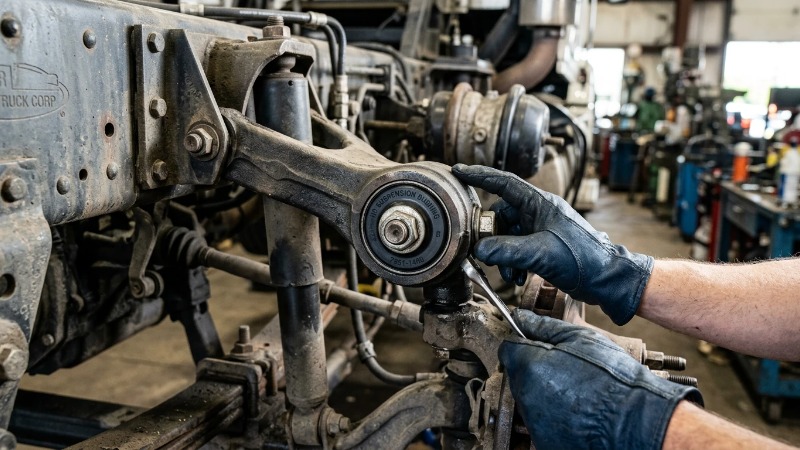
Correct installation begins with the right tooling. Pressing bushings in and out requires proper presses and adapters to avoid damaging the component or its housing.
Follow the manufacturer’s torque specifications precisely. Under-torquing invites movement and premature wear, while over-torquing can distort the bushing and shorten its life.
Critically, torque bushing fasteners with the suspension loaded at ride height. This ensures the bushing sits in a neutral position rather than perpetually twisted, which dramatically extends service life.
After installation, always perform a wheel alignment. New bushings can subtly change geometry, and alignment locks in the benefit.
Preventive Maintenance Scheduling
Reactive maintenance is expensive maintenance. A preventive schedule catches wear before it triggers failure and downtime.
Set inspection intervals based on duty cycle rather than a fixed calendar. A vocational truck warrants more frequent checks than a highway cruiser.
Integrate bushing inspection into existing service events. Checking bushings during scheduled maintenance costs little and prevents surprises.
For greaseable bushings, honor the lubrication schedule. Regular greasing keeps wear surfaces protected and prevents the squeaking that plagues neglected polyurethane components.
Extending Bushing Service Life
Several practical steps stretch the useful life of any bushing. They cost little yet pay real dividends.
Environmental protection helps considerably. Keeping bushings away from oil leaks and washing off corrosive road salt preserves the material.
Proper lubrication matters for greaseable designs. A disciplined greasing routine can meaningfully extend service intervals.
Load management is the final lever. Avoiding chronic overloading reduces the stress bushings endure and slows the wear process across the entire suspension.
Combined, these habits protect your parts investment and keep vehicles on the road where they belong. For detailed procedures, consult our technical support library.
Frequently Asked Questions (FAQ)
Below are direct answers to the questions enterprise buyers ask most often about suspension bushings.
How long do heavy-duty truck suspension bushings last?
Service life varies widely based on material, duty cycle, and environment. Rubber bushings in moderate service often last several years, while durable polyurethane bushings in harsh conditions frequently outlast them significantly. The best estimate comes from benchmarking against your own fleet’s operating profile rather than a generic average.
Are polyurethane suspension bushings worth the extra cost?
For many heavy-duty and vocational applications, yes. Polyurethane resists oil, chemicals, and environmental degradation while holding suspension geometry longer, which reduces replacement frequency and downtime. The higher upfront price is often offset by lower lifecycle cost, though comfort-focused operations may still prefer premium rubber for its superior NVH isolation.
What are the most common signs of worn suspension bushings?
The classic indicators include clunking or knocking noises over bumps, uneven or accelerated tire wear, steering wander, excessive cab vibration, and visible cracking of the bushing material. Any of these warrants inspection, and multiple symptoms together strongly suggest replacement is due.
Can I replace suspension bushings individually or should I buy a full kit?
Both approaches work, but full kits often deliver better value on heavy-duty vehicles. A complete kit ensures all related bushings are replaced together with matching material and hardware, reducing the chance of a soon-to-fail neighbor triggering another shop visit. For isolated failures on newer components, individual replacement can be appropriate.
How much does truck suspension bushing replacement cost on average?
Cost depends on the bushing position, vehicle type, and labor rates in your region, so a single figure is misleading. What matters most is that labor and downtime usually exceed the part cost itself. This is why investing in longer-lasting bushings frequently lowers total spend over the vehicle’s life.
Do harder durometer bushings always improve performance?
No. A harder durometer improves control and load resistance but transmits more noise and vibration and can accelerate wear on mating surfaces. The goal is to match durometer to the specific application, not simply to choose the firmest option available. Over-stiffening a comfort-oriented vehicle degrades the driver experience without benefit.
Conclusion & Next Steps
Suspension bushings may be small, but their influence on safety, comfort, and total cost of ownership is anything but. Treating them as a strategic component rather than a commodity is the mark of a sophisticated buyer.
Throughout this guide, we have seen how design, material, and sourcing decisions ripple across your entire operation. The right choices protect adjacent components, reduce downtime, and stabilize maintenance budgets.
Key Takeaways for Fleet & Procurement Leaders
As you refine your bushing strategy, keep these priorities front of mind.
- Match material to mission. Rubber for isolation, polyurethane for durability and control.
- Specify durometer thoughtfully. Firmer is not automatically better; fit the application.
- Think in lifecycle cost. Upfront price is only a fraction of total spend once labor and downtime are counted.
- Diagnose early. Catching wear symptoms prevents cascading, expensive damage.
- Consolidate sourcing. A single trusted partner for bushings and related engine components streamlines your supply chain.
Apply these principles consistently, and your suspension bushing program will shift from a source of surprise costs to a well-managed advantage.
Call to Action: Partner With a Trusted Heavy-Duty Component Supplier
Ready to reduce downtime and lower your total cost of ownership? The right supplier partnership makes all the difference.
Whether you need suspension bushings, oil pans, or a broader range of heavy duty truck engine parts, our team is ready to help you specify the ideal solution for your fleet. We combine engineering expertise with the manufacturing breadth to serve as your single-source partner.
Request a quote, download detailed specifications, or consult with our engineering experts today. Reach out through our contact page, explore our full catalog on the homepage, or review real results in our customer success stories. Let’s build a more reliable, cost-efficient fleet together.


