China Truck Oil Pan Suppliers: The 2026 B2B Sourcing Guide to Vet Manufacturers, Cut Costs & Avoid Costly Engine Failures.
A comprehensive procurement guide for fleet operators, OEM buyers, and aftermarket distributors evaluating Chinese manufacturing partners.
Every heavy-duty engine depends on components that rarely make headlines yet quietly determine whether a truck runs for 500,000 miles or seizes at 200,000. The oil pan is one of those components. Choosing the right truck oil pan supplier China sourcing partner is not a small procurement task — it is a decision that ripples across your warranty budget, your uptime metrics, and your total cost of ownership.
This guide is built for decision-makers who need clarity, not marketing fluff. We will walk through engineering fundamentals, supplier evaluation frameworks, custom manufacturing workflows, logistics, and real-world risk mitigation. By the end, you will have a repeatable process for vetting any manufacturer with confidence.
Introduction: Why the Oil Pan Sourcing Decision Matters
The oil pan sits at the bottom of the engine, holding the lubricating oil that keeps everything moving. It sounds simple. In practice, a poorly engineered or badly manufactured pan causes leaks, oil starvation, and catastrophic engine failure.
For a fleet running dozens or hundreds of trucks, a single recurring leak issue multiplies into thousands of dollars in downtime, roadside recovery, and reputational damage with customers. That is why the sourcing decision reaches far beyond the unit itself.
When you evaluate a supplier, you are really evaluating a chain of promises: material integrity, dimensional accuracy, leak-proof sealing, and consistent delivery. Get that chain right, and the oil pan disappears into reliable background performance. Get it wrong, and it becomes a persistent operational headache.
A component that costs relatively little to produce can cost a fortune when it fails in the field. Procurement quality is insurance against that risk.
The Rising Role of China in Global Heavy-Duty Parts Supply
Over the past two decades, China has evolved from a low-cost assembly base into a mature manufacturing ecosystem for commercial vehicle components. Today it accounts for a substantial share of the world’s heavy-duty truck parts output.
This shift matters for B2B buyers. Chinese factories now operate advanced stamping presses, die-casting lines, and CNC machining centers that rival facilities in Europe and North America. Many hold international quality certifications and export to demanding markets.
The result is a broad, competitive supplier base. For buyers who know how to evaluate partners properly, that competition translates into strong pricing, flexible order quantities, and genuine engineering capability. The challenge is separating the capable manufacturers from the middlemen and the underqualified.
Who This Guide Is For
This resource speaks directly to several audiences. Procurement managers who must justify sourcing decisions to leadership will find frameworks and scorecards. Fleet operators concerned with uptime will find fitment and quality guidance.
OEM sourcing teams exploring custom fabrication will find a development workflow. And aftermarket wholesalers evaluating a wholesale truck oil pan manufacturer will find verification steps to protect their brand reputation.
Whatever your role, the goal is the same: reduce sourcing risk while capturing the cost and capability advantages that a well-vetted Chinese partner can offer.
Understanding the Truck Oil Pan: Function and Engineering Fundamentals
Before discussing procurement, it helps to understand what you are actually buying. Technical fluency changes the conversation with suppliers — it signals that you cannot be sold a substandard product, and it lets you specify exactly what you need.
What a Truck Oil Pan Does in a Heavy-Duty Engine
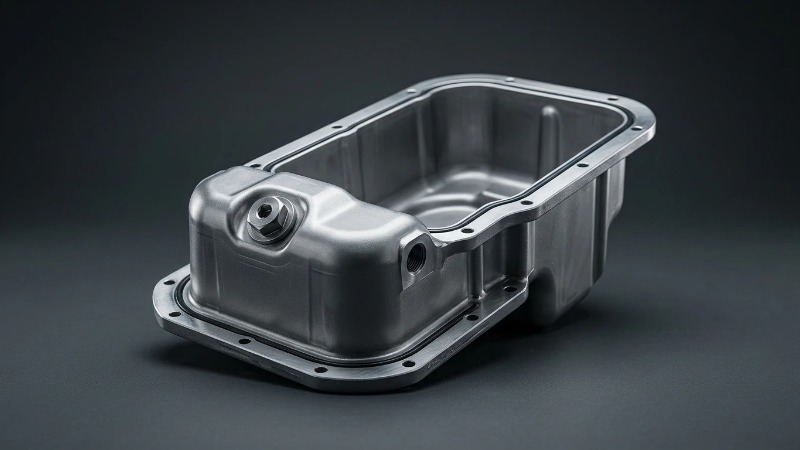
At its most basic, the oil pan is a reservoir. It stores the engine oil when the vehicle is stationary and collects it as it drains back from the upper engine during operation.
But its job goes further. The pan helps regulate oil temperature by dissipating heat through its walls. In heavy-duty applications, thermal management is critical because sustained loads generate significant heat.
The pan also provides a sealed enclosure at the bottom of the engine, preventing contaminants from entering and oil from escaping. On many designs it contributes structural rigidity to the lower engine assembly, tying components together and resisting vibration.
Finally, it houses the drain plug and often integrates baffles that control oil movement during acceleration, braking, and cornering. Each of these functions must be engineered correctly for a truck that may operate under continuous heavy load.
Key Design Variables That Affect Performance
Not all oil pans are created equal, even for the same engine platform. Several design variables directly influence how well a pan performs in real conditions.
- Capacity: The oil volume must match engine specifications. Too little oil accelerates wear; too much creates windage losses.
- Baffle design: Internal baffles keep oil around the pickup tube during hard maneuvers, preventing momentary oil starvation.
- Drain plug placement: Positioning affects serviceability and how completely old oil evacuates during changes.
- Sump depth: Deeper sumps store more oil but may reduce ground clearance — a real concern for off-highway trucks.
- Windage tray integration: Reduces oil aeration and parasitic drag from the rotating crankshaft.
A quality manufacturer understands these variables and can advise on trade-offs. A trading company simply forwards your drawings without insight.
Material Options Compared
Material choice is one of the most consequential decisions in oil pan procurement. It affects weight, heat behavior, durability, and cost. The right choice depends entirely on your application.
Steel vs. Aluminum vs. Composite Oil Pans
| Material | Weight | Heat Dissipation | Corrosion Resistance | Relative Cost | Best Use Case |
|---|---|---|---|---|---|
| Stamped Steel | Heavier | Moderate | Requires coating | Low | Standard fleet trucks |
| Cast Aluminum | Lighter | Excellent | High | Medium-High | Performance / long-haul |
| Composite | Lightest | Good | Excellent | Variable | Emerging applications |
Stamped steel remains the workhorse choice. It is economical, easy to repair in the field, and structurally forgiving. Its main drawbacks are weight and the need for protective coating to resist corrosion.
Cast aluminum offers superior heat dissipation and meaningful weight savings. These qualities make it attractive for long-haul and fuel-conscious operations. An experienced aluminum truck oil pan supplier can deliver pans that outperform steel thermally while resisting corrosion naturally.
Composite pans are still emerging in heavy-duty use. They offer the lowest weight and excellent corrosion resistance, but acceptance varies by application and buyer comfort with newer materials.
When to Choose an Aluminum Truck Oil Pan
Aluminum makes the strongest case when weight and thermal management are priorities. For long-haul fleets counting every kilogram against fuel economy, the reduction adds up across thousands of miles.
Aluminum’s superior heat dissipation also helps engines running sustained high loads, keeping oil temperatures more stable. That stability protects lubricant properties and extends oil service intervals in some cases.
The trade-off is upfront cost and the fact that aluminum is less tolerant of impact damage than steel. Fleets operating in rough off-road environments sometimes prefer steel’s forgiving nature. The decision should always follow the application, not fashion.
The Business Case for Sourcing Truck Oil Pans from China
With the fundamentals established, let us turn to the commercial rationale. Enterprise buyers need more than a low unit price to justify a sourcing shift — they need a defensible total-value argument.
Cost Advantages Beyond Unit Price
Unit price is the most visible number, but it is rarely the most important. Smart buyers evaluate landed cost, which includes freight, duties, packaging, and handling.
China’s advantage extends into tooling amortization. Because production volumes are high and tooling costs are competitive, the per-unit tooling burden shrinks quickly across a program’s life.
Economies of scale reinforce this. A factory producing large volumes of a heavy duty truck oil pan spreads fixed costs thin, passes savings along, and can sustain competitive pricing even as material markets fluctuate. For distributors, that stability matters as much as the headline figure.
Manufacturing Capability and Capacity
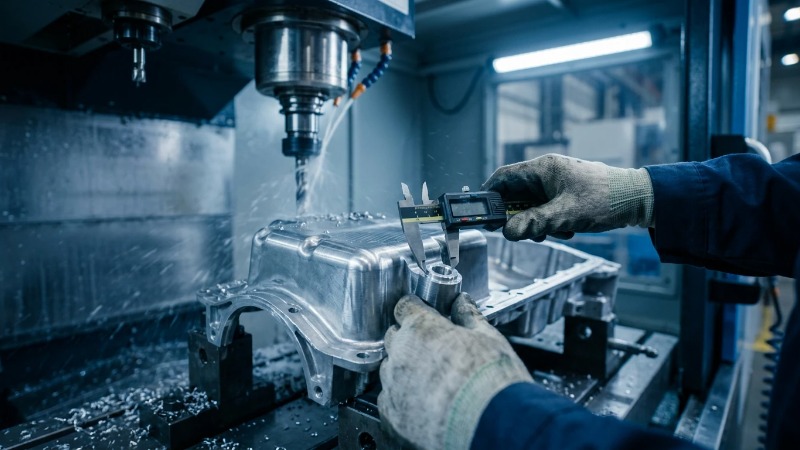
Modern Chinese manufacturers combine several core processes under one roof. Stamping presses form steel pans; die-casting lines produce aluminum; and CNC machining centers finish critical sealing surfaces to tight tolerances.
This integration reduces reliance on subcontractors, improving both quality control and lead-time predictability. The best factories also maintain in-house tooling shops, allowing them to build and repair dies without external delays.
Capacity is another advantage. Leading suppliers can scale from prototype quantities to large recurring orders, giving buyers room to grow without changing partners. You can explore the range of engine component systems available from an established manufacturer to gauge that breadth.
Quality Perception vs. Reality
An outdated perception still lingers that “made in China” means lower quality. The current reality is more nuanced. Many Chinese factories now hold IATF 16949 and ISO certifications and supply directly to global OEMs.
The variation is real — but it exists between suppliers, not because of national origin. A rigorously vetted factory produces components indistinguishable from Western output, while an unvetted workshop produces problems.
The lesson for buyers is straightforward. Do not judge on stereotypes; judge on documented evidence. The evaluation framework later in this guide gives you the tools to do exactly that. Real customer success cases often reveal far more than a sales brochure.
Sample Cost Comparison Table
| Sourcing Region | Relative Unit Cost (Steel Pan) | Lead Time | MOQ Flexibility | Tooling Cost |
|---|---|---|---|---|
| China | Baseline (lowest) | Moderate | High | Lowest |
| Southeast Asia | +10–15% | Moderate | Moderate | Low-Medium |
| Eastern Europe | +20–30% | Short | Low | Medium |
| Domestic (US/EU) | +40–60% | Shortest | Low | Highest |
The table illustrates a familiar trade-off. Domestic sourcing offers the shortest lead times but the highest cost and least flexibility. China offers the strongest cost and flexibility profile with a manageable lead time, which is why it remains the dominant choice for high-volume programs.
How to Evaluate a Truck Oil Pan Supplier in China
This is the heart of the guide. A structured evaluation process protects you from the most common sourcing failures. Treat it as a checklist you apply to every candidate, not a set of loose impressions.
Certifications and Compliance Standards to Verify
Certifications are your first filter. They do not guarantee perfection, but their absence is a serious red flag for automotive components.
- IATF 16949: The global automotive quality management standard. Its presence signals a factory built around automotive-grade discipline.
- ISO 9001: General quality management. A baseline expectation for any serious manufacturer.
- ISO 14001: Environmental management, increasingly important for buyers with sustainability commitments.
- Material traceability: Documentation linking each batch to its raw material source and test data.
Always request current certificates and verify their validity dates. A lapsed certification suggests slipping standards. When in doubt, cross-check with the issuing body.
Manufacturing Capabilities Checklist
Certifications tell you a factory can manage quality; capabilities tell you it can actually build your part. Confirm the following exist in-house rather than being outsourced.
- In-house tooling and die shop
- Stamping presses sized for your pan dimensions
- Die-casting lines for aluminum programs
- Robotic or certified manual welding
- Dedicated leak-testing stations
- Coating and surface-treatment lines
A supplier that owns these processes controls its own quality and schedule. One that subcontracts each step introduces coordination risk and variability. For technical questions during evaluation, a responsive manufacturer will point you to dedicated technical support resources rather than dodging specifics.
Quality Control Processes That Signal a Reliable Partner
Quality is a process, not an inspection at the end. The best suppliers control quality at three stages.
First, incoming material inspection verifies that raw steel or aluminum meets specification before production begins. Contaminated or off-spec material dooms the finished part.
Second, in-process checks catch dimensional drift as tooling wears and conditions change. Statistical process control keeps output within tolerance rather than discovering defects too late.
Third, final testing — especially 100% leak or pressure testing — ensures no pan ships with a hidden defect. For a sealing component, this step is non-negotiable. Ask to see actual testing records, not just a verbal assurance.
Supplier Evaluation Scorecard
| Criteria | Weight | What to Look For |
|---|---|---|
| Certifications | High | Valid IATF / ISO documentation |
| QC Testing | High | 100% leak testing records |
| Production Capacity | Medium | Monthly output vs. your volume |
| Communication | Medium | English-speaking export team |
| R&D / Custom Capability | Variable | CAD, prototyping, sample turnaround |
| Export Experience | High | Track record in your region |
Score each candidate against these criteria and weight them to your priorities. The exercise converts a fuzzy gut feeling into a defensible, comparable ranking you can present to leadership.
Wholesale Truck Oil Pan Manufacturer vs. Trading Company
One of the most important distinctions in Chinese sourcing is direct manufacturer versus trading company. Both can be legitimate, but they serve different roles.
A direct manufacturer controls production, quality, and pricing. You gain transparency, faster technical response, and the ability to influence the process. This is usually preferable for recurring or custom programs.
A trading company aggregates products from multiple factories. It can be convenient for small mixed orders, but it adds a margin layer and distances you from the actual production floor. When quality issues arise, resolution is slower because the trader must relay everything.
To identify a true manufacturer, ask for factory videos, request a live video tour, verify the business license category, and check whether technical answers come from engineers or salespeople. You can learn more about a genuine producer’s operations on their company background page.
Custom Truck Engine Oil Pan Manufacturing
Standard catalog parts serve most needs, but many buyers require something specific. A capable custom truck engine oil pan program opens options that off-the-shelf sourcing cannot match.
When Custom Fabrication Makes Sense
Custom work is justified in several scenarios. Retrofit applications may require a pan that fits a modified chassis or an engine swap where no standard part exists.
Discontinued OEM parts are another driver. When a manufacturer stops producing a legacy pan, fleets running older equipment need a reliable replacement source to keep those assets alive.
Finally, fleet-specific designs — perhaps with added capacity, reinforced sumps, or special drain arrangements — deliver operational advantages worth the tooling investment. In each case, custom fabrication turns a constraint into a competitive edge.
The Custom Development Workflow
A disciplined custom process moves through clear stages, each with defined deliverables. Understanding the sequence helps you plan realistically and hold the supplier accountable.
It begins with a design review, where engineers assess your CAD files or reverse-engineer a physical sample. Next comes tooling fabrication, the longest phase, where dies and fixtures are built.
Sampling follows, producing first articles for your inspection and approval. Only after you sign off does mass production begin. Skipping or rushing any stage invites costly errors downstream.
Custom Project Timeline Overview
| Phase | Typical Duration | Buyer Deliverables |
|---|---|---|
| Design Review | 1–2 weeks | CAD files or physical sample |
| Tooling Fabrication | 4–8 weeks | Approved specifications |
| Sampling | 1–2 weeks | Feedback / approval |
| Mass Production | Volume-dependent | Confirmed purchase order |
Build these durations into your planning. A common mistake is expecting production-speed delivery on a first custom run. Tooling takes time, and pushing to compress it usually compromises quality.
Protecting Intellectual Property and Designs
When you share proprietary designs, protection matters. Several instruments reduce your exposure.
A non-disclosure agreement establishes confidentiality obligations before drawings change hands. While enforcement across borders has limits, an NDA sets expectations and provides recourse.
Tooling ownership clauses are equally important. Specify in your contract that you own the tooling you pay for, so you can move production if needed. Exclusivity agreements can prevent the supplier from selling your unique design to competitors.
Reputable manufacturers respect these terms because their long-term business depends on trust. If a supplier resists reasonable IP protection, treat it as a warning sign and reach out through their contact channel to clarify terms before committing.
Heavy-Duty Truck Oil Pan Applications and Compatibility
The finest oil pan is useless if it does not fit. Compatibility is where sourcing meets the physical reality of your fleet.
Matching Oil Pans to Engine Platforms
Heavy-duty trucks run a range of engine families, each with distinct pan geometry, bolt patterns, and capacity requirements. Accurate matching prevents expensive mistakes.
The safest approach is cross-referencing part numbers against OEM specifications. A knowledgeable supplier maintains cross-reference data and can confirm fitment for the platforms you operate.
When part numbers are unavailable — common for older or modified equipment — a physical sample becomes the reference. Providing an existing pan lets the manufacturer replicate critical dimensions precisely. Browsing a supplier’s brand-specific product listings is often the fastest way to check platform coverage.
Aftermarket vs. OEM-Replacement Considerations
Buyers must decide between OEM-replacement parts and aftermarket alternatives. Each carries implications.
OEM-replacement pans match original specifications exactly, ensuring seamless fitment and preserving factory tolerances. They are the low-risk choice for warranty-sensitive fleets.
Aftermarket options may offer improvements — greater capacity, better coatings, or reinforced construction — sometimes at attractive value. The key is verifying interchangeability and understanding any warranty implications before switching. A transparent supplier will disclose exactly where their part matches and where it enhances the original.
Logistics, Shipping, and Import Considerations
Once you have selected a supplier and a product, the goods still have to reach you. Cross-border logistics can make or break the economics of a deal, so treat it with the same rigor as supplier selection.
Incoterms Every Buyer Should Understand
Incoterms define who is responsible for what along the shipping journey. Misunderstanding them creates disputes and unexpected costs.
- FOB (Free On Board): The supplier delivers goods onto the vessel; you assume responsibility and cost from that point. Common and buyer-friendly for those with freight arrangements.
- CIF (Cost, Insurance, Freight): The supplier covers shipping and insurance to your destination port; you handle import clearance onward.
- DDP (Delivered Duty Paid): The supplier handles everything, including duties, delivering to your door. Simplest for the buyer but requires a supplier with strong export logistics.
Choose the term that matches your internal logistics capability. Buyers without customs expertise often prefer DDP for its simplicity, while experienced importers favor FOB for cost control.
Freight, Packaging, and Damage Prevention
Oil pans are bulky and, in steel form, prone to corrosion and dent damage in transit. Packaging is not an afterthought — it protects your investment.
Proper palletization stabilizes loads and prevents shifting inside containers. Corrosion protection, such as anti-rust coatings and desiccant packaging, guards steel pans during long sea voyages with high humidity.
Container optimization also affects cost. Because pans are voluminous, efficient nesting and stacking reduce the per-unit freight burden. Discuss packaging standards with your supplier and, ideally, confirm them during sampling.
Tariffs, Duties, and Total Landed Cost
The number that ultimately matters is total landed cost — the fully delivered cost per unit including every fee. Calculating it accurately prevents nasty surprises.
Start with the product cost, then add freight, insurance, import duties, tariffs, customs brokerage, and inland delivery. Trade policy shifts periodically, so confirm current duty rates for your specific product classification and country before finalizing any 2026 sourcing plan.
A useful discipline is to model landed cost across several scenarios — different Incoterms, container loads, and order volumes. The comparison often reveals that a slightly higher unit price with better freight efficiency wins on total cost.
Common Risks and How to Mitigate Them
No sourcing strategy is risk-free. The difference between a smooth program and a troubled one lies in anticipating problems and building safeguards before they occur.
Quality Inconsistency Across Production Runs
A supplier may deliver a flawless first order, then drift on later runs. This is one of the most common and damaging sourcing risks.
Golden sample retention combats it. You and the supplier each keep an approved reference sample against which future production is measured. Any deviation becomes objectively identifiable.
Third-party inspection adds a further layer. Independent inspectors verify quality before shipment, catching problems while the goods are still in the factory rather than after they cross the ocean. For high-value or safety-critical orders, this modest cost is well justified.
Communication and Time-Zone Challenges
Distance and time zones can slow decision-making and create misunderstandings. Left unmanaged, they erode trust and delay projects.
Establish clear communication protocols early. Agree on a primary contact, preferred channels, and expected response windows. A dedicated English-speaking export team on the supplier side dramatically reduces friction.
Written confirmations of key decisions prevent “lost in translation” errors. Whenever specifications or commitments are discussed verbally, follow up in writing to create a shared, unambiguous record.
Payment Terms and Financial Protection
Payment structure balances your cash-flow needs against your risk exposure. Several mechanisms protect buyers without alienating suppliers.
- Staged payments: A deposit to begin, with balances tied to milestones such as sample approval and pre-shipment inspection.
- Letter of Credit (L/C): A bank instrument that releases funds only when documentary conditions are met, protecting both parties.
- Escrow services: Useful for newer relationships, holding funds until agreed conditions are satisfied.
Avoid paying the full amount upfront to an unproven partner. A reasonable deposit-and-balance structure aligns incentives and keeps leverage on your side until you have verified the goods.
Real-World Sourcing Example: A Fleet Procurement Scenario
To see the framework in action, consider a composite scenario drawn from typical distributor experiences. It illustrates how the principles above combine into a sound decision.
A North American aftermarket distributor needed a reliable source for steel and aluminum oil pans covering several popular heavy-duty engine platforms. Their existing supplier had grown inconsistent, with recurring leak complaints damaging the distributor’s reputation.
The procurement lead began by shortlisting four Chinese candidates. Applying the evaluation scorecard, two were eliminated immediately — one lacked valid IATF certification, and the other turned out to be a trading company rather than a manufacturer.
The remaining two candidates were both genuine manufacturers with strong certifications. To break the tie, the distributor requested samples and commissioned a third-party factory inspection.
One factory demonstrated 100% leak testing with documented records and a responsive engineering team that flagged a potential improvement in baffle design. The other provided samples but was vague about its testing records.
The choice became clear. The distributor selected the transparent, engineering-driven manufacturer, negotiated staged payments, and retained a golden sample. Over the following year, leak-related returns dropped sharply, and the distributor expanded the relationship into a small custom program for a discontinued OEM pan.
The winning supplier was not necessarily the cheapest on unit price — it was the one whose process transparency and engineering input reduced total cost and protected the buyer’s brand.
This outcome underscores the guide’s central message. Rigorous evaluation, not price-chasing, produces durable sourcing success. You can review comparable outcomes among documented partnership case studies to see the pattern repeat.
Frequently Asked Questions (FAQ)
What is the typical minimum order quantity for a truck oil pan supplier in China?
Minimum order quantities vary considerably based on material and customization. Standard catalog steel pans often carry lower MOQs because tooling already exists, while custom or aluminum programs require higher quantities to justify tooling investment. Direct manufacturers generally offer more MOQ flexibility than trading companies, and many are willing to negotiate for buyers who demonstrate genuine long-term potential. Always discuss MOQ early so it aligns with your inventory strategy.
How do I verify a wholesale truck oil pan manufacturer is legitimate?
Verification combines several steps. Request valid IATF 16949 and ISO certificates and confirm their status. Ask for a live video factory tour to confirm actual production equipment. Check the business license to ensure the entity is registered as a manufacturer, not merely a trader. Finally, request references from buyers in your region and, for significant orders, commission an independent third-party audit before committing.
Are aluminum truck oil pan suppliers more expensive than steel?
Generally, aluminum pans carry a higher cost than stamped steel because of material and casting expenses. However, the right comparison is value, not just price. Aluminum offers weight savings that improve fuel economy over a vehicle’s life, superior heat dissipation that protects the engine, and natural corrosion resistance that reduces long-term maintenance. For long-haul and performance applications, those benefits often justify the difference. For standard fleet duty, steel frequently remains the more economical choice.
What lead times should I expect for custom truck engine oil pans?
A realistic custom timeline spans several stages. Design review typically takes one to two weeks, tooling fabrication four to eight weeks, and sampling another one to two weeks for production and approval. Mass production duration then depends on your order volume. Overall, plan for roughly two to three months from design approval to first production shipment. Building this buffer into your planning prevents unrealistic expectations and rushed decisions.
How is quality controlled for heavy duty truck oil pans?
Quality control operates across the production cycle. It starts with incoming material inspection to verify raw steel or aluminum meets specification. In-process checks monitor dimensional accuracy as production runs. The most critical step for a sealing component is final testing — reputable suppliers perform 100% leak or pressure testing and retain records. Material traceability documentation ties each batch to its source, allowing full accountability if any issue arises.
Can suppliers ship directly to my country with duties handled?
Yes, many experienced exporters offer DDP (Delivered Duty Paid) arrangements, in which the supplier manages freight, customs clearance, duties, and final delivery to your location. This is the most convenient option for buyers without in-house import expertise. Confirm that the supplier has a proven export track record in your specific market, since customs procedures differ by country. For buyers who prefer cost control, FOB remains a strong alternative when paired with a reliable freight forwarder.
Conclusion and Next Steps
Sourcing oil pans from China is neither a gamble nor a shortcut — it is a strategic decision that rewards diligence. The buyers who succeed are those who treat supplier selection as an engineering and risk-management exercise rather than a race to the lowest quote.
Throughout this guide, one theme has recurred. Transparency, documented quality, and genuine manufacturing capability separate reliable partners from costly mistakes. Apply that lens consistently and the sourcing landscape becomes far less intimidating.
Your Supplier Selection Checklist Recap
- Verify valid IATF 16949 and ISO certifications.
- Confirm the partner is a direct manufacturer, not a trading intermediary.
- Insist on documented 100% leak testing and material traceability.
- Match production capacity to your volume needs.
- Assess communication quality and export experience in your region.
- Protect designs with NDAs and tooling-ownership clauses.
- Calculate total landed cost, not just unit price.
- Retain a golden sample and consider third-party inspection.
- Structure staged payments to align incentives.
Keep this checklist beside you during every supplier conversation. It converts abstract caution into concrete, repeatable action — the kind of discipline that protects your budget and your reputation.
Call to Action: Request a Quote and Sample
If you are ready to move from research to action, the next step is straightforward. Partner with an experienced manufacturer that welcomes scrutiny, shares its testing data, and supports you from specification through delivery.
Explore the full range of heavy-duty component systems, review real customer success stories, and lean on dedicated technical support as you evaluate your options. When you are ready to request specifications, samples, or a tailored sourcing consultation, reach out to the team directly.
Take the first step toward a more reliable supply chain today. A well-vetted truck oil pan supplier China partner is not just a vendor — it is a long-term contributor to your fleet’s uptime, your warranty performance, and your bottom line. Visit the main homepage to begin the conversation.
Meta Description: Expert guide to sourcing quality truck oil pans from China suppliers.


