Truck oil pump failing? Expert guide to diagnosis, symptoms, replacement steps & costs. Protect your fleet from costly engine damage now.
A comprehensive technical reference for fleet technicians, diesel mechanics, and commercial vehicle professionals covering oil pump design, failure diagnosis, and replacement procedures.
Few components carry as much responsibility inside a commercial engine as the oil pump. It works quietly, out of sight, yet the entire lubrication network depends on its steady output. When it falters, the consequences arrive fast and expensive.
This guide walks through everything a professional needs to know. We cover pump architecture, operating principles, failure symptoms, diagnostic methods, replacement procedures, cost analysis, and long-term maintenance strategy. The goal is practical authority you can apply on the shop floor.
Understanding the Truck Oil Pump Assembly
Before diagnosing failures or planning a rebuild, it helps to understand what the pump actually does. Think of it as the heart of the engine lubrication system, circulating oil the way a heart circulates blood.
In heavy-duty applications, the stakes rise considerably. Larger bearings, higher loads, and longer duty cycles all demand consistent oil pressure. A pump that underperforms even slightly can accelerate wear across dozens of internal surfaces.
What Is an Oil Pump Assembly and Why It Matters
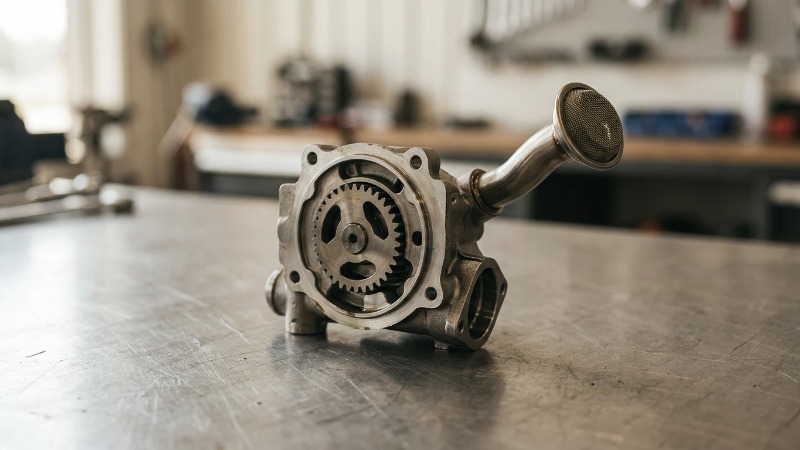
The Oil Pump Assembly is the mechanical unit that draws oil from the sump and forces it under pressure through the engine’s galleries. It sits low in the lubrication circuit, usually driven directly by the crankshaft or camshaft.
Its position is deliberate. By mounting near the oil supply, the pump minimizes intake restriction and maintains a reliable prime. This matters because dry starts and pressure drops cause the most damage.
When the pump fails, metal-to-metal contact begins almost immediately. Crankshaft bearings, connecting rod bearings, and camshaft journals all rely on a pressurized oil film. Lose that film, and catastrophic engine failure often follows within minutes.
For fleet operators, this translates directly into downtime and repair bills. That is why understanding the assembly is not academic—it protects both equipment and operating margins.
Core Components of the Assembly
The complete assembly contains several interdependent parts. Each plays a defined role, and each has its own wear characteristics.
- Oil pump gears and rotor: The rotating elements that generate flow. Depending on design, these are either meshing gears or an inner/outer rotor set.
- Pump housing: The precision-machined body that contains the rotating elements and maintains tight clearances.
- Drive mechanism: A shaft, gear, or chain that transmits rotational force from the crankshaft.
- Oil pickup tube and screen: The intake pathway that draws oil from the sump while filtering large debris.
- Oil pressure relief valve: A spring-loaded valve that caps maximum pressure and protects the system from over-pressurization.
Together, these parts form a tightly toleranced unit. Even small wear in the rotor or housing reduces volumetric efficiency, which shows up as low pressure at idle.
How the Oil Pump Fits Into the Engine Lubrication System
Oil begins its journey in the sump at the bottom of the engine. The pump draws it upward through the pickup tube, then pressurizes it and sends it forward.
From there, oil passes through the filter, where contaminants are captured. Many heavy-duty engines also route oil through a cooler to manage temperature under load.
Next, pressurized oil enters the main gallery. This channel distributes oil to crankshaft bearings, camshaft journals, valvetrain components, and turbocharger bearings where applicable.
After lubricating each surface, oil drains back to the sump under gravity. The cycle then repeats continuously as long as the engine runs. For deeper technical resources on lubrication systems, our technical support library offers additional reference material.
How a Truck Oil Pump Works: Functions Explained
Understanding the mechanics helps technicians diagnose problems more accurately. The pump does two things at once: it moves volume and it builds pressure.
These are related but distinct. Flow ensures every surface receives oil, while pressure ensures the oil forms a load-bearing film. A healthy system balances both.
The Lubrication Cycle Step by Step
Let us trace the full sequence. Each stage matters, and a fault in any one affects the whole.
- Pickup: The pump pulls oil through the pickup tube and screen from the sump.
- Pressurization: Rotating gears or rotors compress and force oil forward, raising system pressure.
- Filtration: Oil passes through the filter media, removing particulates before distribution.
- Distribution: Pressurized oil travels through galleries to every bearing and moving surface.
- Return: Spent oil drains back to the sump, ready to cycle again.
This loop happens thousands of times per minute at highway speed. Any restriction or leak in the path reduces effectiveness immediately.
Role of the Oil Pressure Relief Valve
The oil pressure relief valve is a safety governor. When pressure exceeds a set threshold, the valve opens and bleeds excess oil back to the sump.
This protects seals, gaskets, and the filter from rupture. It also stabilizes pressure across the engine’s operating range.
Cold starts illustrate its importance clearly. Thick, cold oil creates high pressure spikes, and the relief valve opens to prevent damage. As the oil warms and thins, the valve closes and normal regulation resumes.
A stuck-open relief valve causes chronically low pressure. A stuck-closed valve can spike pressure dangerously. Both conditions warrant inspection.
Function of the Oil Pickup Tube and Screen
The pickup tube and screen form the first line of defense. The screen blocks large debris that could jam the pump gears.
However, this benefit comes with a risk. Over time, sludge and carbon can clog the screen, starving the pump of oil.
Common failure points include screen blockage, cracked tubes, and failed gaskets at the pump interface. A leaking gasket introduces air, which causes pressure to fluctuate and the pump to lose prime.
During any pan-off service, technicians should inspect and clean the pickup screen. It is a small task that prevents major problems.
Pressure and Flow Requirements for Heavy-Duty Engines
Different truck classes demand different pressure profiles. The table below summarizes typical ranges. Always verify against the specific engine manufacturer’s specification.
| Truck Class | Typical Idle Pressure (psi) | Pressure at Operating RPM (psi) | Typical Flow Demand |
|---|---|---|---|
| Light-duty diesel | 10–20 | 30–50 | Moderate |
| Medium-duty diesel | 15–25 | 40–60 | High |
| Heavy-duty diesel | 20–30 | 45–70 | Very high |
These figures highlight a clear pattern. As engine size and load increase, so does the required oil pressure and volume. Matching pump capacity to the engine is essential.
Types of Truck Oil Pump Assembly
Not all pumps are built the same way. Engineers select designs based on packaging, cost, efficiency, and durability targets.
Knowing the differences helps you specify correct replacements and anticipate failure modes. The main types of truck oil pump assembly are covered below.
Gerotor Oil Pump
The gerotor oil pump—short for “generated rotor”—uses an inner rotor and an outer rotor with one fewer tooth on the inner element. As they rotate, the changing cavity volume draws and expels oil.
This design is compact and efficient. It runs quietly and handles high speeds well, which explains its prevalence in modern diesel engines.
Because the inner rotor mounts directly on the crankshaft in many layouts, the gerotor pump also reduces part count. Fewer parts often means better long-term reliability.
Wear typically appears as increased rotor tip clearance. When that clearance exceeds spec, pressure at idle drops noticeably.
Gear-Type Oil Pumps (External and Internal)
Gear-type pumps use meshing gears to move oil. In external gear designs, two spur gears mesh and carry oil around their outer teeth to the outlet.
These pumps are robust and forgiving. They tolerate contamination better than tight-clearance alternatives, which suits older and heavier engines.
Internal gear designs place a smaller gear inside a larger ring gear. This arrangement is more compact while retaining good durability.
Both variants are proven and widely serviced. Their simplicity makes them a favorite in many heavy-duty applications.
Crescent (Internal Gear) and Rotary Pumps
Crescent-type pumps are a subclass of internal gear pumps. A crescent-shaped divider separates the intake and discharge sides between the two gears.
This design provides smooth flow with low pulsation. It appears in specific engine layouts where packaging favors a crankshaft-mounted pump.
Rotary pumps share similar operating principles and are chosen for their compactness. Each layout trades certain advantages for others depending on the engine architecture.
Variable Displacement Oil Pumps
Variable displacement pumps represent the newest evolution. Rather than pumping a fixed volume per revolution, they adjust output based on demand.
This saves energy. By not over-pressurizing at high RPM, the engine consumes less power driving the pump, improving fuel economy.
Electronic control and internal actuators regulate displacement in real time. Newer commercial engines increasingly adopt this technology to meet efficiency targets.
The trade-off is complexity. More components and control logic mean more potential failure points and higher replacement cost.
Comparison Table: Oil Pump Types
| Pump Type | Efficiency | Relative Cost | Durability | Noise | Typical Application |
|---|---|---|---|---|---|
| Gerotor | High | Moderate | High | Low | Modern diesel engines |
| External gear | Moderate | Low | Very high | Moderate | Heavy-duty and older engines |
| Internal gear / crescent | Moderate–high | Moderate | High | Low | Compact engine layouts |
| Variable displacement | Very high | High | Moderate | Low | Newer efficiency-focused engines |
Use this comparison as a starting point. The right choice depends on the engine platform, availability, and your fleet’s operating priorities. You can explore compatible options within our engine systems catalog.
Symptoms of a Failing Truck Oil Pump
Early detection saves engines. Recognizing the symptoms of a failing truck oil pump allows you to act before minor wear becomes major damage.
Symptoms fall into two groups: dashboard indicators and physical signs. Experienced technicians watch for both.
Warning Signs on the Dashboard and Gauges
The oil pressure warning light is the most obvious signal. If it illuminates during operation, treat it as urgent.
Fluctuating gauge readings are equally telling. Pressure that swings erratically often points to a failing pump, a clogged pickup screen, or a faulty relief valve.
Consistently low pressure at idle is another red flag. As pump clearances wear, idle pressure typically drops first.
Audible and Physical Symptoms
Sound can reveal a lot. A ticking noise from the valvetrain suggests hydraulic lifters are not receiving adequate oil.
Deeper knocking indicates bearing distress, which often follows extended low-pressure operation. This is a serious warning that demands immediate shutdown.
Overheating may also accompany pump failure, since oil helps carry heat away. Vibration and rough running can appear as internal components suffer.
Diagnostic Table: Symptom, Likely Cause, and Urgency
| Symptom | Likely Cause | Urgency | Recommended Action |
|---|---|---|---|
| Oil pressure light on | Failing pump or low oil level | Critical | Stop engine, inspect immediately |
| Fluctuating pressure | Clogged pickup screen or relief valve fault | High | Test pressure, inspect pickup |
| Low idle pressure | Worn pump clearances | Medium–high | Measure clearances, plan replacement |
| Valvetrain ticking | Oil starvation to lifters | High | Verify pressure, inspect galleries |
| Engine knocking | Bearing damage from oil starvation | Critical | Stop immediately, full inspection |
Diesel Truck Oil Pump Problems Specific to Heavy-Duty Use
Heavy-duty operation introduces unique stresses. Extended idle cycles, common in commercial trucking, keep oil pressure low for long periods.
High-mileage engines accumulate sludge, which clogs pickup screens and accelerates wear. Heavy load operation raises oil temperature, thinning the lubricant and reducing film strength.
These conditions combine to make diesel truck oil pump problems a recurring maintenance concern. Fleets that monitor pressure proactively catch these issues early. Reviewing our customer success case studies shows how proactive monitoring reduces unplanned downtime.
Diagnosing Oil Pump Failure
Symptoms suggest a problem, but confirmation requires testing. A structured diagnostic process prevents unnecessary part replacement.
The goal is to distinguish a genuine pump fault from related issues that mimic its symptoms. Careful measurement is the foundation.
Measuring Oil Pressure with a Mechanical Gauge
Electronic sensors can drift, so a mechanical gauge provides the reliable baseline. Begin by warming the engine to operating temperature.
Remove the oil pressure sender and thread in the mechanical gauge. Record pressure at idle and at a specified elevated RPM.
Compare your readings to the manufacturer’s specification. Pressure well below spec, especially at idle, points strongly toward a worn pump or clogged pickup.
Document each reading. Consistent records help track gradual decline across service intervals.
Inspecting the Pump, Pickup Screen, and Relief Valve
Once the pan is off, inspect the physical parts. Look for scoring on the rotor or gear faces and check the housing for wear.
Measure rotor tip clearance and end clearance with feeler gauges. Compare against the tolerance limits in the service manual.
Examine the pickup screen for sludge and debris. Then check the relief valve for free movement and a healthy spring.
Any component outside tolerance justifies replacement. Reusing marginal parts risks a repeat failure.
Ruling Out Related Faults
Low pressure does not always mean a bad pump. Fuel dilution thins the oil and reduces measured pressure.
Worn crankshaft bearings increase clearances, allowing oil to escape and pressure to fall. A faulty sensor can also report false readings.
Incorrect oil viscosity is another common culprit. Oil that is too thin will never reach spec pressure regardless of pump health.
Eliminate these possibilities before condemning the pump. This disciplined approach saves both parts and labor.
How to Replace a Truck Oil Pump: Step-by-Step
When diagnosis confirms pump failure, replacement is the fix. Understanding how to replace a truck oil pump correctly ensures the repair lasts.
The procedure varies by engine, but the core steps remain consistent. Always consult the specific service manual for torque values and sequence.
Tools, Parts, and Safety Preparation
Preparation reduces mistakes. Gather the right tools and confirm you have the correct replacement parts before starting.
- Socket and wrench set with torque wrench
- New Oil Pump Assembly and pickup tube gasket
- Replacement oil pan gasket and fresh engine oil
- New oil filter and appropriate thread sealant
- Drain pan, gloves, and eye protection
Secure the vehicle on level ground with wheels chocked. Disconnect the battery to prevent accidental cranking during the job.
Keep the torque specification sheet within reach. Accurate torque prevents both leaks and stripped threads.
Removing the Old Oil Pump Assembly
Start by draining the engine oil completely into a suitable pan. Allow adequate time for full drainage.
Next, remove the oil pan. On many trucks, this requires loosening or removing crossmembers or exhaust components for access.
With the pan off, detach the pickup tube and unbolt the pump from its mounting. Note the orientation and drive engagement before removal.
Inspect the mounting surfaces for old gasket material. Clean them thoroughly to ensure a proper seal for the new unit.
Installing the New Pump and Priming
Position the new pump and engage the drive correctly. Install the mounting bolts and torque them in the specified sequence.
Fit a fresh gasket to the pickup tube and attach it securely. Verify the screen clears the sump floor by the correct margin.
Priming is critical. Fill the pump with clean oil before final assembly, or use a priming tool to establish oil in the galleries.
Reinstall the oil pan with a new gasket. Torque the pan bolts evenly to avoid warping the sealing surface.
Post-Installation Testing and Verification
Refill the engine with the correct oil grade and quantity. Install a new filter at the same time.
Before starting, crank the engine with the fuel or ignition disabled to build initial pressure. Confirm the gauge responds.
Start the engine and monitor oil pressure closely. Check for leaks around the pan and pickup interfaces.
Let the engine reach operating temperature and verify pressure holds within spec at idle and elevated RPM. A short break-in period with gentle load helps seat components.
DIY vs. Professional Replacement
In-house fleet service makes sense when you have trained technicians and proper facilities. The job is labor-intensive but well within the reach of a capable shop.
However, some situations favor professional or dealer service. Complex engine layouts, warranty considerations, and limited access all raise the difficulty.
If your team lacks the tooling or the engine requires special procedures, referral is the prudent choice. Our contact page connects you with specialists who can advise on the best path.
Truck Oil Pump Replacement Cost Analysis
Cost planning matters for any fleet. Understanding truck oil pump replacement cost helps you budget and decide between in-house and outsourced repair.
Total cost combines parts and labor. Both vary widely by truck class and engine design.
Parts Cost by Truck Class and Pump Type
Parts pricing depends on whether you choose OEM or quality aftermarket components. The table below shows relative cost tiers rather than fixed figures.
| Truck Class | Pump Type | OEM Cost Tier | Aftermarket Cost Tier |
|---|---|---|---|
| Light-duty pickup | Gerotor / gear | Moderate | Lower |
| Medium-duty truck | Gear / internal gear | Higher | Moderate |
| Heavy-duty tractor | Gear / variable displacement | Highest | Higher |
Quality matters more than headline price. A premium pump that lasts twice as long often delivers the lower total cost of ownership. Browse verified options in our branded parts catalog.
Labor Cost and Total Estimates
Labor is often the larger portion of the bill. Access difficulty drives labor hours more than any other factor.
| Truck Class | Estimated Labor Hours | Access Difficulty | Relative Total Cost |
|---|---|---|---|
| Light-duty pickup | 4–7 hours | Moderate | Lower |
| Medium-duty truck | 6–10 hours | High | Moderate |
| Heavy-duty tractor | 8–14 hours | Very high | Higher |
Real-world example: a heavy tractor with limited pan clearance may require removing crossmembers, which adds several hours. That single access factor can double effective labor time.
Cost of Delayed Replacement
Delaying replacement is a false economy. A failing pump that starves bearings leads to a full engine rebuild or replacement.
The downstream costs dwarf the pump repair. Add unplanned downtime, towing, and lost revenue, and the total climbs quickly.
For fleets, one failed engine can disrupt scheduling across multiple routes. Preventive replacement at the first confirmed symptom is almost always cheaper.
Oil Pump Considerations Across Truck Configurations
Lubrication demands vary by platform. Drivetrain layout, load rating, and duty cycle all influence what the oil system must deliver.
Matching the pump and maintenance plan to the configuration protects the engine. Below we connect lubrication to real vehicle platforms.
Lubrication Demands by Semi Truck Axle Configurations
Semi truck axle configurations reflect load capacity and traction needs. A vehicle’s drive axle wheel formula—such as 4×2, 6×4, or 8×4—describes how many wheels drive the truck.
Higher load ratings mean heavier engines working harder. Heavy duty tractor units in linehaul service run at sustained high output, which raises oil temperature and demands robust pump flow.
All-wheel drive prime movers used in off-road or heavy haul add further stress. These vehicles benefit from oversized oil coolers and pumps sized for worst-case conditions.
Requirements for Commercial Trucking Fleet Vehicles
Mixed fleets complicate maintenance planning. Commercial trucking fleet vehicles often span several engine families and pump designs.
Standardizing parts where possible reduces inventory complexity. It also speeds repairs, since technicians work with familiar components.
Telematics helps here too. Fleet-wide oil pressure monitoring flags outliers before they become failures, allowing scheduled intervention.
Oil Pump Sizing for Light Trucks and Pickups
Light commercial vehicles have different needs than tractor units. Smaller engines require less flow, so pumps are correspondingly compact.
However, payload and towing still stress the system. A loaded pickup climbing grades pushes oil temperature up, and the pump must sustain pressure under that load.
Selecting the correct pump for a light truck balances efficiency with adequate reserve capacity. Undersizing risks pressure loss under peak demand.
Spotlight: Foton Truck Models and Oil Pump Specifications
Foton commercial vehicles provide a useful real-world reference across the light and medium segments. The lineup spans pickups, light trucks, and larger commercial platforms.
The Foton Tunland, for example, sits in the pickup category. Foton pickup specifications typically emphasize a balance of payload, durability, and efficiency suited to working conditions.
Foton light truck payload capacity varies by model and configuration. Heavier-rated variants naturally place greater demand on the lubrication system, which influences pump sizing and service intervals.
On pricing, Foton Tunland price positioning generally targets value-focused buyers seeking capable work vehicles. Because pricing shifts by market and specification, verify current figures directly with a dealer.
Sourcing genuine components through a Foton commercial vehicle dealer ensures correct fitment and warranty coverage. Matching the exact Oil Pump Assembly to the engine variant prevents pressure mismatches. Foton truck models remain a practical illustration of how platform choice shapes lubrication requirements.
Preventive Maintenance and Extending Pump Life
The best repair is the one you never need. Preventive maintenance dramatically extends pump life and protects the wider engine.
These practices cost little compared to a failed engine. For fleets, they translate directly into better uptime and lower lifecycle cost.
Oil Change Intervals and Correct Viscosity
Clean oil is the pump’s best friend. Fresh oil carries fewer abrasives, reducing wear on gears and rotors.
Follow the manufacturer’s service interval, and shorten it under severe duty. Frequent idling, dusty environments, and heavy loads all justify earlier changes.
Viscosity selection matters just as much. Using the specified grade ensures the pump reaches target pressure and the film holds under load.
Monitoring Oil Pressure and Early Detection
Modern telematics makes monitoring effortless. Continuous pressure logging reveals gradual decline long before a warning light appears.
Encourage drivers to report any gauge irregularity immediately. A quick check often prevents a roadside breakdown.
Routine inspections should include the pickup screen during oil changes when access allows. Small habits like this catch problems early.
Preventive Maintenance Schedule Table
| Service Item | Normal Duty Interval | Severe Duty Interval |
|---|---|---|
| Oil and filter change | Per manufacturer spec | Shortened interval |
| Oil pressure verification | Every major service | Continuous via telematics |
| Pickup screen inspection | During pan-off service | Every extended service |
| Relief valve check | At overhaul | At any pressure anomaly |
| Pump clearance measurement | At major engine service | At first sign of low pressure |
Adapt these intervals to your operating reality. A disciplined schedule pays for itself many times over. Learn more about our maintenance philosophy on our company profile.
Frequently Asked Questions (FAQ)
How long does a truck oil pump last?
A well-maintained oil pump often lasts the life of the engine, frequently exceeding several hundred thousand miles. Longevity depends heavily on oil cleanliness, correct viscosity, and service discipline. Contaminated oil and skipped changes shorten pump life considerably.
Can you drive with a failing oil pump?
No, driving with a failing pump is extremely risky. Oil starvation causes rapid, often irreversible bearing and engine damage. If the oil pressure light comes on or pressure drops, stop the engine safely and diagnose the problem before continuing.
What causes a truck oil pump to fail?
The most common causes are contamination, normal wear, and improper maintenance. Sludge clogs the pickup screen, abrasive particles wear the gears and rotor, and incorrect oil viscosity strains the system. A stuck relief valve or a leaking pickup gasket can also trigger failure.
How much does it cost to replace a truck oil pump?
Total cost varies significantly by truck class and engine access difficulty, combining parts and labor. Light-duty replacements are less involved, while heavy-duty tractors require far more labor hours. Refer to the detailed cost analysis above and request a quote for your specific vehicle.
Is it worth replacing the oil pump or the whole engine?
If the pump failed but the engine has not suffered bearing damage, replacing only the pump is clearly worthwhile. However, if oil starvation has already damaged bearings or the block, a rebuild or replacement engine may be more economical. Base the decision on mileage, damage extent, and the vehicle’s remaining value.
Conclusion and Next Steps
The oil pump may be small, but its role is enormous. Understanding its design, function, and failure modes is essential knowledge for every fleet professional.
Key Takeaways for Fleet Professionals
Several points stand out. Gerotor, gear, and variable displacement pumps each suit different applications, so match the design to the engine.
Watch for warning signs early—low or fluctuating pressure, unusual noise, and dashboard alerts. Confirm every suspected failure with a mechanical gauge before replacing parts.
Above all, prioritize preventive maintenance. Clean oil, correct viscosity, and pressure monitoring extend pump life and protect the entire engine investment.
Call to Action: Source Quality Parts and Expert Support
Reliable lubrication starts with reliable parts. Whether you manage a single vehicle or an entire fleet, sourcing quality components protects your uptime and your margins.
Explore our full range through the systems catalog and trusted brand selection. When you need expert guidance or a quote, our team is ready to help.
Visit MettLead to learn more, review real fleet success stories, or reach out directly through our contact page. Let our specialists support your maintenance planning and keep your engines running strong.


