
Overheated trucks? A damaged engine fan blade is often the hidden cause. Learn to diagnose, repair & prevent fan failures to protect fleet uptime.
A comprehensive technical guide for fleet operators, mechanics, and commercial vehicle procurement professionals covering the diagnosis, repair, and prevention of engine fan blade failures in demanding trucking environments.
When a heavy-duty truck sits idle at the roadside because of an overheated engine, the culprit is often overlooked. In many cases, a damaged cooling fan blade is to blame. This single rotating component keeps the entire cooling system alive, yet it rarely gets the attention it deserves until something goes wrong.
For fleet managers running long-haul routes or vocational operations, understanding fan blade behavior can make a real difference. It often separates a quick preventive swap from a catastrophic engine failure. Throughout this guide, therefore, we will break down every angle of the problem in plain, actionable terms.
Whether you operate a mixed fleet or a fleet built around durable heavy-duty trucks, the principles here apply across the board. So let’s start with the fundamentals before moving into diagnosis and repair.
Before we dive deep, keep one idea in mind. The fan blade is small, but its impact on uptime is enormous. As a result, treating it as a priority component pays off over the life of every truck.
1. Understanding the Engine Fan Blade System
The cooling fan blade might look simple, but it plays a decisive role in engine thermal management. Without it, even the best radiator cannot shed enough heat during heavy loading or slow city crawling.
In heavy-duty trucking, thermal loads are relentless. Grades, cargo weight, and ambient heat all stack up. Consequently, the fan blade becomes the frontline defense against overheating.
To appreciate why failures happen, you first need to understand how the system works. So let’s examine the blade itself, then the assembly around it, and finally the different drive types.
1.1 What Is an Engine Fan Blade and How It Works
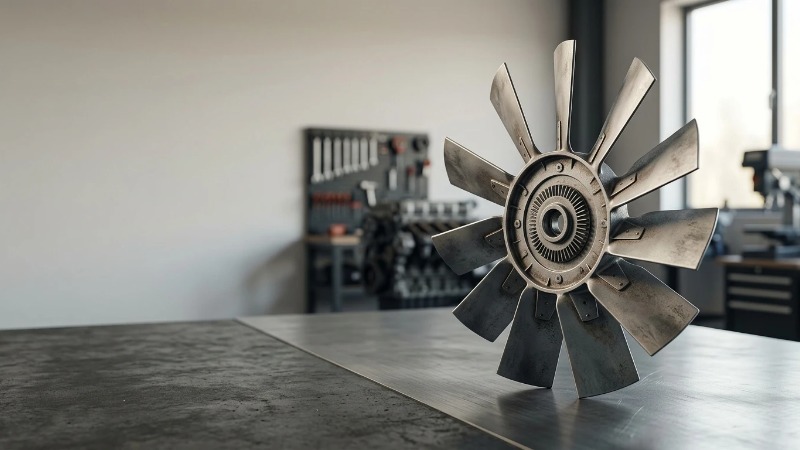
An Engine Fan Blade is a set of angled vanes that spin to pull air across the radiator core. As air moves through the fins, it carries away heat from the circulating coolant.
At low vehicle speeds, natural airflow is minimal. Therefore, the fan does most of the cooling work. This is precisely why fan integrity matters most during idling, climbing, and stop-start conditions.
The blade converts rotational energy from the engine or an electric motor into a strong directional airstream. However, when the geometry of that blade changes—through cracks, warping, or missing material—airflow drops and temperatures climb.
Think of the blade as an air pump. Its efficiency depends entirely on shape and balance. Even a slight distortion, therefore, reduces the volume of air it can move.
In addition, the pitch angle of each vane is engineered for a specific engine and radiator pairing. As a result, using a mismatched or generic blade can quietly undermine cooling performance from day one.
1.2 Core Components of the Cooling Fan Assembly
The fan blade never works alone. Instead, it is part of an integrated assembly, and a fault in any member can accelerate blade wear.
- Fan blade: The rotating vanes that generate airflow.
- Fan clutch: Engages or disengages the fan based on temperature demand.
- Fan shroud: Directs and concentrates airflow through the radiator.
- Viscous coupling: Modulates fan speed using temperature-sensitive fluid.
- Drive mechanism: Belts, pulleys, or an electric motor that spins the assembly.
Because these parts interact so closely, a worn clutch or damaged shroud can transfer stress directly to the blade. That interdependence, in fact, is a recurring theme throughout this guide.
Consider the shroud, for example. When it cracks or shifts, air recirculates instead of flowing cleanly through the radiator. Consequently, the blade spins harder for less cooling, which shortens its life.
The viscous coupling deserves similar respect. As its fluid ages, engagement becomes unpredictable. Over time, this irregular behavior loads the blade roots and speeds up fatigue.
For a deeper look at how these assemblies vary between models, you can browse our full range of truck systems and configurations. This overview helps you match components to your exact application.
1.3 Fan Blade Types: Mechanical, Viscous & Electric
Not all cooling fans behave the same way. In practice, the drive system defines how the blade responds to engine load and temperature.
| Fan Type | Drive Method | Typical Application | Key Advantage |
|---|---|---|---|
| Mechanical | Direct belt/pulley | Older heavy-duty engines | Simple, robust |
| Viscous | Temperature-sensitive clutch | Modern tractors and prime movers | Fuel efficiency |
| Electric | Electric motor | Light and medium trucks | Precise control |
Each system carries distinct failure modes. Viscous fans, for example, are prone to clutch fluid degradation. Mechanical fans, by contrast, stress the blade continuously at all engine speeds.
Electric fans introduce yet another set of variables. Because they rely on sensors and motors, an electrical fault can stop cooling entirely, even when the blade itself is perfect.
Understanding your fan type, therefore, is the foundation of accurate diagnosis. Once you know the drive method, you can predict the most likely failure path and inspect accordingly.
1.3.1 Application in FAW Heavy Duty Tractor Trucks
The FAW heavy duty tractor truck lineup typically uses a viscous or clutch-driven fan matched to its high-torque diesel engines. These configurations balance cooling performance with fuel economy on long routes.
In FAW J6 tractor truck for export models, cooling assemblies are often specified for elevated ambient temperatures. That specification matters greatly for fleets operating in tropical or desert climates.
For instance, a truck destined for the Middle East may carry a heavier-duty clutch than the same model sold for temperate regions. As a result, ordering the correct cooling package upfront prevents chronic overheating later.
To explore complete vehicle configurations, procurement teams can review our full FAW brand product range for detailed specifications and cooling system options.
2. Common Causes of Engine Fan Blade Damage
Understanding engine fan blade damage causes is the first step toward prevention. Most failures, fortunately, trace back to a handful of predictable root causes.
By recognizing these patterns early, maintenance teams can intervene before a minor issue becomes a roadside breakdown. So let’s examine each cause in detail.
2.1 Material Fatigue and Stress Cracking
Every rotation subjects the blade to centrifugal force and thermal cycling. Over thousands of hours, these repeated stresses create microscopic cracks in the material.
These cracks grow gradually and often go unnoticed. Eventually, however, they reach a critical length where the blade fractures suddenly—sometimes at high RPM.
This slow degradation is exactly why engine cooling fan blade failure frequently appears without warning. Regular inspection, therefore, is the only reliable way to catch it in time.
It helps to picture the process. First, a tiny surface flaw forms. Then, with each hot-cold cycle, it deepens. Finally, one ordinary startup pushes it past the breaking point.
Because fatigue is cumulative, the risk rises steadily with age. For this reason, high-hour blades warrant closer scrutiny even when they still look intact.
2.2 Foreign Object Impact and Debris
Road debris, gravel, and dislodged engine components can strike the spinning blade. Even a small impact at high speed can chip or bend a vane.
Once a blade is chipped, its balance is compromised. That imbalance, in turn, accelerates wear across the entire assembly, including bearings and the clutch.
Vocational trucks operating on unpaved sites face the highest risk. Consequently, debris ingestion is a leading trigger of physical blade failure in these environments.
A cracked or failing radiator can also shed fragments. Moreover, a loose fan bolt or a broken belt can whip into the blade, causing instant damage.
To reduce this risk, keep the engine bay clean and the shroud intact. In addition, address any rattling component promptly before it works loose and reaches the fan.
2.3 Worn Fan Clutch and Bearing Failure
A degrading fan clutch introduces jerky, uneven engagement. This irregular motion, in turn, places sudden torsional loads on the blade roots.
Proper worn fan clutch diagnosis is therefore essential when investigating blade damage. A failing clutch often precedes and even causes blade cracking.
Similarly, worn bearings allow the fan to wobble. That wobble then translates into vibration that fatigues the blade material over time.
Because these parts fail together, treating them as a set makes sense. If you replace a blade but ignore a tired clutch, you simply invite the next failure.
If clutch or bearing symptoms exceed your workshop’s comfort zone, our technical support team can guide you through a structured evaluation.
2.4 Improper Installation and Balancing
Installation errors are surprisingly common. Incorrect torque, missing spacers, or misaligned mounting can all doom a new blade prematurely.
An unbalanced fan generates harmful vibration from the moment it starts spinning. This vibration, over time, shortens the life of the blade, the clutch, and adjacent components.
Rushed work is often the underlying cause. When a technician skips the balance check to save minutes, the truck may return with a failure within weeks.
Furthermore, reusing old spacers or damaged bolts introduces hidden stress. Small details like these, consequently, determine whether a repair lasts years or fails quickly.
For guidance on correct procedures, technicians can lean on the resources within our technical support library for installation best practices.
2.5 Corrosion, Age & Environmental Factors
Metal fan blades exposed to road salt, moisture, and chemicals slowly corrode. Corrosion weakens the material and provides starting points for cracks.
Age alone is a factor too. Even well-maintained blades reach the end of their fatigue life eventually and must be replaced.
Export fleets facing high humidity, coastal air, or extreme heat see accelerated degradation. Therefore, environmental exposure should always factor into replacement scheduling.
Plastic and composite blades are not immune either. Ultraviolet exposure and heat can make them brittle, so they crack more easily upon impact.
For fleets in tough climates, choosing corrosion-resistant materials pays dividends. In the long run, the small premium is far cheaper than repeated replacements.
2.5.1 Data Table: Leading Causes of Fan Blade Failure by Frequency
The following distribution reflects common field observations from heavy-duty fleet maintenance records compiled through 2026.
| Failure Cause | Approximate Frequency | Typical Severity |
|---|---|---|
| Material fatigue / stress cracking | 32% | High |
| Worn fan clutch / bearing | 24% | High |
| Foreign object impact | 18% | Medium-High |
| Improper installation / balancing | 15% | Medium |
| Corrosion / environmental | 11% | Medium |
Notice that fatigue and clutch-related issues together account for more than half of all failures. This clearly underscores the value of routine inspection over reactive repair.
In practical terms, most failures are preventable. If you address the top two causes systematically, you eliminate the majority of your risk.
3. Symptoms of a Failing Engine Fan Blade
Recognizing the symptoms of failing fan blade early can prevent a minor annoyance from becoming a major engine repair. The warning signs are usually detectable if you know what to look and listen for.
Drivers and technicians alike should treat these symptoms as urgent. After all, ignoring them almost always leads to escalating damage.
3.1 Unusual Noises: Rattling, Humming & Whirring
A healthy fan runs with a smooth, consistent tone. So when you hear rattling, humming, or an intermittent whirring, something is off.
Rattling often signals a loose or cracked blade. Humming or roaring at certain RPMs, meanwhile, may indicate a stuck clutch driving the fan too aggressively.
These acoustic clues are among the earliest and most accessible warning signs. Therefore, encourage drivers to report any change in fan sound immediately.
A clicking noise that rises with engine speed is another red flag. In most cases, it points to a component contacting the shroud or a fractured vane.
3.2 Visible Cracks, Chips & Warping
Among cracked fan blade symptoms, visible damage is the most definitive. Hairline cracks near the blade root, in particular, are especially dangerous.
Chips along the leading edge reduce airflow and create imbalance. Warping, meanwhile, often results from prolonged heat exposure or impact.
During any engine bay inspection, examine each blade with a flashlight. Specifically, look closely at the hub and root area where stress concentrates most.
A wipe with a clean rag can reveal fine cracks hidden under grime. In addition, running a fingernail across suspect areas often catches edges the eye misses.
3.3 Engine Overheating from Fan Damage
A damaged blade moves less air, and less airflow means poorer cooling. The result is engine overheating from fan damage, particularly at low speeds or under heavy load.
If your temperature gauge climbs while idling but stabilizes at highway speed, suspect the fan. This pattern, in fact, is a classic indicator of insufficient fan-driven airflow.
Persistent overheating threatens the head gasket, cylinder head, and other costly components. For that reason, it should never be dismissed as a minor concern.
Watch for a slow creep back to normal after you accelerate. That behavior strongly suggests the fan, rather than the radiator, is the weak link.
3.4 Excessive Vibration at Idle and RPM
An imbalanced fan blade produces noticeable vibration. You may feel it through the cab or, alternatively, see it in the engine bay while idling.
This vibration worsens as RPM increases. Left unaddressed, it then damages bearings, mounts, and the radiator itself.
Vibration is both a symptom and an accelerant of failure. In other words, it signals existing damage while simultaneously creating more.
Because vibration spreads through the whole engine, early action protects far more than the fan. Consequently, treating it promptly saves you from a cascade of related repairs.
3.5 Coolant Warning Lights and Temperature Spikes
Modern trucks monitor coolant temperature closely. As a result, a dashboard warning light or sudden temperature spike often points to reduced cooling capacity.
When these alerts appear, the fan system should be part of your investigation. A failing blade, though sometimes overlooked, is a frequent cause.
Always treat coolant warnings as time-sensitive. Continued operation under high temperature, after all, can cause irreversible engine harm.
If a warning appears on the road, pull over safely and let the engine cool. Then arrange an inspection before driving further, because pushing on risks major damage.
3.5.1 Symptom-to-Cause Diagnostic Table
This quick-reference table helps field technicians map observable symptoms to likely underlying causes for faster diagnosis.
| Observed Symptom | Most Likely Cause | Recommended Action |
|---|---|---|
| Rattling at idle | Cracked or loose blade | Visual inspection, replace if cracked |
| Constant roaring fan | Seized fan clutch | Test clutch engagement |
| Overheating at low speed | Weak fan airflow / clutch slip | Check clutch and blade integrity |
| Cab vibration at RPM | Blade imbalance | Balance test, replace blade |
| Coolant temp spikes | Reduced airflow | Full cooling system inspection |
Use this table as a starting point, not a final diagnosis. In every case, confirm findings with hands-on inspection and testing.
4. How to Diagnose Fan Blade Problems
A structured diagnostic workflow saves time and prevents misdiagnosis. Ideally, you follow a logical sequence from visual checks to functional testing.
The goal is to isolate the failing component quickly. In many cases, the fan blade and clutch must be evaluated together.
4.1 Visual Inspection Checklist
Begin every diagnosis with the engine off and cool. Above all, safety comes first when working near cooling fans.
- Inspect each blade for cracks, chips, and warping.
- Check the hub and mounting bolts for looseness.
- Examine the fan shroud for cracks or contact marks.
- Look for oil residue around the clutch, indicating a leak.
- Rotate the fan by hand to feel for roughness or resistance.
Document any findings with photos. A clear visual record, in turn, supports better maintenance decisions and warranty claims.
It also helps to compare against a known-good reference. That way, subtle warping or wear becomes obvious rather than debatable.
4.2 Worn Fan Clutch Diagnosis Procedure
The worn fan clutch diagnosis begins with a spin test. With the engine off, spin the fan by hand—it should rotate a few times then stop, rather than spin freely or seize.
Next, check for viscous fluid leaks around the clutch body. Leaking fluid, importantly, indicates the clutch can no longer modulate fan speed properly.
Finally, observe fan behavior during warm-up. A functioning clutch engages audibly as temperature rises, then quiets once the engine cools.
If any of these checks fails, treat the clutch as suspect. In that situation, replacing it alongside the blade is usually the wisest move.
4.3 Vibration and Balance Testing
For precise diagnosis, use a vibration analyzer or dial indicator. These tools, unlike the naked eye, quantify imbalance that would otherwise go undetected.
Mount the sensor near the fan hub and record readings across the RPM range. Excessive amplitude, in that case, confirms an imbalance requiring correction.
Balance testing is especially valuable after any blade or clutch replacement. Essentially, it verifies that the new assembly runs true before returning the truck to service.
4.4 When to Escalate to a Professional Mechanic
Some issues exceed routine maintenance scope. For example, suspected internal engine damage or complex clutch faults warrant professional attention.
If overheating persists after replacing the blade and clutch, deeper investigation is needed. The root cause, in such cases, may lie in the radiator, water pump, or thermostat.
Fleet operators seeking expert support can reach out through our contact page for technical guidance and parts assistance.
Escalating early is not a sign of weakness. On the contrary, it often prevents a small problem from spiraling into an expensive engine rebuild.
5. How to Fix Fan Blade Problems
Once the diagnosis is confirmed, the next question is how to resolve it. Knowing how to fix fan blade problems correctly, therefore, prevents repeat failures.
The right approach depends on the severity and location of the damage. So let’s walk through the decision process and repair steps.
5.1 Repair vs. Replacement Decision Framework
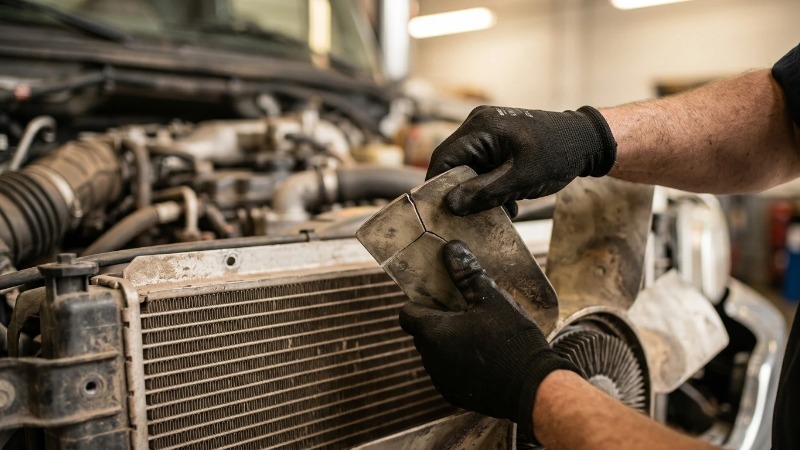
In general, a cracked fan blade should be replaced, not repaired. Attempting to weld or patch a cracked blade, indeed, risks catastrophic failure at speed.
Minor cosmetic marks that do not affect balance or structure may be acceptable. Any crack near the root, however, demands immediate replacement.
When in doubt, replace. Compared with the damage a failed blade can cause to the radiator and engine, a new blade is a modest and sensible investment.
5.2 Step-by-Step Fan Blade Replacement Guide
Here is a general procedure for cracked engine fan blade repair through replacement in heavy-duty applications. In all cases, consult the specific service manual for your vehicle.
- Disconnect the battery and allow the engine to cool completely.
- Remove the fan shroud to access the assembly.
- Loosen and remove the fan mounting bolts in a crisscross pattern.
- Carefully lift out the fan and clutch as a unit.
- Separate the damaged blade from the clutch or hub.
- Install the new blade, ensuring correct orientation and spacers.
- Torque all bolts to specification in stages.
- Reinstall the shroud and reconnect the battery.
Take your time with alignment. A rushed installation, after all, is the leading cause of premature repeat failure.
Before final assembly, double-check that the new blade matches the old one in size and pitch. Otherwise, a subtle mismatch could quietly undermine cooling later.
5.3 Fan Clutch and Bearing Replacement
Whenever you replace a blade damaged by clutch issues, replace the clutch too. Otherwise, reusing a worn clutch will simply destroy the new blade.
Inspect the fan bearing during this process. A rough or noisy bearing, likewise, must be replaced to prevent renewed vibration.
Addressing supporting components together restores the full system. This holistic approach, ultimately, is far more reliable than piecemeal repairs.
5.4 Proper Torque and Balancing After Installation
After installation, verify torque values with a calibrated wrench. Under-torqued bolts loosen; over-torqued bolts, on the other hand, stress the hub.
Run a balance check before releasing the truck. Even a factory-new blade, surprisingly, can arrive slightly out of balance.
Finally, monitor coolant temperature during a test drive. This step confirms that the repair has truly restored proper cooling under load.
5.4.1 Sourcing Quality Parts from a FAW Jiefang Spare Parts Supplier
Part quality directly affects durability. Sourcing from a reputable FAW Jiefang spare parts supplier, therefore, ensures OEM-grade materials and correct fitment.
Genuine components are engineered to the original balance and fatigue specifications. This precision matters enormously for a part that spins thousands of times per minute.
Fleets running FAW vehicles can source verified cooling components through our cooling system product range, which helps match parts to exact truck configurations.
In addition, quality parts often come with clear traceability and support. As a result, you gain peace of mind alongside the physical component.
6. Fan Blade Replacement Cost Analysis
Budgeting for repairs requires understanding all cost drivers. Both the fan blade replacement cost and the broader downtime impact, therefore, deserve careful consideration.
Rather than listing specific figures, this section focuses on the relative cost structure. This approach, importantly, remains useful regardless of regional pricing variation.
6.1 Parts Cost by Fan Blade Type
Different fan types carry different parts costs. In relative terms, mechanical blades tend to be the most economical.
| Fan Type | Relative Parts Cost | Complexity |
|---|---|---|
| Mechanical blade | Lowest | Simple |
| Viscous fan + clutch | Moderate to high | Moderate |
| Electric fan assembly | Highest | Complex |
Remember that the clutch often needs replacing alongside the blade. Accordingly, budget for both when planning a viscous fan repair.
6.2 Labor Cost Estimates
Labor depends on truck accessibility and shroud complexity. A straightforward mechanical fan swap, for instance, may take an hour or two.
Viscous and electric systems require more time. Shroud removal, clutch handling, and balance verification, in particular, all add labor hours.
Fleet shops with dedicated bays and trained technicians reduce labor time significantly. Efficiency here, in turn, directly lowers total repair cost.
6.3 Total Cost of Ownership Considerations
The worn fan blade replacement cost extends well beyond parts and labor. Downtime, in fact, is often the largest hidden expense.
An overheating event caused by a failed blade can damage the head gasket or engine block. These secondary repairs, consequently, dwarf the cost of a proactive blade swap.
Viewing fan maintenance as an investment in uptime reframes the decision entirely. Prevention, as the record consistently shows, costs less than reactive repair.
6.3.1 Cost Comparison: DIY vs. Professional Repair
The table below compares repair scenarios in relative terms, based on 2026 fleet maintenance patterns. It highlights trade-offs rather than absolute figures.
| Scenario | Relative Total Cost | Risk Level | Best For |
|---|---|---|---|
| DIY blade only | Lowest | Higher (balance risk) | Experienced in-house teams |
| Professional blade + clutch | Moderate | Low | Most fleet operators |
| Full assembly overhaul | Highest | Lowest | High-mileage or export fleets |
For critical vehicles, the professional route usually offers the best value. Ultimately, the reduced risk of repeat failure outweighs the modest cost premium.
To see how disciplined maintenance pays off in the field, browse our customer success stories. These real cases show how proactive planning protects fleet budgets.
7. Preventive Maintenance Best Practices
Prevention is the most cost-effective strategy of all. A disciplined maintenance program, quite simply, can dramatically extend fan blade life.
These practices also reduce unplanned downtime. For commercial fleets, moreover, predictable maintenance is a genuine competitive advantage.
7.1 Inspection Intervals and Scheduling
Incorporate fan blade checks into every scheduled service. A visual inspection takes only minutes, yet it catches early cracks reliably.
For high-duty vehicles, inspect more frequently. Vocational and off-road trucks, after all, accumulate stress faster than highway units.
Log every inspection in your maintenance system. Over time, trend data reveals wear patterns and helps predict replacement timing.
7.2 Coolant System Health and Fan Longevity
A healthy cooling system reduces demand on the fan. When the radiator, thermostat, and water pump work well, consequently, the fan runs less aggressively.
Maintain proper coolant concentration and cleanliness. Contaminated coolant, otherwise, leads to overheating that stresses the entire assembly.
Think of the cooling system as an integrated whole. In this sense, caring for every component protects the fan blade indirectly.
7.3 Operator Training and Early Warning Recognition
Drivers are your first line of defense. For this reason, train them to recognize unusual fan noises and temperature behavior.
A simple report of a new rattle can trigger an inspection that prevents a breakdown. In short, empowered operators catch problems early.
Provide a clear reporting channel so concerns reach maintenance quickly. Fast communication, in turn, converts symptoms into scheduled repairs rather than emergencies.
7.4 Choosing Durable Components for Export Fleets
Fleets operating FAW J6 tractor truck for export units face harsh climates. Component durability, therefore, becomes even more important in these conditions.
Select fan blades and clutches rated for high ambient temperatures. Corrosion-resistant materials, moreover, pay dividends in humid or coastal regions.
Learn how established suppliers support demanding fleets by visiting our company profile page to understand our quality standards and export experience.
8. Fan Blade Reliability Across Truck Applications
Fan blade wear varies by vehicle type and duty cycle. Understanding these differences, in turn, helps tailor maintenance to actual usage.
A one-size-fits-all schedule ignores real operating stress. Application-specific planning, by contrast, delivers better reliability.
8.1 Tractor Heads and Prime Movers
The FAW 6×4 tractor head and similar prime movers face sustained high-load cooling demands. Long grades and heavy trailers, after all, keep the engine working hard.
These vehicles benefit from robust viscous fan systems. Consistent airflow, in particular, protects the engine during extended climbs.
As a leading FAW prime mover supplier perspective suggests, matching the cooling package to the route profile is critical. The right specification, quite simply, prevents chronic overheating.
To compare prime mover options in detail, explore our FAW brand truck lineup. There, you can align each model with your typical load and terrain.
8.2 Dump Trucks and Vocational Vehicles
The FAW Jiefang dump truck operates in stop-start, high-load cycles. This pattern, in turn, places unique stress on the fan and clutch.
Frequent low-speed operation means the fan does most of the cooling work. That constant engagement, therefore, accelerates wear compared to highway duty.
Dust and debris on job sites add further risk. For this reason, more frequent inspection intervals are strongly recommended for vocational fleets.
8.3 Long-Haul vs. Regional Duty Cycles
Long-haul trucks cruise at steady speeds with strong natural airflow. As a result, their fans engage less often, which extends blade life.
Regional and urban trucks stop and start constantly. Their fans work harder, so wear accumulates faster despite lower mileage.
Match your maintenance schedule to the duty cycle, not just the odometer. In the end, real stress rather than distance drives fan blade fatigue.
9. Frequently Asked Questions (FAQ)
Below are answers to the most common questions fleet operators and technicians ask about engine fan blades.
9.1 How long does an engine fan blade last?
With proper maintenance, a quality fan blade often lasts the life of the engine or several hundred thousand kilometers. However, duty cycle and environment matter greatly. Vocational trucks in dusty, high-load conditions, for instance, may need replacement much sooner than long-haul units.
9.2 Can I drive with a cracked fan blade?
No. Driving with a cracked blade is dangerous because it can shatter at high RPM, damaging the radiator, engine, and surrounding components. A cracked blade also reduces airflow, which risks overheating. Therefore, replace it before returning the truck to service.
9.3 What is the average worn fan blade replacement cost?
Costs vary by fan type, truck model, and labor rates. Mechanical blades are the most economical, while viscous and electric systems cost more, especially when the clutch is replaced together. The larger consideration, however, is downtime and the risk of secondary engine damage from delayed repair.
9.4 How do I know if it’s the fan blade or the fan clutch?
Inspect the blade visually for cracks and chips, then spin the fan by hand to assess clutch resistance. A blade problem shows physical damage or imbalance vibration, whereas a clutch problem shows a constantly roaring fan or free-spinning behavior. In practice, both must often be evaluated together for an accurate diagnosis.
9.5 Where can I buy replacement fan blades for FAW commercial trucks?
Genuine replacement blades and cooling components are available through an established Chinese FAW truck manufacturer or authorized parts supplier. For fleets sourcing Chinese FAW commercial trucks wholesale, working with a verified partner ensures correct fitment and OEM quality. Visit our homepage to begin a parts inquiry.
9.6 Should I replace both fan blades on a dual-fan setup at once?
Generally, yes. When one blade fails from age or fatigue, its twin is usually close behind. Replacing both together, therefore, restores balanced airflow and avoids a second round of downtime. For guidance on your specific configuration, our technical support team can advise.
9.7 How can I reduce fan blade failures across my whole fleet?
Start with consistent inspection intervals and driver training. Then standardize on quality parts and match maintenance to each vehicle’s duty cycle. Finally, track failures to spot patterns. Many fleets that adopt this approach see results similar to our documented cooperative case studies.
10. Conclusion & Next Steps
Engine fan blade health is central to reliable heavy-duty truck operation. From material fatigue to clutch wear, the causes are predictable and the symptoms detectable.
By combining regular inspection, correct repair, and quality parts, fleets can virtually eliminate unexpected fan failures. Prevention, once again, consistently outperforms reactive repair on both cost and uptime.
10.1 Key Maintenance Takeaways
- Inspect fan blades at every service for cracks, chips, and imbalance.
- Always evaluate the fan clutch alongside the blade.
- Replace cracked blades immediately—never attempt to repair them.
- Torque and balance every new installation carefully.
- Match maintenance intervals to real duty cycles, not just mileage.
These habits protect not only the fan but the entire engine. In the end, a small investment in vigilance prevents major repair bills.
10.2 Partner With a Trusted FAW Prime Mover Supplier
Reliable trucks start with reliable partners. As an established Chinese FAW truck manufacturer and exporter, we supply durable FAW Jiefang J6 heavy duty truck models along with genuine cooling components engineered for demanding fleets.
Whether you need a complete FAW J6 tractor truck for export, a robust FAW Jiefang dump truck, or verified spare parts, our team is ready to support your operation from procurement through after-sales service. To learn more about who we are, visit our about us page.
Ready to strengthen your fleet’s reliability? Explore our full truck brand catalog, review real cooperative case studies, and contact our team today to source dependable trucks and genuine FAW spare parts. Partner with a trusted supplier and keep your fleet moving.


