
Introduction
A lorry front axle is one of the most important structural and safety-related components in a heavy-duty commercial vehicle. Although engines, gearboxes and rear drive axles often receive more attention, the front axle plays a critical role in steering control, front-end load support, braking stability and overall road handling. For fleet operators, repair workshops and parts buyers, understanding how a lorry front axle works can help reduce downtime, improve safety and support better purchasing decisions.
In commercial vehicles, axles are not simply metal beams connecting wheels. They support vehicle weight, allow wheel rotation and provide mounting points for suspension and braking systems.1 The front axle is especially important because it carries the front portion of the vehicle while helping the driver control direction through the steering system. When it is correctly specified and maintained, it contributes to predictable handling, even tyre wear and reliable long-distance operation.
What Is a Lorry Front Axle?
A lorry front axle is the axle assembly located at the front of a lorry or truck. Its main purpose is to support the front-end weight of the vehicle and connect the front wheels to the steering, suspension and braking systems. In most road-going lorries, the front axle is a steer axle, meaning it allows the wheels to pivot left and right so the vehicle can change direction.
In practical terms, the front axle must perform several tasks at the same time. It needs to be strong enough to carry vertical load, precise enough to maintain steering geometry, durable enough to withstand road shocks and compatible with braking and suspension components. This combination makes the lorry front axle a key factor in both vehicle safety and operating efficiency.
A front steer axle is not only a load-bearing component; it is also a directional-control component. If the axle, steering linkage or related suspension parts are worn or incorrectly aligned, the vehicle may become harder to control, especially under heavy load or long-distance operating conditions.
How a Lorry Front Axle Works
The front axle works as part of a larger system. The axle beam or axle housing supports the wheel ends, while kingpins, steering knuckles, tie rods and related steering components allow the wheels to turn. Suspension parts absorb road impact, and the braking system uses the axle area as a mounting location for wheel-end brake components.
When the driver turns the steering wheel, the steering system transfers movement to the front axle assembly. The steering knuckles pivot around the kingpins, changing the direction of the front wheels. At the same time, the axle continues to carry front-end load and maintain stable contact between the tyres and the road surface. This is why front axle condition directly affects steering response, tyre wear, braking stability and driver confidence.
The following table summarizes the main functions of a lorry front axle.
| Function | What It Means for the Vehicle | Why It Matters |
| Front load support | Carries the front portion of the chassis, cab, engine and cargo load distribution | Prevents structural stress and supports safe vehicle operation |
| Steering control | Allows front wheels to pivot through steering linkage and knuckles | Determines directional stability and manoeuvrability |
| Suspension mounting | Works with leaf springs, air suspension or other suspension systems | Improves ride comfort, road handling and component protection |
| Brake system support | Provides mounting areas for wheel-end braking components | Helps maintain safe stopping performance |
| Wheel alignment stability | Maintains correct wheel angles when properly installed and adjusted | Reduces tyre wear and improves fuel efficiency |
Main Types of Lorry Front Axles
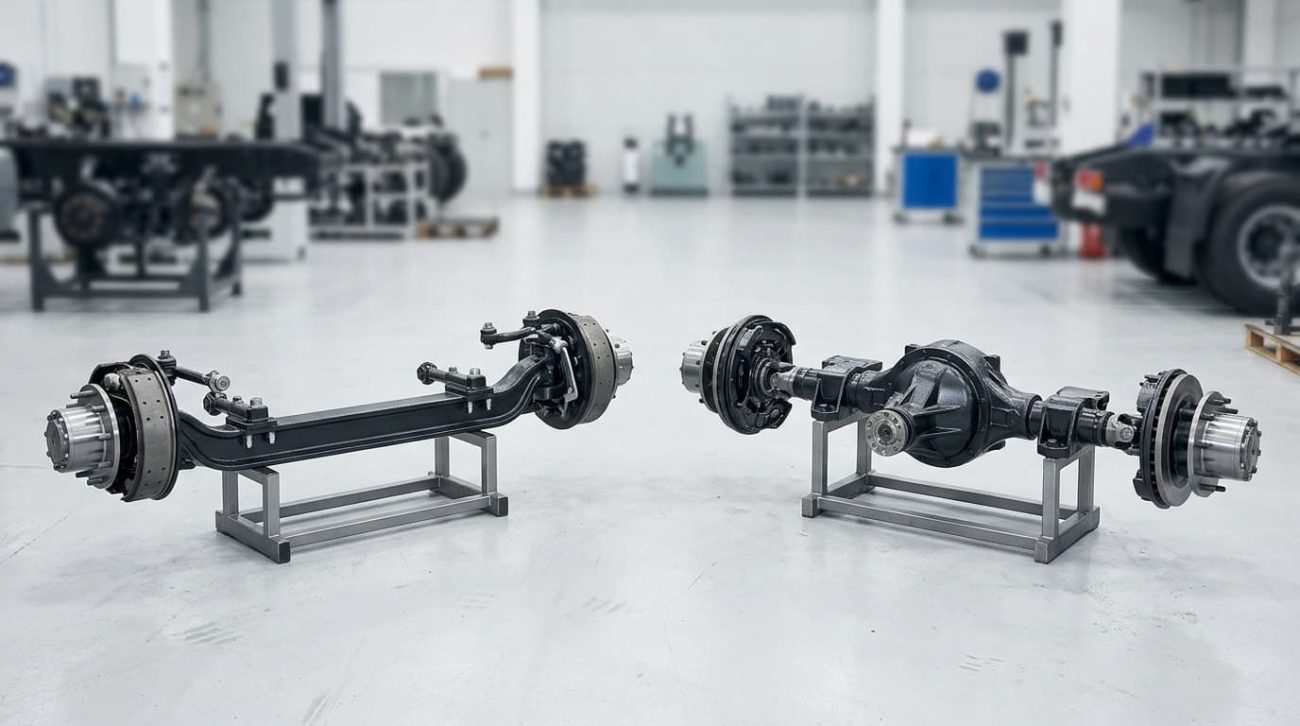
Not all front axles are the same. The right design depends on vehicle configuration, operating environment, load requirement and whether the vehicle needs front-wheel drive capability. Modern commercial vehicle axle manufacturers offer both non-drive steer axles and front drive steer axles for different heavy-duty applications.2
1. Non-Drive Front Steer Axle
A non-drive front steer axle is the most common front axle type for standard road-going lorries. It does not transmit engine power to the front wheels. Instead, its primary purpose is steering, front-end support and wheel-end stability. This type is widely used in delivery trucks, long-haul lorries, rigid trucks and many tractor units.
The main advantages of a non-drive lorry front axle are simplicity, lower weight and easier maintenance compared with a driven front axle. Because it does not include drive shafts or differential components, it is often more cost-effective for vehicles that operate mainly on highways and paved roads.
2. Front Drive Steer Axle
A front drive steer axle combines steering function with power transmission. It can send torque to the front wheels while still allowing them to turn. This design is commonly used in all-wheel-drive heavy-duty vehicles, construction trucks, mining vehicles, military vehicles, logging trucks and off-highway applications where traction is essential.
Compared with a non-drive axle, a front drive steer axle is more complex and usually heavier. However, it provides better traction in difficult terrain, poor weather or soft ground conditions. Cummins, for example, highlights front drive axles for heavy-duty all-wheel-drive applications where durability and reliability are required.2
3. Heavy-Duty Front Axle for Special Applications
Some commercial vehicles require front axles with higher rated capacity or application-specific geometry. Fire trucks, emergency vehicles, construction lorries and vocational trucks may need reinforced front axles because they carry heavy front-mounted equipment, operate under severe duty cycles or require special suspension packaging. In such cases, the correct axle capacity and beam design are essential for long service life.
| Front Axle Type | Best Used For | Key Advantage | Typical Consideration |
| Non-drive front steer axle | Highway lorries, delivery trucks, rigid trucks | Simple, durable and efficient | Not suitable for traction-demanding off-road use |
| Front drive steer axle | AWD trucks, construction, mining, military and logging vehicles | Adds traction while steering | More complex and usually higher maintenance cost |
| Heavy-duty vocational front axle | Emergency, refuse, heavy haul and special-purpose vehicles | Higher capacity and application-specific fit | Must match axle rating, suspension and chassis design |
Lorry Front Axle vs Other Truck Axles
A lorry may use several axle types depending on its design and payload requirements. The front axle is usually associated with steering, while rear drive axles transmit power from the drivetrain to move the vehicle. Additional axles, such as tag axles and pusher axles, can help distribute weight and increase legal payload capacity.1
Understanding these differences helps buyers avoid choosing the wrong component. A front axle must be evaluated primarily by steering geometry, load rating, compatibility and wheel-end design. A rear drive axle, by contrast, must be assessed by torque capacity, gear ratio, differential design and traction requirements.
| Axle Type | Position | Powered? | Main Purpose |
| Lorry front axle / steer axle | Front | Usually no, except front drive axles | Steering control and front load support |
| Drive axle | Usually rear | Yes | Transfers engine power to the wheels |
| Tag axle | Behind drive axle | No | Adds load capacity and improves weight distribution |
| Pusher axle | Ahead of drive axle | No | Helps distribute weight and improve stability |
| Trailer axle | Trailer section | No | Supports trailer load and improves payload distribution |
Why the Lorry Front Axle Matters for Safety and Performance
The lorry front axle has a direct effect on vehicle safety because it influences steering control, tyre contact and braking stability. If the front axle is overloaded, worn or incorrectly aligned, the driver may experience poor handling, uneven tyre wear, pulling to one side or unstable braking. These issues can be especially serious in long-haul transport, where fatigue, high mileage and heavy loads increase operational risk.
Weight distribution is another important factor. Axle arrangement affects vehicle weight distribution, turning radius and road impact.1 A front axle that is not properly matched to the vehicle’s load profile may suffer premature wear or compromise steering performance. For fleet managers, this means the lorry front axle should never be selected only by price. Rated capacity, application, road condition and maintenance support must all be considered.
Fuel efficiency can also be affected indirectly. Poor wheel alignment or worn axle components can increase rolling resistance and accelerate tyre wear. Although the front axle does not always drive the vehicle, it still contributes to total operating cost through maintenance, tyre life and vehicle stability.
Common Signs of Lorry Front Axle Problems
Front axle problems often develop gradually. Early detection is important because minor wear in steering or wheel-end components can lead to more expensive failures if ignored. Drivers and maintenance teams should pay close attention to changes in steering feel, tyre wear and vehicle behaviour.
Common warning signs include vibration through the steering wheel, uneven front tyre wear, knocking noises over bumps, steering pull, visible axle beam damage, leaking wheel-end components or excessive play in the kingpin area. If a vehicle becomes difficult to keep straight, feels unstable when braking or shows abnormal tyre patterns, the front axle assembly and related steering components should be inspected promptly.
| Symptom | Possible Cause | Recommended Action |
| Uneven front tyre wear | Poor alignment, worn kingpins or bent axle beam | Check alignment and inspect steering components |
| Steering wheel vibration | Wheel imbalance, worn wheel-end parts or loose components | Inspect tyres, hubs, bearings and steering linkage |
| Vehicle pulls to one side | Incorrect alignment, brake drag or suspension imbalance | Diagnose alignment, brakes and suspension together |
| Knocking or clunking noise | Worn bushings, loose fasteners or kingpin wear | Perform front-end inspection before continued heavy use |
| Poor steering response | Excessive play in linkage or worn axle-related components | Repair or replace worn parts immediately |
Lorry Front Axle Maintenance Tips
A well-maintained lorry front axle can deliver long service life and safer vehicle operation. Maintenance should not be limited to visual inspection. It should include lubrication, torque checks, wheel alignment, kingpin inspection, bearing assessment and brake component inspection. Because the front axle works closely with the steering and suspension systems, technicians should treat it as part of an integrated front-end system rather than an isolated component.
Regular lubrication is essential for components such as kingpins and bushings where applicable. Insufficient lubrication increases friction and accelerates wear. Alignment should also be checked periodically, especially after suspension repairs, tyre replacement, accident damage or repeated operation on rough roads. In fleet operations, scheduled inspection intervals help prevent unexpected downtime and reduce long-term cost.
The following maintenance checklist can be used as a practical reference.
| Maintenance Area | What to Check | Why It Is Important |
| Axle beam | Cracks, bending, corrosion and accident damage | Structural integrity is essential for safe operation |
| Kingpins and bushings | Wear, excessive play and lubrication condition | Directly affects steering precision and tyre wear |
| Wheel bearings | Noise, play, heat and lubrication | Prevents wheel-end failure and improves reliability |
| Steering linkage | Tie rods, drag links, joints and fasteners | Maintains accurate steering response |
| Alignment | Toe, camber and caster where applicable | Reduces tyre wear and improves handling |
| Braking components | Brake mounting, wheel-end condition and imbalance | Supports stable and predictable braking |
| Suspension interfaces | Springs, air bags, bushings and U-bolts | Protects axle geometry and ride stability |
How to Choose the Right Lorry Front Axle
Choosing the right lorry front axle requires more than matching the part visually. The axle must be compatible with the vehicle’s gross weight, front axle load rating, suspension type, steering geometry, brake system and wheel-end configuration. Buyers should also consider whether the vehicle operates on highways, in cities, on construction sites or in off-road environments.
For standard road transport, a durable non-drive steer axle may be the best option because it offers a balance of strength, simplicity and operating efficiency. For off-highway or all-wheel-drive vehicles, a front drive steer axle may be necessary to provide the traction required for demanding terrain. For emergency, mining, refuse or heavy-haul applications, the axle should be selected according to duty cycle and rated capacity.
When comparing suppliers, buyers should ask for technical specifications, rated load capacity, material quality, compatibility information and after-sales support. A lower-cost axle may become expensive if it causes poor fitment, premature wear or repeated downtime. The best lorry front axle is the one that matches the vehicle application and delivers reliable long-term performance.
| Selection Factor | Why It Matters | Buyer’s Question |
| Rated capacity | Prevents overloading and premature failure | Does this axle meet or exceed the required front axle load? |
| Vehicle application | Highway and off-road vehicles have different needs | Is the axle designed for my operating environment? |
| Steering geometry | Ensures safe handling and correct wheel alignment | Is it compatible with the original steering system? |
| Brake compatibility | Supports safe stopping performance | Does it match the required brake configuration? |
| Suspension fitment | Prevents installation issues | Is it compatible with leaf spring, air suspension or other suspension type? |
| Parts availability | Reduces downtime | Are replacement parts and service support available? |
FAQ: Lorry Front Axle
What is the main function of a lorry front axle?
The main function of a lorry front axle is to support the front weight of the vehicle and enable steering. It also works with suspension and braking systems to maintain road handling, braking stability and driver control.
Is a lorry front axle the same as a steer axle?
In most commercial vehicles, the lorry front axle is also called a front steer axle because it allows the front wheels to turn. However, some front axles are also drive axles, especially in all-wheel-drive or off-highway trucks.
How often should a lorry front axle be inspected?
Inspection intervals depend on mileage, duty cycle and operating conditions. For heavy-duty or high-mileage fleets, the front axle should be inspected during regular preventive maintenance, and immediately if the driver reports vibration, pulling, abnormal noise or uneven tyre wear.
What causes front axle failure in lorries?
Common causes include overloading, poor lubrication, worn kingpins, damaged bearings, incorrect alignment, impact damage, corrosion and lack of scheduled maintenance. Severe-duty vehicles are more likely to experience accelerated wear if the axle is not correctly specified.
How do I know which lorry front axle to buy?
You should check the vehicle model, front axle load rating, suspension type, brake configuration, steering geometry and operating environment. If the vehicle works in off-road or high-load conditions, consult the axle supplier or manufacturer before purchase.
Conclusion
A lorry front axle is a critical component for steering control, load support, braking stability and overall commercial vehicle safety. By understanding how it works, how it differs from other truck axles and what signs indicate wear or failure, fleet operators and parts buyers can make better maintenance and purchasing decisions.
For the best long-term value, choose a lorry front axle that matches the vehicle’s rated capacity, application and operating environment. Whether the vehicle is used for highway delivery, construction, heavy haul or off-highway work, the right front axle can improve reliability, reduce downtime and support safer driving performance.


