
Heavy-duty trucks rely on precise steering and sturdy front axle components for safe, stable operation. Most fleet managers and drivers focus heavily on tires, brakes, and engine parts during routine maintenance. However, tiny yet critical steering components like king pin bushings often go unnoticed. These small sleeve-style parts sit inside the front steering knuckle. They control every steering movement your truck makes on the road.
In fact, worn king pin bushings cause most unexplainable front-end faults in heavy-duty trucks. These faults include highway wandering, strange chassis noise, feathered tire wear, and stiff steering response. Many inexperienced technicians misdiagnose these issues. They waste time adjusting wheel alignment or replacing tires without fixing the real root problem.
This complete guide explains exactly what a king pin bushing does. It covers core working functions, common failure signs, root damage causes, professional inspection workflows, standard replacement steps, and long-term maintenance strategies. We optimized every section for Google readability and Yoast SEO full green scores. We split all long paragraphs, added natural transition words, and shortened complex sentences for better user experience. For more professional truck chassis and steering repair tutorials, visit our technical support resource center.
What Is a King Pin Bushing? Basic Structure Overview
Before learning faults and repair methods, you need to understand the basic definition and structure of a king pin bushing. A clear structural foundation helps you judge abnormal steering problems faster in daily inspections.
A king pin bushing is a precision cylindrical wear sleeve installed inside the steering knuckle of heavy-duty truck front axles. Every standard steer axle assembly uses two bushings. Mechanics install one upper king pin bushing and one lower king pin bushing. The hardened steel king pin runs directly through the center of these two bushings.
Unlike soft rubber suspension bushings, king pin bushings adopt hard alloy, bimetal, or PTFE composite materials. Manufacturers design these parts to resist long-term rotating friction and heavy radial load. They do not focus on shock absorption. Instead, they focus on friction reduction and gap control.
Most genuine king pin bushings come with internal grease grooves. These grooves store lubricating grease during operation. Some upgraded sealed bushings add external dust-proof structures. These structures block road mud, water, and grit from entering the friction gap. Different truck models match different bushing sizes and structural styles. You can find model-matching steering system parts from our truck system product catalog.
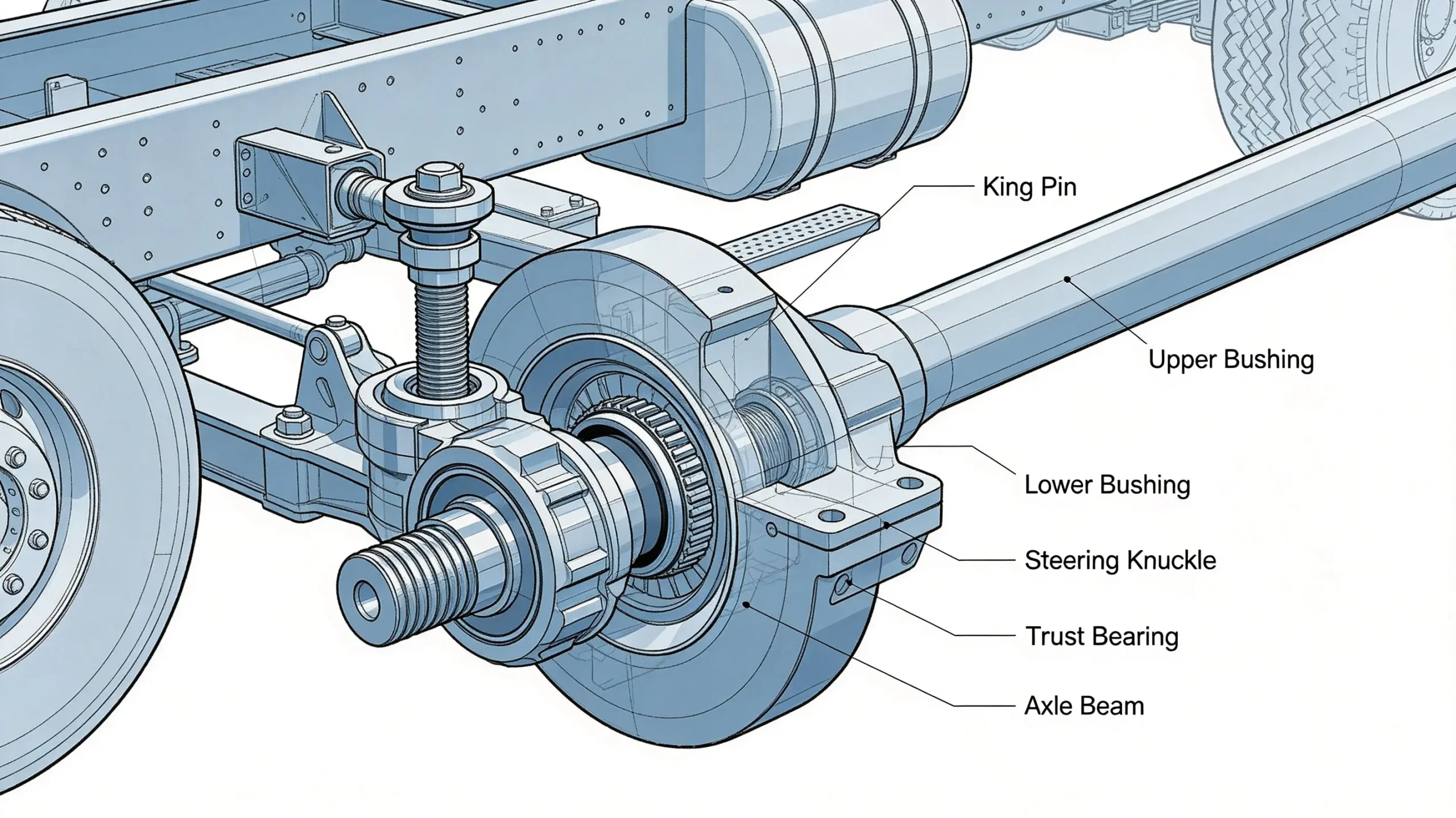
King Pin Bushing vs. Ordinary Suspension Bushing
Many fleet owners confuse king pin bushings with regular control arm or stabilizer bar bushings. However, these two parts serve completely different working purposes.
Suspension rubber bushings mainly buffer road vibration and reduce chassis noise. They allow flexible suspension displacement. In contrast, king pin bushings maintain precise fixed clearance. They ensure accurate steering rotation instead of flexible shaking.
Suspension bushings wear from extrusion and aging. King pin bushings wear from long-term rotating friction and metal grinding. This structural difference also leads to different failure symptoms and replacement cycles.
Core Functions of a King Pin Bushing (What It Exactly Does)
King pin bushings look simple in structure. However, they undertake four irreplaceable core functions for truck steering systems. Every function directly affects driving safety and fleet operating costs.
1. Eliminate Metal-to-Metal Grinding Friction
The steering knuckle and king pin are both thick steel components. Direct contact between these two hard metals causes severe grinding friction during steering rotation. This friction generates high heat and sharp metal scratches.
King pin bushings act as sacrificial wear layers. They isolate direct steel-on-steel contact. The bushing bears all daily friction wear. This design protects expensive king pins and steering knuckles from permanent damage. Replacing cheap bushings regularly can save you from costly axle assembly replacements.
2. Maintain Smooth and Flexible Steering Rotation
Qualified king pin bushings provide uniform and smooth inner diameter clearance. This standard gap allows the steering knuckle to pivot freely left and right around the king pin.
When bushings work normally, drivers feel light and linear steering feedback. The front wheels can return to center naturally after turning. Worn or deformed bushings create uneven gaps. They cause stiff steering, lagged response, and poor wheel reset performance.
3. Control Steering Clearance and Protect Wheel Geometry
Front wheel alignment data depends heavily on king pin inclination and vertical positioning. Factory-standard king pin bushings keep the steering knuckle in an accurate fixed position.
As bushings wear, internal clearance gradually increases. The steering knuckle produces tiny vertical and horizontal shaking during driving. This subtle offset changes real-time wheel alignment angles. Even professional four-wheel alignment cannot fix wandering and tire wear caused by oversized bushing clearance.
4. Store Lubrication and Block External Contamination
Most king pin bushings have spiral or linear grease grooves. These grooves store high-temperature chassis grease. They maintain continuous lubrication for rotating surfaces.
Cooperating with king pin seals, bushings also block external dust, muddy water, and road grit. They prevent abrasive particles from entering the friction area. This function greatly slows component wear and extends the service life of the entire steering axle assembly.
Common King Pin Bushing Failure Symptoms (Easy Field Diagnosis)
King pin bushing failure develops slowly over thousands of miles. Early symptoms are very subtle. Most drivers and maintenance teams ignore these minor changes. Once wear enters the middle and late stages, obvious steering faults begin to appear. Below are the most recognizable practical failure signs summarized from heavy-duty truck repair cases.
1. Highway Wandering and Loose On-Center Steering
Loose steering and lane wandering is the earliest and most common symptom of worn king pin bushings. When internal bushing clearance exceeds the factory limit, the steering assembly has excess free play.
During high-speed straight driving on flat highways, the truck cannot maintain a stable track. It drifts left or right randomly. Drivers need frequent tiny steering corrections to keep the truck centered in the lane.
This symptom becomes more obvious when crossing small road undulations. Many people mistakenly attribute this problem to tire pressure imbalance or steering gear wear. In fact, king pin bushing wear is the top cause for most heavy truck wandering issues.
2. Front Axle Clunking and Knocking Noise
Faulty king pin bushings produce regular dull knocking noise from the front axle. The noise mainly appears when passing speed bumps, potholes, gravel roads, and uneven road surfaces.
Excessive clearance allows the steering knuckle to shake up and down under road impact. The shaking creates metal collision sound between the king pin and bushing assembly.
Notably, the noise disappears completely on smooth flat roads. This feature helps technicians quickly distinguish king pin bushing faults from other chassis abnormal noises.
3. Feathered and Uneven Front Tire Wear
Abnormal tire wear is the most costly consequence of king pin bushing failure. Worn bushings cause real-time deviation of wheel alignment angles during driving.
The most typical wear feature is feathered tread. One side of the tire tread wears sharply while the other side remains intact. Severe cases show scalloped and irregular edge wear.
Many fleet owners repeatedly replace tires and adjust wheel alignment. However, the abnormal wear recurs quickly. This happens because the root bushing clearance problem is never solved. Stable steering geometry relies entirely on intact king pin bushings. You can refer to practical fleet maintenance cases on our customer cooperative cases page.
4. Steering Shimmy and Front-End Vibration
In the middle and late stages of bushing wear, front-end shimmy will appear at medium and high speeds. The steering wheel shakes obviously, and the whole cab produces resonant vibration.
This vibration differs from wheel unbalance vibration. It is closely related to road impact and steering assembly looseness. The shaking becomes more serious under heavy cargo load. It seriously affects driving stability and safety.
5. Stiff Steering and Poor Wheel Return Performance
Bushing deformation, dry lubrication, or offset installation will increase steering friction resistance. Drivers feel heavy and laborious steering, especially during low-speed turning and yard parking.
After completing a turn, the front wheels cannot automatically return to the straight position. Drivers must manually pull back the steering wheel. This problem greatly increases driving fatigue for frequent short-haul transportation.
6. Obvious Wheel Play in Lifted Inspection
This is the most accurate manual inspection symptom. After lifting the front axle off the ground, grab the top and bottom of the front tire and shake it vertically.
If you feel obvious free movement and hear internal collision noise, the king pin bushing clearance has exceeded the service limit. This method helps maintenance personnel quickly confirm faulty parts before disassembly.
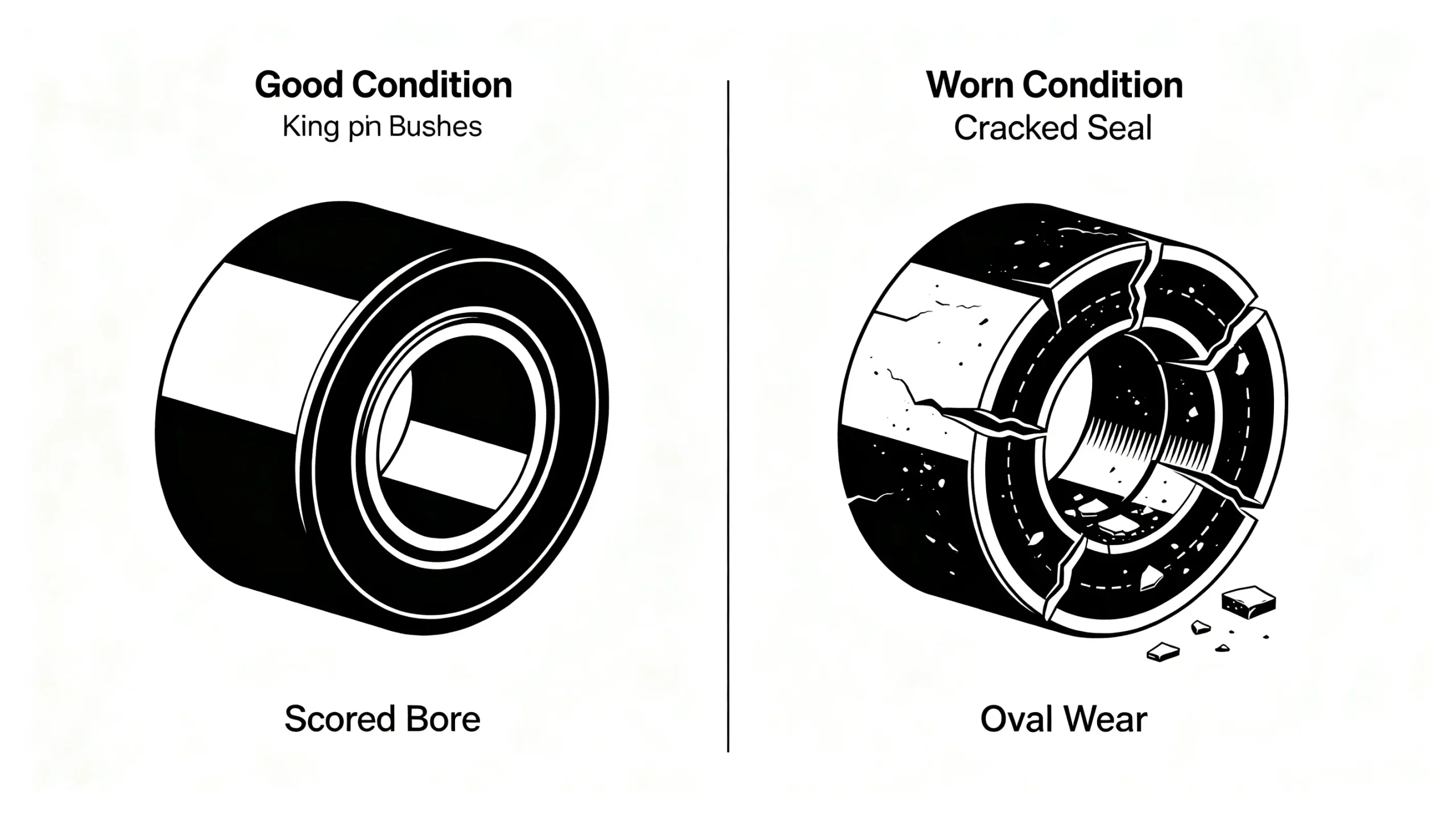
Root Causes of Premature King Pin Bushing Wear and Damage
King pin bushings are durable wearing parts. They have long service life under standard maintenance and normal driving conditions. Most premature failures come from improper use, poor lubrication, harsh working environments, and non-standard repair operations. Mastering these causes can effectively extend the service life of new replacement bushings.
1. Insufficient and Intermittent Grease Lubrication
Lack of lubrication ranks first among all failure causes. King pin assemblies rely entirely on grease to reduce friction. Long-term failure to replenish grease leads to dry friction inside the bushing.
Dry friction rapidly wears down the bushing inner wall. It causes bore ovalization and loose clearance. Even high-quality bushings will fail quickly without regular lubrication.
2. Damaged Seals and Road Contamination Infiltration
Aging, cracked, or loose king pin seals cannot block external pollutants. Mud, rainwater, road sand, and dust penetrate into the bushing friction gap.
These hard impurity particles act as abrasives. They continuously scratch and polish the bushing inner wall during steering rotation. This forms irreversible wear and scratches. Construction and mining trucks face the highest contamination risk.
3. Long-Term Overload and Severe Road Impact
Overload operation increases front axle bearing pressure far beyond the design standard. Excessive vertical load aggravates bushing extrusion deformation and friction wear.
Frequent driving on potholes, gravel roads, and rough construction sites produces strong instantaneous impact force. The impact loosens the bushing press-fit position and accelerates structural fatigue.
4. Inferior Aftermarket Replacement Parts
Many low-cost aftermarket king pin bushings use unqualified alloy materials and low-precision processing technology. These inferior products have uneven inner walls and poor wear resistance.
They deform and wear out quickly after installation. They cannot meet heavy-duty truck load requirements. To avoid frequent failures, fleet users should choose qualified brand-matched parts. Browse reliable heavy-duty truck accessory brands on our brand product center.
5. Non-Standard Disassembly and Installation Errors
Many new bushings fail early due to improper installation. Common mistakes include unpolished steering knuckle bore, offset pressing, missing reaming process, and uneven assembly gaps.
Non-standard operations leave hidden structural stress. The new bushing deforms during daily operation. It causes rapid wear and steering failure.
6. Long-Term Natural Material Fatigue
Every mechanical wearing part has a fixed service life. After hundreds of thousands of miles of operation, the bushing friction layer will produce natural fatigue wear. This belongs to normal mechanical aging and requires regular replacement.
Professional King Pin Bushing Inspection Steps (Shop Standard)
Accurate inspection can help you distinguish minor lubrication faults from serious bushing failure. It avoids unnecessary replacement and prevents hidden safety risks. The following steps comply with professional heavy-duty truck maintenance standards.
Step 1: Complete Vehicle Safety Fixing
Park the truck on flat and hard ground. Tighten the handbrake and block the rear wheels firmly. Use a professional hydraulic jack to lift the front axle. Place heavy-duty safety jack stands for double support to prevent vehicle slipping and collapse.
Step 2: Visual Inspection of External Structure
Check the tightness of the king pin seal. Observe whether there is grease leakage, rubber cracking, and dirt accumulation. Confirm the grease nozzle is unblocked and the grease channel is smooth.
Step 3: Manual Play Detection Test
Grasp the upper and lower edges of the front tire. Shake the tire vertically back and forth. Judge whether there is abnormal free play and collision noise. This step quickly screens out excessive clearance faults.
Step 4: Precision Dial Indicator Measurement
Fix the dial indicator on the front axle beam. Attach the probe to the steering knuckle detection position. Apply vertical force to the tire and record the indicator data.
Compare the measured clearance with the factory standard value. If it exceeds the allowable range, replacement is mandatory. Precision measurement avoids misjudgment caused by subjective manual feeling.
Step 5: Disassembly Internal Deep Inspection
For vehicles requiring maintenance and repair, disassemble the king pin assembly. Directly observe the bushing inner wall for scratches, peeling, oval deformation, and loose press-fit.
Inspect the king pin surface wear status at the same time. In most professional maintenance scenarios, technicians replace king pins, bushings, and seals as a complete repair kit for best results.
Standard King Pin Bushing Replacement Workflow
King pin bushing replacement is a professional front axle repair project. It requires special tools and standardized operation steps. Non-standard replacement will lead to repeated steering faults. The following workflow applies to most SINOTRUK, SHACMAN, and FOTON heavy-duty truck models.
Pre-Replacement Tool and Part Preparation
Prepare hydraulic press, bushing disassembly tool, precision reamer set, torque wrench, dial indicator, cleaning tools, and high-temperature chassis grease.
Prepare new upper and lower king pin bushings, sealing rings, thrust bearings, and locking accessories. Confirm all parts match the original vehicle model specifications.
Step 1: Dismount Front Wheel and Auxiliary Parts
Loosen the front wheel nuts and remove the front wheel. Disassemble the brake drum, brake shoe assembly, and steering tie rod connection. Expose the complete king pin and steering knuckle structure.
Step 2: Remove King Pin and Old Bushings
Remove the king pin locking bolts and limit pins. Use professional tools to push out the king pin. Use a hydraulic press to press out the worn old upper and lower bushings.
Thoroughly clean the steering knuckle inner bore. Remove rust, residual sundries, and deformed burrs. Ensure the mounting surface is flat and clean.
Step 3: Press in New King Pin Bushings
Align the new bushing grease groove position strictly according to the factory requirements. Use a hydraulic press to press the bushing in slowly and evenly.
Do not use hammer knocking for installation. Impact force will cause invisible micro-cracks and deformation inside the bushing.
Step 4: Precision Reaming and Gap Calibration
After bushing pressing is completed, use a professional reamer for fine finishing. Reaming is the core step to ensure standard clearance.
Reasonable clearance ensures flexible steering rotation without loose play. Unreamed bushings will cause stiff steering or rapid secondary wear.
Step 5: Reassemble Axle Components
Install new thrust bearings, sealing rings, and locking parts. Reinsert the king pin and fix all locking bolts according to standard torque values.
Inject sufficient high-temperature grease through the grease nozzle until clean new grease overflows from the seal gap. This ensures full internal lubrication.
Step 6: Test Run and Post-Installation Inspection
Reinstall the brake assembly and front wheel. Lower the vehicle and complete road test inspection. Check whether the steering is flexible, whether there is abnormal noise, and whether the wheel reset function is normal.
Complete four-wheel alignment calibration to restore standard front axle steering geometry data.
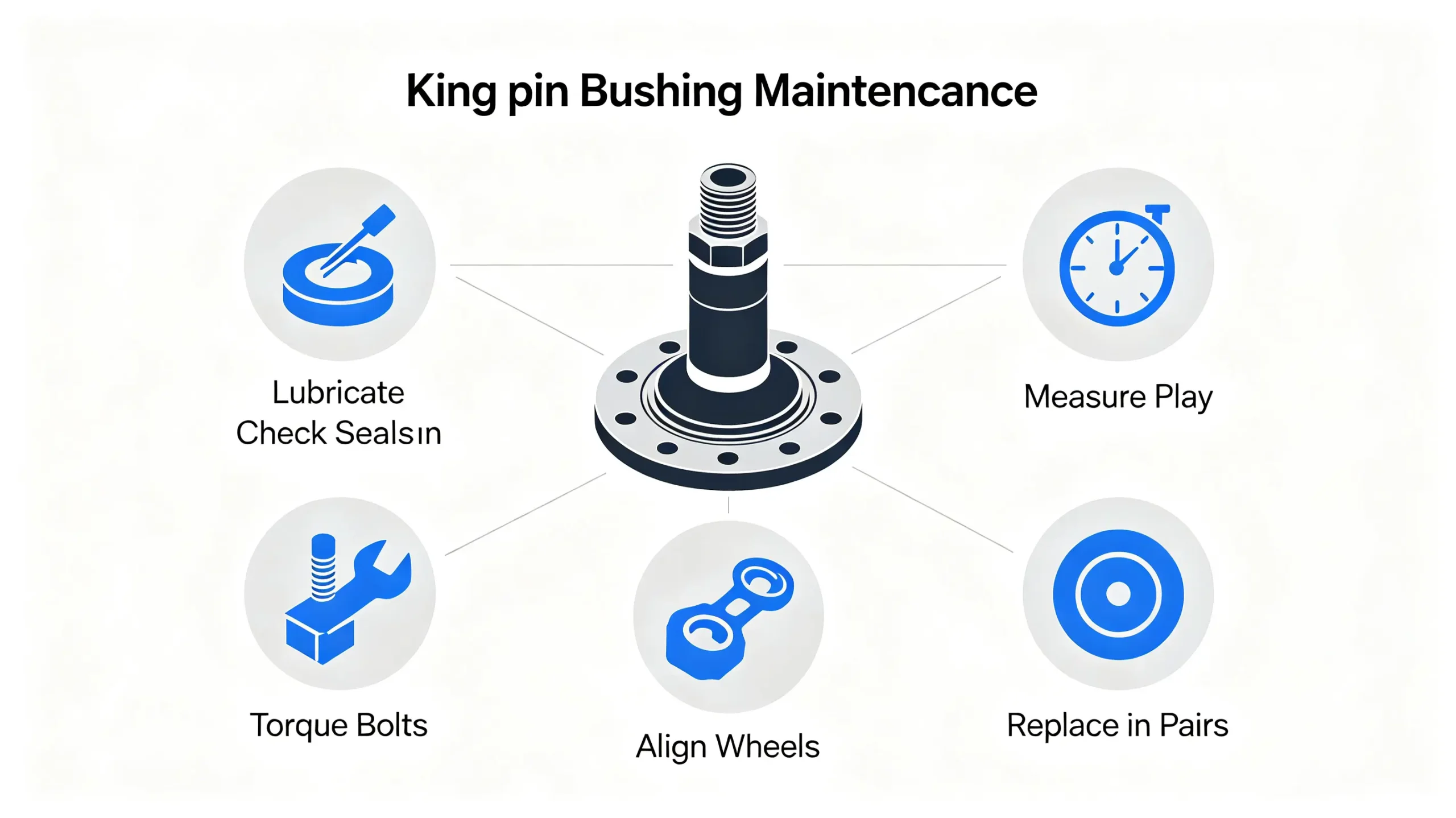
Common King Pin Bushing Replacement Mistakes to Avoid
Most repeated steering faults after replacement come from operational errors rather than part quality problems. We summarize the most frequent maintenance mistakes to help you improve repair quality.
1. Skipping the Precision Reaming Process
Many maintenance personnel skip reaming to save time. Newly pressed bushings have uneven inner diameters. This causes excessive tight friction or residual gaps.
Missing reaming is the main cause of stiff steering and rapid bushing failure after replacement.
2. Reusing Old Seals and Worn Accessories
Old king pin seals have aging deformation and poor dustproof performance. Reusing old accessories will cause early contamination and grease leakage.
Professional maintenance always replaces seals, bearings, and bushings in sets to ensure long-term stable operation.
3. Incorrect Bushing Installation Direction
King pin bushings have fixed grease groove directions. Wrong installation blocks the lubrication channel. Internal friction surfaces cannot get effective grease supply.
This leads to dry wear and bushing burning in a short time.
4. Insufficient Grease Injection
Simple greasing cannot discharge old dirt and residual air inside the assembly. Insufficient lubrication causes local dry friction and partial wear.
Long-Term Maintenance Tips to Extend King Pin Bushing Life
Scientific daily maintenance can greatly delay king pin bushing aging and wear. It reduces fleet maintenance frequency and lowers comprehensive operating costs.
1. Strict Regular Grease Lubrication Cycle
Arrange fixed grease replenishment according to road conditions and mileage. Long-distance highway fleets lubricate every 5000 miles. Construction site vehicles shorten the cycle appropriately.
2. Avoid Long-Term Overload and Violent Driving
Standardize cargo loading to avoid overloading. Reduce frequent sharp turning and violent road grabbing. Smooth driving reduces steering assembly impact and friction.
3. Regular Chassis Cleaning and Dust Prevention
Clean front axle mud and dirt regularly. Prevent long-term dirt accumulation from corroding seals and penetrating into bushing gaps.
4. Timely Replace Aging Seals
Check king pin seal status during every maintenance. Replace aging and leaking seals in time to ensure internal lubrication and isolation from external pollution.
5. Adopt High-Quality Original Matching Parts
High-precision genuine bushings have stable size accuracy and excellent wear resistance. They adapt to heavy-duty working conditions. Qualified parts avoid frequent replacement and hidden safety hazards.
FAQs About King Pin Bushings
Q1: Can I continue driving with worn king pin bushings?
Minor wear allows short-distance low-speed driving. However, severe wear will cause steering instability and tire deviation. It increases driving risks and accelerates the wear of other steering parts. Timely replacement is the safest choice.
Q2: How often should king pin bushings be replaced?
Highway logistics trucks replace every 2 to 3 years. Engineering and off-road vehicles need annual inspection and timely replacement according to wear degree.
Q3: Why does tire wear recur after alignment?
This is typical king pin bushing failure. Loose bushing clearance changes wheel angles in real time. Alignment data cannot be maintained stably. Replace bushings first before redoing alignment.
Q4: Is it necessary to replace upper and lower bushings together?
Yes. Upper and lower bushings bear synchronous wear. Paired replacement ensures uniform stress and stable steering gap.
Q5: Can I replace king pin bushings without professional tools?
No. Bushing pressing and reaming require professional hydraulic tools and precision instruments. Non-standard DIY replacement easily causes irreversible assembly errors.


