
Heavy-duty trucks carry heavy cargo across long distances, rough mountain roads, construction sites and wet coastal routes. Every shift operation directly affects driving safety, transmission service life and fleet operation efficiency. Many fleet managers focus heavily on gearbox overhaul, clutch replacement and engine maintenance. However, they often overlook a simple but critical component: the gear shift cable.
The heavy-duty truck gear shift cable builds a flexible mechanical bridge between the cabin gear lever and transmission selector mechanism. Without a functional shift cable, drivers cannot send accurate shift commands to the gearbox. Even minor stretching, outer sheath cracking or inner wire fraying can lead to stiff shifting, wrong gear selection or sudden gear locking. In severe cases, a broken cable may trap the truck in a single gear and stop transportation completely.
This full guide covers heavy duty truck gear shift cable construction, core features, working theory, typical application scenarios, common failure signs, root damage causes, inspection workflow, standard replacement process and long-term maintenance practices. The whole article is optimized for Yoast SEO green readability. Paragraphs are kept short with natural transition words. For more truck transmission component repair guides, visit our technical support resource center.
What Is a Heavy Duty Truck Gear Shift Cable? Structure Overview
Before diving into product features and real applications, it helps to understand the basic construction of a heavy-duty gear shift cable. Most modern cab-over heavy trucks use two separate cables for shift control: the shift cable and selector cable. They work as a matched pair.
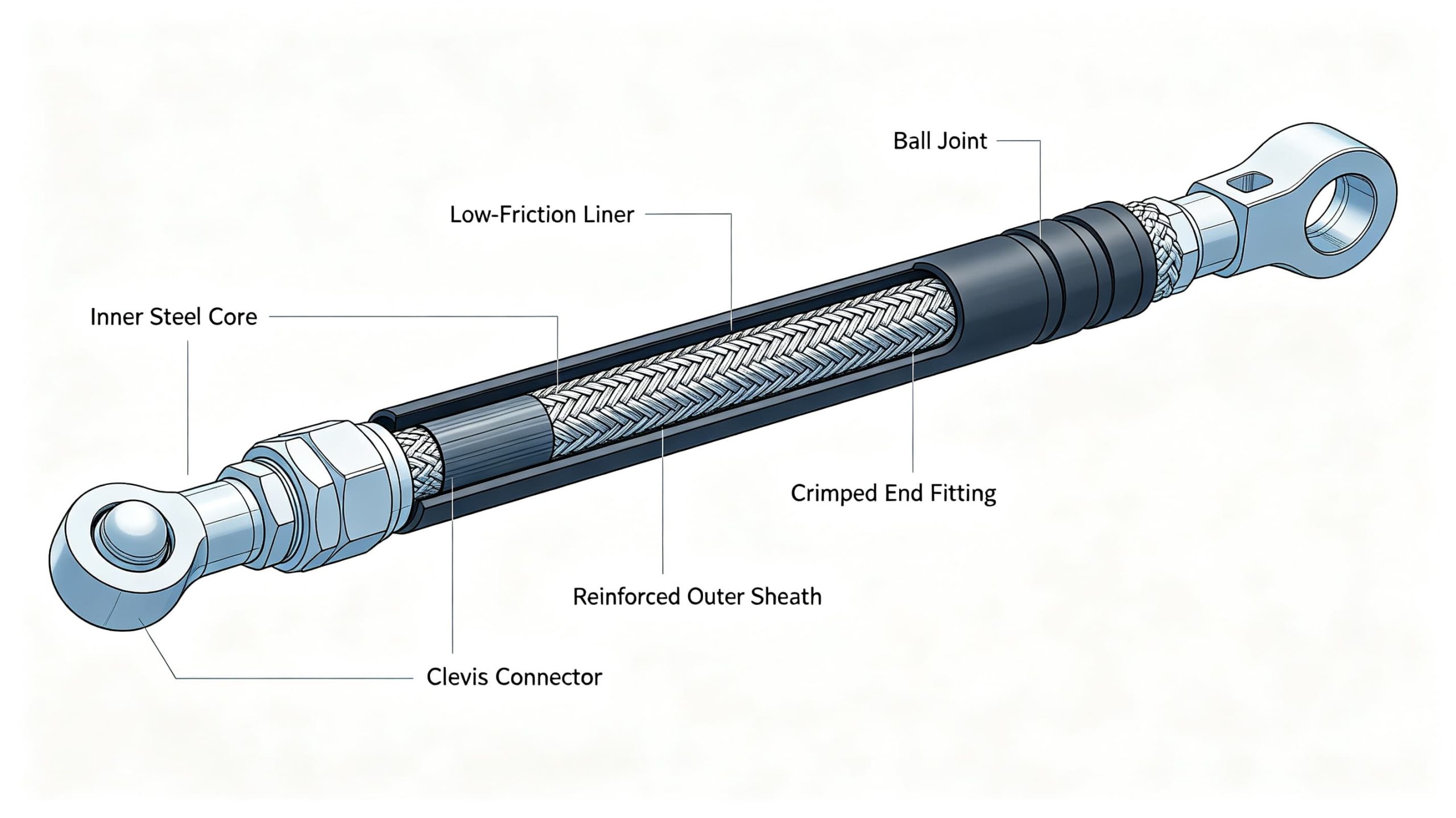
A heavy-duty truck gear shift cable assembly consists of four main parts: inner steel wire core, low-friction liner tube, reinforced outer sheath and precision swaged end fittings. The inner core is made of multi-strand braided steel wire. It transfers push and pull force from cabin lever movement. The inner liner reduces sliding friction and protects the steel strands from abrasion.
The outer sheath uses rubber composite with embedded steel braid reinforcement. It resists chassis vibration, oil splashes, mud, road salt and temperature fluctuations. End fittings include ball joints, clevis forks or threaded connectors. These fittings lock firmly to the gear lever bracket and transmission selector arm.
Unlike light vehicle cables, heavy-duty shift cables are engineered for repeated high-load push-pull cycles. They must maintain fixed length and low hysteresis under constant vibration. Different truck brands and gearbox models require custom cable length, stroke and connector types. Browse transmission system spare parts on our truck system product catalog.
Gear Shift Cable vs Selector Cable: Know The Difference
Many new maintenance technicians mix up shift cable and selector cable. These two cables are installed side by side, yet they carry separate tasks.
The selector cable controls side-to-side movement of the gear lever. It chooses which gear plane the transmission will access. The gear shift cable manages forward and backward lever travel. It pushes or pulls the selector rail to engage or disengage the target gear.
If one cable fails, the whole shift system cannot operate normally. During maintenance or replacement, technicians always inspect and adjust both cables at the same time. Mismatched cable stroke will still cause poor gear selection after repair.
Core Features of Heavy Duty Truck Gear Shift Cable
Heavy-duty operating environments create strict requirements for shift cable performance. A qualified OEM-grade gear shift cable comes with multiple key features designed for commercial vehicle working conditions.
1. High Tensile Strength With Low Stretch Rate
The inner braided steel core provides high tensile strength to handle repeated push and pull force. Premium heavy-duty cables control stretching to a very low level after thousands of shift cycles.
Excessive cable stretch is one of the most common failure triggers. When the steel wire elongates, shift lever free play increases. The gearbox cannot receive full travel movement, so some gears become hard or impossible to engage. Low-stretch design keeps shift precision stable over long mileage.
2. Reinforced Outer Sheath With Oil & Abrasion Resistance
Truck chassis areas face constant splashing of engine oil, gear oil, mud, sand and road salt. A cheap plastic sheath cracks quickly under these conditions.
Quality heavy-duty shift cables use composite rubber outer casing with steel wire reinforcement. This material can resist oil corrosion, surface scraping and ultraviolet aging. Even when routed near hot exhaust parts, high-temperature rated sheaths maintain flexibility and avoid hardening.
3. Low-Friction Internal Liner for Smooth Operation
Inside the outer sheath sits a smooth polymer liner. The steel core slides along this liner during every shift action. Good liner material cuts friction and reduces shift effort for drivers.
This feature matters greatly for long-haul drivers. Repeated hard shifting increases fatigue over hundreds of kilometers. Low friction also lowers heat build-up inside the cable assembly and slows internal wear.
4. Wide Temperature Adaptability
Heavy trucks travel through cold northern winters and hot desert summer regions. Temperature changes affect cable flexibility and internal lubrication.
Professional grade shift cables keep working normally in a broad temperature range. The internal lubricant will not thicken and freeze in cold weather, nor melt and leak under high heat. Stable flexibility prevents temporary shift binding caused by extreme weather.
5. Vibration Resistance & Anti-Kink Structure
Truck chassis generates strong vibration while running. Vibration can loosen end fittings and accelerate wire fatigue. The reinforced outer structure reduces vibration transfer to the inner steel strands.
Besides that, heavy-duty shift cables support fixed minimum bend radius. Sharp bending will damage the internal liner and break steel strands. Proper cable design and routing prevent kinks when the cab tilts or chassis flexes under load.
6. Precision Crimped End Fittings
End fittings connect the cable assembly to cabin lever and gearbox linkage. Poor crimping is a frequent hidden defect on low-cost aftermarket cables.
High-quality cables use hydraulic swaging to lock steel core and fittings tightly. The connection point can sustain rated load without slipping or separation. Each fitting matches original mounting hole size and ball joint dimension for direct replacement.
How Heavy Duty Truck Gear Shift Cable Works
The working principle of gear shift cable looks simple on the surface. However, the whole transmission control chain depends on accurate linear movement transfer.
When the driver moves the gear lever inside the cab, the lever pushes or pulls the inner steel wire core. The outer sheath stays fixed on mounting brackets and does not move. The steel wire slides inside the liner and transfers motion all the way back to the transmission selector arm.
The selector arm pushes the internal shift rail inside the gearbox. The rail moves shift forks to engage or disengage gear pairs. At the same time, the selector cable controls lateral position of the shift rail to pick different gear groups.
Since the outer sheath stays stationary, the cable can follow complex chassis routing around fuel tanks, exhaust pipes and frame rails. This flexible layout is why cab-over heavy trucks widely adopt cable shift systems instead of solid metal shift rods.
Main Applications of Heavy Duty Truck Gear Shift Cable
Gear shift cables are widely used across multiple heavy vehicle types and working scenarios. Different applications create different wear rates and maintenance cycles.
1. Long-Distance Highway Logistics Trucks
Long-haul highway trucks run at steady speed and perform frequent gear changes during hill climbing and overtaking. These trucks usually work with manual or AMT transmissions.
Highway vehicles face less mud impact, but continuous chassis vibration slowly stretches the shift cable. Regular inspection of cable play and fitting tightness helps avoid sudden breakdown on motorways. You can check real fleet operation cases from our customer cooperative cases page.
2. Construction & Mining Heavy Trucks
Dump trucks and mining haulers work on rough, muddy construction sites. Dirt, gravel and water easily splash onto shift cable routing areas.
Broken outer sheath allows sand and mud to enter the liner. Abrasive particles scratch the steel core and accelerate fraying. For this application, users must select heavy-duty cables with thicker outer casing and sealed end joints. Inspection intervals should also be shortened.
3. AMT Automated Manual Transmission Trucks
Many modern heavy trucks use AMT gearboxes. Even though gear selection is controlled electronically, some AMT models still retain mechanical shift cables as backup or main linkage.
On AMT trucks, the cable transfers movement from electric actuator to gearbox selector rail. Cable precision directly affects the speed and stability of automatic gear shifting. Sticky or stretched cables cause delayed gear engagement and AMT fault codes.
4. Urban Waste Trucks & Municipal Special Vehicles
Municipal trucks stop and start constantly. Drivers shift gears many times within a short route. High cycle count accelerates fatigue of the steel core and end fittings.
These vehicles often operate in wet, corrosive environments. Road salt and sewage increase corrosion risk. Anti-corrosion coated cables are strongly recommended for municipal fleets.
5. Agricultural & Forestry Heavy Vehicles
Farm tractors and forest logging trucks run on uneven off-road terrain. Big chassis flex may bend and twist shift cables repeatedly. These working conditions require flexible yet kink-resistant cable assemblies.
Frequent exposure to fertilizer, plant residue and humid soil also raises corrosion risk. Operators need to clean cable routing points during seasonal maintenance.
Common Failure Symptoms of Heavy Duty Truck Gear Shift Cable
Gear shift cable failure develops gradually. Early warning signs are easy to ignore. If fleet teams catch these symptoms early, they can arrange replacement before roadside breakdown happens.
1. Sloppy Gear Lever With Excessive Free Play
This is the earliest warning sign. When the inner steel wire stretches, the gear lever moves a noticeable distance before it starts to actuate the transmission.
Drivers feel loose and vague shift feedback. They cannot quickly judge whether the gear has fully engaged. Many drivers mistakenly think the problem comes from gearbox internal wear or clutch failure.
2. Stiff, Heavy or Binding Gear Shifting
When the internal liner wears out, dirt enters the cable and creates high sliding resistance. The lever becomes heavy and hard to push. Sometimes the lever sticks at neutral position.
Cold weather can make this symptom worse. Thickened internal grease further increases friction. If the binding only appears in low temperature, the cable internal lubrication has degraded.
3. Cannot Select Certain Gears or Wrong Gear Engagement
When cable length changes or fittings shift, the travel range no longer matches gearbox requirements. Drivers may fail to select reverse gear or high gears.
In worse situations, the selected gear on lever does not match the actual gear inside transmission. This mismatch creates huge safety risk during driving.
4. Clicking or Knocking Noise During Shifting
Loose end fittings or frayed inner wire can produce clicking sound when moving the gear lever. The noise comes from impact between loose metal parts at cable joints.
Technicians should inspect both ends of the cable when hearing this noise. Check ball joint wear, bracket looseness and outer sheath damage along the routing path.
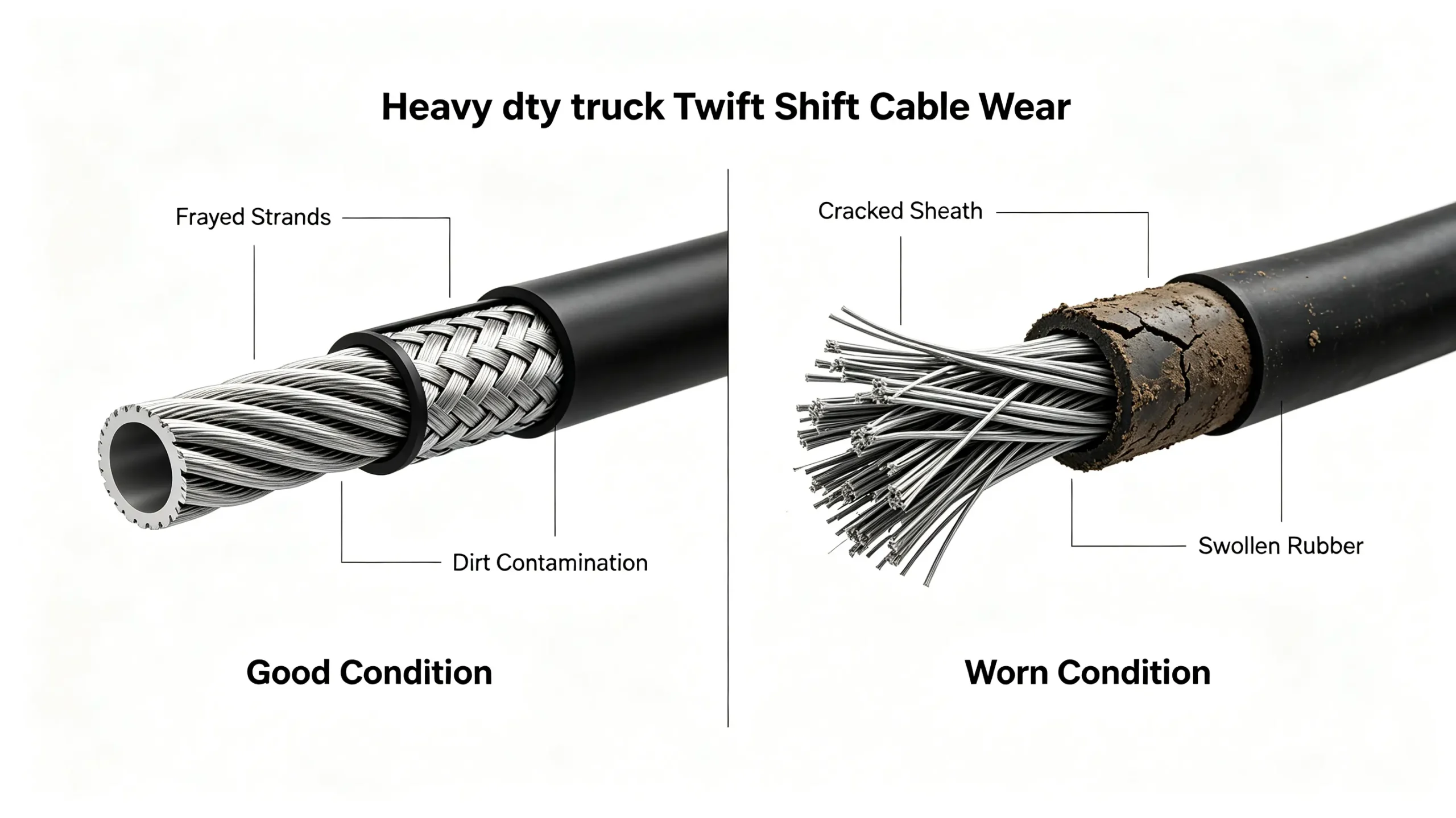
5. Visible Outer Sheath Cracks, Abrasion or Oil Swelling
Visual inspection can quickly spot damaged cables. Cracks, splits or swelling rubber on the outer jacket mean the protective layer has failed.
Oil swelling usually happens when low-grade rubber meets gear oil or engine oil. Once the sheath is broken, water and sand get inside and destroy the steel core rapidly.
6. Gear Lever Moves Freely Without Any Resistance (Cable Breakage)
This is the final failure stage. The inner steel strands snap completely. The gear lever moves freely with no connection to transmission. The truck cannot shift gears and must stop operation immediately.
Drivers should not attempt to drive the truck in this state. Towing to repair shop is the only safe solution.
Root Causes of Premature Gear Shift Cable Damage
Genuine high-quality shift cables can last for hundreds of thousands of kilometers under proper use. Most premature failures come from bad routing, low-quality parts, improper operation and poor maintenance.
1. Incorrect Routing & Too Sharp Bends
This is one of the top reasons for early cable failure. If installers route the cable with sharp bends smaller than minimum bend radius, the inner steel core will bend repeatedly and fatigue quickly.
Cables may also get pinched between frame brackets or touch hot exhaust pipes. Heat and physical squeezing damage the outer sheath and liner over time.
2. Internal Steel Core Fatigue & Stretching
Every gear shift creates push-pull load on steel strands. Over cycles, metal fatigue appears. The wire stretches slowly or individual strands break one by one.
Frequent heavy-handed shifting speeds up fatigue. Drivers who slam the gear lever put extra shock load on cable assemblies.
3. Outer Sheath Damage by Oil, Salt and Abrasion
Gear oil and engine oil attack ordinary rubber materials. Road salt in winter accelerates corrosion of exposed steel strands. Rocks and chassis debris scrape the sheath while driving.
Once the outer jacket breaks, the protection layer disappears. The inner liner and steel core become exposed to contaminants.
4. Low-Grade Aftermarket Cable Parts
Cheap aftermarket cables use thin steel strands, poor liner material and weak rubber casing. These products cannot sustain heavy-duty truck load cycles.
They stretch rapidly and crack within a short time after installation. To avoid repeated downtime, choose model-matched heavy-duty cables. Browse trusted truck spare part brands in our brand product center.
5. Wrong Installation & Poor Adjustment
Improper installation causes new cables to fail early. Common mistakes include loose locking nuts, misaligned ball joints, wrong cable length setting and unadjusted free play.
When cable tension is set incorrectly, the shift mechanism cannot reach full travel. Partial gear engagement increases load and accelerates wear.
6. Cab Tilt Interference
Many heavy trucks tilt the whole cab for engine service. If the shift cable lacks enough slack during cab tilt, repeated stretching will damage the assembly.
Professional installation reserves enough cable length for cab movement, while avoiding excessive loose routing that causes vibration knocking.
Professional Inspection Steps for Gear Shift Cable
Fleet maintenance teams can perform systematic inspection during routine service. These steps help identify hidden cable damage before failure occurs.
Step 1: Safety Preparation
Park the truck on flat ground. Engage parking brake and block wheels. For under-chassis inspection, lift the truck and secure it with heavy-duty jack stands. Make sure the cab is locked or tilted safely according to workshop manual.
Step 2: Cabin Side Visual & Functional Test
Operate the gear lever slowly. Check free play, binding and abnormal noise. Watch how the lever returns to neutral position. Compare the shift feel against normal working condition.
Record whether some gears are hard to select. This simple test helps narrow down the fault to shift cable, selector cable or gearbox internal parts.
Step 3: Under-Chassis Cable Routing Inspection
Trace the whole cable path from cabin bracket to transmission end. Check sheath cracks, rubbing marks, oil contamination and kinks. Verify mounting clips are in place and tight.
Look for heat damage near exhaust components. Confirm the cable does not contact moving suspension parts during compression and rebound.
Step 4: Check End Fittings, Ball Joints and Bushings
Inspect ball joint rubber boots for cracking. Check for play at cable connection points. Worn ball joint bushings create extra free play even if the steel cable itself remains intact.
Many technicians only replace the cable but ignore worn joint bushings. The shifting problem will still exist after repair.
Step 5: Measure Cable Play and Adjustment
Follow factory service manual to check allowable free travel. If play exceeds specification, try adjustment first. When adjustment cannot restore full gear travel, cable replacement becomes necessary.
Test all gears again after adjustment. Confirm reverse gear and high gears can fully engage without binding.
Standard Gear Shift Cable Replacement Workflow
Replacing heavy-duty truck gear shift cable needs careful disassembly, routing and adjustment. Poor installation leads to repeated shifting issues. This workflow applies to most SINOTRUK, SHACMAN and FAW heavy truck models.
Pre-Job Tool and Part Preparation
Prepare new matched shift and selector cable set, socket wrenches, pliers, cleaning cloths, grease, marker pen and vehicle workshop manual.
Before disassembly, take photos or mark original cable routing and bracket positions. Mark adjustment threads to help restore original setting quickly.
Step 1: Disconnect Cable Ends at Gear Lever
Remove cabin trim panels to access gear lever assembly. Release ball joint clips or locking pins. Separate shift cable and selector cable from the lever.
Do not use excessive force to pry joints. Improper prying can break plastic brackets and ball joint sockets.
Step 2: Disconnect Cable at Transmission End
Go under the truck and access transmission shift linkage. Remove locking nuts and release cable end fittings from selector arm.
Check surrounding parts for oil leaks while you work. Repair oil leaks first, otherwise the new cable sheath will swell and fail quickly.
Step 3: Remove Old Cable Assembly
Release all mounting clips along the chassis frame. Pull out the old cable carefully along its routing path. Do not drag broken steel strands through brackets to avoid scratching frame paint or other hoses.
Clean the cable channel and mounting points. Remove mud, rust and broken clip fragments before installing new cable.
Step 4: Route New Cable Correctly
Lay the new cable following original routing. Keep minimum bend radius and avoid sharp corners. Reserve enough slack for cab tilting, but prevent excessive loose loops that vibrate.
Fix mounting clips one by one. Keep cable away from exhaust, suspension moving parts and sharp frame edges.
Step 5: Install End Fittings and Pre-Adjustment
Connect both ends of cable to gear lever and transmission linkage. Install locking clips and nuts loosely first. Follow the marked reference position from disassembly.
Grease ball joint sockets lightly. Do not over-grease, as excess grease attracts dust and dirt.
Step 6: Fine Adjustment and Gear Test
Tune cable length to remove excessive free play while keeping smooth movement. Test all forward gears and reverse gear multiple times.
Confirm the gear lever returns to neutral naturally. Check no binding occurs at any gear position. Double-check lock nuts after adjustment completes.
Step 7: Road Test and Final Inspection
Lower the truck and perform road test. Shift through all gears under light load. Listen for abnormal noise and check shift feel.
After road test, recheck all mounting clips and end fittings for looseness. Confirm cable does not rub any chassis parts during driving.
Common Mistakes During Gear Shift Cable Replacement
Many post-repair shift problems come from installation mistakes instead of defective new cables. Avoid these typical errors to improve repair quality.
1. Ignoring Minimum Bend Radius
Many installers squeeze the cable into tight spaces. Sharp bends increase internal friction and break steel strands quickly. Always follow the minimum bend radius specified by cable manufacturer.
2. Reusing Damaged Ball Joint Bushings
Old worn rubber bushings still create play even after fitting brand new cables. Best practice is to replace joint bushings at the same time of cable service.
3. Wrong Cable Length or Mismatched Model
Cables from different truck models cannot be swapped randomly. Wrong total length or stroke will make gear selection impossible. Always match OEM part number before purchase.
4. Insufficient Slack for Cab Tilt
Too tight cable limits cab movement. When technicians tilt cab for engine repair, the cable gets pulled and damaged. Reserve proper slack during installation.
5. Forgetting to Lock Adjustment Nuts
Unlocked adjustment nuts will shift under chassis vibration. The cable length changes gradually, and shift play returns after a short running time. Always secure lock nuts after adjustment.
Maintenance Tips to Extend Gear Shift Cable Service Life
Regular simple maintenance greatly reduces unexpected cable failure and cuts fleet repair cost. These practices fit routine service schedules.
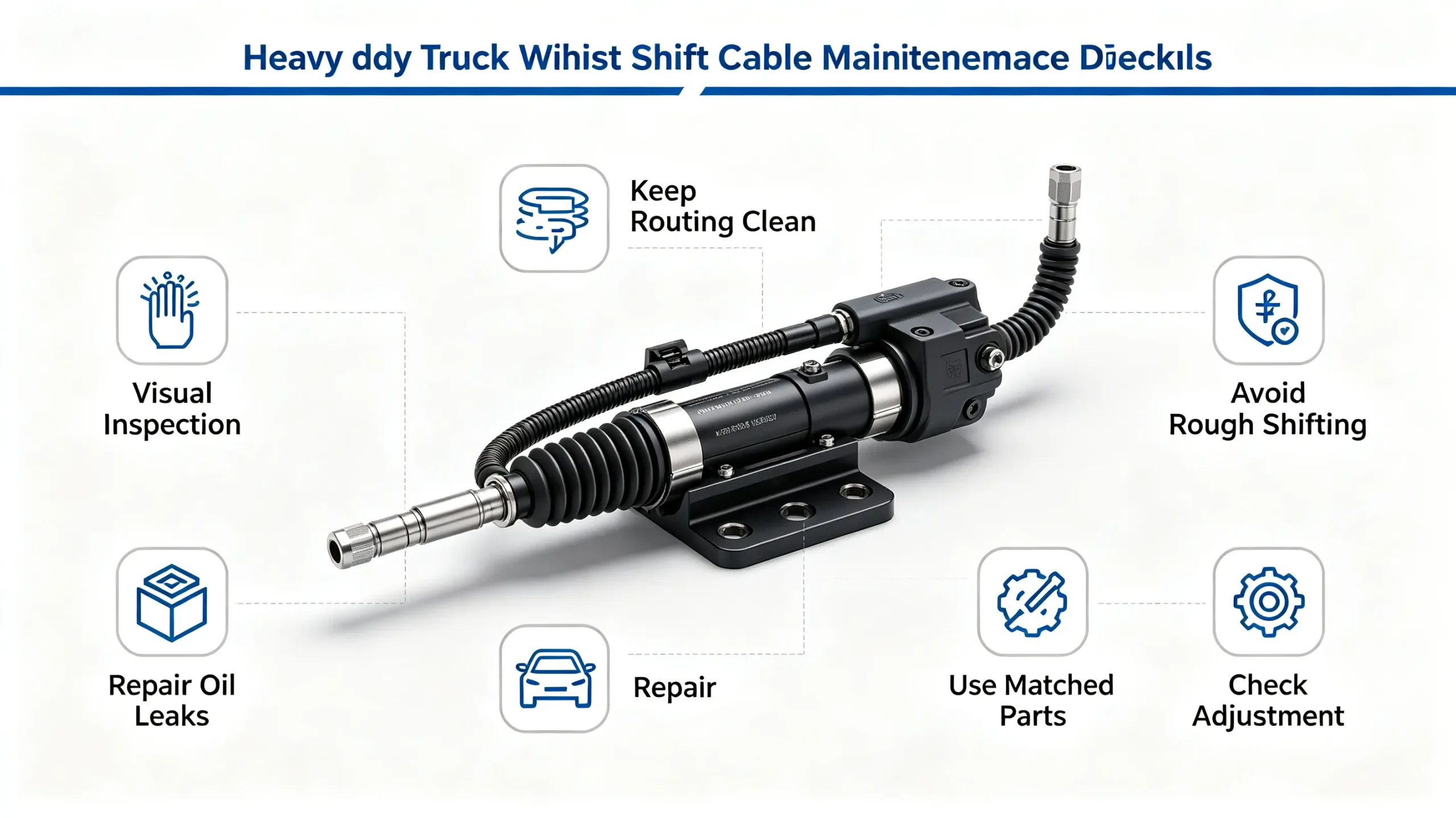
1. Visual Inspection At Every Service Stop
Check outer sheath condition, mounting clips and end joints during each maintenance cycle. Early detection of sheath damage saves the cable before internal steel core corrodes.
2. Keep Cable Routing Area Clean
Clean mud, debris and oil around the cable path. Remove accumulated road salt in winter. Contaminants are the main trigger for sheath aging and steel corrosion.
3. Avoid Rough Gear Operation
Train drivers to shift smoothly. Slamming the gear lever creates impact shock to cable assembly. Gentle operation reduces fatigue load on steel strands and fittings.
4. Repair Oil Leaks Near Cable Routing
Gear oil and engine oil degrade rubber sheath rapidly. Fix nearby oil leaks immediately once discovered. Prevent oil from soaking the shift cable.
5. Select OEM-Matched High-Quality Cables for Replacement
High-precision heavy-duty shift cables maintain stable length and low friction. Quality parts reduce repeated repair downtime. Get model-matched transmission spare parts from our official truck system product page.
FAQs About Heavy Duty Truck Gear Shift Cable
Q1: Can I repair a frayed gear shift cable instead of replacing it?
No. Once inner steel strands fray, temporary repair cannot restore original strength. Splices will create friction points and fail quickly. Full assembly replacement is the only safe professional solution.
Q2: What is the typical service life of heavy-duty truck gear shift cable?
High-quality cables for highway fleets can last 200,000 km or more. Construction and off-road trucks need inspection every 50,000 km, with shorter replacement cycles.
Q3: Do I need to replace shift cable and selector cable together?
Recommended. Both cables experience the same vibration and working environment. If one cable shows heavy wear, the paired cable is also near the end of service life. Replacing as a set avoids repeated disassembly.
Q4: Can bad shift cable damage the truck gearbox?
Yes. A cable with excessive play may cause incomplete gear engagement. Partial gear meshing wears gearbox synchronizers and gear teeth rapidly. Early cable maintenance protects expensive transmission assemblies.
Q5: What happens if the gear shift cable breaks while driving?
The gear lever loses connection with transmission. You cannot change gears. Stop driving safely and arrange towing. Continuing driving creates serious safety risks.
Conclusion
The heavy duty truck gear shift cable is the flexible control link between cabin shifter and transmission. Its core features include high tensile strength, low stretch, oil-resistant reinforced sheath, low-friction liner and vibration-proof end fittings.
This component applies widely on highway logistics trucks, construction dumpers, AMT trucks and municipal heavy vehicles. Many roadside breakdown events start from ignored cable stretching or cracked outer sheath.
Regular inspection, correct routing, smooth driving style and high-quality replacement parts help maintain reliable shifting performance and protect expensive gearbox components. For more heavy-duty truck transmission maintenance tutorials, visit our technical support center.
If you need matched heavy-duty gear shift cables and transmission spare parts, check our full product portfolio on the truck system product page.
Explore full range of trusted heavy truck spare part brands in our brand product catalog.
Check practical fleet maintenance and project cases at our customer cooperative cases.
For bulk inquiry, technical drawing confirmation and customized part service, please contact us.
Learn about our company background and global service layout from our about us page. Browse all heavy-duty truck spare parts and one-stop supply solution on our official homepage.


