
Understanding the Modern Freight Landscape
Marketing logistics services in the current economic climate requires a deep understanding of how goods move across continents. The trucking industry remains the backbone of global commerce, responsible for transporting over 70% of all freight by tonnage in most developed economies. Yet many fleet operators struggle to differentiate their offerings and attract high-value contracts in an increasingly competitive environment.
As someone who has advised transport companies for over fifteen years, I have witnessed firsthand how the sector has evolved from simple load-board bidding to sophisticated digital marketing ecosystems. Today’s shippers demand transparency, speed, and sustainability from their carriers. The companies that thrive are those that communicate their value proposition clearly and consistently across every customer touchpoint.
Why Effective Marketing Matters for Logistics Providers
Many freight operators assume that relationships and word-of-mouth referrals are sufficient for growth. While these remain important, the digital transformation of procurement means that over 60% of shippers now research carriers online before making contact. Without a visible, professional marketing presence, logistics companies forfeit substantial revenue opportunities.
The cost of customer acquisition in freight transportation has risen steadily. According to industry benchmarks from early 2026, the average cost per qualified lead for mid-size carriers exceeds $340 — a 22% increase from just two years prior. This makes marketing efficiency not merely a growth lever but a survival imperative for fleet operators navigating thin margins.

Core Strategies to Market Logistics Services
1. Build Authority Through Specialized Content
Content marketing is the single most effective long-term strategy for transport companies seeking to establish credibility. Shippers search for answers to complex questions about routing, customs compliance, and capacity planning. By publishing expert guides, case studies, and operational insights, carriers position themselves as trusted advisors rather than commodity vendors.
Focus content on verticals where you possess genuine expertise. A refrigerated carrier should publish extensively about cold chain integrity, temperature monitoring technology, and perishable goods compliance. This specificity attracts precisely the clients who value specialized capability and are willing to pay premium rates for it.
2. Leverage Digital Advertising With Precision Targeting
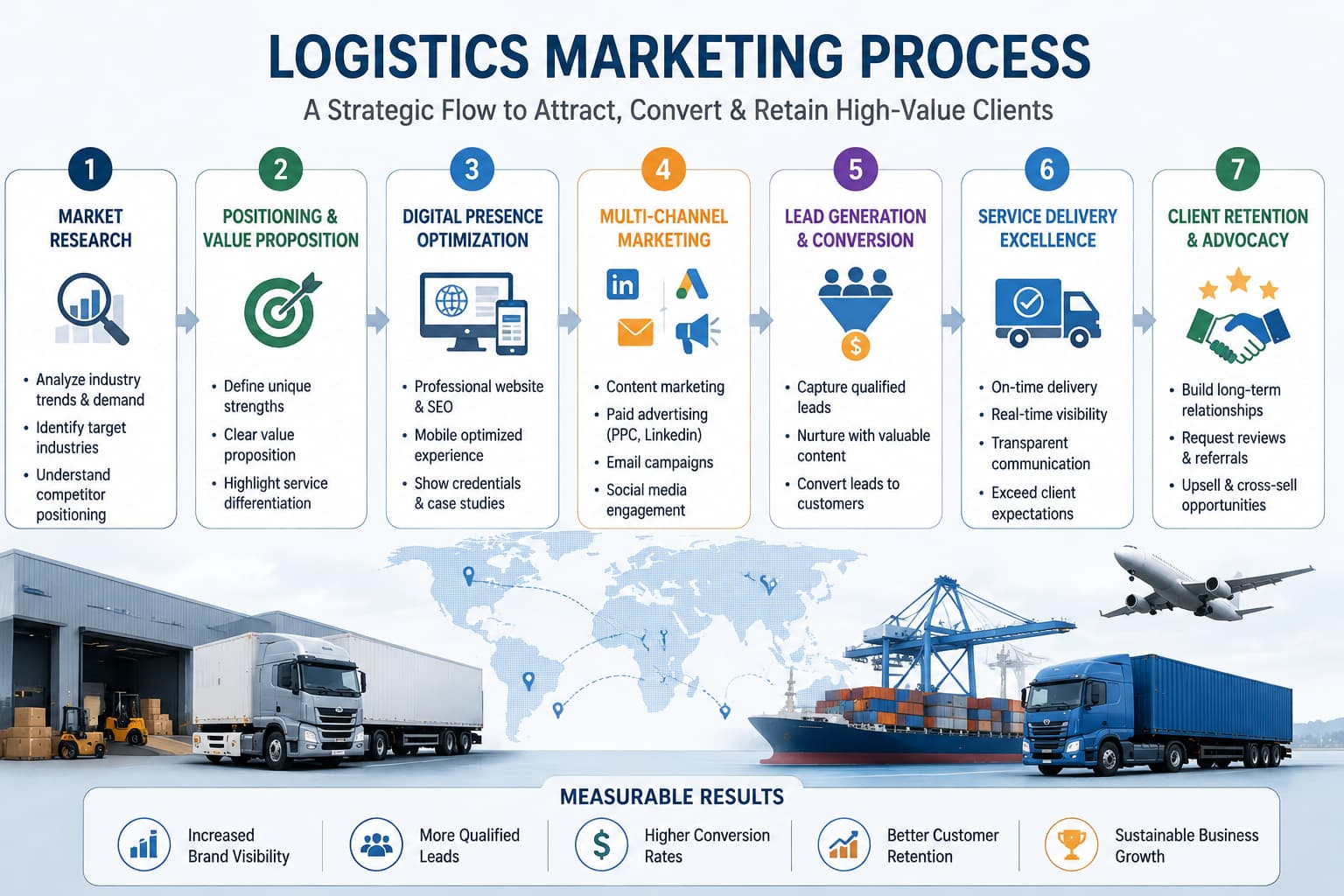
Pay-per-click campaigns on platforms like Google Ads and LinkedIn allow carriers to reach decision-makers at the exact moment they are sourcing transport solutions. The key is granular targeting — by geography, cargo type, shipment frequency, and company size. Broad campaigns waste budget; narrow campaigns convert.
LinkedIn advertising is particularly effective for B2B logistics providers. Supply chain logistics managers and procurement directors are active on the platform, and Sponsored Content campaigns with compelling case studies generate engagement rates 3-4 times higher than generic brand advertising.
3. Optimize Your Digital Presence for Local and National Search
Search engine optimization remains foundational. Your website must clearly communicate service areas, equipment types, certifications, and capacity. Technical SEO — site speed, mobile responsiveness, structured data markup — determines whether potential clients ever discover your company in organic results.
For companies exploring trucking industry regulations and compliance updates, publishing current regulatory content serves dual purposes: it demonstrates operational expertise and captures high-intent search traffic from shippers verifying carrier credentials.
4. Develop Strategic Partnerships and Referral Networks
No logistics provider operates in isolation. Building alliances with complementary service providers — warehousing companies, customs brokers, packaging specialists — creates referral channels that deliver pre-qualified leads at near-zero cost. Formalize these relationships with mutual referral agreements and co-marketing initiatives.
Reviewing a cooperative case between fleet operators and parts suppliers illustrates how strategic alliances drive mutual growth and customer satisfaction across the value chain.
The Rise of Chinese Truck Brands in Global Markets
A significant development reshaping the commercial vehicle landscape is the aggressive international expansion of Chinese manufacturers. Brands like Sinotruk, FAW, Dongfeng, and Shacman have collectively increased their global market share to approximately 18% of heavy-duty truck sales outside China, according to Q1 2026 trade data.
This expansion is driven by compelling economics. Chinese commercial vehicles typically offer 25-40% lower acquisition costs compared to European or American equivalents, while increasingly matching them in durability and technological sophistication. For fleet operators in emerging markets — and increasingly in developed ones — this value proposition is impossible to ignore.
| Factor | Chinese Truck Brands | European/American Brands |
|---|---|---|
| Average Purchase Price (Heavy-Duty) | $45,000 – $75,000 | $110,000 – $180,000 |
| Global Market Share (2026) | ~18% (outside China) | ~65% combined |
| EV Model Availability | Rapidly expanding | Limited, premium-priced |
| Parts Availability (International) | Improving significantly | Well-established networks |
| Technology Integration | Advanced telematics, ADAS | Industry-leading but costly |
For logistics marketers, this shift presents both opportunity and narrative. Companies operating Chinese-manufactured fleets can emphasize cost efficiency, modern technology, and environmental credentials — all increasingly important to shippers evaluating carrier partnerships.
Competitive Advantages of Chinese-Manufactured Fleets
Cost Leadership Without Quality Compromise
The perception gap between Chinese and Western commercial vehicles has narrowed dramatically. Modern Chinese heavy-duty trucks incorporate Bosch fuel injection systems, ZF transmissions, and proprietary engines that meet Euro VI emission standards. Fleet managers report mean-time-between-failure rates competitive with established European brands at significantly lower capital expenditure.
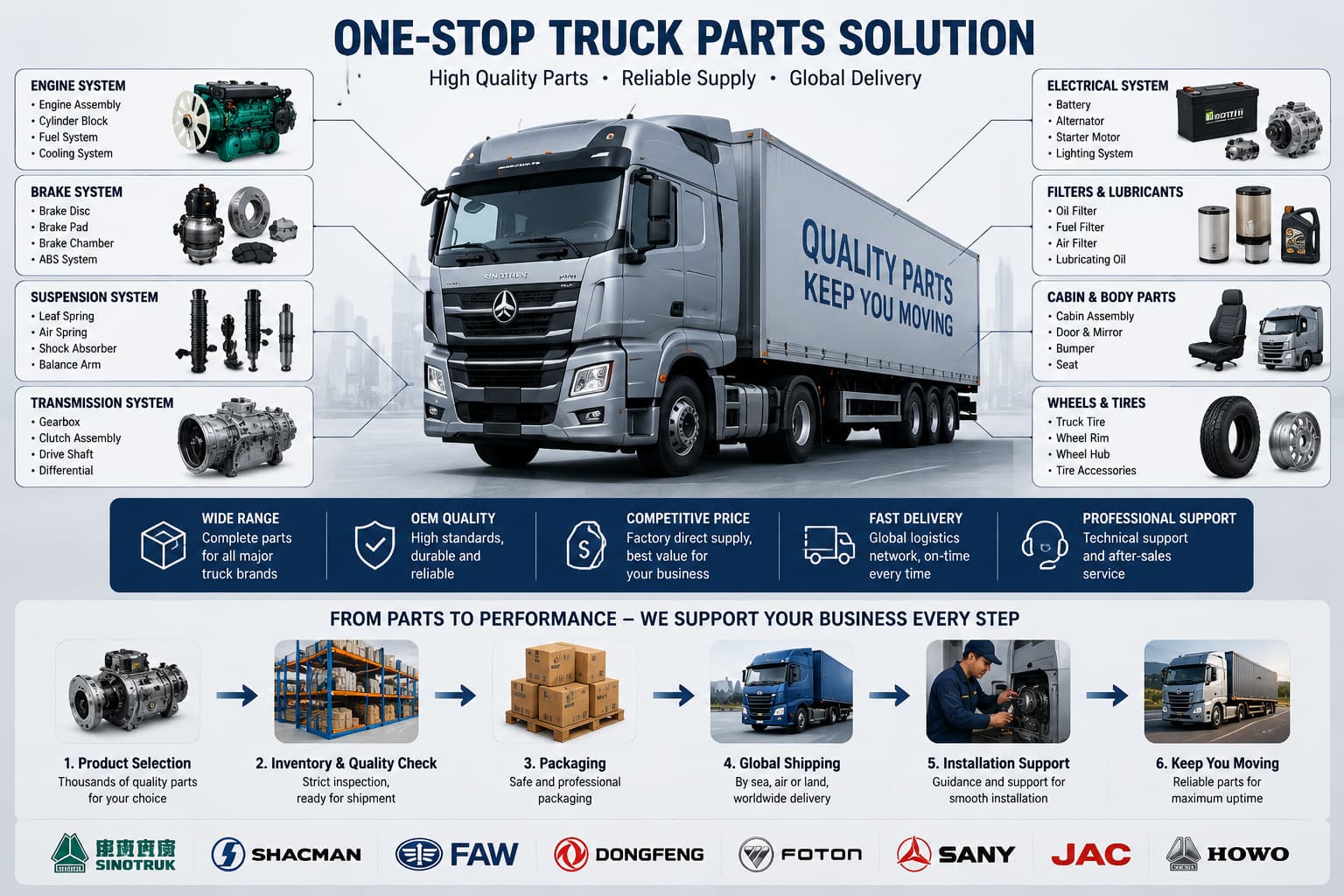
Operators seeking quality Truck parts for maintenance and repair can now source genuine components through dedicated international distribution networks, eliminating what was historically a barrier to Chinese vehicle adoption in overseas markets.
Electric Vehicle Innovation
Chinese manufacturers lead globally in electric heavy-duty vehicle production volume. The pace of trucking industry electric vehicle adoption has accelerated, and Chinese brands offer battery-electric and hydrogen fuel cell models at price points 30-50% below Western competitors. For logistics companies marketing sustainability credentials, operating zero-emission Chinese-manufactured trucks is an increasingly powerful differentiator.
Technology and Telematics
Fleet management technology embedded in newer Chinese trucks rivals any global competitor. Integrated telematics, predictive maintenance alerts, and advanced driver assistance systems come standard on most export models. These capabilities allow operators to offer real-time shipment visibility — a feature that has become table stakes for winning enterprise logistics contracts.
For detailed information on components organized by manufacturer, explore options through our product category brand directory covering major Chinese OEMs and their international model ranges.
Addressing the Driver Shortage Through Marketing
The global shortage of qualified commercial vehicle operators represents both a challenge and a marketing opportunity. Companies that successfully recruit and retain drivers gain capacity advantages over competitors still struggling to fill seats. Your recruitment marketing should mirror your customer-facing marketing in quality and professionalism.
Effective trucking industry driver shortage solutions include employer branding campaigns on social media, competitive compensation transparency, and showcasing driver lifestyle improvements. Companies that invest in modern, comfortable equipment — another advantage of newer Chinese-manufactured vehicles with their focus on cab ergonomics — find recruitment significantly easier.
Marketing your driver-centric culture serves a dual purpose: it attracts operators and signals to shippers that your company maintains consistent capacity and low turnover, reducing the risk of service disruptions.
Industry Trends Shaping Marketing Strategy
Understanding trucking industry trends 2026 is essential for crafting relevant marketing messages. Several macro forces are reshaping how logistics services are purchased and evaluated by shippers worldwide.
| Trend | Marketing Implication | Action Item |
|---|---|---|
| Sustainability mandates | Shippers require carbon reporting from carriers | Publish emissions data and reduction targets |
| Digital freight matching | Platform presence replaces cold calling | Optimize profiles on major freight platforms |
| Nearshoring supply chains | New lanes and regional demand emerging | Create content for emerging corridors |
| Autonomous vehicle pilots | Technology leadership signals reliability | Communicate technology adoption roadmap |
| Regulatory tightening | Compliance becomes a selling point | Highlight certifications and safety records |
To browse components by vehicle system — engine, transmission, braking, electrical — visit our organized product category system page for streamlined procurement.
Starting a Fleet Operation: Marketing From Day One
For entrepreneurs researching how to start a trucking company in 2026, marketing should not be an afterthought. Your brand identity, digital presence, and go-to-market strategy should be developed concurrently with operational setup. Companies that launch with professional marketing infrastructure grow revenue 2-3 times faster in their first two years than those that rely solely on personal networks.
New entrants should invest in professional photography of their equipment, develop a clear brand story, create a mobile-optimized website, and establish social media profiles before hauling their first load. The initial capital saved by purchasing cost-effective Chinese-manufactured trucks can be partially redirected toward marketing — creating a compound advantage of lower operating costs and faster market penetration.
For ongoing maintenance guidance and operational best practices, our technical support resources help fleet operators maximize vehicle uptime and minimize unplanned service interruptions.
Measuring Marketing Effectiveness in Logistics
Key Performance Indicators for Freight Marketers
Unlike consumer marketing where brand awareness suffices, logistics marketing must demonstrate direct revenue impact. Track these metrics rigorously: cost per qualified lead, lead-to-contract conversion rate, average contract value, customer lifetime value, and customer acquisition cost ratio. These figures tell you precisely which channels deserve increased investment.
Attribution remains challenging in B2B logistics because sales cycles often span 3-6 months with multiple touchpoints. Implement CRM tracking from first touch to closed contract. Many carriers discover that content marketing generates the highest-value long-term clients, while paid advertising fills short-term capacity gaps.
Benchmarks for Mid-Size Fleet Operators
| Metric | Industry Average | Top Quartile |
|---|---|---|
| Website Conversion Rate | 1.8% | 4.2% |
| Cost Per Qualified Lead | $340 | $185 |
| Lead-to-Contract Rate | 12% | 28% |
| Marketing ROI (Annual) | 3.2x | 7.8x |
| Content Engagement Rate | 2.1% | 5.6% |
Building Trust and Credibility in Your Marketing
In an industry where a single failed delivery can cost a shipper hundreds of thousands of dollars, trust is the ultimate currency. Every marketing asset — from your website copy to your sales presentations — must communicate reliability, transparency, and operational excellence. Generic claims are worthless; specific evidence is everything.
Publish your on-time delivery rates, safety records, insurance coverage details, and customer testimonials prominently. Video testimonials from recognizable shippers are particularly powerful. Case studies with quantified results (e.g., “reduced transit time by 14 hours on the São Paulo–Buenos Aires corridor”) convert prospects more effectively than any advertisement.
To learn more about our company history, capabilities, and commitment to the global heavy vehicle parts market, visit our about us page for detailed background information.
The China Export Opportunity for Fleet Marketers
Global sales of Chinese-manufactured heavy vehicles exceeded 680,000 units in export markets during 2025, representing a year-over-year increase of approximately 16%. This trajectory shows no signs of slowing. For fleet operators who have adopted these vehicles, there is a clear marketing narrative: modern technology, lower total cost of ownership, and proven reliability across demanding operating environments from Southeast Asia to Africa to South America.
Marketing this choice effectively requires addressing residual perception concerns head-on. Publish maintenance logs, share parts availability data, and document real-world fuel economy figures. Transparency about your fleet composition builds confidence rather than raising questions. Forward-thinking shippers recognize that carrier cost efficiency translates to competitive freight rates without compromising service quality.
Actionable Marketing Checklist for Logistics Companies
- Audit your website for mobile responsiveness, load speed, and clear calls-to-action
- Develop a content calendar publishing at least two expert articles monthly
- Claim and optimize profiles on major freight matching platforms
- Create video content showcasing your fleet, facilities, and team
- Implement CRM tracking across all lead sources
- Build a LinkedIn company page and publish weekly industry insights
- Establish Google Business profiles for every terminal location
- Develop case studies with quantified results from at least three clients
- Set up retargeting campaigns for website visitors who did not convert
- Monitor competitor marketing activities quarterly and identify gaps
If you have questions about sourcing vehicles, parts, or operational support for your fleet, do not hesitate to contact us for personalized assistance tailored to your market and operational requirements.
Conclusion
Marketing logistics services effectively in the current environment demands a blend of digital sophistication, operational transparency, and genuine industry expertise. The trucking industry continues to evolve rapidly, driven by electrification, regulatory change, and the growing influence of Chinese manufacturers in global markets. Companies that invest in professional, data-driven marketing — while leveraging cost-effective equipment to maintain competitive pricing — will capture disproportionate market share.
Success comes from consistency, measurement, and willingness to adapt. The strategies outlined above are not theoretical — they are drawn from fifteen years of observing what separates thriving logistics companies from those that stagnate. Start with the fundamentals, measure everything, and scale what works.
Frequently Asked Questions
What is the most cost-effective marketing channel for small logistics companies?
Content marketing combined with search engine optimization delivers the highest long-term return for small fleet operators. While paid advertising produces faster results, a well-optimized website with expert content generates compounding organic traffic over time. Most small carriers should allocate 60% of their marketing budget to digital presence and content, with 40% toward targeted paid campaigns on Google and LinkedIn.
How can fleet operators use Chinese-manufactured trucks as a marketing advantage?
Operators running Chinese-manufactured vehicles can emphasize lower freight rates enabled by reduced capital expenditure, modern technology features like integrated telematics, and sustainability credentials from electric vehicle availability. Transparency about fleet composition — including published maintenance records and uptime statistics — converts potential skepticism into competitive differentiation.
What role does social media play in B2B logistics marketing?
LinkedIn is the primary social platform for B2B freight marketing, with procurement managers and logistics directors actively using it for supplier research. Companies should post operational updates, industry analysis, and employee spotlights at least three times weekly. Video content showing daily operations, safety procedures, and equipment quality generates significantly higher engagement than static posts.
How long does it take for logistics marketing efforts to generate measurable results?
Paid advertising campaigns typically produce qualified leads within 2-4 weeks of launch. Search engine optimization requires 4-8 months before generating consistent organic traffic. Content marketing compounds over 12-18 months but ultimately delivers the lowest cost-per-acquisition. Most successful carriers operate all three channels simultaneously, using paid campaigns for short-term revenue while building long-term organic authority.
What are the biggest marketing mistakes made by freight companies?
The most common errors include: treating marketing as an expense rather than an investment, failing to track lead attribution, publishing generic content without industry specificity, neglecting mobile optimization, and relying exclusively on personal networks without building scalable digital channels. Companies that avoid these pitfalls and commit to consistent, measured marketing efforts outperform competitors within 12-18 months regardless of fleet size.


