7 Signs Your Truck Alternator Is Failing
Why Your Truck's Charging System Deserves Attention
A healthy electrical charging unit is the lifeblood of any commercial vehicle. It powers everything from headlights and climate control to the brake control unit and onboard electronics. When this component begins to deteriorate, the consequences range from inconvenient dashboard warnings to a complete roadside breakdown.
Fleet maintenance data from the American Trucking Associations (published early 2026) shows that electrical system failures account for roughly 12% of all unplanned commercial vehicle downtime. Understanding the early indicators of trouble can save you thousands in towing fees, lost revenue, and cascading component damage.
How the Charging System Works in Heavy Vehicles
The unit bolted to your engine converts mechanical rotation into electrical current via an internal rotor and stator assembly. A voltage regulator ensures a steady 13.8–14.5 volts reach the battery bank and downstream loads. In diesel-powered rigs, demand is considerably higher because sleeper cab appliances, liftgate motors, and telematics systems draw continuous power.
Because commercial trucks often idle for extended periods, the charging component endures far more thermal stress than its passenger-car counterpart. That is precisely why choosing a best heavy duty truck alternator for diesel engines matters when it is time for a replacement.
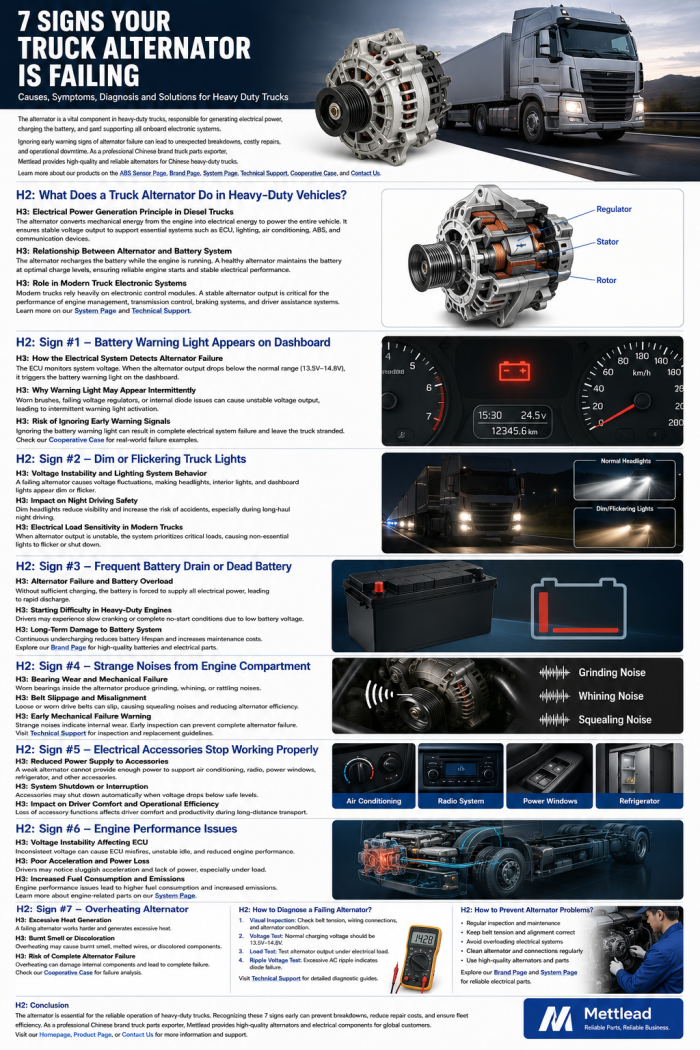
What Does a Truck Alternator Do in Heavy-Duty Vehicles?
Electrical Power Generation Principle in Diesel Trucks
The alternator in a heavy-duty truck is responsible for generating alternating current (AC) and converting it into direct current (DC) to supply power to the truck’s electrical system. Unlike passenger vehicles, heavy-duty trucks operate multiple high-load electrical systems such as ECU modules, lighting systems, air conditioning units, GPS tracking devices, and fuel management systems. The alternator ensures that all these components receive stable voltage during engine operation.

When the engine runs, the alternator belt drives the rotor inside the alternator, creating a magnetic field that induces electrical current. This process must remain stable under high vibration, long-distance operation, and varying engine loads. Any inconsistency in output voltage can immediately affect truck performance.
Relationship Between Alternator and Battery System
The alternator works closely with the truck battery to maintain stable voltage levels. While the battery provides initial starting power, the alternator continuously recharges it during driving. If the alternator fails, the battery becomes the sole power source, which leads to rapid discharge and eventual vehicle shutdown.
In heavy-duty applications, battery drain caused by alternator failure can occur within 30–120 minutes depending on load conditions. This makes alternator reliability critical for long-haul transportation operations.
Role in Modern Truck Electronic Systems
Modern trucks increasingly rely on electronic systems such as ABS braking control, engine ECU, transmission control modules, and stability systems. These systems require stable voltage to function correctly. A failing alternator can introduce voltage fluctuations that disrupt ECU communication and trigger false fault codes.
For ABS-related electrical stability systems, you can learn more from our System Page and Technical Support resources.
Sign #1 – Battery Warning Light Appears on Dashboard
How the Electrical System Detects Alternator Failure
One of the earliest indicators of alternator failure is the illumination of the battery warning light on the dashboard. This does not necessarily mean the battery itself is faulty. Instead, it often indicates that the alternator is no longer producing sufficient voltage to recharge the battery during engine operation.
The ECU continuously monitors system voltage. When it detects voltage below the normal range (typically 13.5V–14.8V for heavy-duty trucks), it triggers a warning light. This is often the first stage of alternator degradation.
Why Warning Light May Appear Intermittently
In early-stage alternator failure, the warning light may appear only during specific conditions such as idle speed, heavy electrical load, or high engine temperature. This intermittent behavior is usually caused by worn brushes, failing voltage regulators, or internal diode issues inside the alternator.
Fleet operators often misdiagnose this as battery failure, which delays proper repair and increases downtime.
Risk of Ignoring Early Warning Signals
Ignoring the battery warning light can lead to complete electrical shutdown. In heavy-duty trucks, this may affect engine control modules, lighting systems, and braking electronics. For fleet reliability analysis, real-world failure cases are available in our Customer Success Case section.
Sign #2 – Dim or Flickering Truck Lights
Voltage Instability and Lighting System Behavior
When a truck alternator begins to fail, one of the most visible symptoms is unstable lighting performance. Headlights, dashboard lights, and indicator lights may appear dim, flicker, or fluctuate in brightness depending on engine speed.
This occurs because the alternator is unable to maintain consistent voltage output, especially under low RPM conditions such as idling or slow traffic.
Impact on Night Driving Safety
For long-haul drivers operating at night, dim headlights significantly reduce visibility and increase accident risk. In heavy-duty transport scenarios, lighting instability can also affect trailer signal systems and road communication with other vehicles.
Electrical Load Sensitivity in Modern Trucks
Modern trucks carry multiple electrical loads simultaneously. When alternator output becomes unstable, the system prioritizes critical functions, which may cause non-essential systems to flicker or shut down intermittently.
Sign #3 – Frequent Battery Drain or Dead Battery
Alternator Failure and Battery Overload
A failing alternator forces the battery to supply all electrical power without proper recharging. This leads to rapid battery depletion, especially in trucks with high electrical demand.
Starting Difficulty in Heavy-Duty Engines
Drivers may notice slow cranking or complete failure to start the engine. This is often misdiagnosed as a battery issue, but the root cause is insufficient alternator charging.
Long-Term Damage to Battery System
Continuous undercharging shortens battery lifespan significantly. In fleet operations, this increases maintenance costs and downtime.
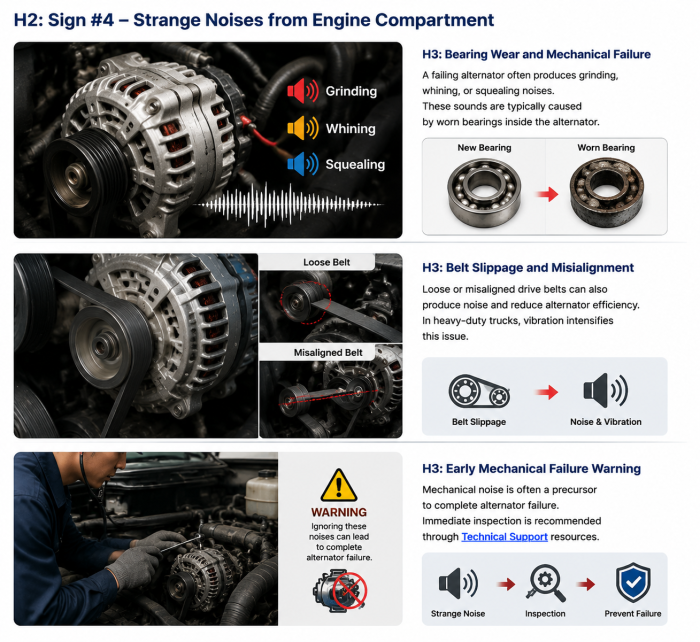
Sign #4-Unusual Whining or Grinding Noise
Bearings inside the housing wear over time, producing a high-pitched whine that increases with engine speed. A grinding sound indicates metal-on-metal contact—meaning failure is imminent. Serpentine belt misalignment can mimic this noise, so isolate the source with a mechanic's stethoscope before condemning the unit.
Heat accelerates bearing wear. Trucks operating in southern U.S. climates or hauling loads that restrict underhood airflow often experience premature bearing failure well before the brushes or diodes give out.
Sign #5 – Burning Smell or Electrical Odor
Overheating of Alternator Components
A failing alternator may generate excessive heat due to worn internal components, short circuits, or high-resistance connections. Drivers might notice a distinct burning smell coming from the engine compartment. This often occurs during prolonged highway operation or under heavy electrical load when the alternator struggles to maintain voltage.
Risk to Electrical Systems
Overheating can damage insulation on wires and connectors, potentially affecting multiple truck systems. This includes lighting, ECU modules, fuel injection electronics, and ABS or traction control systems. Early detection of electrical odor is critical to prevent cascading failures.
Fleet Maintenance Strategy
For fleets operating Chinese heavy-duty trucks such as SINOTRUK or FAW, preventive inspection is essential. Technicians should visually inspect alternator connections, test voltage output, and monitor for abnormal thermal conditions. Guidance is available through our Technical Support page.
Sign #6 – Frequent Engine Stalling or Electrical System Malfunction
Alternator-Related Engine Performance Issues
When an alternator fails, insufficient voltage can lead to engine ECU errors. Modern diesel engines rely heavily on electronics for fuel injection timing, turbo control, and emission systems. Voltage drops may cause the engine to stall, hesitate, or fail to start under load.
Effects on Connected Electrical Systems
Other electrical systems, including headlights, cabin electronics, and instrument panels, may behave erratically. This is particularly dangerous during night driving or in adverse weather conditions, where sudden electrical failure can compromise driver control.
Diagnostic Recommendations
Operators should verify alternator output using a heavy-duty multimeter or scan tool. Technicians can cross-reference real-time voltage data with expected parameters. More detailed procedures and fleet-level best practices are outlined in our System page.
Sign #7 – Strange Dashboard Warning Combinations
Interconnected Warning Lights
A failing alternator can trigger multiple dashboard warnings simultaneously, such as battery warning, ABS light, traction control alerts, and engine service notifications. This occurs because fluctuating voltage impacts multiple vehicle control modules simultaneously.
Operational Risks for Fleets
Trucks experiencing these combined warnings may experience reduced functionality or enter limp mode to prevent damage. In heavy-duty operations, this could lead to downtime and scheduling delays, affecting both logistics and cargo safety.
Importance of Systematic Troubleshooting
Fleet operators should perform comprehensive diagnostic checks before replacing individual components. Guidance for coordinated diagnostics is available through our Technical Support resources.
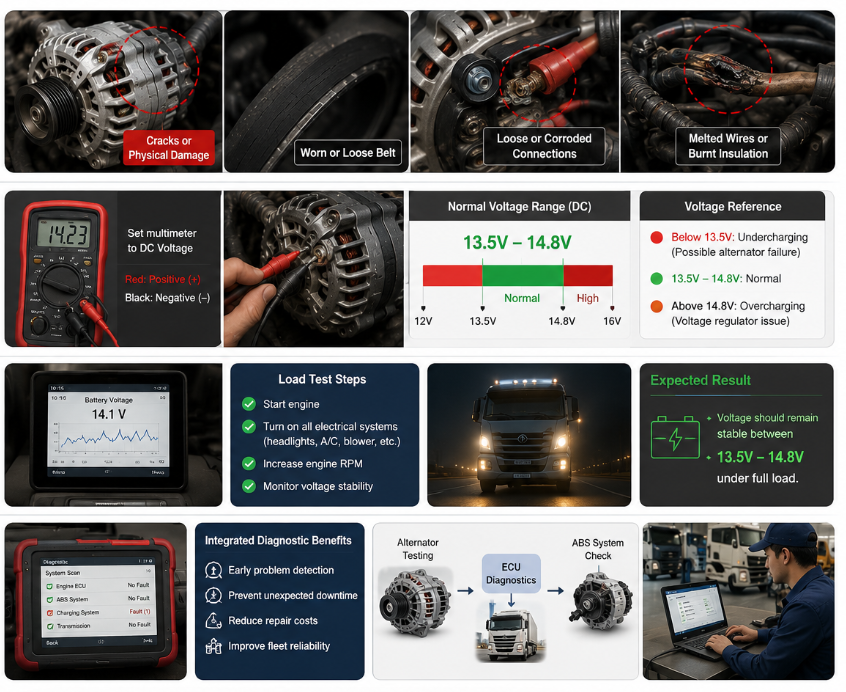
Quick Diagnostic: Testing Output with a Multimeter
For those who prefer a hands-on approach, here is how to test a truck alternator with a multimeter in three steps:
- Set the meter to DC volts, 20 V range.
- With the engine off, measure resting battery voltage (should read 12.4–12.7 V for a healthy battery).
- Start the engine and measure across the battery terminals again. A properly functioning unit should output 13.8–14.5 V at idle.
If the reading stays below 13.5 V or fluctuates wildly, the internal regulator or diode pack is likely compromised. A voltage drop test on the output cable can further isolate wiring resistance from internal component failure.
Preventive Maintenance Tips
- Inspect the serpentine belt every 50,000 miles for cracks, glazing, or misalignment.
- Check mounting bolts and brackets for fatigue cracks—vibration is the enemy of longevity.
- Keep connections clean. Corroded output terminals create voltage drop and mimic internal failure.
- Monitor battery health. A shorted cell forces the charging unit to overwork, accelerating wear.
- Upgrade wisely. Adding aftermarket accessories? Confirm total amperage demand does not exceed rated output.
When to Replace vs. Rebuild
Rebuilding makes financial sense when only the brushes or voltage regulator are worn and the housing, rotor, and stator remain structurally sound. For units past 400,000 miles with multiple failure modes, a full replacement is the safer bet.
Fleet operators often adopt a lifecycle threshold: once repair costs exceed 60% of a new unit's price, they swap rather than rebuild. This strategy minimizes repeat downtime and gives drivers a fresh warranty window.
Frequently Asked Questions
How long does a charging unit typically last on a commercial truck?
Most heavy-duty units last between 300,000 and 600,000 miles, depending on operating conditions, electrical load, and maintenance practices. High-idle applications like refrigerated trailers tend to shorten lifespan significantly.
Can I drive with a failing generator?
Technically, the engine will run on stored battery power for a limited time—usually 30 minutes to an hour depending on load. However, driving this way risks stalling in traffic and damaging voltage-sensitive electronics. It is strongly recommended to address the issue immediately.
What causes premature failure in heavy vehicles?
Common culprits include excessive heat, belt over-tension, coolant or oil leaks reaching internal windings, and chronic overloading from aftermarket accessories. A shorted battery cell can also force the unit to overwork until it fails.
Is a higher-amp unit always better as a replacement?
Not necessarily. A higher-output unit draws more mechanical energy from the engine and requires adequate wiring to handle the increased current. Match the amperage to your actual electrical demand plus a 20% headroom margin for reliability.
How do I differentiate between a battery problem and a charging system problem?
Perform a simple voltage test with the engine running. If voltage at the battery terminals stays below 13.5 V while the engine idles, the charging system is underperforming. If the battery cannot hold 12.4 V after a full charge with the engine off, the battery itself is the weak link.
Conclusion
Truck alternators are essential for reliable operation of modern heavy-duty vehicles. From battery warning lights to electrical odors, stalling, or multiple dashboard alerts, recognizing early signs of alternator failure can prevent costly downtime and accidents.
For Chinese brand truck fleets, maintaining reliable alternators ensures safe, efficient operations. High-quality alternators and full technical support can be found through ABS Sensor products, Technical Support, and Contact Us.