Introduction
Heavy-duty manual transmission trucks rely on dozens of small mechanical parts to deliver smooth shifting and reliable power output during long-haul transportation. For most fleet owners, truck drivers, and independent repair technicians, routine clutch maintenance always focuses on well-known wearable components.
Most people prioritize inspecting and replacing clutch discs, pressure plates, and clutch release bearings during regular service intervals. These parts are widely recognized as the core wearable components of the truck clutch system.
However, one tiny but extremely critical component is constantly overlooked in daily inspections and preventive maintenance. This component is the clutch fork, also widely known as the release fork in the heavy-duty truck industry.
Unlike clutch discs that wear out gradually with obvious slipping signs, a faulty clutch fork develops hidden damage over thousands of miles. Its early warning signs are extremely subtle and intermittent, making it very easy to misdiagnose or completely ignore.
As minor wear slowly develops into permanent deformation, cracks, or loose pivoting, drivers will begin to experience unstable clutch pedal feedback, stiff gear shifts, and annoying gear grinding issues.
In the worst-case scenarios, a severely damaged clutch fork can lead to complete clutch disengagement failure while driving. This unexpected fault directly causes roadside breakdowns, delayed cargo delivery schedules, and costly emergency repair fees for fleet companies.
To help you accurately identify clutch fork faults, avoid unnecessary part replacements, and eliminate recurring clutch system problems, this comprehensive guide covers every key detail of clutch fork failure and maintenance.
We elaborate on core working principles, common failure types, identifiable symptoms, deep-rooted causes, step-by-step professional inspections, standardized repair solutions, and long-term preventive maintenance strategies. For more professional truck mechanical troubleshooting content, you can explore our professional technical support library.
What Is a Clutch Fork? Basic Definition & Working Principle
Before diving into specific fault diagnosis and repair operations, it is necessary to clarify the basic definition and working logic of a truck clutch fork. This foundational knowledge helps you understand why minor fork damage can trigger a series of serious clutch system failures.
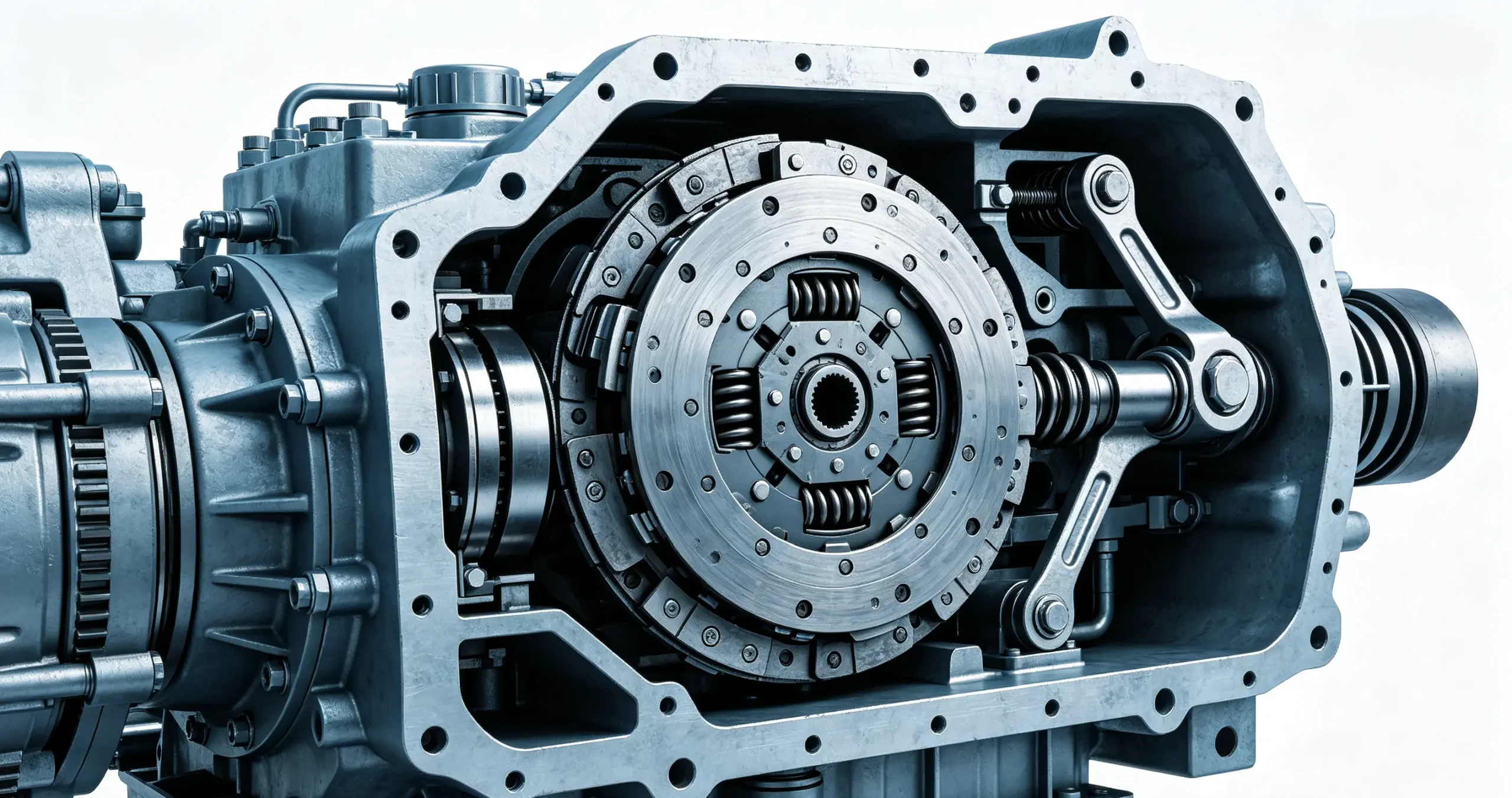
Simply put, the clutch fork is a high-strength metallic lever installed inside the transmission bell housing, which is the sealed cavity between the truck engine and manual transmission assembly.
It is precisely positioned between the engine flywheel group and the front end of the manual transmission. It acts as the only mechanical transfer medium connecting the driver’s clutch pedal operation and the clutch release bearing movement.
The entire working process of the clutch fork follows a fixed mechanical linkage logic. When the driver steps down the clutch pedal, the truck’s hydraulic clutch system or mechanical pull rod linkage generates pushing force.
This force acts on the outer arm of the clutch fork. Subsequently, the entire fork body rotates and pivots around a fixed ball stud support point installed on the bell housing inner wall.
As the fork pivots inward, the two fork tips at the other end firmly push the outer ring of the clutch release bearing forward toward the engine flywheel direction.
The forward-moving release bearing continuously presses the pressure plate diaphragm fingers. This pressure separates the clutch disc from the engine flywheel surface, cutting off the power transmission between the engine and transmission.
Once power transmission is disconnected, the transmission gears lose power lock, allowing the driver to complete smooth gear shifting, gear reduction, or reverse gear operation.
When the driver releases the clutch pedal, hydraulic pressure disappears, and the pressure plate’s elastic reset force pushes the release bearing back to its original position. Meanwhile, the clutch fork resets automatically to standby status.
Every single gear shift operation during truck driving completely depends on the flexible, stable, and accurate pivoting movement of the clutch fork. Without a healthy clutch fork, the entire manual transmission clutch system cannot work normally.
For matched OEM-grade clutch system accessories and complete transmission assembly parts, you can check truck transmission system parts to ensure part matching accuracy during replacement and maintenance.
Core Roles of a Healthy Truck Clutch Fork
Most novice drivers and even junior maintenance technicians hold a one-sided understanding of clutch fork functions. Many people simply believe that the clutch fork only undertakes the single task of pushing the release bearing.
In actual heavy-duty truck operation scenarios, a qualified and intact clutch fork undertakes three irreplaceable core mechanical functions. These functions guarantee the stability and durability of the entire clutch system.
First, the clutch fork achieves accurate clutch pedal force conversion and transmission. It converts the linear stepping stroke of the clutch pedal into directional lateral pushing force for the release bearing.
This precise force conversion ensures that every pedal movement can correspond to an accurate bearing displacement, avoiding insufficient or excessive clutch disengagement stroke.
Second, the clutch fork maintains long-term center alignment of the clutch release bearing. The two symmetrical fork tips ensure that the bearing is always stressed evenly during each pushing and reset cycle.
Even under high-torque and heavy-load driving conditions, a straight and undamaged clutch fork can prevent the release bearing from deflection, tilt, and unilateral wear.
Third, the clutch fork plays a key role in mechanical shock buffering and pressure relief. Frequent gear shifting inevitably produces tiny mechanical impact and vibration inside the bell housing.
The metal lever structure of the clutch fork can absorb and buffer these instantaneous shocks, protecting the pressure plate diaphragm, clutch disc, and release bearing from rigid impact damage.
Once the clutch fork is deformed, worn, or loose, all three core functions will fail simultaneously. This triggers a chain reaction of clutch system faults, ranging from subtle shifting unsmoothness to complete clutch failure.
Most Common Clutch Fork Problems in Heavy-Duty Trucks
Based on long-term heavy-duty truck fleet maintenance data and a large number of on-site repair cases, clutch fork failure types in commercial vehicles are highly fixed and regular.
Different types of clutch fork damage correspond to different driving symptoms and failure degrees. Distinguishing these fault types can help you accurately locate problems and avoid misdiagnosing fork damage as ordinary clutch disc wear.
1. Clutch Fork Bending & Permanent Deformation
Bending and permanent deformation are the most prevalent clutch fork faults in heavy-duty trucks. This fault occurs far more frequently than cracks and fracture damage in daily driving.
The main inducement is long-term heavy-load gear shifting and aggressive clutch pedal operation. Many truck drivers are used to stepping the clutch pedal violently or shifting gears in a hurry without complete clutch disengagement.
Each rough operation will produce instantaneous impact torque on the fork body. Although a single impact is not enough to cause visible damage, thousands of repeated impacts will cause irreversible metal bending deformation.
A slightly bent clutch fork will deviate from the standard horizontal lever angle. It can no longer keep the release bearing stressed evenly during operation.
As a result, the clutch disengagement stroke becomes insufficient and asymmetrical. Drivers will obviously feel stiff gear shifting, laborious gear engagement, and frequent gear grinding noise during each shift.
2. Pivot Ball Stud Wear & Loose Pivoting Play
The clutch fork relies entirely on the fixed pivot ball stud on the bell housing wall to complete reciprocating pivoting movement. This contact point is the core stress and friction position of the entire fork assembly.
Every clutch pedal operation will drive the fork to rub against the surface of the ball stud. After tens of thousands of miles of cyclic friction, the smooth surface of the ball stud will gradually wear, pit, and lose roundness.
When the ball stud wears severely, the matching gap between the fork mounting hole and the stud increases significantly. This creates obvious loose play during fork pivoting.
The direct consequence of loose pivot play is inconsistent clutch pedal travel. Sometimes the clutch can disengage completely with half pedal travel, while other times full pedal depression still cannot achieve complete disengagement.
3. Fork Tip Wear & Deep Groove Scratches
The two front fork tips are the direct contact parts with the release bearing housing. These two positions keep sliding and rubbing against the bearing shell during every clutch engagement and disengagement process.
Under long-term high-frequency friction, the flat contact surface of the fork tips will gradually wear down, and even form obvious deep annular grooves and scratch marks.
The worn fork tips reduce the effective pushing distance of the release bearing. Even if the driver steps the clutch pedal to the bottom according to standard operation, the bearing still cannot reach the complete disengagement position.
This fault is extremely easy to misdiagnose in actual maintenance. Most technicians will directly replace the release bearing when encountering incomplete clutch disengagement, while ignoring the underlying wear problem of the clutch fork tips.
4. Metal Fatigue Cracks & Complete Fracture Damage
Cracks and fracture damage belong to severe late-stage clutch fork failures, which mostly appear on high-mileage old trucks or vehicles with long-term rough shifting habits.
Long-term cyclic stress will cause metal fatigue inside the fork body. Tiny invisible internal cracks will gradually form and expand with each pedal operation.
In the early cracking stage, the symptoms are extremely subtle, only accompanied by occasional faint abnormal noise. Once the cracks expand to the critical stress point, the clutch fork may snap completely during driving.
A completely broken clutch fork will lose all pushing capacity. The clutch pedal will lose resistance instantly, and the driver cannot select any gear, resulting in immediate vehicle stalling and road stranding.
5. Rust, Corrosion & Stagnant Fork Movement
Trucks operating in humid coastal areas, rainy mountainous areas, or dusty construction sites are more prone to clutch fork rust and corrosion problems.
Damaged bell housing sealing gaskets and aging rubber seals will lose their dustproof and waterproof capabilities. External rainwater, muddy water, and humid air will penetrate into the closed bell housing cavity.
Moisture accumulation will cause oxidative rust on the fork body, pivot ball stud, and fork contact surfaces. Rust deposits increase friction and cause local jamming.
The fork movement becomes jittery, sluggish, and unsmooth. This leads to sudden clutch engagement, uneven power output, and obvious vehicle jerking during startup and shifting.
Typical Bad Clutch Fork Symptoms (Driver & Technician Guide)
The biggest identification feature of clutch fork faults is randomness and inconsistency, which is completely different from the linear and steady deterioration of ordinary clutch wearing parts.
Clutch disc wear, pressure plate fatigue, and hydraulic system failure all have regular and stable failure processes. However, clutch fork problems show intermittent and irregular symptoms.
One hundred percent of unstable clutch faults that appear occasionally and return to normal automatically are basically related to clutch fork wear, looseness, or deformation. Below are all authoritative and practical diagnostic symptoms.
1. Unstable & Inconsistent Clutch Pedal Feel
A failing clutch fork brings completely unpredictable pedal feedback to the driver. The pedal feel will switch randomly between normal, stiff, and spongy states.
During one driving cycle, the clutch pedal may feel smooth and normal for dozens of shifts. Suddenly, the pedal becomes extremely stiff, requiring great force to step down.
In other cases, the pedal will appear spongy and empty. Half of the pedal travel has no resistance at all, and the clutch only responds when pressed to the bottom.
This irregular dead zone and resistance change is caused by the unbalanced pivoting gap and deformed angle of the faulty clutch fork.
2. Hard Shifting & Recurrent Gear Grinding Noise
When the clutch fork is bent or worn, the release bearing cannot completely separate the clutch disc from the flywheel. The transmission gears still retain residual rotating power.
Under this incomplete disengagement state, gear meshing will inevitably produce harsh metal grinding noise. Gear shifting becomes laborious and stuck.
This symptom has obvious load correlation. When the truck is empty, the residual power torque is small, and the grinding phenomenon is not obvious.
Once the truck is fully loaded or climbing with heavy cargo, the residual torque increases, and gear grinding and difficult shifting will become extremely serious.
3. Idle Rattling Noise & Clutch Pedal Vibration
A loose or worn clutch fork will produce unique abnormal noise inside the bell housing when the engine is idling. The sound is a faint rhythmic ticking or rattling metal collision sound.
This noise is completely different from the continuous humming sound of a faulty release bearing. Fork noise is intermittent and will change obviously with slight pedal movement.
When the driver gently steps on the clutch pedal, the loose fork is positioned and tightened, and the abnormal noise will disappear immediately. Meanwhile, obvious tiny vibration will be transmitted to the pedal.
4. Uneven Clutch Grabbing & Violent Startup Jerking
A rusted, stuck, or deformed clutch fork cannot complete smooth and uniform reset movement. The clutch engagement process becomes sudden and abrupt instead of gradual and gentle.
Even if the driver operates the clutch pedal slowly and smoothly, the truck will still experience obvious forward jerking and power jumping during startup.
Most drivers will mistakenly judge this fault as clutch disc glaze or pressure plate spring fatigue. In fact, fork misalignment and unbalanced movement are the core causes in most cases.
5. Partial Clutch Disengagement & Vehicle Creeping
In the middle and late stages of clutch fork failure, the effective pushing stroke is severely insufficient. Even if the clutch pedal is fully pressed to the floor, the clutch cannot be completely disengaged.
At this time, the truck will have an obvious creeping phenomenon when idling in gear. The vehicle still has forward driving tendency even with the clutch fully depressed.
Forward gear shifting is difficult, and reverse gear grinding becomes particularly severe. This is a typical deterministic symptom of bent and worn clutch forks.
6. Sudden Total Clutch Failure & Pedal Collapse
This is the most dangerous extreme fault of a damaged clutch fork. When the fatigued fork body cracks or breaks completely, the entire force transmission mechanism fails instantly.
The clutch pedal will lose all pressure resistance and sink directly to the floor. No matter how the driver operates, the clutch cannot disengage, and no gears can be selected.
This fault occurs suddenly during driving and cannot be recovered. The vehicle can only be towed back to the repair shop for disassembly and replacement.
Root Causes of Clutch Fork Failure in Heavy-Duty Trucks
Many repair shops only replace damaged clutch forks during maintenance but fail to solve the fundamental causes. As a result, new forks are damaged again in a short time, causing repeated failures.
Almost all clutch fork premature failures are caused by unreasonable driving habits, inadequate maintenance, and non-standard installation. We summarize six core root causes for reference.
1. Aggressive Driving & Rough Shifting Habits
Aggressive clutch operation is the number one cause of fork bending and fatigue damage. Many professional drivers pursue shifting efficiency and often step the clutch pedal violently and release it quickly.
Rush shifting without waiting for complete clutch disengagement will form huge instantaneous impact force on the fork body.
Long-term cumulative impact will destroy the original mechanical balance of the fork, causing slow bending deformation and internal metal fatigue.
2. Long-Term Overload & High-Torque Operation
Heavy-duty trucks often face overloaded transportation and long-distance climbing conditions. Overloaded vehicles require far greater clutch transmission torque than standard load conditions.
The clutch fork bears ultra-limited pressure and friction for a long time, which greatly exceeds the factory design load standard.
Continuous high-load operation accelerates metal fatigue speed, shortens the service life of the fork, and easily induces bending and cracking faults.
3. Long-Term Lack of Lubrication & Dry Friction Wear
The clutch fork pivot ball stud and fork tip contact surfaces need high-temperature resistant clutch grease for long-term lubrication protection.
However, this internal lubrication point is hidden inside the bell housing and cannot be observed directly. Most fleet maintenance plans ignore regular clutch system lubrication.
Long-term dry friction causes rapid wear of contact surfaces, increases pivoting gaps, and produces loose play and abnormal noise.
4. Seal Damage & Internal Dust and Moisture Contamination
Aging and damaged bell housing sealing gaskets and rubber oil seals will lose their protective effect. Road dust, sediment, rainwater, and humid air will penetrate into the clutch cavity.
Dust forms abrasive particles after entering, which accelerates the wear of fork tips and pivot points. Moisture causes metal rust and corrosion, leading to stuck fork movement.
5. Inferior Aftermarket Replacement Parts & Unqualified Accessories
Many small repair shops choose low-cost inferior clutch forks to save maintenance costs. These unqualified accessories use low-strength recycled steel materials.
The material toughness and compression resistance are far lower than OEM standards. They are very prone to bending and cracking under normal driving load.
In addition, inferior forks have inaccurate dimensional tolerances, resulting in poor fitting and unilateral stress after installation. For reliable standard accessories, you can browse genuine truck parts catalog.
6. Non-Standard Installation & Fork Misalignment
Clutch fork installation has strict angle and position requirements. During clutch kit replacement, inexperienced technicians often install the fork randomly.
Skewed and misaligned fork installation will cause unilateral stress on the fork body. Long-term uneven force will lead to rapid local wear and bending deformation.
Professional Clutch Fork Inspection Steps (No Guesswork)
Accurate fault inspection can help you avoid blind transmission disassembly and unnecessary parts replacement. The following is the standard industrial inspection process for clutch fork faults, suitable for all heavy-duty manual transmission trucks.
1. Road Test Symptom Verification & Recording
First, conduct an actual road test to reproduce and record all abnormal symptoms. Test empty load and full load driving states respectively.
Check whether the clutch pedal is unstable, whether there is gear grinding, whether there is idle abnormal noise, and whether the vehicle jerks during startup.
Record the occurrence rules of symptoms to preliminarily screen and eliminate hydraulic system and clutch disc faults.
2. External Hydraulic & Linkage System Inspection
Before checking internal fork parts, first eliminate external simple faults. Check the clutch master cylinder and slave cylinder for oil leakage and air bubble accumulation.
Detect whether the clutch pull rod and linkage are stuck, deformed, or loose. Ensure all external mechanisms work normally.
If external faults exist, repair them first to avoid misjudging internal fork problems.
3. Visual Inspection Through Bell Housing Observation Port
Most heavy-duty truck bell housings are designed with detachable observation covers. Remove the cover to directly observe the internal clutch fork state.
Visually check whether the fork body is bent, whether the surface is rusted, whether there are tiny cracks, and whether the pivot point lacks lubricating grease.
Observe the wear degree of the fork tips to preliminarily judge the fault severity.
4. Manual Fork Movement Gap Test
Use a professional pry bar to gently push and pull the clutch fork manually. Feel the tightness and smoothness of pivoting movement.
A healthy fork moves smoothly without jitter and loose play. A faulty fork has obvious stagnation, jitter, or large loose gap.
This step can accurately judge pivot wear and deformation problems.
5. Complete Disassembly Fine Inspection
For vehicles with inconspicuous symptoms or severe faults, remove the transmission assembly for full disassembly and inspection.
Check the straightness of the fork body with a straight ruler, measure the wear depth of fork tip grooves, and observe hidden fatigue cracks on the fork body.
Any visible wear, deformation, or cracking must be judged as invalid and replaced directly.

How to Fix Bad Clutch Fork Issues (Complete Repair Guide)
Different types of clutch fork faults correspond to targeted repair schemes. It is impossible to solve all problems with a single replacement method. Below are the most cost-effective and professional repair solutions for various faults.
1. Replace Bent, Cracked, or Deformed Clutch Fork
Bent and cracked clutch forks cannot be repaired by manual correction. Even if the bent shape is forcibly restored, internal metal fatigue still exists.
The hidden fatigue will cause secondary deformation and fracture in a short time. The only safe solution is to replace with a new OEM-grade clutch fork.
The new fork restores standard lever angle and mechanical balance, completely solving unstable disengagement problems.
2. Replace Worn Pivot Ball Stud
If the pivot ball stud is worn, pitted, or loose, it must be replaced together with the clutch fork. Old worn studs cannot match new forks stably.
A new ball stud provides smooth and stable pivot support, completely eliminating pedal jitter and inconsistent travel caused by loose gaps.
3. Inspect and Replace Damaged Release Bearing
Fork tip wear and jittery movement will inevitably cause abnormal wear of the release bearing. During fork maintenance, the bearing must be inspected synchronously.
Replace noisy, stuck, and fatigued release bearings to avoid secondary clutch failure after repair. You can learn detailed judgment methods in our guide about bad clutch release bearing symptoms.
4. Comprehensive High-Temperature Lubrication Maintenance
Thoroughly clean old dry grease, rust, and metal debris on the fork pivot and fork tips. Polish rusty positions smoothly.
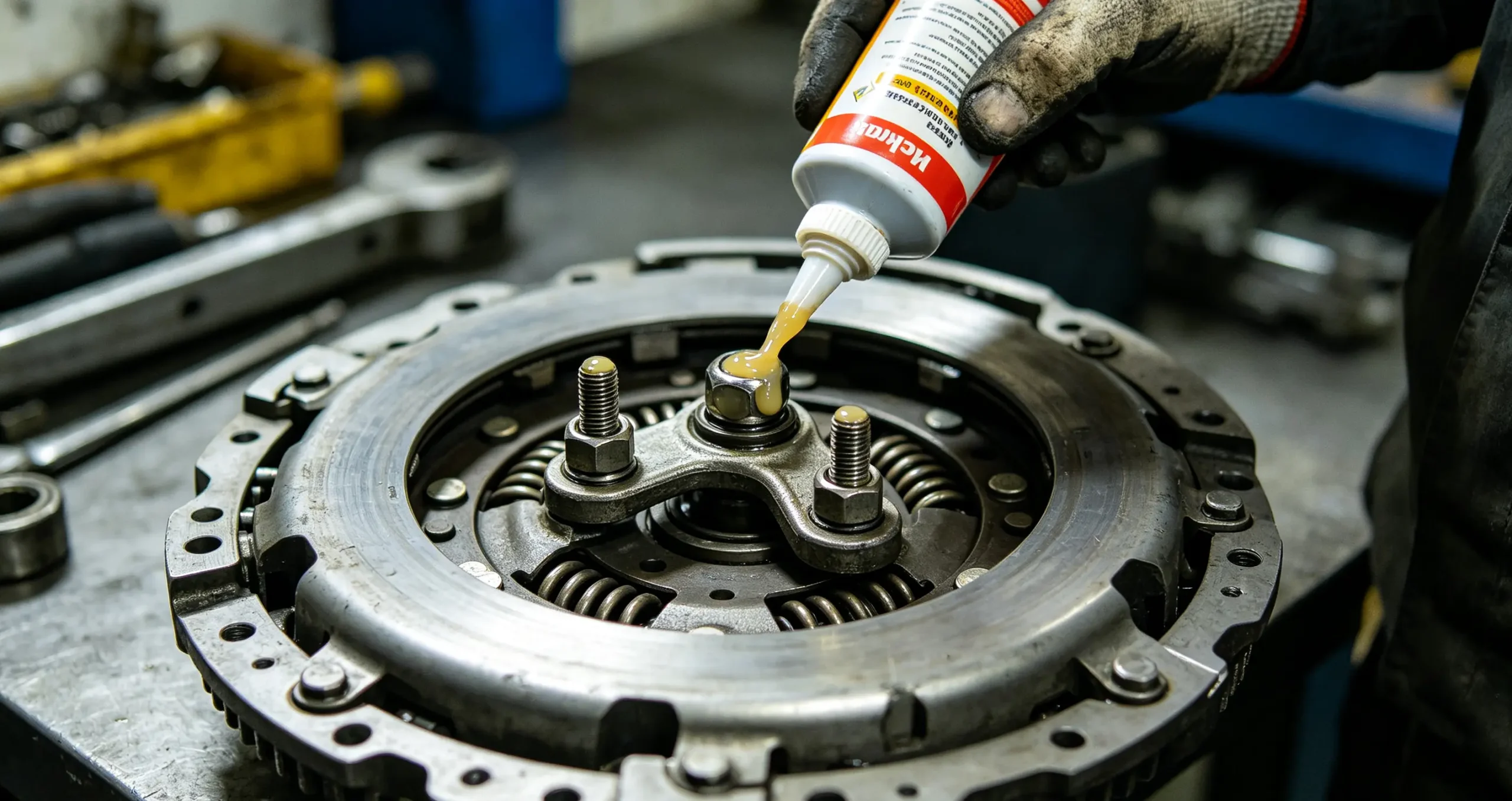
Apply special high-temperature resistant clutch grease to all friction contact points. This ensures long-term smooth pivoting and eliminates friction noise.
5. Replace Aging Seals & Clean Internal Contamination
Replace damaged bell housing gaskets and waterproof and dustproof seals. Block external moisture and dust intrusion channels.
Clean all residual sediment and metal debris inside the clutch cavity to prevent abrasive wear on new parts.
6. Recalibrate Clutch Pedal Free Travel
After all parts are replaced, strictly adjust the clutch pedal free travel to the factory standard range. Incorrect travel will cause premature fatigue of new forks.
Standard calibration ensures the most reasonable force-bearing state of the clutch fork and prolongs service life.
Common Repair Mistakes to Avoid During Clutch Fork Service
Repeated clutch fork failures after repair are mostly caused by non-standard maintenance operations. We summarize six most common repair mistakes to help you avoid detours.
First, never reuse old pivot ball studs. Slight wear will produce gaps, which will directly affect the use effect of new forks.
Second, do not omit lubrication steps. Dry assembly is the main cause of early wear and abnormal noise of new parts.
Third, do not only replace the fork while ignoring damaged seals. Water and dust leakage will cause repeated corrosion and wear.
Fourth, do not choose inferior accessories. Low-quality forks have unqualified material and size, which are prone to failure quickly.
Fifth, do not ignore aging matching parts. Single-part replacement cannot solve hidden dangers of system aging. For professional matching guidance, contact our professional technical team.
Daily Maintenance Tips to Extend Clutch Fork Service Life
Scientific daily maintenance can effectively double or even triple the service life of clutch forks, greatly reducing fleet maintenance costs and vehicle downtime.
First, develop smooth shifting habits. Avoid violent clutch stepping and fast releasing, and prohibit rush gear shifting.
Second, strictly control overload driving. Reduce long-term high-torque impact on the clutch transmission system.
Third, conduct quarterly clutch system inspections. Regularly check seal integrity, internal lubrication, and fork movement state.
Fourth, replace high-temperature grease regularly to avoid dry friction and rust accumulation.
Fifth, park vehicles in dry and ventilated environments to reduce internal moisture corrosion.
Sixth, formulate standardized preventive replacement cycles. Refer to our fleet cooperation cases to formulate scientific maintenance plans.
How to Tell Clutch Fork Failure Apart From Other Clutch Faults
Accurate fault distinction is the core of efficient maintenance. Many technicians confuse clutch fork faults with other clutch system problems. Here is the simplest and most accurate discrimination method.
Clutch disc wear shows gradual load slipping, and the pedal feel is always stable without random changes.
Hydraulic system failure shows soft pedal and slow response, without internal metal collision noise.
Release bearing failure shows continuous humming noise during idling or pedal pressing.
Only clutch fork failure has intermittent inconsistent pedal feel, random gear grinding, and internal metal tapping noise.
For more professional truck mechanical fault comparison and diagnosis content, visit our official homepage to obtain complete technical guide resources.
FAQs About Bad Clutch Fork Problems & Repairs
Q1: Can I continue driving with a slightly bad clutch fork?
A: Minor fork wear with very subtle symptoms supports short-distance low-speed driving. However, deformed, cracked, or loose forks have huge hidden dangers. Sudden complete failure may occur at any time, causing road stranding. Early repair is the safest choice.
Q2: What is the standard service life of a heavy-duty truck clutch fork?
A: With standard maintenance and smooth driving habits, genuine OEM clutch forks can last 150,000 to 300,000 miles. Rough shifting and long-term overload will reduce the service life by more than half.
Q3: Is it necessary to replace the whole clutch kit when changing a clutch fork?
A: No mandatory full replacement requirement. If the clutch disc and pressure plate are in good condition, only replace the fork, ball stud, and release bearing. For high-mileage aging vehicles, full kit replacement is more stable.
Q4: Why is shifting still hard after clutch fork replacement?
A: Common reasons include incorrect pedal free travel adjustment, insufficient lubrication, residual transmission internal faults, and uncalibrated hydraulic system. Recheck installation and calibration standards.
Q5: Is clutch fork repair costly for heavy trucks?
A: The accessory cost of clutch forks is low. The main cost comes from transmission disassembly labor. Early preventive inspection and maintenance can greatly save emergency repair costs.
Final Conclusion
The clutch fork is a tiny but irreplaceable core component of heavy-duty truck manual transmission systems. It undertakes force transmission, positioning and buffering functions, and determines the smoothness and stability of all gear shifting operations.
Most intermittent and mysterious clutch faults in daily truck operation are rooted in worn, bent, loose, or rusted clutch forks. Due to hidden installation positions and subtle early symptoms, this component is always overlooked.
By mastering the typical failure symptoms, root causes, professional inspection methods, and standardized repair processes summarized in this guide, you can completely solve various clutch fork-related shifting faults.
Cooperating with scientific daily maintenance and standardized driving habits, you can effectively extend the service life of the clutch system, reduce fleet vehicle downtime, and control overall maintenance costs.
For high-quality OEM-grade heavy-duty truck clutch system accessories and one-stop professional technical support, Mettlead provides reliable products and after-sales services for global repair shops and fleet enterprises.


