Introduction
Heavy-duty trucks and commercial trailers rely entirely on stable air brake systems to ensure road safety. Unlike light passenger vehicles, large commercial vehicles carry massive loads and travel long distances every day. Therefore, every component inside the brake system must maintain precise and consistent working accuracy.
Among all brake parts, the brake adjuster, also widely known as the slack adjuster, stands as one of the most critical safety components. Many fleet owners and drivers overlook this small part. However, minor failures or incorrect adjustments can directly cause uneven braking, delayed brake response, dragging brakes, and extended stopping distances.
In severe cases, poor-quality or maladjusted brake adjusters lead to DOT inspection failures, sudden roadside breakdowns, and even traffic accidents. For this reason, choosing a professional and reliable truck brake adjuster supplier becomes essential for fleet long-term safe operation.
Many aftermarket suppliers provide low-cost brake adjusters with unstable quality. These generic parts often suffer from loose internal gears, weak return springs, poor wear resistance, and inaccurate stroke control. Short service life and frequent replacements ultimately increase fleet operating costs instead of reducing them.
In contrast, cooperating with a specialized heavy-duty brake system supplier ensures stable part quality, precise dimensional standards, full model compatibility, and professional after-sales technical support.
This comprehensive guide focuses entirely on heavy-duty truck brake adjusters. It covers core functions, working principles, main types, common failure symptoms, root causes of damage, professional installation steps, adjustment standards, supplier selection strategies, and long-term maintenance methods.
By reading this article, fleet managers, truck owners, and maintenance technicians can accurately identify brake adjuster problems, complete standard installation and adjustment, and select qualified brake adjuster suppliers to stabilize fleet brake system performance.
To explore the complete composition of truck pneumatic brake components, visit our professional product system category: truck system parts and pneumatic brake components.
What Is a Truck Brake Adjuster? Core Function & Working Principle
Before understanding supplier selection and maintenance skills, it is necessary to clarify the basic definition and working logic of the truck brake adjuster. This component is the core stroke control unit of the air brake foundation braking system.
Simply put, brake linings and brake drums will gradually wear out after long-term braking friction. As wear accumulates, the gap between the lining and the drum becomes larger. Without automatic or manual adjustment, the pushrod stroke of the brake chamber will increase continuously.
Excessive pushrod stroke directly causes slow brake response, insufficient braking force, and unbalanced wheel braking. The core task of the brake adjuster is to automatically or manually compensate for friction material wear to keep the brake stroke within the factory standard range at all times.
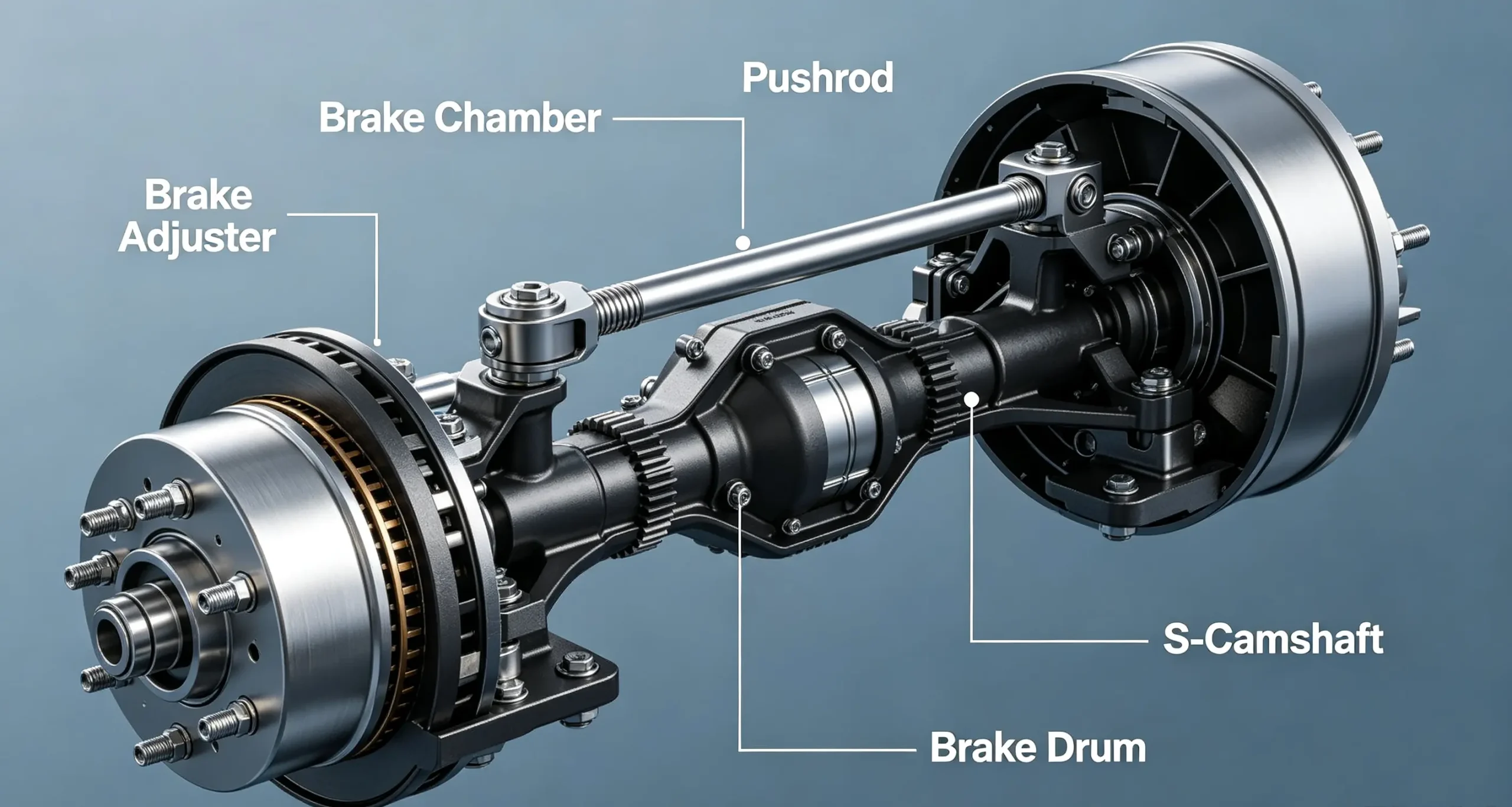
The brake adjuster is installed between the brake chamber pushrod and the S-camshaft. When the driver steps on the brake pedal, the brake chamber pushrod pushes the slack adjuster lever. The adjuster drives the S-cam to rotate, expanding the brake shoes to complete braking.
During the braking and releasing cycle, the internal gear structure of the adjuster accurately compensates for tiny gaps caused by lining wear. This mechanism ensures consistent brake sensitivity and uniform braking force on all wheels.
Without qualified brake adjusters, the entire air brake system cannot maintain stable working efficiency. Even if you replace high-quality brake chambers, brake shoes, and air valves, unadjusted brake stroke will still cause continuous brake failures.
For more professional brake system troubleshooting and repair guidance, refer to our technical support library: heavy duty truck technical support and repair guides.
Two Main Types of Heavy-Duty Truck Brake Adjusters
In the current commercial vehicle industry, brake adjusters are divided into two mainstream types according to adjustment methods: manual slack adjusters and automatic slack adjusters. Each type has distinct structural features, applicable scenarios, maintenance requirements, and supplier quality standards.
1. Manual Brake Slack Adjuster
Manual brake adjusters are the traditional and classic brake stroke control parts. They rely on manual rotation of the internal adjustment gear to compensate for brake lining wear.
This type of adjuster features a simple structure, fewer internal precision parts, strong durability, and low failure rate under standard maintenance cycles. It is widely used in engineering machinery trucks, old-model heavy-duty trucks, and regional short-haul fleets.
The biggest feature of manual adjusters is low failure probability. Since there is no complex automatic compensation mechanism, internal gear wear is slow. As long as technicians complete regular inspection and adjustment according to maintenance cycles, manual adjusters can achieve a very long service life.
However, manual adjusters have obvious disadvantages. They require regular manual inspection and calibration. Many fleets miss adjustment cycles due to busy schedules or insufficient maintenance awareness. This negligence gradually leads to excessive brake stroke and hidden brake safety hazards.
2. Automatic Brake Slack Adjuster
Automatic slack adjusters are upgraded modern brake components. They can automatically complete gap compensation during each brake release cycle without manual intervention.
The internal structure of automatic adjusters is more precise, including worm gears, limit springs, clutch structures, and self-locking devices. These precision structures can sense tiny brake gap changes and complete accurate compensation in real time.
The greatest advantage of automatic adjusters is zero daily adjustment work. They always maintain the optimal brake stroke range, effectively avoiding safety risks caused by human negligence. At present, most new-generation heavy-duty trucks and long-haul logistics fleets fully adopt automatic brake adjusters.
Nevertheless, automatic adjusters have higher requirements for part precision, material quality, and processing technology. Low-quality automatic adjusters from irregular suppliers are prone to jamming, over-adjustment, self-locking failure, and brake dragging problems.
Therefore, when purchasing automatic brake adjusters, fleet operators must cooperate with professional suppliers with mature production standards to avoid frequent failures caused by inferior parts.
Core Quality Standards for Qualified Truck Brake Adjusters
Many fleet buyers only compare prices when purchasing brake adjusters. In fact, brake adjusters belong to safety-critical parts. Substandard quality will lead to endless hidden troubles. A professional brake adjuster supplier strictly follows the following core quality standards.
First, high-strength alloy steel overall forging. Qualified brake adjusters adopt integral forging technology instead of ordinary welding and splicing. Integral forging ensures uniform material density, strong impact resistance, and no deformation under long-term alternating braking load.
Second, precision gear matching tolerance. The internal worm gear and worm structure must maintain micron-level matching accuracy. Excessive gear gaps will cause delayed braking and abnormal noise. Overly tight matching will cause jamming and brake dragging.
Third, high fatigue resistance and wear resistance. Road vibration, frequent braking, and temperature changes will continuously test the adjuster performance. High-quality adjusters adopt special heat treatment and surface hardening technology to extend service life.
Fourth, strict stroke calibration standards. Formal suppliers will complete factory stroke testing one by one to ensure that each adjuster meets OEM standard parameters. Unqualified products will be eliminated directly to avoid inconsistent braking performance.
Learn about genuine truck part brands and factory-level quality standards: genuine truck brand parts and factory supply standards.
Common Symptoms of Failing Brake Adjusters
Brake adjuster failures do not happen suddenly. Almost all malfunctions develop gradually from minor wear, improper adjustment, or long-term lack of maintenance. Early warning signs are often subtle and easy to ignore during daily fleet inspections. However, capturing these abnormal signals in advance can completely avoid sudden brake failure, roadside shutdowns, and expensive traffic accident losses. For fleet managers and maintenance technicians, mastering failure symptom identification is the most basic and core maintenance skill.
Most brake adjuster faults manifest in braking performance changes, wheel temperature differences, abnormal noise, and inspection data anomalies. The following content sorts out the most common ten failure symptoms of manual and automatic slack adjusters, explains the corresponding root causes one by one, and provides targeted judgment methods.
1. Extended Vehicle Stopping Distance
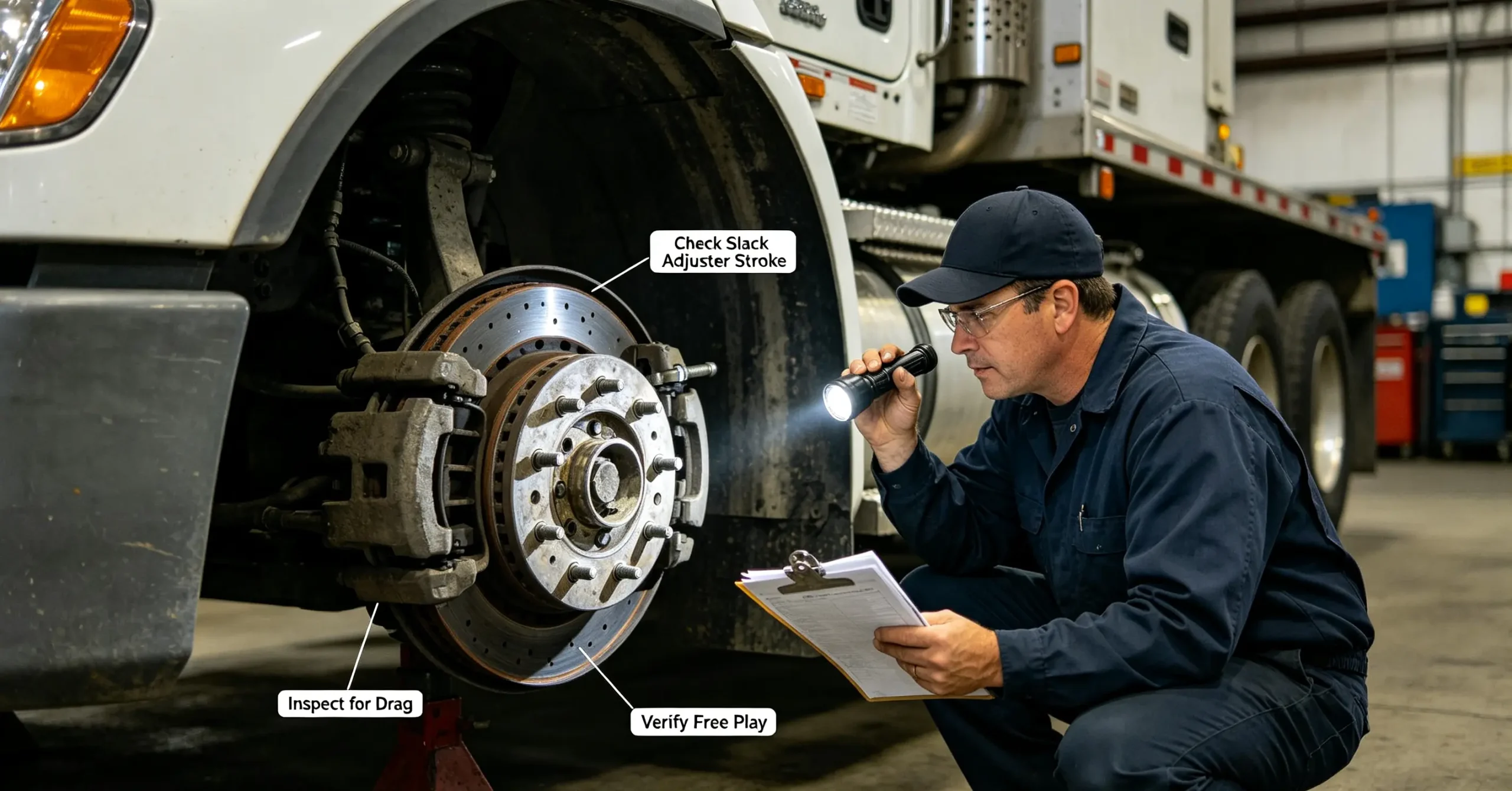
Extended stopping distance is the earliest and most intuitive failure manifestation of invalid brake adjusters. When the slack adjuster cannot complete normal gap compensation, the brake pushrod stroke continues to increase. The brake chamber cannot output enough thrust to clamp the brake drum in place, resulting in soft braking feeling and significantly prolonged stopping distance.
This problem is extremely dangerous for heavy-load long-haul trucks. Under high-speed driving and emergency braking conditions, insufficient braking margin will directly lead to rear-end collisions and rollover risks. In daily road tests, if the driver finds that the brake pedal travel becomes longer and the braking response is lagging, the brake adjuster stroke must be checked immediately.
2. Single-Side Brake Delay & Uneven Braking
Uneven braking on the left and right wheels is a typical fault caused by inconsistent brake adjuster working states. When one side of the slack adjuster fails to adjust normally while the other side works normally, the braking force of the two wheels is unbalanced.
During braking, the truck will deviate to one side, which seriously affects driving stability. This fault is often misjudged as a brake air circuit failure or brake shoe wear problem. In fact, more than 60% of truck brake deviation faults are ultimately caused by aging and failure of a single-side brake adjuster.
3. Hot Wheel Hub and Brake Dragging
Brake dragging refers to the state where the brake shoes cannot completely separate from the brake drum after releasing the brake pedal. This phenomenon is mainly caused by over-adjustment failure of automatic brake adjusters or stuck internal gear structures.
Long-term brake dragging will cause continuous friction between the brake shoe and the drum, leading to a sharp rise in hub temperature. In severe cases, it will cause tire blowout, brake drum thermal deformation, and even spontaneous combustion of brake parts. For fleets, brake dragging will also cause increased fuel consumption and serious wear of brake accessories, greatly raising operating costs.
4. Abnormal Brake Noise
If the truck makes continuous clicking, grinding or collision noise during braking or driving, it is mostly caused by excessive internal gear wear, loose limit springs or foreign matter jamming of the brake adjuster.
Low-quality adjusters with poor machining accuracy are more prone to gear meshing gaps. After long-term vibration and impact, the gap continues to expand, forming abnormal noise during operation. Although minor noise does not affect braking performance temporarily, it is a clear early warning of adjuster scrapping.
5. Excessive Pushrod Stroke (DOT Inspection Failure)
Each model of heavy-duty truck has a clear factory standard for brake chamber pushrod stroke. When the brake adjuster fails, the stroke will far exceed the safe range. Excessive pushrod stroke is one of the main reasons for truck annual inspection and DOT roadside inspection failure.
Many fleets face frequent inspection failures and fines simply because they ignore daily adjuster stroke calibration. Replacing high-quality standard brake adjusters and maintaining regular stroke detection can completely solve inspection failure problems caused by stroke overrun.
6. Automatic Adjuster Self-Locking Failure
Self-locking failure is a unique fault of automatic slack adjusters. The internal clutch and limit spring fail to lock the gear position, resulting in random jump of the brake gap. Sometimes the gap is too large and the brake is weak, and sometimes the gap is too small and the brake is dragged.
This kind of intermittent fault is extremely difficult to troubleshoot. It is mostly caused by inferior accessory materials and insufficient heat treatment process. Therefore, choosing a reliable truck brake system parts supplier is the fundamental way to avoid intermittent adjuster faults.
7. Return Spring Fatigue and Failure
The return spring inside the brake adjuster undertakes the core reset work after each braking. After millions of reciprocating movements, spring fatigue, deformation and breakage will occur, resulting in incomplete reset of the adjuster lever.
The direct consequence of spring failure is long-term slight brake dragging, accelerated wear of brake shoes and drums, and increased vehicle running resistance. Professional suppliers use high-toughness alloy springs with fatigue resistance, which can effectively extend the overall service life of adjusters.
8. Rust and Structural Stuck
Trucks often run in complex road conditions such as rain, snow, mud and dust. The exposed brake adjuster is easily corroded by rainwater and sediment, resulting in internal gear rust and structural stuck.
Stuck adjusters completely lose the automatic compensation function, forcing the brake system to work in an uncalibrated state. Regular cleaning and anti-rust maintenance, as well as the use of surface anti-corrosion treated high-quality adjusters, can effectively avoid such failures.
Root Causes of Brake Adjuster Damage and Failure
To fundamentally solve brake adjuster faults, it is necessary to clarify the essential causes of damage. Most fleet failures are not caused by part quality problems alone, but are the result of the superposition of improper use, irregular maintenance and unqualified accessories.
The first core cause is the use of inferior non-standard adjusters. Many small factories produce adjusters without OEM parameter calibration, using ordinary carbon steel instead of alloy steel, and unqualified heat treatment process. Such products have poor wear resistance, low structural strength and extremely short service life, and are prone to various faults in a short time.
The second cause is irregular installation and adjustment. Even for high-quality genuine adjusters, wrong installation angle, incorrect lever position and unreasonable pre-tightening force will lead to early failure. Many maintenance personnel rely on experience to adjust without referring to factory standards, resulting in hidden safety hazards.
The third cause is long-term lack of daily maintenance. The brake system is a wearable system that requires regular inspection of stroke data, cleaning of sediment, inspection of spring elasticity and gear wear. Long-term zero maintenance will turn minor wear into permanent failure.
The fourth cause is overload and long-term harsh working conditions. Overload driving will increase the braking load exponentially, causing the adjuster to bear excessive impact force each time, accelerating internal gear fatigue and wear.
View our successful long-term cooperation cases with global fleet clients to learn professional bulk parts matching solutions: global truck parts cooperative cases and fleet service solutions.
Professional Brake Adjuster Installation & Standard Adjustment Steps
Correct installation and standard adjustment are key prerequisites to ensure the long-term stable operation of brake adjusters. Even high-quality original parts will have frequent failures if installed incorrectly. This chapter provides universal standard installation and adjustment steps for manual and automatic slack adjusters, suitable for most SINOTRUK, SHACMAN, FAW and FOTON heavy-duty truck models.
Before formal installation preparation, confirm that the vehicle is parked on a flat road, the air pressure of the air storage cylinder reaches the standard working pressure, and the tires are fixed to avoid vehicle sliding during operation. Prepare professional tools: torque wrench, stroke measuring ruler, screwdriver and rust remover.
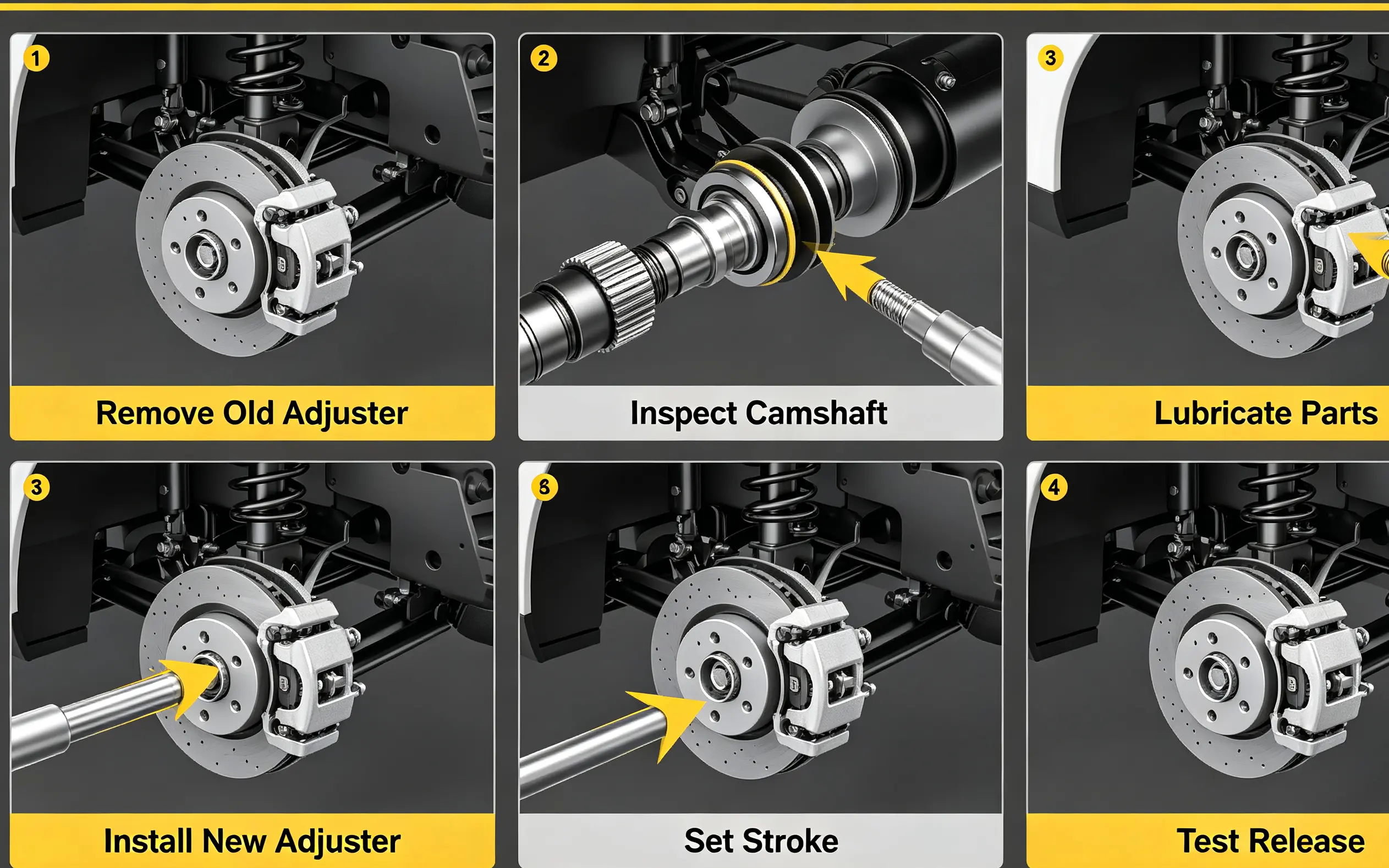
Step 1: Remove Old Damaged Adjuster
First, release the vehicle brake air pressure to ensure no residual air pressure in the brake chamber. Disconnect the connection between the brake chamber pushrod and the adjuster lever. Use professional tools to remove the fixing bolts of the old adjuster, and take off the failed part completely.
During the disassembly process, carefully check the wear of the S-camshaft and bearing position. If the camshaft is severely worn or rusted, polish and maintain it in time, otherwise it will affect the installation accuracy of the new adjuster.
Step 2: Clean the Installation Base
Thoroughly clean the installation shaft head and gasket position to remove rust, sediment and old lubricating oil residues. Keep the installation base flat and clean to ensure that the new adjuster is installed in place without deviation.
Step 3: Install New Brake Adjuster
Align the new adjuster with the S-camshaft, install it in place, and tighten the fixing bolts according to the factory torque standard. Avoid excessive or insufficient bolt torque, which will cause structural deformation or loose fit.
After installation, manually toggle the adjuster lever to check whether the rotation is flexible and whether there is jamming or abnormal resistance. Ensure that the internal gear structure operates smoothly.
Step 4: Complete Standard Gap Adjustment
For manual slack adjusters: Rotate the adjusting gear clockwise until the brake shoe is completely close to the brake drum, then reverse 1/4 to 1/2 circle to reserve a standard safe gap. After adjustment, test the brake flexibility repeatedly to ensure no dragging.
For automatic slack adjusters: After installation, complete one-time manual calibration according to the model standard. The automatic adjuster will automatically complete fine gap compensation in subsequent braking cycles without frequent manual adjustment.
Step 5: Stroke Detection and Commissioning
After installation and adjustment, start the vehicle to inflate to standard air pressure. Step on the brake pedal repeatedly to test the brake response. Use a professional measuring tool to detect the pushrod stroke to ensure that all data are within the OEM safe range.
Finally, conduct a road test to confirm that the vehicle brakes evenly, no deviation, no dragging and no abnormal noise, and the installation and adjustment work is completed.
Solve more brake installation and adjustment problems through our professional technical guidance: truck brake system installation and adjustment technical guides.
How to Choose a Reliable Heavy-Duty Brake Adjuster Supplier
Supplier selection determines the quality stability and service life of brake adjusters, and also directly affects the long-term operating cost and driving safety of the fleet. Many fleet owners only pursue low prices when purchasing parts, resulting in frequent replacement of accessories, increased maintenance costs and hidden safety hazards.
A professional and qualified truck brake adjuster supplier must have complete brand qualification, mature production system, strict quality inspection system, rich model compatibility and perfect after-sales service. The following are the core selection criteria sorted out for fleet buyers.
1. Complete Brand and Factory Qualifications
Excellent suppliers have formal factory production qualifications, complete product inspection reports and OEM supporting capabilities. They can provide genuine matching parts for mainstream Chinese heavy-duty truck brands including SINOTRUK, SHACMAN, FAW and FOTON.
Regular suppliers strictly follow national and industry heavy-duty truck parts production standards, and each batch of products has traceable quality records to ensure zero defective products delivered.
2. Strict Factory Quality Inspection System
Quality control is the core advantage of professional suppliers. Qualified brake adjusters need to pass multi-process inspections including material inspection, gear precision detection, fatigue resistance test, stroke calibration test and anti-corrosion test before leaving the factory.
Products that fail the precision test and durability test will be completely eliminated to ensure that every adjuster delivered to customers meets factory original standards.
3. Complete Model Coverage and Stable Supply
Fleet procurement requires stable batch supply and complete model compatibility. Excellent suppliers have large-scale warehouses and complete product systems, which can cover all mainstream heavy-duty truck models and meet the one-stop procurement needs of fleets.
At the same time, stable inventory can ensure fast delivery, avoid fleet maintenance shutdown losses caused by out-of-stock parts, and support long-term bulk customized procurement.
4. Professional Technical Support and After-Sales Service
High-quality suppliers are not only simple parts sellers, but also professional fleet service providers. They can provide professional installation guidance, parameter matching, fault diagnosis and customized solution services.
For fleet users with large procurement volume, professional suppliers can provide targeted parts matching lists and maintenance plans to help fleets optimize inventory and reduce operating costs.
5. Cost-Effective Factory Direct Sales Price
Factory direct sales can eliminate intermediate price differences, providing customers with the most competitive ex-factory prices on the premise of ensuring original quality. Compared with secondary and tertiary distributors, professional factory suppliers have obvious advantages in cost performance and quality stability.
Learn about our company’s strength, production standards and service advantages: professional truck parts manufacturer and supplier introduction.
Long-Term Fleet Maintenance Tips to Extend Brake Adjuster Service Life
High-quality brake adjusters matched with scientific maintenance methods can greatly extend service life, reduce replacement frequency and save fleet operating costs. Brake adjuster maintenance does not require complex operation, but it needs to be standardized and regularized.
First, complete regular stroke inspection. Arrange special maintenance personnel to detect the pushrod stroke of each vehicle every month, timely adjust the excessive gap, and avoid long-term over-stroke operation of the adjuster.
Second, regular cleaning and anti-rust maintenance. Clean the dust and sediment on the surface and internal gap of the adjuster quarterly, spray professional anti-rust lubricant, keep the gear structure flexible, and prevent rust and jamming.
Third, avoid long-term overload driving. Overload is the biggest killer of brake system parts. Reasonable load-bearing can reduce the working load of the adjuster and avoid structural fatigue damage.
Fourth, standardize braking habits. Avoid frequent emergency braking in daily driving. Gentle braking can reduce the impact wear of internal gears and greatly extend the service life of accessories.
Fifth, replace wearing parts regularly. The internal spring, gasket and other wearing parts of the adjuster have a fixed service cycle. Regular replacement of vulnerable parts can avoid overall failure of the adjuster.
FAQ About Truck Brake Adjusters & Supplier Selection
1. Is an automatic slack adjuster better than a manual one?
There is no absolute distinction between good and bad. Automatic adjusters are suitable for long-haul fleets with high safety requirements and insufficient maintenance frequency, with low daily maintenance pressure. Manual adjusters have simple structure, low failure rate and lower cost, which is more suitable for short-haul engineering vehicles and fleets with complete daily maintenance teams.
2. How often should the brake adjuster be replaced?
Under standard maintenance and normal driving conditions, high-quality brake adjusters can be used for 2 to 3 years. If there are frequent stroke overruns, jamming and self-locking failures, they need to be replaced immediately regardless of the service time.
3. Can inferior adjusters be used temporarily for cost saving?
It is not recommended at all. Inferior adjusters have unstable performance and hidden safety hazards, which are easy to cause brake failure and traffic accidents. The accident loss and fine cost are far higher than the parts cost saved, and the gain is not worth the loss.
4. Can you provide customized and bulk brake adjuster supply services?
Yes. We support OEM customization, sample processing, batch wholesale and long-term exclusive supply for fleets. We can provide tailored parts matching schemes according to customer vehicle models, market standards and procurement budgets.
Get bulk procurement quotations and customized service solutions: contact our professional truck parts service team.
Conclusion
The truck brake adjuster is a small but vital safety component of the heavy-duty air brake system. Its working state directly determines the braking performance, driving safety and inspection qualification rate of the vehicle. For fleet operators, blindly pursuing low prices and ignoring part quality will only bring continuous maintenance costs and potential safety risks.
Choosing a professional, qualified and experienced heavy-duty brake adjuster supplier is the core key to ensuring long-term stable operation of the fleet brake system. Standard installation and adjustment, regular daily maintenance, and matching high-quality genuine accessories can maximize the service life of brake adjusters, reduce fleet operating costs, and ensure road driving safety.
As a professional heavy-duty truck parts supplier, we insist on providing factory-standard brake adjusters and full-cycle technical services for global customers. With stable quality, cost-effective prices and professional after-sales support, we help every fleet achieve safe, efficient and low-cost operation.
Browse our full range of heavy-duty truck mechanical parts and system accessories: complete heavy-duty truck system parts and brake accessories.


