
Introduction
Heavy-duty truck suspension systems serve as the core buffer structure for all commercial vehicles. They carry full cargo loads, absorb complex road impacts, and maintain stable driving posture during long-haul transportation. Every stable mile of a truck relies on the coordinated operation of dozens of precision chassis components.
Among all suspension parts, leaf spring assemblies are the most fundamental load-bearing structure. Unlike lightweight automobile suspensions, truck leaf springs endure tons of static load and frequent dynamic impact every single day. They connect the vehicle frame firmly to the front and rear axles.
However, rigid steel leaf springs cannot work alone without auxiliary flexible parts. This is where leaf spring bushings play an irreplaceable role. These small rubber or polyurethane components are often overlooked by fleet managers and drivers.
In fact, leaf spring bushings are the key flexible connection points of the entire leaf spring suspension system. They are installed inside the spring eye loops at both ends of leaf spring packs. Simply put, they separate rigid metal parts with elastic materials to avoid direct metal-to-metal friction and collision.
Many truck owners only notice these bushings when abnormal noise or severe tire wear occurs. In reality, bushing performance directly determines suspension flexibility, driving stability, riding comfort and even overall chassis service life.
Once leaf spring bushings age, harden or crack, the entire leaf spring system will lose its calibrated buffer capacity. Even intact leaf springs cannot exert normal shock absorption and load-bearing effects. Gradually, a series of chassis faults will appear one after another.
To help fleet teams and professional technicians understand suspension maintenance more systematically, this guide explains how leaf spring bushings work in truck suspension systems in full detail. It covers structure classification, step-by-step working principles, core functions, wear mechanisms, fault symptoms and standardized maintenance solutions.
By mastering the working logic of leaf spring bushings, you can achieve early fault prevention. This method effectively reduces fleet maintenance costs and avoids unnecessary roadside breakdowns. A complete understanding of truck suspension system structure is the foundation of scientific chassis maintenance.
What Are Leaf Spring Bushings? Basic Definition & Installation Position
Before exploring working principles, it is necessary to clarify the basic definition and installation position of leaf spring bushings. This basic knowledge helps you accurately identify components during daily inspection and maintenance.
A leaf spring bushing is an elastic buffer component specially designed for leaf spring suspension systems. It is mainly made of high-toughness rubber or wear-resistant polyurethane material, with built-in internal and external metal sleeves for structural reinforcement.
These bushings are precisely pressed into the circular spring eye holes at both ends of leaf spring packs. The inner sleeve penetrates through fixing bolts to connect with frame hangers or suspension shackles. Meanwhile, the outer sleeve fits tightly with the leaf spring body.
Different from torque rod bushings that control axle lateral displacement, leaf spring bushings focus on solving vertical compression and horizontal telescopic movement of leaf springs. They adapt to real-time suspension changes during truck driving.
Under static parking conditions, leaf spring bushings remain in a stable compressed state to support vehicle weight. Under dynamic driving conditions, they deform flexibly to coordinate leaf spring stretching and shrinking movements.
In short, leaf spring bushings are the only flexible transition medium between rigid leaf springs and rigid truck frames. They turn hard metal connections into elastic movable connections, which is the core premise of suspension shock absorption.
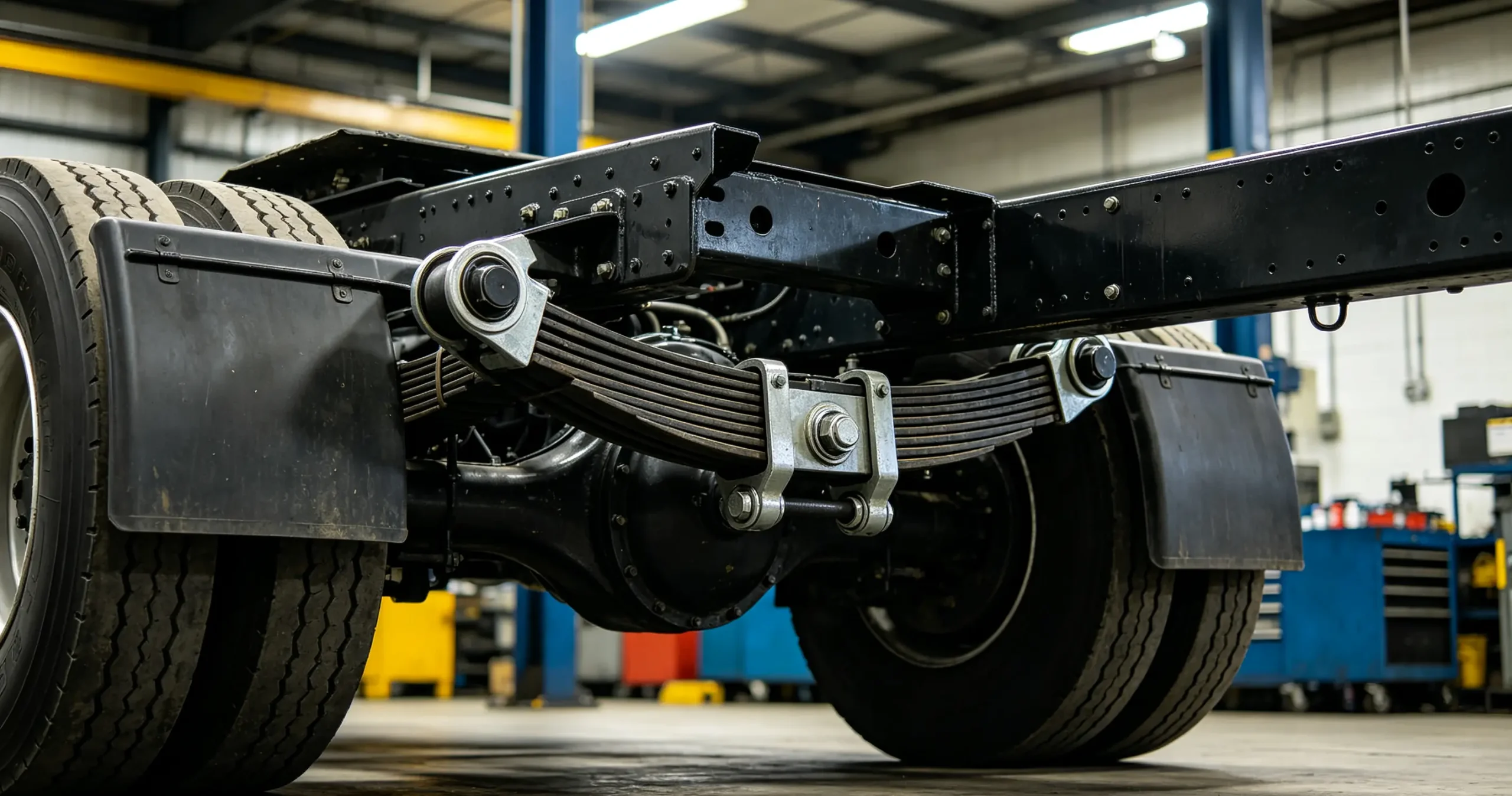
Core Structure of Leaf Spring Bushings (Complete Component Breakdown)
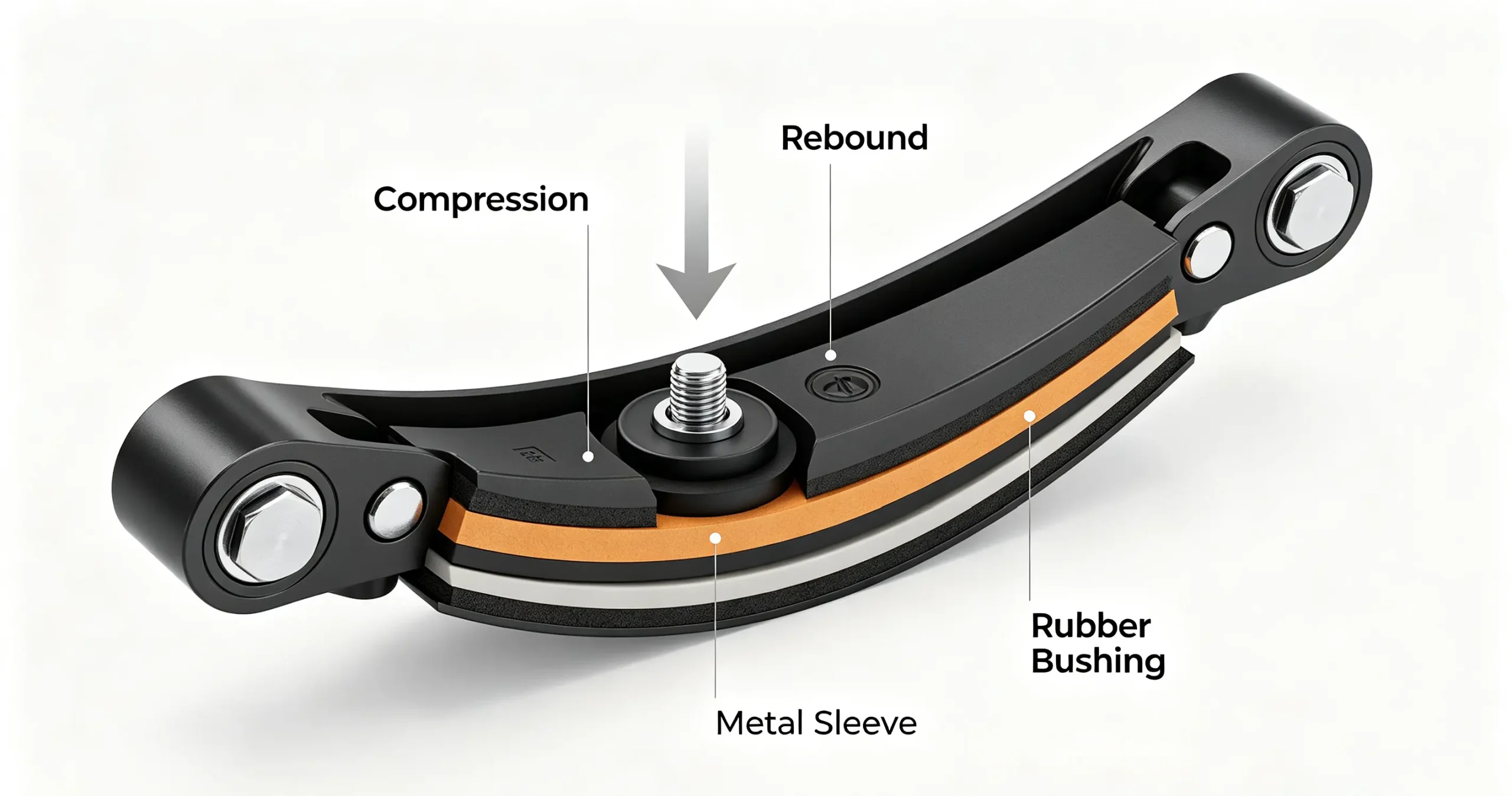
To understand how leaf spring bushings work, you first need to recognize their internal structural composition. Each structural layer undertakes independent functions and cooperates to complete buffer and positioning tasks.
1. Outer Metal Sleeve: The outermost layer is a high-precision seamless steel sleeve. It fits closely with the inner wall of the leaf spring eye. Its main function is to fix the overall bushing structure and prevent displacement during compression and rebound. It also avoids direct friction between rubber and steel spring holes.
2. Elastic Rubber/Polyurethane Layer: This is the core functional layer of the bushing. High-quality truck bushings use industrial-grade natural rubber or upgraded polyurethane materials. This layer bears all deformation, shock absorption and vibration isolation work. It can withstand repeated compression, stretching and torsion under heavy load conditions.
3. Inner Metal Sleeve: The innermost thin steel sleeve penetrates the fixing bolt. It provides rigid support for bolt locking force. It prevents the elastic layer from being directly squeezed and damaged by bolt tension, and ensures stable installation positioning.
4. Sealing & Anti-Corrosion Layer: Premium heavy-duty bushings are equipped with surface sealing layers. They effectively isolate road sediment, rainwater, dust and corrosive liquids. This structure delays internal material aging and avoids rust between sleeves.
The integrated structure of double-layer steel sleeves and middle elastic layer forms a stable rigid-elastic composite structure. This structure not only ensures installation firmness but also retains flexible deformation space, perfectly matching the working requirements of truck leaf spring suspensions.
Common Types of Truck Leaf Spring Bushings & Applicable Scenarios
Not all leaf spring bushings are the same. Different material formulas and structural designs adapt to different truck types, load conditions and road environments. Choosing the right bushing type is key to extending suspension service life.
1. Standard Rubber Leaf Spring Bushings
This is the most widely used original factory matching type. It features high elasticity, excellent vibration isolation effect and soft buffering performance. It can effectively filter fine road vibration and improve driving comfort.
Standard rubber bushings are suitable for light and medium-duty trucks operating on flat urban roads and highway routes. They balance comfort and daily load-bearing needs perfectly. Genuine branded truck suspension parts mostly adopt standard rubber bushing configurations for original vehicle matching.
2. Reinforced Polyurethane Bushings
Polyurethane material is an upgraded version of traditional rubber. It has stronger compression resistance, tear resistance and aging resistance. It is not easy to deform under long-term heavy load and high-frequency impact.
This type of bushing is very suitable for heavy-duty fleets, engineering trucks and vehicles often driving on mountain roads, gravel roads and harsh road surfaces. Its service life is 30%–50% longer than ordinary rubber bushings. The only minor drawback is slightly harder driving feel.
3. Greaseable Leaf Spring Bushings
Greaseable bushings are designed with reserved grease nipples for regular lubrication maintenance. They can eliminate internal dry friction through periodic grease injection.
This type is highly recommended for long-haul trucks and high-frequency operating vehicles. Scientific lubrication can avoid early wear and greatly extend the overall service cycle of bushings.
4. Solid Metal Composite Bushings
Individual engineering heavy trucks and special vehicles use metal composite bushings. They have extremely high rigidity and load-bearing capacity. However, their shock absorption performance is weak, so they are only used in special working condition scenarios.
How Leaf Spring Bushings Work in Truck Suspension Systems (Step-by-Step Working Principle)
Leaf spring bushings do not work in a single fixed mode. Their working state changes dynamically in real time according to truck driving conditions, road conditions and load changes. The complete working process can be divided into four core scenarios.
Each working link relies on the elastic deformation of the bushing itself to coordinate the leaf spring movement. Meanwhile, it isolates vibration, buffers impact and maintains positioning accuracy. Professional technical analysis of truck suspension operating status helps us clearly sort out the working logic of bushings.
1. Static Load Support (Parking & Stable Cruising)
When the truck is parked stably or driving smoothly on flat roads, leaf spring bushings are in a static balanced state. At this time, the vehicle’s cargo weight and body pressure are evenly transmitted to the leaf spring pack.
The leaf spring transfers vertical pressure to the bushing assembly. The elastic rubber layer produces slight uniform compression deformation. It stably bears static load without excessive displacement or gap.
In this state, bushings fix the leaf spring in the factory calibration position. They maintain standard axle parallelism and wheel alignment angles. This avoids random shaking of the suspension and ensures stable straight-line driving performance.
2. Vertical Shock Absorption (Passing Bumps & Uneven Roads)
When the truck passes speed bumps, potholes or uneven road surfaces, the road surface generates instantaneous upward impact on the tires and axles. The rigid leaf spring will compress upward instantly.
If there were no bushings, the rigid leaf spring would directly collide with the frame hanger. This would produce harsh metal impact noise and transmit strong vibration to the cab.
With the buffer of leaf spring bushings, the elastic layer absorbs most instantaneous impact force through compression deformation. It slows down the rigid collision speed and converts violent impact into gentle elastic buffering.
After crossing the bump, the bushing rebounds rapidly to its original state. It pushes the leaf spring back to the standard position to complete a complete shock absorption cycle. This cycle repeats continuously during driving to protect the chassis structure.
3. Telescopic Adaptation (Spring Length Change)
Many truck owners do not know that leaf springs will change length during compression and rebound. When the leaf spring is compressed under pressure, the overall arc becomes larger and the horizontal length shortens slightly.
When the load is reduced or the spring rebounds, the arc recovers and the horizontal length increases accordingly. This real-time length change requires flexible coordination of end connections.
Leaf spring bushings perfectly undertake this telescopic adaptation work. Through flexible torsion and stretching of the elastic layer, they adapt to the length change of the leaf spring. This avoids structural jamming and forced extrusion caused by rigid fixation.
Without qualified bushings, the rigid connection will restrict spring deformation. This leads to unsmooth suspension movement, increased driving resistance and even leaf spring fracture in severe cases.
4. Vibration Isolation & Noise Reduction (Full Working Condition)
During truck driving, tire rolling, engine operation and road friction will generate continuous high-frequency vibration. These vibrations will be transmitted upward along the axle and leaf spring.
Leaf spring bushings act as natural vibration isolation barriers. The elastic rubber layer can filter and weaken most high-frequency vibration. It prevents vibration from being directly transmitted to the truck frame and cab.
At the same time, bushings eliminate metal-to-metal dry friction. They avoid abnormal friction noise between leaf springs, hangers and shackles. This significantly improves overall driving smoothness and quietness.
Six Core Functions of Leaf Spring Bushings in Truck Suspensions
Based on the above working principles, leaf spring bushings summarize six irreplaceable core functions in the entire truck suspension system. Every function is related to driving safety and chassis durability.
1. Flexible Connection & Structural Transition
The most basic function of leaf spring bushings is to build flexible connection between rigid metal components. They connect leaf springs, frame hangers and shackles organically.
They allow the suspension system to have reasonable movable gaps. This ensures that all parts can operate freely according to road changes and load adjustments. Rigid structures cannot complete adaptive movement without bushing transition.
2. Road Shock Absorption & Buffering
As the primary buffer component of leaf spring suspension, bushings assist leaf springs in absorbing road impact. They reduce the rigid impact force borne by the chassis.
This function protects expensive chassis parts including axles, leaf springs and frame structures. It reduces overall chassis wear and effectively prolongs suspension system service life.
3. Vibration Isolation & Riding Comfort Optimization
Continuous road vibration is the main cause of driver fatigue and chassis loosening. Leaf spring bushings isolate most low and high-frequency vibration.
They make the cab driving feel smoother and more stable. For long-haul truck drivers, intact bushing performance directly reduces driving fatigue and improves travel safety.
4. Precise Axle Positioning & Suspension Geometry Maintenance
Healthy leaf spring bushings can firmly lock the axle within the factory calibration range. They maintain standard wheel camber, toe angle and axle parallelism.
They prevent axle offset and suspension geometry distortion during driving. This is the key to ensuring straight-line stability and accurate steering response. Standard suspension maintenance cases prove that most steering drift faults are related to bushing wear.
5. Anti-Friction & Abnormal Noise Elimination
Bushings completely isolate metal contact between suspension moving parts. They eliminate dry friction and metal collision noise during suspension movement.
A quiet chassis operation state also helps drivers quickly identify new abnormal faults. This improves the efficiency of daily vehicle fault diagnosis.
6. Load Balance & Fatigue Resistance Enhancement
During cargo loading and driving, bushings balance the pressure of each stress point of the leaf spring. They avoid local over-compression and concentrated stress.
This uniform stress distribution prevents local fatigue damage of leaf springs. It reduces the probability of spring piece breakage and extends the service life of the entire suspension assembly.
Why Leaf Spring Bushings Wear Out? Main Causes of Premature Failure
Many fleet owners reflect that new leaf spring bushings wear out quickly after replacement. In fact, less than 20% of failures are caused by natural aging. Most premature wear comes from unreasonable use and maintenance negligence.
Understanding the root causes of wear can help you avoid repeated faults and effectively extend bushing service life.
1. Long-Term Overload Operation
Overload is the number one killer of leaf spring bushings. When the truck carries excess cargo, the instantaneous pressure borne by the suspension increases exponentially.
The bushing elastic layer is in an over-compressed state for a long time. This causes irreversible fatigue deformation, elasticity loss and structural collapse. Once the material elasticity fails, the bushing completely loses buffer and positioning functions.
2. Frequent Driving on Harsh Road Conditions
Mountain roads, gravel roads, construction roads and rainy muddy roads bring continuous high-frequency impact to the suspension. Each impact causes repeated compression and stretching of bushings.
Tiny internal cracks continue to expand. Finally, macroscopic cracking, peeling and hardening failure occur. Trucks engaged in engineering transportation and rural freight are more prone to premature bushing wear.
3. Lack of Regular Lubrication Maintenance
Most heavy-duty leaf spring bushings support grease maintenance. However, most fleets ignore this basic daily maintenance item.
Long-term lack of grease leads to dry friction inside the bushing. Internal wear accelerates, gaps increase rapidly, and looseness appears in advance.Scientific maintenance of chassis system components including regular lubrication can greatly delay component aging.
4. Low-Quality Aftermarket Replacement Parts
To save short-term costs, many repair shops choose cheap inferior bushings made of recycled rubber. These products have unstable material formulas and poor compression resistance.
They cannot adapt to heavy-duty truck working conditions. Cracking and deformation often occur within tens of thousands of miles, resulting in repeated maintenance costs.
5. Non-Standard Installation Process
Improper installation is a hidden cause that is easily ignored. Over-tightened bolts will crush new bushings and damage internal elastic structure.
Skewed installation and forced assembly will cause unbalanced bushing stress. Local overloading leads to rapid partial wear, which spreads to overall failure soon.
6. Long-Term Static Parking & Environmental Corrosion
Long-term stationary parking makes bushings bear fixed compression for a long time, resulting in permanent deformation. In addition, rainwater, road salt, dust and temperature changes will accelerate rubber aging and corrosion.
Common Wear & Failure Symptoms of Leaf Spring Bushings (From Mild to Severe)
Leaf spring bushing failure is a gradual process. Symptoms change from subtle driving feeling to obvious mechanical faults. Timely judgment according to progressive symptoms can avoid major chassis losses.
1. Slight Straight-Line Drift (Early Wear)
Early bushing wear causes tiny internal gaps. The axle cannot be fixed stably, resulting in slight straight-line drift during cruising.
Drivers need to fine-tune the steering wheel frequently to maintain straight driving. This symptom is more obvious under full-load and crosswind conditions.
2. Abnormal Uneven Tire Wear
Unstable axle positioning caused by bushing wear changes wheel stress angles in real time. This leads to feathered tread, unilateral wear and shoulder excessive wear.
Frequent alignment but recurring tire wear is a typical feature of unqualified leaf spring bushings. Replacing tires without replacing worn bushings cannot solve the fundamental problem.
3. Chassis Clunking Noise on Bumpy Roads
After the bushing elastic layer hardens and cracks, internal gaps increase significantly. When passing uneven roads, metal parts collide to produce obvious clunking and banging noise from the chassis.
The noise gradually changes from occasional occurrence on rough roads to frequent occurrence during acceleration and deceleration on flat roads, marking severe bushing fatigue.
4. Increased Cab Vibration & Poor Comfort
Failed bushings lose vibration isolation ability. Road vibration is directly transmitted to the frame and cab. Drivers can obviously feel floating and jittering during driving.
Long-term driving in this state will not only affect comfort but also easily cause driver fatigue and reduce driving safety.
5. Delayed Braking Response & Braking Offset
During emergency braking, the axle will shift forward and backward due to loose bushings. This leads to delayed braking feedback and soft pedal feeling.
In severe cases, bilateral bushing wear inconsistency causes unilateral axle offset, resulting in truck pulling left or right during braking, bringing major safety risks.
6. Visible Cracks, Peeling & Obvious Looseness (Late Failure)
In the late failure stage, the bushing surface has dense radial cracks, rubber peeling and serious deformation. Manual shaking of the leaf spring will produce obvious floating play.
At this stage, the bushing has completely lost buffer and positioning functions. It must be replaced immediately to avoid leaf spring breakage and axle displacement accidents.
Professional Leaf Spring Bushing Inspection & Maintenance Guide
Effective daily inspection and maintenance can maximize leaf spring bushing service life and reduce fleet overall maintenance costs. Combined with years of heavy truck maintenance experience, we have sorted out standardized operation procedures.
Our professional team has long been engaged in heavy truck chassis maintenance research and summarizes practical maintenance rules suitable for commercial fleets.
1. Regular Visual Inspection
Check leaf spring bushing status every 10,000 miles. Focus on observing whether the surface is cracked, hardened, deformed or peeled. Check for rubber aging and oil contamination.
Timely detection of minor defects can prevent early wear from evolving into complete failure.
2. Manual Looseness Detection
Shake the leaf spring up and down manually. If there is obvious gap and shaking, it proves that the bushing has loose wear and needs to be replaced in time.
This simple detection method can quickly judge bushing working status without professional tools.
3. Periodic Grease Lubrication
For greasable bushings, inject high-temperature chassis grease every 10,000–15,000 miles. Stop filling until new grease overflows evenly.
Regular lubrication eliminates dry friction, delays rubber aging and effectively extends bushing service life by more than 30%.
4. Standardize Driving & Loading Habits
Avoid long-term overloading, sharp acceleration and sharp braking. These operations will produce instantaneous huge impact load on bushings and accelerate fatigue damage.
Smooth driving and standardized loading are the most economical and effective maintenance methods.
5. Replace in Pairs & Choose High-Quality Parts
Leaf spring bushings on both sides of the same axle must be replaced synchronously. Single-sided replacement will cause unbalanced chassis stress and affect suspension balance.
Choose genuine or high-quality polyurethane upgraded bushings. Although the initial cost is higher, the long-term stability and service life are far better than inferior products.
6. Post-Replacement Wheel Alignment
Bushing replacement resets suspension geometry. Professional four-wheel alignment must be carried out after construction to recalibrate axle and wheel angles.
This step can completely solve hidden troubles such as tire wear and steering drift after replacement.
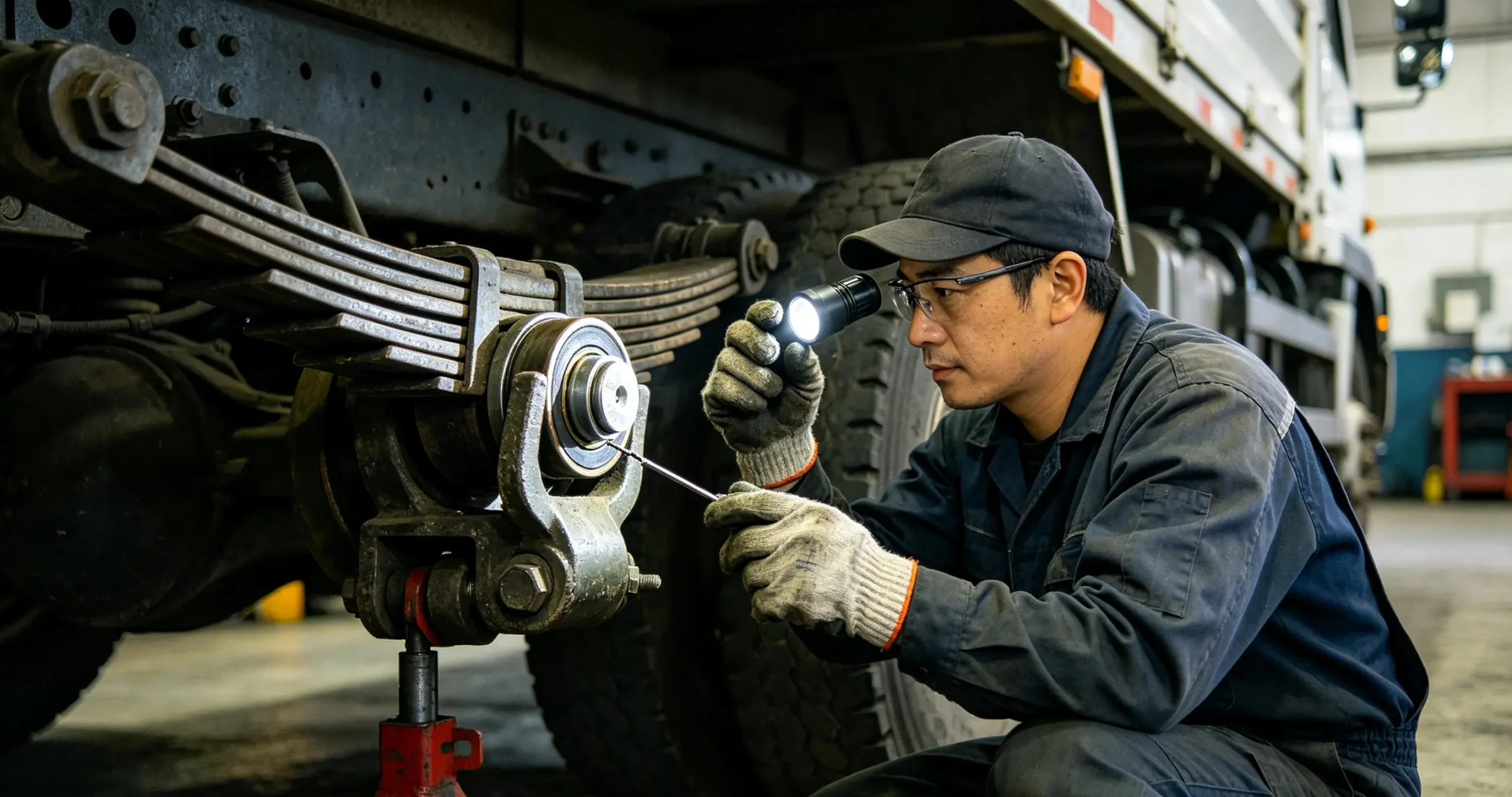
Leaf Spring Bushing Replacement Precautions & Standard Process Tips
Many premature failures of new bushings are caused by non-standard replacement processes. Mastering professional construction details is the key to ensuring long-term repair effect.
Standardized chassis component replacement cases verify that process standardization determines component service life.
First, lift the axle to release suspension tension before disassembly. Avoid bolt breakage and thread damage caused by direct disassembly under load.
Second, use professional press tools to press out old bushings. Do not beat violently to prevent deformation of leaf spring eye holes.
Third, thoroughly clean the inner wall of spring holes to remove rust and debris. Ensure zero-gap fitting for new bushings.
Fourth, keep new bushings horizontal and vertical during press-in. Avoid skew and torsion to prevent unbalanced internal stress.
Fifth, tighten bolts according to OEM standard torque values. Over-tightening crushes rubber, and under-tightening causes looseness.
Sixth, complete grease injection and road test inspection after installation. Confirm no abnormal noise and stable suspension operation.
Frequently Asked Questions About Leaf Spring Bushings
1. Can I continue driving with worn leaf spring bushings?
Short-distance low-speed driving is temporarily feasible, but long-term use is absolutely not recommended. Worn bushings will cause unstable suspension, tire wear, braking deviation and other faults.
Moreover, it will induce secondary damage to leaf springs, axles and frame brackets, resulting in higher maintenance costs. It is recommended to replace them as soon as early wear symptoms appear.
2. Which is better, rubber or polyurethane leaf spring bushings?
Rubber bushings have better shock absorption and comfort, suitable for flat road and conventional freight fleets. Polyurethane bushings have stronger wear resistance and load resistance, suitable for heavy-load and harsh road working conditions.
You can choose according to your daily transportation road conditions and load standards.
3. How long do leaf spring bushings last?
High-quality genuine rubber bushings can last 80,000–120,000 miles under standard load and flat road conditions. Polyurethane bushings can last more than 150,000 miles.
Overload, rough roads and lack of maintenance will reduce the service life to less than 30,000 miles.
4. Why does chassis noise still exist after bushing replacement?
The main reasons include incomplete cleaning of spring holes, non-standard pressing installation, unupdated old accessories and missing post-installation lubrication. In addition, uncalibrated wheel alignment will also cause abnormal suspension feeling.
It is necessary to recheck the installation process and complete professional calibration.
5. Is leaf spring bushing replacement necessary for tire wear?
Yes. If tire wear recurs after multiple alignments, it must be caused by loose suspension gaps represented by bushing wear. Simply replacing tires cannot solve the fundamental problem. Replacing bushings is the key to completely repairing abnormal tire wear.
Conclusion
Leaf spring bushings are small in size but undertake the core buffer and positioning tasks of heavy-duty truck leaf spring suspension systems. They are the key bridge connecting rigid chassis structures and flexible suspension movements.
By analyzing the working principle of leaf spring bushings, we can clearly find that most common chassis faults such as steering drift, abnormal tire wear, chassis noise and driving vibration are closely related to bushing aging and wear.
Understanding how leaf spring bushings work in truck suspension systems helps fleet managers and technicians achieve scientific fault diagnosis and proactive maintenance.
Timely inspection, standardized replacement and daily refined maintenance can effectively extend bushing service life, reduce fleet operating costs and improve driving safety. If you need professional truck suspension parts matching and maintenance consulting services, welcome to contact our team at any time.


