The Critical Role of Truck Front Axle in Heavy-Duty Operations
For heavy-duty trucks, the front axle is more than a structural component—it’s a cornerstone of safety and performance. It bears the truck’s front-end weight, supports the steering system, and transfers driving force to the front wheels, ensuring stable handling even under full loads.
Moreover, a high-quality front axle directly impacts overall driving safety. It maintains wheel alignment, prevents uneven tire wear, and ensures responsive steering—critical for navigating construction sites, mountain roads, and busy highways.
Without a reliable front axle, drivers face increased risks of accidents, while fleet operators deal with costly downtime and repairs.
Additionally, the front axle works seamlessly with other key components, such as the steering gear and suspension. This synergy ensures smooth, consistent performance, even in harsh environments where dust, vibration, and extreme temperatures test every part of the truck.
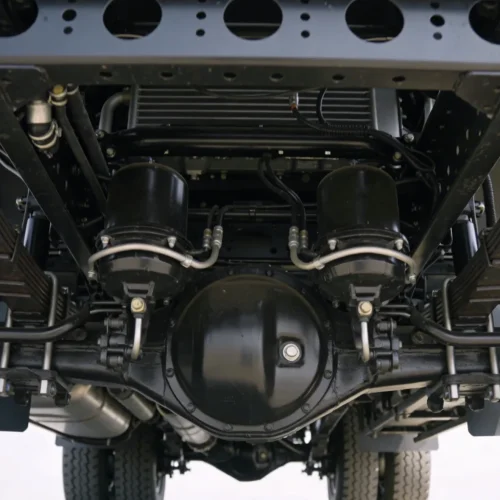
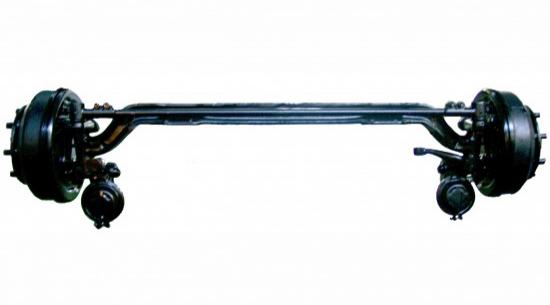
This image clearly shows the front axle located under the front of the cab, between the two front wheels, connecting the frame and the steering system, which is a typical steering axle layout.
Key Features of a High-Quality Truck Front Axle
Not all front axle options are created equal. To deliver long-lasting reliability, a premium front axle must meet strict standards for material, design, and performance. Below are the core features that set high-quality axles apart from ordinary ones.
First and foremost, durable materials are non-negotiable. We use high-strength alloy steel for our front axle components, ensuring they can withstand heavy loads, constant stress, and corrosion from harsh work environments. This material choice extends the axle’s service life and reduces the need for frequent replacements.
Furthermore, precision machining is essential. Our front axle undergoes rigorous precision processing to ensure perfect alignment and fit, minimizing wear and tear on connected parts like tie rods and steering shafts.
This precision also enhances steering responsiveness, making it easier for drivers to maintain control in all conditions, whether navigating busy highways or uneven construction sites.
In addition to material and machining, we also focus on optimized structural design. Our front axle features a reinforced beam structure that distributes weight evenly, reducing stress on individual components and preventing deformation under heavy loads.
This structural optimization not only improves durability but also enhances overall vehicle stability, especially when the truck is fully loaded or traveling on bumpy roads.
We also equip our front axle with high-quality seals and gaskets to prevent dust, moisture, and debris from entering internal components.
These seals are designed to withstand extreme temperatures and harsh conditions, ensuring the axle operates smoothly and reliably for years to come, with minimal maintenance requirements.
Our Premium Truck Front Axle Products
We focus on providing high-quality front axle parts that fit mainstream heavy-duty truck models, covering a wide range of brands, including both popular and smaller, niche options, to avoid any limitations. Our products are designed to meet the rigorous demands of heavy-duty operations, ensuring compatibility, reliability, and long service life.
Our standard front axle is the core of our product line, tailored for daily heavy-duty transportation and moderate to heavy load scenarios.
It integrates all the key features mentioned above—high-strength alloy steel construction, precision machining, optimized structural design, and premium sealing—to deliver consistent performance for long-haul, regional delivery, and construction transport trucks.
For detailed specifications, compatible truck models, and technical data to help you find the perfect fit for your customers’ needs, visit our standard truck front axle product page.
For off-road and construction trucks, our off-road truck front axle offers enhanced durability and load-bearing capacity. It features reinforced housing and heavy-duty bearings to withstand the rigors of rough terrain and heavy loads.
Compatibility & After-Sales Support for Truck Front Axle
In addition to premium product quality, we prioritize compatibility and comprehensive after-sales support to meet your business needs. Our front axle parts are carefully designed to fit most mainstream heavy-duty truck models, covering a wide range of brands—including both major names and various smaller brands—to ensure no limitation in your product selection.
We have a professional technical team that can provide accurate compatibility guidance, helping you quickly match the right truck front axle for different truck models and configurations.
Whether your customers need replacement parts for long-haul trucks, construction vehicles, or special-purpose heavy-duty trucks, we can offer targeted solutions to avoid mismatches and save your time.
Moreover, we provide reliable after-sales service to ensure your peace of mind. All our front axle products come with a quality guarantee period, and we offer timely technical support for installation, maintenance, and troubleshooting.
If you encounter any problems during use, our team will respond quickly to provide practical solutions, minimizing downtime for your customers.
Common Truck Front Axle Issues & Quick Solutions
Even the best truck front axle can develop issues over time, especially with heavy use in harsh environments. Fortunately, most common problems are easy to identify and fix with basic inspections, saving you time and money on unnecessary repairs.
Axle Misalignment
Axle misalignment is a common issue that causes uneven tire wear, poor steering, and increased fuel consumption. It often stems from hitting potholes, curbs, or rough terrain. To fix this, have a professional align the front axle using precision tools—this restores proper alignment and prevents further damage.
Bearing Failure
Bearing failure in the front axle can cause grinding noises, vibration, and even wheel lock-up. This typically occurs due to insufficient lubrication or contamination from dust and debris. Regularly check and replace lubricants, and inspect bearings for wear—replace them promptly if you notice signs of damage.
Corrosion and Rust
Corrosion can weaken the front axle and lead to component failure. To prevent this, keep the axle clean and free of debris, and apply anti-corrosion treatments if needed. If you notice rust, remove it promptly and inspect the axle for structural damage.
Proactive Maintenance Tips for Truck Front Axle
Preventive maintenance is the key to extending the life of your front axle and avoiding costly breakdowns. By following these simple tips, you can keep your axle in top condition for years to come.
Start with a monthly inspection of your front axle for signs of wear, damage, or oil leaks. Focus closely on bearings, seals, and axle housing—these are the most prone to issues. Additionally, check wheel alignment every 6 months or after hitting a major pothole or curb.
Next, replace lubricants regularly according to the manufacturer’s recommendations. Using the correct lubricant reduces friction and prevents premature wear. Avoid over-lubrication, as this can attract dust and debris.
Finally, keep the front axle clean. Wash it regularly to remove dust, mud, and salt, which can cause corrosion. For trucks operating in harsh environments, consider adding a protective cover to shield the axle from debris.
🟡 How Truck Front Axle Works
The truck front axle is a key structural and functional component responsible for supporting the front portion of the vehicle while enabling steering control and maintaining stability under load.Its operation involves both load-bearing and directional control functions. The axle carries vertical weight from the chassis and transfers it to the wheels, while also supporting the steering mechanism that allows the driver to control vehicle direction.
When the vehicle moves over uneven road surfaces, the front axle works together with the suspension system to absorb shock forces and maintain tire contact with the road. This ensures stability, steering accuracy, and safe handling under different driving conditions.Without a properly functioning front axle system, vehicle alignment, steering response, and load distribution would all be negatively affected.
🔍 Front Axle Failure Mechanism
Front axle systems typically fail gradually due to continuous load stress, road impact, and alignment deviation.One of the most common starting points is kingpin wear. As the kingpin assembly wears out, steering precision decreases and instability increases during driving.
Misalignment is another major issue. Even slight deviation in axle positioning can cause uneven tire wear and affect steering balance.Bushings and mounting components may also degrade over time due to vibration and load pressure, reducing structural stability.In severe cases, bearing overload or lubrication failure can lead to excessive friction, heat buildup, and accelerated component wear.
🔧 Diagnostic Logic
Front axle issues are diagnosed through a combination of visual inspection and performance analysis during vehicle operation.One of the earliest indicators is uneven tire wear, which often suggests alignment issues or suspension imbalance.
Steering instability, such as drifting or vibration during driving, can indicate worn kingpins or loose axle components.Technicians also inspect mounting bolts, bushings, and lubrication points to ensure structural integrity and proper mechanical movement.In advanced diagnostics, alignment testing is performed to determine whether axle geometry has been affected by long-term wear or impact damage.
💰 Fleet Cost Impact Module
Front axle issues can significantly increase operational costs in commercial truck fleets.When alignment becomes incorrect, tire wear accelerates, leading to more frequent replacement cycles. This directly increases maintenance expenses.Poor axle condition can also reduce steering efficiency, increasing driver fatigue and reducing fuel efficiency due to unstable vehicle motion.
In severe cases, front axle failure can lead to vehicle downtime, which disrupts logistics operations and increases overall fleet operating costs.Preventive maintenance is therefore essential to reduce long-term financial impact and ensure operational stability.
Choose Our Truck Front Axle for Reliability
When it comes to truck front axle parts, quality and compatibility are critical. We specialize in premium axles that meet or exceed industry standards, ensuring they fit most mainstream heavy-duty truck models across a variety of brands—both major and minor—to suit your diverse needs.
All our truck front axle products undergo rigorous testing, including load-bearing and wear resistance tests, to guarantee durability and performance. We also offer one-stop procurement and expert after-sales support to help you find the right axle for your customers’ needs, saving you time and streamlining your operations.
For more information on our full range of truck front axle products, visit our truck front axle product page. You can also contact our team via ourcontact page for personalized assistance.
Complete Truck Front Axle Parts Set
❓ Frequently Asked Questions (FAQ)
What is a truck front axle and why is it important?
A truck front axle is a key structural and functional component that supports the front portion of the vehicle while also enabling steering control. It is designed to carry vertical loads from the chassis and transfer them to the wheels, while simultaneously supporting directional movement through the steering system.
In addition to load-bearing, the front axle plays an important role in maintaining vehicle stability and alignment. It works together with the suspension system to absorb road impact and ensure that the tires maintain consistent contact with the road surface.
Without a properly functioning front axle, the vehicle would experience poor steering response, unstable handling, and uneven load distribution, which can significantly affect driving safety and operational efficiency.
What are the main functions of a truck front axle?
The main functions of a truck front axle include supporting vehicle weight, enabling steering movement, and maintaining wheel alignment under different driving conditions.It acts as a structural bridge between the chassis and the wheels, allowing vertical load transfer while ensuring controlled directional movement. At the same time, it helps distribute road impact forces evenly across the suspension system.
Another important function is maintaining geometric stability during driving. This ensures that the wheels remain aligned and the vehicle can maintain a straight path with minimal steering correction.Together, these functions make the front axle essential for safe, stable, and efficient truck operation.
What causes front axle failure in trucks?
Front axle failure in trucks is usually caused by long-term mechanical stress, poor lubrication, and continuous exposure to road impact.One of the most common causes is kingpin wear. As the kingpin assembly deteriorates over time, steering precision decreases and wheel movement becomes less stable.
Misalignment is another major issue. Even small deviations in axle geometry can lead to uneven tire wear, steering instability, and increased vibration during driving.Bushings and mounting components also degrade due to constant vibration and load pressure. When these components lose elasticity, the axle loses structural stability and becomes less effective at absorbing road forces.
In severe cases, bearing overload or insufficient lubrication can cause excessive friction and heat buildup, accelerating internal wear and potentially leading to mechanical failure.
What are the early symptoms of front axle problems?
Early front axle problems usually develop gradually and become more noticeable as component wear increases over time.One of the first signs is uneven tire wear, which often indicates alignment issues or structural imbalance in the axle system. This is usually one of the earliest and most important warning signals.
Another common symptom is steering instability. Drivers may feel that the vehicle pulls to one side or requires constant correction to maintain a straight path.Vibration in the steering wheel, especially at higher speeds, can also indicate worn kingpins or loose axle components.
In more advanced stages, abnormal noises from the front suspension area or increased difficulty in steering may occur, signaling that multiple components are already affected.
Can front axle problems affect driving safety?
Yes, front axle problems can significantly affect driving safety because they directly influence steering control, vehicle stability, and load distribution.When the front axle is worn or misaligned, tire contact with the road becomes inconsistent, reducing traction and increasing stopping distance during braking.
Poor axle condition can also cause unstable steering response, making it more difficult for the driver to maintain control, especially during high-speed driving or emergency maneuvers.In heavy-duty trucks, this can increase the risk of instability under load conditions, making front axle maintenance a critical safety requirement.
How often should a truck front axle be inspected?
Truck front axle systems should be inspected regularly based on operating conditions, load intensity, and road environment.For vehicles operating under normal highway conditions, inspection can be performed during routine maintenance intervals. However, for trucks operating in heavy-load, construction, or rough terrain environments, more frequent inspections are required.
Inspection typically includes checking kingpin condition, evaluating bushings for wear, inspecting alignment accuracy, and ensuring proper lubrication.Regular inspection helps detect early-stage wear before it develops into more serious structural or safety issues.
What happens if front axle issues are ignored?
If front axle issues are ignored, small mechanical problems can gradually escalate into serious system failures due to continuous stress and misalignment.As components wear out, steering precision decreases and vibration increases, which can accelerate tire wear and reduce driving efficiency.
Misalignment can also place additional stress on suspension and steering components, leading to cascading damage across multiple systems.Over time, this results in higher maintenance costs, reduced vehicle stability, and increased safety risks, especially during heavy-load transportation.
Why does front axle wear happen faster in heavy-duty trucks?
Front axle wear occurs faster in heavy-duty trucks because these vehicles operate under significantly higher load and stress conditions compared to light vehicles.Heavy loads increase pressure on kingpins, bushings, and bearings, causing faster material fatigue. Continuous vibration from long-distance driving or rough road conditions further accelerates wear.
In addition, frequent steering adjustments under load conditions increase mechanical stress on axle components, reducing their service life.Over time, this combination of load pressure, vibration, and mechanical stress leads to faster degradation of the front axle system.
How does front axle condition affect tire lifespan?
Front axle condition has a direct impact on tire lifespan because it determines how evenly weight and road forces are distributed across the tires.When the front axle is properly aligned and in good condition, tires maintain consistent contact with the road surface, resulting in even tread wear.
However, when axle components such as kingpins or bushings are worn, alignment becomes unstable. This leads to uneven pressure distribution, causing certain areas of the tire to wear faster than others.Over time, this significantly reduces tire lifespan and increases replacement frequency, especially in heavy-duty operations.