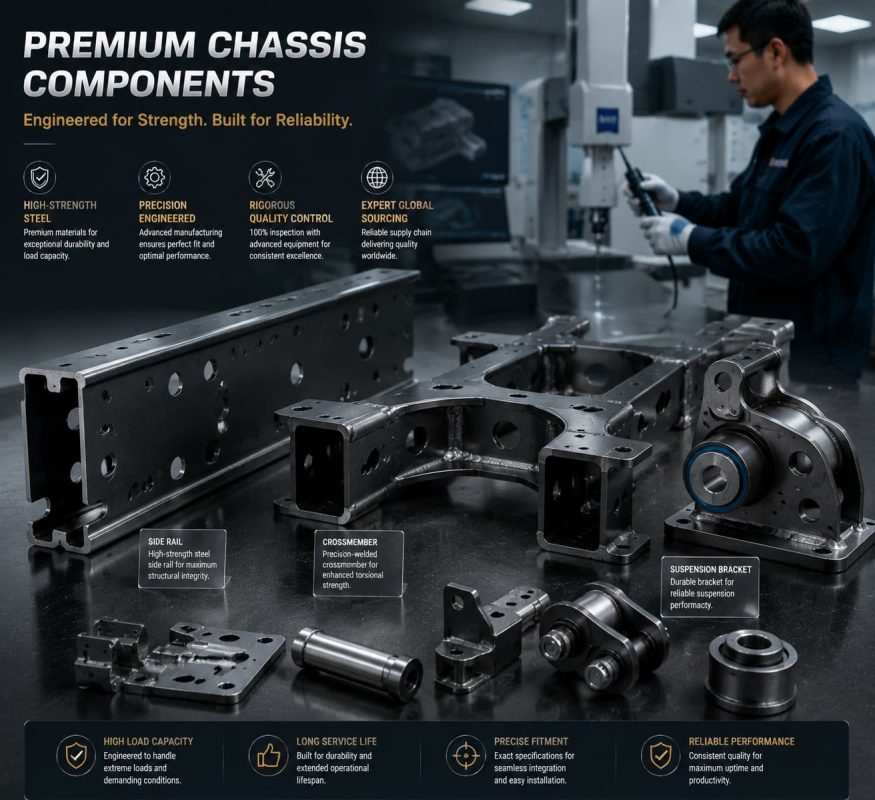
In the demanding world of heavy-duty trucking, the chassis is more than just a foundation; it is the backbone that defines a vehicle’s strength, durability, and operational integrity. From the rugged terrains of construction sites to the long hauls across continents, a truck’s chassis components bear immense loads, absorb relentless stresses, and provide the critical platform for all other systems. For fleet operators, maintenance professionals, and procurement specialists, understanding the intricacies of chassis components is paramount to ensuring vehicle longevity, safety, and optimal performance. As a specialized exporter of premium heavy-duty truck parts, we recognize that the quality of each frame component directly impacts a truck’s ability to withstand the rigors of its operational life. Our commitment lies in supplying robust, precisely engineered chassis parts that meet the exacting demands of the global market, particularly for leading Chinese truck brands.
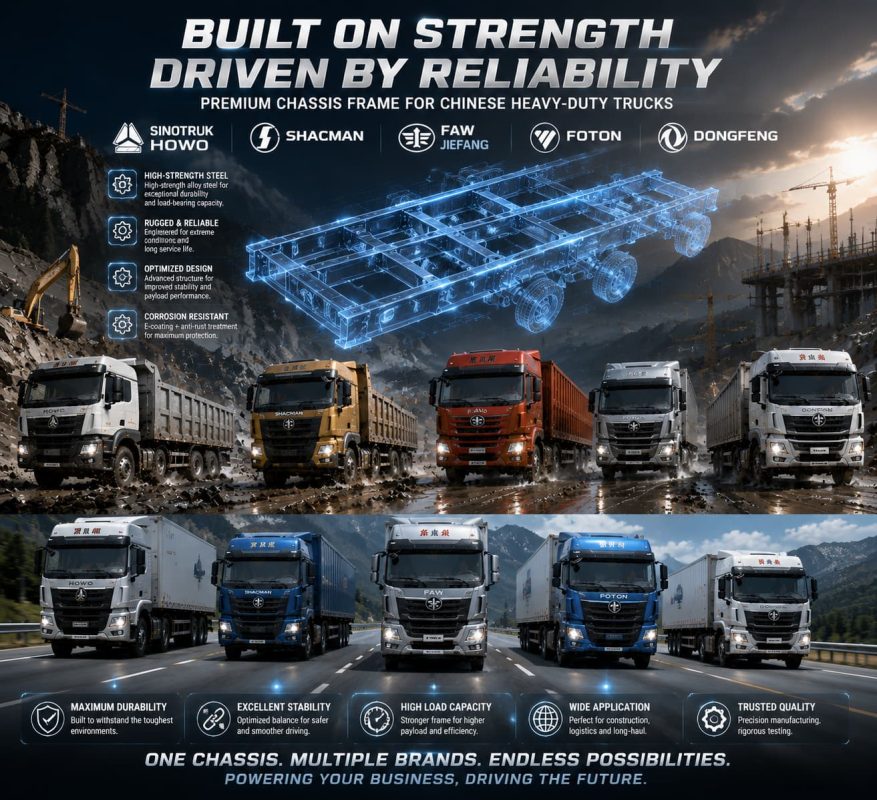
This comprehensive guide delves into the essential components of a truck chassis, exploring their functions, the materials that define their strength, and the critical role they play in overall vehicle dynamics. We aim to provide invaluable insights for those seeking to enhance their fleet’s reliability and efficiency. Our expertise extends to a wide array of Chinese heavy-duty trucks, including Sinotruk (HOWO), Shacman, FAW (Jiefang), Foton, and Dongfeng, ensuring that our supplied components offer perfect compatibility and superior performance. For a broader understanding of our product range, we invite you to explore our Product Brands Page.
The Foundation: Understanding the Truck Frame
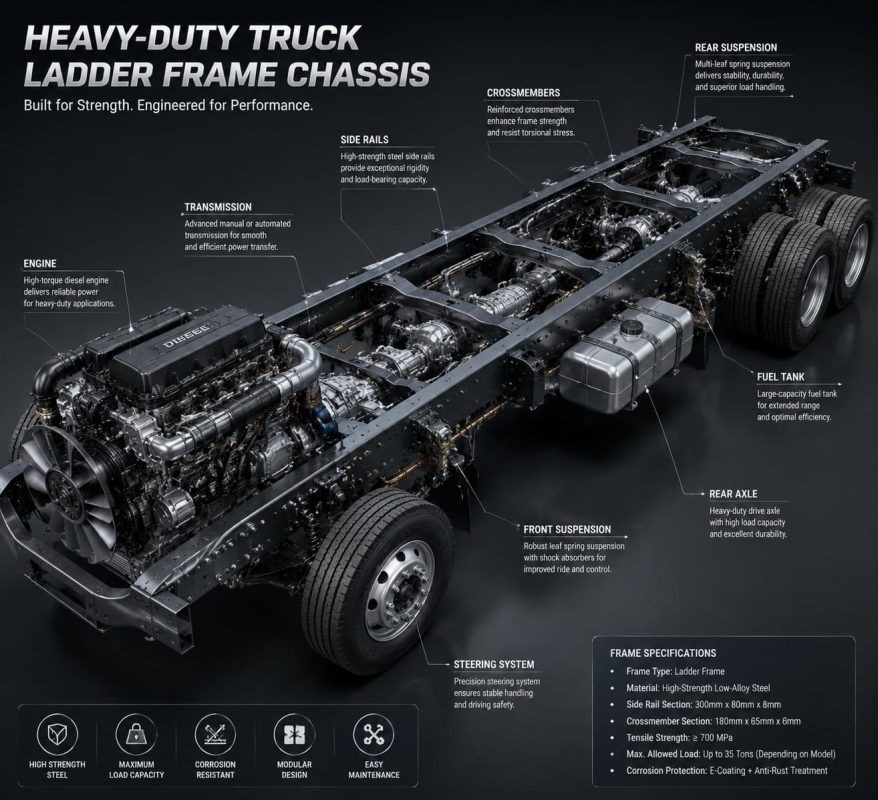
The truck frame, often referred to as the ladder frame, is the primary structural component of the chassis. It consists of two long, parallel side rails connected by several crossmembers. This design provides exceptional strength and rigidity, forming the base upon which the engine, transmission, axles, suspension, and body are mounted. The frame’s ability to resist bending, twisting, and impact forces is fundamental to the truck’s structural integrity and load-carrying capacity.
Side Rails: The Longitudinal Strength and Material Science
Side rails are the main longitudinal beams of the frame, typically made from high-strength low-alloy (HSLA) steel. Their design is crucial for distributing stress evenly across the chassis. The cross-section of a side rail, often C-channel or box-section, is engineered to maximize its section modulus—a measure of its resistance to bending. The thickness of the steel, its yield strength, and the manufacturing process (e.g., cold-rolled, heat-treated) all contribute to the rail’s ability to withstand dynamic loads without permanent deformation. For detailed technical specifications and support, please visit our Technical Support Page.
Delving deeper into the material science, HSLA steels are chosen for their superior strength-to-weight ratio compared to conventional carbon steels. This allows for lighter frames without compromising load-bearing capacity, contributing to better fuel efficiency and increased payload. The specific alloying elements (such as manganese, niobium, vanadium, and titanium) and controlled thermomechanical processing (CTP) during manufacturing create a fine-grained microstructure that enhances both strength and toughness. This resilience is critical for absorbing the constant shock and vibration experienced by heavy-duty trucks, especially those operating in challenging environments like mining sites or unpaved roads. Understanding these material properties is key to appreciating the engineering behind a durable truck chassis.
Crossmembers: Torsional Rigidity, Support, and Connection Methods
Crossmembers are horizontal beams that connect the two side rails, providing crucial torsional rigidity to the frame. They prevent the side rails from twisting relative to each other, especially during cornering, braking, or when traversing uneven terrain. Different types of crossmembers (e.g., tubular, C-channel, or formed sections) are strategically placed along the frame to support specific components like the engine, transmission, and suspension mounts. The number and placement of crossmembers are optimized for the truck’s intended application, whether it’s a heavy-duty dump truck or a long-haul tractor unit. Our System Products Page offers a deeper dive into integrated chassis systems.
The connection method of crossmembers to side rails is equally vital. Historically, cold riveting was a common practice, offering excellent fatigue resistance and allowing for some flexibility in the frame. Modern chassis often utilize high-strength bolted connections or advanced welding techniques. Bolted connections, when properly torqued, provide strong, rigid joints that are easier to repair or modify. Welding, particularly robotic welding, offers high precision and strength, creating a monolithic structure. Each method has its advantages and disadvantages in terms of manufacturing cost, repairability, and specific stress distribution, all of which are carefully considered in the design of a robust truck chassis for brands like Sinotruk and Shacman.
Axle Systems: Bearing the Load and Driving Force
The axles are integral to the chassis, responsible for supporting the vehicle’s weight, transmitting power from the drivetrain to the wheels, and facilitating steering and braking. Heavy-duty trucks typically feature multiple axles, each designed for specific functions.
Front Axles: Steering, Support, and King Pin Integration
Front axles are primarily responsible for steering and supporting the front portion of the truck’s weight. They are typically non-driven (dead axles) in conventional heavy-duty trucks, though some specialized applications may feature driven front axles. The design of the front axle beam, often an I-beam or tubular section, is engineered for high strength and resistance to bending and torsional forces. The king pin assembly, discussed in previous guides, is a critical component of the front axle, enabling precise steering articulation. For insights into our successful client collaborations, explore our Cooperative Case Studies.
The integration of the king pin assembly into the front axle beam is a testament to precision engineering. The bores for the king pins must be machined to extremely tight tolerances to ensure proper fitment of bushings and bearings. Any misalignment or excessive wear in these bores can lead to premature king pin failure, affecting steering stability and tire wear. The robust design of front axles in Chinese trucks like FAW and Foton is specifically adapted to handle the diverse road conditions and heavy loads encountered in global operations, demanding equally robust and precisely manufactured king pin components.
Rear Axles: Drive, Load Distribution, and Differential Integration
Rear axles are typically driven axles, transmitting power from the differential to the wheels. Heavy-duty trucks often employ tandem or tridem rear axle configurations to distribute heavy loads more effectively and enhance traction. Each rear axle assembly includes the axle housing, differential, and axle shafts. The strength and gearing of these components are critical for matching the engine’s power to the vehicle’s load and operational speed. We ensure our axle components are robust enough for the most demanding applications, including those of Shacman and Sinotruk vehicles.
The differential, a complex gear train within the axle housing, allows the wheels on the same axle to rotate at different speeds, crucial for turning. Heavy-duty trucks often feature inter-axle and inter-wheel differentials, sometimes with locking mechanisms, to optimize traction in challenging conditions. The robust construction of the axle housing, often made from cast steel or fabricated steel, is designed to protect these intricate components from impact and to withstand the immense torque generated during propulsion. Our expertise ensures that replacement axle components, including differential parts, are perfectly compatible with the specific designs found in Dongfeng and other leading Chinese truck brands.
Suspension Systems: Ride Comfort, Load Stability, and Advanced Designs
The suspension system connects the axles to the frame, absorbing road shocks, maintaining tire contact with the road, and controlling vehicle height and stability. For heavy-duty trucks, suspension systems are designed to handle massive loads while providing a reasonable level of ride comfort.
Leaf Spring Suspension: The Workhorse of Heavy Haulage
Leaf spring suspension is a common and robust choice for heavy-duty trucks, particularly in rear axle applications. It consists of multiple layers of steel leaves (springs) stacked together, which flex to absorb road irregularities. The number and thickness of the leaves determine the spring’s load-carrying capacity and stiffness. While simple and durable, leaf springs can sometimes offer a harsher ride compared to air suspensions. Our range includes high-quality leaf springs designed for the rigorous demands of FAW and Foton trucks.
Beyond traditional multi-leaf springs, parabolic leaf springs are gaining traction in heavy-duty applications. These springs feature leaves that are thicker in the center and taper towards the ends, providing a more progressive spring rate. This design offers a better ride quality when unladen or lightly loaded, while still providing robust support for heavy loads. The material quality and heat treatment of these springs are paramount to their fatigue life and resistance to sagging, especially in the continuous heavy-duty cycles experienced by Sinotruk dump trucks or Shacman tractors.
Air Suspension: Comfort, Adaptability, and Load Optimization
Air suspension systems utilize air springs (air bags) instead of or in conjunction with traditional leaf springs. These systems offer superior ride comfort, better load equalization, and the ability to adjust vehicle height. Air suspensions are particularly beneficial for sensitive cargo or applications requiring precise loading dock alignment. They also contribute to reduced wear on other chassis components by providing a smoother ride. For any inquiries or technical assistance, please Contact Us.
Modern air suspension systems often incorporate electronic controls (ECAS – Electronically Controlled Air Suspension) that automatically adjust air pressure in the springs to maintain a constant ride height regardless of load. This not only optimizes ride comfort but also ensures consistent headlight aim and brake performance. The durability of air bags, leveling valves, and air lines is critical, especially in environments with extreme temperature fluctuations or abrasive road conditions. Our supplied air suspension components are rigorously tested to meet the demanding specifications of **Dongfeng** and other leading Chinese truck manufacturers, ensuring long-term reliability and performance.
Steering System Components: Precision, Control, and Driver Ergonomics
The steering system allows the driver to control the direction of the truck. Beyond the king pin assembly, several other components work in concert to provide precise and responsive steering.
Steering Gearbox: Translating Input with Power Assist
The steering gearbox translates the rotational motion of the steering wheel into linear motion, which is then transmitted to the steering linkage. Heavy-duty trucks typically use power steering systems, where hydraulic pressure assists the driver in turning the wheels, significantly reducing steering effort. The precision and durability of the steering gearbox are vital for maintaining accurate steering control, especially at highway speeds. Visit our Homepage for more information about our company.
The design of the steering gearbox, whether it’s a recirculating ball type or a rack-and-pinion system (less common in heavy trucks), directly impacts steering feel and responsiveness. The internal components, such as the worm gear, sector shaft, and hydraulic valving, must be manufactured to extremely tight tolerances to minimize play and ensure smooth operation. A well-maintained steering gearbox is crucial for driver confidence and reducing fatigue during long hauls, a key consideration for Sinotruk and Shacman operators.
Steering Linkage: Connecting the System with Robustness
The steering linkage consists of various rods, arms, and joints (e.g., tie rods, drag links, pitman arms) that connect the steering gearbox to the steering knuckles. These components must be robust enough to withstand significant forces while maintaining precise alignment. Worn joints or bent rods can lead to excessive play in the steering, affecting handling and tire wear. Our About Us page details our commitment to supplying reliable steering components.
The materials used for steering linkage components, typically forged steel, are selected for their high tensile strength and fatigue resistance. Ball joints and tie rod ends feature internal bearings and seals that require regular inspection and lubrication to prevent premature wear and corrosion. The precise geometry of the steering linkage is also critical for maintaining proper steering angles (caster, camber, toe) throughout the suspension’s travel, ensuring optimal tire contact and predictable handling for FAW and Foton trucks.
Braking System Integration: Safety First, Performance Always
While often considered a separate system, the braking system is intrinsically linked to the chassis. Its components are mounted directly to the frame and axles, and its performance is critical for vehicle safety.
Brake Chambers and Calipers: The Stopping Power and Mounting Integrity
Brake chambers (for air brakes) or calipers (for hydraulic brakes) are mounted on the axles and are responsible for applying force to the brake shoes or pads, which then press against the drums or rotors to slow or stop the vehicle. The mounting points for these components on the axle and frame must be incredibly strong to withstand the immense forces generated during braking. The reliability of these components is non-negotiable for heavy-duty truck operations. For a deeper dive into brake calipers, refer to our previous guide: Brake Caliper Guide: Types, Symptoms of Failure & Replacement.
The structural integrity of the brake mounting brackets and the surrounding chassis frame is paramount. Any deformation or cracking in these areas can lead to brake misalignment, uneven braking, and ultimately, brake failure. Our supplied brake components, including chambers and calipers, are designed to integrate seamlessly with the chassis of Dongfeng and other Chinese heavy-duty trucks, ensuring that the critical connection between the braking force and the vehicle’s foundation remains uncompromised.
Air Tanks and Lines: The Air Brake Network and Chassis Integration
In air brake systems, compressed air is stored in air tanks mounted to the chassis frame. A network of air lines and valves distributes this compressed air to the brake chambers. The secure mounting of these tanks and the integrity of the air lines are crucial for maintaining brake system pressure and functionality. Any compromise in these chassis-mounted components can lead to air leaks and brake failure.
The placement and secure fastening of air tanks and lines along the chassis frame are engineered to protect them from road debris, vibration, and corrosion. High-quality mounting straps, anti-chafing materials, and robust connectors are essential for preventing leaks and ensuring the continuous supply of compressed air to the braking system. Our expertise ensures that these critical chassis-integrated components meet the stringent safety and performance standards required for Sinotruk and Shacman vehicles operating in diverse conditions.
Advanced Chassis Technologies and Future Trends
The evolution of truck chassis design is continuous, driven by demands for increased efficiency, safety, and adaptability. Modern chassis incorporate advanced materials and intelligent systems to meet these challenges.
Lightweighting and Advanced Materials
The pursuit of lightweighting is a major trend in chassis design, aiming to reduce tare weight and increase payload capacity. This involves the greater use of advanced high-strength steels (AHSS), aluminum alloys, and even composite materials in non-load-bearing or selectively loaded areas. While these materials offer significant weight savings, they also require specialized manufacturing processes and repair techniques. Our commitment to quality extends to understanding these material advancements, ensuring that replacement parts maintain the original design’s integrity and performance for FAW and Foton trucks.
Modular Chassis Design
Modular chassis designs are becoming more prevalent, allowing manufacturers to customize trucks for various applications with greater flexibility. This involves using standardized frame sections and mounting points that can be easily configured for different wheelbases, axle arrangements, and body types. This modularity simplifies manufacturing, reduces lead times, and facilitates easier maintenance and repair, as components can be more readily interchanged. This approach benefits the global supply chain, allowing for more efficient sourcing and distribution of parts for diverse Dongfeng models.
Integrated Telematics and Sensor Systems
Modern chassis are increasingly integrated with telematics and sensor systems. These systems monitor various parameters such as load distribution, suspension travel, brake wear, and tire pressure. Data collected from these sensors can be used for predictive maintenance, optimizing operational efficiency, and enhancing safety. For instance, real-time load monitoring can prevent overloading, extending the lifespan of chassis components. As a forward-thinking supplier, we ensure our components are compatible with these intelligent systems, supporting the technological evolution of Sinotruk and Shacman fleets.
The Role of a Specialized Supplier in Chassis Component Procurement
Procuring heavy-duty truck chassis components requires more than just finding a part; it demands a partner who understands the intricate balance of quality, compatibility, and operational demands. As a specialized exporter focusing on Chinese truck brands, we bridge the gap between advanced manufacturing and global operational needs.
Unwavering Commitment to Quality Assurance
Every chassis component we supply undergoes rigorous quality control testing. We partner with manufacturers who utilize advanced materials like high-strength low-alloy (HSLA) steels, precision welding techniques, and robust anti-corrosion coatings. Our expertise lies in sourcing parts that offer a perfect fit and reliable operation for **Sinotruk (HOWO), Shacman, FAW, Foton, and Dongfeng trucks. We understand the specific engineering requirements of these brands and ensure that our components enhance their inherent robustness. This includes verifying material certifications, conducting dimensional checks, and performing functional tests to guarantee that each part meets or exceeds industry standards. Our commitment to quality is your assurance of reduced downtime and enhanced safety.
Expertise in Chinese Truck Brand Compatibility
The Chinese heavy-duty truck market is vast and diverse, with each brand and model having its unique chassis specifications. Our team possesses in-depth knowledge of the specific design philosophies and technical requirements of HOWO, Shacman, FAW, Foton, and Dongfeng trucks. This allows us to provide precise compatibility guidance, ensuring that you receive the correct component for your specific vehicle configuration. We don’t just match part numbers; we understand the engineering nuances that make a difference in performance and longevity. This specialized knowledge is invaluable for international buyers seeking reliable parts for their Chinese truck fleets.
Seamless Global Logistics and Technical Support
Our efficient logistics network ensures timely delivery of chassis components to any corner of the globe. We manage the complexities of international shipping, customs, and documentation, providing a seamless procurement experience. Beyond logistics, our technical support team is always ready to assist with compatibility queries, installation guidance, and troubleshooting. We pride ourselves on being more than just a parts supplier; we are a strategic partner committed to the safety and success of your logistics operations. For any inquiries or technical assistance, please Contact Us. Our Homepage and About Us page provide further details on our capabilities and commitment.