How to Identify Original Truck Parts: Essential Guide
In the field of heavy-duty truck operation and maintenance, identifying original truck parts is not only a key part of ensuring driving safety but also a critical measure to avoid economic losses caused by counterfeit products.
For fleet managers, repair technicians, and truck operators, mastering the skills to distinguish genuine parts from counterfeits is essential to maintaining vehicle reliability and reducing long-term operational costs.
This guide focuses on practical and operable methods to help you accurately identify original truck parts, avoid common identification mistakes, and ensure that every part you choose meets the quality standards required for heavy-duty operations.
It covers core identification steps, common pitfalls, and the unique value of original parts, providing a one-stop reference for all those involved in truck maintenance and operation.
Why Identifying Original Truck Parts Matters
For heavy-duty truck operations, the quality of parts directly determines the safety, reliability, and service life of the vehicle.
Counterfeit or low-quality parts not only fail to meet the operational requirements of heavy-duty work but also easily lead to vehicle breakdowns, road safety hazards, and increased maintenance costs.
In contrast, original truck parts are produced in strict accordance with industry standards and vehicle model specifications, ensuring perfect compatibility and stable performance
Choosing original parts can effectively reduce the frequency of vehicle failures, extend the service life of the fleet, and ultimately reduce long-term operational costs.
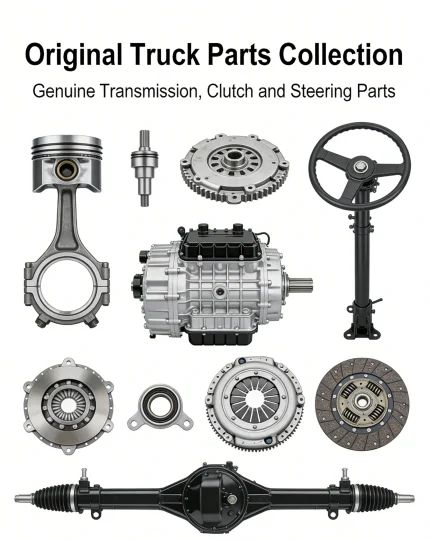
Genuine Transmission, Clutch and Steering Parts
Key Steps to Identify Original Truck Parts
Identifying original truck parts does not require advanced professional knowledge, but it does need careful observation and scientific verification.
The following key steps will help you quickly distinguish genuine parts from counterfeits and ensure that you choose the right parts for your truck.
Check Brand Markings and Serial Numbers
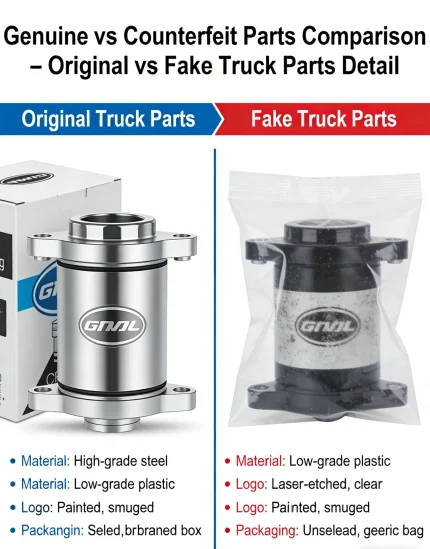
One of the most direct ways to identify original truck parts is to check the brand markings and serial numbers. Original parts have clear, standardized brand logos that are etched or stamped on the surface, with no blurriness or misspellings.
Each original part is also equipped with a unique serial number, which is the “identity card” of the part.
You can enter this serial number on the official verification page of the brand to confirm the part’s authenticity—original parts will show detailed information such as production date, model matching, and quality inspection results.
while counterfeit parts often lack valid serial numbers or have blurred, unrecognizable markings. For detailed verification steps, visit our part verification guide (non-keyword anchor).
Inspect Material Quality and Craftsmanship
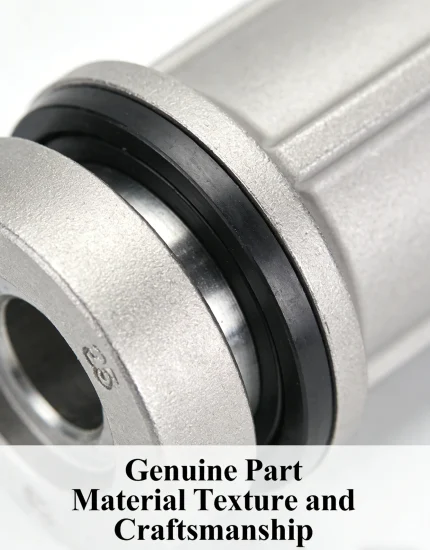
Original truck parts are made of high-strength, wear-resistant materials that can withstand the harsh working environment of heavy-duty trucks, such as high temperatures, vibration, and friction.
When you hold an original part, you can feel its solid weight and fine texture, with no rough edges, burrs, or uneven surfaces.
In contrast, counterfeit parts often use cheap, low-quality materials, which are light in weight, rough in surface, and even have obvious defects such as uneven welding or incomplete processing.
For example, original clutch parts have a uniform texture and stable performance, while counterfeit clutch parts are easy to wear and deform after a short period of use.
Genuine Part Material Texture and Craftsmanship
Verify Model Compatibility
Original truck parts are developed for specific truck models, with perfect compatibility—no additional modification is needed during installation.
You can use the official part number query tool to confirm whether the part matches your truck’s make and model, ensuring that it fits perfectly with the vehicle’s original components.
Counterfeit parts often claim to be “universally applicable” but cannot achieve precise matching, which may lead to installation difficulties, abnormal vehicle operation, or even damage to other components.
Counterfeit truck parts today are no longer low-quality obvious imitations. Many fake components are produced using advanced replication techniques that allow them to closely match the appearance of original parts.
This includes similar packaging design, copied logos, and even duplicated part numbers. In some cases, counterfeiters use real OEM reference data to create highly convincing products.
However, while the appearance may be similar, the internal material quality, machining precision, and durability standards are significantly different. These hidden differences are what ultimately lead to early failure in real operating conditions.
⚠️ Where Fake Parts Usually Fail First
Although counterfeit truck parts may look identical externally, they typically fail first in high-stress operating conditions.The most common failure points include heat resistance, structural fatigue, and long-term vibration tolerance. For example, counterfeit bearings may function normally at low load but fail quickly under continuous highway operation.
Similarly, fake electrical components may pass initial testing but degrade rapidly when exposed to temperature fluctuations and vibration.This is why counterfeit parts often appear “normal at installation” but fail prematurely during real-world operation.
🧩 Why Serial Numbers Alone Are Not Enough
Many users rely on serial number verification as the primary method of identifying original truck parts. However, this method alone is not always reliable.Modern counterfeit parts can replicate serial numbers or reuse valid codes from genuine products. In some cases, fake parts may even pass basic online verification checks.Because of this, serial number verification must be combined with physical inspection, supplier verification, and packaging consistency analysis to ensure authenticity.
🔥 The Real Risk of Using Fake Truck Parts
The biggest danger of counterfeit truck parts is not immediate failure, but gradual system degradation.A fake part may initially function normally, but its lower material quality can increase wear on connected components. This creates a chain reaction where surrounding parts are also affected.
For example, a counterfeit bearing may increase friction, which then leads to overheating in adjacent components. Over time, this can escalate into serious mechanical failure and unexpected downtime.For fleet operations, this creates hidden maintenance costs that are often higher than the price difference of the part itself.
🧠 Why Buyers Still Get Confused
Even experienced technicians can sometimes struggle to identify counterfeit parts because modern fake products are designed to reduce obvious visual differences.Additionally, inconsistent supply chains, mixed sourcing channels, and online marketplaces increase the difficulty of verifying authenticity.This creates a situation where buyers must rely on a combination of technical inspection, supplier credibility, and performance experience rather than a single identification method.
Common Mistakes to Avoid When Identifying Original Parts
Many people easily fall into misunderstandings when identifying original truck parts, which leads to the purchase of counterfeit products. Here are the most common mistakes to avoid to help you make the right choice:
Mistake 1: Ignoring packaging details. Original parts come in standardized packaging with clear brand logos, detailed installation instructions, and warranty certificates, while counterfeit parts often have simple, shoddy packaging with missing information.
Learn more about original part packaging via our packaging guide (non-keyword anchor).
Mistake 2: Focusing only on price. Original parts are reasonably priced due to strict quality control, while counterfeit parts are often cheap but have hidden safety hazards and short service life.
Mistake 3: Skipping serial number verification. Even if a part looks genuine, you should still verify its serial number through official channels to avoid buying counterfeits.
Original vs Fake Truck Parts Detail
The Value of Choosing Original Truck Parts
Choosing original truck parts is not only a guarantee of vehicle safety but also a wise investment in long-term operations.
Original parts have strict quality control, stable performance, and a formal warranty, allowing you to get professional after-sales service and technical support when problems occur.
In addition, original parts can maintain the optimal performance of the vehicle, reduce fuel consumption and maintenance costs, and help your fleet achieve more efficient and safe operation.
Whether you are a fleet manager or a repair technician, choosing original parts is the most cost-effective and reliable choice.
For more professional guidance on identifying original truck parts, you can visit our genuine parts resource center(non-keyword anchor) or contact our expert team for a one-on-one consultation.
We will provide you with accurate verification methods and professional suggestions to help you avoid counterfeit parts and protect your operational interests.
❓ FAQ – Truck Parts Authenticity & Identification
How do counterfeit truck parts enter the supply chain?
Counterfeit truck parts usually enter the supply chain through multiple indirect channels rather than direct sales. They often move through unofficial distributors, mixed inventory warehouses, or online marketplaces where product origin is not strictly controlled.
In some cases, fake parts are mixed with genuine inventory during bulk distribution, making them difficult to distinguish at the purchasing stage. Because packaging and labeling can be replicated, counterfeit products may pass through several layers of distribution before reaching end users.This is why supply chain transparency and supplier verification are critical factors in preventing counterfeit part usage.
Why do some fake truck parts pass basic quality inspection?
Some counterfeit truck parts can pass basic inspection because initial quality checks often focus on surface-level characteristics such as dimensions, appearance, or packaging.
However, many performance issues only appear under real operating conditions such as heat, vibration, and long-term load stress. Fake parts may meet short-term specifications but fail to maintain durability under continuous use.This creates a false sense of reliability during early inspection stages, even though the internal material quality is significantly lower than genuine components.
What is the difference between OEM, aftermarket, and counterfeit parts?
OEM parts are manufactured according to original equipment specifications, often by the same or authorized factories that produce components for vehicle manufacturers.Aftermarket parts are produced by third-party manufacturers and may vary in quality depending on production standards and material selection.
Counterfeit parts, however, are unauthorized replicas designed to imitate OEM products without meeting technical or safety standards. While they may look similar externally, their internal structure, durability, and performance are not consistent with original specifications.Understanding this distinction is essential for making safe purchasing decisions.
Why do counterfeit parts sometimes look more polished than original parts?
Counterfeit parts may sometimes appear more visually polished because manufacturers prioritize external appearance to increase market acceptance.
However, visual quality does not necessarily reflect internal engineering precision. In many cases, counterfeit products invest more effort into packaging and surface finishing than into material strength or durability.This imbalance between appearance and internal quality is one of the key reasons why fake parts fail under real operating conditions despite looking high-quality externally.
Can counterfeit truck parts damage other vehicle systems?
Yes, counterfeit truck parts can indirectly damage other systems because they often do not maintain stable performance under operational stress.
For example, a low-quality bearing may increase friction, which leads to higher heat generation in surrounding components. Similarly, a poorly manufactured sensor may send inaccurate signals, affecting ECU behavior and system efficiency.Over time, this creates a cascading effect where one weak component accelerates wear in multiple connected systems.
Why do counterfeit parts become more common in heavy-duty trucking?
Counterfeit parts are more common in heavy-duty trucking due to high demand for replacement components and cost pressure in fleet operations.
Since heavy-duty vehicles operate under continuous stress, parts require frequent replacement, creating a large aftermarket demand. This demand attracts counterfeit suppliers who target price-sensitive buyers.In addition, global supply chains and multiple distribution layers make it easier for non-authentic products to enter the market unnoticed.
How can buyers reduce the risk of purchasing fake truck parts?
Buyers can reduce risk by focusing on supplier credibility, traceability, and consistency of product quality rather than relying only on visual inspection.
Working with verified distributors, checking documentation, and comparing product behavior over time are more reliable methods than appearance-based evaluation.In professional fleet operations, maintaining a controlled procurement system significantly reduces exposure to counterfeit products.
Can visual inspection alone ensure a truck part is original?
No, visual inspection alone cannot guarantee authenticity. While packaging quality, labeling, and appearance can provide initial indicators, modern counterfeit parts can closely replicate external features.Reliable identification requires a combination of physical inspection, supplier verification, traceability checks, and performance evaluation under real operating conditions.
Why is counterfeit detection becoming more difficult in the truck parts industry?
Counterfeit detection is becoming more difficult because counterfeit manufacturing technology has significantly improved in recent years.
Many fake parts now replicate not only external appearance but also part numbers and packaging design. At the same time, globalized supply chains make tracking product origin more complex.This increases the importance of system-level verification rather than relying on single-point checks.