Categories
Technical Support
Cooperative Case
Parts Categories
Brand Categories
Heavy Truck Brake Parts: A Complete Guide for Buyers and Wholesalers
Introduction
Heavy truck brake parts are among the most critical safety components in commercial transportation. The braking system of a heavy-duty truck must reliably stop vehicles weighing 20-40 tons traveling at highway speeds, often on challenging terrain and in adverse weather conditions. Understanding the types, specifications, and maintenance requirements of heavy truck brake parts is essential for fleet managers, truck operators, and parts wholesalers seeking to ensure vehicle safety, minimize downtime, and optimize operational costs.
This comprehensive guide explores the anatomy of heavy truck braking systems, identifies key brake components, examines performance standards, discusses maintenance best practices, and introduces professional sourcing solutions for high-quality brake parts.
Understanding Heavy Truck Braking Systems
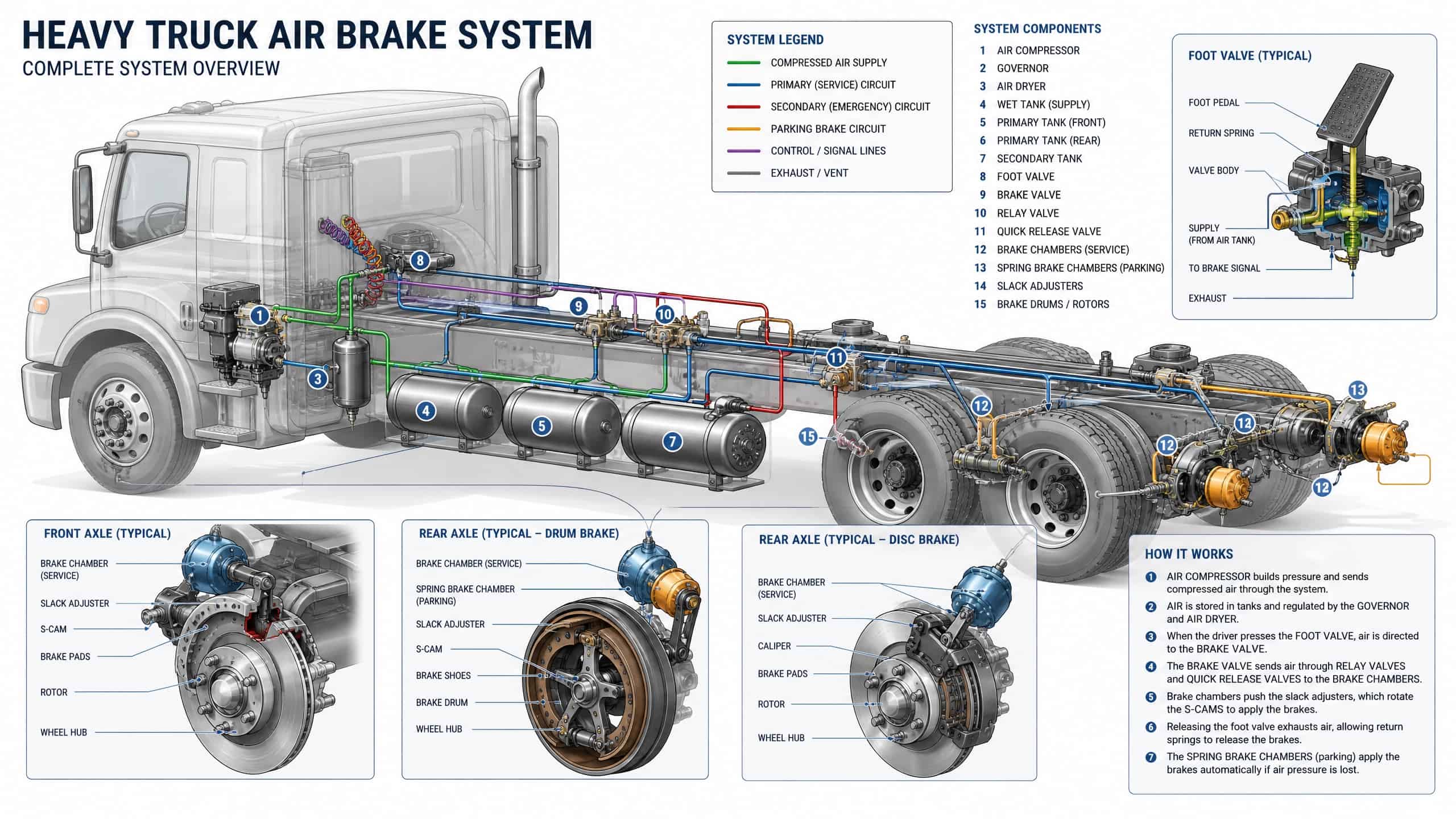
Modern heavy trucks employ sophisticated braking systems combining multiple technologies to ensure safe, controlled stopping:
Primary Braking System (Service Brakes) The primary system provides the main stopping force during normal driving. Heavy trucks typically use air brake systems, which utilize compressed air to apply brake force. This system offers several advantages over hydraulic systems including superior modulation, reduced brake fade, and better performance when fully loaded.
Secondary Braking System (Parking/Emergency Brakes) Spring-applied brakes engage automatically if air pressure is lost, preventing uncontrolled vehicle movement. These brakes hold the truck stationary during parking and provide emergency stopping capability if the primary system fails.
Auxiliary Braking Systems (Engine Brakes) Engine brakes, also called Jake brakes, provide additional stopping force on long downhill grades by using engine compression to slow the vehicle. This reduces wear on service brakes and prevents brake fade during extended descents.
Anti-Lock Braking System (ABS) ABS prevents wheel lockup during emergency braking by modulating brake pressure to individual wheels. This technology maintains directional control and reduces stopping distance on slippery surfaces.
Critical Heavy Truck Brake Parts
Brake Pads and Linings
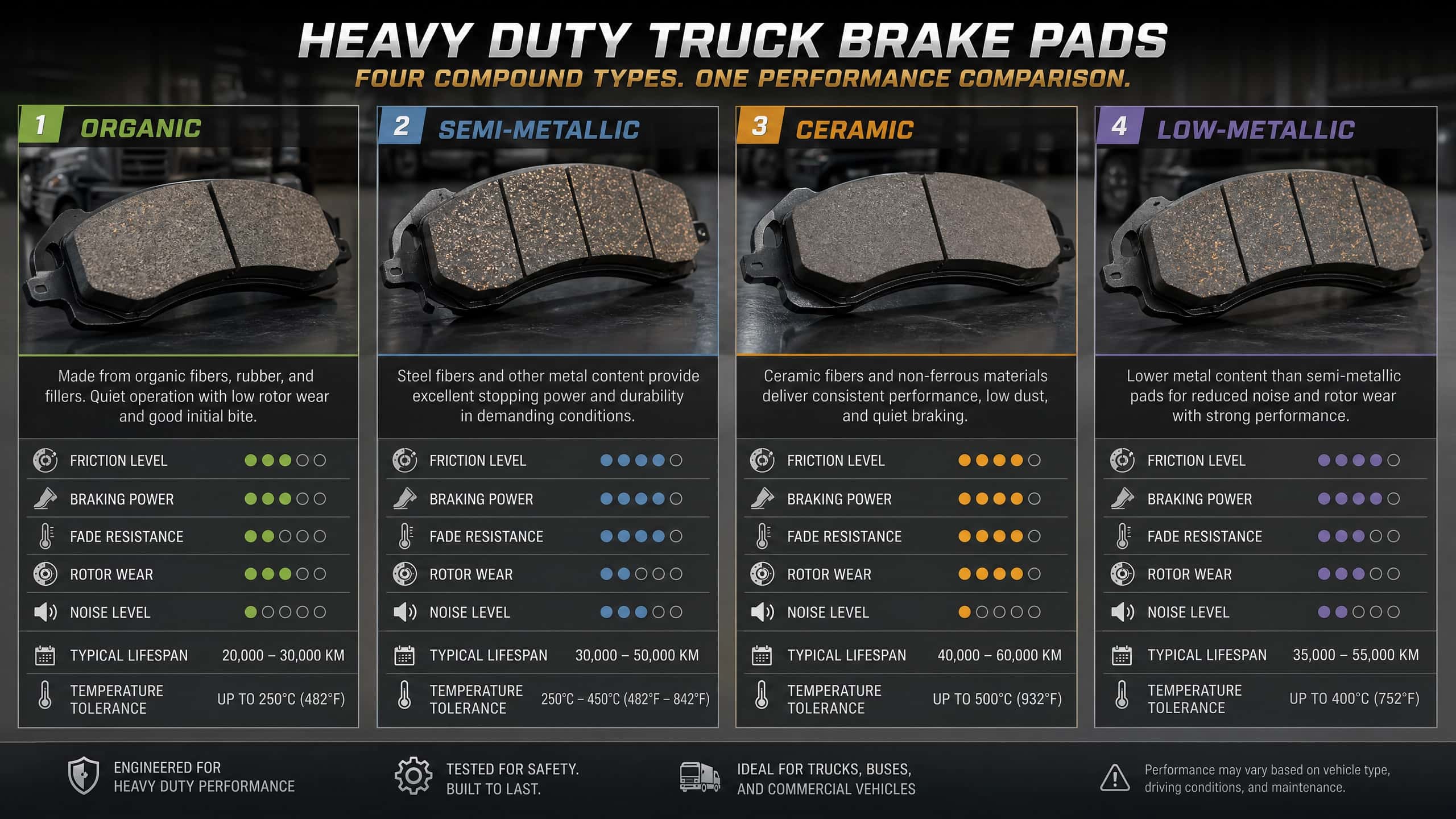
Brake pads are friction materials that create stopping force by pressing against brake rotors or drums. Heavy truck brake pads must withstand extreme temperatures, repeated braking cycles, and heavy loads.
Types of Heavy Truck Brake Pads:
- Organic brake pads - Composed of organic materials bonded with resin. Advantages include quiet operation and good initial bite. Disadvantages include lower temperature tolerance and shorter lifespan (25,000-40,000 miles).
- Semi-metallic brake pads - Contain 30-65% metal particles mixed with organic materials. Offer improved heat dissipation and longer lifespan (40,000-60,000 miles). More durable than organic pads but generate more noise and dust.
- Ceramic brake pads - Premium option using ceramic compounds and copper fibers. Provide superior heat resistance, extended lifespan (60,000-80,000 miles), lower dust generation, and consistent performance across temperature ranges. Higher cost but superior total cost of ownership.
- Low-metallic brake pads - Balance between semi-metallic and ceramic options. Offer reasonable performance and lifespan (35,000-50,000 miles) at moderate cost.
Performance Specifications:
- Friction coefficient (μ) - typically 0.35-0.45 for heavy truck applications
- Maximum operating temperature - 300-400°C depending on pad type
- Wear rate - measured in millimeters per 10,000 kilometers
- Noise level - critical for urban operations and driver comfort
Brake Drums and Rotors
Brake drums and rotors are the friction surfaces against which brake pads press to create stopping force. Heavy trucks typically use drum brakes on rear axles and disc brakes on front axles, though some modern applications use disc brakes on all wheels.
Brake Drums:
- Cylindrical cast iron components that rotate with the wheel
- Brake shoes press outward against the inner drum surface to create friction
- Typical diameter: 330-430mm for heavy trucks
- Heat dissipation critical - drums must cool quickly after heavy braking
- Resurfacing or replacement required when wear exceeds 2-3mm
Brake Rotors:
- Flat disc components that rotate with the wheel
- Brake pads press against both sides of the rotor to create friction
- Typical thickness: 30-40mm for heavy truck front brakes
- Superior heat dissipation compared to drums
- Replacement required when wear exceeds 2-3mm or thickness falls below minimum specification
Brake Lines and Hoses
Brake lines transmit air pressure from the compressor and brake valve to individual brake chambers. These components must withstand high pressure (80-100 PSI), temperature variations, and vibration.
Materials and Construction:
- Steel tubing with protective coating for main brake lines
- Reinforced rubber hoses for flexible connections and vibration isolation
- Proper routing and support prevents chafing and rupture
- Regular inspection identifies cracks, leaks, and corrosion
Brake Chambers and Actuators
Brake chambers convert compressed air pressure into mechanical force that applies the brakes. Different chamber sizes (type 20, 24, 30) provide varying force outputs for different axle configurations.
Components:
- Diaphragm - separates air chamber from mechanical linkage
- Return spring - retracts brake when air pressure is released
- Push rod - transmits force to brake shoes or calipers
- Mounting bracket - secures chamber to vehicle frame
Brake Valves and Regulators
These components control air pressure distribution throughout the braking system, ensuring proper brake application and preventing over-pressurization.
Key Types:
- Foot valve - driver-operated valve controlling brake application
- Load sensing valve - adjusts brake force based on vehicle load
- Proportioning valve - distributes brake force between front and rear axles
- Pressure relief valve - prevents excessive system pressure
Air Compressor and Dryer
The air compressor generates compressed air for the entire braking system. The air dryer removes moisture and contaminants, preventing corrosion and ice formation in brake lines during cold weather.
Specifications:
- Displacement: typically 5-7 cubic inches per revolution
- Output pressure: 120-140 PSI
- Duty cycle: continuous operation during vehicle use
- Maintenance: regular dryer cartridge replacement (typically 100,000-150,000 kilometers)
Performance Standards and Regulations
International Standards
Heavy truck brake parts must meet stringent performance standards established by regulatory bodies worldwide:
SAE (Society of Automotive Engineers) Standards:
- SAE J37 - Brake fluid specifications
- SAE J348 - Brake lining performance requirements
- SAE J2430 - Brake system performance standards
ECE (Economic Commission for Europe) Regulations:
- ECE R13 - Braking system performance and safety requirements
- ECE R90 - Brake component certification
ISO (International Organization for Standardization) Standards:
- ISO 6311 - Brake lining friction coefficient measurement
- ISO 6312 - Brake lining wear rate testing
Regional Compliance
Different markets impose specific requirements:
- North America - DOT (Department of Transportation) standards
- Europe - ECE regulations and CE marking requirements
- Middle East and Africa - Increasingly adopting ECE standards
- Asia-Pacific - Mix of national standards and international requirements
Heavy truck brake parts are fundamental to vehicle safety, operational reliability, and regulatory compliance. Understanding brake system components, performance standards, and maintenance requirements enables fleet operators and parts professionals to make informed decisions that enhance safety and optimize costs.
Whether you operate a single truck or manage a large commercial fleet, selecting quality brake components from a reliable, knowledgeable supplier is essential. Mettlead's professional expertise, comprehensive inventory, quality assurance, and technical support make us the preferred partner for heavy truck brake parts sourcing.
For premium quality heavy truck brake parts, expert technical guidance, and competitive pricing, contact Mettlead at https://mettlead.com/. Our team of brake system specialists is ready to assist you in selecting the right components for your specific needs and ensuring your fleet operates safely and efficiently.