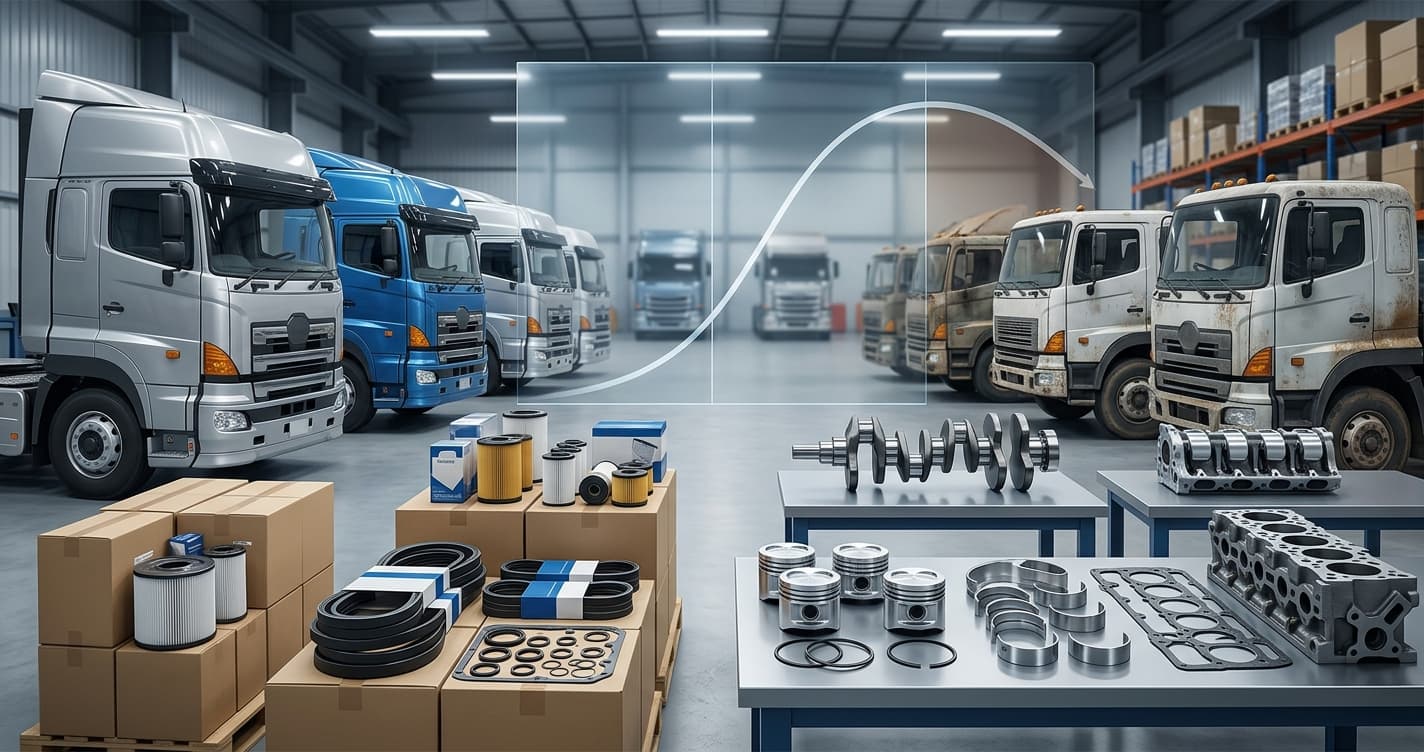
Let’s be honest — buying heavy truck parts from China can feel a lot like a blind date. There’s exciting potential (great prices, massive selection), but also that nagging uncertainty: Will they actually show up as advertised? You’ve probably heard the horror stories. Wrong parts, vanishing suppliers, quality that nosedives after the first order.
Here’s the good news: this guide exists precisely so you can skip the drama. We’re going to walk you through how to identify a truly reliable china heavy truck parts supplier, avoid the costly mistakes that plague first-time buyers, and ultimately keep your fleet running smoothly — without the headaches.
Consider the scale we’re talking about. China exported over $80 billion in automotive and truck components in 2023 alone, supplying commercial fleets across Africa, Southeast Asia, the Middle East, and Latin America. Furthermore, with thousands of suppliers competing for your attention, the real challenge isn’t finding a supplier — it’s finding the right one. That’s exactly the problem we’re solving today.
At Mettlead, we’ve spent 15 years navigating this landscape. So think of this article as a conversation with a friend who’s been through it all — and wants to save you the tuition fees of learning the hard way.
Why China Dominates the Heavy Truck Spare Parts Market
The Manufacturing Scale Advantage
China didn’t become the world’s largest commercial vehicle spare parts exporter by accident. The country’s industrial ecosystem is purpose-built for scale. Production clusters in Guangzhou, Shandong, and Zhejiang each specialize in different component categories, creating a supply chain that’s both deep and wide.
To put it in perspective, China accounts for roughly 30-35% of global truck parts production. That’s not just volume — it’s variety. From engine assemblies to cabin mirrors, from brake drums to wiring harnesses, the manufacturing infrastructure covers virtually every system on a commercial vehicle. As a result, an OEM truck parts supplier Guangzhou-based operation can often source components that would take weeks to find elsewhere.
Meanwhile, the competitive density among manufacturers keeps pricing sharp. When hundreds of factories produce similar components, quality and price naturally optimize. The trick, of course, is knowing which factories consistently deliver — and which ones cut corners when nobody’s watching.
Chinese Truck Brands Driving Global Demand
Here’s something many buyers overlook: the explosive global growth of Chinese truck brands has created an equally explosive aftermarket. Sinotruk (HOWO), FAW, Dongfeng, Shacman, Foton, JAC, CAMC, and Beiben now operate on every continent. These aren’t niche vehicles anymore — they’re workhorses hauling cargo, mining ore, and building infrastructure worldwide.
Consequently, the need for a reliable heavy duty truck parts wholesale china network grows exponentially each year. Every HOWO dumping gravel in Nigeria, every Dongfeng delivering goods in Vietnam, every Shacman grinding through Central Asian highways — they all need parts. Regularly. Reliably.
| Chinese Truck Brand | Key Export Regions | Common Parts in Demand |
|---|---|---|
| Sinotruk HOWO | Africa, Middle East, SE Asia | Engine parts, cabin parts, chassis components |
| Shacman | Africa, Central Asia | Transmission, brake systems |
| Dongfeng | SE Asia, Latin America | Electrical systems, filters |
| FAW | Africa, Russia | Suspension, drivetrain |
| Foton | Global markets | Light-to-heavy duty full range |
| Beiben | Africa, Mining regions | Axle parts, heavy-duty components |
Explore our full product brands page to see which Chinese truck brands we cover — spoiler: it’s all of them.
What Makes a Supplier the “Best”? (It’s Not Just Price)
Quality Consistency Over One-Time Luck
Anyone can send you one good batch. The real question is: can they do it every single time? There’s a world of difference between a factory that can make good parts and one that always does. Consistency is the unsexy superpower of great suppliers.
Look for certifications like ISO/TS 16949, CCC (China Compulsory Certification), and SGS inspection reports. These aren’t just wall decorations — they indicate systematic quality control rather than random luck. In other words, a good supplier is like a good mechanic: they remember your truck’s quirks, they don’t guess, and they never gamble with your uptime.
Product Range and System Coverage
Imagine ordering engine parts from one supplier, brake components from another, electrical systems from a third, and cabin parts from a fourth. That’s four relationships to manage, four shipping timelines to track, and four potential points of failure. Exhausting, right?
A comprehensive chinese truck components manufacturer who stocks across multiple brands and systems saves you enormous time and logistics costs. When one supplier covers engine, transmission, braking, electrical, cabin, and chassis components, your procurement process transforms from chaos into a single, streamlined conversation. Check out our product systems page to see what consolidated sourcing actually looks like.
Experience and Industry Knowledge
Years in the business aren’t just a vanity metric. An experienced supplier understands fitment nuances, cross-references part numbers across generations, and knows which factory produces which version of a component. They know that a “HOWO water pump” might refer to three completely different items depending on the engine series and production year.
This is where 15 years of experience stops being a number on a website and starts being your safety net. When your fleet depends on getting the right part the first time, industry knowledge isn’t optional — it’s essential.
Communication and After-Sales Support
On top of that, the best supplier relationship isn’t transactional — it’s a partnership. How quickly do they respond? Do they communicate clearly in English? More importantly, are they willing to solve problems after delivery, or do they vanish once payment clears?
A genuine truck replacement parts factory china partner understands that issues will occasionally arise. What matters is how they handle them. Do they have a claims process? Can you reach a real person within 24 hours? These questions matter more than you think — especially at 2 AM when your fleet is down. Visit our support page to see how responsive after-sales actually works.
Common Problems When Sourcing Heavy Truck Parts from China (And How to Solve Them)
This is the section that might save you thousands of dollars — and a few gray hairs. These are real problems that real buyers face every day. We know because we’ve helped solve them hundreds of times. Let’s dig in with practical, actionable solutions.
Problem 1 — Receiving Wrong Parts or Incorrect Fitment
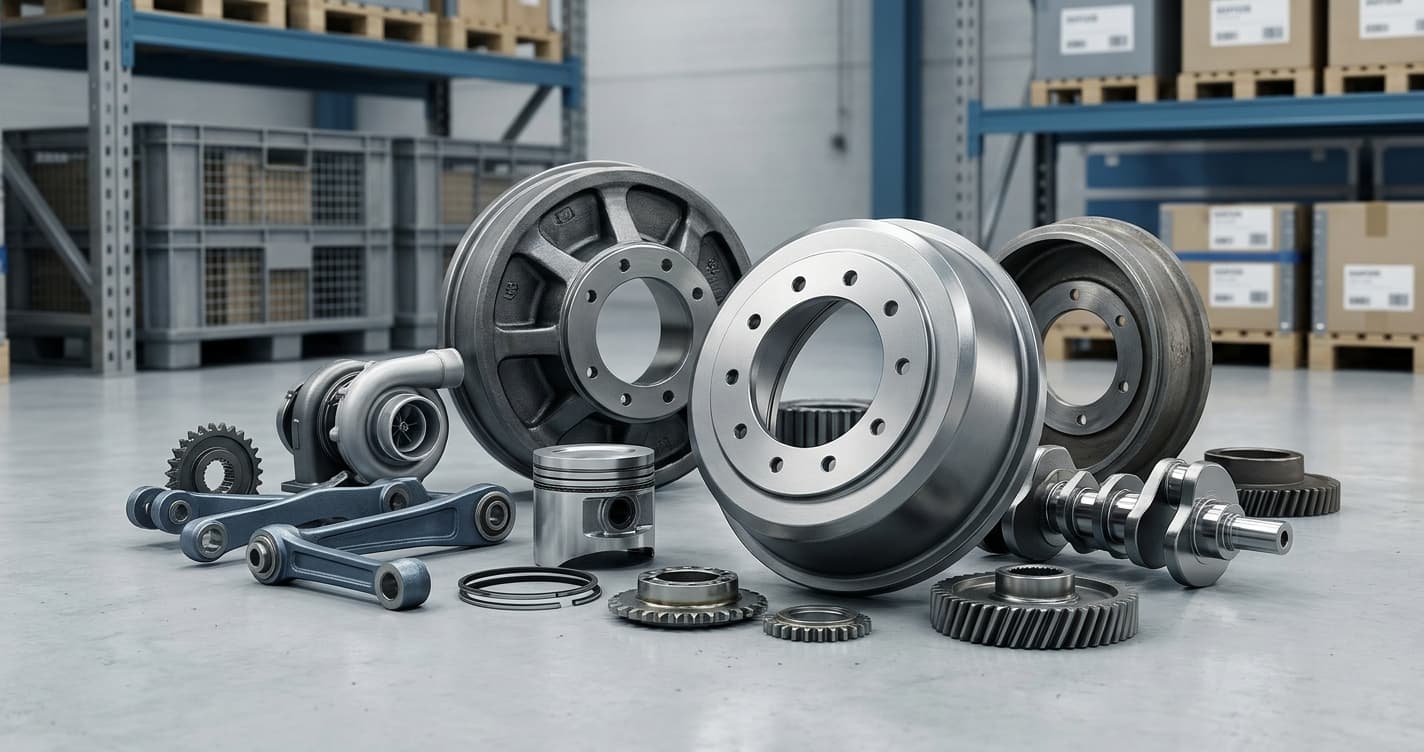
It happens more often than anyone likes to admit. You order a brake drum for a HOWO A7, and what arrives fits a HOWO 371 from 2012. The part looks similar, the description matched, but the dimensions are just slightly off. Now you’ve got dead inventory and a truck still waiting.
Why it happens: Vague part descriptions, multiple generations of the same model, and regional specification variations all contribute. Many suppliers simply don’t ask enough questions before shipping.
Solution: Work with a supplier who cross-references by VIN or chassis number, requests photos of old parts, and confirms dimensions before anything leaves the warehouse. A supplier with genuine experience knows that a “HOWO brake drum” could mean five different items — and they’ll ask which one you actually need.
Problem 2 — Inconsistent Quality Between Orders
Your first order was perfect. The second was acceptable. The third? Noticeably worse. This quality rollercoaster is one of the most frustrating experiences in international sourcing.
Why it happens: The supplier quietly switches factories to chase better margins, or they lack any real quality control process. Without fixed manufacturing partnerships, every order becomes a lottery.
Solution: Choose a supplier with established, fixed factory partnerships and in-house quality inspection. Ask for their QC process documentation — not just certificates, but actual workflow descriptions. Consistent sourcing equals consistent quality. There are no shortcuts here.
Problem 3 — Long Lead Times and Shipping Confusion
You were told “7-10 days.” It’s now day 25, and you’re still getting vague updates. Meanwhile, your trucks sit idle, your contracts suffer, and your blood pressure rises.
Why it happens: Poor inventory management and unclear communication about what’s actually in stock versus what needs to be manufactured. Some suppliers say “yes” to everything and figure out the details later.
Solution: Partner with a supplier who maintains warehouse stock for fast-moving parts and communicates realistic timelines upfront. Before placing your first order, ask about their inventory model. Do they hold stock? What’s made-to-order? Honest answers here prevent painful surprises later.
Problem 4 — No After-Sales Support When Issues Arise
The payment cleared. The container shipped. Then… silence. When you discover a problem three weeks later, your messages go unanswered. Sound familiar?
Why it happens: Many online traders operate with a “sell and forget” mentality. They lack the infrastructure — or the intention — to handle post-delivery issues.
Solution: Verify the supplier has a dedicated support process before you need it. Can you reach them on WhatsApp or email within 24 hours? Do they have a documented claims process? A real partner stands behind their parts — not just until payment, but for the lifetime of the business relationship. See how our support team handles exactly these situations.
Problem 5 — Difficulty Verifying Supplier Legitimacy
Thousands of listings on B2B platforms, all claiming to be “factory direct” with “best quality.” How do you separate genuine manufacturers from middlemen reselling at markup? It’s genuinely difficult.
Why it happens: The barrier to creating an online supplier profile is extremely low. Anyone with a website template and stock photos can look legitimate for about five minutes.
Solution: Look for suppliers with verifiable business history, real customer testimonials, a physical warehouse or office, and willingness to do video calls. Better yet — work with a supplier whose existing customers you can actually contact for references. Browse our customer success cases to see real partnerships in action.
| Problem | Root Cause | Solution | Red Flag to Watch |
|---|---|---|---|
| Wrong parts received | Poor cross-referencing | VIN-based confirmation + photos | Supplier never asks for details |
| Quality inconsistency | Factory switching | Fixed supply chain + QC inspection | Prices fluctuate wildly between orders |
| Shipping delays | No real inventory | Warehouse stock + honest timelines | “Everything is in stock” (always) |
| No after-sales support | Trader mentality | Dedicated support team + claims process | Slow replies after payment |
| Unverifiable supplier | Low barrier to entry online | Check history, references, video calls | No physical address or real photos |
How to Evaluate a China Heavy Truck Parts Supplier — A Practical Checklist
Step 1 — Check Their Brand Coverage
Start with the basics. Does this supplier actually cover the specific Chinese truck brands you operate? Can they supply across multiple systems for those brands, or are they limited to one narrow category?
A supplier who covers Sinotruk, Shacman, Dongfeng, FAW, Foton, and Beiben under one roof immediately simplifies your life. Conversely, if they only handle one brand or one component type, you’ll inevitably need additional suppliers — and additional complexity.
Step 2 — Assess Their Experience Level
How many years have they operated in this specific industry? Do they understand model generations and regional specifications? Can they explain the difference between a Euro II and Euro V engine component without hesitation?
Experience reveals itself in the details. An experienced supplier doesn’t just sell parts — they consult. They’ll tell you when a cheaper alternative exists, warn you about known compatibility issues, and suggest solutions you hadn’t considered.
Step 3 — Request Sample Orders
Never commit to a large order without testing the waters first. Start small, verify quality, check packaging, confirm fitment — then scale with confidence. A confident supplier welcomes this approach because they know their product speaks for itself.
In contrast, suppliers who pressure you into large minimum orders before you’ve verified anything are waving a red flag. Trust is earned incrementally, not demanded upfront.
Step 4 — Test Their Communication
Here’s a simple but powerful test: send a complex inquiry. Ask about a specific part for a specific model year with a specific configuration. Then observe. How fast do they respond? How accurately? Do they ask clarifying questions, or do they just say “yes, we have it” to everything?
The quality of pre-sale communication directly predicts the quality of post-sale support. Suppliers who take time to understand your needs before selling will take time to solve your problems after delivery.
Step 5 — Verify Customer References
Ask for case studies or references from buyers in your region. Look for evidence of long-term relationships, not just one-time transactions. A supplier with repeat customers over multiple years has proven their reliability in the most meaningful way possible.
Similarly, check if they have documented success stories you can review. Real partnerships leave real evidence. Visit our customer success cases for examples, or contact us directly to connect with references in your market.
Why Buyers in Key Regions Keep Coming Back to Established Chinese Suppliers
Africa — Keeping HOWO and Shacman Fleets Alive
Picture this: a fleet operator in East Africa running 40 HOWO dump trucks across multiple construction sites. Brake drums wear out every few months. Engine gaskets need regular replacement. Cabin components take a beating on unpaved roads. Without a consistent parts pipeline, trucks sit idle — and idle trucks don’t earn money.
For operators like these, a reliable OEM truck parts supplier Guangzhou-based partner isn’t a luxury — it’s a lifeline. The right supplier understands African logistics challenges, consolidates shipments efficiently, and maintains stock on the exact items that wear fastest in these conditions.
Southeast Asia — Dongfeng and Foton Dominance
Transport companies across Vietnam, Philippines, and Indonesia rely heavily on Dongfeng and Foton trucks for daily logistics. Tropical humidity accelerates electrical system corrosion. Monsoon seasons punish suspension components. The demand for replacement parts is constant and predictable.
That said, predictable demand only helps if your supplier understands the patterns. An experienced partner anticipates seasonal spikes, recommends climate-appropriate component grades, and helps you build inventory buffers before peak periods hit.
Middle East and Central Asia — Harsh Conditions, Zero Tolerance for Failure
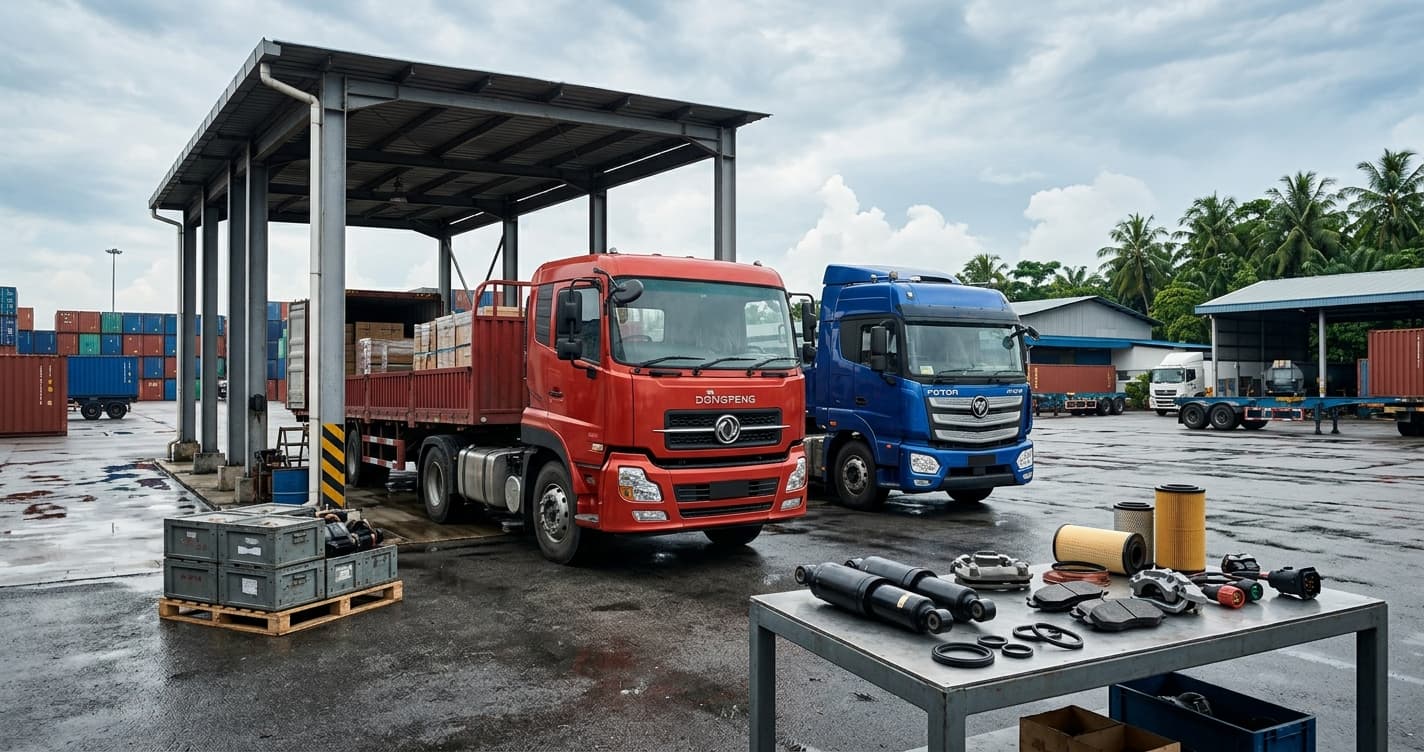
Mining operations in the Middle East and construction projects across Central Asia push trucks to their absolute limits. Extreme temperatures, heavy loads, and abrasive dust create punishing conditions for every component. When a Beiben mining truck goes down, the cost isn’t just the part — it’s the entire operation stalling.
In these environments, quality-first sourcing from a proven heavy duty truck parts wholesale china partner becomes non-negotiable. Buyers in these regions don’t shop on price alone — they shop on reliability, because failure costs exponentially more than the parts themselves.
FAQ — Your Questions About Sourcing Truck Parts from China, Answered
What is the minimum order quantity (MOQ) for heavy truck parts from China?
MOQ varies significantly by supplier and part type. Established suppliers often offer flexible minimums, especially for mixed-brand orders combining multiple component categories. Many stock items — particularly fast-moving wear parts — have no MOQ requirement at all. The key is working with a supplier who accommodates your actual purchasing patterns rather than forcing arbitrary minimums.
How do I ensure the parts fit my specific truck model?
Provide your VIN number, chassis number, or clear photos of existing parts. Experienced suppliers cross-reference this information across their databases and confirm exact specifications before production or shipping. Additionally, sharing the truck’s production year and engine model eliminates ambiguity for components that changed between generations.
Can I get OEM-quality parts without OEM prices?
Absolutely. Many Chinese factories produce OEM-equivalent parts using identical tooling, materials, and manufacturing processes as original equipment. The price difference comes from distribution, not quality. The critical factor is working with a supplier who sources from these verified factories — not random traders who can’t guarantee manufacturing origin.
What payment terms are standard when working with a china heavy truck parts supplier?
T/T (telegraphic transfer) with 30% deposit and 70% balance before shipping is the most common arrangement. Established suppliers may offer more flexible terms for repeat customers with proven payment history. Always use secure, traceable payment channels and confirm banking details through verified communication channels to prevent fraud.
How long does shipping typically take?
Sea freight averages 15-40 days depending on your destination port. Air freight delivers within 5-7 days for urgent orders, though at higher cost. A good supplier helps you plan inventory cycles strategically, so you’re ordering by sea during normal operations and only using air freight for genuine emergencies — saving you significant logistics costs over time.
What if I receive defective parts?
A reputable supplier maintains a clear claims process — offering replacement, credit, or refund depending on the situation and defect type. This is precisely why choosing a supplier with documented after-sales support matters so much. Before your first order, ask specifically about their warranty policy and claims procedure. If they can’t answer clearly, that tells you everything you need to know.
Ready to Source Smarter? Here’s Your Next Step
Finding the right china heavy truck parts supplier takes effort upfront. There’s no way around that. But the payoff — in cost savings, fleet uptime, reduced stress, and long-term peace of mind — makes that initial investment worthwhile many times over.
You don’t have to navigate this alone, though.
We’ve spent 15 years in this industry — not just selling parts, but solving problems. At Mettlead, we’ve encountered every sourcing headache in the book, and we’ve built our entire operation around making sure you never lose sleep over truck parts again. Whether you’re running 5 trucks or 500, whether you need a single urgent component or a full container of mixed parts across multiple brands — we’ve got you covered.
Contact us at Mettlead, and we’ll give you a practical, workable solution tailored to your specific fleet and market. You’ll get the most competitive pricing for genuine Chinese brand truck components available globally — backed by experience, quality control, and a team that actually picks up the phone when you call.
Your trucks keep your business moving. Let us keep your trucks moving. Learn more about who we are, or simply reach out today. We’re ready when you are.


