Compare the best Chinese truck brands for heavy hauling. See how Sinotruk and Shacman differ and how to choose a heavy truck by duty cycle, axles and service.
Both brands will haul your load.
Sinotruk and Shacman are the two names that come up first among the best Chinese truck brands, and the right pick depends on duty cycle, specification and local service rather than the badge on the grille. This guide follows the order in which the decision actually gets made: duty cycle, axle configuration, coupling, reliability evidence and final verification. Work through it in that order and the brand choice usually narrows itself.
Which Are the Best Chinese Truck Brands for Heavy Hauling?
Sinotruk and Shacman lead the Chinese heavy-duty segment by volume and model breadth. FAW, Dongfeng, JAC and Foton are credible alternatives, and which one fits depends on your region, your duty cycle and who can service the truck near you.
That is the short answer. The longer one is that “best” only means something once you define the job. A quarry dump truck and a highway tractor pulling a 13.6 m semi-trailer share almost nothing beyond the cab badge.
Typical heavy-duty specifications
Most heavy tractors in this class are 6×4 units. Dump trucks and mixers are commonly 6×4 or 8×4. Engine outputs typically fall between roughly 336 and 550 hp, with the higher end used for heavy-haul and mountain work.
Gross combination weights for conventional tractor-trailer work usually sit in the 40 to 55 t range. Treat that as a general band only. Your legal limit depends on the road class, axle count and local regulation, and it can be lower or higher than that range.
Why dealer coverage outweighs brand count
It is tempting to compare six or seven brands. In practice, a shortlist of two or three is easier to evaluate, and the deciding factor is rarely the engine brochure. It is how fast a gearbox, a turbocharger or a set of brake chambers reaches your yard when a truck is down.
Ask each dealer where the nearest authorised workshop is, which wear parts they hold in stock, and how long a non-stock part takes to arrive. A brand with slightly weaker specs and strong local support often beats a better-specified truck that waits three weeks for a clutch.
If you want to see how different truck and trailer brands are presented side by side, the brand pages on Mettlead are a useful starting reference. Use them to build the shortlist, then test the shortlist against your own routes.
Sinotruk vs Shacman: Where Do They Actually Differ?
On paper the two overlap on most specifications. The real differences sit in model lines, engine and transmission pairings, cab options and regional service networks, so a heavy duty truck comparison guide like this one is better read by line than by brand.
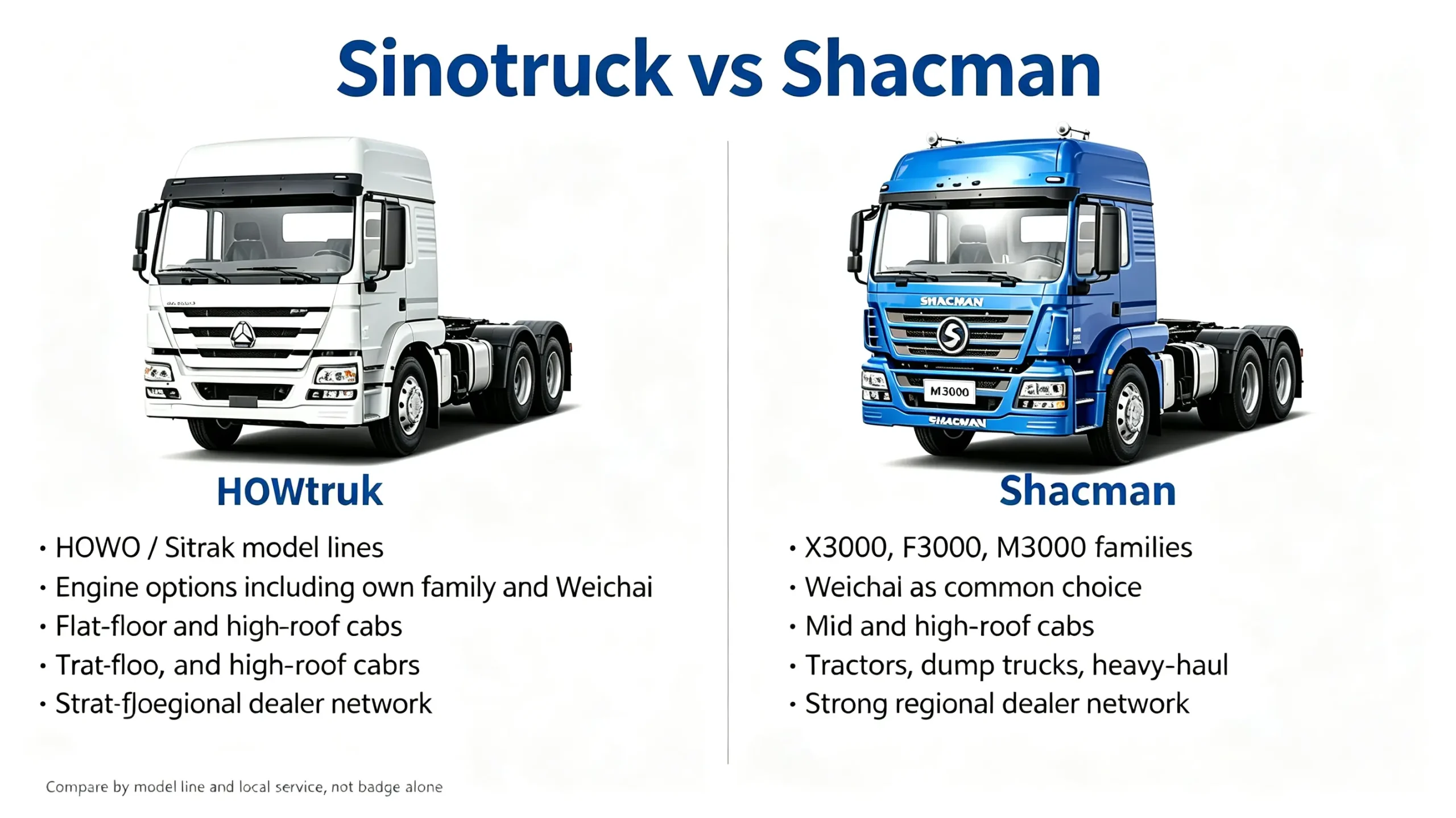
Sinotruk sells under the HOWO and Sitrak names, among others. Shacman builds around the X3000, F3000 and M3000 families. The table below compares them on general public information only. Specific outputs and ratings vary by market and model year, so confirm them against the current spec sheet.
| Aspect | Sinotruk | Shacman |
|---|---|---|
| Main model lines | HOWO for general heavy work; Sitrak positioned as the higher-spec line | X3000 for long-haul and heavy-haul; F3000 and M3000 for construction and mixed duty |
| Engine options | Own engine family plus Weichai and other suppliers, depending on market | Weichai as the common choice, with other suppliers offered in some markets |
| Cab and sleeper choices | Flat-floor and high-roof options, several sleeper lengths | Mid and high-roof cabs, sleeper and day-cab variants |
| Typical applications | Tractors, dump trucks, mixers, special-purpose chassis | Tractors, dump trucks, mixers, heavy-haul tractors |
| Parts and service | Strong where a regional dealer network exists | Strong where a regional dealer network exists |
The takeaway: neither brand wins on specification alone, so the tiebreaker is whichever has the stronger service presence in your area.
Reference models by role
The HOWO range is the usual reference point for general-purpose 6×4 tractors and 8×4 dump trucks, with a broad choice of power ratings and cab heights. It suits fleets that want a familiar platform with a wide parts base.
The Shacman X3000 is a typical reference for a heavier-duty 6×4 tractor, often specified for long-haul or heavy-haul work with higher-output engines and a high-roof sleeper cab. Compare it with the Sitrak line if your duty cycle is similar.
Which Chinese Truck Is Most Reliable?
No brand wins on reliability in the abstract. Reliability follows the drivetrain specification, build consistency, maintenance discipline and parts access, which is why a question like “which Chinese truck is most reliable” has a different answer for each fleet.
Reputation is a weak guide here. Two trucks of the same model can behave very differently if one runs on a paved corridor with scheduled servicing and the other works a gravel haul road with deferred maintenance.
What to weigh instead of reputation
Start with the named components. Check the engine maker and emissions package, the gearbox type and brand, and the axle supplier and ratio. These three decide most of the long-term running behaviour, and they are often swappable within one model line.
Then look at service intervals. A longer interval looks attractive until you see what it assumes about oil quality and operating conditions. Ask the dealer to show the schedule for your duty, not the brochure maximum.
Finally, read the warranty terms. Note what is covered, for how long or how many kilometres, and whether wear items, labour and towing are included. A short, clear warranty usually beats a long one full of exclusions.
Downtime is the real cost
A truck that stands for a week costs you the lost trips, the late-delivery penalties and often a hired replacement. Put an honest daily figure on downtime for your operation, and compare dealers on how quickly they can bring that number down.
In this trade, uptime is usually decided by parts logistics more than by the spec sheet. A fleet with a local parts stockholder and a trained technician generally outperforms a better-specified fleet that depends on long-distance shipments.
If you are unsure where to look for service documentation and maintenance guidance, the technical support section collects practical material you can compare with what a dealer tells you.
How to Choose a Heavy Truck: Settle Payload and Axle Configuration First
Fix your real payload, your route and your legal axle limits before you compare brands. Those three set your configuration, and the configuration narrows the field faster than any badge.
Here are the criteria that matter most, in the order to check them.
Gross vehicle weight rating and gross combination weight. The gross vehicle weight rating (GVWR) is the maximum loaded weight the manufacturer allows for the vehicle. The combination figure adds the trailer. Both must sit above your heaviest realistic load with a margin, and both must fit local registration rules.
Axle load distribution. Axle load distribution is how the total weight is shared across steer, drive and trailer axles. A truck can be under its gross limit and still be illegal if one axle group is overloaded, so plan where the cargo sits, not only what it weighs.
Configuration. A 6×4 tractor suits most semi-trailer work. An 8×4 rigid carries more on a dump or mixer body. On the trailer side, tri-axle and quad-axle configurations spread heavy machines across more axle lines, which matters for both legal limits and road wear.
Engine power against terrain. Flat corridors rarely justify the top output. Long grades, high altitude and heavy-haul weights do. Match power and gearbox ratio to the steepest sustained grade on your route, not the average.
Cab and fuel considerations. Sleeper cabs add comfort and weight. Larger tanks add range and weight. If your runs are short and return to base nightly, a day cab and a smaller tank leave more payload.
The trade-off is straightforward. A heavier-spec truck carries more but costs more to run, maintain and register, and it may spend much of its life under-used.
Rule of thumb: choose the lightest configuration that legally carries your heaviest regular load with a small margin.
Fifth Wheel Height, Kingpin Size and Coupling: What Has to Match
Tractor and trailer must agree on fifth wheel height, kingpin size and load rating, or the combination is unsafe and often non-compliant. This is the point in the decision where a strong tractor paired with a mismatched trailer causes the most trouble.
Kingpin size: 2-inch vs 3.5-inch
The 2-inch kingpin is the standard for general road semi-trailers, and it is what most fifth wheels are built to accept. The 3.5-inch kingpin is a larger-diameter design associated with heavy-haul and special-purpose trailers, where kingpin load is much higher.
Check which size your trailer carries and which your fifth wheel is rated for. Do not assume a coupling that physically engages is rated for the load. Confirm the rating plate on both parts.
Kingpin load and fifth wheel coupling limits
Kingpin load is the vertical force the trailer places on the fifth wheel. Each coupling carries a rated figure, and your loaded trailer must stay below it, including dynamic effects such as braking and uneven roads.
Coupling components generally need to follow recognised standards. ECE R55 covers mechanical coupling components for vehicle combinations, and SAE J-series standards cover related coupling and trailer dimensions. Ask the supplier which one applies and for the matching documentation.
Height and trailer level
Fifth wheel height sets how level the trailer rides. If the tractor is too high, the trailer nose-lifts and shifts weight rearward. If too low, the trailer tilts forward and may foul the tractor cab on turns. Low-bed trailers also need clearance under the gooseneck, so height and kingpin position matter together.
Once you have these basics settled, the glossary below keeps the terms straight.
- GVWR — the maximum loaded weight the manufacturer allows for a vehicle.
- Kingpin — the steel pin under the trailer nose that locks into the fifth wheel.
- Fifth wheel — the coupling plate on the tractor that holds the kingpin.
- RGN — a removable gooseneck trailer whose front section detaches so machines can drive on.
- Axle load distribution — how total weight is shared across the vehicle’s axles.
- Tri-axle and quad-axle — trailer layouts with three or four axles to spread heavy loads.
Chinese Dump Truck Buying Tips: Body, Frame and Hydraulics
For dump work, check the body steel, frame strength and hoist system against your material and terrain before you look at engine power. A strong engine pulling a weak body only moves the failure somewhere else.
These Chinese dump truck buying tips apply whether you are running sand, aggregate or blasted rock. The 6×4 and 8×4 choice comes first, and the body shape comes second.
6×4 vs 8×4 dump configuration
A 6×4 dump is lighter and cheaper to run, and it handles tight sites well. An 8×4 carries a larger body and spreads weight across four axles, which helps both payload and legal axle loads. The table summarises the 8×4 case.
| Advantages | Limitations |
|---|---|
| Higher legal payload through better axle load distribution | Heavier tare weight reduces gains on short, light-material hauls |
| Larger body volume for bulky material | Wider turning circle and more demanding on tight sites |
| Less stress per axle and per tyre on rough ground | More tyres, brakes and axle components to maintain |
| Stable under load on grades and uneven surfaces | Higher registration and operating cost in many jurisdictions |
U-shape vs box body
A U-shape body has rounded bottom corners that shed sticky material cleanly and absorb impact from rock loading. A box body has flat corners and suits lighter aggregates and sand. For heavy rock, the U-shape is usually the better fit.
What to inspect
Measure the body floor and side plate thickness against the specification, and ask what wear-resistant grade the plate is. Look at the frame sections: high-tensile steel such as Q690 allows strong sections without excess weight, and the supplier should be able to state the grade in writing.
Check the hoist cylinder type, front-mounted or underbody, along with its stroke and lift angle. Then confirm suspension type and tyre specification against the haul road. Rock sites usually need reinforced suspension and cut-resistant tyres.
Heavy Equipment Transport: Pairing the Tractor with the Right Trailer
A contractor needs to move a tracked excavator across the region on Monday and a larger dozer on Thursday. Same tractor, two different trailers, and a different legal answer each time.
Moving excavators, cranes and bulldozers means matching tractor, trailer and axle count to the machine’s weight and height. The following scenarios show how that plays out in general terms. They are illustrative examples, not customer cases.
Mid-size excavator on a tri-axle low bed
A mid-size excavator is commonly carried on a tri-axle low-bed trailer with a 6×4 tractor. The goal is to keep machine height within the road clearance limit while keeping each axle group inside its rating. Look for a deck height suited to the machine, adequate ramps and a kingpin load that fits your fifth wheel.
Large crane or dozer on a quad-axle detachable gooseneck
Heavier machines usually call for a quad-axle trailer with a detachable gooseneck (RGN) design. The front section drops away so the machine drives on from the front, which suits tracked equipment with no road drive. At this weight, a 3.5-inch kingpin and a heavy-haul tractor are typical.
Mixed-fleet yard
A yard that moves everything from small loaders to large dozers does not need a trailer for each weight. A modular or extendable trailer paired with a strong tractor often covers the range, though it requires careful axle load checks on every load.
Frames and load spreading
Heavy trailers rely on a high-tensile girder frame, commonly T-1 or Q690 steel, so that the main beams stay strong without adding dead weight. The load-spreading logic is simple. More axle lines, correctly spaced, and a stiff frame distribute the machine’s weight across the road and the trailer, rather than concentrating it under one point.
To see how system configurations are laid out, the system pages give a useful reference for comparing layouts before you speak to a supplier.
Common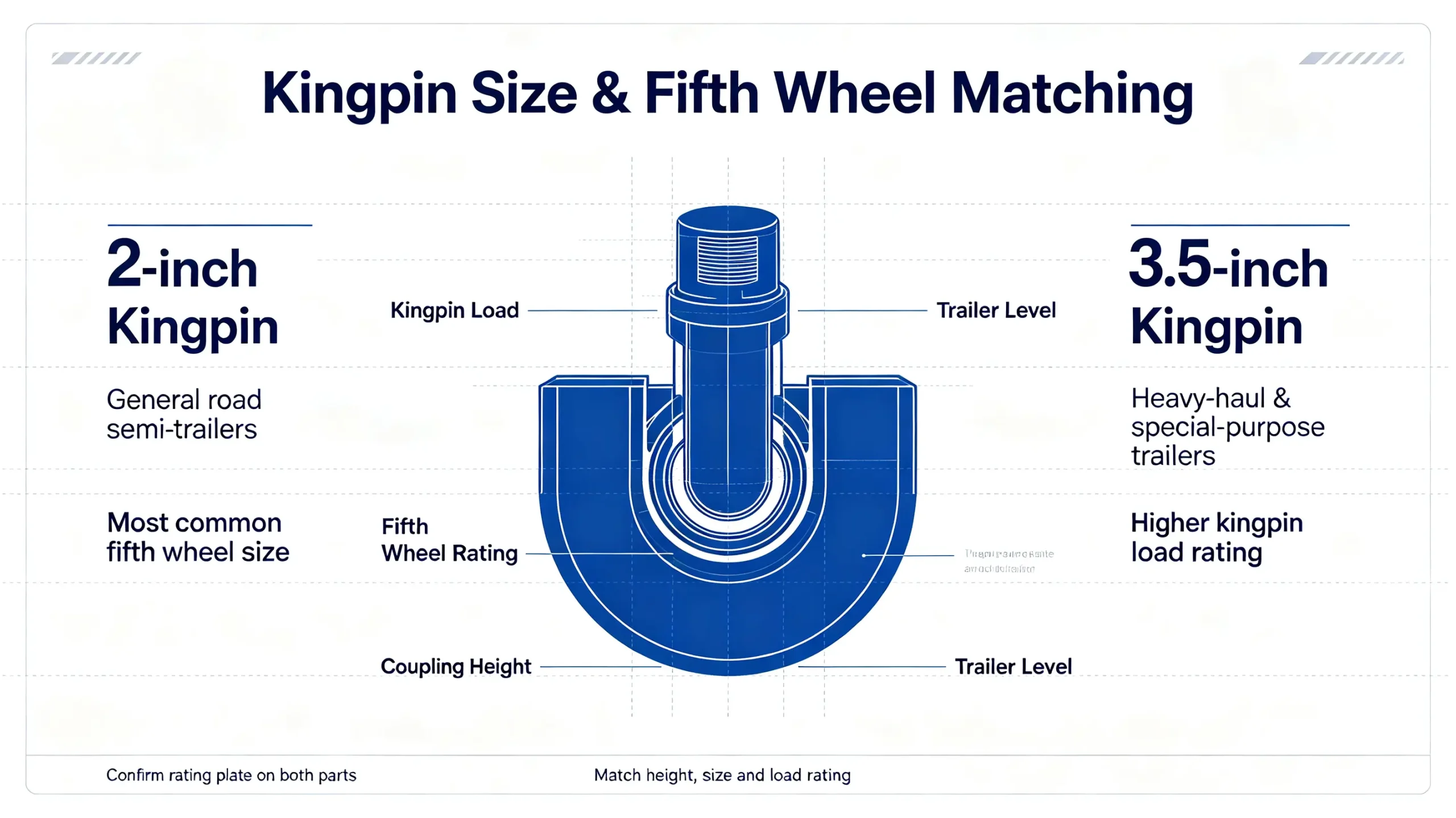 Mistakes and Myths When Buying Chinese Heavy Trucks
Most costly errors come from buying on price or horsepower alone and from ignoring service coverage and compliance. Three myths come up again and again, and each one leads to a predictable problem.
Myth: “All Chinese trucks are the same.” They are not. Model lines, component choices and build consistency differ between brands and even between variants of one brand. Compare the engine, gearbox, axles and frame on each spec sheet, not the country of origin.
Myth: “More horsepower means a better truck.” Extra output costs fuel and often adds weight, and it does little if the axle ratio, gearbox and brakes are not matched to the load. Choose power for your steepest sustained grade, then check the braking and cooling capacity that goes with it.
Myth: “The cheapest trailer is fine if the tractor is strong.” The trailer carries the load, and a weak frame, a poorly rated kingpin or undersized axles will fail regardless of the tractor. Spend on the part that takes the stress, and verify its frame steel grade and ratings.
Mistake: treating ISO 9001 as a product guarantee. ISO 9001 is a quality management standard. It shows that a manufacturer runs a documented process, but it says nothing about whether a specific truck or trailer meets your load requirement. Use it as one signal, then ask for product-level evidence.
Mistake: skipping coupling and trailer compliance. ECE R55 applies to mechanical coupling components, and SAE J-series standards cover related coupling and trailer dimensions. A combination that ignores them can fail inspection or insurance, even if it runs well. Ask for the relevant documents, and check them against local rules.
If you are unsure how a supplier presents its compliance documents, the cooperative case section shows how project requirements and specifications are typically described.
What to Verify Before You Commit
Confirm specification, compliance, parts supply and warranty in writing before any deposit. A verbal assurance is difficult to enforce once the truck is on your yard.
Work through the sequence below in order, and do not skip a step because a dealer sounds confident.
- Define your duty cycle, including payload, route, grades and daily distance.
- Shortlist two or three models that fit that duty on configuration, not on brand.
- Compare the spec sheets line by line, covering engine, gearbox, axles, frame and cab.
- Inspect or trial a unit, and run it loaded on a route like your own.
- Review the contract for warranty scope, delivery terms and parts commitments.
- Request written confirmation of every item that affects compliance or load rating.
Once the sequence is done, run through the checklist below against the actual documents, not the sales summary.
- Check the GVWR plate and confirm local registration rules for that weight.
- Verify that the kingpin size and fifth wheel rating match the trailer.
- Confirm the axle ratings against your planned axle load distribution.
- Review the emissions and homologation papers for your market.
- Ask for spare-parts lead times on wear items and major assemblies.
- Read the warranty scope, including labour, towing and exclusions.
- Locate the nearest authorised dealer service point and visit it.
If any answer is vague, treat it as a no until it is written down. For a second opinion on the paperwork or a specific configuration, you can contact the Mettlead team, or read more about the company on its about page.
Summary: Choosing Between Sinotruk and Shacman
Choose on duty cycle, configuration and service access, then verify. A brand-first decision tends to cost more later, usually through downtime or a mismatched coupling.
Start by fixing payload, route and legal axle limits. Then match the tractor and trailer on kingpin size, fifth wheel height and rating. Compare Sinotruk and Shacman by model line and local support, and confirm every critical item in writing.
Your next step is simple: write down your heaviest regular load and your steepest grade, and take that single page to each dealer on your shortlist. For more reference material, visit the Mettlead home page.
FAQ
Is Sinotruk or Shacman better for dump work?
Neither is better in general. Both offer 6×4 and 8×4 dump chassis, so compare body steel, frame grade, hoist system and local service. The brand with the stronger workshop near your site usually wins.
Which Chinese truck is most reliable for long-haul tractor use?
No single model is. Reliability depends on the engine, gearbox and axle combination, plus maintenance and parts access. Shortlist two or three tractors, then compare warranty terms and service coverage on your actual route.
Do I need a 2-inch or 3.5-inch kingpin?
A 2-inch kingpin suits most general road semi-trailers. A 3.5-inch kingpin is typical for heavy-haul and special-purpose trailers with higher kingpin loads. Match the size to your trailer and confirm the fifth wheel rating.
How do I know a trailer’s frame steel is what the seller says?
Ask for the mill certificate or material test report and the frame drawings. Request the steel grade, such as Q690 or T-1, in writing. An independent inspection or sample test gives extra confidence on a large order.
How should I plan axle load distribution for an excavator move?
Start with the machine’s weight and centre of gravity, then position it so each axle group stays within its rating. Use a tri-axle or quad-axle trailer to spread the load. Weigh the loaded combination before the first long trip.
What should a warranty cover on a heavy truck?
A good warranty covers the engine, gearbox, axles and frame, with labour and towing stated clearly. It should name the duration, mileage limits and exclusions. Make sure repairs can be done at a dealer near your operation.


