
Engine timing gear failure can destroy your engine in seconds. Learn expert diagnosis, repair costs & prevention tips from certified technicians.
A comprehensive technical reference for automotive technicians, fleet managers, and engine rebuild specialists.
Few components carry as much mechanical responsibility as the humble timing gear. When it wears, slips, or shears, the consequences ripple through the entire engine within seconds. This guide walks through the mechanics, diagnostics, and repair economics that professionals need to make confident decisions.
Introduction: Why Timing Gear Integrity Determines Engine Longevity
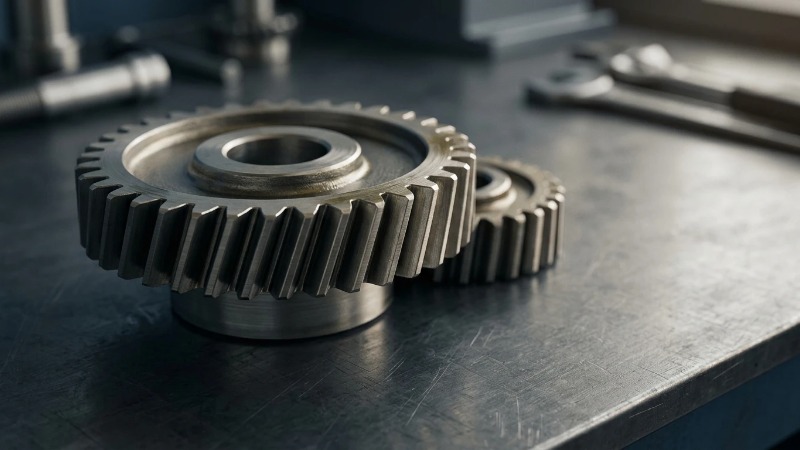
The Engine Timing Gear sits at the heart of valvetrain synchronization. It coordinates the rotation of the crankshaft and camshaft so that valves open and close at precisely the right moment relative to piston position.
When that synchronization drifts even a few degrees, combustion timing degrades. In severe cases on interference engines, valves and pistons collide, turning a modest repair into a full rebuild.
Because gear-driven systems are common in diesel and heavy-duty platforms, fleet operators feel these failures acutely. A single unplanned teardown can idle a vehicle for days and cascade into collateral component damage.
This article treats the subject at a professional depth. We move from mechanical fundamentals through diagnosis, repair, cost analysis, and preventive strategy. Along the way, we reference practical data and field observations that reflect current shop realities.
Who This Guide Is For
This reference is written for practicing technicians, service advisors, and engine rebuild specialists. It assumes familiarity with basic engine architecture and shop tooling.
Fleet managers evaluating maintenance policy will also find the cost and prevention sections directly applicable. Casual DIYers may find portions useful, but the recommended procedures assume access to professional equipment.
If you support technical teams or source replacement components, our technical support resources can supplement the guidance here with hands-on assistance.
Timing Gears vs. Timing Chains vs. Timing Belts
Terminology matters when diagnosing timing faults. All three systems accomplish the same synchronization task, but they behave and fail differently.
Timing gears mesh directly, tooth to tooth, often without any intermediate flexible element. They are durable, tolerate high loads, and are favored in diesel engines.
Timing chains use a roller chain riding on sprockets. They stretch over time and depend heavily on tensioners and guides.
Timing belts use a reinforced rubber belt. They run quietly and cheaply but require strict replacement intervals because they degrade with age and heat.
| System | Drive Method | Typical Lifespan | Failure Signature |
|---|---|---|---|
| Timing Gears | Direct gear mesh | Very long, often engine life | Whine, backlash, tooth wear |
| Timing Chain | Roller chain on sprockets | Long, but tensioner-dependent | Rattle, stretch, slack |
| Timing Belt | Toothed rubber belt | 60,000–100,000 miles typical | Cracking, snapping, tooth loss |
How Engine Timing Gears Work: A Technical Overview
To diagnose gear failures accurately, you first need a clear mental model of how the gear train functions under load. The mechanics are deceptively simple, but the tolerances are tight.
The Gear Train and Valve Timing Synchronization
The crankshaft gear is the driver. As the crankshaft rotates, it turns the camshaft timing gear at exactly half crankshaft speed on a four-stroke engine.
This 2:1 relationship ensures each cylinder fires once per two crankshaft revolutions. Any deviation caused by wear or backlash shifts valve events away from their designed positions.
In many diesel engines, the gear train also drives the injection pump, oil pump, and other accessories. That means gear wear can affect more than just valve timing.
Precision here is measured in thousandths of an inch. Even modest tooth wear introduces angular lag that a modern engine management system will detect and flag.
Common Timing Gear Materials and Their Trade-offs
Manufacturers choose gear materials to balance noise, cost, and durability. Understanding these trade-offs helps predict failure modes before you even remove a cover.
Fiber and composite gears were historically used to keep operation quiet in passenger gasoline engines. They cushion the mesh but are prone to tooth shearing when stressed.
Aluminum gears offer moderate weight and cost benefits but wear and deform under sustained load. Steel and alloy gears dominate heavy-duty applications where longevity outweighs noise concerns.
| Gear Material | Typical Applications | Noise Level | Durability | Failure Mode |
|---|---|---|---|---|
| Fiber/Composite | Older gas engines, quiet operation | Low | Moderate | Tooth shearing |
| Aluminum | Performance/older designs | Medium | Low–Moderate | Wear, deformation |
| Steel/Alloy | Diesel & heavy-duty | Higher | High | Slow wear, pitting |
When sourcing replacements, matching the original material specification is critical. Our product brand catalog lists components engineered to OEM tolerances for a range of engine families.
Engines Most Prone to Gear-Driven Timing Systems
Gear-driven valvetrains appear most often where durability and load capacity are paramount. Diesel engines lead this category by a wide margin.
Heavy-duty commercial trucks, agricultural equipment, and marine diesels almost universally rely on gear trains. The direct drive tolerates the high torque and long duty cycles these machines demand.
Certain legacy gasoline platforms also used gear drives, particularly older domestic V8s and industrial engines. These remain in service across fleets and restoration markets.
If you manage a mixed fleet, our engine system components section groups parts by system type to simplify matching across platforms.
Root Causes of Engine Timing Gear Failure
Timing gears rarely fail without a contributing cause. Identifying the root cause prevents repeat failures and informs warranty decisions.
Below we examine the most common mechanical and operational factors. Recognizing the pattern of worn timing gears often points directly to the underlying problem.
Normal Wear from High Mileage and Operating Hours
Every gear mesh experiences microscopic material loss with each rotation. Over hundreds of thousands of miles, this cumulative fatigue eventually erodes the tooth profile.
Steel gears in diesel engines often survive the full engine life. Composite and aluminum gears, however, may reach their wear limit well before overhaul.
Operating hours matter more than odometer readings for equipment that idles heavily. A truck that spends hours idling accumulates gear wear the mileage never reflects.
Inadequate Lubrication and Oil Quality Issues
The gear mesh relies on a robust oil film to prevent metal-to-metal contact. Oil starvation, even briefly, accelerates wear dramatically.
Degraded lubricant loses its film strength and additive protection. Extended drain intervals or contaminated oil leave gear teeth vulnerable to scuffing and pitting.
Cold starts are particularly punishing because oil pressure lags behind mechanical load. This is why lubricant selection is central to any prevention strategy, as we discuss later.
Manufacturing Defects and Material Fatigue
Not all failures trace to service conditions. Casting flaws, porosity, and improper heat treatment can seed premature cracking.
Occasionally an OEM issues a recall or technical service bulletin covering a defective gear batch. Checking for these before a rebuild can save significant diagnostic time.
Material fatigue also concentrates at stress risers such as keyways and bolt holes. Inspect these areas closely during any teardown.
Improper Installation and Backlash Misadjustment
A surprising share of premature failures originate in the rebuild bay. Incorrect gear lash tolerances are a leading culprit.
Too little backlash causes binding, heat, and accelerated wear. Too much backlash introduces slap, noise, and timing drift.
Following manufacturer torque sequences and lash specifications is non-negotiable. When in doubt, verify against factory service data rather than assumption.
Contamination, Debris, and Coolant Intrusion
Hard particulates circulating in the oil act like grinding compound on tooth surfaces. Even fine debris pits and scores the gear face over time.
Coolant intrusion from a failed gasket introduces glycol, which strips lubrication and promotes corrosion. This is a common secondary cause of camshaft timing gear failure in older engines.
Any teardown should include a thorough inspection of oil passages and the gear cavity for foreign material. Cleanliness during reassembly is equally critical.
Overheating and Thermal Stress
Excessive heat causes differential thermal expansion between mating gears and their housings. That expansion tightens the mesh and can eliminate protective clearance.
Repeated thermal cycling also work-hardens and eventually cracks certain materials. Chronic overheating events should raise suspicion during failure analysis.
Addressing cooling system health is therefore part of protecting the timing gear train. The two systems are more connected than they first appear.
Warning Signs: Symptoms of Failing Engine Timing Gears
Catching a failing gear early is the difference between a routine repair and a catastrophic one. The following catalog covers the full range of engine timing gear failure symptoms technicians should recognize.
Learning to read these timing gear wear symptoms quickly builds diagnostic confidence and protects your customer’s engine.
Abnormal Timing Gear Noise (Whining, Rattling, Grinding)
Sound is often the first clue. A high-pitched whine that changes with engine speed frequently indicates worn or improperly lashed gears.
Among worn timing gear noise causes, excessive backlash tops the list. A rattling that intensifies at idle usually points to slack in the mesh.
Grinding is more ominous, suggesting metal-to-metal contact from failed lubrication or severe wear. This timing gear noise demands immediate investigation before further damage occurs.
Isolating the noise source with a mechanic’s stethoscope helps distinguish gear noise from injector or accessory sounds. Location and pitch together tell the story.
Engine Misfires and Rough Idle
As gear wear shifts valve timing, cylinder charging and exhaust scavenging suffer. The result is intermittent misfires and an uneven idle.
These symptoms often appear before any dramatic noise. A rough idle that resists conventional tune-up fixes should prompt a timing correlation check.
Because misfires have many causes, timing gear wear is frequently overlooked. Keeping it on your differential list saves wasted labor.
Loss of Power and Reduced Fuel Efficiency
When valve events drift from their optimal windows, combustion efficiency falls. Drivers notice sluggish acceleration and reduced throttle response.
Fuel economy declines as the engine works harder to produce the same output. Fleet fuel logs sometimes flag this trend before a driver complains.
Monitoring fuel efficiency across a fleet can therefore serve as an early warning indicator. Small percentage drops across a unit warrant inspection.
Check Engine Light and Relevant DTCs
Modern engines monitor the relationship between crankshaft and camshaft position continuously. When that relationship deviates, the ECM sets a correlation code.
These diagnostic trouble codes are among the most reliable indicators of mechanical timing error. The table below lists the codes most relevant to gear wear.
| DTC | Description | Timing Gear Relevance |
|---|---|---|
| P0016 | Crank/Cam Position Correlation (Bank 1) | Gear wear or slippage |
| P0017 | Crank/Cam Correlation (Bank 1 Sensor B) | Timing misalignment |
| P0008 | Engine Position System Performance | Mechanical timing error |
A correlation code does not automatically condemn the gear. However, once sensors and wiring are cleared, mechanical wear becomes the prime suspect.
Metal Shavings in Oil
Routine oil analysis frequently catches gear wear before other symptoms appear. Fine metal particles suspended in the oil signal internal wear.
Ferrous shavings on a magnetic drain plug are a strong indicator. Their size and quantity help gauge how advanced the wear has become.
Any unexplained metal in the oil justifies a deeper inspection. Catching it here can prevent a complete gear failure.
Difficulty Starting or Failure to Start
In advanced cases, timing has drifted so far that the engine struggles to start. Cranking may be prolonged, or the engine may not fire at all.
A sheared composite gear can cause a sudden no-start with normal cranking. On interference engines, this scenario often coincides with valve damage.
A no-start combined with recent noise complaints strongly suggests timing gear failure. Confirm mechanically before assuming an electrical fault.
Professional Diagnosis: How to Confirm Timing Gear Problems
Symptoms point the way, but confirmation requires methodical diagnosis. This workflow moves from least to most invasive.
Visual Inspection Procedures
Begin by accessing the timing cover according to the service manual. Document the condition of surrounding components as you go.
Inspect each visible tooth for chipping, pitting, and abnormal wear patterns. Uneven wear across the gear face often indicates alignment issues.
Check for debris in the gear cavity and evidence of coolant or oil contamination. Photograph findings for the repair record and customer communication.
Measuring Gear Backlash and Wear with Dial Indicators
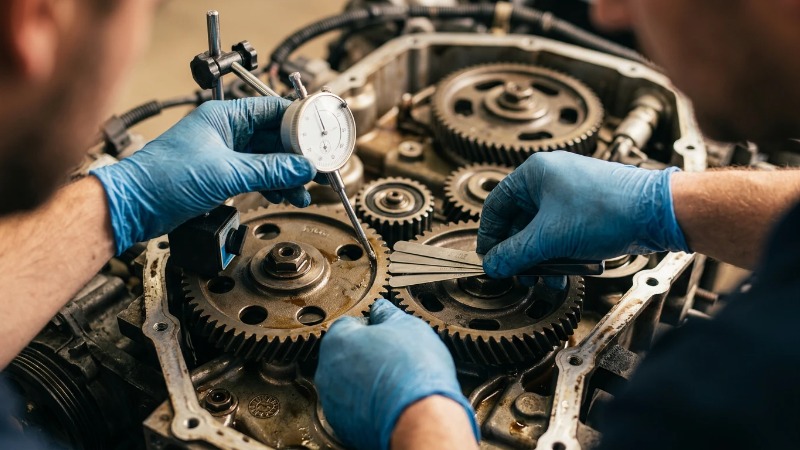
Backlash measurement quantifies wear objectively. Mount a dial indicator against a gear tooth and gently rock the gear while holding its mate stationary.
Compare the reading to the manufacturer’s specified range. Excessive backlash confirms wear beyond serviceable limits.
Record measurements at several points around the gear. A gear can wear unevenly, and a single reading may mislead.
Scan Tool Analysis and Cam/Crank Correlation Testing
A capable scan tool displays live camshaft and crankshaft correlation data. Compare the measured offset against the specified value.
A persistent offset that survives sensor replacement points to mechanical timing error. This confirms the gear as the likely fault.
Freeze-frame data captured when the correlation code set can reveal the operating conditions at failure. Use it to corroborate your findings.
Oil Analysis and Ferrography
Laboratory oil analysis identifies the metallurgy of wear particles. Ferrography can distinguish gear-source metal from bearing or ring wear.
Matching particle composition to gear alloy confirms the source. This is especially valuable for fleets tracking wear trends over time.
Combining lab data with backlash measurements builds an airtight diagnosis. It also strengthens any warranty claim you may need to file.
Diagnostic Decision Table
| Symptom | Likely Cause | Confirmation Method |
|---|---|---|
| High-pitched whine | Excessive backlash / wear | Dial indicator measurement |
| P0016 / P0017 code | Timing misalignment | Scan tool correlation test |
| Metal on drain plug | Advanced gear wear | Oil analysis / ferrography |
| Rough idle & misfire | Valve timing drift | Live data + visual inspection |
| No-start, normal crank | Sheared gear | Visual inspection |
Timing Gear Replacement: Solutions and Repair Process
Once diagnosis confirms the fault, the repair path splits between servicing and full replacement. Knowing how to fix timing gear problems correctly prevents costly repeat failures.
When to Repair vs. Replace
Minor issues such as a loose bolt or a fouled sensor may be correctable without gear replacement. However, once teeth are worn or damaged, replacement is the only durable fix.
Weigh the cost of a partial repair against the risk of recurrence. On high-hour engines, replacing the full gear set is usually the wiser investment.
Consider replacing mating gears together even if only one appears worn. Mixing new and worn gears often produces noise and accelerated wear.
Step-by-Step Timing Gear Replacement Overview
The following overview is intentionally high-level. Always follow the engine-specific service procedure for exact steps.
- Disconnect the battery and relieve any relevant system pressures.
- Drain fluids and remove accessories obstructing the timing cover.
- Rotate the engine to the specified timing reference position.
- Remove the timing cover and document current gear alignment.
- Extract the worn gears using the correct pullers.
- Clean all surfaces and inspect mating components.
- Install new gears, aligning timing marks precisely.
- Verify backlash, reassemble, and refill fluids.
Required Tools and Torque Specifications
Professional replacement demands the right tooling. A gear puller, dial indicator, and calibrated torque wrench are essential.
- Gear/bearing puller set
- Dial indicator with magnetic base
- Calibrated torque wrench and angle gauge
- Feeler gauges for lash verification
- Engine-specific timing pins or locating tools
Always torque fasteners to the manufacturer’s published values in the correct sequence. Guessing torque is a frequent cause of premature failure.
Proper Gear Alignment and Timing Marks
Timing marks exist to guarantee correct valve events. Aligning them exactly is the single most important step in the procedure.
Double-check alignment after installation and before closing the cover. It is far easier to correct a mark now than to diagnose a mistimed engine later.
On engines with multiple driven gears, verify every reference mark. A single misaligned idler can throw off the entire train.
Setting Correct Backlash After Installation
With new gears installed, re-measure backlash to confirm it falls within specification. This verifies both part quality and installation accuracy.
If backlash is out of range, investigate before proceeding. Shimming or component replacement may be required to reach the target clearance.
Documenting the final backlash reading protects both the shop and the customer. It provides a baseline for future service.
OEM vs. Aftermarket Timing Gears
Choosing between OEM and aftermarket gears involves quality, availability, and warranty considerations. OEM parts guarantee fitment and material match.
Quality aftermarket suppliers can offer equivalent or superior gears, but verification is essential. Look for documented material specifications and warranty coverage.
| Factor | OEM Gears | Quality Aftermarket |
|---|---|---|
| Fitment | Guaranteed | Usually excellent, verify |
| Material match | Exact | Varies by supplier |
| Availability | Sometimes limited | Often broad |
| Warranty | Manufacturer-backed | Supplier-dependent |
For sourcing reliable components across engine families, explore our system component catalog. Matching the right part the first time avoids repeat labor.
Timing Gear Replacement Cost Analysis
Cost is often the deciding factor in repair decisions. Understanding the drivers behind bad timing gear replacement cost helps you set accurate expectations.
The timing gear replacement cost varies widely by engine type, labor complexity, and regional rates. The ranges below reflect general market conditions rather than any single quote.
Parts Cost by Engine Type
Parts and labor scale with engine size and complexity. Heavy-duty engines require more labor hours because of their extensive gear trains and accessories.
| Engine Category | Relative Parts Cost | Labor Hours | Relative Total Effort |
|---|---|---|---|
| Passenger Gas Engine | Lower | 4–8 | Moderate |
| Light-Duty Diesel | Moderate | 6–12 | Higher |
| Heavy-Duty/Commercial | Higher | 10–20 | Highest |
These labor hour ranges reflect typical 2026 shop estimates. Actual figures depend on engine access and whether collateral repairs are required.
Labor Rate Considerations by Region and Shop Type
Labor rates differ significantly between dealerships and independent shops. Dealers typically command higher rates but offer brand-specific expertise.
Independent specialists often deliver comparable quality at more competitive rates. Regional cost of living also shapes the final labor charge in 2026 markets.
For fleets, negotiating a standing labor agreement can smooth out these variations. Volume relationships frequently unlock better terms.
Hidden Costs: Collateral Damage from Delayed Repairs
Ignoring early symptoms is the most expensive choice of all. On interference engines, a failed gear can bend valves and damage pistons.
What might have been a straightforward gear replacement becomes a full head or engine rebuild. The cost multiplies several times over.
Downtime is another hidden cost, especially for commercial vehicles. Each idle day represents lost revenue that dwarfs the repair itself.
This economic reality is why proactive inspection almost always pays for itself. Prevention is dramatically cheaper than emergency repair.
Real-World Case Studies
Abstract principles land better with concrete examples. The following cases reflect representative field scenarios encountered in professional service.
Case Study 1: Fleet Diesel Timing Gear Wear Pattern
A regional delivery fleet noticed a gradual fuel efficiency decline across several high-hour diesel units. Routine oil analysis flagged rising ferrous particle counts.
Technicians pulled the timing cover on the worst-performing unit and measured backlash well beyond specification. The steel gears showed uniform pitting consistent with extended drain intervals.
The fleet corrected its oil change policy and replaced the affected gear sets. Follow-up analysis confirmed the wear trend had stopped, validating the intervention.
This case illustrates how documented maintenance outcomes guide smarter fleet-wide decisions. Data-driven policy prevented a wave of future failures.
Case Study 2: Composite Gear Failure in a Gasoline Engine
An older gasoline engine arrived with a sudden no-start after a reported rattling noise. Cranking was normal, but the engine would not fire.
Inspection revealed a sheared composite camshaft timing gear. Root-cause analysis traced the failure to a prior overheating event that had embrittled the gear material.
Because the engine was an interference design, several valves were bent. The repair expanded from a simple gear swap into a cylinder head reconditioning.
The lesson is clear: composite gears combined with thermal stress create a high-risk failure profile. Early noise investigation could have avoided the valve damage entirely.
Preventive Maintenance to Extend Timing Gear Life
The most cost-effective repair is the one you never have to make. A disciplined maintenance program dramatically extends gear service life.
Oil Change Intervals and Lubricant Selection
Clean, correctly specified oil is the timing gear’s best protection. Adhere to or tighten manufacturer drain intervals under severe-duty conditions.
Select a lubricant with the correct viscosity and additive package for your engine. High-quality oil maintains film strength and resists thermal breakdown.
For engines that idle heavily, base intervals on operating hours rather than mileage alone. Idle time consumes oil life invisibly.
Scheduled Inspection Intervals by Service Hours
Building inspection into scheduled service catches wear before it escalates. The cadence below offers a practical starting framework.
| Service Interval | Recommended Inspection Action |
|---|---|
| Every oil change | Check drain plug for metal, note any new noise |
| Every major service | Send oil sample for analysis |
| High-hour milestones | Measure backlash if access permits |
| After overheating event | Inspect gear condition proactively |
Adjust these intervals to your specific engine and duty cycle. Manufacturer recommendations always take precedence.
Early Detection Through Vibration and Noise Monitoring
Condition-based maintenance leverages vibration and acoustic signatures to detect wear early. A rising vibration trend often precedes audible failure.
Simple periodic listening with a stethoscope catches many issues. For critical fleets, dedicated monitoring equipment provides objective baselines.
Tracking these signals over time turns unexpected breakdowns into planned repairs. That predictability is invaluable for maximizing uptime.
If you want help designing a monitoring program, our team is ready to assist through our contact page. Tailored guidance can be built around your equipment mix.
Frequently Asked Questions (FAQ)
Can I still drive with a worn timing gear?
Driving with a worn timing gear is risky and generally not advisable. On interference engines, continued operation can lead to sudden failure and severe valve damage. If you notice timing gear noise or a correlation code, have the engine inspected before driving further.
How long do engine timing gears typically last?
Service life depends heavily on material and application. Steel gears in well-maintained diesel engines often last the entire engine life, while composite and aluminum gears may wear out sooner. Proper lubrication and inspection are the biggest factors in longevity.
What does a bad timing gear sound like?
A failing gear commonly produces a high-pitched whine that varies with engine speed. Excessive backlash can cause a rattling at idle, while grinding suggests metal-to-metal contact. Any of these among the signs of failing engine timing gears warrants immediate diagnosis.
Is timing gear replacement worth it on high-mileage engines?
It usually is, provided the rest of the engine is sound. The cost of replacement is far lower than the collateral damage from a failed gear. Evaluate overall engine health, then weigh the repair against the value of continued reliable service.
How do I tell timing gear noise from timing chain noise?
Gear noise tends to be a consistent whine tied closely to engine speed, while chain noise is more of a rattle that changes with tensioner slack. Isolating the sound with a stethoscope and reviewing the engine’s design help distinguish them. A proper mechanical inspection confirms the source.
Conclusion and Next Steps
Engine timing gears carry an outsized responsibility for such compact components. When they wear, the effects cascade through valve timing, performance, and ultimately engine integrity.
The pattern is consistent across every scenario in this guide. Early detection through noise, oil analysis, and correlation data prevents small problems from becoming catastrophic ones.
Understanding failure causes, mastering diagnosis, and following precise replacement procedures protect both your customers and your reputation. The economics reward proactive care over reactive repair every time.
To learn more about our capabilities and background, visit our homepage or read about our engineering approach on our company profile.
Call to Action
Do not wait for a whine to become a no-start. Schedule a professional timing gear inspection, request a diagnostic checklist, or consult a certified specialist for an accurate assessment.
Our specialists are ready to support your shop or fleet with parts, diagnostics, and expert guidance. Reach out through our contact page or browse our quality-engineered components to get started today.


