
Master heavy duty truck engine front covers—expert tips on diagnostics, repair, sealing & sourcing for fleets, technicians & bulk parts buyers.
A comprehensive resource for fleet managers, diesel technicians, and commercial truck parts buyers covering design, diagnostics, repair, and sourcing.
Few components on a diesel powerplant get less attention than the front cover, yet fewer still cause as much frustration when they fail. For fleet operators running long-haul tractors or vocational dump trucks, an overlooked oil weep at the front of the engine can escalate into a costly teardown.
This guide pulls together everything working professionals need to know. From material science and sealing strategy to diagnostics, replacement workflows, and global sourcing, we cover the full lifecycle of the heavy duty truck engine front cover in practical detail.
Whether you manage a fleet, turn wrenches daily, or buy parts in bulk, the sections below are structured to help you make faster, better-informed decisions.
Understanding the Heavy Duty Truck Engine Front Cover
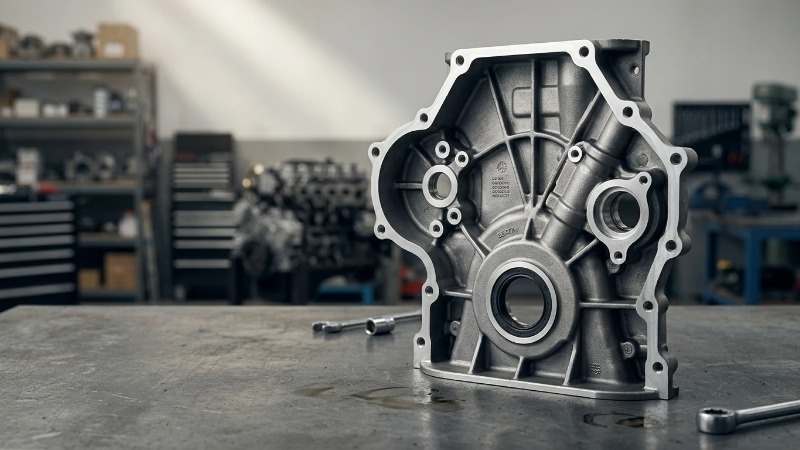
The front cover sits at the very nose of a diesel engine, capping the timing gear train and sealing the front of the crankcase. It is one of those parts that quietly does its job for years, then suddenly becomes the focus of an entire shop.
Because it interfaces with the crankshaft, camshaft drive, oil galleries, and often the cooling system, its condition affects far more than a single subsystem. That’s precisely why industry professionals should understand it thoroughly.
What Is an Engine Front Cover (Timing Cover)?
An Engine Front Cover is the housing bolted to the front face of the engine block. It encloses the timing gears or chain, protects them from debris, and retains the oil that lubricates them.
Terminology often creates confusion. In many shops, “front cover” and “diesel engine timing cover” describe the same part. The word “timing” simply emphasizes its role in protecting the timing drive.
On heavy duty diesel platforms, gear-driven timing is common, so the cover must be robust and precisely machined. Unlike lighter automotive covers, these units frequently integrate mounting bosses, seal housings, and oil passages into a single casting.
Core Functions in Heavy Duty Diesel Engines
The front cover performs several duties simultaneously. Understanding each one helps technicians diagnose problems more effectively.
- Sealing: It keeps engine oil inside the crankcase and prevents contaminants from entering.
- Timing gear protection: It shields the gear train that synchronizes the crankshaft and camshaft.
- Oil containment: It channels oil through internal passages to lubricate front-mounted components.
- Mounting support: It carries accessories such as the water pump, tensioners, and sensors.
When any of these functions degrade, the symptoms rarely stay isolated. A minor seal failure, for instance, can cascade into belt contamination or overheating.
Where the Front Cover Fits Among Heavy Truck Engine Components
Within the broader assembly, the front cover acts as a hub. It bridges the rotating crankshaft, the driven camshaft, and the front-end accessory drive.
The crankshaft snout passes through the cover, sealed by a dedicated front seal. Directly behind the cover sits the timing gear set, while the cooling fan and water pump typically mount to or near its front face.
This central location means the cover interacts with nearly every major heavy truck engine components group. That interconnectedness makes it a logical starting point for many diagnostics. To explore related parts categories, visit the full truck parts catalog.
Anatomy & Key Features of the Diesel Engine Front Cover
To repair or source a front cover intelligently, you need to understand how it is built. Modern heavy duty covers are engineering-dense components, not simple stamped plates.
Below, we break down the materials, integrated features, and sealing architecture that define these parts.
Material Composition — Cast Aluminum vs. Cast Iron
Two materials dominate front cover manufacturing: cast aluminum and cast iron. Each carries distinct trade-offs that affect performance and repair strategy.
Cast iron offers exceptional durability and dimensional stability under heat. However, it adds significant weight, which matters in fuel-conscious long-haul applications.
Cast aluminum, by contrast, reduces weight and dissipates heat well. Yet it is more prone to warping, thread damage, and cracking under stress. The following table summarizes the differences.
| Property | Cast Aluminum | Cast Iron |
|---|---|---|
| Weight | Lower (favors fuel economy) | Higher |
| Thermal dissipation | Excellent | Moderate |
| Warping resistance | Lower | Higher |
| Crack resistance | Moderate | High |
| Thread durability | Requires care | Robust |
| Typical application | Modern on-highway engines | Legacy & heavy vocational |
Aluminum Front Cover Gasket Considerations
Aluminum housings present unique sealing challenges. Because aluminum expands and contracts more than iron, gaskets must accommodate greater thermal movement.
An aluminum front cover gasket should therefore tolerate cycling without losing clamp load. Many manufacturers now specify multi-layer or elastomer-coated gaskets for these applications.
Technicians must also avoid over-torquing fasteners on aluminum. Excess clamp force can distort the sealing surface, creating the very leak you were trying to prevent.
The Crankshaft Seal Housing Explained
The crankshaft seal housing is the portion of the cover that supports the front crankshaft seal. This seal rides on the rotating crank snout and keeps oil from escaping at the front of the engine.
Two seal styles are common: lip seals and cassette-style seals. Lip seals are traditional and serviceable, while cassette designs integrate the seal and wear sleeve for easier, more reliable installation.
When the seal housing wears or corrodes, even a new seal may leak. Inspecting the housing bore for scoring or ovality is a critical—yet frequently skipped—step during repair.
Integrated Components — Water Pump Mounts, Sensors & Oil Passages
Modern front covers consolidate multiple functions to reduce part count and assembly complexity. This trend has real implications for diagnosis and sourcing.
- Water pump mounts: Many covers integrate the coolant pump housing directly.
- Sensor bosses: Crank position and speed sensors often mount to the cover.
- Oil passages: Internal galleries route oil to tensioners and timing components.
- Timing marks: Reference indicators for engine timing verification.
This integration means a single cracked casting can affect cooling, sealing, and sensor signals at once. Buyers should confirm that a replacement matches all integrated features, not just the bolt pattern.
Feature Comparison Table by Engine Platform
The table below compares typical front cover characteristics across common heavy duty engine families. Exact specifications vary by model year and configuration.
| Engine Platform | Cover Material | Relative Weight | Seal Type | Gasket Kit Complexity |
|---|---|---|---|---|
| FAW CA6DM (J6) | Cast aluminum | Light | Cassette seal | Moderate |
| Legacy inline-6 diesel | Cast iron | Heavy | Lip seal | Simple |
| Modern on-highway 13L | Cast aluminum | Light | Cassette seal | Complex (integrated) |
| Vocational 11L | Cast iron | Heavy | Lip seal | Moderate |
For platform-specific technical breakdowns, the knowledge base library offers additional reference material.
Common Front Cover Failures & Diagnostics
This is the section most technicians turn to first. A methodical approach to diagnosis saves both time and unnecessary parts replacement.
Front cover problems generally fall into three buckets: leaks, cracks, and fan-related stress. We’ll examine each in turn.
Front Cover Oil Leak Repair — Causes & Symptoms
Oil leaks are the most frequent front cover complaint. They usually originate from one of three sources, and identifying the correct one is half the battle.
- Warped or aged gaskets: Loss of clamp load allows oil to seep past the joint.
- Degraded crankshaft seals: Hardened or grooved seals lose their grip on the crank snout.
- Cracked castings: Fatigue or impact damage creates a direct path for oil.
Symptoms include oil accumulation at the front of the engine, drips on the crossmember, and belt or fan contamination. In severe cases, low oil level warnings may appear.
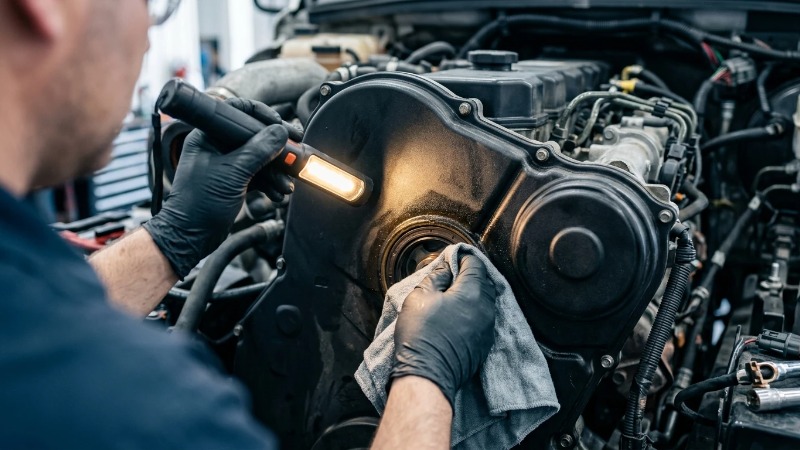
Effective front cover oil leak repair starts with a clean-and-dye test. Applying UV dye and inspecting under blacklight isolates the exact source before disassembly begins.
Diagnosing a Cracked or Damaged Front Cover
Cracks can be deceptive. A hairline fracture may leak only under load or heat, making it easy to misdiagnose as a gasket problem.
Begin with a thorough visual inspection under good light. Clean the surface, then look for fine lines radiating from bolt bosses, mounting points, or the seal housing.
For confirmation, a low-pressure air test with soapy solution reveals bubbling at crack sites. On aluminum covers especially, always inspect around threaded holes where stress concentrates.
Fan-Related Failures Adjacent to the Front Cover
The cooling fan mounts at the front of the engine, right in the front cover’s neighborhood. When fan components fail, they can transmit damaging vibration and heat to the cover area.
Understanding this relationship helps technicians connect seemingly unrelated symptoms. A vibrating fan and a leaking cover may share a single root cause.
Cracked Fan Blade Symptoms & Detection
A cracked fan blade introduces imbalance that vibrates the entire front-end assembly. Left unchecked, that vibration accelerates seal and gasket wear.
Watch for these cracked fan blade symptoms: unusual whirring or whooshing noise, visible cracks near the hub, and vibration that intensifies with engine speed. Any missing chunk of blade is a critical hazard requiring immediate shutdown.
Inspect blades with the engine off, flexing each gently to detect movement or fatigue lines. Early detection prevents catastrophic separation.
Worn Fan Clutch Diagnosis
The fan clutch engages and disengages the fan based on cooling demand. When it wears, it can either seize or slip, and both conditions stress the front assembly.
A proper worn fan clutch diagnosis checks for excessive fan free-spin when hot, roughness when spun by hand, and silicone fluid leakage. A clutch stuck engaged causes constant load and noise; one stuck disengaged causes overheating.
Because the fan mounts near the front cover, a failing clutch can transmit uneven loads that loosen fasteners and disturb seals over time.
Engine Overheating from Fan Damage
When engine cooling fan blade failure reduces airflow, coolant temperatures climb quickly under load. That heat radiates into the front cover region.
Sustained engine overheating from fan damage can warp aluminum covers and degrade gaskets prematurely. In extreme cases, thermal cycling cracks the casting itself.
This is why technicians should never treat overheating and front cover leaks as unrelated. Restoring proper airflow protects the sealing components downstream.
Diagnostic Symptom-to-Cause Reference Table
Use the table below as a quick-reference tool when troubleshooting front cover and cooling issues in the field.
| Observed Symptom | Likely Root Cause | Recommended Action |
|---|---|---|
| Oil pooling at front of engine | Failed gasket or crank seal | UV dye test, then reseal |
| Oil only under load/heat | Hairline casting crack | Pressure test cover |
| Vibration rising with RPM | Cracked or imbalanced fan blade | Inspect and replace fan |
| Overheating at idle | Fan clutch stuck disengaged | Test and replace clutch |
| Constant fan roar | Fan clutch stuck engaged | Replace clutch |
| Coolant loss near cover | Integrated water pump seal | Inspect pump/cover joint |
| Erratic crank sensor signal | Cracked sensor boss on cover | Inspect and replace cover |
For complex diagnostic support, the customer service team can help match symptoms to the correct replacement parts.
Replacement & Repair Procedures
Once diagnosis confirms the front cover as the culprit, careful procedure ensures a lasting repair. Rushing this job frequently leads to comebacks.
The following workflows and best practices reflect field-proven methods used in professional shops.
Diesel Engine Timing Cover Replacement Step-by-Step
A successful diesel engine timing cover replacement follows a logical sequence. While specifics vary by engine, the general workflow remains consistent.
- Prepare the engine: Disconnect the battery, drain coolant, and relieve any belt tension.
- Remove accessories: Take off the fan, belt, water pump, and any sensors on the cover.
- Access the crankshaft damper: Remove the harmonic balancer to expose the seal area.
- Unbolt the cover: Loosen fasteners evenly to avoid distortion, then remove the cover.
- Clean sealing surfaces: Remove all old gasket material without gouging the metal.
- Install new seal and gasket: Fit the crankshaft seal and position the new gasket kit.
- Reinstall the cover: Hand-thread bolts, then torque to spec in the correct sequence.
- Reassemble accessories: Reinstall components, refill fluids, and test for leaks.
Take special care aligning the cover to the crankshaft. Misalignment forces the seal off-center, guaranteeing a premature leak.
Choosing the Right Truck Front Cover Gasket Kit
A complete truck front cover gasket kit should include every sealing element for the job. Buying a partial kit almost always means a return trip to the parts counter.
Look for these items in a comprehensive semi truck engine cover parts kit:
- Main front cover gasket
- Crankshaft front seal
- Water pump gasket or O-ring (if integrated)
- Sensor O-rings and seals
- Any required RTV or sealant specifications
When comparing OEM versus aftermarket kits, weigh fitment precision against availability. Quality aftermarket kits can match OEM performance, but only when sourced from reputable suppliers. Browse verified options through the Mettlead Truck homepage.
Heavy Duty Timing Cover Seal Installation Best Practices
Proper installation of a heavy duty timing cover seal separates a lasting repair from a repeat leak. These best practices reflect what experienced technicians insist upon.
- Use an installation tool: Drive seals squarely with a proper driver, never a screwdriver and hammer.
- Lubricate the lip: Apply a light film of oil to the seal lip before installation.
- Check the sealing surface: Inspect the crank snout for grooves; use a wear sleeve if needed.
- Follow torque sequence: Tighten fasteners in a cross pattern to the specified value.
- Avoid over-torquing: Especially on aluminum, excess force warps the sealing face.
Common installation errors include cocked seals, contaminated surfaces, and skipping the torque sequence. Each of these dramatically shortens service life.
Fan Blade Replacement Cost & Labor Estimates
Because fan issues frequently accompany front cover repairs, buyers often need cost context. The table below presents relative fan blade replacement cost ranges and labor considerations based on 2026 market conditions. Figures are shown as relative effort rather than fixed prices, since costs vary by region and supplier.
| Repair Task | Parts Effort | Labor Hours (typical) | Notes |
|---|---|---|---|
| Fan blade replacement | Low–Moderate | 1–2 | Higher if clutch also replaced |
| Fan clutch replacement | Moderate | 1.5–3 | Often bundled with fan |
| Front cover gasket reseal | Low | 4–8 | Depends on accessory removal |
| Full front cover replacement | High | 6–10 | Includes seal and gasket kit |
| Crank seal only | Low | 2–4 | Requires damper removal |
Bundling related repairs saves labor. Since the fan must come off to reach the cover, replacing a marginal fan or clutch at the same time is often the economical choice.
Applications Across Heavy Duty Truck Platforms
The front cover’s design requirements shift with the vehicle’s mission. A long-haul tractor imposes different demands than a vibration-heavy dump truck.
Understanding these application differences helps buyers select the right parts and anticipate wear patterns.
Semi Truck Engine Cover Parts in On-Highway Fleets
Long-haul tractors accumulate enormous mileage at steady cruising loads. Here, thermal cycling and vibration fatigue drive front cover wear over time.
Fleets running these routes prioritize sealing longevity and easy serviceability. Quality semi truck engine cover parts reduce unplanned downtime, which is the single largest hidden cost in on-highway operations.
For high-mileage fleets, standardizing on proven gasket kits and seals across the fleet simplifies inventory and training.
Vocational & Dump Truck Applications
Vocational trucks face a harsher environment. Constant load changes, off-road vibration, and dust intrusion stress every front-end component.
In these settings, cast iron covers often prove more durable, and robust sealing becomes essential. The elevated vibration also raises the likelihood of fan-related fatigue, reinforcing the need for regular inspection.
Dump truck operators should treat front cover and cooling inspections as routine, not exceptional. The payoff is fewer roadside failures on demanding job sites.
Case Study — FAW Jiefang J6 Heavy Duty Truck
The FAW Jiefang J6 heavy duty truck offers an instructive real-world example. Widely exported and deployed globally, it represents a modern Chinese heavy truck platform with a well-integrated front cover design.
As a popular FAW J6 tractor truck for export, the J6 combines an aluminum front cover with a cassette-style crankshaft seal. This design reduces weight while simplifying seal service—an appealing trait for international fleets.
Operators of the J6 report that adhering to inspection intervals keeps front cover issues rare. Explore documented deployments in the cooperative case studies.
FAW 6×4 Tractor Head Specifications & Price Range
The FAW 6×4 tractor head is a workhorse configuration for regional and long-haul freight. Its 6×4 drive layout balances traction and payload capacity for demanding routes.
Rather than quoting fixed figures, buyers should evaluate configurations by horsepower rating, axle setup, and cab specification. The FAW 6×4 tractor head price depends heavily on engine displacement, emissions tier, and optional equipment.
Working directly with a FAW prime mover supplier lets buyers configure the tractor to their exact operating profile. To discuss configurations, reach out via the contact page.
Sourcing FAW Jiefang Spare Parts
Reliable parts availability is central to fleet uptime. A dependable FAW Jiefang spare parts supplier should carry front cover components, gaskets, seals, and cooling parts in stock.
Buyers benefit from suppliers offering documented part numbers, fitment guidance, and export-ready logistics. Consistent supply of FAW Jiefang spare parts prevents the extended downtime caused by parts hunting.
When evaluating suppliers, confirm they support the specific J6 variant in your fleet, since integrated covers vary by configuration.
Sourcing & Procurement Guide for Fleet Buyers
Procurement decisions ripple across an entire fleet’s lifecycle costs. Choosing the right parts and partners protects both budget and uptime.
This section addresses the practical considerations that fleet buyers and purchasing managers weigh daily.
OEM vs. Aftermarket Front Cover Parts
The OEM-versus-aftermarket debate hinges on three factors: quality, warranty, and fitment. Neither option is universally superior.
OEM parts guarantee precise fitment and factory warranty coverage. Aftermarket parts often offer better availability and value, provided the supplier maintains rigorous quality control.
For critical sealing components like the front cover, insist on documented material specifications and dimensional tolerances. A low-quality gasket saves little if it fails within months.
Working with Chinese FAW Truck Manufacturers
The global market for Chinese FAW commercial trucks wholesale has matured significantly. Established suppliers now offer export-ready vehicles and parts backed by real documentation.
When engaging a Chinese FAW truck manufacturer, prioritize transparency. Verifiable certifications, clear part traceability, and responsive communication distinguish reliable partners from opportunistic ones.
Learn more about supplier credentials and history on the about us page.
Vendor Evaluation Checklist
Use the checklist below to assess any prospective supplier, whether a FAW prime mover supplier or a FAW Jiefang dump truck exporter.
| Evaluation Criterion | What to Verify | Priority |
|---|---|---|
| Part traceability | OEM cross-reference numbers | High |
| Quality certification | Documented QC standards | High |
| Inventory depth | Stock availability for key parts | High |
| Export experience | Documented shipping history | Medium |
| Technical support | Fitment and diagnostic guidance | High |
| Warranty terms | Clear coverage and claim process | Medium |
| Communication speed | Responsiveness to inquiries | Medium |
A supplier scoring well across these criteria typically delivers fewer surprises over the long term.
Total Cost of Ownership Impact
Front cover reliability influences total cost of ownership more than its modest part value suggests. A single unplanned failure can idle a truck for days.
Downtime, towing, and cascading damage often dwarf the cost of a quality part. Factoring reliability into procurement decisions therefore pays dividends across the vehicle’s life.
Fleets that standardize on proven components and trusted suppliers consistently report lower lifecycle costs. The upfront diligence more than justifies itself.
Maintenance Best Practices to Extend Front Cover Life
Prevention beats repair every time. A modest investment in routine inspection avoids the far greater expense of emergency service.
The practices below help technicians and fleet managers maximize front cover service life.
Inspection Intervals & Preventive Checks
Establish a consistent inspection schedule tied to service intervals. Regular attention catches small issues before they escalate.
- Every service: Visually check the front cover area for oil weeping.
- Cooling system checks: Inspect fan, clutch, and belt condition periodically.
- Torque verification: Confirm accessory fasteners remain properly tightened.
- Seal monitoring: Watch the crankshaft seal area for early leakage.
Documenting these checks builds a maintenance history that supports both warranty claims and resale value.
Preventing Oil Leaks Before They Start
Most front cover leaks are preventable with proactive care. The key is maintaining proper clamp load and clean sealing surfaces.
During any related service, verify fastener torque and inspect gasket condition. Address minor seepage immediately rather than waiting for a major leak to develop.
Keeping the front of the engine clean also makes early detection far easier. A film of grime can hide a developing leak for months.
Early Detection of Fan & Cooling Issues
Because fan and cooling failures cascade into front cover damage, early detection protects the entire assembly. Vigilance here prevents expensive chain reactions.
Monitor coolant temperatures, listen for abnormal fan noise, and inspect blades during routine service. Any vibration change deserves prompt investigation.
Catching a marginal fan clutch early spares the front cover from months of damaging vibration and heat. This simple discipline extends component life significantly.
Frequently Asked Questions (FAQ)
How long does a heavy duty truck engine front cover last?
A quality front cover casting itself can last the life of the engine, often many hundreds of thousands of miles. The gaskets and seals wear faster and typically require attention at major service intervals or when leaks appear. Operating environment, cooling health, and maintenance discipline all influence longevity.
What are the signs my timing cover needs replacement?
Persistent oil leaks that reseal jobs cannot resolve often indicate a warped or cracked cover. Other signs include visible cracks near bolt bosses, coolant seepage from integrated pump areas, and erratic sensor signals from cracked mounting points. A pressure test confirms whether the casting itself has failed.
Can I replace a front cover gasket without removing the engine?
In most heavy duty applications, yes. The cover is accessible from the front once the fan, belt, water pump, and harmonic balancer are removed. Engine removal is rarely required, though tight chassis packaging can add labor time on certain configurations.
How much does front cover oil leak repair typically cost?
Cost varies with the extent of disassembly and whether related components are replaced. The gasket and seal parts are relatively inexpensive, but labor drives the total, since numerous accessories must come off. Bundling a fan or clutch replacement during the same job reduces overall labor cost.
Are aluminum and cast iron front covers interchangeable?
Generally no. Even when bolt patterns appear similar, differences in thermal expansion, gasket specification, and integrated features make substitution risky. Always match the cover to the specific engine platform and configuration to ensure proper sealing and fitment.
Where can I buy genuine FAW Jiefang tractor head parts?
Genuine FAW Jiefang tractor head components are best sourced through a verified supplier with documented part traceability and export experience. Look for vendors offering OEM cross-references, technical support, and reliable inventory. You can begin your inquiry through the contact page for fitment-specific guidance.
Conclusion & Next Steps
The heavy duty truck engine front cover is far more than a simple housing. It seals the crankcase, protects the timing gears, supports critical accessories, and interacts with the cooling system in ways that affect the entire engine.
For technicians, methodical diagnosis—separating gasket leaks from cracks and fan-related stress—saves both time and money. For buyers, choosing quality parts and reliable suppliers protects fleet uptime and total cost of ownership.
By combining preventive inspection with informed sourcing, professionals can keep this quiet but critical component performing reliably for the long haul.
Call to Action
Ready to source the right front cover, gasket kit, or complete FAW tractor for your fleet? Our team is here to help you find the exact parts that fit your engine platform.
Request a parts quote, review technical specifications, or connect with a verified supplier today. Explore the complete parts catalog, or contact our specialists to discuss your fleet’s specific requirements. For ongoing support, the customer service team stands ready to assist.


