
Introduction
Heavy-duty trucks depend entirely on a stable hydraulic clutch system for daily shifting operations. Unlike light vehicles, freight and engineering trucks face heavy loads, frequent start-stop cycles, and long-hour continuous operation. These harsh working conditions put huge pressure on every hydraulic clutch component.
Among all clutch hydraulic parts, the clutch master cylinder acts as the core control source of the entire system. Simply put, it is the “pressure generator” of the hydraulic clutch circuit. Every pedal press, every clutch separation, and every smooth gear shift relies on the normal pressure output of this small component.
In most fleet maintenance scenarios, clutch faults are easily misjudged. Many mechanics tend to check the clutch disc, release bearing, or clutch slave cylinder first. However, more than 40% of soft pedal, delayed shifting, and incomplete clutch faults actually stem from master cylinder failure.
The biggest problem with master cylinder issues is concealment. Minor internal wear and tiny seal aging do not cause complete failure instantly. Instead, they slowly deteriorate over thousands of kilometers. This gradual damage leads to intermittent faults that are hard to capture in routine inspections.
As a result, many truck owners ignore early warning signs. They continue driving with faulty hydraulic pressure, which eventually leads to sudden clutch failure on highways or construction sites. This situation causes serious transportation delays and high emergency maintenance costs.
To help fleet managers, drivers, and maintenance technicians solve master cylinder faults fundamentally, this guide elaborates on every key detail. We cover symptom identification, internal failure causes, accurate diagnosis methods, step-by-step repair processes, and long-term maintenance strategies.
By following this practical tutorial, you can effectively reduce clutch system failure rates, cut down fleet operating costs, and improve truck driving safety. For more professional heavy-duty truck troubleshooting knowledge, visit our technical support center.
What Is a Truck Clutch Master Cylinder & Its Core Role
Before troubleshooting and repairing faults, it is necessary to clarify the basic positioning and working value of the clutch master cylinder. Many people only know it controls the clutch pedal, but few understand its irreplaceable functional logic in the entire hydraulic system.
The clutch master cylinder is a hydraulic pressure generating component installed inside the truck cab or on the front firewall. It is directly connected to the clutch pedal linkage and matched with the external slave cylinder to form a fully closed hydraulic circulation loop.
Different from the slave cylinder that only performs mechanical actions, the master cylinder undertakes pressure conversion and pressure transmission tasks. It converts the driver’s manual pedaling force into stable hydraulic pressure. Then, it transmits the pressure to the slave cylinder through sealed oil pipes to complete clutch separation and engagement.
In short, the slave cylinder is the “executor”, while the master cylinder is the “commander”. Once the commander outputs unstable pressure or fails to build pressure, the entire clutch hydraulic system will lose accuracy and sensitivity.
For heavy-duty trucks with high load operation requirements, the master cylinder has stricter manufacturing standards. It needs to withstand frequent pressure changes, long-term static pressure, and high-temperature aging. Therefore, genuine truck-specific master cylinders adopt enhanced sealing structures and high-pressure resistant cylinder bodies.
If you need high-quality original clutch master cylinders and complete hydraulic system accessories for Sinotruk, Shacman, Foton, and FAW trucks, you can find matched model parts in our truck system parts category.
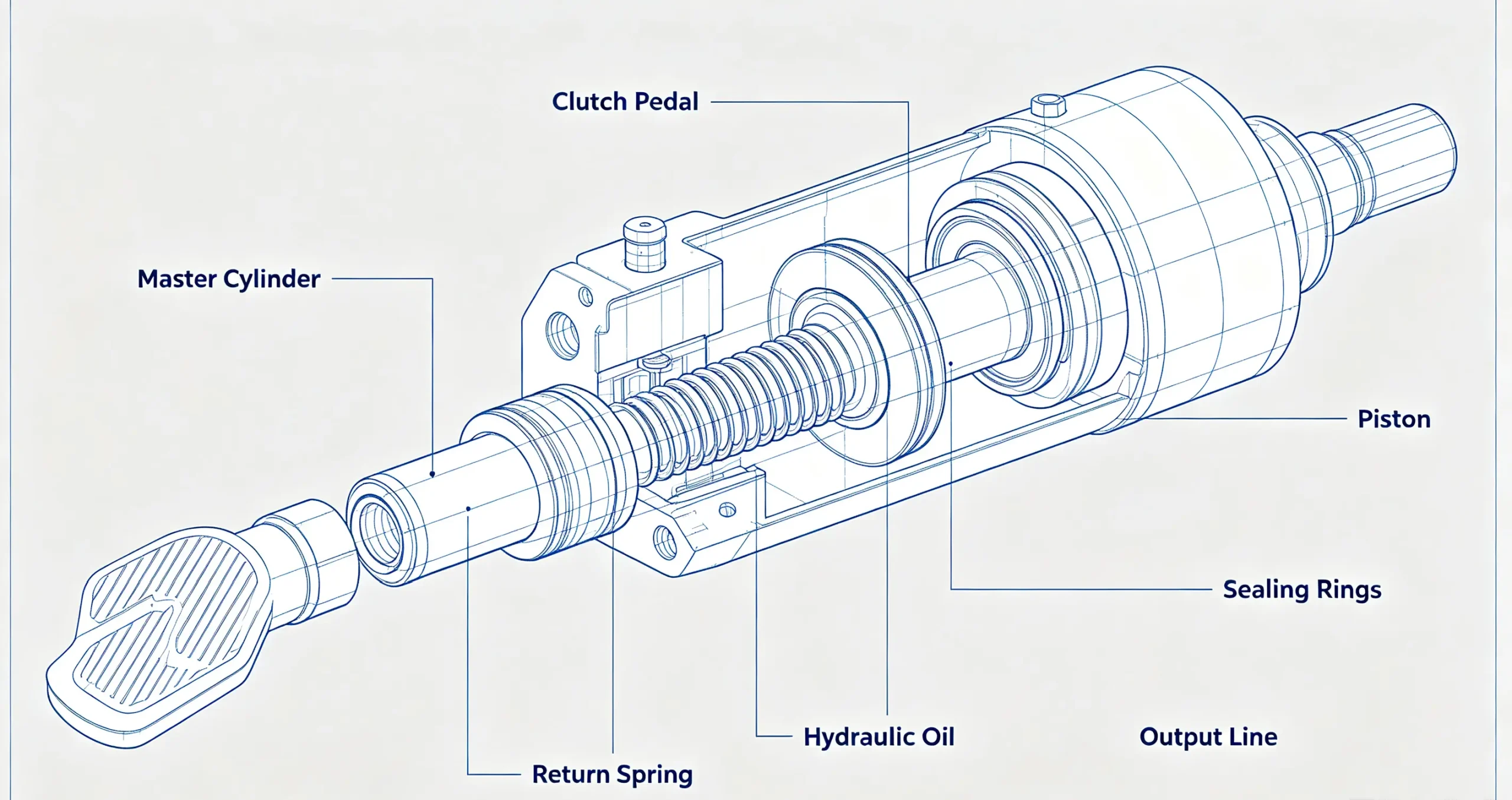
Internal Structure of Clutch Master Cylinder (Real Truck Standard)
The compact structure of the master cylinder determines its precise working logic. Every internal part coordinates closely. Any tiny damage or aging will directly affect hydraulic pressure stability. To help you understand failure causes clearly, we break down the core structure in detail.
1. Cylinder Body Shell
The master cylinder shell is usually made of high-strength cast aluminum. This material features light weight, strong compression resistance, and not easy to deform. It can adapt to cab vibration and temperature changes for a long time.
The inner wall of the cylinder body undergoes precision grinding treatment. The smooth inner wall ensures zero resistance for piston movement. Meanwhile, it cooperates with sealing rings to lock internal hydraulic pressure and avoid pressure leakage.
2. Primary & Secondary Pistons
Most heavy-duty truck master cylinders adopt dual-piston design. The primary piston connects with the pedal push rod to receive external force. The secondary piston assists in pressure buildup to ensure stable hydraulic output.
The dual-piston structure effectively avoids complete pressure loss caused by single piston failure. It improves the overall stability of the clutch system and is a key safety design for heavy-load trucks.
3. High-Temperature Resistant Sealing Rings
Sealing rings are the most vulnerable parts of the master cylinder. They are responsible for isolating hydraulic oil, locking pressure, and preventing internal oil backflow.
Genuine sealing rings adopt oil-resistant and aging-resistant rubber materials. They can maintain stable toughness in high-temperature and low-temperature environments. Inferior seals are prone to hardening, cracking, and deformation after short-term use, which is the main cause of internal pressure leakage.
4. Return Spring & Check Valve
The built-in return spring resets the piston quickly after the pedal is released. It ensures the hydraulic system returns to a balanced state and prepares for the next operation.
The check valve controls the one-way flow of hydraulic oil. It prevents oil backflow and pressure loss during pedaling, ensuring rapid and continuous pressure buildup.
5. Oil Storage Tank & Oil Port
The external oil storage tank stores clutch hydraulic oil and supplements oil volume in real time according to piston movement. The oil inlet and outlet ports ensure the circulation and pressure transmission of hydraulic oil in the closed loop.
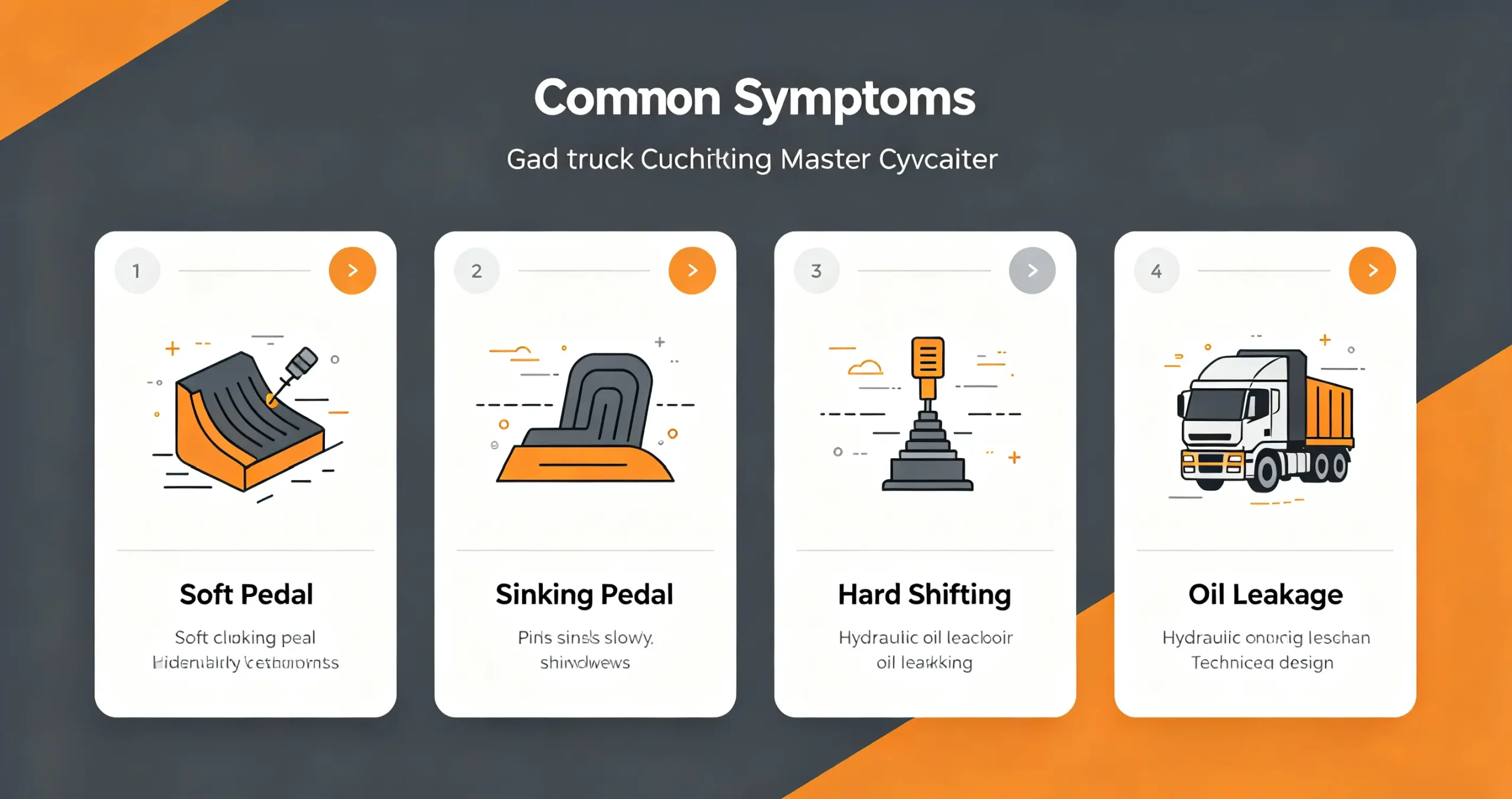
10 Common Symptoms of Bad Clutch Master Cylinder (Real Truck Fault Performance)
Master cylinder failures have obvious progressive characteristics. The symptoms start intermittently and become permanent as wear worsens. Timely identification of early signs can avoid sudden road failures. The following are the most typical fault manifestations summarized from actual truck maintenance cases.
1. Spongy & Soft Clutch Pedal
This is the earliest and most common symptom. When stepping on the clutch pedal, the feedback is empty and weak. The pedal sinks softly without rigid pressure feeling.
This situation is caused by slight aging of internal sealing rings. The piston cannot lock pressure completely, leading to tiny internal oil leakage and insufficient pressure buildup.
2. Pedal Sinks Gradually When Holding
When you step the clutch pedal to the bottom and hold it stationary, the pedal will slowly sink further. After releasing and stepping again, the feeling temporarily returns to normal.
This is a typical internal leakage fault of the master cylinder. The hydraulic oil slowly flows back through the gap of aging seals, resulting in continuous pressure loss.
3. Incomplete Clutch Separation & Gear Grinding
Due to insufficient hydraulic pressure output, the slave cylinder cannot push the release fork to reach the standard stroke. The clutch cannot be completely separated.
In actual driving, this leads to difficult gear shifting and obvious gear grinding noise. Many people misdiagnose this as a transmission fault, while the real cause is insufficient master cylinder pressure.
4. Clutch Pedal Sticks & Slow Rebound
After releasing the clutch pedal, the pedal rebounds slowly and cannot return to the original position instantly. In severe cases, the pedal gets stuck in the middle position.
This fault is caused by aging spring elasticity, piston jamming, or dirty oil dirt blocking the piston stroke. Long-term accumulation will aggravate component wear.
5. External Hydraulic Oil Leakage
Obvious oil stains appear at the master cylinder push rod gap or oil tank connection. In serious cases, dripping hydraulic oil can be observed.
External leakage directly reduces the total amount of hydraulic oil. It causes insufficient system pressure and eventually leads to complete clutch failure. You can learn more about leakage troubleshooting in our hydraulic system fault guide.
6. Frequent Air Bleeding Fails to Solve Soft Pedal
After manual air bleeding, the clutch returns to normal temporarily. However, the soft pedal problem recurs within one or two days.
This situation excludes air mixing faults. It is 100% caused by internal seal aging of the master cylinder. Air will continuously infiltrate the cylinder cavity through tiny gaps.
7. Clutch Pedal Vibration During Operation
When stepping on the clutch pedal at idle speed, obvious slight jitter and vibration can be felt. The vibration intensifies with the increase of engine speed.
This is caused by unstable piston movement and uneven internal pressure. It is an early warning of severe master cylinder wear.
8. High Clutch Pedal & Insufficient Stroke
The clutch pedal is significantly higher than normal. The effective stroke becomes shorter, and the separation state is not thorough.
This problem is caused by piston wear and spring fatigue. The pressure stroke cannot reach the standard value, affecting normal clutch operation.
9. Intermittent Normal & Abnormal States
In the early stage of failure, the clutch works normally in cold weather but becomes soft and ineffective after the truck runs for a period of time.
High temperature accelerates the aging and deformation of sealing rings, leading to increased internal leakage. This intermittent fault is the most easily ignored by drivers.
10. Continuous Drop of Hydraulic Oil Level
The clutch oil tank level drops frequently without any external leakage point. This phenomenon fully proves that the master cylinder has serious internal oil return and leakage faults.
Root Causes of Clutch Master Cylinder Failure (Practical Maintenance Summary)
Most master cylinder failures are not caused by product quality problems. In fact, 90% of faults come from daily driving habits, improper maintenance, and working environment influence. The following are the core failure causes sorted by actual failure rate.
1. Long-Term Use of Deteriorated Hydraulic Oil
Many fleets ignore regular replacement of clutch hydraulic oil. After long-term use, the hydraulic oil will oxidize, deteriorate, and produce impurities and sludge.
These tiny dirt particles will scratch the cylinder wall and wear the sealing rings during piston movement. This gradually causes internal leakage and pressure loss. It is the biggest hidden danger of master cylinder premature failure.
2. Inappropriate Driving Habits
Many drivers habitually step on the clutch pedal for a long time during waiting, uphill sliding, or idle parking. This keeps the master cylinder piston in a compressed state for a long time.
Long-term static pressure will cause permanent deformation and fatigue aging of sealing rings and springs. This greatly shortens the service life of the master cylinder.
3. High Temperature Aging & Vibration Wear
The truck engine compartment maintains a high-temperature state for a long time during driving. High temperature accelerates the aging and hardening of rubber sealing parts.
At the same time, chassis vibration and engine vibration are transmitted to the cab. Long-term vibration leads to loose internal fit and accelerated wear of precision components.
4. Mixed Use of Different Types of Hydraulic Oil
Randomly replacing different brands or different specifications of hydraulic oil will cause chemical reactions inside the oil circuit. It leads to oil deterioration, rubber expansion, and seal corrosion.
This irregular maintenance behavior will cause rapid failure of the master cylinder sealing system in a short time.
5. Inferior Aftermarket Master Cylinder Replacement
To save costs, many truck owners choose low-cost inferior master cylinders. These products have unqualified cylinder wall precision, poor sealing material, and unstable spring tension.
They are prone to leakage and pressure failure within several thousand kilometers. Frequent replacement increases comprehensive maintenance costs instead. For reliable branded master cylinders, check our truck brand parts page.
6. Long-Term Overload & Frequent Shifting
Overload operation increases the resistance of the clutch separation mechanism. Each pedal pressing requires higher hydraulic pressure support.
Long-term high-pressure operation increases the load of the master cylinder, accelerates fatigue wear of internal parts, and induces early failure.
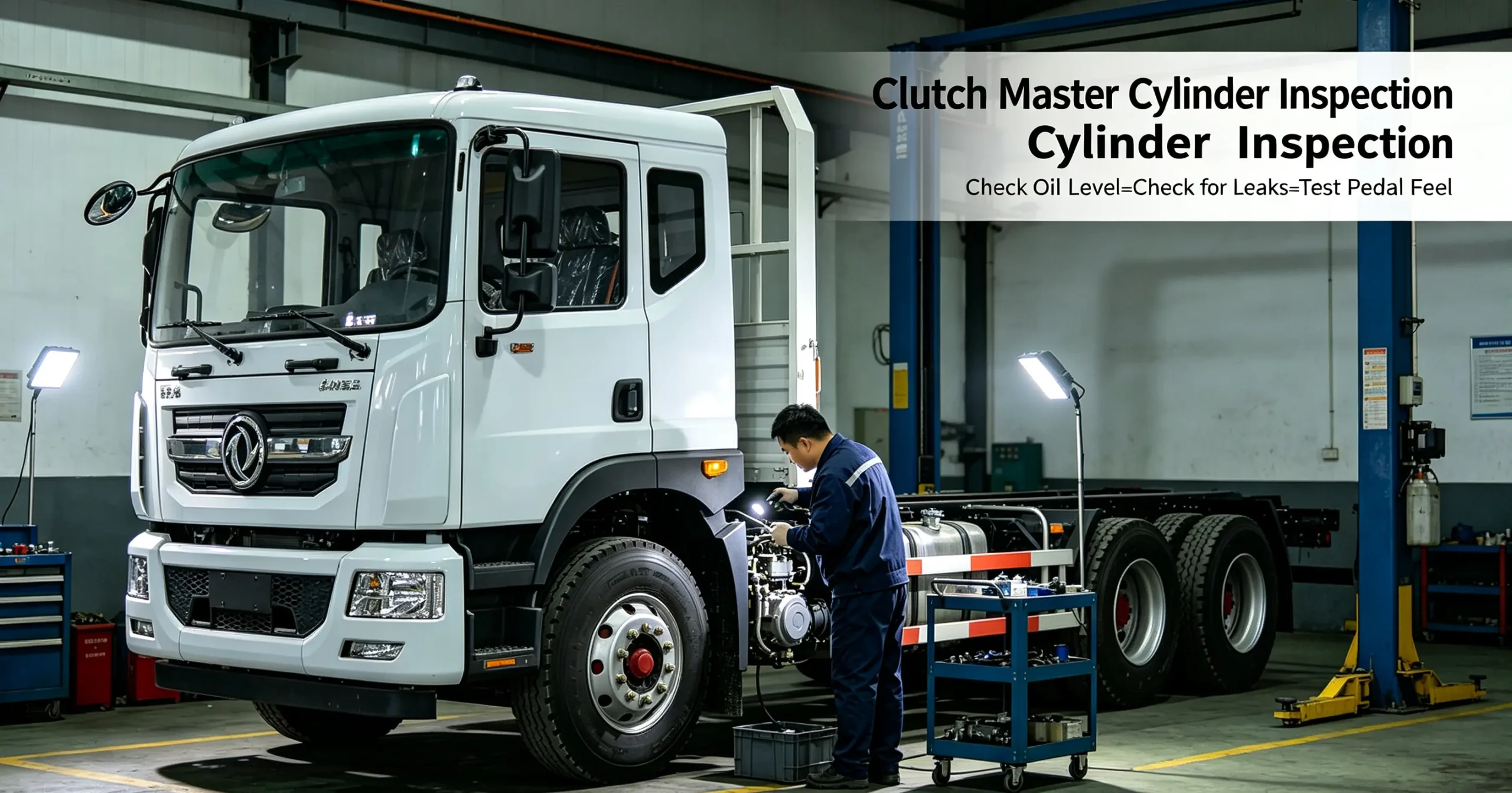
How to Diagnose Bad Clutch Master Cylinder (Accurate & Fast Field Method)
Before formal repair and replacement, accurate fault diagnosis is essential. Blind disassembly will waste maintenance time and increase unnecessary labor costs. The following are practical field diagnosis methods summarized for heavy-duty trucks.
Step 1: Static Pedal Pressure Test
Start the engine and keep the truck in neutral gear. Step on the clutch pedal firmly and hold it for 30 seconds.
If the pedal continues to sink slowly and the pressure feedback becomes softer, it can be judged that the master cylinder has internal leakage failure. If the pedal remains stable, the internal pressure locking function is normal.
Step 2: Hydraulic Oil Level & Oil Quality Inspection
Open the master cylinder oil tank cover to observe the oil level and oil color. If the oil level drops significantly without external leakage, internal leakage is confirmed.
If the hydraulic oil turns black, turbid, or contains suspended impurities, it indicates that the internal parts are worn and the oil has deteriorated.
Step 3: Manual Oil Pipe Pressure Test
Remove the oil pipe connecting the master cylinder and slave cylinder. Press the clutch pedal manually to observe the oil output state.
If the oil output is weak, discontinuous, or cannot maintain pressure, the master cylinder pressure buildup function fails. If the oil output is strong and stable, the fault lies in the slave cylinder or pipeline.
Step 4: Air Bleeding Verification Test
Completely exhaust the air in the hydraulic system according to standard procedures. After finishing the test drive, observe whether the soft pedal fault recurs.
If the fault reappears in a short time, it excludes air mixing problems and confirms master cylinder seal aging failure.
Complete Step-by-Step Guide to Fix Clutch Master Cylinder Issues
It is important to note that once the master cylinder has internal leakage, seal aging, or piston wear, simple maintenance cannot repair it. Direct replacement is the only thorough solution. Below is the standard repair process for heavy-duty trucks.
Step 1: Prepare Tools & Safety Protection
Park the truck on flat ground, turn off the engine, and pull up the hand brake. Prepare standard hydraulic oil, wrench tools, clean rags, and a new master cylinder assembly.
Clean the dust and dirt around the master cylinder installation position in advance to prevent impurities from entering the oil circuit during disassembly.
Step 2: Discharge Residual Hydraulic Oil
Use a hose to pump out the residual old hydraulic oil in the oil tank. Wipe the oil tank clean to avoid old oil impurities from polluting the new oil circuit.
This step is very important. Residual deteriorated oil will affect the service life of the new master cylinder.
Step 3: Disconnect Oil Pipe & Fixed Bolts
Slowly disassemble the hydraulic oil inlet and outlet pipes of the master cylinder. Wrap the pipe interface with a clean rag to prevent residual oil from splashing.
Remove the fixed bolts of the master cylinder and disconnect the connecting pin between the pedal push rod and the master cylinder piston.
Step 4: Remove the Old Master Cylinder
Take out the old master cylinder assembly completely. Check the internal aging degree and wear condition to confirm the fault cause.
Clean the installation base to ensure no sundries affect the installation accuracy of the new part.
Step 5: Install the New Master Cylinder
Fix the new master cylinder in the original installation position, tighten the fixed bolts evenly, and ensure no shaking or deviation.
Connect the push rod pin and adjust the pedal stroke appropriately to ensure flexible piston movement without jamming.
Step 6: Reconnect Oil Pipe & Add New Hydraulic Oil
Reinstall the hydraulic oil pipe and tighten the interface to avoid oil leakage. Inject new standard hydraulic oil into the oil tank until it reaches the standard liquid level.
Do not mix different types of hydraulic oil to prevent chemical deterioration.
Step 7: Full System Air Bleeding
Air bleeding is the key step to ensure repair quality. Cooperate with two people to complete the operation. One person steps on the clutch pedal repeatedly, and the other exhausts air at the slave cylinder bleeder valve.
Repeat the operation until the discharged hydraulic oil has no bubbles. Tighten the bleeder valve and supplement the oil level to the standard position.
Step 8: Test & Verify Repair Effect
Start the engine, test the clutch pedal feedback, and check for softness, sinking, and jamming.
Test shift operation to confirm smooth gear engagement without grinding noise. After no abnormality in static test, carry out road test to verify stable operation.
Daily Maintenance Tips to Avoid Master Cylinder Failure
Most master cylinder faults are caused by lack of daily maintenance. Adopting scientific maintenance habits can extend the service life of the master cylinder by more than double and reduce fleet failure rates effectively.
1. Replace Hydraulic Oil Regularly
It is recommended to replace clutch hydraulic oil every 20,000 to 30,000 kilometers. Timely replacement avoids oil deterioration and impurity wear.
Always use high-quality standard hydraulic oil matching the truck model to ensure the stability of the hydraulic system.
2. Correct Clutch Operation Habits
Do not step on the clutch pedal for a long time during parking and waiting. Do not use half-clutch state for long-distance driving.
Let the master cylinder piston return to a relaxed state completely after each shift to avoid long-term static pressure fatigue.
3. Regular Oil Level Inspection
Check the clutch oil tank level every month. Timely supplement hydraulic oil when the liquid level is low to avoid air inhalation caused by insufficient oil volume.
4. Avoid Overload & Frequent Sharp Shifting
Strictly follow the rated load capacity of the truck. Overload will increase clutch operating resistance and master cylinder working load.
Smooth shifting operation reduces frequent pressure changes of the hydraulic system and delays component aging.
5. Choose Genuine Matching Parts for Replacement
When replacement is required, always select genuine or high-quality branded master cylinders. Stable quality can avoid repeated faults and reduce long-term maintenance costs.
We provide full series of matching clutch hydraulic parts for mainstream heavy-duty truck models. You can contact our team for accurate model matching and bulk quotation.
Why Genuine Master Cylinders Prevent Recurring Faults
Many fleet owners choose cheap aftermarket parts to save short-term costs. However, inferior products often lead to repeated leakage, soft pedals, and frequent rework.
Genuine master cylinders adopt precision cylinder wall polishing, high-temperature resistant sealing materials, and strictly calibrated spring tension. All parameters match the original truck hydraulic pressure standards perfectly.
They feature stable pressure buildup, no internal leakage, strong high-temperature adaptability, and long service life. For fleet operation, genuine parts can effectively reduce vehicle downtime and improve operation efficiency.
To learn more about our factory supply strength and global customer cooperation cases, browse our customer cooperation cases.
Conclusion
The clutch master cylinder is the core pressure source of the heavy-duty truck hydraulic clutch system. Its small volume hides crucial functional value. Any minor aging and wear will affect shifting smoothness and driving safety.
Most early master cylinder faults have obvious warning signs. As long as drivers and maintenance personnel can identify symptoms in time, diagnose faults accurately, and replace parts professionally, most sudden clutch failures can be avoided.
At the same time, standardized driving habits and regular hydraulic maintenance are the most effective ways to extend the service life of the master cylinder. Scientific fleet maintenance can greatly reduce comprehensive operating costs.
If you are looking for high-quality, model-matching truck clutch master cylinders and complete hydraulic system accessories, Mettlead provides one-stop truck parts supply services. We support global shipping and customized bulk orders. You can also visit our about us page to know more about our company scale and product advantages.


