How to Fix Truck Wheel Bearing Issues
Wheel bearing is one of the most fundamental load-bearing and rotating components inside heavy-duty truck wheel hub assemblies. In simple terms, it acts as the core rotating support between the vehicle axle and the wheel hub. While bearing the whole vehicle weight and cargo load, it greatly reduces friction resistance during wheel rotation. Without intact and qualified wheel bearings, trucks cannot run smoothly, safely and stably on various road surfaces.
This kind of chassis wearing part has wide universal compatibility. It can be perfectly installed and used on SINOTRUK HOWO, SITRAK, SHACMAN X series, FAW J series and FOTON Auman full range heavy-duty trucks. No matter it is used for long-distance highway freight, short-distance urban distribution, engineering dump transportation or mountain area material transportation, the service state of wheel bearings will directly influence driving comfort, running stability and overall driving safety.
In daily vehicle use and fleet management work, most drivers and maintenance staff always focus much attention on engine power output, braking system response effect, tire wear degree and fuel consumption status. On the contrary, they often ignore daily inspection and regular maintenance of hidden wheel bearings inside wheel hubs. This kind of neglected maintenance habit easily leads to early wear, seal damage and even bearing burnout faults.
In fact, wheel bearings are in high-strength working state all year round. They bear heavy static load, dynamic impact load and high-speed rotating friction at the same time. Once early hidden troubles are not eliminated in time, minor wear problems will gradually develop into serious mechanical faults. In serious cases, wheel jamming, hub overheating and even wheel falling off may happen, which will bring extremely huge hidden dangers to personal safety and cargo transportation benefits.
This all-round practical maintenance guide is specially compiled for global heavy-duty truck users and professional repair technicians. It systematically sorts out complete internal structure and stable working principle of truck wheel bearings, sums up all observable failure symptoms in daily driving, deeply analyzes various inducements leading to bearing damage. In addition, it arranges standardized disassembly inspection, replacement installation and clearance adjustment operation steps, and matches targeted long-term maintenance schemes. If you need to obtain more complete truck chassis fault diagnosis knowledge and practical repair tutorials, you can enter our exclusive truck technical support category to study systematically. For related chassis fault cases, you can also check our guide about King Pin Problems in Trucks, another common chassis issue that affects driving stability.
Basic Structure and Working Principle of Truck Wheel Bearings
Before carrying out fault judgment, daily inspection and formal maintenance replacement work, users must master the basic structural composition and normal working operation logic of heavy-duty truck wheel bearings clearly. This can help people quickly locate abnormal damage positions and effectively avoid wrong judgment and blind disassembly operations.
According to different installation positions, wheel bearings used on modern heavy-duty trucks are divided into front wheel bearings and rear wheel bearings. Due to different load-bearing pressure, rear wheel bearings adopt thicker and more reinforced overall design to adapt to larger cargo load pressure. However, the internal main structure composition and basic working principle of front and rear wheel bearings keep highly consistent.
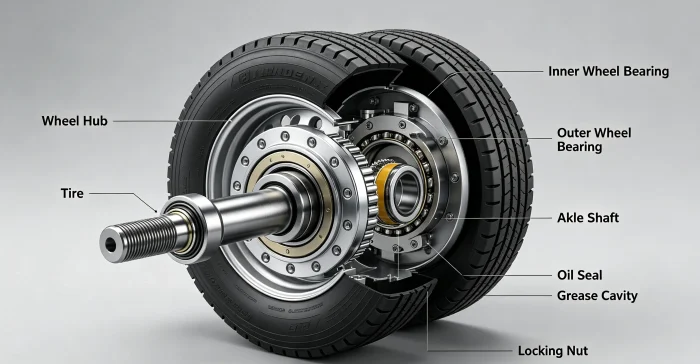
A set of standard heavy-duty truck integral wheel bearing assembly consists of multiple core precision accessories. The main components include inner ring, outer ring, high-hardness rolling steel ball, nylon integrated retainer frame, double-sided rubber sealing oil seal, built-in wear-resistant isolation gasket and anti-rust protective coating. Compared with ordinary light truck bearings, heavy-duty models use larger-size steel balls and thicker ring bodies, which own stronger compression resistance, impact resistance and high temperature resistance performance.
Each built-in component undertakes different indispensable core functions respectively. The inner ring is closely sleeved on the vehicle axle and keeps fixed without rotating. Meanwhile, the outer ring is installed inside the wheel hub and rotates synchronously with the wheel. The rolling steel balls clamped in the middle can roll freely in the standard track gap. In this way, traditional sliding friction is converted into labor-saving rolling friction, which effectively lowers vehicle driving resistance and helps control comprehensive fuel consumption level.
The double-sided integrated sealing oil seal is the most critical protective structure of the whole bearing assembly. It can firmly lock the high-temperature resistant lubricating grease filled inside the bearing cavity to prevent grease loss and dry friction. At the same time, it can effectively block external rainwater, muddy water, road surface dust, fine sand and gravel impurities from invading into the internal moving gap. Good sealing performance is the core premise to ensure long stable service life of wheel bearings.
In the actual running process of the truck, when the vehicle moves forward or backward, the wheels drive the hub and the outer bearing ring to rotate rapidly. The internal steel balls keep stable rolling operation under the isolation limit of the retainer frame. All rotating friction is completed inside the sealed cavity full of lubricating grease. The whole operation process is smooth and stable without extra noise and abnormal resistance.
Besides the bearing main body itself, matched installation auxiliary parts also play a vital role in normal use. These matching accessories include hub adjusting screw nut, anti-loose locking gasket, outer dust-proof protective cover and limit positioning sleeve. They can scientifically control the rotating clearance of wheel bearings within the factory standard range, avoid too tight rotation resistance increase or too loose shaking phenomenon. If you intend to purchase original high wear-resistant truck wheel bearings and complete hub system supporting accessories suitable for full-series heavy trucks, you can browse our professional truck chassis system parts product area to finish model matching and bulk purchasing work efficiently. Proper chassis part matching is critical to avoid uneven tire wear and abnormal wheel movement caused by mismatched accessories.
Obvious Observable Failure Symptoms of Damaged Truck Wheel Bearings
The damage process of truck wheel bearings is a gradual changing process from slight fatigue wear to complete functional failure. Different damage degrees correspond to different obvious external abnormal manifestations. Drivers and maintenance personnel can accurately judge the current bearing health condition and specific fault severity through driving listening, running feeling experience and simple on-site manual detection, so as to arrange reasonable maintenance plans in advance.
1. Continuous Variable Speed Abnormal Rotating Noise
Abnormal running noise is the earliest and easiest found early warning signal of wheel bearing failure. When the truck drives stably on flat and smooth road sections, obvious uniform buzzing sound can be clearly heard near the left or right wheel position.
Furthermore, this kind of bearing noise has obvious speed linkage characteristics. In general, the faster the vehicle driving speed rises, the louder and more obvious the buzzing abnormal sound will become. When the driving speed slows down gradually, the noise volume will also decrease synchronously.
In addition, users can quickly distinguish which side wheel bearing is damaged through steering operation. When turning the steering wheel to the left side and tilting the vehicle body load to the right wheel, if the noise becomes louder, it proves that the right wheel bearing has serious wear problems. On the contrary, turning right with louder noise means left wheel bearing failure.
When the internal bearing wear degree continues to worsen and internal lubricating grease is completely exhausted, the original mild buzzing sound will turn into harsh and sharp metal dry friction sound. Once this kind of noise appears, it indicates that the bearing has entered the late failure stage and must be replaced immediately.
2. Wheel Vibration and Unstable Straight Running State
After wheel bearings appear excessive wear and rotating clearance exceeds the standard value, the wheels cannot keep stable rotating posture during high-speed running. At this moment, obvious wheel jitter and body floating feeling will occur when driving at medium and high speed.
Under the influence of bearing looseness, the truck is easy to appear irregular left and right deviation trend when driving in a straight line. Drivers need to constantly correct the steering angle to maintain normal driving route, which greatly increases long-distance driving fatigue and reduces overall driving safety.
Different from vehicle drifting caused by steering linkage failure, the unstable running state caused by bearing damage is more obvious at high speed, and it will be relieved appropriately after reducing speed obviously.
3. Hub Overheating and Abnormal Temperature Rise
After long-distance continuous driving, users can touch the surface of each wheel hub after stopping the vehicle to check temperature difference. If a certain wheel hub temperature is obviously higher than other normal hubs and presents obvious hot hand phenomenon without long-time braking operation, it can be judged that the internal bearing rotation resistance is too large.
Too small bearing rotating clearance, internal grease deterioration failure or mixed hard impurities will all lead to increased rotating friction heat. Long-term accumulated heat cannot dissipate in time, which will cause continuous temperature rise of the hub. In serious cases, there will be scorching smell near the wheel position.
4. Loose Wheel Clearance and Abnormal Shaking Sensation
People can finish simple looseness detection on flat ground easily. Steady the vehicle firmly, then hold the upper and lower positions of the tire tightly to push and pull back and forth with moderate force.
If there is obvious loose gap and obvious shaking feeling between the wheel and the axle, it fully proves that the internal wheel bearing has been severely worn and the matching gap is seriously out of limit. This kind of hidden danger must be eliminated through replacement as soon as possible.
5. Grease Leakage and External Dust Seal Damage
Users can directly observe the outer side of the wheel hub in daily inspection work. If there are obvious black oil stains and grease overflow traces at the hub edge sealing position, it means that the bearing outer oil seal has aged and cracked.
Once the sealing structure fails, internal lubricating grease will continue to leak outward. Meanwhile, external muddy water and dust will invade inward, accelerating the overall damage speed of internal rolling parts.
Main Root Causes Leading to Truck Wheel Bearing Damage
Under normal standard driving environment and complete regular maintenance conditions, the service life of qualified heavy-duty truck wheel bearings can reach a relatively long driving mileage. Most bearing early failures are not caused by natural service life expiration, but are jointly affected by bad driving modes, harsh road environment, non-standard maintenance, unreasonable clearance adjustment and inferior matching parts.
1. Long-term Overload Operation and Cargo Loading
Excessive overload is the primary factor causing premature fatigue damage of wheel bearings. Many truck users blindly increase cargo loading weight in pursuit of higher transportation income. Long-term overload state makes each group of wheel bearings bear far beyond the designed limit load pressure. Overload operation also damages other core chassis components and is one of the main causes of heavy-duty truck cylinder head failure and other mechanical faults caused by long-term overloaded operation.
Under long-term ultra-load pressure, the internal steel balls and bearing ring bodies are easy to produce permanent deformation and fatigue spots. The original smooth rolling track will be damaged, which directly leads to increased friction, early noise generation and rapid shortening of overall service life.
2. Bad Driving Habits and Violent Road Condition Passing
Frequent high-speed rushing over road pits, curb stones, road bulges and uneven road sections will produce instantaneous huge impact force. This strong impact force will be directly transmitted to the internal wheel bearings through tires and hubs, causing hidden structural damage.
In addition, frequent emergency braking and long-time continuous braking will make the hub produce a lot of braking heat. High temperature will accelerate the deterioration and thinning of internal bearing lubricating grease, reduce lubrication effect and indirectly speed up bearing wear progress. Excessive driving heat also easily leads to vehicle fluid failure, including emulsified engine oil caused by high-temperature cooling system abnormalities.
3. Severe External Environment Erosion and Invasion
When driving in rainy days, snowy days and muddy road sections, a large amount of muddy water mixed with corrosive substances will splash to the wheel hub position. If the bearing oil seal has slight aging cracks, these liquid impurities will easily penetrate into the bearing interior.
For vehicles running in mining areas, construction sites and sandy windy areas all year round, floating fine sand and dust will continuously erode the hub sealing position. After entering the bearing cavity, hard sand grains will form abrasive materials together with grease, which will continuously polish rolling parts and cause rapid failure.
4. Non-standard Maintenance and Improper Grease Selection
Regular cleaning and grease refilling are essential maintenance items for wheel bearings, but many vehicle owners ignore this key work for a long time. Long-term lack of new lubricating grease filling will lead to internal grease dry-up and failure, forming complete dry friction working state.
At the same time, random use of low-quality inferior lubricating grease is also a common maintenance mistake. Inferior grease has poor high temperature resistance, poor low temperature fluidity and weak adhesion. It will soon lose its protective effect in high-speed and high-temperature working environment and cannot play effective anti-wear and cooling roles.
Moreover, untimely replacement of aging oil seals also will shorten bearing service life greatly. Many people only replace worn bearings while reusing old aging oil seals, which will cause secondary grease leakage and early damage again in a short time.
5. Unreasonable Bearing Rotating Clearance Adjustment
During bearing installation and daily maintenance adjustment, too tight or too loose clearance will bring different negative influences. If the adjustment is too tight, the internal rolling space is insufficient, rotating resistance increases obviously, heat generation rises sharply and burnout failure is easy to happen.
On the contrary, excessive loose clearance will cause wheels to shake left and right during operation, impact force increases obviously, and the bearing is easy to suffer eccentric wear, which will also shorten normal service life.
6. Installation of Low-Grade Refurbished Bearings and Unqualified Accessories
In order to reduce short-term maintenance costs, some repair shops and vehicle owners choose low-cost refurbished disassembled bearings and substandard products. This kind of low-grade bearing has rough internal processing precision, uneven steel ball hardness and unqualified sealing performance.
After short-term use, it is easy to appear noise, overheating, looseness and other faults. The failure recurrence rate is extremely high, which not only increases repeated maintenance costs, but also brings serious potential safety hazards to driving process.
Standard Step-by-Step Wheel Bearing Replacement and Formal Repair Process
When wheel bearings have obvious abnormal noise, serious hub overheating, excessive shaking clearance and irreversible grease leakage failure, simple maintenance and grease filling can not restore their normal working performance. Users must follow professional standard procedures to complete overall disassembly, cleaning, replacement installation and clearance adjustment work.
Step 1: Prepare tools and safely lift the vehicle Park the heavy truck on flat hard ground, tighten the hand brake firmly and pad solid anti-slip blocks on the opposite side tires to prevent vehicle sliding. Use professional lifting equipment to stably lift the axle position where the faulty bearing is located until the tires completely leave the ground. Then remove tires, brake drums or brake discs in sequence to expose the internal hub assembly structure completely.
Step 2: Remove limit accessories and take out old bearings Use special tools to loosen the hub adjusting nut and take out the anti-loose locking gasket and outer dust cover in turn. Slowly take out the old damaged wheel bearing from the hub inner cavity, and thoroughly clean away residual deteriorated grease, iron scrap impurities and dust inside the hub to keep the installation position clean and tidy.
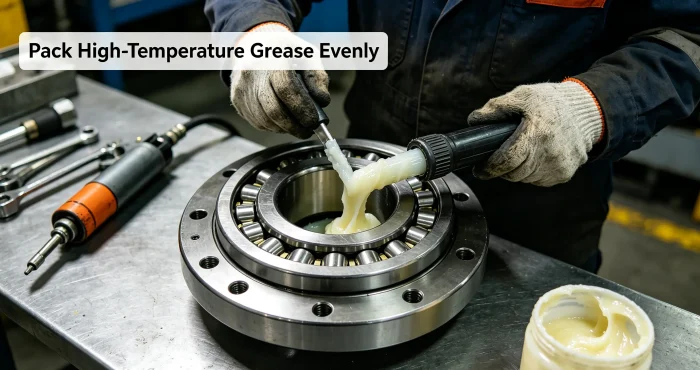
Step 3: Clean inspection and pre-lubrication treatment Carefully check whether the inner wall of the hub and the surface of the axle shaft are worn, scratched or deformed. If there are obvious abnormal damages, repair or replace matching parts together. Evenly and fully fill high-standard high-temperature resistant lubricating grease inside the new bearing and the hub installation cavity to ensure full coverage of all rotating gaps.
Step 4: Install new bearings and assemble accessories Install the new qualified wheel bearing in place smoothly according to the correct direction. Do not use violent knocking mode to avoid bearing ring deformation and internal steel ball damage. Install the sealing oil seal, limit sleeve and other auxiliary parts in order, and ensure all accessories are installed in place without deflection.
Step 5: Scientifically adjust rotating clearance and lock firmly According to the factory standard data of different truck models, reasonably adjust the bearing rotating clearance through the adjusting nut. After adjustment, push and pull the wheel manually to check the rotating flexibility and slight floating allowance. Confirm no jamming and no excessive looseness, then install the locking gasket and tighten the limit nut firmly to avoid position deviation caused by driving vibration.
Step 6: Restore assembly and test running inspection Install brake system parts and tires back to original positions in sequence, and standardize the tightening torque of wheel fixing nuts. After finishing all assembly work, lower the vehicle steadily. Carry out low-speed test running on flat road, listen carefully to wheel operation sound and check hub temperature change to confirm the repair effect is qualified.
Daily Scientific Inspection and Long-Term Bearing Maintenance Methods
Adhering to standardized daily inspection and periodic standardized maintenance is the most effective way to delay wheel bearing wear speed, reduce overall failure rate and save long-term vehicle use costs. All inspection and maintenance items are simple and easy to operate, which can be completed by drivers themselves in daily parking rest period.
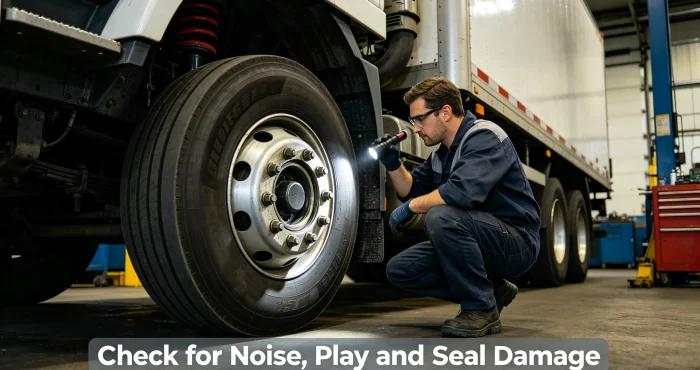
First of all, finish regular sound inspection before departure every day. Listen carefully to the running sound of each wheel during low-speed driving. Once abnormal buzzing noise is found, check and confirm the fault position in time to avoid fault deterioration.
Secondly, regularly check hub sealing and grease leakage conditions. Observe the outer dust cover and oil seal position every week. Replace aging and cracked oil seals timely to prevent internal grease loss and external impurity invasion.
Thirdly, implement periodic cleaning and grease replacement maintenance. Under normal highway transportation conditions, clean and refill special bearing grease every 50000 to 80000 kilometers. For vehicles often running in muddy and mine road sections, shorten the maintenance cycle properly to ensure good internal lubrication state all the time.
Fourthly, strictly control cargo loading weight to avoid long-term overload driving. Reasonable load can effectively reduce bearing load pressure and greatly extend the overall stable service cycle of wheel bearings.
Fifthly, form good driving habits. Try to slow down and pass slowly when encountering potholes and uneven road surfaces. Reduce frequent emergency braking behaviors, so as to lower impact wear and high-temperature heat generation of wheel bearings.
Frequently Asked Questions about Truck Wheel Bearing Troubleshooting
Q1: Can I continue driving with noisy wheel bearings? Slight early noise allows short-distance low-speed temporary driving, but long-distance high-speed running is absolutely not allowed. It is necessary to arrange inspection and replacement as soon as possible to prevent bearing burnout and wheel locking accidents.
Q2: Why do new replaced bearings make noise soon after installation? The main reasons include unreasonable clearance adjustment, use of inferior lubricating grease, unclean hub internal impurities and installation direction errors. Recheck and adjust one by one to eliminate abnormal noise.
Q3: What is the normal service life of heavy truck wheel bearings? Under standard load and good road conditions, the normal service life ranges from 100000 to 150000 kilometers. The service life will be greatly shortened if working in harsh environments and overload states for a long time.
Q4: Is it necessary to replace oil seals together when changing bearings? Yes, it is the most standard maintenance operation. Old oil seals have already aged and fatigued. Replacing them together can effectively avoid secondary grease leakage and repeated maintenance troubles in the later period.
Q5: How to distinguish bearing noise from tire abnormal noise? Bearing noise changes obviously with speed and steering angle. Tire noise is mostly related to road surface texture, and there is no obvious corresponding change rule with steering operation. Users can quickly distinguish through contrast test.
Full Article Final Summary
Wheel bearing is an indispensable safety core component in the whole heavy-duty truck chassis system. Its stable working state is closely related to driving smoothness, running stability and travel safety of the whole vehicle. Most wheel bearing failures are caused by human factors such as unreasonable load bearing, bad driving habits and insufficient daily maintenance, rather than pure natural aging loss.
In daily vehicle use process, establishing regular inspection awareness, adhering to standardized periodic lubrication maintenance, matching high-quality genuine accessories and forming scientific driving habits can effectively reduce the failure probability of wheel bearings to the greatest extent. Meanwhile, it can save a lot of repeated maintenance time and later repair costs for fleet users and individual car owners.
Timely discovery and scientific solution of wheel bearing abnormal faults can thoroughly eliminate hidden safety troubles in driving process, ensure stable and efficient operation of transport vehicles, and create more stable economic benefits for transportation work. If you need to purchase high-precision wear-resistant truck wheel bearings and complete hub assembly series accessories, Mettlead can provide full-specification matching products and professional one-stop technical support services for global heavy truck users. We also provide professional purchasing guidance for users looking for reliable Sinotruk spare parts suppliers and full-range heavy-duty truck maintenance solutions including common rail injector technical guides for full vehicle maintenance.


