Common Rail Injector: Technical Guide

The common rail injector is the cornerstone of modern diesel engine technology, revolutionizing efficiency, power, and emissions control in heavy-duty vehicles. For professionals in the trucking industry, fleet management, or automotive parts supply, a deep understanding of this technology is essential for optimizing operational performance, ensuring regulatory compliance, and minimizing costly downtime.

This comprehensive guide will demystify the common rail injector, exploring its operational principles, evolution, and critical role. We will dissect its core components, compare distinct types, and provide practical insights into diagnosing failures, implementing effective maintenance, and making informed replacement decisions. Whether you seek technical knowledge, enhanced fleet reliability, or a trusted , this article is your definitive resource.

Understanding the Common Rail Injection System: The Foundation of Modern Diesel Power

The common rail injection system fundamentally altered how fuel is delivered to a diesel engine by separating high-pressure fuel generation from the precise injection event, offering unprecedented control over combustion.

The Core Principle: Decoupling Pressure Generation and Injection

At its heart, the "common rail" is a robust, high-pressure accumulator that serves as a shared reservoir for all injectors. Unlike older systems where fuel pressure was linked to engine speed, the common rail maintains a constant, extremely high fuel pressure (1,600 to over 2,500 bar or 23,000 to 36,000+ PSI) , ensuring optimal fuel atomization across the entire engine operating range.
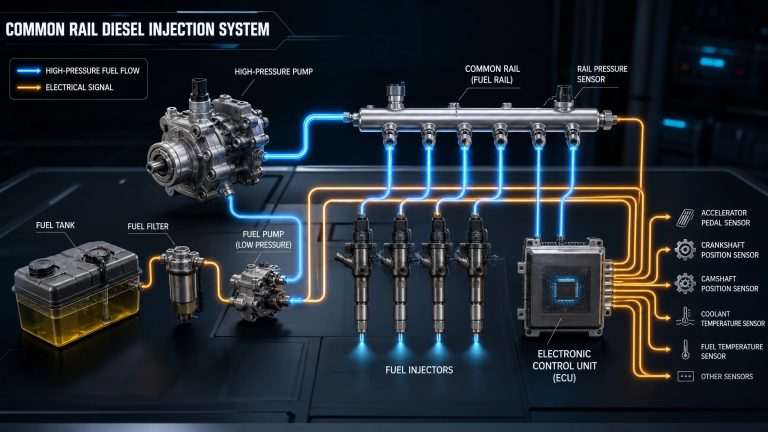
A mechanically driven high-pressure fuel pump continuously draws diesel from the tank and compresses it, delivering it to the common rail where it is stored until needed by the injectors.

The Precision of the Common Rail Injector: A Step-by-Step Overview

The common rail injector is a marvel of precision engineering, functioning as an ultra-fast, electronically controlled valve. Its primary mission is to accurately meter and atomize high-pressure fuel directly into the engine's combustion chamber for efficient combustion.
The process:
1.Fuel Supply: Low-pressure lift pump draws fuel from the tank to the high-pressure pump.
2.High-Pressure Generation: The high-pressure pump (e.g., Bosch CP3/CP4) compresses fuel to operating pressure (e.g., 2,000 bar) and feeds it to the common rail .
3.Electronic Control Unit (ECU) Command: The ECU, the engine's brain, processes real-time data from sensors (crankshaft position, RPM, accelerator, boost pressure, temperatures, exhaust gas) to calculate optimal injection timing, duration, and quantity.
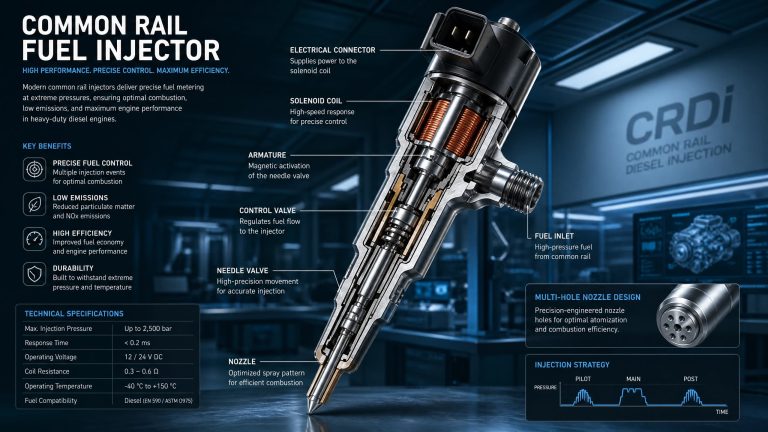
4.Injector Actuation: The ECU sends an electrical signal to the injector's actuator (solenoid or piezoelectric), rapidly opening a microscopic needle valve.
5.Fuel Injection and Atomization: High-pressure fuel sprays through tiny nozzle holes into the combustion chamber, atomizing into a fine mist. This ensures rapid, complete mixing with compressed air, leading to highly efficient and clean combustion.
6.Multiple Injection Events: Common rail injectors perform multiple, distinct injections per cycle:
Pilot Injection: A small pre-injection to smooth combustion, raise cylinder temperature, and significantly reduce "diesel clatter" .
Main Injection: The primary fuel delivery for power and torque.
Post-Injection: Small injections after main combustion to burn residual soot and raise exhaust gas temperatures for Diesel Particulate Filter (DPF) regeneration .

This precisely choreographed sequence, managed in microseconds, enables modern diesel engines to balance power, fuel efficiency, and low emissions. For system integration details, visit our .

The Evolutionary Leap: Common Rail vs. Traditional Fuel Injection Systems

Common rail technology's revolutionary impact is best understood by examining the limitations of its predecessors.

The Era of Mechanical and Unit Injector Systems

Early diesel engines used mechanical systems (inline or rotary pumps) where a camshaft-driven pump generated pressure for each injection. This pressure was directly proportional to engine speed, leading to poor atomization, incomplete combustion, black smoke, and inefficiency at low RPMs. Timing and quantity control were crude, and only a single injection event per cycle was possible, contributing to loud "diesel clatter."

Electronic Unit Injectors (EUI) and Hydraulic Electronic Unit Injectors (HEUI) integrated the pump and injector per cylinder, offering electronic timing control. However, pressure generation remained linked to engine speed or oil pressure, limiting multiple, finely controlled injections .

This precisely choreographed sequence, managed in microseconds, enables modern diesel engines to balance power, fuel efficiency, and low emissions. For system integration details, visit our .

The Unprecedented Advantages of Common Rail Technology

Common rail systems decoupled pressure generation from injection, providing engine designers with unparalleled control and benefits:
Constant High Injection Pressure: Optimal fuel atomization at all operating points, reducing particulate matter (soot) and improving fuel economy.
Infinite Flexibility in Injection Timing and Duration: Microsecond-level accuracy allows dynamic optimization of combustion for performance, efficiency, and emissions.
Multiple Injection Events per Cycle: Pilot, main, and post-injections reduce combustion noise, lower NOx emissions, and aid exhaust aftertreatment systems, making modern diesels quieter and cleaner.
Improved Fuel Economy: Precise control minimizes fuel waste and maximizes energy extraction.
Reduced Emissions: High injection pressure, fine atomization, and multiple injections lead to a cleaner burn, drastically reducing NOx and PM, enabling compliance with stringent global emission standards like Euro VI and EPA 2010 .

Comparison Table: Common Rail vs. Traditional Injection Systems

Feature Common Rail System Traditional Mechanical System (e.g., Inline Pump) Electronic Unit Injector (EUI/HEUI)
Pressure Generation Independent of engine speed; constant high pressure Dependent on engine speed; pressure varies with RPM Linked to engine speed/oil pressure; pressure varies
Injection Pressure (Max) Up to 2,500+ bar ~800-1,200 bar ~1,800-2,200 bar
Timing Control Fully electronic, microsecond precision Mechanical, limited adjustability Electronic, but mechanically constrained
Injection Events Multiple (pilot, main, post) Single Single (some limited pre-injection on advanced EUIs)
Fuel Atomization Excellent, consistent across all RPMs Poor at low RPMs, better at high RPMs Good, but less consistent than common rail
Noise Level Significantly quieter due to pilot injection Loud, characteristic "diesel clatter" Quieter than mechanical, but louder than common rail
Emissions Control Excellent, meets stringent modern standards Poor, high NOx and PM Improved, but struggles with latest standards
Fuel Economy High efficiency across operating range Lower efficiency, especially at off-peak RPMs Improved, but less optimized than common rail

This table highlights why the common rail injector became pivotal in the modern clean diesel revolution, enabling heavy-duty diesel engines to meet strict global emissions standards while enhancing performance and fuel economy.

common_rail_injector_technical

Delving Deeper: Types of Common Rail Injectors – Solenoid vs. Piezoelectric

Common rail injectors are primarily differentiated by their actuation mechanism, which dictates response speed, precision, and performance. The two dominant types are solenoid-operated and piezoelectric-operated injectors.

Solenoid Injectors: The Workhorse of Common Rail Systems

Solenoid injectors use an electromagnetic coil to control the nozzle. When the ECU sends current, the energized solenoid creates a magnetic field, pulling an armature that lifts a control valve, allowing high-pressure fuel injection.
Advantages:
Robust and Reliable: Well-established and durable.
Cost-Effective: Less expensive to manufacture and replace.
Serviceability: Easier to diagnose, repair, and remanufacture.
Widespread Availability: Parts and expertise are globally available.
Disadvantages:
Slower Response Time: Physical movement limits precise injection events per cycle.
Limited Multi-Injection Capability: Fewer and less finely controlled events than piezo systems.

Piezoelectric Injectors: The Pinnacle of Precision

Piezoelectric injectors use a stack of piezo crystals that rapidly expand when voltage is applied, directly actuating a control valve. This enables ultra-fine control over fuel delivery.
Advantages:
Extremely Fast Response: Up to five times faster than solenoid actuators, enabling precise control.
Unmatched Precision and Fine Metering: Accurate metering of microscopic fuel quantities for superior atomization and combustion.
Enhanced Multi-Injection Capability: Higher number of distinct injection events (up to 7+) for optimizing combustion, reducing noise, and lowering emissions.
Quieter Operation: More precise pilot injections contribute to significantly quieter engine operation.
Disadvantages:
Higher Cost: More complex and expensive to manufacture and replace.
Fragility and Repair Difficulty: Delicate piezo stack is susceptible to damage; often requires complete replacement.
Sensitivity to Contamination: Highly sensitive to fuel contamination due to tight tolerances.
Comparison Table: Solenoid vs. Piezoelectric Common Rail Injectors
Feature Solenoid Injectors Piezoelectric Injectors
Actuation Mechanism Electromagnetic coil (solenoid) Piezoelectric crystals
Response Speed Good, but slower than piezo Extremely fast (up to 5x faster)
Precision High Ultra-high, microsecond accuracy
Multi-Injection Capability Moderate (typically 3-5 events) High (up to 7+ events)
Cost Lower Higher
Robustness Very robust More delicate, sensitive to contamination
Serviceability/Remanufacture Easier to repair and remanufacture Difficult to repair, often requires full replacement
Typical Applications Wide range of diesel engines, heavy-duty trucks, commercial vehicles Premium diesel engines, passenger cars, high-performance commercial vehicles
Understanding these differences is crucial for selecting replacement parts or diagnosing issues. For a comprehensive selection of injectors from various brands, explore our .

Identifying Trouble: Common Symptoms of Common Rail Injector Failure

Common rail injectors operate under extreme conditions, making them susceptible to failure from contamination, wear, or defects. Recognizing early warning signs prevents severe engine damage and costly repairs.

Exhaust Smoke: A Visual Diagnostic Indicator

Exhaust smoke color indicates injector problems:
Black Smoke: Incomplete combustion, often from a stuck-open or leaking injector, or worn nozzle. Excess fuel leads to unburned carbon, clogging DPF and increasing fuel consumption.
White Smoke: Unburned diesel passing through the exhaust, especially during cold starts. Caused by an injector not firing correctly, poor spray pattern, or leaking. Can dilute engine oil and damage aftertreatment systems.
Blue/Grey Smoke: Can indicate a dripping or partially seized injector, where fuel burns inefficiently or mixes with engine oil, producing a bluish tint and strong diesel smell.

Engine Performance Issues: Misfires, Rough Idle, and Power Loss

Precise fuel delivery is critical. Deviations cause performance problems:
Engine Misfires and Rough Idle: Uneven fuel delivery causes vibrations, shaking, and uneven idle. ECU may store diagnostic trouble codes (DTCs).
Loss of Power and Reduced Acceleration: Worn nozzles, internal leaks, or incorrect spray patterns reduce engine power, leading to sluggish acceleration and unresponsiveness.
Increased Fuel Consumption: Inefficient injectors cause the engine to consume more fuel, increasing operational costs.

Starting Difficulties: Hard Starts and No-Start Conditions

Common rail systems require minimum fuel pressure to start. Injector problems impact this:
Hard Starting: An internal injector leak (high return rate) prevents the high-pressure pump from building sufficient rail pressure during cranking, leading to extended cranking times or failure to start, especially when cold.
No-Start Condition: Severe internal leakage or a seized injector can completely prevent the high-pressure pump from building necessary rail pressure.

Engine Knocking or "Diesel Clatter"

A loud metallic knocking sound indicates a serious issue, often with pilot injection or main injection timing/quantity. If an injector delivers fuel too early or too much, it causes an uncontrolled pressure rise, leading to knocking. Immediate diagnosis is crucial to prevent piston and engine damage.
If you observe these symptoms, seek professional diagnosis promptly to avoid cascading failures and higher repair costs. For expert advice, .

Precision Diagnostics: Testing and Troubleshooting Common Rail Injectors

Accurate diagnosis is crucial for common rail injector repair. Due to complexity and cost, pinpointing the exact cause before repairs is essential, requiring specialized tools and expertise.

On-Vehicle Diagnostic Procedures

Initial troubleshooting without removing injectors:
Diagnostic Scanner (OBD-II/J1939): Connect a professional scanner to monitor engine parameters and DTCs. Key parameters:
Injector Balance Rates/Cylinder Contribution: Indicates if an injector requires significant fuel correction to maintain smooth idle.
Actual vs. Desired Rail Pressure: Deviation suggests an internal injector leak or high-pressure pump issue.
Fuel Temperature and Pressure Sensor Readings: Helps identify fuel delivery or sensor malfunctions.
Injector Leak-Off Test (Return Flow Test): Measures fuel returning from each injector. Excessively high return volume indicates an internal leak, impacting rail pressure and starting.
Cylinder Contribution Test: Individually disables cylinders to observe impact on engine smoothness, identifying non-contributing injectors.

Off-Vehicle Bench Testing: The Definitive Diagnosis

For conclusive diagnosis, injectors are removed and tested on a specialized common rail injector test bench:
Visual Inspection and Cleaning: Before testing, injectors are cleaned and inspected for damage.
Delivery Volume Testing: Measures fuel injected at various operating points (idle, part load, full load, pilot injection) against manufacturer specifications.
Return Volume Testing: Measures internal leakage at different pressures, confirming sealing integrity.
Spray Pattern Analysis: Assesses fuel spray pattern. A healthy injector produces a fine, symmetrical cone; a faulty one may stream, drip, or have an uneven pattern.
Response Time Measurement: Ensures actuator opens and closes within specifications.
Nozzle Opening Pressure (NOP) Test: Verifies pressure at which the nozzle needle lifts.
Electrical Coil Resistance Test: Checks solenoid coil integrity.

Comprehensive bench testing determines if an injector needs cleaning, repair, remanufacturing, or replacement. For advanced technical support, visit our .

Extending Lifespan: Best Practices for Common Rail Injector Maintenance

Common rail injectors are highly susceptible to damage from contaminants. Proactive maintenance ensures longevity and prevents premature failure.

The Paramount Importance of Fuel Quality

Fuel quality is the most critical factor. Microscopic tolerances mean minute particles or water can cause significant damage.
Source from Reputable Suppliers: Purchase diesel from trusted, high-volume stations to ensure fresh fuel and reduce water condensation/microbial growth.
Avoid Contamination: Prevent contamination during refueling; ensure clean equipment and sealed fuel caps.
Understand Fuel Standards: Familiarize with local/international diesel fuel quality standards (e.g., EN 590, ASTM D975) affecting injector health.

Rigorous Fuel Filtration: The First Line of Defense

The fuel filter system is the primary guardian. Compromising filtration leads to injector failure.
Adhere to OEM Service Intervals: Never exceed recommended filter replacement intervals; shorten in harsh conditions.
Utilize OEM or Premium Aftermarket Filters: Use filters meeting/exceeding OEM specifications (2-5 microns filtration) to capture microscopic contaminants.
Regularly Drain Water Separators: Drain regularly to remove accumulated water. Water in the high-pressure system causes corrosion, cavitation, and can destroy injector nozzles.
Source from Reputable Suppliers: Purchase diesel from trusted, high-volume stations to ensure fresh fuel and reduce water condensation/microbial growth.
Avoid Contamination: Prevent contamination during refueling; ensure clean equipment and sealed fuel caps.
Understand Fuel Standards: Familiarize with local/international diesel fuel quality standards (e.g., EN 590, ASTM D975) affecting injector health.

The Role of Fuel Additives

High-quality fuel additives can support injector health, but are not a substitute for good fuel and filtration.
Lubricity Enhancers: Protect moving parts from wear, especially with ultra-low sulfur diesel (ULSD).
Detergents/Cleaners: Help prevent carbon buildup on nozzles, but cannot fix mechanically failed injectors.
Cetane Boosters: Improve combustion, reducing stress on the injection system.

Strategic Replacement: Choosing the Right Common Rail Injector

When replacing common rail injectors, an informed choice is crucial for optimal engine performance, reliability, and cost-effectiveness.

Understanding Your Options: OEM, OEM Supplier, and Aftermarket

Genuine OEM (Original Equipment Manufacturer) Injectors: Supplied by the engine manufacturer (e.g., Cummins, Volvo) and identical to original parts. Manufactured by primary suppliers (Bosch, Denso, Delphi) to exact specifications.
Pros: Guaranteed fitment, highest quality, full warranty, optimal performance.
Cons: Most expensive.
OEM Supplier Aftermarket Injectors: Manufactured by the original component supplier (e.g., Bosch, Denso) but sold independently. Often identical to genuine OEM but branded differently.
Pros: Identical quality/performance to OEM, often lower price. Full warranty from component manufacturer.
Cons: May require cross-referencing part numbers.
Third-Party Aftermarket Injectors: Produced by independent manufacturers. Quality varies widely.
Pros: Most budget-friendly.
Cons: Inconsistent quality, risk of poor fitment/premature failure, less comprehensive warranty. When sourcing from overseas (e.g., China), partner with a trusted exporter with stringent quality control and verifiable certifications. Our details our commitment to quality.

New vs. Remanufactured Injectors: A Cost-Benefit Analysis

New Injectors: Brand-new units from the factory, offering highest assurance.
Pros: Ultimate peace of mind, full factory warranty, guaranteed to meet all original specifications.
Cons: Highest cost.
Remanufactured Injectors: Undergo a comprehensive process: disassembly, cleaning, replacement of all critical wearing parts with new OEM-spec components, reassembly to factory tolerances, and rigorous bench testing/calibration to meet or exceed new factory specifications. Often coded with a new IMA/trim code.
Pros: Significant cost savings (30-60% less than new) without sacrificing quality from reputable remanufacturers (e.g., Bosch Reman). Environmentally friendly.
Cons: Quality varies. Choose suppliers with proven track record. Avoid generic "rebuilt" injectors.
To see how high-quality replacement parts have benefited others, explore our .
common_rail_system_layout

Frequently Asked Questions (FAQ) about Common Rail Injectors

This section addresses common queries from fleet managers, truck owners, and parts buyers.

Q1: How long do common rail injectors typically last in heavy-duty trucks?

A: With proper maintenance and high-quality fuel, 150,000 to 300,000 miles (240,000 to 480,000 km) or 5,000 to 10,000 operating hours. Poor fuel filtration or water contamination drastically reduces this.

Q2: Can I replace just one faulty common rail injector, or should I replace all of them?

A: While technically possible, it's highly recommended to replace them as a complete set, especially on higher mileage engines or if failure is due to wear/contamination. This ensures balanced performance, prevents repeated downtime, and simplifies calibration.

Q3: What are the main differences between Bosch, Denso, and Delphi common rail injectors?

A: These are the dominant manufacturers:
Bosch: Pioneer, prevalent in European heavy-duty trucks. Known for extreme durability, precision, and robust design.
Denso: Major in Asian markets. Known for incredibly tight manufacturing tolerances, consistent pressure output, and compact designs.
Delphi (BorgWarner): Found in Ford Power Stroke, PSA Group, and some commercial vehicles. Known for robust flow consistency.

Q4: Why is my common rail diesel engine making a loud knocking sound?

A: A loud "diesel clatter" indicates a serious issue, often with pilot injection or main injection timing/quantity. Fuel delivered too early or too much causes an uncontrolled pressure rise. Immediate diagnosis is crucial to prevent engine damage.

Q5: Can I use fuel additives to clean my common rail injectors myself?

A: High-quality in-tank fuel system cleaners can help prevent light carbon deposits but cannot fix mechanically failing or heavily fouled injectors. Severe issues require professional ultrasonic cleaning and bench testing.

Q6: What happens if water gets into a common rail injection system?

A: Water causes catastrophic damage by displacing lubrication, leading to rapid wear, corrosion, cavitation, and can literally "blow the tips off" injector nozzles due to immense pressures. Regularly drain your fuel-water separator.

Q7: Do new common rail injectors need to be coded (programmed) to the ECU?

A: Yes, in almost all modern applications. Each injector has a unique alphanumeric code (IMA, trim, C2i, C3i, IQA) detailing its flow characteristics. This code must be programmed into the ECU for precise fuel delivery, cylinder balance, optimal combustion, and emission compliance. Failing to code leads to rough running, misfires, increased emissions, poor fuel economy, and premature failure.
Q8: How can I ensure I'm buying high-quality common rail injectors from an overseas supplier?

A: Due diligence is paramount:
Verify Certifications: Look for ISO 9001, IATF 16949.
Request Product Samples: For bulk, request samples for independent testing.
Check References and Reviews: Look for testimonials and independent reviews.
Ensure Clear Specifications: Demand detailed product specs, material, tolerances, test results.
Understand Warranty and Return Policies: Reputable suppliers offer clear policies.
Factory Audits: Consider for large volume purchases.
Communication and Transparency: Choose a responsive, transparent supplier. Our provides direct channels.

JINAN METTLEAD AUTO SALES CO.LTD.

SCAN CODE AND TALK TO US DIRECTLY

WhatsApp: +86 18653162432

Email:sinotruckctb@163.com

WeChat: +86-18653162432

+86-18653162432

Telegram: +86-18653162432

WhatsApp

WeChat

Telegram

LEAVE A MESSAGE FOR ANY QUESTIONS