
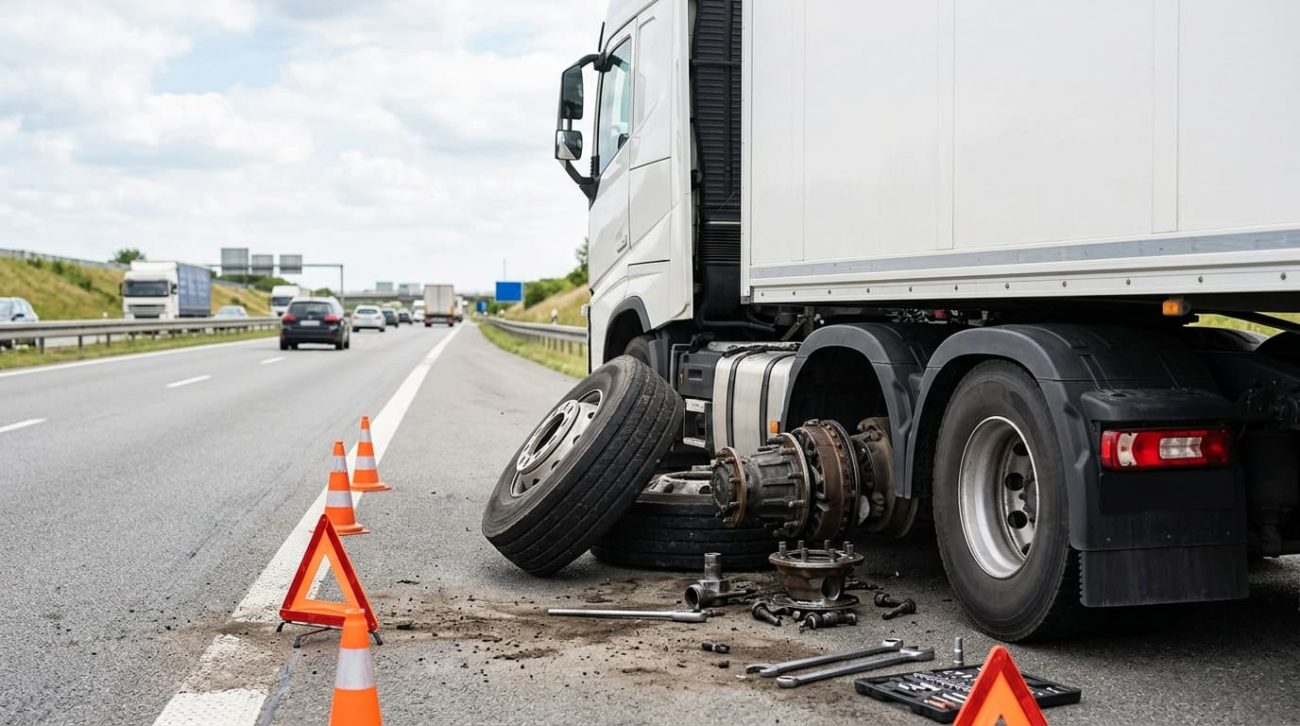
Your truck axle carries the weight of your entire operation — literally. When it starts crying for help, ignoring those whispers can turn into a catastrophic breakdown on the highway. A single axle failure event costs fleet operators an average of $5,000–$15,000 in towing, repairs, and downtime. Here’s how to catch the warning signs before your axle gives up on you.
Why Truck Axle Health Matters More Than You Think
Your axle isn’t just a metal bar connecting your wheels — it’s the backbone of your entire drivetrain. When axle shaft damage begins, it doesn’t stay contained. It cascades into your differential, stresses your transmission, and eventually destroys your wheel-end components.
Think of it like a domino effect: one compromised axle bearing creates play, which misaligns gears, which chews through seals, which starves components of lubricant. Before you know it, a $500 bearing job has become a $10,000 drivetrain overhaul.
According to FMCSA data, wheel and axle-related defects account for approximately 15% of all out-of-service violations during roadside inspections. That’s not just a repair bill — it’s lost revenue, compliance penalties, and a truck sitting idle when it should be earning.
Proactive heavy duty axle maintenance isn’t optional for serious fleet operators. And when commercial truck axle replacement becomes necessary, having the right parts sourced quickly is the difference between one day of downtime and one week.
7 Warning Signs Your Truck Axle Needs Immediate Repair
1. Unusual Clunking or Clicking Noises
Your axle is literally knocking on your door — begging you to pay attention. A distinct clunking sound when shifting gears, or a repetitive clicking during low-speed turns, signals worn CV joints or damaged axle splines that are losing their grip.
Pay close attention during acceleration from a stop and tight-radius turns. That’s when the load shifts most dramatically across the axle, and damaged components scream the loudest. If the noise is rhythmic and speed-dependent, your axle is telling you its time is running short.
2. Visible Grease Leaking Near Wheels
If you spot dark grease splattered on the inner sidewall of your tire or sprayed across the wheel hub area, you’re looking at a torn axle boot or failed seal. This is your axle’s lifeblood leaking out — and contaminants rushing in.
Once that protective seal breaks, dirt, water, and road debris accelerate axle shaft damage at an alarming rate. What starts as a simple boot tear becomes a full bearing failure within weeks if left unaddressed. A quick visual check during pre-trip inspections catches this early.
3. Excessive Drivetrain Vibration
A healthy axle delivers smooth, consistent power to your wheels. If your cab starts shaking during acceleration — especially in the 30–50 mph range — something is fundamentally wrong. Your axle may be bent, or the U-joints connecting it are failing under load.
Drivetrain vibration diagnosis starts with ruling out tire balance and driveshaft issues. If the vibration intensifies specifically under throttle and disappears when coasting, the axle assembly is your prime suspect. Don’t let this one slide — a bent axle under full load is a ticking time bomb.
4. Vehicle Pulling to One Side
When your truck drifts left or right without steering input, most drivers assume it’s an alignment issue. But if alignment checks come back clean, you may be dealing with an axle bearing on the verge of seizure or uneven axle shaft play.
A weakened axle on one side creates inconsistent rolling resistance, pulling the vehicle toward the compromised wheel. This is one of the most overlooked truck axle failure symptoms — and one of the most dangerous at highway speeds.
5. Visible Cracks, Bends, or Rust on the Axle Shaft
Physical inspection reveals what your ears can’t always detect. Even hairline cracks that seem insignificant under static conditions can propagate explosively under full load, leading to sudden axle fracture without warning.
Visual inspection checklist:
- Look for surface cracks near the flange and spline areas
- Check for any bowing or bending along the shaft length
- Inspect for deep rust pitting that compromises structural integrity
- Examine weld points on axle housing for stress fractures
- Look for discoloration indicating overheating
6. Abnormal Tire Wear Patterns
Your tires are silent witnesses to axle problems. Cupping, feathering, or aggressive one-sided wear patterns often trace directly back to axle misalignment or bearing play. Your tires are literally recording axle shaft damage warning signs in their rubber.
If you’re replacing tires more frequently than expected, or your tire shop keeps pointing out unusual wear, don’t just buy new rubber — investigate the axle. Fixing the symptom without addressing the cause is throwing money away.
7. ABS or Traction Warning Lights
Modern trucks communicate through their dash lights. An ABS warning that appears intermittently — especially during acceleration or rough roads — can indicate a damaged axle-mounted tone ring or a speed sensor displaced by excessive axle movement.
Don’t dismiss these lights as “electrical gremlins.” When axle play increases beyond spec, it physically moves sensors out of their calibrated position. The computer is telling you something mechanical has changed — listen to it.
Quick Diagnostic Reference Table
| Warning Sign | Likely Axle Issue | Urgency Level | Estimated Repair Cost (USD) |
|---|---|---|---|
| Clunking / clicking noise | Worn CV joint / spline damage | 🔴 High | $800 – $2,500 |
| Grease leak near wheel | Torn axle boot / seal failure | 🟡 Medium-High | $200 – $600 |
| Drivetrain vibration | Bent axle shaft / U-joint failure | 🔴 High | $1,000 – $4,000 |
| Vehicle pulling to one side | Axle bearing wear / seizure | 🔴 High | $500 – $1,500 |
| Visible cracks or bends | Structural axle fatigue | 🔴 Critical | $2,000 – $6,000+ |
| Abnormal tire wear | Axle misalignment / bearing play | 🟡 Medium | $300 – $1,200 |
| ABS / traction warning light | Tone ring / sensor displacement | 🟡 Medium | $150 – $500 |
Common Causes Behind Premature Axle Failure
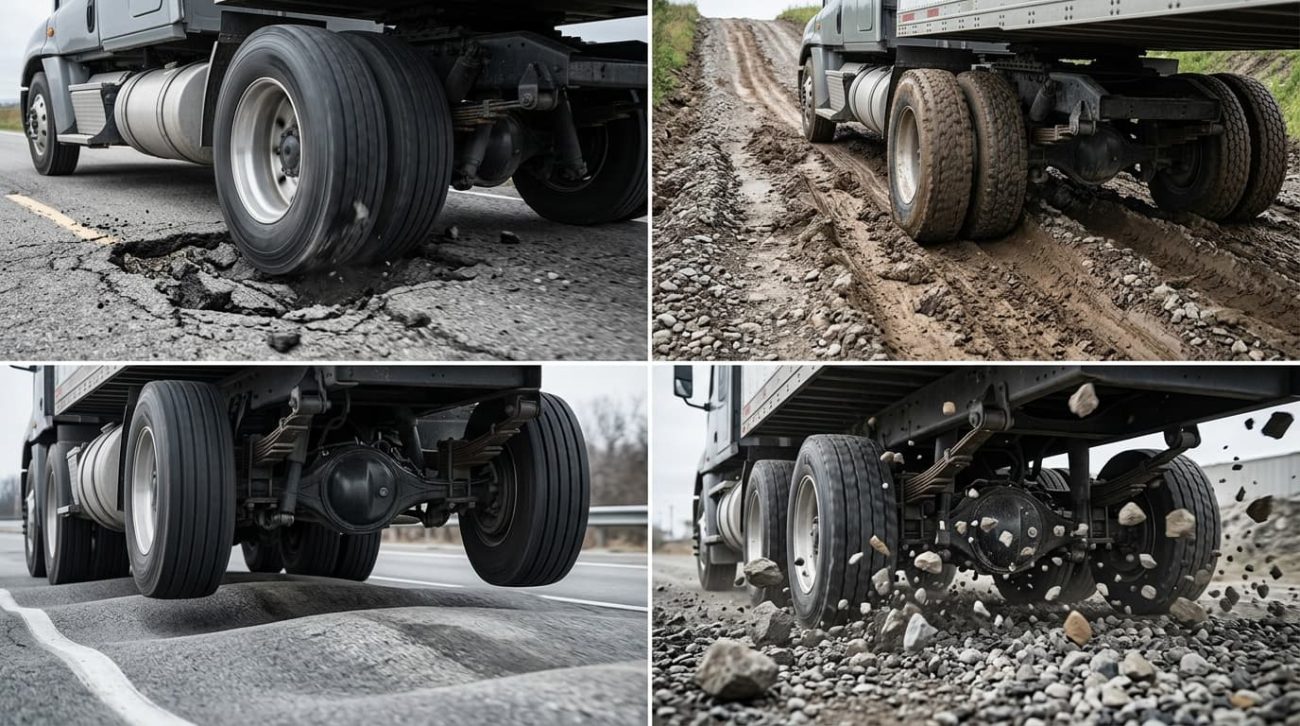
Understanding why axles fail helps you prevent the next failure. Most premature axle deaths aren’t random — they’re caused by patterns you can break.
| Cause | How It Damages the Axle | Prevention Tip |
|---|---|---|
| Chronic overloading | Exceeds axle rated capacity, causes metal fatigue over time | Strictly follow GAWR ratings on every load |
| Poor road conditions | Repeated impact stress on axle housing and shafts | Reduce speed on rough terrain; inspect after harsh routes |
| Skipped maintenance intervals | Lubricant breakdown leads to undetected wear and heat buildup | Follow OEM heavy duty axle maintenance schedules religiously |
| Incorrect axle parts/specs | Mismatched components create dangerous stress points | Source OEM-spec replacement parts from verified suppliers |
| Corrosion / salt exposure | Weakens axle shaft structural integrity from the outside in | Regular undercarriage washing and protective coating |
Repair vs. Replace — When to Make the Call
Not every axle problem demands a full replacement. But knowing where to draw the line saves you from pouring money into a component that’s already past its useful life.
When Repair Is Enough
- Minor seal or boot replacement with no internal contamination
- Bearing repacking or a single bearing swap when the shaft is undamaged
- U-joint replacement with no visible shaft damage or spline wear
- Tone ring or sensor replacement for ABS-related issues
When Full Commercial Truck Axle Replacement Is Necessary
- Cracked or bent axle housing that cannot be safely straightened
- Multiple bearing failures indicating systemic wear throughout the assembly
- Axle shaft twist or spline stripping from overload events
- Post-accident structural compromise — even if damage looks minor externally
- Severe corrosion that has reduced shaft cross-section below safe limits
Rule of thumb: If truck axle repair costs exceed 50–60% of a new axle assembly price, replacement is the smarter long-term investment. A new axle gives you a fresh fatigue life and full warranty coverage — patching an old one just resets the countdown.
Preventive Maintenance Schedule to Extend Axle Life
The cheapest axle repair is the one you never need. Follow this schedule and your axles will reward you with years of reliable, quiet service.
| Mileage Interval | Maintenance Action |
|---|---|
| Every 10,000 miles | Visual inspection of boots, seals, and axle housing for leaks or damage |
| Every 30,000 miles | Axle lubricant level check and top-off; inspect for metal particles |
| Every 60,000 miles | Full axle fluid drain and refill; bearing inspection and adjustment |
| Every 100,000 miles | Comprehensive axle disassembly inspection; replace all wear items proactively |
| Post-incident (any) | Immediate full axle and drivetrain inspection regardless of mileage |
Note: Trucks operating in harsh conditions — extreme temperatures, heavy salt exposure, or consistently hauling near max capacity — should compress these intervals by 20–30%.
Frequently Asked Questions
How long can I drive with a bad truck axle?
Technically, not a single extra mile if you hear clunking or see visible damage. A failing axle can lock a wheel at highway speed — risking a rollover or loss of vehicle control. Pull over and inspect immediately. The risk-to-reward ratio of “just making it to the shop” is never in your favor.
What does a failing axle sound like?
A rhythmic clunking during acceleration, repetitive clicking on turns, or a low humming and growling that increases with speed. Your axle has its own language — learn to listen. The sounds typically worsen under load and may disappear when coasting, which helps distinguish axle noise from tire or engine issues.
Can a bad axle cause transmission problems?
Yes, absolutely. A damaged axle creates irregular load on the differential and transmission output shaft, accelerating wear on gears and seals throughout the drivetrain. Vibration from a bent axle also hammers transmission mounts and bearings. Fixing the axle early protects everything upstream.
How much does a truck axle repair typically cost?
Minor repairs such as seals, boots, and individual bearings range from $200–$1,500. Full axle shaft or housing replacement runs $2,000–$6,000+, depending on truck model, axle configuration, and whether you source OEM or quality aftermarket components. Labor rates vary significantly by region.
What are the most common truck axle failure symptoms?
Vibration during acceleration, clunking noises, grease leaks near wheels, abnormal tire wear, and vehicle pulling to one side are the top five axle shaft damage warning signs. Any single symptom warrants inspection; multiple symptoms together indicate urgent attention is needed.
How often should I inspect my heavy-duty truck axle?
At minimum every 10,000 miles for visual checks, with full fluid service every 60,000 miles. Trucks operating in harsh conditions or hauling near max capacity should inspect more frequently — some fleets on severe-duty cycles inspect every 5,000 miles. Consistent heavy duty axle maintenance is always cheaper than emergency repairs.
Sinotruk Chassis Parts for Axle and Drivetrain Systems
If you’re running Sinotruk vehicles, sourcing the correct chassis parts — especially axle shafts, bearings, hubs, and suspension components — is critical to avoiding the failures described above. Here’s a quick overview of the most popular Sinotruk chassis part categories we supply:
Sinotruk Howo Chassis Parts
The Sinotruk Howo series is one of the most widely used heavy-duty truck platforms across Africa, Southeast Asia, and the Middle East. Sinotruk Howo Chassis Parts include front and rear axle shafts, wheel hubs, king pins, leaf spring assemblies, U-bolts, brake drums, and steering knuckles. These components are engineered for high-load applications and rough-road durability, making genuine-spec replacements essential for maintaining axle integrity and overall vehicle safety.
Sinotruk Howo A7 Chassis Parts
The Howo A7 represents Sinotruk’s upgraded platform with improved ride quality and heavier payload ratings. Sinotruk Howo A7 Chassis Parts cover the enhanced rear axle assemblies, differential housings, drive shafts, hub reduction gears, and heavy-duty suspension brackets specific to the A7 configuration. Due to the higher torque output of A7 models, using correctly rated chassis components is non-negotiable for preventing premature axle and drivetrain failures.
Sinotruk Sitrak Chassis Parts
The Sinotruk Sitrak (developed with MAN technology) is positioned as a premium heavy-duty platform with tighter engineering tolerances. Sinotruk Sitrak Chassis Parts include precision-machined axle components, air suspension modules, disc brake assemblies, stabilizer bars, and advanced steering system parts. Sitrak chassis parts demand exact OEM specifications — aftermarket substitutes that don’t meet these tolerances can introduce the vibration and misalignment issues that lead directly to axle damage.
Don’t Wait Until Your Axle Gives Up — Talk to Us
Your truck axle works hard every single day, carrying tons of cargo across thousands of miles without complaint. It deserves attention before it breaks down and takes your schedule — and your budget — with it.
We are Mettlead — a professional truck parts exporter backed by experienced technical engineers who understand axle systems inside and out. Whether you need a diagnosis consultation, the right replacement axle shaft, or a complete axle assembly sourced at the most competitive price for Chinese-brand truck parts worldwide, we’re ready to help.
Contact Mettlead today. We’ll give you a practical, proven solution — and the most reasonable global pricing on quality Chinese-brand truck axle components. Your axle carried you this far. Let us help you carry it forward.


