Picture this: a Sinotruk HOWO is parked in your yard, bleeding money by the hour. The brake drum is shot. You flip the worn part over, squint at a faded string of characters stamped into the casting — WG9231…something — and wonder if those digits hold the key to getting this truck back on the road.
Good news: they absolutely do. That OEM number is the DNA of every heavy duty truck spare part. It’s a fingerprint, a passport, and a shopping list rolled into one. This guide will show you exactly how to turn that string of digits into the correct replacement part — fast, confidently, and without expensive mistakes.
Why OEM Numbers Are the Universal Language of Heavy Duty Truck Spare Parts
What an OEM Number Actually Tells You
An OEM number isn’t random. It’s a structured code that tells you who made the part, what system it belongs to, and which revision you’re looking at. Think of it as a sentence written in a very compact language — every segment carries meaning.
Take a Sinotruk HOWO brake drum with the number WG9231342006. The “WG” prefix identifies the brand family. The middle digits point to the brake system category. The trailing numbers narrow it down to a specific drum diameter, bolt pattern, and revision. Change even one digit, and you might end up with a part that looks right but doesn’t fit — like ordering shoes in the wrong size because you misread a “7” as a “1.”
Chinese truck manufacturers — Sinotruk, Shacman, FAW, Dongfeng, Foton — each follow their own numbering logic. Learning the pattern for the brands you work with most is like learning to read a map: once you get it, navigation becomes second nature.
OEM vs. Aftermarket Part Numbers — Key Differences
Original Equipment Manufacturer numbers come directly from the truck maker’s engineering department. Aftermarket suppliers, on the other hand, often assign their own catalog codes while referencing the original OEM number for cross-compatibility. This is where the concept of OEM part number cross reference becomes essential.
An aftermarket part might carry a completely different code on its packaging, yet be dimensionally and functionally identical to the OEM original. The bridge between these two worlds is a cross-reference database — a tool that says, “Your OEM number WG9231342006 is equivalent to our catalog item XYZ.” Without that bridge, you’re guessing. With it, you’re matching.
| Brand | Sample OEM Number | Part Category | System |
|---|---|---|---|
| Sinotruk HOWO | WG9231342006 | Brake drum | Chassis |
| Shacman | DZ95259590002 | Engine mount | Powertrain |
| FAW J6 | 1003015-81D | Turbocharger | Engine |
| Dongfeng | 3501015-ZQ2A0 | Wheel hub | Axle |
| Foton Auman | H4545010001A0 | Cabin lock | Body |
Want to explore the full range of brands we support? Visit our Product Brands page for a complete overview.
Step-by-Step Process to Match Spare Parts by OEM Number
Step 1 — Locate the OEM Number on the Part or Documentation
Before you can match anything, you need the number itself. Here’s where to look — in order of reliability:
- Stamped directly on the part — castings, forgings, and machined surfaces often carry embossed or laser-etched numbers. Check flat surfaces, flanges, and mounting faces.
- Vehicle identification plate (VIN plate) — while the VIN itself isn’t a part number, it helps narrow down the exact truck configuration, which guides catalog lookup.
- Maintenance manual or parts book — the heavy duty truck parts catalog for your model lists every component with its OEM number and exploded-view diagram.
- Previous purchase invoices — if you’ve ordered the part before, old invoices are gold.
Pro tip for faded numbers: Rub chalk or a light grease across the stamped area, then wipe the surface clean. The residue settles into the engraved characters, making them readable again. A phone camera with flash at a low angle also works wonders.
Step 2 — Verify the Number Format Against the Heavy Duty Truck Parts Catalog
Got your number? Don’t rush to order yet. First, verify it makes sense. Each Chinese truck brand follows predictable formatting rules — digit count, prefix logic, and revision codes all follow patterns.
For example, Shacman parts typically start with “DZ” followed by a long numeric string. If your number starts with “DZ” but has only 6 digits instead of the usual 11-13, something’s off — you might be looking at a sub-assembly code rather than the individual part number. Cross-check against the official parts catalog or a trusted digital database to confirm you have the complete, correct string.
This verification step catches transcription errors before they become expensive shipping mistakes. It takes two minutes and saves two weeks.
Step 3 — Use an OEM Part Number Cross Reference Tool
Cross-reference tools are the workhorses of truck spare parts identification. They take your OEM number and return matching results — including exact matches, superseded numbers (old numbers that have been replaced by updated ones), and interchangeable alternatives from aftermarket manufacturers.
Here’s how the matching logic typically works:
- Exact match — the database finds your number directly. Best-case scenario.
- Superseded match — your number has been retired and replaced by a newer revision. The tool shows the current valid number.
- Interchangeable match — multiple OEM numbers from different platforms or production batches refer to the same physical part.
Not all cross-reference tools are created equal. The best ones are maintained by suppliers who physically handle these parts daily and update their databases based on real-world fitment feedback — not just paper specs.
Step 4 — Confirm Compatibility with Vehicle Model, Year & Configuration
Here’s a subtlety that catches even experienced buyers: the same OEM number can appear across multiple truck models, but fitment isn’t always guaranteed. Why? Because trucks are configured differently depending on their intended use.
A Dongfeng Tianlong built for highway logistics might share a frame rail part number with a construction-spec Kinland — but the mounting hardware, axle ratio, and surrounding components differ. Always confirm these variables:
- Exact truck model and series
- Year of manufacture
- Engine variant (e.g., Weichai WP10 vs. WP12)
- Emission standard (China III, IV, V, or VI — this affects sensors, EGR valves, and DPF components)
- Axle configuration (4×2, 6×4, 8×4)
One OEM number, multiple contexts. Always check the full picture.
Step 5 — Validate with a Trusted Supplier
Databases are powerful, but they’re not infallible. A final human verification step — someone who has physically seen, handled, and shipped the part you need — is the safety net that prevents costly errors.
This is where experience matters enormously. A supplier with deep knowledge of commercial vehicle parts lookup can spot issues that software misses: a revision that changed bolt spacing by 2mm, a regional variant that uses a different gasket thickness, or a supersession that technically matches on paper but requires a bracket modification in practice.
With 15 years in the Chinese truck parts industry, we at Mettlead serve as that verification layer every day. Reach out to us with your OEM number, and we’ll confirm the match before anything ships.
Common Pitfalls When Matching Heavy Duty Truck Spare Parts
Superseded & Discontinued Numbers
Truck manufacturers continuously improve their components. When they do, the old OEM number gets “superseded” — retired in favor of a new one that reflects the updated design. This doesn’t mean the part is unavailable. It means you need to follow the supersession chain to find the current valid number.
Think of it like a forwarding address. The old resident moved, but the mail still gets there if you know where to redirect. Experienced suppliers maintain these chains meticulously, so an “obsolete” number in your hand doesn’t mean a dead end — it just means one extra lookup step.
Regional Variants of the Same Truck Model
A Sinotruk A7 built for the African export market is not identical to one built for China’s domestic highways. Export-spec trucks often have different cooling systems (for hotter climates), different electrical configurations (for different voltage standards), and different emission components (for different regulatory environments).
The parts might look the same. The truck might look the same. But the OEM numbers differ — and for good reason. A radiator hose designed for a tropical-spec cooling system has different pressure ratings than its temperate-climate counterpart. Always confirm whether your truck is domestic-spec or export-spec before ordering.
Counterfeit or Mislabeled Parts
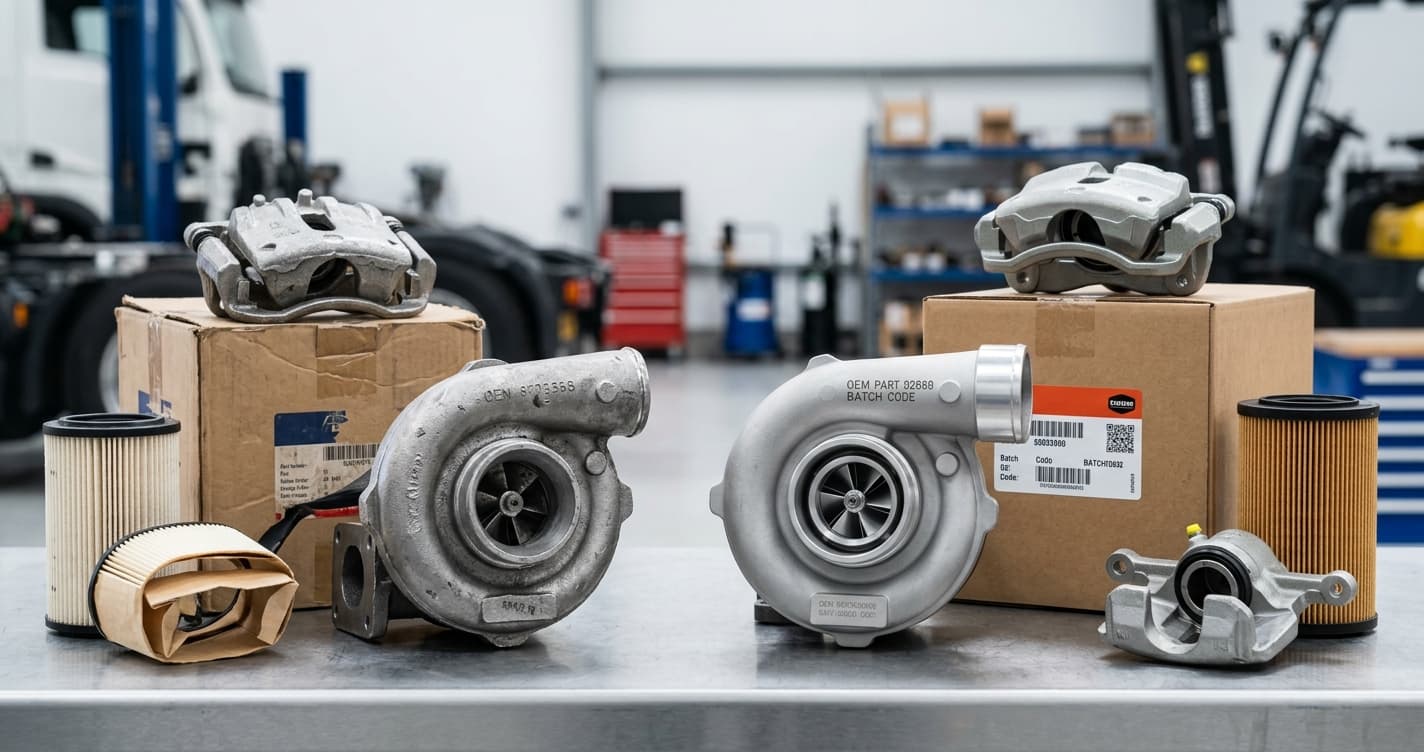
Unfortunately, the heavy duty truck aftermarket has its share of counterfeit products. Fake OEM stamps, copied packaging, and mislabeled part numbers are real risks — especially when sourcing from unverified channels.
Red flags to watch for:
- Casting quality noticeably rougher than genuine parts
- Font style or stamp depth inconsistent with known originals
- Packaging that lacks batch codes or QC markings
- Pricing that seems too good to be true (it usually is)
| Mistake | Risk | Prevention |
|---|---|---|
| Transposed digits | Wrong part delivered, return shipping costs | Double-check every digit against catalog |
| Ignoring revision suffix | Outdated spec, poor fit or premature failure | Always use the latest revision number |
| Mixing domestic/export variants | Incompatible dimensions or ratings | Confirm market destination with VIN or documentation |
| Trusting unverified sellers | Counterfeit parts, safety hazards | Work with experienced, established suppliers |
| Skipping vehicle configuration check | Fitment failure on installation | Match model + year + engine + axle config |
Running into matching issues or suspect parts? Our Support page is built to help you troubleshoot exactly these problems.
Matching Parts Across Popular Chinese Truck Brands — Practical Tips
Sinotruk HOWO & A7 Series
Sinotruk’s numbering system uses prefixes like WG (chassis and body), VG (engine), and AZ (older series). The HOWO and A7 share many platform components — particularly in the transmission and rear axle systems — which means cross-compatibility is common within the family.
High-demand parts include D12 and MC series engine components, HW19710 transmission gears, and HC16 rear axle assemblies. When ordering HOWO parts, always specify whether it’s a HOWO 371, 375, or 420 — the horsepower rating often determines which sub-variant of a component you need.
Shacman (SHAANXI) F2000 / F3000 / X3000
Shacman trucks are tightly integrated with Weichai engines and Fast (Fuller-type) gearboxes. This means part numbers often cross two systems: the truck-level number (DZ prefix) and the engine/gearbox-level number (612600 series for Weichai, or specific Fast codes).
When matching Shacman parts, ask yourself: is this a truck-body component or a powertrain component? Truck-body parts follow Shacman’s own DZ numbering. Engine parts follow Weichai’s system. Gearbox parts follow Fast’s system. Knowing which system you’re in prevents confusion and speeds up the cross-reference process.
FAW J6 / J7 / Jiefang Series
FAW’s Jiefang series uses a CA-prefix for vehicle-level identification and numeric strings starting with category codes (1002 for engine mounting, 3501 for braking, etc.) for individual parts. The Xichai CA6D engine family has its own numbering logic that’s distinct from the truck-level catalog.
The J6 has been in production for over a decade with multiple facelifts, so revision suffixes matter here more than with newer models. A J6 from 2012 and a J6P from 2020 may share a part name but carry different OEM numbers due to engineering updates. Always check the production date.
Dongfeng Kinland / Tianlong Series
Dongfeng’s partnership with Cummins creates a dual-numbering situation similar to Shacman’s. Truck-level parts carry Dongfeng’s own codes (often starting with 35xx for brake components, 49xx for electrical). Engine parts carry Dongfeng Cummins (DCI) numbers that follow Cummins’ global logic but with China-specific suffixes.
If you’re sourcing a DCI engine part, having both the Dongfeng truck-level number AND the Cummins engine part number dramatically speeds up matching. They’re two paths to the same destination.
Foton Auman / CAMC / Beiben
Foton Auman uses H4 and S-series prefixes for many cabin and chassis parts. Their partnership with Cummins ISG engines means the same dual-numbering dynamic applies here. CAMC (Hualing) and Beiben (North Benz) have their own unique quirks — Beiben parts sometimes carry legacy numbering from the original Mercedes-Benz NG80 platform that the brand was built on decades ago.
For aftermarket parts compatibility across these brands, pay special attention to mounting dimensions and bolt patterns. A part might be functionally equivalent but require adapter brackets if crossing brand lines.
| Brand | Common Prefix Pattern | Engine Partner |
|---|---|---|
| Sinotruk HOWO | WG / AZ / VG | Sinotruk D12, MC series |
| Shacman | DZ / 612600 | Weichai WP series |
| FAW Jiefang | 1002- / 3501- / CA | Xichai CA6D series |
| Dongfeng | 3509 / 4938 / C-series | Dongfeng Cummins DCI |
| Foton Auman | H4 / S series | Cummins ISG |
Explore our full parts catalog organized by vehicle system on our Product Systems page.
How a Reliable Supplier Simplifies the Entire Process
The Value of 15 Years in Commercial Vehicle Parts Lookup
A cross-reference database is only as good as the people maintaining it. After 15 years of sourcing, verifying, and shipping Chinese truck parts to markets worldwide, we’ve built something that no software alone can replicate: institutional memory.
We recognize superseded numbers on sight because we’ve tracked their evolution in real time. We know which regional variants cause confusion because we’ve solved those puzzles hundreds of times. We maintain verified cross-reference databases that are updated not just from manufacturer bulletins, but from actual fitment feedback sent back by our customers in the field.
This isn’t just about having a big catalog. It’s about knowing which catalog entry actually fits your specific truck, in your specific market, with your specific configuration.
Real Success Stories
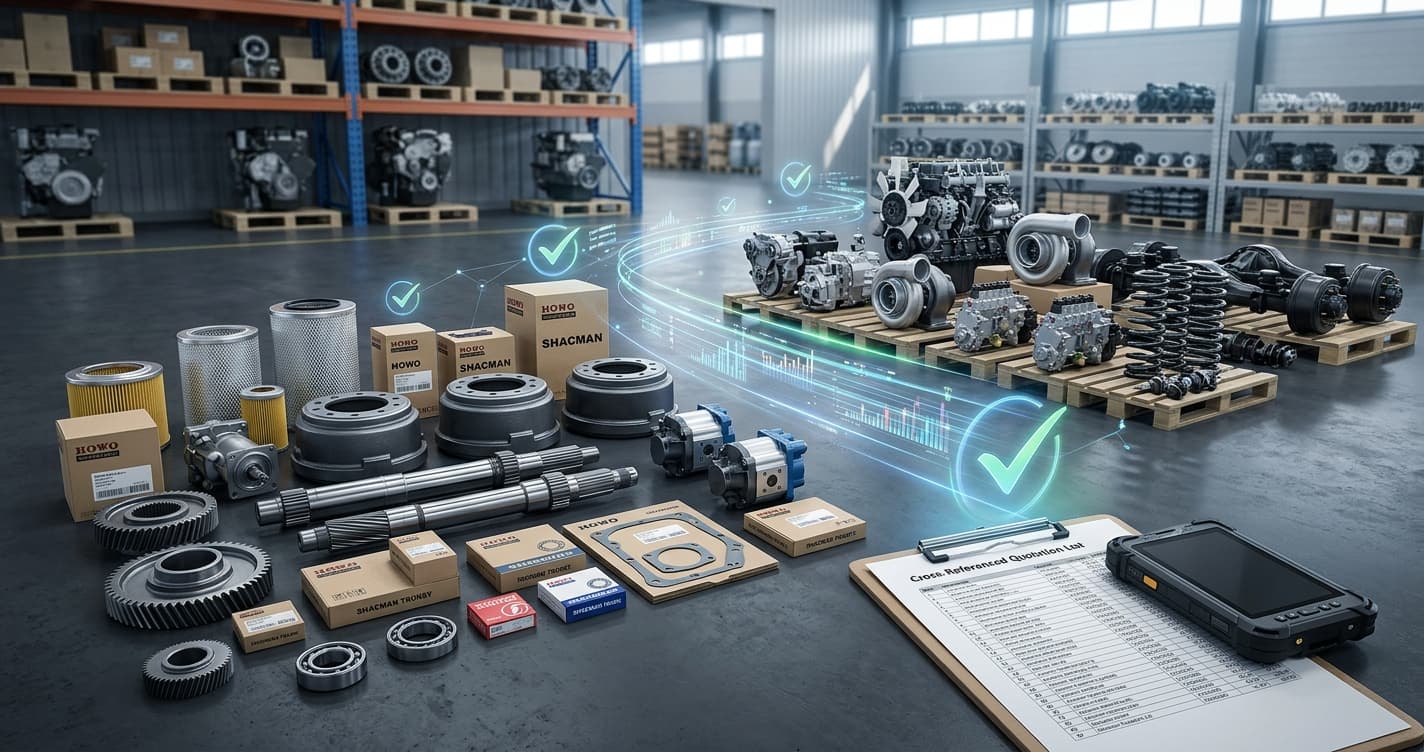
An African fleet operator came to us with a purchase list of over 200 line items — a mix of HOWO and Shacman parts, many with partially legible numbers from worn components. Our team cross-referenced every item, identified 12 superseded numbers, flagged 3 that were export-variant specific, and delivered a complete, verified quotation within 48 hours. The fleet was back to full operation within weeks of the order arriving.
A Southeast Asian workshop had been searching for months for a discontinued Shacman F3000 brake caliper. The original OEM number returned zero results everywhere they looked. Our team traced the supersession chain, identified the current replacement number, confirmed dimensional compatibility, and shipped the correct part on the first attempt. No returns, no guesswork.
These aren’t exceptions — they’re Tuesday. Read more stories like these on our Customer Success Cases page.
FAQ — Matching Heavy Duty Truck Spare Parts by OEM Numbers
Can I match a part if the OEM number is partially unreadable?
Yes — and this happens more often than you’d think. Experienced suppliers can work with partial numbers by cross-referencing the readable digits against known patterns for that brand and part category. Supplementing with a clear photo of the part, its physical dimensions, the truck model, and the VIN gives us enough context to identify the correct match even when the number is 30-40% illegible.
Are aftermarket parts with different numbers still compatible?
In many cases, yes. Aftermarket manufacturers assign their own catalog codes but design parts to OEM specifications. The key is confirming equivalence through a reliable OEM part number cross reference — not just assuming compatibility because a seller claims it. A proper cross-reference confirms dimensional specs, material grades, and fitment parameters, not just visual similarity.
How do I handle OEM numbers that have been superseded?
Supersession is normal — it means the manufacturer improved the part. Every superseded number has a successor. Reliable suppliers maintain supersession chain databases that track old-to-new transitions. When you provide an old number, we trace it forward to the current valid replacement. In some cases, the supersession chain is three or four numbers deep, but the end result is always a currently-available, improved part.


